

The DOI matches its Crossref record; 92 of the 93 references it cites were found in a registry or an index, and 1 are not checked yet.
The prion hypothesis in Parkinson's disease: Braak to the future
Open accessAbstract
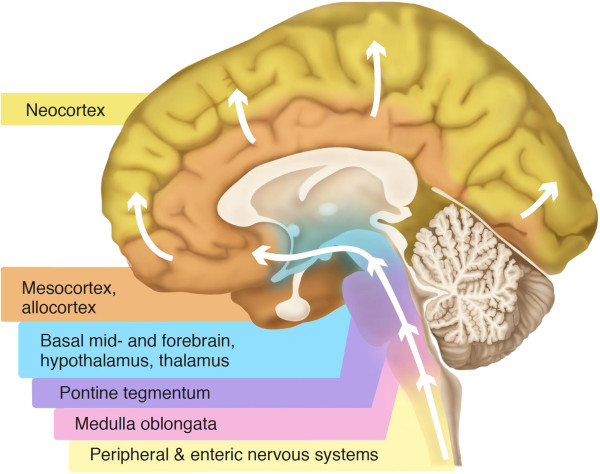
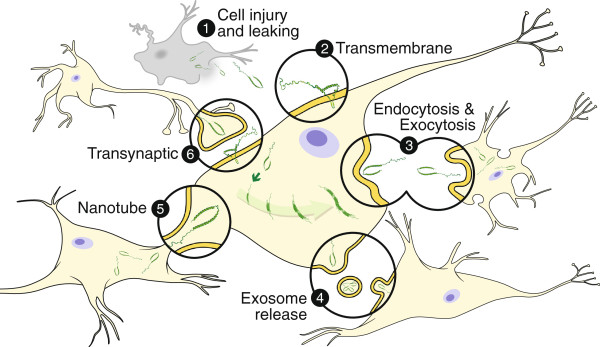
Parkinson's disease (PD) is a progressive neurodegenerative disorder typified by the presence of intraneuronal inclusions containing aggregated alpha synuclein (αsyn). The progression of parkinsonian pathology and clinical phenotype has been broadly demonstrated to follow a specific pattern, most notably described by Braak and colleagues. In more recent times it has been hypothesized that αsyn itself may be a critical factor in mediating transmission of disease pathology from one brain area to another. Here we investigate the growing body of evidence demonstrating the ability of αsyn to spread transcellularly and induce pathological aggregation affecting neurons by permissive templating and provide a critical analysis of some irregularities in the hypothesis that the progression of PD pathology may be mediated by such a prion-like process. Finally we discuss some key questions that remain unanswered which are vital to determining the potential contribution of a prion-like process to the pathogenesis of PD.
Overview
The claims and statistics of this paper haven’t been checked yet.
Run the check — free, no account needed. It reads the open-access text and checks the sources it cites.
Integrity signals
Registry
Cites
Statistics
Figures
Verification
Claims the paper makes
The claims and statistics of this paper haven’t been checked yet.
Run the check — free, no account needed. It reads the open-access text and checks the sources it cites.
Claims other papers make about this one
Each is checked against this paper’s own text: does it say what the citing paper says it does?
In the citing paper
“It has been suggested that alpha-synuclein could act like a prion protein during PD pathogenesis.In this theory pathologic, misfolded alpha-synuclein is an 'infectious' protein spreading pathology by forming a template that seeds misfolding for nearby alpha-synuclein protein, turning the previously healthy protein into a pathogenic protein (Jucker and Walker, 2013;Visanji et al., 2013).”
From The Gut-Brain Axis in Parkinson’s Disease: Possibilities for Food-Based Therapies (2017) · cites this paper as Visanji et al., 2013
Self-check
Percentages, sums and reported differences re-computed from the paper’s own numbers.
The self-check needs the paper’s full text.
Citations
Cites
Staging of brain pathology related to sporadic Parkinson’s disease
Braak, H., Tredici, K. D., Rüb, U., de Vos, R. A. I., Jansen Steur, E. N. H., & Braak, E. (2003) · Neurobiology of Aging · doi:10.1016/s0197-4580(02)00065-9 · Cited by 10,777
Prusiner, S. B. (1998) · Proceedings of the National Academy of Sciences · doi:10.1073/pnas.95.23.13363 · Cited by 5,373
Novel Proteinaceous Infectious Particles Cause Scrapie
Prusiner, S. B. (1982) · Science · doi:10.1126/science.6801762 · Cited by 5,221
Luk, K. C., Kehm, V., Carroll, J., Zhang, B., O’Brien, P., Trojanowski, J. Q., & Lee, V. M.-Y. (2012) · Science · doi:10.1126/science.1227157 · Cited by 2,563
Pan, K. M., Baldwin, M. A., Nguyen, J. T., Gasset, M., Serban, A. V., Groth, D., Mehlhorn, I., Huang, Z., Fletterick, R. J., & Cohen, F. E. (1993) · Proceedings of the National Academy of Sciences · doi:10.1073/pnas.90.23.10962 · Cited by 2,281
Li, J.-Y., Englund, E., Holton, J. L., Soulet, D., Hagell, P., Lees, A. J., Lashley, T., Quinn, N. P., Rehncrona, S., Björklund, A., et al. (2008) · Nature Medicine · doi:10.1038/nm1746 · Cited by 1,845
Lewy body–like pathology in long-term embryonic nigral transplants in Parkinson's disease
Kordower, J. H., Chu, Y., Hauser, R. A., Freeman, T. B., & Olanow, C. W. (2008) · Nature Medicine · doi:10.1038/nm1747 · Cited by 1,722
Braak, H., R�b, U., Gai, W. P., & Del Tredici, K. (2003) · Journal of Neural Transmission · doi:10.1007/s00702-002-0808-2 · Cited by 1,683
Inclusion formation and neuronal cell death through neuron-to-neuron transmission of α-synuclein
Desplats, P., Lee, H.-J., Bae, E.-J., Patrick, C., Rockenstein, E., Crews, L., Spencer, B., Masliah, E., & Lee, S.-J. (2009) · Proceedings of the National Academy of Sciences · doi:10.1073/pnas.0903691106 · Cited by 1,485
Braak, H., de Vos, R. A. I., Bohl, J., & Del Tredici, K. (2006) · Neuroscience Letters · doi:10.1016/j.neulet.2005.11.012 · Cited by 1,354
Cited by
Sorted by citations
Kalia, L. V., & Lang, A. E. (2015) · The Lancet · doi:10.1016/s0140-6736(14)61393-3 · Cited by 6,184
Self-citationGastrointestinal Dysfunction in Parkinson’s Disease
Fasano, A., Visanji, N. P., Liu, L. W. C., Lang, A. E., & Pfeiffer, R. F. (2015) · The Lancet Neurology · doi:10.1016/s1474-4422(15)00007-1 · Cited by 1,016
Self-citationMicroglial exosomes facilitate α-synuclein transmission in Parkinson’s disease
Guo, M., Wang, J., Zhao, Y., Feng, Y., Han, S., Dong, Q., Cui, M., & Tieu, K. (2020) · Brain · doi:10.1093/brain/awaa090 · Cited by 522
Exploring Braak’s hypothesis of Parkinson’s disease
Rietdijk, C. D., Perez-Pardo, P., Garssen, J., van Wezel, R. J. A., & Kraneveld, A. D. (2017) · Frontiers in Neurology · doi:10.3389/fneur.2017.00037 · Cited by 395
Are dementia with Lewy bodies and Parkinson’s disease dementia the same disease?
Jellinger, K. A., & Korczyn, A. D. (2018) · BMC Medicine · doi:10.1186/s12916-018-1016-8 · Cited by 406
Metadata
- Authors
- Visanji, N. P., Brooks, P. L., Hazrati, L.-N., & Lang, A. E.
- Affiliations
- Toronto Western Hospital (CA)
- University of Toronto (CA)
- Corresponding author
- Lang, Anthony E
- Venue
- Acta Neuropathologica Communications
- Published
- 2013-05-08
- Volume
- 1
- Issue
- 1
- Pages
- 2-2
- ISSN
- 2051-5960 (ISSN-L)
- PMC
- PMC3776210
- OpenAlex
- W2159340140
- Cited by
- 278
- References
- 92
- Citations by year
- 2026: 11 · 2025: 20 · 2024: 23 · 2023: 23 · 2022: 27 · 2021: 23 · 2020: 29 · 2019: 22 · 2018: 18 · 2017: 20 · 2016: 21 · 2015: 22 · 2014: 14 · 2013: 5
- FWCI
- 2.69
- Type
- journal article
- Language
- en
- Open access
- gold
- doi.org
- Licence
- cc-by
- Locations
- Acta Neuropathologica Communications (publishedVersion, cc-by)
- Europe PMC (PubMed Central) (publishedVersion, cc-by)
- PubMed Central (publishedVersion, cc-by)
- PubMed (publishedVersion)
- TSpace (University of Toronto) (submittedVersion)
- eScholarship@McGill (McGill) (submittedVersion, cc-by)
- Topics
- Health Sciences › Medicine › Clinical Neurology › Parkinson's Disease Mechanisms and Treatments
- Life Sciences › Neuroscience › Cellular and Molecular Neuroscience › Alzheimer's disease research and treatments
- Life Sciences › Biochemistry, Genetics and Molecular Biology › Molecular Biology › Nuclear Receptors and Signaling
- Keywords
- Parkinson's disease, prion hypothesis, alpha-synuclein, prion-like propagation, templating, Braak staging, neurodegeneration, alpha-synuclein aggregation, disease progression
- MeSH terms
- Animals, Humans, Models, Neurological, Parkinson Disease, Prions, Severity of Illness Index
About these checks
Registry, retraction, Cites and statistics results are computed, not judged, with one exception: a printed reference that no index lists is read once by a model before it counts as a citation error. Claims are extracted by a model and kept only when their quote appears verbatim in the text; each cited source is then checked, with a model’s help, for whether it says what the claim relies on. Those verdicts can be wrong — read the claim’s quote and the cited source before relying on one.
Statistics and arithmetic are recomputed, not judged.
Confidence bands are shown only for fields calibrated on our annotated test set. None is calibrated yet, so no band is shown.
What counts as a claim ›How we measure confidence ›How we check this ›
Are you an author, or do you see a problem with this page? Request a review
