

Quetiapine monotherapy in bipolar II depression: combined data from four large, randomized studies
Open accessThe DOI matches its Crossref record; 60 of the 61 references it cites were found in a registry or an index.
Abstract
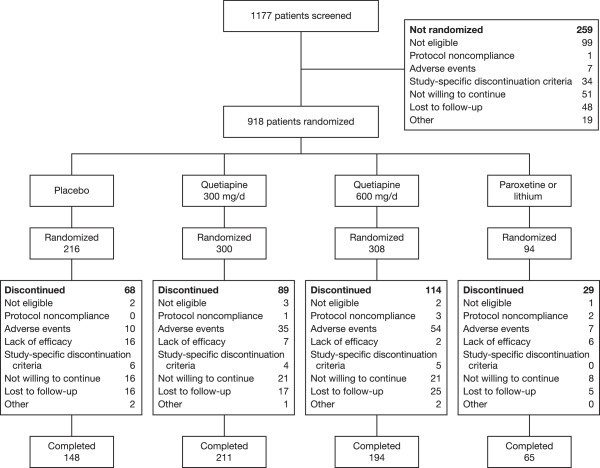
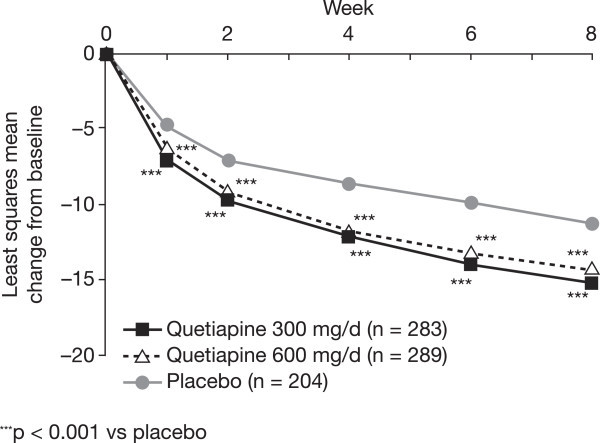
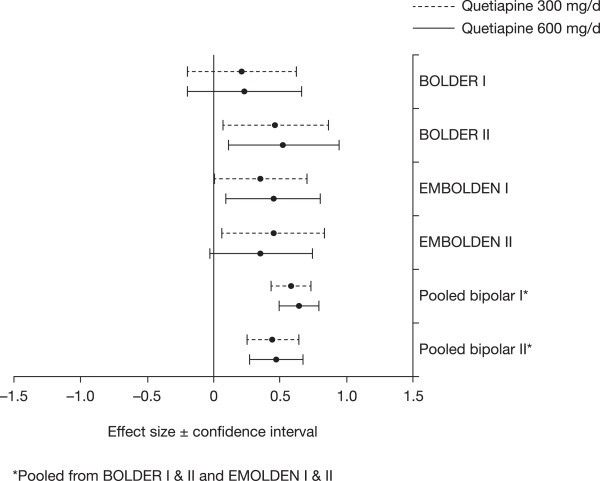
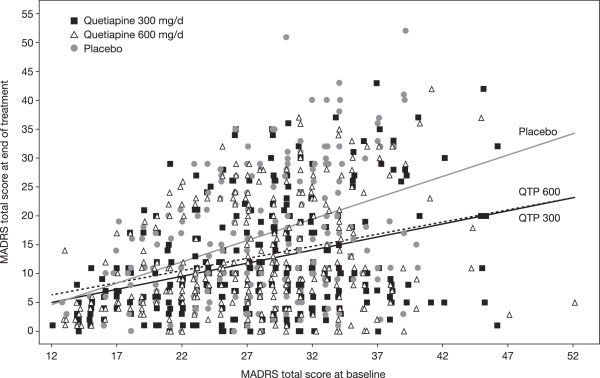
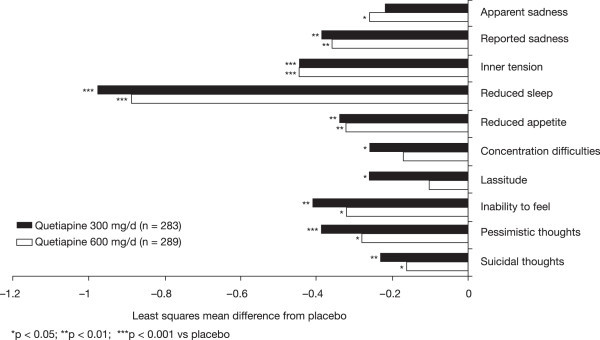
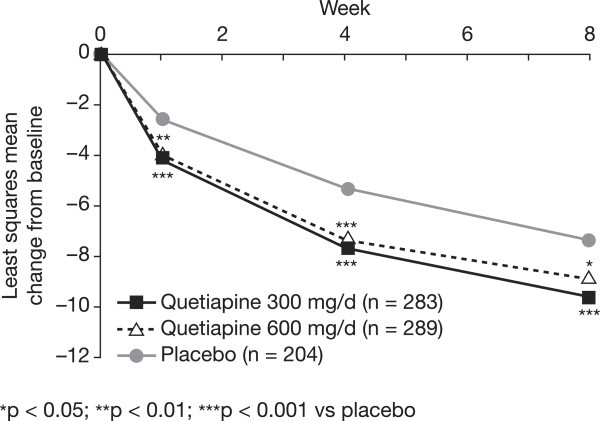
BACKGROUND: Despite being present in up to 1% of the population, few controlled trials have examined the efficacy of treatments for bipolar II depression. Pooled data are presented from four placebo-controlled studies (BOLDER I [5077US/0049] and II [D1447C00135]; EMBOLDEN I [D1447C00001] and II [D1447C00134]) that evaluated the efficacy of quetiapine monotherapy for depressive episodes in patients with bipolar II disorder. METHODS: All studies included an 8-week, double-blind treatment phase in which patients were randomly assigned to treatment with quetiapine 300 mg/day, quetiapine 600 mg/day, or placebo. Outcome measures included the change from baseline in MADRS total score at week 8, effect sizes, and MADRS response and remission rates. RESULTS AND DISCUSSION: Improvements in mean MADRS total scores from baseline to week 8 were significantly greater with quetiapine 300 and 600 mg/day (-15.58 [n = 283] and -14.88 [n = 289]; p < 0.001) compared with placebo (-11.61 [n = 204]). The MADRS effect sizes were 0.44 for quetiapine 300 mg/day and 0.47 for 600 mg/day (p < 0.001 vs placebo). Significantly higher proportions of patients receiving quetiapine, at both doses, than placebo-treated patients achieved response and remission at week 8 (p < 0.01). Common adverse events associated with quetiapine (both doses) included dry mouth, somnolence, sedation, dizziness, and headache. Rates of mania and hypomania were similar for quetiapine and placebo. Quetiapine monotherapy demonstrated significant efficacy compared with placebo and was generally well tolerated in the treatment of bipolar II depression.
Overview
The claims and statistics of this paper haven’t been checked yet.
Free: it reads the open-access text and checks the first 5 claims that cite a source we can check. Create a free account to check every claim.
Integrity signals
Registry
Cites
Statistics
Figures
Verification
Claims the paper makes
The claims and statistics of this paper haven’t been checked yet.
Free: it reads the open-access text and checks the first 5 claims that cite a source we can check. Create a free account to check every claim.
Claims other papers make about this one
Each is checked against this paper’s own text: does it say what the citing paper says it does?
The source backs part of the claim, not all of it — or backs it for a different population, condition or comparison.
In the citing paper
“Pooled analyses of five identically designed trials demonstrated that quetiapine was superior to placebo, and moreover was equally effective for acute depression in BDI and BDII.243, 437”
From Canadian Network for Mood and Anxiety Treatments ( CANMAT ) and International Society for Bipolar Disorders ( ISBD ) 2018 guidelines for the management of patients with bipolar disorder (2018) · cites this paper as [437]
Experimental — accuracy not yet measured
Self-check
Percentages, sums and reported differences re-computed from the paper’s own numbers.
The self-check needs the paper’s full text.
Citations
Cites
Hamilton, M. (1960) · Journal of Neurology, Neurosurgery & Psychiatry · doi:10.1136/jnnp.23.1.56 · Cited by 32,817 · cited 4×
“Depression is the prevailing phase of illness in patients with bipolar II disorder (Judd et al. 2003; Kupka et al. 2007).”
MethodInfluentialA new depression scale designed to be sensitive to change
Montgomery, S. A., & Åsberg, M. (1979) · British Journal of Psychiatry · doi:10.1192/bjp.134.4.382 · Cited by 13,962 · cited 1×
“The primary efficacy outcome measure in all four studies was the change from baseline to week 8 in Montgomery-Åsberg Depression Rating Scale (MADRS) total score (Montgomery and Asberg 1979), and this is consequently utilized in the current post hoc analysis.”
MethodThe assessment of anxiety states by rating
HAMILTON, M. (1959) · British Journal of Medical Psychology · doi:10.1111/j.2044-8341.1959.tb00467.x · Cited by 11,455 · cited 3×
“…included the change in MADRS individual items, MADRS response (defined as a decrease from baseline of ≥ 50% in MADRS total score) and remission (defined as MADRS total score of ≤ 12) rates, HAM-D total scores and Hamilton Rating Scale for Anxiety (Hamilton 1959) (HAM-A) total scores at week 8.”
MethodInfluentialDiagnostic and Statistical Manual of Mental Disorders, Fourth Edition, Text Revision (DSM-IV-TR)
American Psychiatric Association (2000) · doi:10.1176/appi.books.9780890423349 · Cited by 11,069
A Rating Scale for Mania: Reliability, Validity and Sensitivity
Young, R. C., Biggs, J. T., Ziegler, V. E., & Meyer, D. A. (1978) · British Journal of Psychiatry · doi:10.1192/bjp.133.5.429 · Cited by 8,744 · cited 2×
“quired to have a Hamilton Rating Scale for Depression (Hamilton 1960) (HAM-D) total score ≥20, a HAM-D item 1 (depressed mood) score ≥2, and a Young Mania Rating Scale (Young et al. 1978) (YMRS) score ≤12.”
MethodPrevalence and Correlates of Bipolar Spectrum Disorder in the World Mental Health Survey Initiative
Merikangas, K. R., Jin, R., He, J.-P., Kessler, R. C., Lee, S., Sampson, N. A., Viana, M. C., Andrade, L. H., Hu, C., Karam, E. G., et al. (2011) · Archives of General Psychiatry · doi:10.1001/archgenpsychiatry.2011.12 · Cited by 2,627 · cited 1×
“Among patients with bipolar II disorder, the risk of suicide, comorbidity, and role impairment is generally comparable with that of bipolar I disorder (Angst et al. 2010; Merikangas et al. 2011; Suppes and Dennehy 2002; Valtonen et al. 2005).”
BackgroundMerikangas, K. R., Akiskal, H. S., Angst, J., Greenberg, P. E., Hirschfeld, R. M. A., Petukhova, M., & Kessler, R. C. (2007) · Archives of General Psychiatry · doi:10.1001/archpsyc.64.5.543 · Cited by 2,399 · cited 2×
“(Merikangas et al. 2007).”
Goodwin, G., Haddad, P., Ferrier, I., Aronson, J., Barnes, T., Cipriani, A., Coghill, D., Fazel, S., Geddes, Jr., Grunze, H., et al. (2016) · Journal of Psychopharmacology · doi:10.1177/0269881116636545 · Cited by 1,309
Self-citationJudd, L. L., Akiskal, H. S., Schettler, P. J., Coryell, W., Endicott, J., Maser, J. D., Solomon, D. A., Leon, A. C., & Keller, M. B. (2003) · Archives of General Psychiatry · doi:10.1001/archpsyc.60.3.261 · Cited by 1,243 · cited 2×
“Depression is the prevailing phase of illness in patients with bipolar II disorder (Judd et al. 2003; Kupka et al. 2007).”
BackgroundYatham, L. N., Kennedy, S. H., Parikh, S. V., Schaffer, A., Beaulieu, S., Alda, M., O’Donovan, C., MacQueen, G., McIntyre, R. S., Sharma, V., et al. (2013) · Bipolar Disorders · doi:10.1111/bdi.12025 · Cited by 1,217
Self-citationExtending Indications for Long-Term Pharmacotherapy: Opportunities and Challenges
Kane, J. M. (2002) · American Journal of Psychiatry · doi:10.1176/appi.ajp.159.1.1 · Cited by 987
Calabrese, J. R., Keck, P. E., Macfadden, W., Minkwitz, M., Ketter, T. A., Weisler, R. H., Cutler, A. J., McCoy, R., Wilson, E., Mullen, J., et al. (2005) · American Journal of Psychiatry · doi:10.1176/appi.ajp.162.7.1351 · Cited by 883 · cited 4×
“Overall, there were changes in some glucose and lipid parameters and increases in weight with quetiapine, which were consistent with previous observations (Calabrese et al. 2005; McElroy et al. 2010; Thase et al. 2006; Young et al. 2010).”
BackgroundMethodResultInfluentialSelf-citation(2015) · European Journal of Haematology · doi:10.1111/ejh.12636 · Cited by 780
Thase, M. E., Macfadden, W., Weisler, R. H., Chang, W., Paulsson, B., Khan, A., & Calabrese, J. R. (2006) · Journal of Clinical Psychopharmacology · doi:10.1097/01.jcp.0000248603.76231.b7 · Cited by 559 · cited 4×
“Overall, there were changes in some glucose and lipid parameters and increases in weight with quetiapine, which were consistent with previous observations (Calabrese et al. 2005; McElroy et al. 2010; Thase et al. 2006; Young et al. 2010).”
BackgroundMethodResultInfluentialSelf-citationGoodwin, G., & Consensus Group of the British Association for Psychopharmacology (2009) · Journal of Psychopharmacology · doi:10.1177/0269881109102919 · Cited by 444 · cited 1×
“…have generally adapted recommendations for bipolar I disorder, although more recent guidelines have considered bipolar II depression separately using the extant evidence base (American Psychiatric Association 2002; Goodwin 2003, 2009; Grunze et al. 2010; Keck et al. 2004; Yatham et al. 2013).”
MethodLeverich, G. S., Altshuler, L. L., Frye, M. A., Suppes, T., McElroy, S. L., Keck, P. E., Kupka, R. W., Denicoff, K. D., Nolen, W. A., Grunze, H., et al. (2006) · American Journal of Psychiatry · doi:10.1176/appi.ajp.163.2.232 · Cited by 419 · cited 1×
“…for alterations in Treatment-emergent mania is a concern during treat-ment of bipolar depression with conventional antide-pressants, although the extent to which it occurs in bipolar II depression remains a matter of debate (Altshuler et al. 2006; Leverich et al. 2006; Vazquez et al. 2011).”
BackgroundSelf-citationGrunze, H., Vieta, E., Goodwin, G. M., Bowden, C., Licht, R. W., Möller, H.-J., Kasper, S., & WFSBP Task Force On Treatment Guidelines For Bipolar Disorders (2010) · The World Journal of Biological Psychiatry · doi:10.3109/15622970903555881 · Cited by 399 · cited 2×
“Older guidelines have generally adapted recommendations for bipolar I disorder, although more recent guidelines have considered bipolar II depression separately using the extant evidence base (American Psychiatric Association 2002; Goodwin 2003, 2009; Grunze et al. 2010; Keck et al. 2004; Yatham et al. 2013).”
MethodThree times more days depressed than manic or hypomanic in both bipolar I and bipolar II disorder 1
Kupka, R. W., Altshuler, L. L., Nolen, W. A., Suppes, T., Luckenbaugh, D. A., Leverich, G. S., Frye, M. A., Keck, P. E., McElroy, S. L., Grunze, H., et al. (2007) · Bipolar Disorders · doi:10.1111/j.1399-5618.2007.00467.x · Cited by 397 · cited 3×
“Depression is the prevailing phase of illness in patients with bipolar II disorder (Judd et al. 2003; Kupka et al. 2007).”
BackgroundInfluentialSelf-citationYoung, A. H., McElroy, S. L., Bauer, M., Philips, N., Chang, W., Olausson, B., Paulsson, B., Brecher, M., & EMBOLDEN I (Trial 001) Investigators (2010) · The Journal of Clinical Psychiatry · doi:10.4088/jcp.08m04995gre · Cited by 390 · cited 5×
“These findings were subsequently confirmed in the similarly designed EMBOLDEN (Efficacy of Monotherapy Seroquel in BipOLarDepressioN) I and II trials (McElroy et al. 2010; Young et al. 2010).”
BackgroundResultInfluentialSelf-citationGoodwin, G. M. (2003) · Journal of Psychopharmacology · doi:10.1177/0269881103017002003 · Cited by 390 · cited 1×
“…have generally adapted recommendations for bipolar I disorder, although more recent guidelines have considered bipolar II depression separately using the extant evidence base (American Psychiatric Association 2002; Goodwin 2003, 2009; Grunze et al. 2010; Keck et al. 2004; Yatham et al. 2013).”
MethodBowden, C. L., Grunze, H., Mullen, J., Brecher, M., Paulsson, B., Jones, M., Vågerö, M., & Svensson, K. (2005) · The Journal of Clinical Psychiatry · doi:10.4088/jcp.v66n0116 · Cited by 376 · cited 1×
“The adverse event profile in this patient population was qualitatively similar to findings in acute and maintenance studies of quetiapine monotherapy in patients with bipolar I or II disorder (Bowden et al. 2005; McIntyre et al. 2005; Weisler et al. 2011).”
ResultPractice guideline for the treatment of patients with bipolar disorder (revision).
(2002) · PubMed · Cited by 375
McElroy, S. L., Weisler, R. H., Chang, W., Olausson, B., Paulsson, B., Brecher, M., Agambaram, V., Merideth, C., Nordenhem, A., Young, A. H., et al. (2010) · The Journal of Clinical Psychiatry · doi:10.4088/jcp.08m04942gre · Cited by 328 · cited 6×
“The antidepressant efficacy of quetiapine monotherapy (300 and 600 mg/day) in bipolar I and II depression was established in two pivotal, 8-week, placebo-controlled clinical trials, BOLDER (BipOLarDepRession) I and II (Calabrese et al. 2005; Thase et al. 2006).”
BackgroundMethodResultInfluentialSelf-citationAngst, J., Cui, L., Swendsen, J., Rothen, S., Cravchik, A., Kessler, R. C., & Merikangas, K. R. (2010) · American Journal of Psychiatry · doi:10.1176/appi.ajp.2010.09071011 · Cited by 305 · cited 2×
“Moreover, sub-threshold bipolar II disorder has been estimated to affect up to 6.7% of the general population (Angst et al. 2010).”
BackgroundInfluentialThase, M. E., Jonas, A., Khan, A., Bowden, C. L., Wu, X., McQuade, R. D., Carson, W. H., Marcus, R. N., & Owen, R. (2008) · Journal of Clinical Psychopharmacology · doi:10.1097/jcp.0b013e3181618eb4 · Cited by 251
Self-citationSuicidal Ideation and Attempts in Bipolar I and II Disorders
Valtonen, H., Suominen, K., Mantere, O., Leppämäki, S., Arvilommi, P., & Isometsä, E. T. (2005) · The Journal of Clinical Psychiatry · doi:10.4088/jcp.v66n1116 · Cited by 249 · cited 2×
“Among patients with bipolar II disorder, the risk of suicide, comorbidity, and role impairment is generally comparable with that of bipolar I disorder (Angst et al. 2010; Merikangas et al. 2011; Suppes and Dennehy 2002; Valtonen et al. 2005).”
BackgroundCalabrese, J. R., Huffman, R. F., White, R. L., Edwards, S., Thompson, T. R., Ascher, J. A., Monaghan, E. T., & Leadbetter, R. A. (2008) · Bipolar Disorders · doi:10.1111/j.1399-5618.2007.00500.x · Cited by 248 · cited 1×
“A high placebo response rate has also been observed in other trials of agents evaluated in bipolar depression (Calabrese et al. 2008; Thase et al. 2008).”
ResultSelf-citationSubthreshold Hypomanic Symptoms in Progression From Unipolar Major Depression to Bipolar Disorder
Fiedorowicz, J. G., Endicott, J., Leon, A. C., Solomon, D. A., Keller, M. B., & Coryell, W. H. (2011) · American Journal of Psychiatry · doi:10.1176/appi.ajp.2010.10030328 · Cited by 228 · cited 1×
“In another cohort study, 12.2% of patients had diagnoses changed from major depressive disorder to bipolar II disorder over a mean of 17.5 years (Fiedorowicz et al. 2011).”
BackgroundInfluentialMcIntyre, R. S., Brecher, M., Paulsson, B., Huizar, K., & Mullen, J. (2005) · European Neuropsychopharmacology · doi:10.1016/j.euroneuro.2005.02.006 · Cited by 227 · cited 1×
“The adverse event profile in this patient population was qualitatively similar to findings in acute and maintenance studies of quetiapine monotherapy in patients with bipolar I or II disorder (Bowden et al. 2005; McIntyre et al. 2005; Weisler et al. 2011).”
ResultOtto, M. W., Simon, N. M., Wisniewski, S. R., Miklowitz, D. J., Kogan, J. N., Reilly-Harrington, N. A., Frank, E., Nierenberg, A. A., Marangell, L. B., Sagduyu, K., et al. (2006) · British Journal of Psychiatry · doi:10.1192/bjp.bp.104.007773 · Cited by 223 · cited 1×
“Comorbid anxiety is common among bipolar II patients and can have a large, adverse impact on treatment response, functioning, and quality of life (Angst et al. 2011; Gao et al. 2008; Judd et al. 2003; Otto et al. 2006).”
BackgroundSelf-citationHistory of illness prior to a diagnosis of bipolar disorder or schizoaffective disorder
Berk, M., Dodd, S., Callaly, P., Berk, L., Fitzgerald, P., de Castella, A. R., Filia, S., Filia, K., Tahtalian, S., Biffin, F., et al. (2007) · Journal of Affective Disorders · doi:10.1016/j.jad.2007.01.027 · Cited by 217 · cited 1×
“Temporally, depression usually precedes hypomania (Berk et al. 2007).”
Self-citationFunctional Impairment and Disability across Mood States in Bipolar Disorder
Rosa, A. R., Reinares, M., Michalak, E. E., Bonnin, C. M., Sole, B., Franco, C., Comes, M., Torrent, C., Kapczinski, F., & Vieta, E. (2010) · Value in Health · doi:10.1111/j.1524-4733.2010.00768.x · Cited by 208 · cited 2×
“Depressive symptoms in bipolar disorder have a substantial impact on patients’ quality of life and their ability to function in everyday activities (Rosa et al. 2010; Simon et al. 2007).”
BackgroundBipolar II Disorder: Epidemiology, Diagnosis and Management
Benazzi, F. (2007) · CNS Drugs · doi:10.2165/00023210-200721090-00003 · Cited by 179
Li, C.-T., Bai, Y.-M., Huang, Y.-L., Chen, Y.-S., Chen, T.-J., Cheng, J.-Y., & Su, T.-P. (2012) · British Journal of Psychiatry · doi:10.1192/bjp.bp.110.086983 · Cited by 177 · cited 2×
“, approximately 10% of patients) had bipolar II disorder (Li et al. 2012).”
BackgroundKupka, R. W., Luckenbaugh, D. A., Post, R. M., Suppes, T., Altshuler, L. L., Keck, P. E., Frye, M. A., Denicoff, K. D., Grunze, H., Leverich, G. S., et al. (2005) · American Journal of Psychiatry · doi:10.1176/appi.ajp.162.7.1273 · Cited by 171 · cited 2×
“…profile of quetiapine is demonstrated by the symptomatic improvements in patients with rapid cycling, who typically represent a management challenge (Bauer et al. 2008; Kupka et al. 2005; Lee et al. 2010), and may be particularly common in bipolar II (Berk and Dodd 2004; Kupka et al. 2003).”
BackgroundSelf-citationWeisler, R. H., Nolen, W. A., Neijber, A., Hellqvist, Å., Paulsson, B., & Trial 144 Study Investigators (2011) · The Journal of Clinical Psychiatry · doi:10.4088/jcp.11m06878 · Cited by 169 · cited 1×
“The adverse event profile in this patient population was qualitatively similar to findings in acute and maintenance studies of quetiapine monotherapy in patients with bipolar I or II disorder (Bowden et al. 2005; McIntyre et al. 2005; Weisler et al. 2011).”
ResultRapid and Non-Rapid Cycling Bipolar Disorder: A Meta-Analysis of Clinical Studies
Kupka, R. W., Luckenbaugh, D. A., Post, R. M., Leverich, G. S., & Nolen, W. A. (2003) · The Journal of Clinical Psychiatry · doi:10.4088/jcp.v64n1213 · Cited by 168 · cited 2×
“…profile of quetiapine is demonstrated by the symptomatic improvements in patients with rapid cycling, who typically represent a management challenge (Bauer et al. 2008; Kupka et al. 2005; Lee et al. 2010), and may be particularly common in bipolar II (Berk and Dodd 2004; Kupka et al. 2003).”
BackgroundAltshuler, L. L., Suppes, T., Black, D. O., Nolen, W. A., Leverich, G., Keck, P. E., Frye, M. A., Kupka, R., McElroy, S. L., Grunze, H., et al. (2006) · American Journal of Psychiatry · doi:10.1176/appi.ajp.163.2.313 · Cited by 155 · cited 2×
“pressants, although the extent to which it occurs in bipolar II depression remains a matter of debate (Altshuler et al. 2006; Leverich et al. 2006; Vazquez et al. 2011).”
BackgroundSelf-citationGrunze, H. (2011) · FOCUS: The Journal of Lifelong Learning in Psychiatry · doi:10.1176/appi.focus.9.4.500 · Cited by 149
Simon, G. E., Bauer, M. S., Ludman, E. J., Operskalski, B. H., & Unützer, J. (2007) · The Journal of Clinical Psychiatry · doi:10.4088/jcp.v68n0811 · Cited by 146 · cited 2×
“Depressive symptoms in bipolar disorder have a substantial impact on patients’ quality of life and their ability to function in everyday activities (Rosa et al. 2010; Simon et al. 2007).”
BackgroundCruz, N., Sanchez-Moreno, J., Torres, F., Goikolea, J. M., Valentí, M., & Vieta, E. (2010) · The International Journal of Neuropsychopharmacology · doi:10.1017/s1461145709990344 · Cited by 121 · cited 1×
“Emerging reports support the effectiveness of several therapies in the treatment of acute bipolar II depression (Cruz et al. 2010; Swartz and Thase 2011).”
ResultHirschfeld, R. M. A., Weisler, R. H., Raines, S. R., Macfadden, W., & BOLDER Study Group (2006) · The Journal of Clinical Psychiatry · doi:10.4088/jcp.v67n0304 · Cited by 116 · cited 2×
“BOLDER I trial did not show a statistically significant difference in HAM-A total score from placebo (Hirschfeld et al. 2006), which again may have been due to the smaller number of patients available for analysis.”
ResultVieta, E., Calabrese, Jr., Goikolea, J., Raines, S., Macfadden, W., & for the BOLDER Study Group (2007) · Bipolar Disorders · doi:10.1111/j.1399-5618.2007.00479.x · Cited by 110 · cited 1×
“A planned subanalysis of the BOLDER I study indicated that quetiapine was as effective in bipolar I or II patients with a history of rapid cycling as it was in patients with nonrapid cycling (Vieta et al. 2007).”
BackgroundSelf-citationMagalhães, P. V., Dean, O. M., Bush, A. I., Copolov, D. L., Malhi, G. S., Kohlmann, K., Jeavons, S., Schapkaitz, I., Anderson-Hunt, M., & Berk, M. (2011) · Journal of Affective Disorders · doi:10.1016/j.jad.2010.08.001 · Cited by 101 · cited 1×
“Among other treatments tested in bipolar II depression, the data for lithium, antidepressants (selective serotonin re-uptake inhibitors), N-acetyl cysteine, and pramipexole are suggestive of efficacy but not conclusive (Magalhaes et al. 2011; Swartz and Thase 2011).”
BackgroundSelf-citationMaina, G., Albert, U., Bellodi, L., Colombo, C., Faravelli, C., Monteleone, P., Bogetto, F., Cassano, G. B., & Maj, M. (2007) · The Journal of Clinical Psychiatry · doi:10.4088/jcp.v68n0205 · Cited by 92 · cited 1×
“These results are particularly promising given that a diagnosis of bipolar II disorder is associated with poor health-related quality of life even during periods of euthymia (Maina et al. 2007).”
BackgroundRapid cycling bipolar disorder – diagnostic concepts
Bauer, M., Beaulieu, S., Dunner, D. L., Lafer, B., & Kupka, R. (2008) · Bipolar Disorders · doi:10.1111/j.1399-5618.2007.00560.x · Cited by 91 · cited 2×
“…profile of quetiapine is demonstrated by the symptomatic improvements in patients with rapid cycling, who typically represent a management challenge (Bauer et al. 2008; Kupka et al. 2005; Lee et al. 2010), and may be particularly common in bipolar II (Berk and Dodd 2004; Kupka et al. 2003).”
BackgroundAngst, J., Gamma, A., Bowden, C. L., Azorin, J., Perugi, G., Vieta, E., & Young, A. H. (2011) · European Archives of Psychiatry and Clinical Neuroscience · doi:10.1007/s00406-011-0228-0 · Cited by 90 · cited 2×
“The recent BRIDGE study supports earlier observations that bipolar II disorder may be misdiagnosed as major depressive disorder (Angst et al. 2012) and, in a large cohort study, at least 86% of patients whose diagnosis changed from major depressive disorder to bipolar disorder (i.e., approximately…”
ResultSelf-citationBipolar II Disorder: Symptoms, Course, and Response to Treatment
MacQueen, G. M., & Young, L. T. (2001) · Psychiatric Services · doi:10.1176/appi.ps.52.3.358 · Cited by 87 · cited 1×
“While the debilitating effects of bipolar I disorder are well established, the burden imposed by bipolar II disorder is gaining increasing recognition (Benazzi 2007; MacQueen and Young 2001; Valtonen et al. 2005).”
BackgroundSuppes, T., Hirschfeld, R. M., Vieta, E., Raines, S., & Paulsson, B. (2008) · The World Journal of Biological Psychiatry · doi:10.1080/15622970701317265 · Cited by 73 · cited 2×
“The efficacy of quetiapine in patients with bipolar II depression has been previously reported in a pooled analysis of the BOLDER I and II studies (Suppes et al. 2008).”
BackgroundSelf-citationPharmacotherapy for the Treatment of Acute Bipolar II Depression: Current Evidence
Swartz, H. A., & Thase, M. E. (2011) · The Journal of Clinical Psychiatry · doi:10.4088/jcp.09r05192gre · Cited by 60 · cited 4×
“Among other treatments tested in bipolar II depression, the data for lithium, antidepressants (selective serotonin re-uptake inhibitors), N-acetyl cysteine, and pramipexole are suggestive of efficacy but not conclusive (Magalhaes et al. 2011; Swartz and Thase 2011).”
BackgroundResultInfluentialSelf-citationVázquez, G., Tondo, L., & Baldessarini, R. (2010) · Pharmacopsychiatry · doi:10.1055/s-0030-1265198 · Cited by 57 · cited 2×
“pressants, although the extent to which it occurs in bipolar II depression remains a matter of debate (Altshuler et al. 2006; Leverich et al. 2006; Vazquez et al. 2011).”
BackgroundRapid-cycling bipolar disorder: cross-national community study
Lee, S., Tsang, A., Kessler, R. C., Jin, R., Sampson, N., Andrade, L., Karam, E. G., Mora, M. E. M., Merikangas, K., Nakane, Y., et al. (2010) · British Journal of Psychiatry · doi:10.1192/bjp.bp.109.067843 · Cited by 57 · cited 2×
“…profile of quetiapine is demonstrated by the symptomatic improvements in patients with rapid cycling, who typically represent a management challenge (Bauer et al. 2008; Kupka et al. 2005; Lee et al. 2010), and may be particularly common in bipolar II (Berk and Dodd 2004; Kupka et al. 2003).”
BackgroundYoung, A. H., McElroy, S. L., Olausson, B., Paulsson, B., (D1447C00001), O. B. O. T. E. I., & Embolden II (D1447C00134) Investigators (2014) · The World Journal of Biological Psychiatry · doi:10.3109/15622975.2012.665177 · Cited by 46 · cited 5×
“A continuation phase of 26 to 52 weeks’ duration also formed the design of the EMBOLDEN studies, the results for which have been reported previously (Young et al. 2012).”
BackgroundMethodInfluentialSelf-citationThe bipolar-borderline personality disorders connection in major depressive patients
Perugi, G., Angst, J., Azorin, J.-M., Bowden, C., Vieta, E., Young, A. H., & The BRIDGE Study Group (2013) · Acta Psychiatrica Scandinavica · doi:10.1111/acps.12083 · Cited by 38 · cited 1×
“The patients in these studies had few significant co-morbidities and were likely to have a low risk of suicide, although this may not be the case in all patients with bipolar disorder (Perugi et al. 2013).”
BackgroundSelf-citationEvidence-based long-term treatment of bipolar II disorder.
Suppes, T. M., & Dennehy, E. B. (2002) · PubMed · Cited by 35
Self-citationGao, K., Tolliver, B. K., Kemp, D. E., Verduin, M. L., Ganocy, S. J., Bilali, S. R., Brady, K. T., Shim, S. S., Findling, R. L., & Calabrese, J. R. (2008) · Journal of Affective Disorders · doi:10.1016/j.jad.2007.12.229 · Cited by 29 · cited 1×
“Comorbid anxiety is common among bipolar II patients and can have a large, adverse impact on treatment response, functioning, and quality of life (Angst et al. 2011; Gao et al. 2008; Judd et al. 2003; Otto et al. 2006).”
BackgroundSelf-citationLydiard, R. B., Culpepper, L., Schiöler, H., Gustafsson, U., & Paulsson, B. (2009) · The Primary Care Companion to The Journal of Clinical Psychiatry · doi:10.4088/pcc.08m00659 · Cited by 23 · cited 1×
“In the combined BOLDER I and II trials, quetiapine was effective in the treatment of bipolar I and II depression regardless of the severity of baseline anxiety (Lydiard et al. 2009).”
BackgroundSelf-citationCruz, N., Goikolea, J. M., Sánchez‐Moreno, J., & Vieta, E. (2008) · European Neuropsychopharmacology · doi:10.1016/s0924-977x(08)70078-6 · Cited by 15
Review: rapid cycling bipolar disorder associated with female gender and bipolar type II subgroup
Berk, M., & Dodd, S. (2004) · Evidence-Based Mental Health · doi:10.1136/ebmh.7.3.91 · Cited by 8 · cited 2×
“…profile of quetiapine is demonstrated by the symptomatic improvements in patients with rapid cycling, who typically represent a management challenge (Bauer et al. 2008; Kupka et al. 2005; Lee et al. 2010), and may be particularly common in bipolar II (Berk and Dodd 2004; Kupka et al. 2003).”
BackgroundSelf-citationFC22-02 - Effect of quetiapine on functioning and quality of life in bipolar depression
Gustafsson, U., & Fajutrao, L. (2011) · European Psychiatry · doi:10.1016/s0924-9338(11)73639-2 · Cited by 1
Self-citation
Research works printed but not linked: 2
- Angst J Gamma A Azorin JM Bowden CL Perugi G Vieta E Young AH Evidence-based efforts to re-define bipolar disorders Bipolar Disord 2011 13 Suppl 1 14
- Keck PE Perlis RH Otto MW Carpenter D Ross R Docherty JP The expert consensus guideline series: treatment of bipolar disorder Postgraduate Med Special Report 2004 2004 1 120
Cited by
Yatham, L. N., Kennedy, S. H., Parikh, S. V., Schaffer, A., Bond, D. J., Frey, B. N., Sharma, V., Goldstein, B. I., Rej, S., Beaulieu, S., et al. (2018) · Bipolar Disorders · doi:10.1111/bdi.12609 · Cited by 1,852
Self-citationDiagnosis and management of bipolar disorders
Goes, F. S. (2023) · BMJ · doi:10.1136/bmj-2022-073591 · Cited by 206
Swartz, H. A., Rucci, P., Thase, M. E., Wallace, M., Carretta, E., Celedonia, K. L., & Frank, E. (2018) · The Journal of Clinical Psychiatry · doi:10.4088/jcp.16m11027 · Cited by 64
Self-citationTreatment of bipolar disorder: Review of evidence regarding quetiapine and lithium
Ketter, T. A., Miller, S., Dell’Osso, B. M., & Wang, P. W. (2015) · Journal of Affective Disorders · doi:10.1016/j.jad.2015.11.002 · Cited by 62
Efficacy of bright light therapy in bipolar depression
Yorguner Kupeli, N., Bulut, N. S., Carkaxhiu Bulut, G., Kurt, E., & Kora, K. (2018) · Psychiatry Research · doi:10.1016/j.psychres.2017.12.020 · Cited by 51
Metadata
- Authors
- Young, A. H., Calabrese, J. R., Gustafsson, U., Berk, M., McElroy, S. L., Thase, M. E., Suppes, T., & Earley, W.
- Affiliations
- King's College London (GB)
- University Hospitals Cleveland Medical Center (US)
- AstraZeneca (Sweden) (SE)
- Mental Health Research Institute (AU)
- Lindner Center of HOPE (US)
- University of Pennsylvania (US)
- VA Palo Alto Health Care System (US)
- AstraZeneca (United States) (US)
- Corresponding author
- Young, Allan H
- Venue
- International Journal of Bipolar Disorders
- Published
- 2013-07-04
- Volume
- 1
- Issue
- 1
- Pages
- 10-10
- ISSN
- 2194-7511 (ISSN-L)
- PMC
- PMC4230312
- OpenAlex
- W2104877916
- Cited by
- 35
- References
- 61
- Citations by year
- 2026: 1 · 2025: 1 · 2024: 1 · 2023: 3 · 2022: 1 · 2021: 1 · 2020: 2 · 2019: 1 · 2018: 5 · 2017: 4 · 2016: 6 · 2015: 3 · 2014: 6
- FWCI
- 3.56
- Type
- journal article
- Language
- en
- Open access
- gold
- doi.org
- Licence
- cc-by
- creativecommons.org/licenses/by/2.0 (tdm)
- Locations
- International Journal of Bipolar Disorders (publishedVersion, cc-by)
- PubMed Central (publishedVersion, cc-by)
- PubMed (publishedVersion)
- Figshare (submittedVersion, cc-by)
- Minerva Access (University of Melbourne) (submittedVersion, cc-by)
- Research Portal (King's College London) (submittedVersion, other-oa)
- Funders
- AstraZeneca
- Topics
- Health Sciences › Medicine › Psychiatry and Mental health › Bipolar Disorder and Treatment
- Health Sciences › Medicine › Pharmacology (medical) › Treatment of Major Depression
- Health Sciences › Medicine › Psychiatry and Mental health › Schizophrenia research and treatment
- Keywords
- quetiapine, bipolar II depression, bipolar II disorder, monotherapy, atypical antipsychotics, antidepressant efficacy, remission, response rate, adverse events, dose comparison, Montgomery-Asberg Depression Rating Scale
About these checks
Registry, retraction, Cites and statistics results are computed, not judged, with one exception: a printed reference that no index lists is read once by a model before it counts as a citation error. Claims are extracted by a model and kept only when their quote appears verbatim in the text; each cited source is then checked, with a model’s help, for whether it says what the claim relies on. Those verdicts can be wrong — read the claim’s quote and the cited source before relying on one.
Statistics and arithmetic are recomputed, not judged.
Confidence bands are shown only for fields calibrated on our annotated test set. None is calibrated yet, so no band is shown.
What counts as a claim ›How we measure confidence ›How we check this ›
Are you an author, or do you see a problem with this page? Request a review
Data sources
Bibliographic data: Semantic Scholar, OpenAlex, Crossref.
Contains information from the Semantic Scholar Academic Graph Datasets, made available under the ODC Attribution License (ODC-BY 1.0).
Semantic Scholar’s data is described in: Kinney, R., et al. (2023). The Semantic Scholar Open Data Platform. arXiv:2301.10140.
