

The DOI matches its Crossref record; 70 of the 70 references it cites were found in a registry or an index.
Many LINE1 elements contribute to the transcriptome of human somatic cells
Open accessAbstract
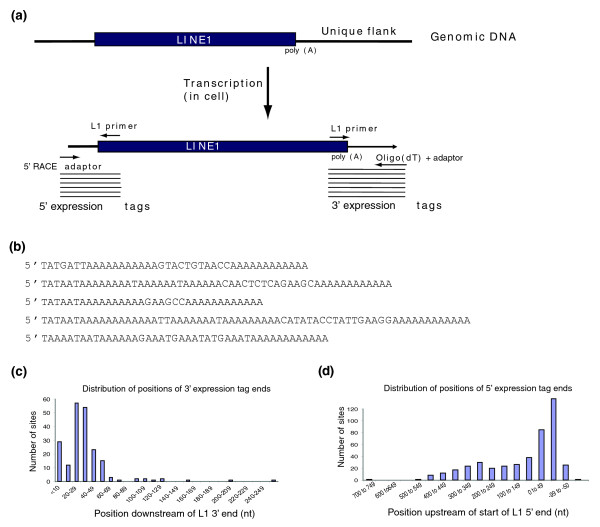
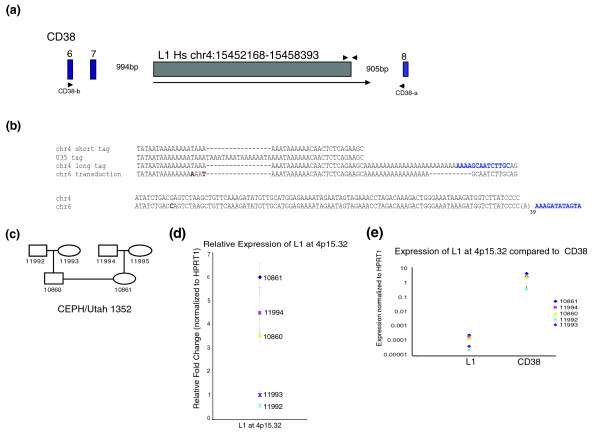
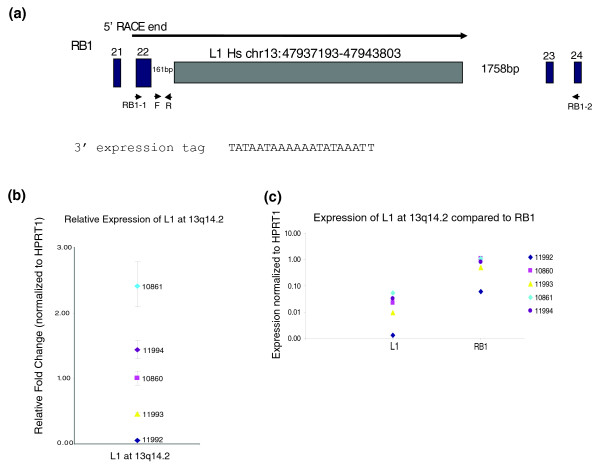
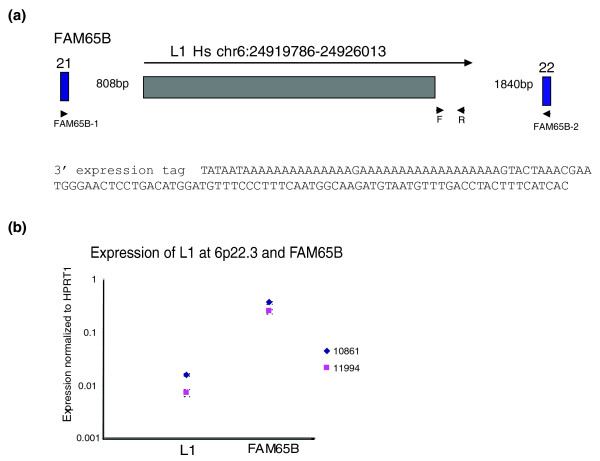
BACKGROUND: While LINE1 (L1) retroelements comprise nearly 20% of the human genome, the majority are thought to have been rendered transcriptionally inactive, due to either mutation or epigenetic suppression. How many L1 elements 'escape' these forms of repression and contribute to the transcriptome of human somatic cells? We have cloned out expressed sequence tags corresponding to the 5' and 3' flanks of L1 elements in order to characterize the population of elements that are being actively transcribed. We also examined expression of a select number of elements in different individuals. RESULTS: We isolated expressed sequence tags from human lymphoblastoid cell lines corresponding to 692 distinct L1 element sites, including 410 full-length elements. Four of the expression tagged sites corresponding to full-length elements from the human specific L1Hs subfamily were examined in European-American individuals and found to be differentially expressed in different family members. CONCLUSIONS: A large number of different L1 element sites are expressed in human somatic tissues, and this expression varies among different individuals. Paradoxically, few elements were tagged at high frequency, indicating that the majority of expressed L1s are transcribed at low levels. Based on our preliminary expression studies of a limited number of elements in a single family, we predict a significant degree of inter-individual transcript-level polymorphism in this class of sequence.
Overview
The claims and statistics of this paper haven’t been checked yet.
Run the check — free, no account needed. It reads the open-access text and checks the sources it cites.
Integrity signals
Registry
Cites
Statistics
Figures
Verification
Claims the paper makes
The claims and statistics of this paper haven’t been checked yet.
Run the check — free, no account needed. It reads the open-access text and checks the sources it cites.
Claims other papers make about this one
Each is checked against this paper’s own text: does it say what the citing paper says it does?
The source backs part of the claim, not all of it — or backs it for a different population, condition or comparison.
In the citing paper
“The initiation of L1 transcription is known to be imprecise, with the majority of start sites occurring +/−50 bp of the consensus start site, and a subset as far down as +180 bp68.”
From L1 drives IFN in senescent cells and promotes age-associated inflammation (2019) · cites this paper as [68]
Experimental — accuracy not yet measured
Self-check
Percentages, sums and reported differences re-computed from the paper’s own numbers.
The self-check needs the paper’s full text.
Citations
Cites
Initial sequencing and analysis of the human genome
International Human Genome Sequencing Consortium, Whitehead Institute for Biomedical Research, C. F. G. R., Lander, E. S., Linton, L. M., Birren, B., Nusbaum, C., Zody, M. C., Baldwin, J., Devon, K., Dewar, K., et al. (2001) · Nature · doi:10.1038/35057062 · Cited by 24,216
Primer3 on the WWW for General Users and for Biologist Programmers
Rozen, S., & Skaletsky, H. (2003) · Humana Press eBooks · doi:10.1385/1-59259-192-2:365 · Cited by 15,068
The Human Genome Browser at UCSC
Kent, W. J., Sugnet, C. W., Furey, T. S., Roskin, K. M., Pringle, T. H., Zahler, A. M., & Haussler, A. D. (2002) · Genome Research · doi:10.1101/gr.229102 · Cited by 10,400
<tt>BLAT</tt> —The <tt>BLAST</tt> -Like Alignment Tool
Kent, W. J. (2002) · Genome Research · doi:10.1101/gr.229202 · Cited by 8,480
The UCSC Genome Browser Database
Karolchik, D. (2003) · Nucleic Acids Research · doi:10.1093/nar/gkg129 · Cited by 1,890
dbEST — database for “expressed sequence tags”
Boguski, M. S., Lowe, T. M., & Tolstoshev, C. M. (1993) · Nature Genetics · doi:10.1038/ng0893-332 · Cited by 1,340
Luan, D. D., Korman, M. H., Jakubczak, J. L., & Eickbush, T. H. (1993) · Cell · doi:10.1016/0092-8674(93)90078-5 · Cited by 1,173
Human L1 retrotransposon encodes a conserved endonuclease required for retrotransposition
Feng, Q., Moran, J. V., Kazazian, H. H., & Boeke, J. D. (1996) · Cell · doi:10.1016/s0092-8674(00)81997-2 · Cited by 1,139
Self-citationHot L1s account for the bulk of retrotransposition in the human population
Brouha, B., Schustak, J., Badge, R. M., Lutz-Prigge, S., Farley, A. H., Moran, J. V., & Kazazian, H. H. (2003) · Proceedings of the National Academy of Sciences · doi:10.1073/pnas.0831042100 · Cited by 1,073
Self-citationLINE-mediated retrotransposition of marked Alu sequences
Dewannieux, M., Esnault, C., & Heidmann, T. (2003) · Nature Genetics · doi:10.1038/ng1223 · Cited by 1,026
Cited by
Sorted by citations
L1 drives IFN in senescent cells and promotes age-associated inflammation
De Cecco, M., Ito, T., Petrashen, A. P., Elias, A. E., Skvir, N. J., Criscione, S. W., Caligiana, A., Brocculi, G., Adney, E. M., Boeke, J. D., et al. (2019) · Nature · doi:10.1038/s41586-018-0784-9 · Cited by 1,255
The Landscape of long noncoding RNA classification
Laurent, G. S., Wahlestedt, C., & Kapranov, P. (2015) · Trends in Genetics · doi:10.1016/j.tig.2015.03.007 · Cited by 1,211
Roles for retrotransposon insertions in human disease
Hancks, D. C., & Kazazian, H. H. (2016) · Mobile DNA · doi:10.1186/s13100-016-0065-9 · Cited by 670
Self-citationMeasuring and interpreting transposable element expression
Lanciano, S., & Cristofari, G. (2020) · Nature Reviews Genetics · doi:10.1038/s41576-020-0251-y · Cited by 415
Burns, K. H., & Boeke, J. D. (2012) · Cell · doi:10.1016/j.cell.2012.04.019 · Cited by 302
Metadata
- Authors
- Rangwala, S. H., Zhang, L., & Kazazian, H. H.
- Affiliations
- University of Pennsylvania (US)
- Corresponding author
- Kazazian, Haig H
- Venue
- Genome Biology
- Published
- 2009-09-22
- Volume
- 10
- Issue
- 9
- Pages
- R100-R100
- ISSN
- 1465-6906 (ISSN-L)
- 1474-760X
- PMC
- PMC2768975
- OpenAlex
- W2107950128
- Cited by
- 102
- References
- 70
- Citations by year
- 2026: 4 · 2025: 6 · 2024: 7 · 2023: 3 · 2022: 6 · 2021: 6 · 2020: 5 · 2019: 8 · 2018: 1 · 2017: 4 · 2016: 9 · 2015: 2 · 2014: 6 · 2013: 9 · 2012: 10
- FWCI
- 10.52
- Type
- journal article
- Language
- en
- Open access
- gold
- doi.org
- Locations
- Genome biology (publishedVersion, cc-by)
- PubMed Central (publishedVersion, cc-by)
- PubMed (publishedVersion)
- Funders
- University of Pennsylvania
- National Institutes of Health
- Topics
- Life Sciences › Biochemistry, Genetics and Molecular Biology › Genetics › Chromosomal and Genetic Variations
- Life Sciences › Biochemistry, Genetics and Molecular Biology › Genetics › Genomic variations and chromosomal abnormalities
- Life Sciences › Biochemistry, Genetics and Molecular Biology › Molecular Biology › Genomics and Chromatin Dynamics
- Keywords
- somatic cells, expressed sequence tags, lymphoblastoid cell lines, epigenetic silencing, human genome
- MeSH terms
- Binding Sites, Cell Line, Chromosomes, Human, Pair 1, Chromosomes, Human, Pair 13, Chromosomes, Human, Pair 4, Chromosomes, Human, Pair 6, Gene Expression Regulation, Humans, Lymphocytes, Transcription, Genetic, Genome, Human, Sequence Analysis, DNA, DNA, Complementary, Long Interspersed Nucleotide Elements, Reverse Transcriptase Polymerase Chain Reaction, Expressed Sequence Tags, Gene Expression Profiling
About these checks
Registry, retraction, Cites and statistics results are computed, not judged, with one exception: a printed reference that no index lists is read once by a model before it counts as a citation error. Claims are extracted by a model and kept only when their quote appears verbatim in the text; each cited source is then checked, with a model’s help, for whether it says what the claim relies on. Those verdicts can be wrong — read the claim’s quote and the cited source before relying on one.
Statistics and arithmetic are recomputed, not judged.
Confidence bands are shown only for fields calibrated on our annotated test set. None is calibrated yet, so no band is shown.
What counts as a claim ›How we measure confidence ›How we check this ›
Are you an author, or do you see a problem with this page? Request a review
