

Genome-wide analysis identifies a functional association of Tet1 and Polycomb repressive complex 2 in mouse embryonic stem cells
Open accessThe DOI matches its Crossref record; 66 of the 66 references it cites were found in a registry or an index.
Abstract
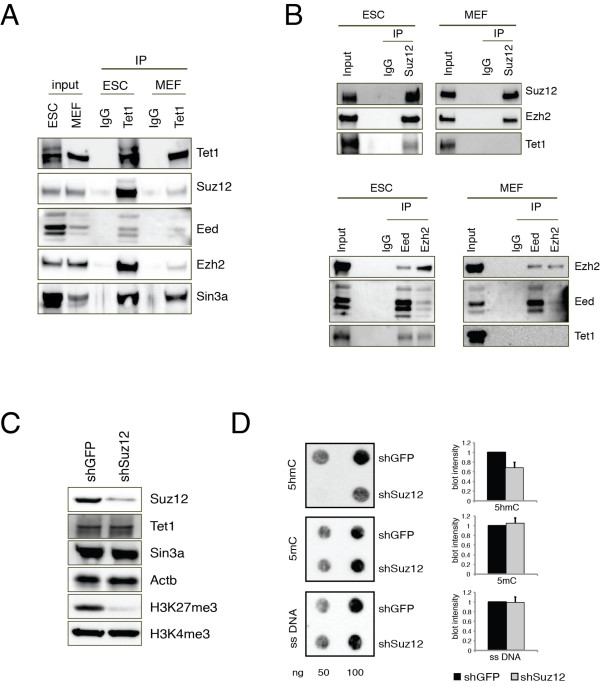
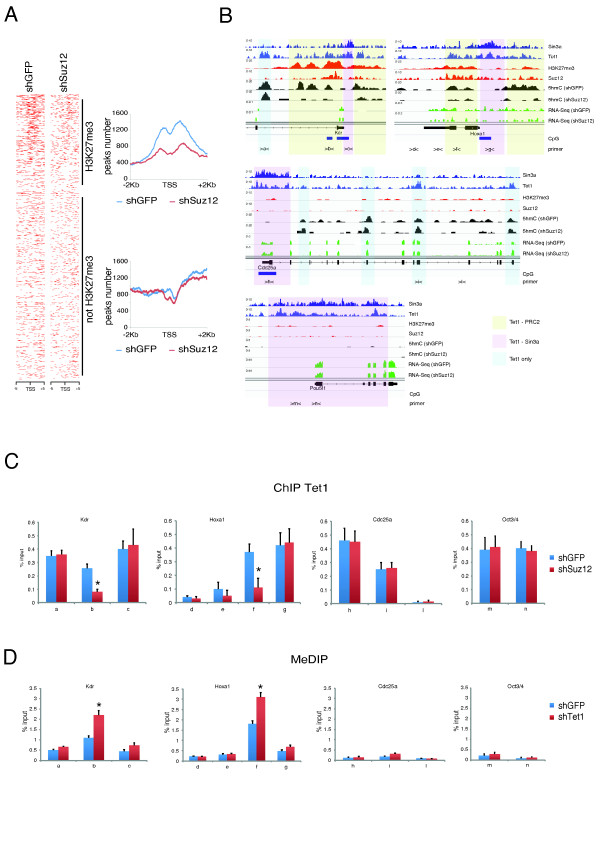
Background: Ten-Eleven Translocation (TETs)proteins mediate the oxidation of 5-methylcytosine (5mC) to 5-hydroxymethylcytosine (5hmC). Tet1 is expressed at high levels in mouse embryonic stem cells (ESCs), where it mediates the induction of 5hmC decoration on gene-regulatory elements. While the function of Tet1 is known, the mechanisms of its specificity remain unclear. Results: We perform a genome-wide comparative analysis of 5hmC in pluripotent ESCs, as well as in differentiated embryonic and adult cells. We find that 5hmC co-localization with Polycomb repressive complex 2 (PRC2) is specific to ESCs and is absent in differentiated cells. Tet1 in ESCs is distributed on bivalent genes in two independent pools: one with Sin3a centered at non-hydroxymethylated transcription start sites and another centered downstream from these sites. This latter pool of Tet1 co-localizes with 5hmC and PRC2. Through co-immunoprecipitation experiments, we show that Tet1 forms a complex with PRC2 specifically in ESCs. Genome-wide analysis of 5hmC profiles in ESCs following knockdown of the PRC2 subunit Suz12 shows a reduction of 5hmC within promoter sequences, specifically at H3K27me3-positive regions of bivalent promoters. Conclusions: In ESCs, PRC2 recruits Tet1 to chromatin at H3K27me3 positive regions of the genome, with 5hmC enriched in a broad peak centered 455 bp after the transcription start site and dependent on the PRC2 component Suz12. These results suggest that PRC2-dependent recruitment of Tet1 contributes to epigenetic plasticity throughout cell differentiation.
Overview
The claims and statistics of this paper haven’t been checked yet.
Free: it reads the open-access text and checks the first 5 claims that cite a source we can check. Create a free account to check every claim.
Integrity signals
Registry
Cites
Statistics
Figures
Verification
Claims the paper makes
The claims and statistics of this paper haven’t been checked yet.
Free: it reads the open-access text and checks the first 5 claims that cite a source we can check. Create a free account to check every claim.
Claims other papers make about this one
Each is checked against this paper’s own text: does it say what the citing paper says it does?
The source backs part of the claim, not all of it — or backs it for a different population, condition or comparison.
In the citing paper
“Interestingly, the signature CpG sites were associated with genes involved in synaptic and neuronal processes and enriched for the binding of polycomb repressive complex 2 (PRC2) and its histone methyltransferase product H3K27me3, both of which are known to recruit Tet enzymes47,48 (Extended Data Fig 10g–i).”
From Reprogramming to recover youthful epigenetic information and restore vision (2020) · cites this paper as [48]
Experimental — accuracy not yet measured
Self-check
Percentages, sums and reported differences re-computed from the paper’s own numbers.
The self-check needs the paper’s full text.
Citations
Cites
An integrated encyclopedia of DNA elements in the human genome
The ENCODE Project Consortium (2012) · Nature · doi:10.1038/nature11247 · Cited by 18,072
Conversion of 5-Methylcytosine to 5-Hydroxymethylcytosine in Mammalian DNA by MLL Partner TET1
Tahiliani, M., Koh, K. P., Shen, Y., Pastor, W. A., Bandukwala, H., Brudno, Y., Agarwal, S., Iyer, L. M., Liu, D. R., Aravind, L., et al. (2009) · Science · doi:10.1126/science.1170116 · Cited by 5,836 · cited 1×
“More recently, a number of studies have identified a mechanism of DNA demethylation involving the oxidation of 5mC to 5-hydroxymethylcytosine (5hmC), which can function as a new epigenetic marker or as an intermediate toward further oxidative states by Ten-eleven translocation (TET) proteins [4-11].”
BackgroundHistone H3K27ac separates active from poised enhancers and predicts developmental state
Creyghton, M. P., Cheng, A. W., Welstead, G. G., Kooistra, T., Carey, B. W., Steine, E. J., Hanna, J., Lodato, M. A., Frampton, G. M., Sharp, P. A., et al. (2010) · Proceedings of the National Academy of Sciences · doi:10.1073/pnas.1016071107 · Cited by 4,302
Genome-wide maps of chromatin state in pluripotent and lineage-committed cells
Mikkelsen, T. S., Ku, M., Jaffe, D. B., Issac, B., Lieberman, E., Giannoukos, G., Alvarez, P., Brockman, W., Kim, T.-K., Koche, R. P., et al. (2007) · Nature · doi:10.1038/nature06008 · Cited by 4,129 · cited 2×
“Datasets for ChIP-Seq of H3K27me3 on MEFs was downloaded from GSE12241.”
MethodThe Polycomb complex PRC2 and its mark in life
Margueron, R., & Reinberg, D. (2011) · Nature · doi:10.1038/nature09784 · Cited by 3,347 · cited 1×
“It is formed by a core complex that includes Enhancer of Zeste 1 or 2 homolog (Ezh1 or Ezh2), Suppressor of Zeste 12 homolog (Suz12), Embryonic ectoderm development (Eed), and other accessory subunits, many of which are specific to ESCs [33-41].”
BackgroundThe Nuclear DNA Base 5-Hydroxymethylcytosine Is Present in Purkinje Neurons and the Brain
Kriaucionis, S., & Heintz, N. (2009) · Science · doi:10.1126/science.1169786 · Cited by 2,700 · cited 1×
“More recently, a number of studies have identified a mechanism of DNA demethylation involving the oxidation of 5mC to 5-hydroxymethylcytosine (5hmC), which can function as a new epigenetic marker or as an intermediate toward further oxidative states by Ten-eleven translocation (TET) proteins [4-11].”
BackgroundGenome-scale DNA methylation maps of pluripotent and differentiated cells
Meissner, A., Mikkelsen, T. S., Gu, H., Wernig, M., Hanna, J., Sivachenko, A., Zhang, X., Bernstein, B. E., Nusbaum, C., Jaffe, D. B., et al. (2008) · Nature · doi:10.1038/nature07107 · Cited by 2,536 · cited 1×
“For comparative analysis, we downloaded GEO Datasets data for the ESC histone modifications GSE12241 [53,54] and GSE11172 [55], and the transcription factors GSE11431 [56], GSE24843 [25], and GSE26833 [19,32].”
MethodHistone modifications at human enhancers reflect global cell-type-specific gene expression
Heintzman, N. D., Hon, G. C., Hawkins, R. D., Kheradpour, P., Stark, A., Harp, L. F., Ye, Z., Lee, L. K., Stuart, R. K., Ching, C. W., et al. (2009) · Nature · doi:10.1038/nature07829 · Cited by 2,533 · cited 1×
“[59], and active or poised enhancers were defined as previously described [60,61].”
BackgroundChen, X., Xu, H., Yuan, P., Fang, F., Huss, M., Vega, V. B., Wong, E., Orlov, Y. L., Zhang, W., Jiang, J., et al. (2008) · Cell · doi:10.1016/j.cell.2008.04.043 · Cited by 2,501
Ito, S., D’Alessio, A. C., Taranova, O. V., Hong, K., Sowers, L. C., & Zhang, Y. (2010) · Nature · doi:10.1038/nature09303 · Cited by 2,373
Cited by
TET-mediated active DNA demethylation: mechanism, function and beyond
Wu, X., & Zhang, Y. (2017) · Nature Reviews Genetics · doi:10.1038/nrg.2017.33 · Cited by 1,661
Reprogramming to recover youthful epigenetic information and restore vision
Lu, Y., Brommer, B., Tian, X., Krishnan, A., Meer, M., Wang, C., Vera, D. L., Zeng, Q., Yu, D., Bonkowski, M. S., et al. (2020) · Nature · doi:10.1038/s41586-020-2975-4 · Cited by 820
Intragenic DNA methylation prevents spurious transcription initiation
Neri, F., Rapelli, S., Krepelova, A., Incarnato, D., Parlato, C., Basile, G., Maldotti, M., Anselmi, F., & Oliviero, S. (2017) · Nature · doi:10.1038/nature21373 · Cited by 739
Self-citationUnderstanding the relationship between DNA methylation and histone lysine methylation
Rose, N. R., & Klose, R. J. (2014) · Biochimica et Biophysica Acta (BBA) - Gene Regulatory Mechanisms · doi:10.1016/j.bbagrm.2014.02.007 · Cited by 542
Regulation of transposable elements by DNA modifications
Deniz, Ö., Frost, J. M., & Branco, M. R. (2019) · Nature Reviews Genetics · doi:10.1038/s41576-019-0106-6 · Cited by 486
Regulation of gene transcription by Polycomb proteins
Aranda, S., Mas, G., & Di Croce, L. (2015) · Science Advances · doi:10.1126/sciadv.1500737 · Cited by 336
The DNA methylation landscape in cancer
Skvortsova, K., Stirzaker, C., & Taberlay, P. (2019) · Essays in Biochemistry · doi:10.1042/ebc20190037 · Cited by 308
TET (Ten-eleven translocation) family proteins: structure, biological functions and applications
Zhang, X., Zhang, Y., Wang, C., & Wang, X. (2023) · Signal Transduction and Targeted Therapy · doi:10.1038/s41392-023-01537-x · Cited by 273
New Insights into 5hmC DNA Modification: Generation, Distribution and Function
Shi, D.-Q., Ali, I., Tang, J., & Yang, W.-C. (2017) · Frontiers in Genetics · doi:10.3389/fgene.2017.00100 · Cited by 228
The interplay between DNA and histone methylation: molecular mechanisms and disease implications
Li, Y., Chen, X., & Lu, C. (2021) · The EMBO Reports · doi:10.15252/embr.202051803 · Cited by 223
“It was also suggested that DNMT3L competes with DNMT3A/B for the binding to PRC2 (Neri et al , 2013b).”
Neri, F., Dettori, D., Incarnato, D., Krepelova, A., Rapelli, S., Maldotti, M., Parlato, C., Paliogiannis, P., & Oliviero, S. (2015) · Oncogene · doi:10.1038/onc.2014.356 · Cited by 192
Self-citationRegulation, functions and transmission of bivalent chromatin during mammalian development
Macrae, T. A., Fothergill-Robinson, J., & Ramalho-Santos, M. (2023) · Nature Reviews Molecular Cell Biology · doi:10.1038/s41580-022-00518-2 · Cited by 186
DNA methylation dynamics in aging: how far are we from understanding the mechanisms?
Ciccarone, F., Tagliatesta, S., Caiafa, P., & Zampieri, M. (2018) · Mechanisms of Ageing and Development · doi:10.1016/j.mad.2017.12.002 · Cited by 183
Epigenetic Control of Stem Cell Potential during Homeostasis, Aging, and Disease
Beerman, I., & Rossi, D. J. (2015) · Cell Stem Cell · doi:10.1016/j.stem.2015.05.009 · Cited by 182
Rapid reprogramming of epigenetic and transcriptional profiles in mammalian culture systems
Nestor, C. E., Ottaviano, R., Reinhardt, D., Cruickshanks, H. A., Mjoseng, H. K., McPherson, R. C., Lentini, A., Thomson, J. P., Dunican, D. S., Pennings, S., et al. (2015) · Genome Biology · doi:10.1186/s13059-014-0576-y · Cited by 173
DNA Methylation in Systemic Lupus Erythematosus
Hedrich, C. M., Mäbert, K., Rauen, T., & Tsokos, G. C. (2016) · Epigenomics · doi:10.2217/epi-2016-0096 · Cited by 149
Li, Y., Zheng, H., Wang, Q., Zhou, C., Wei, L., Liu, X., Zhang, W., Zhang, Y., Du, Z., Wang, X., et al. (2018) · Genome Biology · doi:10.1186/s13059-018-1390-8 · Cited by 146
Johnson, K. C., Houseman, E. A., King, J. E., von Herrmann, K. M., Fadul, C. E., & Christensen, B. C. (2016) · Nature Communications · doi:10.1038/ncomms13177 · Cited by 143
Lai, X., Li, Q., Wu, F., Lin, J., Chen, J., Zheng, H., & Guo, L. (2020) · Frontiers in Cell and Developmental Biology · doi:10.3389/fcell.2020.00760 · Cited by 143
Li, L., Li, C., Mao, H., Du, Z., Chan, W., Murray, P. G., Luo, B., Chan, A. T. �., Mok, T. S. K., Chan, F. K. L., et al. (2016) · Scientific Reports · doi:10.1038/srep26591 · Cited by 140
Tet Enzymes, Variants, and Differential Effects on Function
Melamed, P., Yosefzon, Y., David, C., Tsukerman, A., & Pnueli, L. (2018) · Frontiers in Cell and Developmental Biology · doi:10.3389/fcell.2018.00022 · Cited by 130
“In partially-differentiated gonadotrope precursors, the short TET1 isoform at the Lhb gene promoter is not catalytically active, and in other somatic tissues in which this is the dominant isoform, and in contrast to ESCs, TET1 colocalization with 5hmC is more rarely seen (Neri et al., 2013; Yosefzon et al., 2017).”
BackgroundInfluentialNeri, F., Incarnato, D., Krepelova, A., Rapelli, S., Anselmi, F., Parlato, C., Medana, C., Dal Bello, F., & Oliviero, S. (2015) · Cell Reports · doi:10.1016/j.celrep.2015.01.008 · Cited by 127
Self-citationTET-Mediated Hypermethylation Primes SDH-Deficient Cells for HIF2α-Driven Mesenchymal Transition
Morin, A., Goncalves, J., Moog, S., Castro‐Vega, L. J., Job, S., Buffet, A., Fontenille, M., Woszczyk, J., Gimenez‐Roqueplo, A., Letouzé, É., et al. (2020) · Cell Reports · doi:10.1016/j.celrep.2020.03.022 · Cited by 117
Going beyond Polycomb: EZH2 functions in prostate cancer
Park, S. H., Fong, K.-W., Mong, E. F., Martin, M. C., Schiltz, G. E., & Yu, J. (2021) · Oncogene · doi:10.1038/s41388-021-01982-4 · Cited by 115
Transcriptional and epigenetic regulation of T‐helper lineage specification
Tripathi, S. K., & Lahesmaa, R. (2014) · Immunological Reviews · doi:10.1111/imr.12204 · Cited by 113
Putiri, E. L., Tiedemann, R. L., Thompson, J. J., Liu, C., Ho, T., Choi, J.-H., & Robertson, K. D. (2014) · Genome Biology · doi:10.1186/gb-2014-15-6-r81 · Cited by 112
Hedrich, C. M. (2017) · Current Rheumatology Reports · doi:10.1007/s11926-017-0685-1 · Cited by 109
TET enzymes, DNA demethylation and pluripotency
Ross, S. E., & Bogdanović, O. (2019) · Biochemical Society Transactions · doi:10.1042/bst20180606 · Cited by 103
Salminen, A., Kauppinen, A., & Kaarniranta, K. (2015) · Cellular and Molecular Life Sciences · doi:10.1007/s00018-015-1978-z · Cited by 99
“[89] observed that this interaction was especially present in undifferentiated ESC but not in differentiated cells.”
Background5-hydroxymethylcytosine marks promoters in colon that resist DNA hypermethylation in cancer
Uribe‐Lewis, S., Stark, R., Carroll, T., Dunning, M., Bachman, M., Ito, Y., Stojic, L., Halim, S., Vowler, S. L., Lynch, A. G., et al. (2015) · Genome biology · doi:10.1186/s13059-015-0605-5 · Cited by 99
TET-dependent regulation of retrotransposable elements in mouse embryonic stem cells
de la Rica, L., Deniz, Ö., Cheng, K. C. L., Todd, C. D., Cruz, C., Houseley, J., & Branco, M. R. (2016) · Genome Biology · doi:10.1186/s13059-016-1096-8 · Cited by 87
The roles of TET family proteins in development and stem cells
Yang, J., Bashkenova, N., Zang, R., Huang, X., & Wang, J. (2020) · Development · doi:10.1242/dev.183129 · Cited by 88
Roles of TET and TDG in DNA demethylation in proliferating and non-proliferating immune cells
Onodera, A., González‐Avalos, E., Lio, C. J., Georges, R. O., Bellacosa, A., Nakayama, T., & Rao, A. (2021) · Genome biology · doi:10.1186/s13059-021-02384-1 · Cited by 85
Thomson, J. P., Ottaviano, R., Unterberger, E. B., Lempiäinen, H., Müller, A., Terranova, R., Illingworth, R. S., Webb, S., Kerr, A. R. W., Lyall, M. J., et al. (2016) · Cancer Research · doi:10.1158/0008-5472.can-15-1910 · Cited by 83
Dubois-Chevalier, J., Oger, F., Dehondt, H., Firmin, F. F., Gheeraert, C., Staels, B., Lefebvre, P., & Eeckhoute, J. (2014) · Nucleic Acids Research · doi:10.1093/nar/gku780 · Cited by 83
Ponnaluri, V. K. C., Ehrlich, K. C., Zhang, G., Lacey, M. R., Johnston, D. A., Pradhan, S., & Ehrlich, M. (2017) · Epigenetics · doi:10.1080/15592294.2016.1265713 · Cited by 83
Specific functions of TET1 and TET2 in regulating mesenchymal cell lineage determination
Cakouros, D., Hemming, S., Gronthos, K., Liu, R., Zannettino, A., Shi, S., & Gronthos, S. (2019) · Epigenetics & Chromatin · doi:10.1186/s13072-018-0247-4 · Cited by 81
Intergenerational epigenetic inheritance of cancer susceptibility in mammals
Lesch, B. J., Tóthová, Z., Morgan, E. A., Liao, Z., Bronson, R. T., Ebert, B. L., & Page, D. C. (2019) · eLife · doi:10.7554/elife.39380 · Cited by 80
TET Family of Dioxygenases: Crucial Roles and Underlying Mechanisms
Li, D., Guo, B., Wu, H., Tan, L., & Lu, Q. (2015) · Cytogenetic and Genome Research · doi:10.1159/000438853 · Cited by 81
Zhong, J., Li, X., Cai, W., Wang, Y., Dong, S., Yang, J., Zhang, J., Wang, K., Mao, F., Zeng, C., et al. (2016) · Nucleic Acids Research · doi:10.1093/nar/gkw919 · Cited by 72
In vivo genome-wide profiling reveals a tissue-specific role for 5-formylcytosine
Iurlaro, M., McInroy, G. R., Burgess, H. E., Dean, W., Raiber, E.-A., Bachman, M., Beraldi, D., Balasubramanian, S., & Reik, W. (2016) · Genome Biology · doi:10.1186/s13059-016-1001-5 · Cited by 71
DNA Modification Readers and Writers and Their Interplay
Rausch, C., Hastert, F. D., & Cardoso, M. C. (2019) · Journal of Molecular Biology · doi:10.1016/j.jmb.2019.12.018 · Cited by 71
Webb, W. M., Sánchez, R. G., Perez, G., Butler, A. A., Hauser, R. M., Rich, M. C., O'Bierne, A. L., Jarome, T. J., & Lubin, F. D. (2017) · Neurobiology of Learning and Memory · doi:10.1016/j.nlm.2017.02.010 · Cited by 71
Target specificity of mammalian DNA methylation and demethylation machinery
Ravichandran, M., Jurkowska, R. Z., & Jurkowski, T. P. (2018) · Organic & Biomolecular Chemistry · doi:10.1039/c7ob02574b · Cited by 70
p53-Suppressed Oncogene TET1 Prevents Cellular Aging in Lung Cancer
Filipczak, P. T., Leng, S., Tellez, C. S., Kieu, C., Grimes, M. J., Thomas, C. L., Walton-Filipczak, S. R., Picchi, M. A., & Belinsky, S. A. (2019) · Cancer Research · doi:10.1158/0008-5472.can-18-1234 · Cited by 69
TET1 is a beige adipocyte-selective epigenetic suppressor of thermogenesis
Villivalam, S. D., You, D., Kim, J., Lim, H., Han, X., Zushin, P.-J. H., Oguri, Y., Amin, P., & Kang, S. (2020) · Nature Communications · doi:10.1038/s41467-020-18054-y · Cited by 69
Nutrient regulation of gene expression by O-GlcNAcylation of chromatin
Hardivillé, S., & Hart, G. W. (2016) · Current Opinion in Chemical Biology · doi:10.1016/j.cbpa.2016.06.005 · Cited by 72
Zhang, M., Wang, J., Zhang, K., Lu, G., Liu, Y., Ren, K., Wang, W., Xin, D. E., Xu, L., Mao, H., et al. (2021) · Nature Communications · doi:10.1038/s41467-021-25353-5 · Cited by 66
Chrysanthou, S., Tang, Q., Lee, J., Taylor, S. J., Zhao, Y., Steidl, U., Zheng, D., & Dawlaty, M. M. (2022) · Nucleic Acids Research · doi:10.1093/nar/gkac089 · Cited by 64
Burr, S., Caldwell, A., Chong, M., Beretta, M., Metcalf, S., Hancock, M., Arno, M. J., Balu, S., Kropf, V. L., Mistry, R. K., et al. (2017) · Nucleic Acids Research · doi:10.1093/nar/gkx1197 · Cited by 62
Zhu, Q., Sang, F., Withey, S., Tang, W. W. C., Dietmann, S., Klisch, D., Ramos‐Ibeas, P., Zhang, H., Requena, C. E., Hájková, P., et al. (2021) · Cell Reports · doi:10.1016/j.celrep.2021.108735 · Cited by 63
Kress, C., Montillet, G., Jean, C., Fuet, A., & Pain, B. (2016) · Epigenetics & Chromatin · doi:10.1186/s13072-016-0056-6 · Cited by 58
DNA Cytosine Methylation and Hydroxymethylation at the Borders
Ehrlich, M., & Ehrlich, K. C. (2014) · Epigenomics · doi:10.2217/epi.14.48 · Cited by 56
Tamanaha, E., Guan, S., Marks, K., & Saleh, L. (2016) · Journal of the American Chemical Society · doi:10.1021/jacs.6b03243 · Cited by 55
Neri, F., Incarnato, D., Křepelová, A., Dettori, D., Rapelli, S., Maldotti, M., Parlato, C., Anselmi, F., Galvagni, F., & Oliviero, S. (2015) · Nucleic Acids Research · doi:10.1093/nar/gkv392 · Cited by 55
Self-citationMechanisms of chromatin-based epigenetic inheritance
Du, W., Shi, G., Shan, C., Li, Z., Zhu, B., Jia, S., Li, Q., & Zhang, Z. (2022) · Science China Life Sciences · doi:10.1007/s11427-022-2120-1 · Cited by 54
An epigenetic switch repressing Tet1 in gonadotropes activates the reproductive axis
Yosefzon, Y., David, C., Tsukerman, A., Pnueli, L., Qiao, S., Boehm, U., & Melamed, P. (2017) · Proceedings of the National Academy of Sciences · doi:10.1073/pnas.1704393114 · Cited by 52
Melatonin: A Potential Regulator of DNA Methylation
Linowiecka, K., Slominski, A. T., Reiter, R. J., Böhm, M., Steinbrink, K., Paus, R., & Kleszczyński, K. (2023) · Antioxidants · doi:10.3390/antiox12061155 · Cited by 51
Coluccio, A., Ecco, G., Duc, J., Offner, S., Turelli, P., & Trono, D. (2018) · Epigenetics & Chromatin · doi:10.1186/s13072-018-0177-1 · Cited by 51
Shukla, A., Sehgal, M., & Singh, T. R. (2015) · Gene · doi:10.1016/j.gene.2015.03.075 · Cited by 52
Yiew, N. K. H., Greenway, C., Zarzour, A., Ahmadieh, S., Goo, B. M. S. S., Kim, D. S., Benson, T. W., Ogbi, M., Tang, Y., Chen, W., et al. (2019) · Journal of Biological Chemistry · doi:10.1074/jbc.ra118.006871 · Cited by 50
Smeriglio, P., Grandi, F. C., Davala, S., Masarapu, V., Indelli, P. F., Goodman, S. B., & Bhutani, N. (2020) · Science Translational Medicine · doi:10.1126/scitranslmed.aax2332 · Cited by 47
Evolutionary expansion of DNA hypomethylation in the mammalian germline genome
Qu, J., Hodges, E. C., Molaro, A., Gagneux, P., Dean, M. D., Hannon, G. J., & Smith, A. D. (2017) · Genome Research · doi:10.1101/gr.225896.117 · Cited by 48
Lee, H. G., Kim, H., Son, T., Jeong, Y., Kim, S. U., Dong, S. M., Park, Y. N., Lee, J. D., Lee, J. M., & Park, J. H. (2016) · Oncotarget · doi:10.18632/oncotarget.9723 · Cited by 47
Sepúlveda, H., Villagra, A., & Montecino, M. A. (2017) · Molecular and Cellular Biology · doi:10.1128/mcb.00177-17 · Cited by 49
Stolz, P., Mantero, A. S., Tvardovskiy, A., Ugur, E., Wange, L. E., Mulholland, C. B., Cheng, Y., Wierer, M., Enard, W., Schneider, R., et al. (2022) · Nucleic Acids Research · doi:10.1093/nar/gkac642 · Cited by 45
Decoding the role of TET family dioxygenases in lineage specification
Wu, X., Li, G., & Xie, R. (2018) · Epigenetics & Chromatin · doi:10.1186/s13072-018-0228-7 · Cited by 43
Neri, F., Incarnato, D., Křepelová, A., Parlato, C., & Oliviero, S. (2016) · Nature Protocols · doi:10.1038/nprot.2016.063 · Cited by 40
Self-citationTet enzymes are essential for early embryogenesis and completion of embryonic genome activation
Arand, J., Chiang, H. R., Martin, D., Snyder, M. P., Sage, J., Pera, R. A. R., & Wossidlo, M. (2021) · EMBO Reports · doi:10.15252/embr.202153968 · Cited by 40
Mechanistic aspects of epigenetic dysregulation in SLE
Hedrich, C. M. (2018) · Clinical Immunology · doi:10.1016/j.clim.2018.02.002 · Cited by 39
Histone bivalency regulates the timing of cerebellar granule cell development
Mätlik, K., Govek, E., Paul, M. R., Allis, C. D., & Hatten, M. E. (2023) · Genes & Development · doi:10.1101/gad.350594.123 · Cited by 38
Whole-genome analysis of TET dioxygenase function in regulatory T cells
Yue, X., Samaniego‐Castruita, D., González‐Avalos, E., Li, X., Barwick, B. G., & Rao, A. (2021) · EMBO Reports · doi:10.15252/embr.202152716 · Cited by 39
The TET2 interactors and their links to hematological malignancies
Pan, F., Weeks, O. I., Yang, F., & Xu, M. (2015) · IUBMB Life · doi:10.1002/iub.1389 · Cited by 39
Epigenetic Modification of Histone 3 Lysine 27
Englert, N. A., Luo, G., Goldstein, J. A., & Surapureddi, S. (2014) · Journal of Biological Chemistry · doi:10.1074/jbc.m114.579474 · Cited by 36
Role of TET1-mediated epigenetic modulation in Alzheimer's disease
Armstrong, M. J., Jin, Y., Vattathil, S., Huang, Y., Schroeder, J. P., Bennet, D. A., Qin, Z. S., Wingo, T. S., & Jin, P. (2023) · Neurobiology of Disease · doi:10.1016/j.nbd.2023.106257 · Cited by 35
Polycomb Repressive Complex 2 Regulates Lineage Fidelity during Embryonic Stem Cell Differentiation
Thornton, S. R., Butty, V. L., Levine, S. S., & Boyer, L. A. (2014) · PLoS ONE · doi:10.1371/journal.pone.0110498 · Cited by 34
Nuclear and Mitochondrial DNA Alterations in Newborns with Prenatal Exposure to Cigarette Smoke
Pirini, F., Guida, E., Lawson, F., Mancinelli, A., & Guerrero-Preston, R. (2015) · International Journal of Environmental Research and Public Health · doi:10.3390/ijerph120201135 · Cited by 34
Epigenetic Control of Osteogenic Lineage Commitment
Montecino, M. A., Carrasco, M. E., & Nardocci, G. (2021) · Frontiers in Cell and Developmental Biology · doi:10.3389/fcell.2020.611197 · Cited by 34
Dynamic antagonism between key repressive pathways maintains the placental epigenome
Weigert, R., Hetzel, S., Bailly, N., Haggerty, C., Ilik, İ., Yung, P. Y. K., Navarro, C., Bolondi, A., Kumar, A. S., Anania, C., et al. (2023) · Nature Cell Biology · doi:10.1038/s41556-023-01114-y · Cited by 32
TET1 knockdown inhibits the odontogenic differentiation potential of human dental pulp cells
Rao, L., Yi, B., Li, Q.-M., & Xu, Q. (2016) · International Journal of Oral Science · doi:10.1038/ijos.2016.4 · Cited by 30
Inhibition of TET‐mediated DNA demethylation suppresses osteoblast differentiation
Dusadeemeelap, C., Rojasawasthien, T., Matsubara, T., Kokabu, S., & Addison, W. N. (2022) · The FASEB Journal · doi:10.1096/fj.202101402r · Cited by 30
DNA demethylation is a driver for chick retina regeneration
Luz-Madrigal, A., Grajales‐Esquivel, E., Tangeman, J. A., Kosse, S., Liu, L., Wang, K., Fausey, A., Liang, C., Tsonis, P. A., & Rio‐Tsonis, K. D. (2020) · Epigenetics · doi:10.1080/15592294.2020.1747742 · Cited by 28
Yang, X., Mei, C., Raza, S. H. A., Ma, X., Wang, J., Du, J., & Zan, L. (2022) · International Journal of Biological Macromolecules · doi:10.1016/j.ijbiomac.2022.11.081 · Cited by 28
Lando, D., Ma, X., Cao, Y., Jartseva, A., Stevens, T. J., Boucher, W., Reynolds, N., Montibus, B., Hall, D., Lackner, A., et al. (2024) · Molecular Cell · doi:10.1016/j.molcel.2024.02.015 · Cited by 27
A TET1-PSPC1-Neat1 molecular axis modulates PRC2 functions in controlling stem cell bivalency
Huang, X., Bashkenova, N., Hong, Y., Lyu, C., Guallar, D., Hu, Z., Malik, V., Li, D., Wang, H., Shen, X., et al. (2022) · Cell Reports · doi:10.1016/j.celrep.2022.110928 · Cited by 27
DNMT3B supports meso-endoderm differentiation from mouse embryonic stem cells
Lauria, A., Meng, G., Proserpio, V., Rapelli, S., Maldotti, M., Polignano, I. L., Anselmi, F., Incarnato, D., Křepelová, A., Donna, D., et al. (2023) · Nature Communications · doi:10.1038/s41467-023-35938-x · Cited by 26
Self-citationPrasasya, R. D., Caldwell, B. A., Liu, Z., Wu, S., Leu, N. A., Fowler, J. M., Cincotta, S. A., Laird, D. J., Kohli, R. M., & Bartolomei, M. S. (2024) · Developmental Cell · doi:10.1016/j.devcel.2024.02.012 · Cited by 26
DNA Hydroxymethylation in Smoking-Associated Cancers
Nia, A. B., Caceres, A., & Tommasi, S. (2022) · International Journal of Molecular Sciences · doi:10.3390/ijms23052657 · Cited by 25
A Lexicon of DNA Modifications: Their Roles in Embryo Development and the Germline
Zhu, Q., Stöger, R. J., & Alberio, R. (2018) · Frontiers in Cell and Developmental Biology · doi:10.3389/fcell.2018.00024 · Cited by 25
Rakoczy, J., Padmanabhan, N., Krzak, A. M., Kieckbusch, J., Cindrová‐Davies, T., & Watson, E. D. (2017) · Placenta · doi:10.1016/j.placenta.2017.09.008 · Cited by 25
MicroRNAs mediated targeting on the Yin-yang dynamics of DNA methylation in disease and development
Tu, J., Liao, J., Luk, A. C. S., Tang, N. L. S., Chan, W., & Lee, T. (2015) · The International Journal of Biochemistry & Cell Biology · doi:10.1016/j.biocel.2015.05.002 · Cited by 24
The N-terminal region of DNMT3A engages the nucleosome surface to aid chromatin recruitment
Wapenaar, H., Clifford, G., Rolls, W., Pasquier, M., Burdett, H., Zhang, Y., Deák, G., Zou, J., Spanos, C., Taylor, M. R. D., et al. (2024) · EMBO Reports · doi:10.1038/s44319-024-00306-3 · Cited by 23
Epigenetic Regulatory Dynamics in Models of Methamphetamine-Use Disorder
Jayanthi, S., McCoy, M. T., & Cadet, J. L. (2021) · Genes · doi:10.3390/genes12101614 · Cited by 23
Li, M., Tang, Y., Li, Q., Xiao, M., Yang, Y., & Wang, Y. (2019) · Oncogene · doi:10.1038/s41388-018-0671-8 · Cited by 23
Green, H. L. H., & Brewer, A. C. (2020) · Clinical Epigenetics · doi:10.1186/s13148-020-00848-y · Cited by 22
DNA methylation reprogramming of genomic imprints in the mammalian germline: A TET‐centric view
Caldwell, B. A., & Bartolomei, M. S. (2022) · Andrology · doi:10.1111/andr.13303 · Cited by 22
Multiple Functions of Ten-eleven Translocation 1 during Tumorigenesis
Tian, Y., Zhu, Y., Sun, X., & Lai, M. (2016) · Chinese Medical Journal · doi:10.4103/0366-6999.185873 · Cited by 22
Bitirim, C. V., Aksoy, Z. B., & Akçalı, K. C. (2021) · PeerJ · doi:10.7717/peerj.12071 · Cited by 22
Smeriglio, P., Grandi, F. C., Taylor, S. E. B., Zalc, A., & Bhutani, N. (2020) · JBMR Plus · doi:10.1002/jbm4.10383 · Cited by 21
Martins, N. M. C., Cisneros-Soberanis, F., Pesenti, E., Kochanova, N. Y., Shang, W.-H., Hori, T., Nagase, T., Kimurâ, H., Larionov, V., Masumoto, H., et al. (2020) · Journal of Cell Science · doi:10.1242/jcs.242610 · Cited by 21
Metadata
- Authors
- Neri, F., Incarnato, D., Krepelova, A., Rapelli, S., Pagnani, A., Zecchina, R., Parlato, C., & Oliviero, S.
- Affiliations
- Italian institute for Genomic Medicine (IT)
- University of Siena (IT)
- Politecnico di Torino (IT)
- Corresponding author
- Oliviero, Salvatore
- ORCID
- Venue
- Genome Biology
- Published
- 2013-08-29
- Volume
- 14
- Issue
- 8
- Pages
- R91-R91
- ISSN
- 1465-6906 (ISSN-L)
- 1474-760X
- PMC
- PMC4053938
- OpenAlex
- W2107368073
- Cited by
- 179
- References
- 66
- Citations by year
- 2026: 7 · 2025: 10 · 2024: 7 · 2023: 16 · 2022: 13 · 2021: 18 · 2020: 14 · 2019: 21 · 2018: 11 · 2017: 15 · 2016: 16 · 2015: 18 · 2014: 13
- FWCI
- 7.01
- Type
- journal article
- Language
- en
- Open access
- gold
- doi.org
- Licence
- cc-by
- creativecommons.org/licenses/by/2.0/ (tdm)
- creativecommons.org/licenses/by/2.0/ (vor)
- Locations
- Genome biology (publishedVersion, cc-by)
- Europe PMC (PubMed Central) (publishedVersion, cc-by)
- PubMed Central (publishedVersion, cc-by)
- PubMed (publishedVersion)
- Institutional Research Information System University of Turin (University of Turin) (submittedVersion, other-oa)
- PORTO@Iris (submittedVersion)
- PORTO Publications Open Repository TOrino (Politecnico di Torino) (submittedVersion)
- Funders
- Ministero della Salute
- Associazione Italiana per la Ricerca sul Cancro
- Regione Toscana
- Topics
- Life Sciences › Biochemistry, Genetics and Molecular Biology › Molecular Biology › Epigenetics and DNA Methylation
- Life Sciences › Biochemistry, Genetics and Molecular Biology › Molecular Biology › Genomics and Chromatin Dynamics
- Life Sciences › Biochemistry, Genetics and Molecular Biology › Molecular Biology › Pluripotent Stem Cells Research
- Keywords
- TET1, polycomb repressive complex 2, 5-hydroxymethylcytosine, 5-methylcytosine oxidation, mouse embryonic stem cells, bivalent promoters, H3K27me3, SUZ12, SIN3A, epigenetic plasticity, cell differentiation, transcription start sites
- MeSH terms
- Animals, Cell Differentiation, Chromatin, Cytosine, DNA-Binding Proteins, Gene Expression Regulation, Histones, Promoter Regions, Genetic, Proto-Oncogene Proteins, Repressor Proteins, Transcription, Genetic, Genome, RNA, Small Interfering, Pluripotent Stem Cells, 5-Methylcytosine, Mice, Embryonic Stem Cells, Adult Stem Cells, Sin3 Histone Deacetylase and Corepressor Complex, Polycomb Repressive Complex 2
About these checks
Registry, retraction, Cites and statistics results are computed, not judged, with one exception: a printed reference that no index lists is read once by a model before it counts as a citation error. Claims are extracted by a model and kept only when their quote appears verbatim in the text; each cited source is then checked, with a model’s help, for whether it says what the claim relies on. Those verdicts can be wrong — read the claim’s quote and the cited source before relying on one.
Statistics and arithmetic are recomputed, not judged.
Confidence bands are shown only for fields calibrated on our annotated test set. None is calibrated yet, so no band is shown.
What counts as a claim ›How we measure confidence ›How we check this ›
Are you an author, or do you see a problem with this page? Request a review
Data sources
Bibliographic data: Semantic Scholar, OpenAlex, Crossref.
Contains information from the Semantic Scholar Academic Graph Datasets, made available under the ODC Attribution License (ODC-BY 1.0).
Semantic Scholar’s data is described in: Kinney, R., et al. (2023). The Semantic Scholar Open Data Platform. arXiv:2301.10140.
