

voom: precision weights unlock linear model analysis tools for RNA-seq read counts
Open accessThe DOI matches its Crossref record; 65 of the 67 references it cites were found in a registry or an index; 1 of the 51 sources its claims cite were checked for support.
Abstract
New normal linear modeling strategies are presented for analyzing read counts from RNA-seq experiments. The voom method estimates the mean-variance relationship of the log-counts, generates a precision weight for each observation and enters these into the limma empirical Bayes analysis pipeline. This opens access for RNA-seq analysts to a large body of methodology developed for microarrays. Simulation studies show that voom performs as well or better than count-based RNA-seq methods even when the data are generated according to the assumptions of the earlier methods. Two case studies illustrate the use of linear modeling and gene set testing methods.
Overview
CoChat Summary
TL;DR
voom estimates the mean-variance relationship of log-counts per million and generates observation-level precision weights for limma, allowing normal-based linear model analysis of RNA-seq read counts. Simulations and case studies show voom controls error rates well and often has better power or lower FDR than negative binomial/Poisson methods, especially when library sizes are unequal.
Key findings
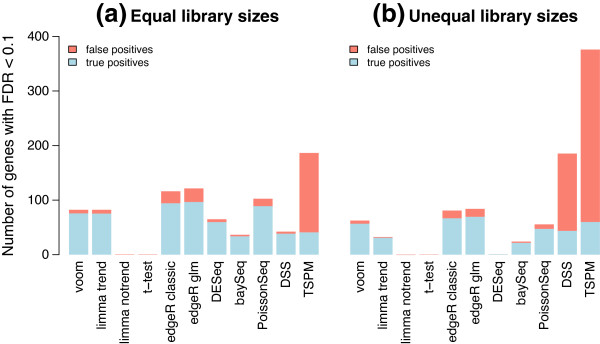
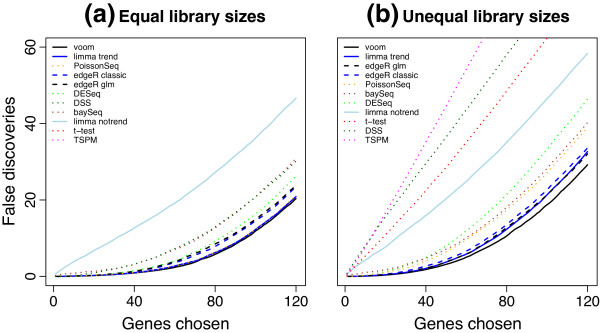
- In simulations with 6 libraries, 10,000 genes, and 100 upregulated plus 100 downregulated genes, voom had the best power among methods that controlled type I and FDR error rates; with unequal library sizes, voom had the best power except for edgeR while maintaining low FDR. edgeR and PoissonSeq were somewhat liberal, while DESeq and DSS became very conservative when library sizes were unequal.
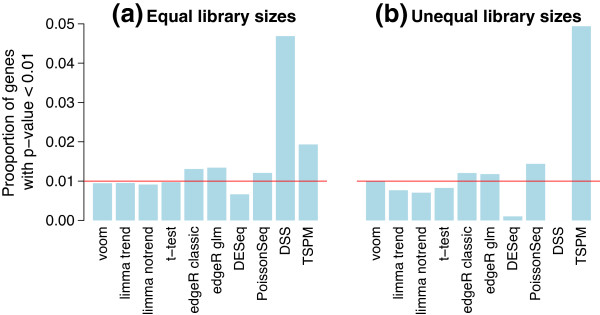
- For type I error at P<0.01, NB/Poisson methods did not control error accurately; voom was close to the nominal rate in both equal and unequal library size scenarios, while limma-trend was similar when sizes were equal but conservative when unequal. In SEQC HBRR technical replicates, voom returned no DE genes at 5% FDR for 6 of 7 possible partitions.
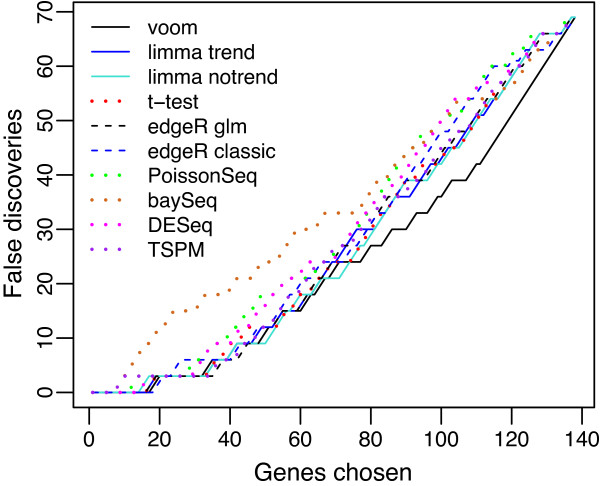
- voom had the lowest FDR at any cutoff in simulations and in SEQC spike-in data; the spike-in analysis used 138 transcripts, half truly DE and half non-DE.
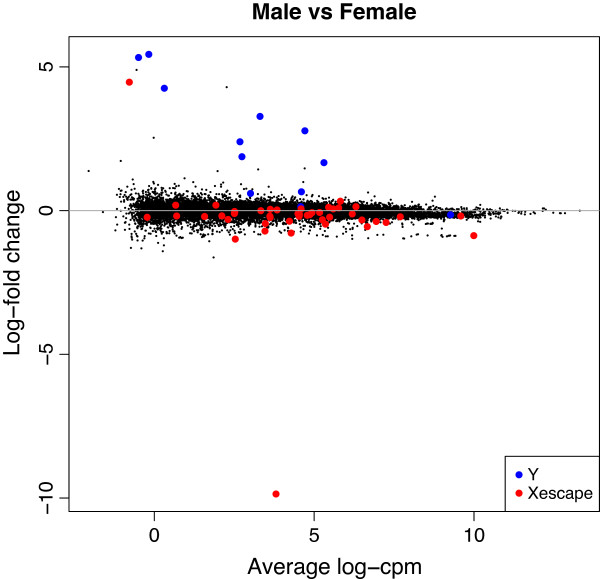
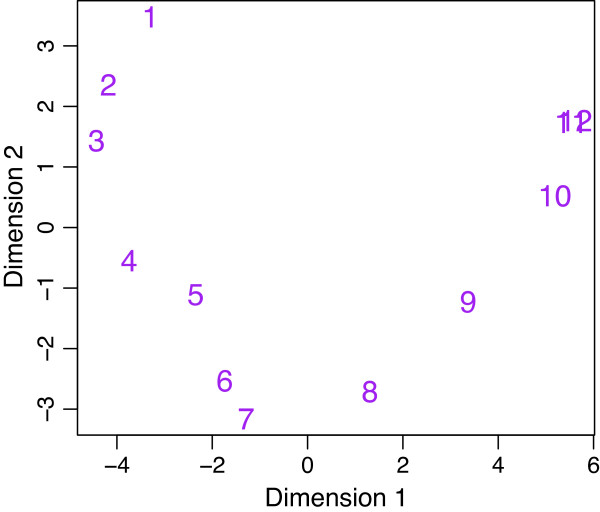
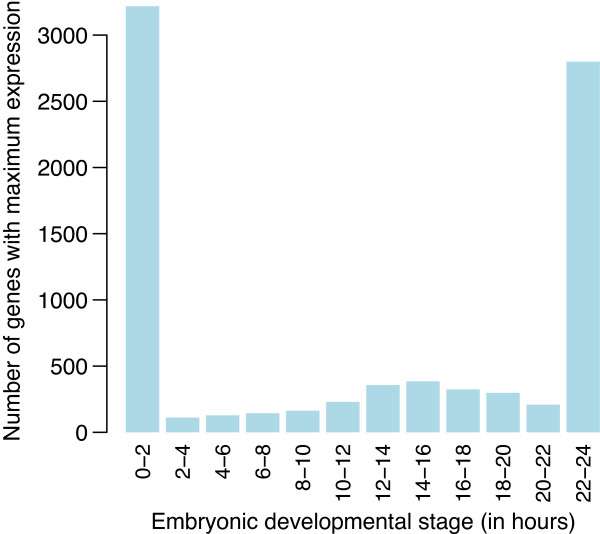
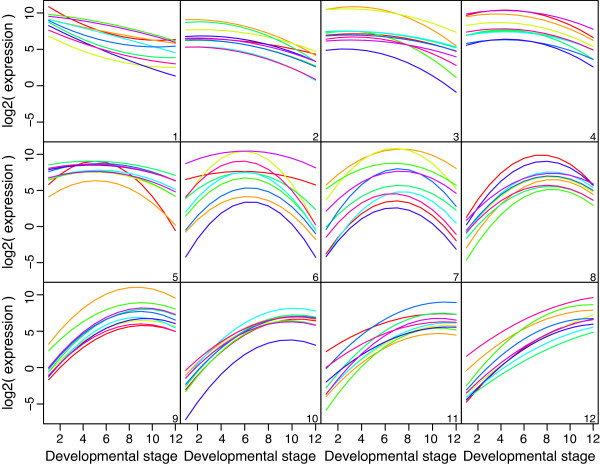
- In the Nigerian lymphoblastoid dataset (29 males, 40 females), voom found 16 genes upregulated in males and 43 upregulated in females at 5% FDR, with XIST the top gene; ROAST and CAMERA confirmed male-specific Y chromosome genes and X-inactivation escape genes. In Drosophila embryonic stages, 8,366 of 14,869 expressed genes showed a significant trend at 5% FDR.
Methods
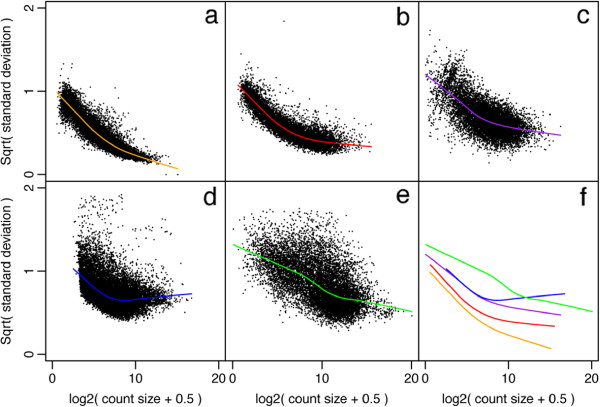
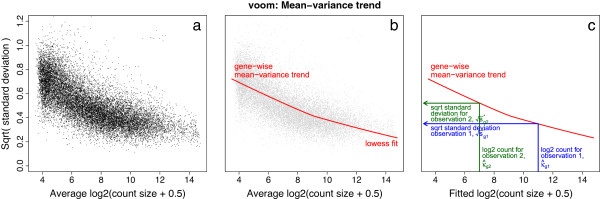
- voom works on log-cpm values: fit gene-wise linear models, estimate residual standard deviations as a function of average log-count using a robust LOWESS trend, interpolate that trend to each observation’s predicted count, and use inverse squared predicted standard deviation as a precision weight in limma’s empirical Bayes pipeline. limma-trend applies the mean-variance trend at the gene level instead.
- Simulations generated NB counts for 6 libraries and 10,000 genes, with baseline cpm distribution matched to real data and dispersion trend ψ^1/2 = 0.2 + λ^-1/2; gene-wise dispersions were drawn from an inverse chi-square with 40 degrees of freedom. Equal library sizes used 11 million reads per library; unequal sizes used 20 million for odd libraries and 2 million for even libraries. Results were averaged over 100 simulations and compared with edgeR, DESeq, baySeq, TSPM, PoissonSeq, and DSS.
- Case studies used SEQC pilot libraries (16 libraries in groups A–D; 4 HBRR libraries; 92 spike-in transcripts expanded to 138), Nigerian lymphoblastoid cell lines from 69 unrelated individuals, Drosophila melanogaster embryonic stages (12 libraries), and C57BL/6J versus DBA/2J mouse striatum data. Gene set testing used ROAST and CAMERA.
Limitations
- Stated: gene-level analysis does not allow different isoforms of the same gene to be differentially expressed in different directions, though voom can be run at exon level. The Drosophila quadratic time trends do not match all intricacies of gene expression over time. Simulations were generated under NB assumptions, and other scenarios may differ. baySeq was excluded from the type I error comparison because it does not return P values.
- Evident: the Drosophila analysis has no replicate libraries, so variances are estimated by assuming smooth expression over time and fitting quadratic trends. Performance comparisons rely on specific simulation settings and default software pipelines, and the case studies illustrate use rather than provide independent experimental validation.
Model-written summary. Check it against the paper before relying on it.
Integrity signals
Registry
Cites
Statistics
Figures
Verification
Claims the paper makes
1 Valid · 4 Not valid · 34 Not checked · 142 Own results and interpretations
The cited sources support only part of this claim — read each source’s verdict below.
In the paper
“voom and limma could be used to analyze any gene-level RNA-seq differential expression experiment, including those with multiple experimental factors [34].”
§ voom: precision weights unlock linear model analysis tools for RNA-seq read counts > Results > Development stages of Drosophila melanogaster
What the sources say
- Partly supportedcites [34] McCarthy DJ Chen Y Smyth GK Differential expression analysis of multifactor RNA-Seq experiments with respect to biological variation Nucleic Acids Res 2012 40 4288 4297 10.1093/nar/gks042 22287627 PMC3378882 sourceExperimental — accuracy not yet measured
Our copy of McCarthy et al. (2012) supports the scope part of the claim: the INTRODUCTION states 'The methodology provides a pipeline for analysing arbitrarily complex RNA-Seq experiments provided that there is some degree of biological replication', the Abstract describes analysis of 'complex experiments involving multiple treatment conditions and blocking variables', and the article's focus is gene-level counts ('For simplicity... counts are summarized at the gene level', RESULTS > Technical and biological variation). However, the capability is attributed to negative-binomial generalized linear models implemented in the edgeR package (DISCUSSION: 'The methods described in this article are implemented in the software package edgeR'), and no passage of our copy mentions voom or limma at all — the closest the paper comes to normal-linear-model analysis of transformed counts is a critique in the INTRODUCTION that transforming counts to approximate normality and analysing as for microarray data 'is however not fully tuned to the characteristics of read count data'. Thus the specific tools named in the citing sentence (voom and limma) are not this paper's methods, while the multifactor/gene-level applicability is. (LLM, conf=0.72)
hedged- Asserted: passes — The authors put it forward as true.
- Checkable: passes — It can be checked against evidence.
- Load-bearing: unclear — It is unclear whether the paper’s conclusions depend on it.
- Based: passes — The paper gives a reason why it holds.
- Rests on an assumption not shown here.
- Partly supported
A result the paper reports from its own data — it cites no other source for it, so there is none to check. The quote shows it is in the paper.
In the paper
“When the library sizes are unequal, DSS and DESeq became extremely conservative.”
§ voom: precision weights unlock linear model analysis tools for RNA-seq read counts > Results > voom and limma-trend control the type I error rate correctly
plainstates a cause- Asserted: passes — The authors put it forward as true.
- Checkable: passes — It can be checked against evidence.
- Load-bearing: unclear — It is unclear whether the paper’s conclusions depend on it.
- Based: passes — The paper gives a reason why it holds.
A result the paper reports from its own data — it cites no other source for it, so there is none to check. The quote shows it is in the paper.
In the paper
“Figures 3 and 4 together show that voom has the best power of those methods that correctly control the type I and FDR error rates.”
§ voom: precision weights unlock linear model analysis tools for RNA-seq read counts > Results > voom has the best power of methods that control the type I error rate
plain- Asserted: passes — The authors put it forward as true.
- Checkable: passes — It can be checked against evidence.
- Load-bearing: passes — The paper’s conclusions depend on it.
- Based: passes — The paper gives a reason why it holds.
- Rests on an assumption not shown here.
A result the paper reports from its own data — it cites no other source for it, so there is none to check. The quote shows it is in the paper.
In the paper
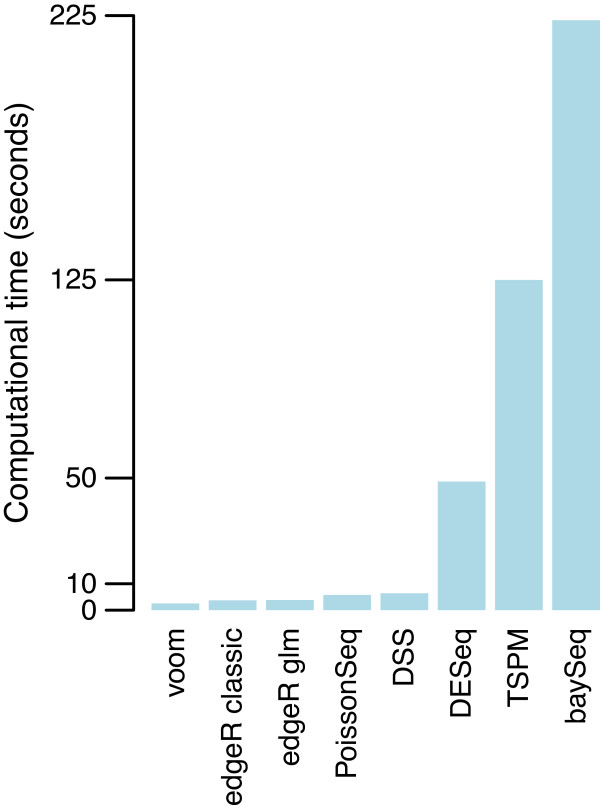
“voom is easily the fastest of the methods compared, with edgeR-classic next fastest (Figure 7).”
§ voom: precision weights unlock linear model analysis tools for RNA-seq read counts > Results > voom and limma-trend are faster than specialist RNA-seq methods
plain- Asserted: passes — The authors put it forward as true.
- Checkable: passes — It can be checked against evidence.
- Load-bearing: unclear — It is unclear whether the paper’s conclusions depend on it.
- Based: passes — The paper gives a reason why it holds.
A result the paper reports from its own data — it cites no other source for it, so there is none to check. The quote shows it is in the paper.
In the paper
“Genes peaking at the last stage tended to be associated with precursor metabolites and energy, the oxidation-reduction process and with metabolic pathways.”
§ voom: precision weights unlock linear model analysis tools for RNA-seq read counts > Results > Development stages of Drosophila melanogaster
plainstates an association- Asserted: passes — The authors put it forward as true.
- Checkable: passes — It can be checked against evidence.
- Load-bearing: unclear — It is unclear whether the paper’s conclusions depend on it.
- Based: passes — The paper gives a reason why it holds.
79 more claims
Create a free account to see all 181 claims and to verify the 45 references still open.
- It may state two separate claims as one. 48
- Probably not a substantial claim. 68
- The quote only partly states this claim. 2
Claims other papers make about this one
Each is checked against this paper’s own text: does it say what the citing paper says it does?
The source backs part of the claim, not all of it — or backs it for a different population, condition or comparison.
In the citing paper
“First, specific caution is needed with all the methods when the number of replicate samples is very small or for genes that are expressed at very low levels [55, 64, 209].”
From A survey of best practices for RNA-seq data analysis (2016) · cites this paper as [55]
Experimental — accuracy not yet measuredThe cited source says what the claim attributes to it.
In the citing paper
“Methods for transforming normalized counts of RNA-seq reads while learning the variance structure of the data have been shown to perform well in comparison to the discrete distribution approaches described above [55, 56].”
From A survey of best practices for RNA-seq data analysis (2016) · cites this paper as [55]
The cited source says what the claim attributes to it.
In the citing paper
“First, the global variance estimate can now incorporate a mean-variance trend (10,17,18).”
From limma powers differential expression analyses for RNA-sequencing and microarray studies (2015) · cites this paper as [10]
The cited source says what the claim attributes to it.
In the citing paper
“This approach is commonly applied in learning error models for bulk RNA-seq in the context of differential expression analysis [22–25], but to our knowledge has not been previously applied in this context for single-cell normalization.”
From Normalization and variance stabilization of single-cell RNA-seq data using regularized negative binomial regression (2019) · cites this paper as [25]
The check wasn’t confident either way, so it gives no verdict — never disputed.
In the citing paper
“SAMseq performs well in terms of FDR but presents an acceptable sensitivity when the number of replicates is relatively high, at least 10 [20, 55, 209].”
From A survey of best practices for RNA-seq data analysis (2016) · cites this paper as [55]
Experimental — accuracy not yet measured
12 more claims about this paper
Create a free account to see every claim other papers make about this one.
Self-check
Percentages, sums and reported differences re-computed from the paper’s own numbers.
Each contradiction between two passages listed here was confirmed by an independent check.
Rated minor: it would not touch a result — a value no result rests on, a p-value that stays on the same side of the significance level, or a conflict that is clerical, resolved elsewhere in the paper, or outside its own findings.
In the paper
§ voom: precision weights unlock linear model analysis tools for RNA-seq read counts > Materials and methods > Lymphoblastoid cell lines from Nigerian individuals
“Read counts, summarized by Ensembl gene, and transcript annotations were obtained from version 1.0.9 of the tweeDEseqCountData Bioconductor package [43]”
§ voom: precision weights unlock linear model analysis tools for RNA-seq read counts > Materials and methods > Software
“The results presented in this article were obtained using R version 3.0.0 and the software packages limma 3.16.2, edgeR 3.2.3, baySeq 1.14.1, DESeq 1.12.0, DSS 1.4.0, PoissonSeq 1.1.2 and tweeDEseqCountData 1.0.8.”
Citations
Cites
Subramanian, A., Tamayo, P., Mootha, V. K., Mukherjee, S., Ebert, B. L., Gillette, M. A., Paulovich, A., Pomeroy, S. L., Golub, T. R., Lander, E. S., et al. (2005) · Proceedings of the National Academy of Sciences · doi:10.1073/pnas.0506580102 · Cited by 53,625 · cited 1×
“This includes methods for differential expression analysis [1, 2, 3], random effects [4, 5], gene set enrichment [6], gene set testing [7, 8] and so on.”
MethodRobinson, M. D., McCarthy, D. J., & Smyth, G. K. (2010) · Bioinformatics · doi:10.1093/bioinformatics/btp616 · Cited by 41,364 · cited 2×
“Specifically we used the goodTuringProportions function of the edgeR package [12], which implements the Good-Turing algorithm [55], to predict the true proportion of total RNA attributable to each gene.”
BackgroundMethodSelf-citationfeatureCounts: an efficient general purpose program for assigning sequence reads to genomic features
Liao, Y., Smyth, G. K., & Shi, W. (2014) · Bioinformatics · doi:10.1093/bioinformatics/btt656 · Cited by 27,219
Self-citation(2005) · Statistics for Biology and Health · doi:10.1007/0-387-27255-0_9 · Cited by 20,133
McCullagh, P., & Nelder, J. A. (1989) · doi:10.1007/978-1-4899-3242-6 · Cited by 16,836
Differential expression analysis for sequence count data
Anders, S., & Huber, W. (2010) · Genome Biology · doi:10.1186/gb-2010-11-10-r106 · Cited by 15,581
Mapping and quantifying mammalian transcriptomes by RNA-Seq
Mortazavi, A., Williams, B. A., McCue, K., Schaeffer, L., & Wold, B. (2008) · Nature Methods · doi:10.1038/nmeth.1226 · Cited by 13,696
RNA-Seq: a revolutionary tool for transcriptomics
Wang, Z., Gerstein, M., & Snyder, M. (2009) · Nature Reviews Genetics · doi:10.1038/nrg2484 · Cited by 13,174 · cited 1×
“olutionary new technology for expression profiling [10].”
Bioconductor: open software development for computational biology and bioinformatics
Gentleman, R. C., Carey, V. J., Bates, D. M., Bolstad, B., Dettling, M., Dudoit, S., Ellis, B., Gautier, L., Ge, Y., Gentry, J., et al. (2004) · Genome Biology · doi:10.1186/gb-2004-5-10-r80 · Cited by 12,172 · cited 1×
“All of these packages are part of the Bioconductor project [67,68], except for PoissonSeq, which is part of the Comprehensive R Archive Network [69].”
BackgroundSelf-citationSmyth, G. K. (2004) · Statistical Applications in Genetics and Molecular Biology · doi:10.2202/1544-6115.1027 · Cited by 11,829
Self-citation
Research works printed but not linked: 2
- Law CW Chen Y Shi W Smyth GK Supplementary information for ‘Voom: precision weights unlock linear model analysis tools for RNA-seq read counts’ [ http://bioinf.wehi.edu.au/voom] PMC4053721 24485249
- Frazee A Langmead B Leek J ReCount: a multi-experiment resource of analysis-ready RNA-seq gene count datasets [ http://bowtie-bio.sourceforge.net/recount] PMC3229291 22087737
Cited by
Items 1,201–1,300 of 7,059
Darragh, K., Orteu, A., Black, D., Byers, K. J. R. P., Szczerbowski, D., Warren, I. A., Rastas, P. M. A., Pinharanda, A., Davey, J. W., Garza, S. F., et al. (2021) · PLoS Biology · doi:10.1371/journal.pbio.3001022 · Cited by 56
Capstaff, N. M., Morrison, F., Cheema, J., Brett, P., Hill, L. M., Muñoz-García, J. C., Khimyak, Y. Z., Domoney, C., & Miller, T. (2020) · Journal of Experimental Botany · doi:10.1093/jxb/eraa283 · Cited by 56
Haile, Z. M., Malacarne, G., Pilati, S., Sonego, P., Moretto, M., Masuero, D., Vrhovšek, U., Engelen, K., Baraldi, E., & Moser, C. (2020) · Frontiers in Plant Science · doi:10.3389/fpls.2019.01704 · Cited by 56
Díaz-Riquelme, J., Zhurov, V. V., Rioja, C., Moreno, I. P., Torres‐Pérez, R., Grimplet, J., Carbonell‐Bejerano, P., Bajda, S., Leeuwen, T. V., Martínez-Zapater, J. M., et al. (2016) · BMC Genomics · doi:10.1186/s12864-016-2401-3 · Cited by 56
De Jesus, D. F., Zhang, Z., Brown, N. K., Li, X., Gaffrey, M. J., Kahraman, S., Wei, J., Hu, J., Basile, G., Xiao, L., et al. (2023) · doi:10.1101/2023.02.16.528701 · Cited by 56
Aducanumab anti-amyloid immunotherapy induces sustained microglial and immune alterations
Cadiz, M. P., Gibson, K. A., Todd, K. T., Nascari, D. G., Massa, N., Lilley, M. T., Olney, K. C., Al-Amin, M. M., Jiang, H., Holtzman, D. M., et al. (2024) · Journal of Experimental Medicine · doi:10.1084/jem.20231363 · Cited by 55
“Counts were log-transformed and sample-specific and observational-level weights were applied using the limma package (Ritchie et al., 2015; Law et al., 2014).”
MethodBelonwu, S. A., Li, Y., Bunis, D., Rao, A. A., Solsberg, C. W., Tang, A., Fragiadakis, G. K., Dubal, D. B., Oskotsky, T., & Sirota, M. (2022) · Molecular Neurobiology · doi:10.1007/s12035-021-02591-8 · Cited by 55
Yang, C.-P., Fu, C.-C., Sugino, K., Liu, Z., Ren, Q., Liu, L.-Y., Yao, X., Lee, L. P., & Lee, T. (2015) · Development · doi:10.1242/dev.129163 · Cited by 55
Mannheimer, J., Tawa, G. J., Gerhold, D. L., Braisted, J. C., Sayers, C. M., McEachron, T. A., Meltzer, P. S., Mazcko, C. N., Beck, J. A., & LeBlanc, A. K. (2023) · Communications Biology · doi:10.1038/s42003-023-05208-z · Cited by 55
Tryptophan metabolism is inversely regulated in the tumor and blood of patients with glioblastoma
Panitz, V., Končarević, S., Sadik, A., Friedel, D., Bausbacher, T., Trump, S., Farztdinov, V. M., Schulz, S., Sievers, P., Schmidt, S., et al. (2021) · Theranostics · doi:10.7150/thno.60679 · Cited by 55
Tarr, I. S., McCann, E. P., Benyamin, B., Peters, T. J., Twine, N. A., Zhang, K. Y., Zhao, Q., Zhang, Z. H., Rowe, D. B., Nicholson, G. A., et al. (2019) · Scientific Reports · doi:10.1038/s41598-019-44765-4 · Cited by 55
Schrader, L., Simola, D. F., Heınze, J., & Oettler, J. (2015) · Molecular Biology and Evolution · doi:10.1093/molbev/msv039 · Cited by 55
Weeden, C. E., Chen, Y., Ma, S. B., Hu, Y., Ramm, G., Sutherland, K. D., Smyth, G. K., & Asselin-Labat, M.-L. (2017) · PLoS Biology · doi:10.1371/journal.pbio.2000731 · Cited by 55
Self-citationWard, M. C., Banovich, N. E., Sarkar, A., Stephens, M., & Gilad, Y. (2021) · eLife · doi:10.7554/elife.57345 · Cited by 55
Ortega‐Loayza, A. G., Friedman, M., Reese, A. M., Liu, Y., Greiling, T. M., Cassidy, P. B., Marzano, A. V., Gao, L., Fei, S. S., & Rosenbaum, J. T. (2021) · Journal of Investigative Dermatology · doi:10.1016/j.jid.2021.08.431 · Cited by 55
Zhou, Y., Dong, F., Lanz, T. A., Reinhart, V., Li, M., Liu, L., Zou, J., Xi, H. S., & Mao, Y. (2017) · Molecular Psychiatry · doi:10.1038/mp.2017.166 · Cited by 55
SuperFreq: Integrated mutation detection and clonal tracking in cancer
Flensburg, C., Sargeant, T., Oshlack, A., & Majewski, I. J. (2020) · PLoS Computational Biology · doi:10.1371/journal.pcbi.1007603 · Cited by 55
Guo, T. W., Sakai, A., Afsari, B., Considine, M., Danilova, L., Favorov, A. V., Yegnasubramanian, S., Kelley, D. Z., Flam, E. L., Ha, P. K., et al. (2017) · Cancer Research · doi:10.1158/0008-5472.can-16-3106 · Cited by 55
Severe COVID-19 Shares a Common Neutrophil Activation Signature with Other Acute Inflammatory States
Schimke, L. F., Marques, A. H. C., Baiocchi, G. C., Prado, C. A. D. S., Fonseca, D. L. M., Freire, P. P., Plaça, D. R., Filgueiras, I. S., Salgado, R. C., Jansen-Marques, G., et al. (2022) · Cells · doi:10.3390/cells11050847 · Cited by 55
Takiguchi, H., Yang, C., Yang, C. W. T., Sahin, B., Whalen, B. A., Milne, S. B., Akata, K., Yamasaki, K., Yang, J. S. W., Cheung, C. Y., et al. (2021) · Scientific Reports · doi:10.1038/s41598-021-87720-y · Cited by 55
Bolen, C. R., Klánová, M., Trněný, M., Sehn, L. H., He, J., Tong, J., Paulson, J. N., Kim, E., Vitolo, U., Rocco, A. D., et al. (2019) · Haematologica · doi:10.3324/haematol.2019.227892 · Cited by 55
Adaptive Evolution of Energy Metabolism-Related Genes in Hypoxia-Tolerant Mammals
Tian, R., Yin, D., Liu, Y., Seim, I., Xu, S., & Yang, G. (2017) · Frontiers in Genetics · doi:10.3389/fgene.2017.00205 · Cited by 55
The impact of sex on gene expression across human tissues
Oliva, M., Muñoz-Aguirre, M., Kim-Hellmuth, S., Wucher, V., Gewirtz, A. D., Cotter, D. J., Parsana, P., Kasela, S., Balliu, B., Viñuela, A., et al. (2021) · Yearbook of pediatric endocrinology · doi:10.1530/ey.18.14.14 · Cited by 55
Drosos, Y., Myers, J., Xu, B., Mathias, K. M., Beane, E. C., Radko-Juettner, S., Mobley, R. J., Larsen, M. E., Piccioni, F., Ma, X., et al. (2022) · Molecular Cell · doi:10.1016/j.molcel.2022.04.015 · Cited by 55
Inhibition of GPX4 enhances CDK4/6 inhibitor and endocrine therapy activity in breast cancer
Herrera-Abreu, M. T., Guan, J., Khalid, U., Ning, J., Costa, M. R., Chan, J., Li, Q., Fortin, J., Wong, W., Perampalam, P., et al. (2024) · Nature Communications · doi:10.1038/s41467-024-53837-7 · Cited by 55
Das, S., Vraspir, L., Zhou, W., Durica, D. S., & Mykles, D. L. (2018) · Comparative Biochemistry and Physiology Part D Genomics and Proteomics · doi:10.1016/j.cbd.2018.06.001 · Cited by 55
The intrinsic circadian clock in podocytes controls glomerular filtration rate
Ansermet, C., Centeno, G., Nikolaeva, S. D., Maillard, M. P., Pradervand, S., & Firsov, D. (2019) · Scientific Reports · doi:10.1038/s41598-019-52682-9 · Cited by 55
The transcription factor Nerfin-1 prevents reversion of neurons into neural stem cells
Froldi, F., Szuperák, M., Weng, C.-F., Shi, W., Papenfuss, A. T., & Cheng, L. Y. (2015) · Genes & Development · doi:10.1101/gad.250282.114 · Cited by 55
Self-citationSUV420H2 is an epigenetic regulator of epithelial/mesenchymal states in pancreatic cancer
Viotti, M., WILSON, C. A., McCleland, M. L., Koeppen, H., Haley, B., Jhunjhunwala, S., Klijn, C. N., Modrusan, Z. D., Arnott, D. P., Classon, M., et al. (2017) · The Journal of Cell Biology · doi:10.1083/jcb.201705031 · Cited by 55
D’Alise, A. M., Leoni, G., Cotugno, G., Siani, L., Vitale, R. L., Ruzza, V., Garzia, I., Antonucci, L., Micarelli, E., Venafra, V., et al. (2024) · Clinical Cancer Research · doi:10.1158/1078-0432.ccr-23-3940 · Cited by 55
Kreamer, N. N. K., Costa, F. G., & Newman, D. K. (2015) · mBio · doi:10.1128/mbio.02549-14 · Cited by 55
Sun, B., Bhati, K. K., Song, P., Edwards, A., Petri, L., Kruusvee, V., Blaakmeer, A., Dolde, U., Rodrigues, V. L., Straub, D., et al. (2022) · PLoS Genetics · doi:10.1371/journal.pgen.1010386 · Cited by 55
Westrick, N. M., Ranjan, A., Jain, S., Grau, C. R., Smith, D. L., & Kabbage, M. (2019) · BMC Genomics · doi:10.1186/s12864-019-5517-4 · Cited by 55
Kusch, S., Singh, M., Thieron, H., Spanu, P. D., & Panstruga, R. (2023) · Molecular Plant Pathology · doi:10.1111/mpp.13324 · Cited by 55
Dantas, W. S., Roschel, H., Murai, I. H., Gil, S., Davuluri, G., Axelrod, C. L., Ghosh, S., Newman, S. S., Zhang, H., Shinjo, S. K., et al. (2020) · Diabetes · doi:10.2337/db19-1180 · Cited by 54
“Raw count data were normalized through trimmed mean of M-values normalization in edgeR (24) and adjusted for mean variance effects through the voom function in limma (25).”
MethodHarvestine, J. N., Gonzalez‐Fernandez, T., Sebastian, A., Hum, N. R., Genetos, D. C., Loots, G. G., & Leach, J. K. (2020) · Science Advances · doi:10.1126/sciadv.aay2387 · Cited by 54
The vascular landscape of human cancer
Kahn, B. M., Lucas, A., Alur, R. G., Wengyn, M. D., Schwartz, G. W., Li, J., Sun, K., Maurer, H. C., Olive, K. P., Faryabi, R. B., et al. (2021) · Journal of Clinical Investigation · doi:10.1172/jci136655 · Cited by 54
Read trimming is not required for mapping and quantification of RNA-seq reads at the gene level
Liao, Y., & Shi, W. (2020) · NAR Genomics and Bioinformatics · doi:10.1093/nargab/lqaa068 · Cited by 54
Self-citationShen, E., Jiang, Y., Javidfar, B., Kassim, B. S., Loh, Y. E., Ma, Q., Mitchell, A., Pothula, V., Stewart, A. F., Ernst, P., et al. (2016) · Neuropsychopharmacology · doi:10.1038/npp.2016.144 · Cited by 54
Bryan, J. M., Fufa, T., Bharti, K., Brooks, B. P., Hufnagel, R. B., & McGaughey, D. M. (2018) · Human Molecular Genetics · doi:10.1093/hmg/ddy239 · Cited by 55
RNA-Seq transcriptomic profiling of primary murine microglia treated with LPS or LPS + IFNγ
Pulido-Salgado, M., Vidal-Taboada, J. M., Barriga, G. G.-D., Solà, C., & Saura, J. (2018) · Scientific Reports · doi:10.1038/s41598-018-34412-9 · Cited by 54
Acute and long-term effects of psilocybin on energy balance and feeding behavior in mice
Fadahunsi, N., Lund, J. T., Breum, A. W., Mathiesen, C. V., Larsen, I. B., Knudsen, G. M., Klein, A. B., & Clemmensen, C. (2022) · Translational Psychiatry · doi:10.1038/s41398-022-02103-9 · Cited by 54
Yadav, R. K., Jablonowski, C. M., Fernandez, A. G., Lowe, B. R., Henry, R. A., Finkelstein, D., Barnum, K. J., Pidoux, A. L., Kuo, Y., Huang, J., et al. (2017) · eLife · doi:10.7554/elife.27406 · Cited by 54
Barra-Carrasco, J., Crosbourne, I., Roberge, C. L., Ramos, R. B., Warren, J., Matteson, K., Wang, L., Jourd’heuil, F. L., Borisov, S. M., Bresnahan, E. R., et al. (2024) · Oncogene · doi:10.1038/s41388-023-02933-x · Cited by 54
Shah, M. A., Cunningham, D., Metges, J., Cutsem, E. V., Wainberg, Z. A., Elboudwarej, E., Lin, K.-W., Turner, S., Zavodovskaya, M., Inzunza, H. D., et al. (2021) · Journal for ImmunoTherapy of Cancer · doi:10.1136/jitc-2021-003580 · Cited by 54
Karpiński, P., Pesz, K. A., & Sasiadek, M. M. (2017) · Epigenomics · doi:10.2217/epi-2017-0070 · Cited by 54
Garbo, S., D’Andrea, D., Colantoni, A., Fiorentino, F., Mai, A., Ramos, A., Tartaglia, G. G., Tancredi, A., Tripodi, M., & Battistelli, C. (2024) · Cell Reports · doi:10.1016/j.celrep.2024.114369 · Cited by 54
Adamik, J., Munson, P. V., Maurer, D. M., Hartmann, F. J., Bendall, S. C., Argüello, R. J., & Butterfield, L. H. (2023) · Nature Communications · doi:10.1038/s41467-023-42881-4 · Cited by 54
Sivakumar, P., Ammar, R., Thompson, J. R., Luo, Y., Streltsov, D., Porteous, M. K., McCoubrey, C., Cantu, E., Beers, M. F., Járai, G., et al. (2021) · Respiratory Research · doi:10.1186/s12931-021-01860-3 · Cited by 54
Domestication rewired gene expression and nucleotide diversity patterns in tomato
Sauvage, C., Rau, A., Aichholz, C., Chadœuf, J., Sarah, G., Ruíz, M., Santoni, S., Causse, M., David, J., & Glémin, S. (2017) · The Plant Journal · doi:10.1111/tpj.13592 · Cited by 55
Diagnosis of childhood febrile illness using a multi-class blood RNA molecular signature
Habgood-Coote, D., Wilson, C., Shimizu, C., Barendregt, A. M., Philipsen, R. L. A., Galassini, R., Calle, I. R., Workman, L., Agyeman, P., Ferwerda, G., et al. (2023) · Med · doi:10.1016/j.medj.2023.06.007 · Cited by 54
Singh, P. K., Khatri, I., Jha, A., Pretto, C. D., Spindler, K. R., Arumugaswami, V., Giri, S., Kumar, A., & Bhasin, M. (2018) · Scientific Reports · doi:10.1038/s41598-018-29329-2 · Cited by 54
Control of Foxp3 induction and maintenance by sequential histone acetylation and DNA demethylation
Li, J., Xu, B., He, M.-H., Zong, X., Cunningham, T. J., Sha, C., Fan, Y., Cross, R. J., Hanna, J. H., & Feng, Y. (2021) · Cell Reports · doi:10.1016/j.celrep.2021.110124 · Cited by 53
In situ tumour arrays reveal early environmental control of cancer immunity
Ortiz-Muñoz, G., Brown, M., Carbone, C. B., Pechuan-Jorge, X., Rouilly, V., Lindberg, H., Ritter, A. T., Raghupathi, G., Sun, Q., Nicotra, T., et al. (2023) · Nature · doi:10.1038/s41586-023-06132-2 · Cited by 53
Michlmayr, D., Kim, E., Rahman, A. H., Raghunathan, R. R., Kim‐Schulze, S., Che, Y., Kalaycı, S., Gumus, Z. H., Kuan, G., Balmaseda, Á., et al. (2020) · Cell Reports · doi:10.1016/j.celrep.2020.107569 · Cited by 53
Ahluwalia, T. S., Eliasen, A. U., Sevelsted, A., Pedersen, C. T., Stokholm, J., Chawes, B., Bork‐Jensen, J., Grarup, N., Pedersen, O. B., Hansen, T. F., et al. (2020) · Nature Communications · doi:10.1038/s41467-020-19814-6 · Cited by 53
Hasan, R., Humphrey, J., Bettencourt, C., Newcombe, J., Lashley, T., Fratta, P., & Raj, T. (2021) · Acta Neuropathologica · doi:10.1007/s00401-021-02399-9 · Cited by 49
Chen, Y., Pal, B., Lindeman, G. J., Visvader, J. E., & Smyth, G. K. (2022) · Scientific Data · doi:10.1038/s41597-022-01236-2 · Cited by 53
Self-citationCancer prognosis with shallow tumor RNA sequencing
Milanez‐Almeida, P., Martins, A. J., Germain, R. N., & Tsang, J. S. (2020) · Nature Medicine · doi:10.1038/s41591-019-0729-3 · Cited by 53
Altered m6A RNA methylation contributes to hippocampal memory deficits in Huntington’s disease mice
Pupak, A., Singh, A., Sancho‐Balsells, A., Alcalá‐Vida, R., Espina, M., Giralt, A., Martí, E., Ørom, U. A., Ginés, S., & Brito, V. (2022) · Cellular and Molecular Life Sciences · doi:10.1007/s00018-022-04444-6 · Cited by 53
Xiang, R., Hayes, B. J., Jagt, C. J. V., MacLeod, I. M., Khansefid, M., Bowman, P. J., Yuan, Z., Prowse-Wilkins, C., Reich, C. M., Mason, B., et al. (2018) · BMC Genomics · doi:10.1186/s12864-018-4902-8 · Cited by 53
Self-citationde Almeida, B. P., Vieira, A. F., Paredes, J., Bettencourt‐Dias, M., & Barbosa-Morais, N. L. (2019) · PLoS Computational Biology · doi:10.1371/journal.pcbi.1006832 · Cited by 53
Ranea‐Robles, P., Violante, S. N., Argmann, C., Dodatko, T., Bhattacharya, D., Chen, H., Yu, C., Friedman, S. L., Puchowicz, M. A., & Houten, S. M. (2021) · Cellular and Molecular Life Sciences · doi:10.1007/s00018-021-03869-9 · Cited by 53
Melsen, J. E., Lugthart, G., Vervat, C., Kiełbasa, S. M., van der Zeeuw, S. A. J., Buermans, H. P. J., Dam, M. M. V. O.-T., Lankester, A. C., & Schilham, M. W. (2018) · Frontiers in Immunology · doi:10.3389/fimmu.2018.01829 · Cited by 53
de Graça, C. G., Sheikh, A. A., Newman, D. M., Wen, L., Li, S. F., Shen, J., Zhang, Y., Gabriel, S. S., Chisanga, D., Seow, J. J. W., et al. (2025) · Science Immunology · doi:10.1126/sciimmunol.adn1945 · Cited by 53
Self-citationJørandli, J. W., Thorsvik, S., Skovdahl, H. K., Kornfeld, B., Sæterstad, S., Gustafsson, B. I., Sandvik, A. K., & Granlund, A. V. B. (2020) · American Journal of Physiology-Gastrointestinal and Liver Physiology · doi:10.1152/ajpgi.00244.2020 · Cited by 53
Day-night and seasonal variation of human gene expression across tissues
Wucher, V., Sodaei, R., Amador, R., Irimia, M., & Guigó, R. (2023) · PLoS Biology · doi:10.1371/journal.pbio.3001986 · Cited by 53
Dong, X., Tian, L., Gouil, Q. A., Kariyawasam, H., Su, S., Paoli‐Iseppi, R. D., Prawer, Y. D. J., Clark, M. B., Breslin, K. A., Iminitoff, M., et al. (2021) · NAR Genomics and Bioinformatics · doi:10.1093/nargab/lqab028 · Cited by 53
Self-citationIdentification of key genes and miRNAs markers of papillary thyroid cancer
Qiu, J., Zhang, W., Zang, C., Liu, X., Liu, F., Ge, R., Sun, Y., & Xia, Q. (2018) · Biological Research · doi:10.1186/s40659-018-0188-1 · Cited by 53
TFAP2 transcription factors are regulators of lipid droplet biogenesis
Scott, C. C., Vossio, S., Rougemont, J., & Grüenberg, J. (2018) · eLife · doi:10.7554/elife.36330 · Cited by 53
Covering all your bases: incorporating intron signal from RNA-seq data
Lee, S. A., Zhang, A. Y., Su, S., Ng, A. P., Holik, A. Z., Asselin-Labat, M.-L., Ritchie, M. E., & Law, C. W. (2020) · NAR Genomics and Bioinformatics · doi:10.1093/nargab/lqaa073 · Cited by 53
Self-citationLeucine Biosynthesis Is Involved in Regulating High Lipid Accumulation in Yarrowia lipolytica
Kerkhoven, E. J., Kim, Y., Wei, S., Nicora, C., Fillmore, T., Purvine, S. O., Webb‐Robertson, B., Smith, R. D., Baker, S., Metz, T., et al. (2017) · mBio · doi:10.1128/mbio.00857-17 · Cited by 53
Alaimo, S., Giugno, R., Acunzo, M., Veneziano, D., Ferro, A., & Pulvirenti, A. (2016) · Oncotarget · doi:10.18632/oncotarget.9788 · Cited by 53
Jungfleisch, J., Böttcher, R., Talló-Parra, M., Pérez-Vilaró, G., Merits, A., Novoa, E. M., & Díez, J. (2022) · Nature Communications · doi:10.1038/s41467-022-31835-x · Cited by 53
Browne, C. J., Futamura, R., Minier-Toribio, A. M., Hicks, E. M., Ramakrishnan, A., Martínez-Rivera, F. J., Estill, M. S., Godino, A., Parise, E. M., Torres‐Berrío, A., et al. (2023) · Science Advances · doi:10.1126/sciadv.adg8558 · Cited by 52
Wu, M., Barnard, J., Kundu, S., & McCrae, K. R. (2015) · Journal of Thrombosis and Haemostasis · doi:10.1111/jth.13072 · Cited by 52
Lun, A. (2018) · bioRxiv (Cold Spring Harbor Laboratory) · doi:10.1101/404962 · Cited by 52
González-Franquesa, A., Gama-Pérez, P., Kulis, M., Szczepanowska, K., Dahdah, N., Moreno-Gomez, S., Latorre, A., Fernandez‐Ruiz, R., Aguilar‐Mogas, A., Hoffman, A., et al. (2022) · Redox Biology · doi:10.1016/j.redox.2022.102353 · Cited by 52
Zambelli, F., Mastropasqua, F., Picardi, E., D’Erchia, A. M., Pesole, G., & Pavesi, G. (2018) · Nucleic Acids Research · doi:10.1093/nar/gky055 · Cited by 52
Folliculin regulates mTORC1/2 and WNT pathways in early human pluripotency
Mathieu, J., Detraux, D., Kuppers, D. A., Wang, Y., Cavanaugh, C., Sidhu, S. B., Levy, S., Robitaille, A. M., Ferreccio, A., Bottorff, T., et al. (2019) · Nature Communications · doi:10.1038/s41467-018-08020-0 · Cited by 52
Tien, J. C.-Y., Luo, J., Chang, Y., Zhang, Y., Cheng, Y., Wang, X., Yang, J., Mannan, R., Mahapatra, S., Shah, P., et al. (2024) · Cell Reports Medicine · doi:10.1016/j.xcrm.2024.101758 · Cited by 52
Bioorthogonal masked acylating agents for proximity-dependent RNA labelling
Pani, S., Qiu, T., Kentala, K., Azizi, S., & Dickinson, B. C. (2024) · Nature Chemistry · doi:10.1038/s41557-024-01493-1 · Cited by 52
Treg cells promote decidual vascular remodeling and modulate uterine NK cells in pregnant mice
Hosking, S. L., Moldenhauer, L. M., Tran, H. M., Chan, H. Y., Groome, H. M., Lovell, E. A. K., Green, E. S., O’Hara, S. E., Roberts, C. T., Foyle, K. L., et al. (2024) · JCI Insight · doi:10.1172/jci.insight.169836 · Cited by 53
Schott, C. R., Koehne, A. L., Sayles, L. C., Young, E. P., Luck, C., Yu, K., Lee, A. G., Breese, M. R., Leung, S. G., Xu, H., et al. (2023) · Clinical Cancer Research · doi:10.1158/1078-0432.ccr-23-0873 · Cited by 52
An integrated scalp and blood biomarker approach suggests the systemic nature of alopecia areata
Glickman, J. W., Dubin, C., Dahabreh, D., Han, J., DUCA, E. D., Estrada, Y. D., Zhang, N., Kimmel, G. W., Singer, G., Krueger, J. G., et al. (2021) · Allergy · doi:10.1111/all.14814 · Cited by 52
Brouwer‐Visser, J., Cheng, W., Bauer‐Mehren, A., Maisel, D., Lechner, K., Andersson, E. K., Dudley, J. T., & Milletti, F. (2018) · Cancer Epidemiology Biomarkers & Prevention · doi:10.1158/1055-9965.epi-17-0461 · Cited by 52
Decoding the hallmarks of allograft dysfunction with a comprehensive pan-organ transcriptomic atlas
Robertson, H., Kim, H. J., Li, J. S. Y., Robertson, N. B., Robertson, P. R., Jimenez‐Vera, E., Ameen, F., Tran, A., Trinh, K., O’Connell, P. J., et al. (2024) · Nature Medicine · doi:10.1038/s41591-024-03030-6 · Cited by 52
Callahan, D. J., Smita, S., Joachim, S. M., Hoehn, K. B., Kleinstein, S. H., Weisel, F. J., Chikina, M. D., & Shlomchik, M. J. (2024) · Nature Immunology · doi:10.1038/s41590-023-01721-9 · Cited by 52
Lee, K., Gamini, R., Olmer, M., Ikuta, Y., Hasei, J., Baek, J., Álvarez-García, Ó., Grogan, S. P., DʼLima, D. D., Asahara, H., et al. (2020) · Science Translational Medicine · doi:10.1126/scitranslmed.aan7967 · Cited by 52
TGFβ and CIS Inhibition Overcomes NK-cell Suppression to Restore Antitumor Immunity
Souza-Fonseca-Guimarães, F., Rossi, G. R., Dagley, L. F., Foroutan, M., McCulloch, T. R., Yousef, J. M., Park, H.-Y., Gunter, J. H., Beavis, P. A., Lin, C., et al. (2022) · Cancer Immunology Research · doi:10.1158/2326-6066.cir-21-1052 · Cited by 52
Targeting triple-negative breast cancers with the Smac-mimetic birinapant
Lalaoui, N., Merino, D., Giner, G., Vaillant, F., Chau, D., Liu, L., Kratina, T., Pal, B., Whittle, J. R., Etemadi, N., et al. (2020) · Cell Death & Differentiation · doi:10.1038/s41418-020-0541-0 · Cited by 51
“Differential expression between TNBC and ER tumors was assessed using the limma software package [63] and the voom method [64].”
MethodSelf-citationWu, T., Hoh, K. L., Boonyaves, K., Krishnamoorthi, S., & Urano, D. (2022) · The Plant Cell · doi:10.1093/plcell/koac204 · Cited by 51
RNA-seq mixology: designing realistic control experiments to compare protocols and analysis methods
Holik, A. Z., Law, C. W., Liu, R., Wang, Z., Wang, W., Ahn, J., Asselin-Labat, M.-L., Smyth, G. K., & Ritchie, M. E. (2016) · Nucleic Acids Research · doi:10.1093/nar/gkw1063 · Cited by 51
Self-citationThe tumor cell‐secreted matricellular protein WISP 1 drives pro‐metastatic collagen linearization
Jia, H., Janjanam, J., Wu, S. C., Wang, R., Pano, G., Celestine, M., Martinot, O., Breeze‐Jones, H., Clayton, G., Garcin, C., et al. (2019) · The EMBO Journal · doi:10.15252/embj.2018101302 · Cited by 51
Villani, A. P., Pavel, A. B., Wu, J., Fernandes, M., Maari, C., Proulx, É. S., Jack, C. S., Glickman, J. W., Choi, S., He, H., et al. (2021) · Allergy · doi:10.1111/all.14859 · Cited by 51
Dysregulated signaling hubs of liver lipid metabolism reveal hepatocellular carcinoma pathogenesis
Lee, S., Mardinoğlu, A., Zhang, C., Lee, D., & Nielsen, J. (2016) · Nucleic Acids Research · doi:10.1093/nar/gkw462 · Cited by 51
Visvanathan, S., Baum, P., Salas, A., Vinisko, R., Schmid, R., Grebe, K. M., Davis, J. W., Wallace, K. L., Böcher, W. O., Padula, S. J., et al. (2018) · Journal of Crohn s and Colitis · doi:10.1093/ecco-jcc/jjy099 · Cited by 51
Functional annotation of rare structural variation in the human brain
Han, L., Zhao, X., Benton, M. L., Perumal, T. M., Collins, R. L., Hoffman, G. E., Johnson, J., Sloofman, L. G., Wang, H. Z., Stone, M. R., et al. (2020) · Nature Communications · doi:10.1038/s41467-020-16736-1 · Cited by 51
An essential role for Argonaute 2 in EGFR-KRAS signaling in pancreatic cancer development
Shankar, S., Tien, J. C.-Y., Siebenaler, R. F., Chugh, S., Dommeti, V. L., Zelenka-Wang, S., Waninger, J. J., Juckette, K. M., Xu, A., Wang, X.-M., et al. (2020) · Nature Communications · doi:10.1038/s41467-020-16309-2 · Cited by 51
Extensive Decoupling of Metabolic Genes in Cancer
Reznik, E., & Sander, C. (2015) · PLoS Computational Biology · doi:10.1371/journal.pcbi.1004176 · Cited by 51
Metadata
- Authors
- Law, C. W., Chen, Y., Shi, W., & Smyth, G. K.
- Affiliations
- The University of Melbourne (AU)
- Corresponding author
- Smyth, Gordon K
- Venue
- Genome Biology
- Published
- 2014-02-03
- Volume
- 15
- Issue
- 2
- Pages
- R29-R29
- ISSN
- 1465-6906 (ISSN-L)
- 1474-760X
- PMC
- PMC4053721
- OpenAlex
- W2137526110
- Semantic Scholar
- f85a6cb90dbe6f064e37b427a129e3976e87a86d
- Cited by
- 6,155
- References
- 67
- Citations by year
- 2026: 472 · 2025: 640 · 2024: 713 · 2023: 671 · 2022: 664 · 2021: 761 · 2020: 586 · 2019: 471 · 2018: 420 · 2017: 307 · 2016: 241 · 2015: 145 · 2014: 52
- FWCI
- 101.89
- Type
- journal article
- Language
- en
- Open access
- gold
- doi.org
- Licence
- cc-by
- creativecommons.org/licenses/by/2.0/ (tdm)
- creativecommons.org/licenses/by/2.0/ (vor)
- Locations
- Genome biology (publishedVersion, cc-by)
- Europe PMC (PubMed Central) (publishedVersion, cc-by)
- PubMed Central (publishedVersion, cc-by)
- PubMed (publishedVersion)
- Minerva Access (University of Melbourne) (submittedVersion, cc-by)
- Topics
- Life Sciences › Biochemistry, Genetics and Molecular Biology › Molecular Biology › Gene expression and cancer classification
- Life Sciences › Biochemistry, Genetics and Molecular Biology › Molecular Biology › Genomics and Phylogenetic Studies
- Life Sciences › Biochemistry, Genetics and Molecular Biology › Molecular Biology › Single-cell and spatial transcriptomics
- Keywords
- RNA-seq read counts, mean-variance relationship, limma, empirical Bayes, linear modeling, differential gene expression
- MeSH terms
- Algorithms, Base Sequence, Bayes Theorem, Computer Simulation, RNA, Linear Models, Sequence Analysis, RNA, Gene Expression Profiling, High-Throughput Nucleotide Sequencing
About these checks
Registry, retraction, Cites and statistics results are computed, not judged, with one exception: a printed reference that no index lists is read once by a model before it counts as a citation error. Claims are extracted by a model and kept only when their quote appears verbatim in the text; each cited source is then checked, with a model’s help, for whether it says what the claim relies on. Those verdicts can be wrong — read the claim’s quote and the cited source before relying on one.
The claim verdicts this report counts are experimental: their accuracy is not yet measured.
A language model drew the claims from the paper on 2026-11-23, under version 3 of the claim definition (model deepseek-v4.1-flash, prompt extract-v3).
A second model labelled each claim on 2026-11-23 (model jev-1.13-20260917, definition revision gold-guideline-v0.2).
Cited sources are checked with a language model’s help (qwen3.8-omni-flash).
Statistics and arithmetic are recomputed, not judged.
Confidence bands are shown only for fields calibrated on our annotated test set. None is calibrated yet, so no band is shown.
What counts as a claim ›How we measure confidence ›How we check this ›
Are you an author, or do you see a problem with this page? Request a review
Data sources
Bibliographic data: Semantic Scholar, OpenAlex, Crossref.
Contains information from the Semantic Scholar Academic Graph Datasets, made available under the ODC Attribution License (ODC-BY 1.0).
Semantic Scholar’s data is described in: Kinney, R., et al. (2023). The Semantic Scholar Open Data Platform. arXiv:2301.10140.
