

Associations between the duration of active commuting to school and academic achievement in rural Chilean adolescents
Open accessThe DOI matches its Crossref record; 34 of the 34 references it cites were found in a registry or an index.
Abstract
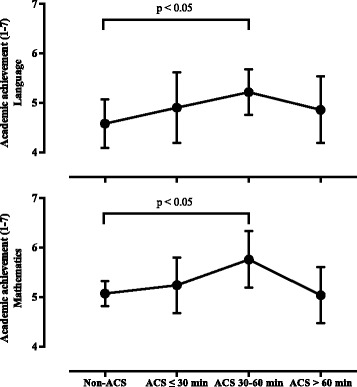
BACKGROUND: Habitual active commuting to school may be positively associated with academic achievement. The aim of this study was to examine the relationship between duration of walking or otherwise actively commuting to school and academic achievement. METHODS: This cross-sectional study included 389 adolescents from seven rural schools (12-13 years). Mode and duration of active commuting to school (use of active means such as walking or biking to and from school) and screen time were self-reported. Academic achievement was determined by the outcome in basic grades (language and mathematics). RESULTS: Active commuting to school was not associated with higher scores in any grades after adjustment for potential confounders. No evidence was found of interactions between gender and academic achievement, but there was interaction with duration of walking (<30 min, 30-60 min, and >60 min). Adjusted binary logistic regression analysis suggested that adolescents who spent between 30 and 60 min actively commuting were more likely to obtain high academic achievement (language and mathematics). CONCLUSIONS: Thirty to 60 min of ACS may have a positive influence on academic achievement in adolescents, so, it is necessary to make recommendations for the children to walk from and/or to school. This could help society to recognize the relevance of physical activity to health as well as to academic performance.
Overview
The claims and statistics of this paper haven’t been checked yet.
Free: it reads the open-access text and checks the first 5 claims that cite a source we can check. Create a free account to check every claim.
Integrity signals
Registry
Cites
Statistics
Figures
Verification
Claims the paper makes
The claims and statistics of this paper haven’t been checked yet.
Free: it reads the open-access text and checks the first 5 claims that cite a source we can check. Create a free account to check every claim.
Claims other papers make about this one
Each is checked against this paper’s own text: does it say what the citing paper says it does?
The source backs part of the claim, not all of it — or backs it for a different population, condition or comparison.
In the citing paper
“Overall, researchers included information regarding the mode of commuting to and from school [25,40,41,42,43,44,45,47,48,49,50], duration of ACS [25,40,42,44,45,46,48,49,50], number of active trips on a weekly basis [42] and distance between home to school [45].”
From Active Commuting to and from School, Cognitive Performance, and Academic Achievement in Children and Adolescents: A Systematic Review and Meta-Analysis of Observational Studies (2019) · cites this paper as [25]
Experimental — accuracy not yet measuredThe source backs part of the claim, not all of it — or backs it for a different population, condition or comparison.
In the citing paper
“and language-related skills [25,40,41,42,45,50] (ES: −0.37; 95% CI: −0.88 to 0.15).”
From Active Commuting to and from School, Cognitive Performance, and Academic Achievement in Children and Adolescents: A Systematic Review and Meta-Analysis of Observational Studies (2019) · cites this paper as [25]
Experimental — accuracy not yet measuredThe source backs part of the claim, not all of it — or backs it for a different population, condition or comparison.
In the citing paper
“In this review, seven studies [25,40,42,46,47,48,50] included adiposity as a covariate, while fitness was only included in two studies [40,48].”
From Active Commuting to and from School, Cognitive Performance, and Academic Achievement in Children and Adolescents: A Systematic Review and Meta-Analysis of Observational Studies (2019) · cites this paper as [25]
Experimental — accuracy not yet measuredThe cited source says what the claim attributes to it.
In the citing paper
“Finally, a total of 12 studies met the inclusion criteria [25,40,41,42,43,44,45,46,47,48,49,50] (Figure 1).”
The cited source says what the claim attributes to it.
In the citing paper
“Finally, the mode of ACS varied across studies: three studies [25,40,42] included only information regarding walkers; eight studies [41,44,45,46,47,48,49,50] combined walkers with cyclists and skaters in the analyses; and only one study [43] analyzed cyclists and walkers separately.”
8 more claims about this paper
Create a free account to see every claim other papers make about this one.
Self-check
Percentages, sums and reported differences re-computed from the paper’s own numbers.
The self-check needs the paper’s full text.
Citations
Cites
Genetics of Food Intake Self-Regulation in Childhood: Literature Review and Research Opportunities
Faith, M. S., Carnell, S., & Kral, T. V. E. (2013) · Human Heredity · doi:10.1159/000353879 · Cited by 7,601
CDC GROWTH CHARTS FOR THE UNITED STATES: METHODS AND DEVELOPMENT 2000
Kuczmarski, R. J., Ogden, C. L., Guo, S. S., Strawn, L. G., Flegal, K. M., & Mei, Z. (2002) · Cited by 6,426
CDC growth charts: United States.
Kuczmarski, R. J., Ogden, C. L., Grummer‐Strawn, L. M., Flegal, K. M., Guo, S. S., Wei, R. X., Mei, Z., Curtin, L. R., Roche, A. F., & Johnson, C. L. (2000) · PubMed · Cited by 6,045
Barlow, S. E., & and the Expert Committee (2007) · Pediatrics · doi:10.1542/peds.2007-2329c · Cited by 4,497 · cited 1×
“Finally, screen time was dichotomized as recommended (<2 h/d) and excessive (≥2 h/d), based on the American Academy of Pediatrics’ international guidance on limiting paediatric screen time [17].”
BackgroundObesity in children and young people: a crisis in public health
Lobstein, T., Baur, L., & Uauy, R. (2004) · Obesity Reviews · doi:10.1111/j.1467-789x.2004.00133.x · Cited by 3,801 · cited 1×
“Cultural shifts and changes in home and neighbourhood environments discourage physical activity (PA) in young people [1].”
BackgroundDavis-Kean, P. E. (2005) · Journal of Family Psychology · doi:10.1037/0893-3200.19.2.294 · Cited by 2,466 · cited 1×
“The majority of the literature on parents’ education pertains to the direct and positive influence on achievement for children and youths [20].”
BackgroundDonnelly, J. E., Hillman, C. H., Castelli, D., Etnier, J. L., Lee, S., Tomporowski, P., Lambourne, K., & Szabo-Reed, A. N. (2016) · Medicine & Science in Sports & Exercise · doi:10.1249/mss.0000000000000901 · Cited by 1,864 · cited 1×
“Possibly, if this time was of “brisk” walking (nearer of “physical fitness” concept) could be have positive effects [32].”
BackgroundEffect of physical education and activity levels on academic achievement in children
COE, D. P., PIVARNIK, J. M., WOMACK, C. J., REEVES, M. J., & MALINA, R. M. (2006) · Medicine & Science in Sports & Exercise · doi:10.1249/01.mss.0000227537.13175.1b · Cited by 611 · cited 2×
“Finally, the intensity of the ACS was not evaluated and higher intensity level of ACS could be associated with higher grades [33].”
BackgroundUpdate – Ethical Standards in Sport and Exercise Science Research
Harriss, D., & Atkinson, G. (2011) · International Journal of Sports Medicine · doi:10.1055/s-0031-1287829 · Cited by 507 · cited 1×
“The study was conducted according to ethical standards in sport and exercise science research [12].”
BackgroundVoelcker-Rehage, C., & Niemann, C. (2013) · Neuroscience & Biobehavioral Reviews · doi:10.1016/j.neubiorev.2013.01.028 · Cited by 433 · cited 1×
“The ACS represented 23% of the total time spent moving per week, and in addition to the health benefits of PA, neuroscience evidence also suggests that PA may exert a positive effect on children’s cognitive functioning [functional brain changes], brain physiology (changes in regional brain volume are associated with i…”
BackgroundPhysical Activity Levels of Children Who Walk, Cycle, or Are Driven to School
Cooper, A. R., Andersen, L. B., Wedderkopp, N., Page, A. S., & Froberg, K. (2005) · American Journal of Preventive Medicine · doi:10.1016/j.amepre.2005.05.009 · Cited by 400 · cited 1×
“Active commuting to school (ACS), defined as the use of active means such as walking or biking to and from school, is an inexpensive form of PA that can be integrated into adolescents’ routines [2].”
BackgroundJoens‐Matre, R. R., Welk, G. J., Calabro, M. A., Russell, D. W., Nicklay, E., & Hensley, L. D. (2008) · The Journal of Rural Health · doi:10.1111/j.1748-0361.2008.00136.x · Cited by 285 · cited 1×
“Youth from rural areas and small cities were more active than urban children, although the differences were small to moderate [10].”
BackgroundFiabilidad y validez del cuestionario de actividad física PAQ-A en adolescentes españoles
Martínez-Gómez, D., Martínez-de-Haro, V., Pozo, T., Welk, G. J., Villagra, A., Calle, M. E., Marcos, A., & Veiga, O. L. (2009) · Revista Española de Salud Pública · doi:10.1590/s1135-57272009000300008 · Cited by 272 · cited 2×
“Martínez-Gómez D, Martínez-de-Haro V, Pozo T, et al. Fiabilidad y validez del cuestionario de actividad física PAQ-A en adolescentes españoles.”
MethodIs Active Commuting the Answer to Population Health?
Shephard, R. J. (2008) · Sports Medicine · doi:10.2165/00007256-200838090-00004 · Cited by 267 · cited 1×
“It has been argued that if sufficient intensity is achieved, ACS could lead to an increase in cardiovascular fitness [3] and is associated with a healthier body composition and metabolic profile [4].”
BackgroundBooth, J. N., Leary, S. D., Joinson, C., Ness, A. R., Tomporowski, P. D., Boyle, J. M., & Reilly, J. J. (2014) · British Journal of Sports Medicine · doi:10.1136/bjsports-2013-092334 · Cited by 177
Syväoja, H. J., Tammelin, T. H., Ahonen, T., Kankaanpää, A., & Kantomaa, M. T. (2014) · PLoS ONE · doi:10.1371/journal.pone.0103559 · Cited by 149 · cited 1×
“Given that studies suggest that PA has positive effects on academic achievement [7] and cognitive performance in adolescents [8], habitual ACS may be positively associated with these as previously the evidence have suggested [9].”
ResultIncreased risk of learning disabilities in low birth weight boys at age 11 years
Johnson, E. O., & Breslau, N. (2000) · Biological Psychiatry · doi:10.1016/s0006-3223(99)00223-1 · Cited by 139
Active Commuting to School and Cognitive Performance in Adolescents: The AVENA Study
Martínez-Gómez, D. (2011) · Archives of Pediatrics & Adolescent Medicine · doi:10.1001/archpediatrics.2010.244 · Cited by 131 · cited 5×
“However, this study [9] evaluated cognitive performance with SRA Test of Educational Ability which measured in the general way verbal (command of language), numeric (speed and precision in performing operations with numbers and quantitative concepts), and reasoning (the ability to find logical ordination criteria in s…”
BackgroundMethodResultInfluentialContribution of the School Journey to Daily Physical Activity in Children Aged 11–12 Years
Southward, E. F., Page, A. S., Wheeler, B. W., & Cooper, A. R. (2012) · American Journal of Preventive Medicine · doi:10.1016/j.amepre.2012.04.015 · Cited by 125 · cited 1×
“org/publicdomain/ze who actively commute to and from school can accumulate an additional 20 min of moderate to vigorous PA across the whole day, compared to adolescents who use passive transport [5].”
BackgroundLawlor, D. A., Najman, J. M., Batty, G. D., O'Callaghan, M. J., Williams, G. M., & Bor, W. (2006) · Paediatric and Perinatal Epidemiology · doi:10.1111/j.1365-3016.2006.00704.x · Cited by 124 · cited 1×
“There is evidence indicating that socioeconomic status (SES) is one of the most important determinants of childhood school achievement [21].”
BackgroundObesity-associated biomarkers and executive function in children
Miller, A. L., Lee, H. J., & Lumeng, J. C. (2015) · Pediatric Research · doi:10.1038/pr.2014.158 · Cited by 122 · cited 1×
“In this sense, obesity is associated with poor executive functioning, which is critical for academic achievement [27].”
BackgroundLi, S., Arguelles, L., Jiang, F., Chen, W., Jin, X., Yan, C., Tian, Y., Hong, X., Qian, C., Zhang, J., et al. (2013) · PLoS ONE · doi:10.1371/journal.pone.0067928 · Cited by 118 · cited 1×
“This oblige to children wake-up too much early and, probably to have an insufficient sleep that has influence in academic achievement [31].”
Background[Scale for measurement of socioeconomic level, in the health area].
Alvarez, M. D. L. L., MUZZO, S., & Ivanovic, D. M. (1985) · PubMed · Cited by 115
Is walking to school associated with improved metabolic health?
Pizarro, A. I. N., Ribeiro, J. C., Marques, E. A., Mota, J. A. P. S., & Santos, M. P. (2013) · International Journal of Behavioral Nutrition and Physical Activity · doi:10.1186/1479-5868-10-12 · Cited by 105 · cited 1×
“It has been argued that if sufficient intensity is achieved, ACS could lead to an increase in cardiovascular fitness [3] and is associated with a healthier body composition and metabolic profile [4].”
BackgroundSchool journeys and leisure activities in rural and urban adolescents in Norway
Sjølie, A. N. (2002) · Health Promotion International · doi:10.1093/heapro/17.1.21 · Cited by 101 · cited 1×
“Regarding ACS, evidence suggests that youth who live in rural areas are less likely to actively commute to school than those living in urban areas [11], which may be related to fewer pedestrian infrastructures, longer commuting routes, and poorer access to public transport.”
BackgroundFedewa, A. L., Ahn, S., Erwin, H., & Davis, M. C. (2015) · School Psychology International · doi:10.1177/0143034314565424 · Cited by 76 · cited 1×
“A recent review suggests that PA is positively related to academic achievement [18].”
BackgroundDuncan, S., White, K., Mavoa, S., Stewart, T. I., Hinckson, E. A., & Schofield, G. (2015) · Journal of Physical Activity and Health · doi:10.1123/jpah.2015-0054 · Cited by 68 · cited 1×
“A long distance to school implies a decreased likelihood of adopting active transport practices [29] and a distance of approximately two kilometres is associated with the best PA outcomes related to active transport [30].”
BackgroundSleep-wake patterns and their influence on school performance in Portuguese adolescents
Duarte, J., Nelas, P. A. D. A. B., Chaves, C., Ferreira, M., Coutinho, E., & Cunha, M. (2014) · Atención Primaria · doi:10.1016/s0212-6567(14)70085-x · Cited by 66
Van Dijk, M. L., De Groot, R. H., Van Acker, F., Savelberg, H. H., & Kirschner, P. A. (2014) · BMC Public Health · doi:10.1186/1471-2458-14-799 · Cited by 64 · cited 2×
“However, intensity associated with this routine is usually light or moderate, and it was suggested that this type of intensity plays a role in cognitive performance [9, 28].”
BackgroundResultValidity and Reliability of a School Travel Survey
Evenson, K. R., Neelon, B., Ball, S. C., Vaughn, A., & Ward, D. S. (2008) · Journal of Physical Activity and Health · doi:10.1123/jpah.5.s1.s1 · Cited by 59 · cited 1×
“Previous studies have demonstrated evidence of the reliability and validity for similar questions [13].”
BackgroundGarcía-Hermoso, A., & Marina, R. (2017) · Obesity Research & Clinical Practice · doi:10.1016/j.orcp.2015.07.006 · Cited by 57 · cited 3×
“This parameter is inversely related to academic achievement [14].”
BackgroundInfluentialSelf-citationZornoza, M. G., Sánchez‐López, M., García‐Hermoso, A., González‐García, A., Chillón, P., & Martínez‐Vizcaíno, V. (2014) · Health Education & Behavior · doi:10.1177/1090198114549373 · Cited by 48 · cited 1×
“A long distance to school implies a decreased likelihood of adopting active transport practices [29] and a distance of approximately two kilometres is associated with the best PA outcomes related to active transport [30].”
BackgroundSelf-citationChildhood Markers of Health Behavior Relate to Hippocampal Health, Memory, and Academic Performance
Hassevoort, K. M., Khan, N. A., Hillman, C. H., & Cohen, N. J. (2016) · Mind Brain and Education · doi:10.1111/mbe.12108 · Cited by 48
Esteban‐Cornejo, I., Tejero‐González, C. M., Castro‐Piñero, J., Conde‐Caveda, J., Cabanas‐Sanchez, V., Sallis, J. F., Veiga, Ó. L., & UP & DOWN Study Group (2015) · Pediatric Obesity · doi:10.1111/ijpo.239 · Cited by 25 · cited 1×
“Birth weight is associated with cognitive impairments persisting into childhood [23].”
Background
Research works printed but not linked: 3
- Currie C Social determinants of health and well-being among young people: world health organization regional office for Europe Copenhagen 2012
- Álvarez ML Muzzo S Ivanovic D Escala para medición del nivel socioeconómico, en el área de la salud Rev Med Chile 1985 113 3 243 9 3915140
- Ministry of Health Global school-based survey. Department of Epidemiology 2007 Santiago de Chile Ministry of Health
Cited by
Ruiz-Hermosa, A., Álvarez-Bueno, C., Cavero-Redondo, I., Martínez-Vizcaíno, V., Redondo-Tébar, A., & Sánchez-López, M. (2019) · International Journal of Environmental Research and Public Health · doi:10.3390/ijerph16101839 · Cited by 54
“The studies were published between 2011 and 2018; they were conducted in seven European countries [40–50] and one in Chile [25].”
BackgroundResultInfluentialGonzález, S. A., Aubert, S., Barnes, J. D., Larouche, R., & Tremblay, M. S. (2020) · International Journal of Environmental Research and Public Health · doi:10.3390/ijerph17165997 · Cited by 61
“Not reported Not specified To and from school Not clear National Survey of Quality of life 2015–2016 (ENCAVI) [99], Survey of Urban Quality of Life Perception 2015 (EPCVU) [100], a cross-sectional study of seventh grade students in the Maule region 2014 [101], and a cross-sectional study in Valparaiso 2017 [102] 1”
BackgroundAguilar-Farías, N., Miranda-Marquez, S., Martino-Fuentealba, P., Sadarangani, K. P., Chandía-Poblete, D., Mella-Garcia, C., Cárcamo-Oyarzún, J., Cristi‐Montero, C., Rodríguez‐Rodríguez, F., Delgado‐Floody, P., et al. (2020) · Journal of Physical Activity and Health · doi:10.1123/jpah.2020-0120 · Cited by 48
“…and adolescents who reported using active transportation (walking or cycling) during the journey to/from school ranged between 8.9% and 32.2% 20,32,33 ; (2) a survey conducted in n = 323 participants found that only 18.1% of adolescents use active transportation daily 20 ; (3) of those…”
BackgroundInfluentialSelf-citationLam, H. Y., Jayasinghe, S. U., Ahuja, K., & Hills, A. P. (2023) · International Journal of Environmental Research and Public Health · doi:10.3390/ijerph20206929 · Cited by 51
Results from Chile’s 2018 Report Card on Physical Activity for Children and Youth
Aguilar-Farías, N., Miranda-Marquez, S., Sadarangani, K. P., Martino-Fuentealba, P., Cristi‐Montero, C., Cárcamo-Oyarzún, J., Delgado‐Floody, P., Chandía-Poblete, D., Mella-Garcia, C., Rodríguez‐Rodríguez, F., et al. (2018) · Journal of Physical Activity and Health · doi:10.1123/jpah.2018-0553 · Cited by 45
Self-citation
Metadata
- Authors
- García-Hermoso, A., Saavedra, J. M., Olloquequi, J., & Ramírez-Vélez, R.
- Affiliations
- Universidad Autónoma de Chile (CL)
- ORCID
- Olloquequi, Jordi
- Venue
- Environmental Health and Preventive Medicine
- Published
- 2017-04-04
- Volume
- 22
- Issue
- 1
- Pages
- 31-31
- ISSN
- 1342-078X (ISSN-L)
- 1347-4715
- PMC
- PMC5664915
- OpenAlex
- W2604169701
- Cited by
- 35
- References
- 34
- Citations by year
- 2026: 5 · 2025: 1 · 2024: 3 · 2023: 5 · 2022: 1 · 2021: 4 · 2020: 6 · 2019: 8 · 2018: 2
- FWCI
- 6.56
- Type
- journal article
- Language
- en
- Open access
- gold
- doi.org
- Locations
- Environmental Health and Preventive Medicine (publishedVersion, cc-by)
- PubMed Central (publishedVersion, cc-by)
- PubMed (publishedVersion)
- Academica-e (Universidad Pública de Navarra) (submittedVersion, cc-by)
- Opin vísindi (Opin vísindi) (submittedVersion, cc-by)
- LA Referencia (Red Federada de Repositorios Institucionales de Publicaciones Científicas) (submittedVersion, public-domain)
- DOAJ (DOAJ: Directory of Open Access Journals) (submittedVersion, cc-by-sa)
- Greater South Information System
- Topics
- Social Sciences › Transportation › Urban Transport and Accessibility
- Health Sciences › Medicine › Public Health, Environmental and Occupational Health › Physical Activity and Health
- Health Sciences › Medicine › Public Health, Environmental and Occupational Health › School Health and Nursing Education
- Keywords
- active commuting to school, walking to school, academic performance, adolescents, rural schools, screen time, physical activity
- MeSH terms
- Academic Success, Adolescent, Adolescent Behavior, Bicycling, Child, Child Behavior, Chile, Cross-Sectional Studies, Female, Humans, Male, Schools, Students, Transportation, Walking, Self Report
About these checks
Registry, retraction, Cites and statistics results are computed, not judged, with one exception: a printed reference that no index lists is read once by a model before it counts as a citation error. Claims are extracted by a model and kept only when their quote appears verbatim in the text; each cited source is then checked, with a model’s help, for whether it says what the claim relies on. Those verdicts can be wrong — read the claim’s quote and the cited source before relying on one.
Statistics and arithmetic are recomputed, not judged.
Confidence bands are shown only for fields calibrated on our annotated test set. None is calibrated yet, so no band is shown.
What counts as a claim ›How we measure confidence ›How we check this ›
Are you an author, or do you see a problem with this page? Request a review
Data sources
Bibliographic data: Semantic Scholar, OpenAlex, Crossref.
Contains information from the Semantic Scholar Academic Graph Datasets, made available under the ODC Attribution License (ODC-BY 1.0).
Semantic Scholar’s data is described in: Kinney, R., et al. (2023). The Semantic Scholar Open Data Platform. arXiv:2301.10140.
