

Cross-sectional survey of depressive symptoms and suicide-related ideation at a Japanese national university during the COVID-19 stay-home order
Open accessThe DOI matches its Crossref record; 40 of the 40 references it cites were found in a registry or an index.
Abstract
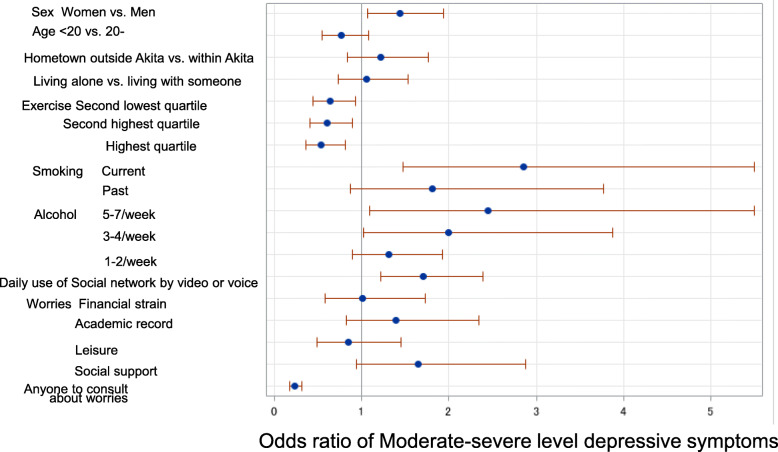
Background: We aimed to estimate the prevalence of depressive symptoms as well as suicide-related ideation among Japanese university students during the stay-home order necessitated by the coronavirus disease 2019 pandemic in Japan, and offer evidence in support of future intervention to depression and suicide prevention strategies among college and university students. Methods: The data for this cross-sectional study were derived from the Student Mental Health Survey conducted from May 20 to June 16, 2020 at a national university in Akita prefecture. Among the 5111 students recruited, 2712 participated in this study (response rate, 53%; mean age ± standard deviation, 20.5 ±3.5 years; men, 53.8%). Depressive symptoms were identified by using the Patient Health Questionnaire-9 (PHQ-9). Results: The prevalence of moderate depressive symptoms based on a PHQ-9 score ≥10 and suicide-related ideation based on question 9 of PHQ-9 ≥1, which encompasses thoughts of both suicide and self-harm, was 11.7% and 6.7%, respectively. Multivariable logistic regression analyses showed that risk factors for depression included being a woman, smoking, alcohol consumption, and social network communication using either video or voice. For suicide-related ideation, alcohol consumption was the only risk factor. Exercise and having someone to consult about worries were associated with decreased risk of both depressive symptoms and suicide-related ideation. Conclusions: Negative lifestyles of smoking and drinking, and being a woman, may be important risk factors for depressive symptoms, whereas exercise and having someone to consult about worries may be protective factors.
Overview
The claims and statistics of this paper haven’t been checked yet.
Free: it reads the open-access text and checks the first 5 claims that cite a source we can check. Create a free account to check every claim.
Integrity signals
Registry
Cites
Statistics
Figures
Verification
Claims the paper makes
The claims and statistics of this paper haven’t been checked yet.
Free: it reads the open-access text and checks the first 5 claims that cite a source we can check. Create a free account to check every claim.
Claims other papers make about this one
Each is checked against this paper’s own text: does it say what the citing paper says it does?
The cited source doesn’t support the claim as written.
In the citing paper
“except for three studies lacking detailed information on data sources and measurement (55, 58, 66)”
From Digital Media Use and Adolescents' Mental Health During the Covid-19 Pandemic: A Systematic Review and Meta-Analysis (2022) · cites this paper as [58]
Checked by a reasoning model — may be wrong.
Experimental — accuracy not yet measured
Self-check
Percentages, sums and reported differences re-computed from the paper’s own numbers.
The self-check needs the paper’s full text.
Citations
Cites
The PHQ-9: Validity of a brief depression severity measure
Kroenke, K., Spitzer, R. L., & Williams, J. B. W. (2001) · Journal of General Internal Medicine · doi:10.1046/j.1525-1497.2001.016009606.x · Cited by 44,910
Salk, R. H., Hyde, J. S., & Abramson, L. Y. (2017) · Psychological Bulletin · doi:10.1037/bul0000102 · Cited by 2,622 · cited 1×
“A meta-analysis of studies based on nationally representative samples in the USA suggested that generally, females have a high risk of depression; however, the higher depression prevalence in females than in males was observed only in early adolescence and gradually disappeared in adulthood [21].”
MethodManea, L., Gilbody, S., & McMillan, D. (2012) · Canadian Medical Association Journal · doi:10.1503/cmaj.110829 · Cited by 1,966 · cited 1×
“The established PHQ-9 cutoff score of 10 (PHQ-9 ≥10), which has previously demonstrated high sensitivity and specificity in detecting major depression was used [11, 12].”
MethodCooney, G. M., Dwan, K., Greig, C. A., Lawlor, D. A., Rimer, J., Waugh, F. R., McMurdo, M., & Mead, G. E. (2013) · Cochrane Database of Systematic Reviews · doi:10.1002/14651858.cd004366.pub6 · Cited by 1,834
The association of cigarette smoking with depression and anxiety: a systematic review
Fluharty, M., Taylor, A. E., Grabski, M., & Munafò, M. R. (2017) · Nicotine & Tobacco Research · doi:10.1093/ntr/ntw140 · Cited by 1,299 · cited 1×
“In a metaanalysis [26], nearly half of the 148 studies reported that baseline depression was associated with later smoking behavior, while over a third found evidence that exposure to smoking was associated with later depression.”
BackgroundAdolescent Onset of the Gender Difference in Lifetime Rates of Major Depression: A Theoretical Model
Cyranowski, J. M., Frank, E., Young, E., & Shear, M. K. (2000) · Archives of General Psychiatry · doi:10.1001/archpsyc.57.1.21 · Cited by 1,276 · cited 1×
“While the mechanisms of higher depression prevalence in females remain unclear, the interplay of gender socialization, social and hormonal mechanisms, and stressful events associated with adolescence may play a role [24].”
BackgroundOdriozola-González, P., Planchuelo-Gómez, Á., Irurtia, M. J., & de Luis-García, R. (2020) · Psychiatry Research · doi:10.1016/j.psychres.2020.113108 · Cited by 1,181
Pieh, C., Budimir, S., & Probst, T. (2020) · Journal of Psychosomatic Research · doi:10.1016/j.jpsychores.2020.110186 · Cited by 1,122
Silverman, M. M., Berman, A. L., Sanddal, N. D., O'Carroll, P. W., & Joiner, T. E. (2007) · Suicide and Life-Threatening Behavior · doi:10.1521/suli.2007.37.3.264 · Cited by 991
Cooney, G. M., Dwan, K., Greig, C. A., Lawlor, D. A., Rimer, J., Waugh, F. R., McMurdo, M., & Mead, G. E. (2014) · Advances in Psychiatric Treatment · doi:10.1192/apt.20.1.2 · Cited by 895
Tang, W., Hu, T., Hu, B., Jin, C., Wang, G., Xie, C., Chen, S., & Xu, J. (2020) · Journal of Affective Disorders · doi:10.1016/j.jad.2020.05.009 · Cited by 787
Groarke, J. M., Berry, E., Graham-Wisener, L., McKenna-Plumley, P. E., McGlinchey, E., & Armour, C. (2020) · PLOS ONE · doi:10.1371/journal.pone.0239698 · Cited by 727
Impact of COVID-19 lockdown on sleep quality in university students and administration staff
Marelli, S., Castelnuovo, A., Somma, A., Castronovo, V., Mombelli, S., Bottoni, D., Leitner, C., Fossati, A., & Ferini-Strambi, L. (2021) · Journal of Neurology · doi:10.1007/s00415-020-10056-6 · Cited by 685
The association between internet addiction and psychiatric co-morbidity: a meta-analysis
Ho, R. C., Zhang, M. W., Tsang, T. Y., Toh, A. H., Pan, F., Lu, Y., Cheng, C., Yip, P. S., Lam, L. T., Lai, C.-M., et al. (2014) · BMC Psychiatry · doi:10.1186/1471-244x-14-183 · Cited by 603
Self-harm, suicidal behaviours, and cyberbullying in children and young people: systematic review
John, A., Glendenning, A. C., Marchant, A., Montgomery, P., Stewart, A., Wood, S., Lloyd, K., & Hawton, K. (2018) · Journal of Medical Internet Research · doi:10.2196/jmir.9044 · Cited by 580 · cited 1×
“Connecting with strangers on social networking platforms may be problematic because it does not involve the responsibility required in relationships, potentially leading to irresponsible and hurtful behavior [32].”
BackgroundMuramatsu, K., Kamijima, K., Yoshida, M., Otsubo, T., Miyaoka, H., Muramatsu, Y., & Gejyo, F. (2007) · Psychological Reports · doi:10.2466/pr0.101.3.952-960 · Cited by 433
Help-Seeking Behaviour and Adolescent Self-Harm: A Systematic Review
Rowe, S. L., French, R. S., Henderson, C., Ougrin, D., Slade, M., & Moran, P. (2014) · Australian & New Zealand Journal of Psychiatry · doi:10.1177/0004867414555718 · Cited by 299
Biswas, T., Scott, J. G., Munir, K., Renzaho, A. M. N., Rawal, L. B., Baxter, J., & Mamun, A. A. (2020) · eClinicalMedicine · doi:10.1016/j.eclinm.2020.100395 · Cited by 290
van den Eijnden, R., Koning, I., Doornwaard, S., van Gurp, F., & ter Bogt, T. (2018) · Journal of Behavioral Addictions · doi:10.1556/2006.7.2018.65 · Cited by 281 · cited 1×
“In young users, this can be detrimental to academic achievement [33].”
BackgroundPsychological Distress during the COVID-19 Lockdown: The Young Adults Most at Risk
Glowacz, F., & Schmits, E. (2020) · Psychiatry Research · doi:10.1016/j.psychres.2020.113486 · Cited by 280 · cited 1×
“A study in Belgium [7] reported that during the lockdown, young adults experienced a greater level of depression than their older counterparts, which may be explained by an intolerance of uncertainty.”
BackgroundMuramatsu, K. (2007) · Psychological Reports · doi:10.2466/pr0.101.7.952-960 · Cited by 277
Huang, J., Nigatu, Y. T., Smail-Crevier, R., Zhang, X., & Wang, J. (2018) · Journal of Psychiatric Research · doi:10.1016/j.jpsychires.2018.09.018 · Cited by 256
Henssler, J., Stock, F., van Bohemen, J., Walter, H., Heinz, A., & Brandt, L. (2021) · European Archives of Psychiatry and Clinical Neuroscience · doi:10.1007/s00406-020-01196-x · Cited by 230
Mental Health During the Covid-19 Outbreak in China: a Meta-Analysis
Ren, X., Huang, W., Pan, H., Huang, T., Wang, X., & Ma, Y. (2020) · Psychiatric Quarterly · doi:10.1007/s11126-020-09796-5 · Cited by 190
Van Der Feltz-Cornelis, C. M., Varley, D., Allgar, V. L., & de Beurs, E. (2020) · Frontiers in Psychiatry · doi:10.3389/fpsyt.2020.588803 · Cited by 165
Rogowska, A. M., Pavlova, I., Kuśnierz, C., Ochnik, D., Bodnar, I., & Petrytsa, P. (2020) · Journal of Clinical Medicine · doi:10.3390/jcm9113494 · Cited by 154
Cheng, Y.-S., Tseng, P.-T., Lin, P.-Y., Chen, T.-Y., Stubbs, B., Carvalho, A. F., Wu, C.-K., Chen, Y.-W., & Wu, M.-K. (2018) · The Journal of Clinical Psychiatry · doi:10.4088/jcp.17r11761 · Cited by 130
Yong, R., & Nomura, K. (2019) · Frontiers in Psychiatry · doi:10.3389/fpsyt.2019.00247 · Cited by 116 · cited 1×
“Consequently, these people may reduce their community participation, eventually becoming socially withdrawn, who are accompanied with psychomorbidity [34].”
BackgroundSelf-citationZhang, Y.-Y., Lei, Y.-T., Song, Y., Lu, R.-R., Duan, J.-L., & Prochaska, J. J. (2019) · Journal of Global Health · doi:10.7189/jogh.09.010604 · Cited by 114
Bakhshaie, J., Zvolensky, M. J., & Goodwin, R. D. (2015) · Comprehensive Psychiatry · doi:10.1016/j.comppsych.2014.10.012 · Cited by 92
Du, N., Yu, K., Ye, Y., & Chen, S. (2017) · Asia-Pacific Psychiatry · doi:10.1111/appy.12266 · Cited by 83
Polanco-Roman, L. A., Anglin, D. M., Miranda, R., & Jeglic, E. L. (2019) · Journal of Youth and Adolescence · doi:10.1007/s10964-019-01097-w · Cited by 75
Tidey, J. W., Pacek, L. R., Koopmeiners, J. S., Vandrey, R. G., Nardone, N., Drobes, D. J., Benowitz, N. L., Dermody, S. S., Lemieux, A. M., Denlinger, R. L., et al. (2016) · Nicotine & Tobacco Research · doi:10.1093/ntr/ntw199 · Cited by 61
Gavurova, B., Ivankova, V., & Rigelsky, M. (2020) · International Journal of Environmental Research and Public Health · doi:10.3390/ijerph17238853 · Cited by 53
Tang, F., & Qin, P. (2015) · PLOS ONE · doi:10.1371/journal.pone.0121023 · Cited by 50
Chow, W. S., Schmidtke, J., Loerbroks, A., Muth, T., & Angerer, P. (2018) · International Journal of Environmental Research and Public Health · doi:10.3390/ijerph15071462 · Cited by 50
Mitsui, N., Asakura, S., Takanobu, K., Watanabe, S., Toyoshima, K., Kako, Y., Ito, Y. M., & Kusumi, I. (2018) · PLoS ONE · doi:10.1371/journal.pone.0201047 · Cited by 37
Goodwin, R. D., Kim, J. H., Weinberger, A. H., Taha, F., Galea, S., & Martins, S. S. (2013) · Drug and Alcohol Dependence · doi:10.1016/j.drugalcdep.2013.08.026 · Cited by 20
Zur Kritik der Valleix'schen Schmerzenspunkte in Neuralgieen
Romberg, M. (1868) · European Archives of Psychiatry and Clinical Neuroscience · doi:10.1007/bf01983069 · Cited by 17
Neurons, Viruses, Infectious Diseases and Vaccinations: A Stake of Public Health
Goaster, J. L., & Haenni, A. (2016) · doi:10.35841/neurology-neurorehabilitation.1.1.1-2 · Cited by 14
Research works printed but not linked: 1
- Ministry of Health, Labour and Welhare, Japan Summary of Vital Statistics 2020
Cited by
Marciano, L., Ostroumova, M., Schulz, P. J., & Camerini, A.-L. (2022) · Frontiers in Public Health · doi:10.3389/fpubh.2021.793868 · Cited by 420
Li, L., Taeihagh, A., & Tan, S. Y. (2023) · Nature Communications · doi:10.1038/s41467-023-36267-9 · Cited by 166
Liu, X., Guo, Y.-X., Zhang, W., & Gao, W. (2022) · World Journal of Psychiatry · doi:10.5498/wjp.v12.i7.860 · Cited by 210
Post-secondary Student Mental Health During COVID-19: A Meta-Analysis
Zhu, J., Racine, N. M., Xie, E. B., Park, J., Watt, J., Eirich, R., Dobson, K. S., & Madigan, S. L. (2021) · Frontiers in Psychiatry · doi:10.3389/fpsyt.2021.777251 · Cited by 94
COVID-19 depression and its risk factors in Asia Pacific – A systematic review and meta-analysis
Balakrishnan, V., Ng, K. S., Kaur, W., Govaichelvan, K. N., & Lee, Z. L. (2021) · Journal of Affective Disorders · doi:10.1016/j.jad.2021.11.048 · Cited by 68
Metadata
- Authors
- Nomura, K., Minamizono, S., Maeda, E., Kim, R., Iwata, T., Hirayama, J., Ono, K., Fushimi, M., Goto, T., Mishima, K., & Yamamoto, F.
- Affiliations
- Akita University (JP)
- Corresponding author
- Nomura, Kyoko
- ORCID
- Venue
- Environmental Health and Preventive Medicine
- Published
- 2021-03-05
- Volume
- 26
- Issue
- 1
- Pages
- 30-30
- ISSN
- 1342-078X (ISSN-L)
- 1347-4715
- PMC
- PMC7934991
- OpenAlex
- W3104079131
- Cited by
- 90
- References
- 38
- Citations by year
- 2026: 6 · 2025: 10 · 2024: 21 · 2023: 15 · 2022: 24 · 2021: 14
- FWCI
- 12.61
- Type
- journal article
- Language
- en
- Open access
- gold
- doi.org
- Licence
- cc-by
- creativecommons.org/licenses/by/4.0/ (tdm)
- creativecommons.org/licenses/by/4.0/ (vor)
- Locations
- Environmental Health and Preventive Medicine (publishedVersion, cc-by)
- PubMed Central (publishedVersion, cc-by)
- PubMed (publishedVersion)
- Institutional Repositories DataBase (IRDB) (acceptedVersion)
- DOAJ (DOAJ: Directory of Open Access Journals) (submittedVersion, cc-by-sa)
- Topics
- Social Sciences › Psychology › Clinical Psychology › COVID-19 and Mental Health
- Social Sciences › Psychology › Clinical Psychology › Suicide and Self-Harm Studies
- Health Sciences › Medicine › Psychiatry and Mental health › Mental Health Treatment and Access
- Keywords
- depressive symptoms, university students, depression prevalence, risk factors, smoking, alcohol consumption, gender differences, physical activity, social support, self-harm, mental health
- MeSH terms
- COVID-19, Adolescent, Alcohol Drinking, Cross-Sectional Studies, Depression, Female, Humans, Japan, Male, Surveys and Questionnaires, Risk Factors, Smoking, Students, Multivariate Analysis, Logistic Models, Young Adult, Pandemics, Suicidal Ideation
About these checks
Registry, retraction, Cites and statistics results are computed, not judged, with one exception: a printed reference that no index lists is read once by a model before it counts as a citation error. Claims are extracted by a model and kept only when their quote appears verbatim in the text; each cited source is then checked, with a model’s help, for whether it says what the claim relies on. Those verdicts can be wrong — read the claim’s quote and the cited source before relying on one.
Statistics and arithmetic are recomputed, not judged.
Confidence bands are shown only for fields calibrated on our annotated test set. None is calibrated yet, so no band is shown.
What counts as a claim ›How we measure confidence ›How we check this ›
Are you an author, or do you see a problem with this page? Request a review
Data sources
Bibliographic data: Semantic Scholar, OpenAlex, Crossref.
Contains information from the Semantic Scholar Academic Graph Datasets, made available under the ODC Attribution License (ODC-BY 1.0).
Semantic Scholar’s data is described in: Kinney, R., et al. (2023). The Semantic Scholar Open Data Platform. arXiv:2301.10140.
