

The DOI matches its Crossref record; 71 of the 71 references it cites were found in a registry or an index.
A neural network multi-task learning approach to biomedical named entity recognition
Open accessAbstract
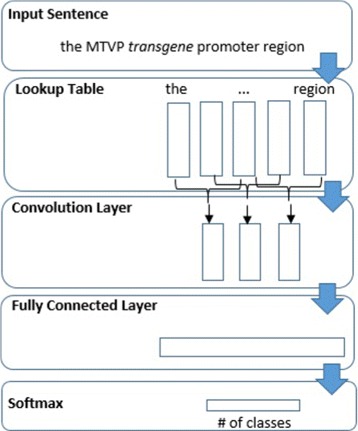
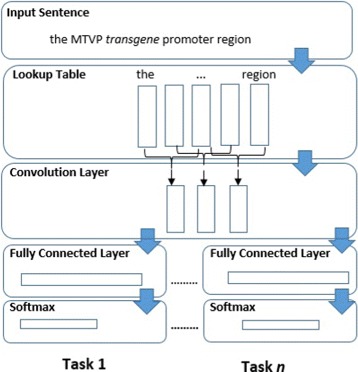
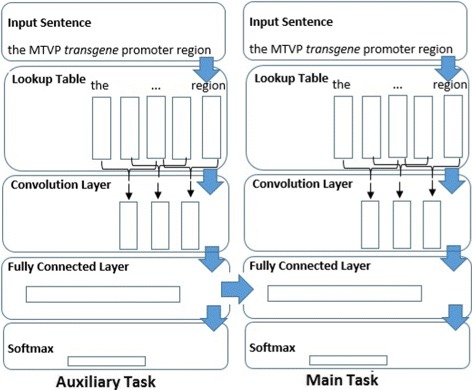
BACKGROUND: Named Entity Recognition (NER) is a key task in biomedical text mining. Accurate NER systems require task-specific, manually-annotated datasets, which are expensive to develop and thus limited in size. Since such datasets contain related but different information, an interesting question is whether it might be possible to use them together to improve NER performance. To investigate this, we develop supervised, multi-task, convolutional neural network models and apply them to a large number of varied existing biomedical named entity datasets. Additionally, we investigated the effect of dataset size on performance in both single- and multi-task settings. RESULTS: We present a single-task model for NER, a Multi-output multi-task model and a Dependent multi-task model. We apply the three models to 15 biomedical datasets containing multiple named entities including Anatomy, Chemical, Disease, Gene/Protein and Species. Each dataset represent a task. The results from the single-task model and the multi-task models are then compared for evidence of benefits from Multi-task Learning. With the Multi-output multi-task model we observed an average F-score improvement of 0.8% when compared to the single-task model from an average baseline of 78.4%. Although there was a significant drop in performance on one dataset, performance improves significantly for five datasets by up to 6.3%. For the Dependent multi-task model we observed an average improvement of 0.4% when compared to the single-task model. There were no significant drops in performance on any dataset, and performance improves significantly for six datasets by up to 1.1%. The dataset size experiments found that as dataset size decreased, the multi-output model's performance increased compared to the single-task model's. Using 50, 25 and 10% of the training data resulted in an average drop of approximately 3.4, 8 and 16.7% respectively for the single-task model but approximately 0.2, 3.0 and 9.8% for the multi-task model. CONCLUSIONS: Our results show that, on average, the multi-task models produced better NER results than the single-task models trained on a single NER dataset. We also found that Multi-task Learning is beneficial for small datasets. Across the various settings the improvements are significant, demonstrating the benefit of Multi-task Learning for this task.
Overview
The claims and statistics of this paper haven’t been checked yet.
Run the check — free, no account needed. It reads the open-access text and checks the sources it cites.
Integrity signals
Registry
Cites
Statistics
Figures
Verification
Claims the paper makes
The claims and statistics of this paper haven’t been checked yet.
Run the check — free, no account needed. It reads the open-access text and checks the sources it cites.
Claims other papers make about this one
Each is checked against this paper’s own text: does it say what the citing paper says it does?
In the citing paper
“Machine learning methods11–14, particularly deep learning, typically employ neural networks and the first generation of transformer-based large language models (e.g., BERT).”
From A critical assessment of using ChatGPT for extracting structured data from clinical notes (2024) · cites this paper as [11]
Self-check
Percentages, sums and reported differences re-computed from the paper’s own numbers.
The self-check needs the paper’s full text.
Citations
Cites
Very Deep Convolutional Networks for Large-Scale Image Recognition
Simonyan, K., & Zisserman, A. (2014) · arXiv · doi:10.48550/arxiv.1409.1556 · Cited by 114,148
Adam: A Method for Stochastic Optimization
Kingma, D. P., & Ba, J. (2014) · arXiv · doi:10.48550/arxiv.1412.6980 · Cited by 98,946
(2014) · Cited by 33,419
Efficient Estimation of Word Representations in Vector Space
Mikolov, T., Chen, K., Corrado, G., & Dean, J. (2013) · arXiv · doi:10.48550/arxiv.1301.3781 · Cited by 26,568
Advances in Neural Information Processing Systems 19
(2007) · The MIT Press eBooks · doi:10.52202/085713 · Cited by 16,043
(2010) · International Conference on Machine Learning · Cited by 13,995
Natural Language Processing (almost) from ScratchPreprint
Collobert, R., Weston, J., Bottou, L., Karlen, M., Kavukcuoglu, K., & Kuksa, P. P. (2011) · arXiv (Cornell University) · doi:10.48550/arxiv.1103.0398 · Cited by 6,923
Caruana, R. (1997) · Machine Learning · doi:10.1023/a:1007379606734 · Cited by 6,636
A unified architecture for natural language processing: deep neural networks with multitask learning
Collobert, R., & Weston, J. (2008) · Proceedings of the 25th international conference on Machine learning - ICML '08 · doi:10.1145/1390156.1390177 · Cited by 5,058
Learning deep structured semantic models for web search using clickthrough data
Huang, P.-S., He, X., Gao, J., Deng, L., Acero, A., & Heck, L. P. (2013) · ACM International Conference on Information and Knowledge Management (CIKM) · doi:10.1145/2505515.2505665 · Cited by 2,120
Argyriou, A., Evgeniou, T., & Pontil, M. (2007) · The MIT Press eBooks · doi:10.7551/mitpress/7503.003.0010 · Cited by 1,376
A Framework for Learning Predictive Structures from Multiple Tasks and Unlabeled Data
Ando, R. K., & Zhang, T. (2005) · doi:10.5555/1046920.1194905 · Cited by 1,319
Dependency-Based Word Embeddings
Levy, O., & Goldberg, Y. (2014) · Proceedings of the conference - Association for Computational Linguistics. Meeting · doi:10.3115/v1/p14-2050 · Cited by 1,125
Aggarwal, C. C., & Zhai, C. (2012) · Springer eBooks · doi:10.1007/978-1-4614-3223-4 · Cited by 1,031
Proceedings of the 49th Annual Meeting of the Association for Computational Linguistics
Gimpel, K., Schneider, N., O’Connor, B., Das, D., Mills, D. Q., Eisenstein, J., Heilman, M., Yogatama, D., Flanigan, J., & Smith, N. A. (2011) · The Association for Computational Linguistics · Cited by 890
NCBI disease corpus: A resource for disease name recognition and concept normalization
Islamaj, R., Leaman, R., & Lu, Z. (2014) · Journal of Biomedical Informatics · doi:10.1016/j.jbi.2013.12.006 · Cited by 857
Learning Multiple Tasks with Kernel Methods
Evgeniou, T., Micchelli, C. A., & Pontil, M. (2005) · doi:10.5555/1046920.1088693 · Cited by 807
Evaluation of time profile reconstruction from complex two-color microarray designs
Fierro, A. C., Thuret, R., Engelen, K., Bernot, G., Kathleen Marchal, D., & Pollet, N. (2008) · BMC Bioinformatics · doi:10.1186/1471-2105-9-1 · Cited by 713
Multi-task Sequence to Sequence LearningPreprint
Luong, M.-T., Le, Q. V., Sutskever, I., Vinyals, O., & Kaiser, Ł. (2015) · arXiv (Cornell University) · doi:10.48550/arxiv.1511.06114 · Cited by 606
Introduction to the bio-entity recognition task at JNLPBA
Kim, J.-D., Ohta, T., Tsuruoka, Y., Tateisi, Y., & Collier, N. (2004) · International Joint Workshop on Natural Language Processing in Biomedicine and its Applications (JNLPBA) · doi:10.3115/1567594.1567610 · Cited by 587
Overview of BioCreative II gene mention recognition
Smith, L. H., Tanabe, L. K., Ando, R. J. N., Kuo, C.-J., Chung, I., Hsu, C., Lin, Y.-S., Klinger, R., Friedrich, C. M., Ganchev, K., et al. (2008) · Genome biology · doi:10.1186/gb-2008-9-s2-s2 · Cited by 486
BANNER: AN EXECUTABLE SURVEY OF ADVANCES IN BIOMEDICAL NAMED ENTITY RECOGNITION
Leaman, R., & Gonzalez‐Hernandez, G. (2007) · Pacific Symposium on Biocomputing (PSB) · doi:10.1142/9789812776136_0062 · Cited by 482
Deep multi-task learning with low level tasks supervised at lower layers
Søgaard, A., & Goldberg, Y. (2016) · Proceedings of the 54th Annual Meeting of the Association for Computational Linguistics (Volume 2: Short Papers) · doi:10.18653/v1/p16-2038 · Cited by 445
The CHEMDNER corpus of chemicals and drugs and its annotation principles
Krallinger, M., Rabal, O., Leitner, F., Vázquez, M., Salgado, D., Lu, Z., Leaman, R., Lu, Y., Ji, D., Lowe, D. M., et al. (2015) · Journal of Cheminformatics · doi:10.1186/1758-2946-7-s1-s2 · Cited by 406
Corpus annotation for mining biomedical events from literature
Kim, J.-D., Ohta, T., & Tsujii, J. (2008) · BMC Bioinformatics · doi:10.1186/1471-2105-9-10 · Cited by 403
Liu, X., Gao, J., He, X., Deng, L., Duh, K., & Wang, Y.-Y. (2015) · Proceedings of the 2015 Conference of the North American Chapter of the Association for Computational Linguistics: Human Language Technologies · doi:10.3115/v1/n15-1092 · Cited by 395
How to Train good Word Embeddings for Biomedical NLP
Chiu, B., Crichton, G., Korhonen, A., & Pyysalo, S. (2016) · Workshop on Biomedical Language Processing (BioNLP) · doi:10.18653/v1/w16-2922 · Cited by 350
Self-citationLINNAEUS: A species name identification system for biomedical literature
Gerner, M., Nenadić, G., & Bergman, C. (2010) · BMC Bioinformatics · doi:10.1186/1471-2105-11-85 · Cited by 344
TaggerOne: joint named entity recognition and normalization with semi-Markov Models
Leaman, R., & Lu, Z.-Y. (2016) · Bioinform. · doi:10.1093/bioinformatics/btw343 · Cited by 297
tmChem: a high performance approach for chemical named entity recognition and normalization
Leaman, R., Wei, C.-H., & Lu, Z. (2015) · Journal of Cheminformatics · doi:10.1186/1758-2946-7-s1-s3 · Cited by 277
Concept annotation in the CRAFT corpus
Bada, M. A., Eckert, M., Evans, D., Garcia, K., Shipley, K., Sitnikov, D. M., Baumgartner, W. A., Cohen, K. B., Verspoor, K. M., Blake, J. A., et al. (2012) · BMC Bioinformatics · doi:10.1186/1471-2105-13-161 · Cited by 276
CHEMDNER: The drugs and chemical names extraction challenge
Krallinger, M., Leitner, F., Rabal, O., Vázquez, M., Oyarzábal, J., & Valencia, A. (2015) · Journal of Cheminformatics · doi:10.1186/1758-2946-7-s1-s1 · Cited by 260
The GENIA corpus: an annotated research abstract corpus in molecular biology domain
Ohta, T., Tateisi, Y., & Kim, J.-D. (2002) · Cited by 252
Rohde, H., Elsner, M., & Clarke, A. V. (2014) · The Association for Computational Linguistics · Cited by 245
Wu, Z., Valentini-Botinhao, C., Watts, O., & King, S. (2015) · IEEE International Conference on Acoustics Speech and Signal Processing · doi:10.1109/icassp.2015.7178814 · Cited by 242
Identifying beneficial task relations for multi-task learning in deep neural networks
Bingel, J., & Søgaard, A. (2017) · Conference of the European Chapter of the Association for Computational Linguistics · doi:10.18653/v1/e17-2026 · Cited by 240
The SPECIES and ORGANISMS Resources for Fast and Accurate Identification of Taxonomic Names in Text
Pafilis, E., Frankild, S. P., Fanini, L., Faulwetter, S., Pavloudi, C., Vasileiadou, A., Arvanitidis, C., & Jensen, L. J. (2013) · PLoS ONE · doi:10.1371/journal.pone.0065390 · Cited by 206
Multitask Learning for Mental Health Conditions with Limited Social Media Data
Benton, A., Mitchell, M., & Hovy, D. (2017) · Conference of the European Chapter of the Association for Computational Linguistics · doi:10.18653/v1/e17-1015 · Cited by 176
Proceedings of the BioNLP Shared Task 2011 Workshop
Tsujii, J., & Association for Computing Machinery-Digital Library (2011) · Cited by 160
Exploring deep knowledge resources in biomedical name recognition
GuoDong, Z., & Su, J. (2004) · doi:10.3115/1567594.1567616 · Cited by 155
Semi-supervised multi-task learning for predicting interactions between HIV-1 and human proteins
Qi, Y., Taştan, Ö., Carbonell, J. G., Klein‐Seetharaman, J., & Weston, J. (2010) · Bioinformatics · doi:10.1093/bioinformatics/btq394 · Cited by 153
Deep Model Based Transfer and Multi-Task Learning for Biological Image Analysis
Zhang, W., Li, R., Zeng, T., Sun, Q., Kumar, S., Ye, J., & Ji, S. (2016) · IEEE Transactions on Big Data · doi:10.1109/tbdata.2016.2573280 · Cited by 152
Attending to Characters in Neural Sequence Labeling ModelsPreprint
Rei, M., Crichton, G., & Pyysalo, S. (2016) · arXiv (Cornell University) · doi:10.48550/arxiv.1611.04361 · Cited by 144
Self-citationCortés‐Ciriano, I., Murrell, D. S., van Westen, G. J. P., Bender, A., & Malliavin, T. E. (2015) · Journal of Cheminformatics · doi:10.1186/s13321-014-0049-z · Cited by 117
Deep Model Based Transfer and Multi-Task Learning for Biological Image Analysis
Zhang, W., Li, R., Zeng, T., Sun, Q., Kumar, S., Ye, J., & Ji, S. (2015) · ACM SIGKDD Conference on Knowledge Discovery and Data Mining (KDD) · doi:10.1145/2783258.2783304 · Cited by 115
The Benefit of Multitask Representation LearningPreprint
Maurer, A., Pontil, M., & Romera‐Paredes, B. (2015) · arXiv (Cornell University) · doi:10.48550/arxiv.1505.06279 · Cited by 103
The Genia Event Extraction Shared Task, 2013 Edition - Overview
Kim, J.-D., Wang, Y., & Yamamoto, Y. (2013) · Cited by 101
Gimli: open source and high-performance biomedical name recognition
Campos, D., Matos, S., & Oliveira, J. L. (2013) · BMC Bioinformatics · doi:10.1186/1471-2105-14-54 · Cited by 101
When is multitask learning effective? Semantic sequence prediction under varying data conditionsPreprint
Alonso, H. M., & Plank, B. (2017) · University of Groningen research database (University of Groningen / Centre for Information Technology) · Cited by 99
Biomedical Text Mining: A Survey of Recent Progress
Simpson, M. S., & Demner‐Fushman, D. (2012) · Springer eBooks · doi:10.1007/978-1-4614-3223-4_14 · Cited by 98
Overview of the ID, EPI and REL tasks of BioNLP Shared Task 2011
Pyysalo, S., Ohta, T., Rak, R., Sullivan, D., Mao, C., Wang, C., Sobral, B., Tsujii, J., & Ananiadou, S. (2012) · BMC Bioinformatics · doi:10.1186/1471-2105-13-s11-s2 · Cited by 97
Self-citationA Unified Tagging Solution: Bidirectional LSTM Recurrent Neural Network with Word EmbeddingPreprint
Wang, P., Qian, Y., Soong, F. K., He, L., & Zhao, H. (2015) · arXiv (Cornell University) · doi:10.48550/arxiv.1511.00215 · Cited by 97
Overview of the Cancer Genetics and Pathway Curation tasks of BioNLP Shared Task 2013
Pyysalo, S., Ohta, T., Rak, R., Rowley, A. G. D., Chun, H.-W., Jung, S.-J., Choi, S.-P., Tsujii, J., & Ananiadou, S. (2015) · BMC Bioinformatics · doi:10.1186/1471-2105-16-s10-s2 · Cited by 89
Self-citationAnatomical entity mention recognition at literature scale
Pyysalo, S., & Ananiadou, S. (2013) · Bioinformatics · doi:10.1093/bioinformatics/btt580 · Cited by 79
Self-citationStereoselective virtual screening of the ZINC database using atom pair 3D-fingerprints
Awale, M., Jin, X., & Reymond, J. (2015) · Journal of Cheminformatics · doi:10.1186/s13321-014-0051-5 · Cited by 76
Proceedings of the BioNLP 2018 workshop
(2018) · doi:10.18653/v1/w18-23 · Cited by 74
A Unified Multitask Architecture for Predicting Local Protein Properties
Qi, Y., Oja, M., Weston, J., & Noble, W. S. (2012) · PLoS ONE · doi:10.1371/journal.pone.0032235 · Cited by 57
Overview of the Pathway Curation (PC) task of BioNLP Shared Task 2013
Ohta, T., Pyysalo, S., Rak, R., Rowley, A. G. D., Chun, H.-W., Jung, S.-J., Choi, S.-P., Ananiadou, S., & Tsujii, J. (2013) · Research Explorer (The University of Manchester) · Cited by 51
Self-citationMunkhdalai, T., Li, M., Batsuren, K., Park, H. A., Choi, N. H., & Ryu, K. H. (2015) · Journal of Cheminformatics · doi:10.1186/1758-2946-7-s1-s9 · Cited by 46
Deep Convolutional Neural Networks for Multi-instance Multi-task Learning
Zeng, T., & Ji, S. (2015) · Proceedings · doi:10.1109/icdm.2015.92 · Cited by 46
Finkel, J. R., & Manning, C. D. (2010) · Cited by 43
Batista-Navarro, R., Rak, R., & Ananiadou, S. (2015) · Journal of Cheminformatics · doi:10.1186/1758-2946-7-s1-s6 · Cited by 31
Investigating heterogeneous protein annotations toward cross-corpora utilization
Wang, Y., Kim, J.-D., Sætre, R., Pyysalo, S., & Tsujii, J. (2009) · BMC Bioinformatics · doi:10.1186/1471-2105-10-403 · Cited by 24
Self-citationSyntactic analyses and named entity recognition for PubMed and PubMed Central — up-to-the-minute
Hakala, K., Kaewphan, S., Salakoski, T., & Ginter, F. (2016) · Workshop on Biomedical Language Processing (BioNLP) · doi:10.18653/v1/w16-2913 · Cited by 24
Prediction of peptide drift time in ion mobility-mass spectrometry
Wang, B., Valentine, S., Raghuraman, S., Plasencia, M. D., & Zhang, X. (2009) · BMC Bioinformatics · doi:10.1186/1471-2105-10-s7-a1 · Cited by 19
Identifying beneficial task relations for multi-task learning in deep neural networksPreprint
Bingel, J., & Søgaard, A. (2017) · arXiv (Cornell University) · doi:10.48550/arxiv.1702.08303 · Cited by 12
Towards exhaustive protein modification event extraction
Pyysalo, S., Ohta, T., Miwa, M., & Tsujii, J. (2011) · Cited by 9
Self-citationProceedings of the 15th Workshop on Biomedical Natural Language Processing (BioNLP)
Hakala, K., Kaewphan, S., Salakoski, T., & Ginter, F. (2022) · UTUPub (University of Turku) · Cited by 1
Research works printed but not linked: 5
- Wei CH, Peng Y, Leaman R, Davis AP, Mattingly CJ, Li J, Wiegers TC, Lu Z. Overview of the Biocreative V chemical disease relation (CDR) task. In: Proceedings of the BioCreative 5 Workshop. Sevilla: The Fifth BioCreative challenge evaluation workshop 2015: 2015. p. 154–66.
- Bakker B, Heskes T. Task clustering and gating for bayesian multitask learning. J Mach Learn Res. 2003; 4:83–99.
- Leaman R, Miller C, Gonzalez G. Enabling recognition of diseases in biomedical text with machine learning: corpus and benchmark. In: Proceedings of the 2009 Symposium on Languages in Biology and Medicine, vol. 82. Jeju Island: The 3rd International Symposium on Languages in Biology and Medicine: 2009.
- Ando RK. Biocreative ii gene mention tagging system at ibm watson. In: Proceedings of the Second BioCreative Challenge Evaluation Workshop, vol. 23. Madrid: Centro Nacional de Investigaciones Oncologicas (CNIO): 2007. p. 101–3.
- Li H, Chen Q, Chen K, Tang B. HITSZ CDR system for disease and chemical named entity recognition and relation extraction. In: Proceedings of the Fifth BioCreative Challenge Evaluation Workshop. Sevilla: The fifth BioCreative challenge evaluation workshop 2015: 2015. p. 196–201.
Cited by
Sorted by citations
Domain-specific language model pretraining for biomedical natural language processing
Gu, Y., Tinn, R., Cheng, H., Lucas, M., Usuyama, N., Liu, X., Naumann, T., Gao, J., & Poon, H. (2022) · ACM Transactions on Computing for Healthcare · doi:10.1145/3458754 · Cited by 2,170
A Survey on Deep Learning for Named Entity Recognition
Li, J., Sun, A., Han, J., & Li, C. (2020) · IEEE Transactions on Knowledge and Data Engineering · doi:10.1109/tkde.2020.2981314 · Cited by 1,801
An introduction to Deep Learning in Natural Language Processing: Models, techniques, and tools
Lauriola, I., Lavelli, A., & Aiolli, F. (2021) · Neurocomputing · doi:10.1016/j.neucom.2021.05.103 · Cited by 755
A critical assessment of using ChatGPT for extracting structured data from clinical notes
Huang, J., Yang, D. M., Rong, R., Nezafati, K., Treager, C., Chi, Z., Wang, S., Cheng, X., Guo, Y., Klesse, L. J., et al. (2024) · npj Digital Medicine · doi:10.1038/s41746-024-01079-8 · Cited by 298
Cross-type biomedical named entity recognition with deep multi-task learning
Wang, X., Zhang, Y., Ren, X., Zhang, Y., Žitnik, M., Shang, J., Langlotz, C. P., & Han, J. (2018) · Bioinformatics · doi:10.1093/bioinformatics/bty869 · Cited by 282
Metadata
- Authors
- Crichton, G., Pyysalo, S., Chiu, B., & Korhonen, A.
- Affiliations
- University of Cambridge (GB)
- Corresponding author
- Crichton, Gamal
- Venue
- BMC Bioinformatics
- Published
- 2017-08-15
- Volume
- 18
- Issue
- 1
- Pages
- 368-368
- ISSN
- 1471-2105 (ISSN-L)
- PMC
- PMC5558737
- OpenAlex
- W2743028754
- Cited by
- 229
- References
- 71
- Citations by year
- 2026: 8 · 2025: 6 · 2024: 23 · 2023: 37 · 2022: 32 · 2021: 44 · 2020: 32 · 2019: 36 · 2018: 9 · 2017: 2
- FWCI
- 8.82
- Type
- journal article
- Language
- en
- Open access
- gold
- doi.org
- Licence
- cc-by
- Locations
- BMC Bioinformatics (publishedVersion, cc-by)
- PubMed Central (publishedVersion, cc-by)
- PubMed (publishedVersion)
- DOAJ (DOAJ: Directory of Open Access Journals) (submittedVersion, cc-by-sa)
- Apollo (University of Cambridge) (submittedVersion, cc-by)
- Apollo
- Funders
- Medical Research Council (MR/M013049/1)
- Cambridge Commonwealth, European and International Trust
- Topics
- Health Sciences › Medicine › Health Informatics › Biomedical Text Mining and Ontologies
- Physical Sciences › Computer Science › Artificial Intelligence › Topic Modeling
- Physical Sciences › Computer Science › Artificial Intelligence › Machine Learning in Healthcare
- Keywords
- biomedical named entity recognition, multi-task learning, convolutional neural networks, multi-output models, dataset size effects, limited training data, biomedical text mining, chemical entity, disease entity
- MeSH terms
- Machine Learning, Models, Theoretical, Databases, Factual, Neural Networks, Computer, Data Mining
About these checks
Registry, retraction, Cites and statistics results are computed, not judged, with one exception: a printed reference that no index lists is read once by a model before it counts as a citation error. Claims are extracted by a model and kept only when their quote appears verbatim in the text; each cited source is then checked, with a model’s help, for whether it says what the claim relies on. Those verdicts can be wrong — read the claim’s quote and the cited source before relying on one.
Statistics and arithmetic are recomputed, not judged.
Confidence bands are shown only for fields calibrated on our annotated test set. None is calibrated yet, so no band is shown.
What counts as a claim ›How we measure confidence ›How we check this ›
Are you an author, or do you see a problem with this page? Request a review
