

Evolution of the p53-MDM2 pathway
Open accessThe DOI matches its Crossref record; 56 of the 56 references it cites were found in a registry or an index; 1 of the 80 sources its claims cite were checked for support.
Abstract
BACKGROUND: The p53 signalling pathway, which controls cell fate, has been extensively studied due to its prominent role in tumor development. The pathway includes the tumor supressor protein p53, its vertebrate paralogs p63 and p73, and their negative regulators MDM2 and MDM4. The p53/p63/p73-MDM system is ancient and can be traced in all extant animal phyla. Despite this, correct phylogenetic trees including both vertebrate and invertebrate species of the p53/p63/p73 and MDM families have not been published. RESULTS: Here, we have examined the evolution of the p53/p63/p73 protein family with particular focus on the p53/p63/p73 transactivation domain (TAD) and its co-evolution with the p53/p63/p73-binding domain (p53/p63/p73BD) of MDM2. We found that the TAD and p53/p63/p73BD share a strong evolutionary connection. If one of the domains of the protein is lost in a phylum, then it seems very likely to be followed by loss of function by the other domain as well, and due to the loss of function it is likely to eventually disappear. By focusing our phylogenetic analysis to p53/p63/p73 and MDM proteins from phyla that retain the interaction domains TAD and p53/p63/p73BD, we built phylogenetic trees of p53/p63/p73 and MDM based on both vertebrate and invertebrate species. The trees follow species evolution and contain a total number of 183 and 98 species for p53/p63/p73 and MDM, respectively. We also demonstrate that the p53/p63/p73 and MDM families result from whole genome duplications. CONCLUSIONS: The signaling pathway of the TAD and p53/p63/p73BD in p53/p63/p73 and MDM, respectively, dates back to early metazoan time and has since then tightly co-evolved, or disappeared in distinct lineages.
Overview
CoChat Summary
TL;DR
The paper examines the evolution of the p53/p63/p73 and MDM protein families, focusing on co-evolution of the p53/p63/p73 transactivation domain (TAD) and the MDM p53/p63/p73-binding domain (p53/p63/p73BD). By restricting phylogenetic analysis to species that retain these interacting domains, it reconstructs trees that follow species evolution and whole-genome duplications.
Key findings
- The p53/p63/p73 TAD and MDM p53/p63/p73BD show a strong evolutionary connection: if one domain is lost in a phylum, the other is likely to lose function and eventually disappear, with a few inconclusive exceptions.
- BLAST searches found 342 unique p53/p63/p73 family genes from 183 species and 166 unique MDM family genes from 98 species; the final phylogenetic analysis included 111 vertebrate and 15 invertebrate p53/p63/p73 species and 84 vertebrate and 14 invertebrate MDM species.
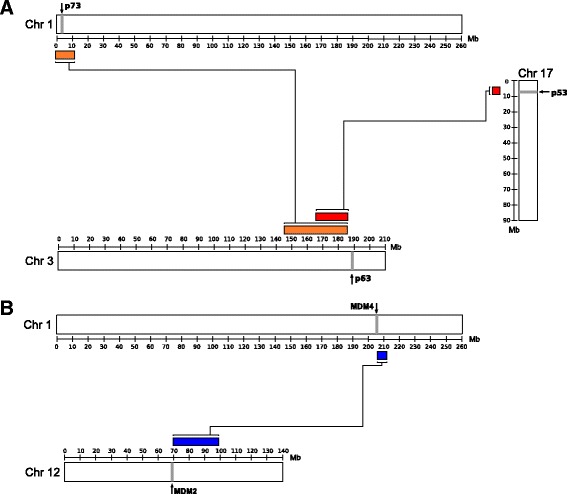
- The p53/p63/p73 and MDM families result from whole-genome duplications; synteny places p63, p53, and p73 on human chromosomes 3, 17, and 1, and MDM2 and MDM4 on chromosomes 12 and 1, within paralogous blocks.
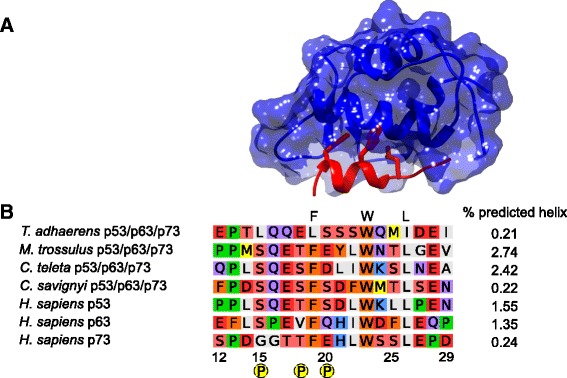
- Human p53 TAD phosphorylation sites Ser15, Thr18, and Ser20 are all conserved in the vertebrate p53 lineage, while only Ser15 is conserved in p63 and Thr18 in p73; mollusk and annelid p53/p63/p73 patterns resemble vertebrate p53 and echinoderm p53/p63/p73, suggesting p53-like regulation existed in the deuterostome/protostome ancestor.
Methods
- p53/p63/p73 and MDM genes were identified by TBLASTN/BLAST searches in Ensembl, Uniprot, OrthoDB, NCBI, and other metazoan databases; duplicates were removed, and sequences were kept if they contained the p53/p63/p73 TAD with an FxxxWxxL-like motif or the MDM p53/p63/p73BD plus the MDM-specific Cys2His2Cys4 RING motif.
- Amino acid alignments were generated with Guidance/MAFFT, gaps removed, best-fit models selected in MEGA 6 (JTT+G+I), and phylogenetic trees built in PhyML 3.0 with NNI improvement and SH-aLRT branch support, rooted against *Trichoplax adhaerens*.
- Additional analyses included human paralogous-block/synteny analysis, phosphorylation-site conservation assessment, and Agadir prediction of helical propensity in the TAD.
Limitations
- Stated: some data are inconclusive because several Mollusca and Chondrichthyes genomes have poor sequence coverage, and missing sequences are likely due to poor sequencing coverage; avian p53 is difficult to detect because of high GC content (~65%) in GC-rich microchromosomes.
- Stated: the phylogenetic trees exclude Nematoda and Arthropoda subphyla Hexapoda and Crustacea because these genes lack the complete interaction domains.
- Evident from the text: conclusions rely on genome assemblies, transcriptomes, and database annotations, with no experimental validation of interactions or functions, and some co-evolution exceptions remain unresolved.
Model-written summary. Check it against the paper before relying on it.
Integrity signals
Registry
Cites
Statistics
Figures
Verification
Claims the paper makes
1 Valid · 1 Not valid · 57 Not checked · 89 Own results and interpretations
The cited sources support only part of this claim — read each source’s verdict below.
In the paper
“We could confirm the presence of two p53/p63/p73-like genes in the unicellular choanoflagellate Monosiga brevicollis [16].”
§ Evolution of the p53-MDM2 pathway > Results > Emergence and loss of domains within the p53/p63/p73 family
What the sources say
- Partly supportedcites [16] King N Westbrook MJ Young SL Kuo A Abedin M Chapman J The genome of the choanoflagellate Monosiga Brevicollis and the origin of metazoans Nature 2008 451 783 788 10.1038/nature06617 18273011 PMC2562698 sourceExperimental — accuracy not yet measured
King et al. (2008) do report p53-family members in the unicellular choanoflagellate Monosiga brevicollis: the transcription-factor section (p. 5) states 'Members of the metazoan p53, Myc and Sox/TCF families were identified,' and the Discussion (p. 5) notes 'the genome encodes representatives of the otherwise metazoan-specific p53, Myc and Sox/TCF transcription factor families.' However, our copy nowhere gives the gene COUNT — the specific claim of TWO p53/p63/p73-like genes is not stated (it would reside in the Supplementary Information, which we do not hold), and the paper refers only to the 'p53' family without the p63/p73 qualification. So the presence of p53-family genes in M. brevicollis is supported, but the number 'two' attributed to this source is not. (LLM, conf=0.72)
hedged- Asserted: passes — The authors put it forward as true.
- Checkable: passes — It can be checked against evidence.
- Load-bearing: passes — The paper’s conclusions depend on it.
- Based: passes — The paper gives a reason why it holds.
- Partly supported
A result the paper states — it cites no source for it, so there is none to check. The quote shows it is in the paper.
In the paper
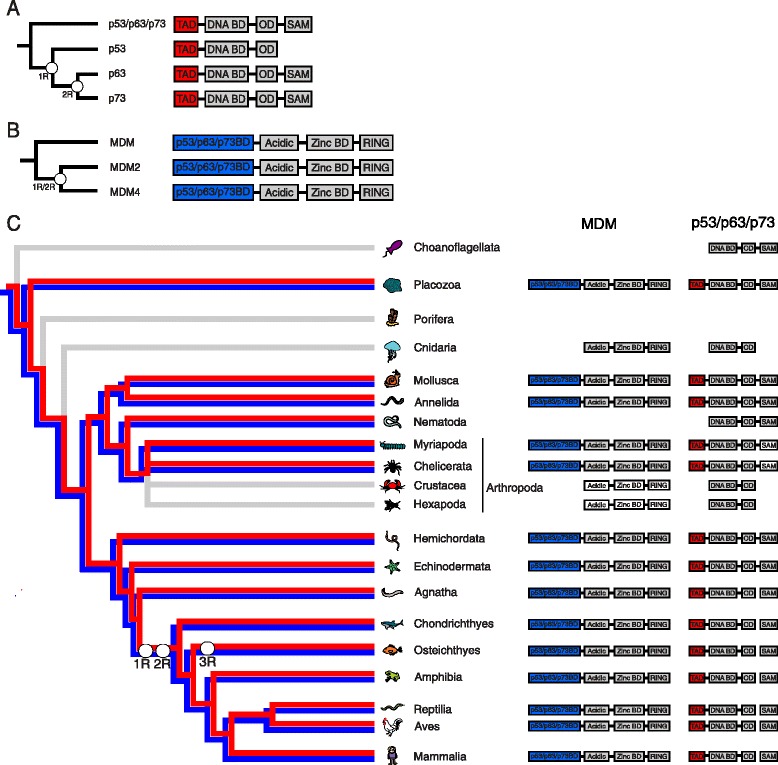
“Similarly, in p53/p63/p73 from Nematoda, the TAD and SAM domains have been lost, and only the DNA BD and OD are present (Fig. 1c).”
§ Evolution of the p53-MDM2 pathway > Results > Emergence and loss of domains within the p53/p63/p73 family
plain- Asserted: passes — The authors put it forward as true.
- Checkable: passes — It can be checked against evidence.
- Load-bearing: passes — The paper’s conclusions depend on it.
- Based: passes — The paper gives a reason why it holds.
In the paper
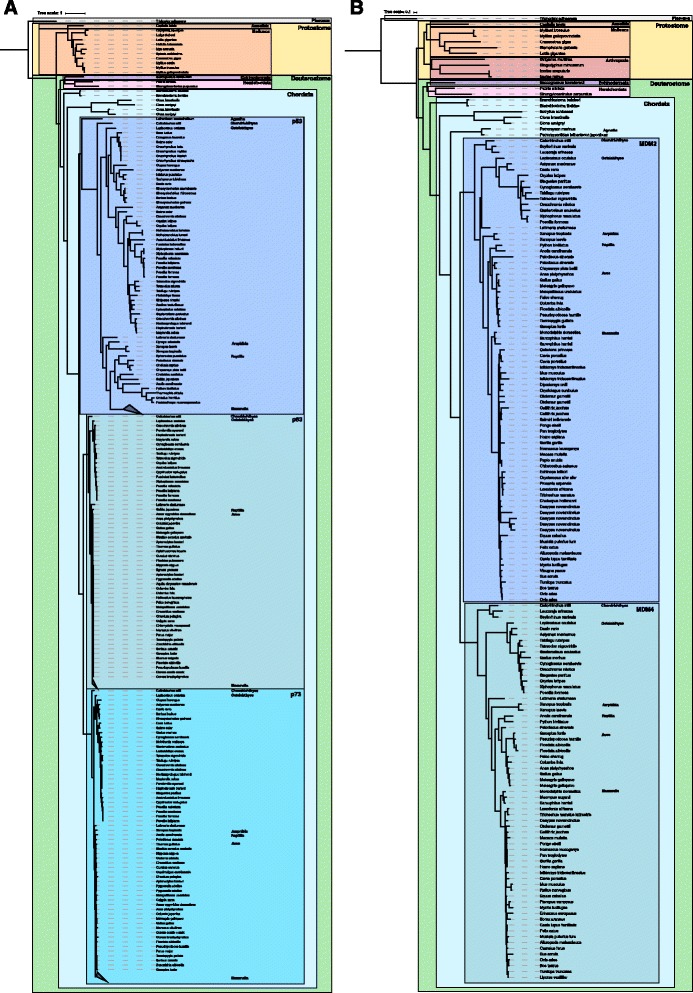
“The trees follow species evolution and contain a total number of 183 and 98 species for p53/p63/p73 and MDM, respectively.”
- Also stated in: § Phylogeny of proteins containing the interacting domains produces phylogenetic trees that follow the species evolution · hedged
“resulting in phylogenetic trees that follow the evolution of species almost perfectly, according to interactive Tree Of Life [26].”
§ Evolution of the p53-MDM2 pathway > Abstract > Results
What the sources say
- Not checked yetcites [26] Letunic I Bork P Interactive tree of life v2: online annotation and display of phylogenetic trees made easy Nucleic Acids Res 2011 39 W475 W478 10.1093/nar/gkr201 21470960 PMC3125724 source
plainstates an association- Asserted: passes — The authors put it forward as true.
- Checkable: passes — It can be checked against evidence.
- Load-bearing: passes — The paper’s conclusions depend on it.
- Based: passes — The paper gives a reason why it holds.
- Also stated in: § Phylogeny of proteins containing the interacting domains produces phylogenetic trees that follow the species evolution · hedged
A result the paper reports from its own data — it cites no other source for it, so there is none to check. The quote shows it is in the paper.
In the paper
“Loss of one of the domains is associated with the lack of the other domain, with few exceptions, demonstrating their functional dependence.”
§ Evolution of the p53-MDM2 pathway > Background
boostedstates an association- Asserted: passes — The authors put it forward as true.
- Checkable: passes — It can be checked against evidence.
- Load-bearing: passes — The paper’s conclusions depend on it.
- Based: passes — The paper gives a reason why it holds.
A result the paper reports from its own data — it cites no other source for it, so there is none to check. The quote shows it is in the paper.
In the paper
“However, the interaction domains in MDM and p53/p63/p73 in Cnidaria are both missing (Fig. 1c).”
§ Evolution of the p53-MDM2 pathway > Results > Loss of the TAD domain in p53/p63/p73 correlates with the loss of the p53/p63/p73BD in MDM
plain- Asserted: passes — The authors put it forward as true.
- Checkable: passes — It can be checked against evidence.
- Load-bearing: passes — The paper’s conclusions depend on it.
- Based: passes — The paper gives a reason why it holds.
75 more claims
Create a free account to see all 148 claims and to verify the 79 references still open.
- It may state two separate claims as one. 55
- Probably not a substantial claim. 17
- Borderline: one of the tests for a substantial claim is unclear. 1
Claims other papers make about this one
Each is checked against this paper’s own text: does it say what the citing paper says it does?
The source backs part of the claim, not all of it — or backs it for a different population, condition or comparison.
In the citing paper
“For the C. teleta genome, however, we retrieved hits for the key functional domains of MDM2, consistent with an earlier report [42] on the presence of an MDM-like gene in this annelid including all four functional domains (p53-binding region, acidic domain, C4 zinc finger, and C-terminal RING domain).”
From Evolutionary history of the p53 family DNA-binding domain: insights from an Alvinella pompejana homolog (2022) · cites this paper as [42]
Experimental — accuracy not yet measuredThe cited source says what the claim attributes to it.
In the citing paper
“The absence of an homologous transactivation domain in the most remote p53 family homologs is consistent with previous observations that the transactivation domain first appeared in Placozoa [52].”
From Characterization of p53 Family Homologs in Evolutionary Remote Branches of Holozoa (2019) · cites this paper as [52]
In the citing paper
“Single MDM-family genes were identified in many, but not all, invertebrates, including placozoans, sea anemones, mollusks, and tunicates [1, 42, 65].”
From Evolutionary history of the p53 family DNA-binding domain: insights from an Alvinella pompejana homolog (2022) · cites this paper as [42]
In the citing paper
“an MDM2 homolog was detected in the genome of the mesophilic annelid C. teleta [42]”
From Evolutionary history of the p53 family DNA-binding domain: insights from an Alvinella pompejana homolog (2022) · cites this paper as [42]
Self-check
Percentages, sums and reported differences re-computed from the paper’s own numbers.
Each contradiction between two passages listed here was confirmed by an independent check.
Rated minor: it would not touch a result — a value no result rests on, a p-value that stays on the same side of the significance level, or a conflict that is clerical, resolved elsewhere in the paper, or outside its own findings.
In the paper
§ Evolution of the p53-MDM2 pathway > Results > Phylogeny of proteins containing the interacting domains produces phylogenetic trees that follow the species evolution
“Thus, we reconstructed a phylogenetic tree of the p53/p63/p73 family only including species containing the TAD (Fig. 3a) and a tree of the MDM family only including species containing the p53/p63/p73BD (Fig. 3b).”
§ Evolution of the p53-MDM2 pathway > Results > Phylogeny of proteins containing the interacting domains produces phylogenetic trees that follow the species evolution
“Figure: Fig. 3 Paralogous blocks descended from the two whole genome duplication events that happened prior to the emergence of bony vertebrates.”
Rated minor: it would not touch a result — a value no result rests on, a p-value that stays on the same side of the significance level, or a conflict that is clerical, resolved elsewhere in the paper, or outside its own findings.
In the paper
§ Evolution of the p53-MDM2 pathway > Results > Species that might not conform to the co-evolution hypothesis
“The Gallus gallus p53 gene has all four-domains, whereas the Pseudopodoces humilis p53 gene only contains the DNA-BD and OD.”
§ Evolution of the p53-MDM2 pathway > Results > Emergence and loss of domains within the p53/p63/p73 family
“p63 and p73 have retained all four domains, while the SAM domain was lost in the p53 lineage and replaced with a C-terminal disordered domain involved in protein-protein interactions [19].”
Citations
Cites
MEGA6: Molecular Evolutionary Genetics Analysis Version 6.0
Tamura, K., Stecher, G., Peterson, D., Filipski, A., & Kumar, S. (2013) · Molecular Biology and Evolution · doi:10.1093/molbev/mst197 · Cited by 47,205
Estimating the Dimension of a Model
Schwarz, G. (1978) · The Annals of Statistics · doi:10.1214/aos/1176344136 · Cited by 47,033
Guindon, S., Dufayard, J.-F., Lefort, V., Anisimova, M., Hordijk, W., & Gascuel, O. (2010) · Systematic Biology · doi:10.1093/sysbio/syq010 · Cited by 18,376
PhosphoSitePlus, 2014: mutations, PTMs and recalibrations
Hornbeck, P. V., Zhang, B., Murray, B., Kornhauser, J. M., Latham, V., & Skrzypek, E. (2015) · Nucleic Acids Research · doi:10.1093/nar/gku1267 · Cited by 3,411
Structure of the MDM2 Oncoprotein Bound to the p53 Tumor Suppressor Transactivation Domain
Kussie, P. H., Gorina, S., Marechal, V., Elenbaas, B., Moreau, J., Levine, A. J., & Pavletich, N. P. (1996) · Science · doi:10.1126/science.274.5289.948 · Cited by 2,206
Two Rounds of Whole Genome Duplication in the Ancestral Vertebrate
Dehal, P., & Boore, J. L. (2005) · PLoS Biology · doi:10.1371/journal.pbio.0030314 · Cited by 1,526 · cited 1×
“tionary connected genes in invertebrate species as Drosophila melanogaster and Caenorhabditis elegans, which did not undergo whole genome duplications [27].”
Interactive Tree Of Life v2: online annotation and display of phylogenetic trees made easy
Letunic, I., & Bork, P. (2011) · Nucleic Acids Research · doi:10.1093/nar/gkr201 · Cited by 1,457
The importance of intrinsic disorder for protein phosphorylation
Iakoucheva, L. M. (2004) · Nucleic Acids Research · doi:10.1093/nar/gkh253 · Cited by 1,429
The Cell–Cycle Arrest and Apoptotic Functions of p53 in Tumor Initiation and Progression
Chen, J. (2016) · Cold Spring Harbor Perspectives in Medicine · doi:10.1101/cshperspect.a026104 · Cited by 1,222
The genome of the choanoflagellate Monosiga brevicollis and the origin of metazoans
King, N., Westbrook, M. J., Young, S. L., Kuo, A., Abedin, M., Chapman, J., Fairclough, S., Hellsten, U., Isogai, Y., Letunic, I., et al. (2008) · Nature · doi:10.1038/nature06617 · Cited by 1,139 · cited 1×
“We could confirm the presence of two p53/p63/p73-like genes in the unicellular choanoflagellate Monosiga brevicollis [16].”
Cited by
Circular RNA CDR1as disrupts the p53/MDM2 complex to inhibit Gliomagenesis
Lou, J., Hao, Y., Lin, K., Lyu, Y., Chen, M., Wang, H., Zou, D., Jiang, X., Wang, R., Jin, D., et al. (2020) · Molecular Cancer · doi:10.1186/s12943-020-01253-y · Cited by 220
Origins of cancer: ain’t it just mature cells misbehaving?
Cho, C. J., Brown, J. W., & Mills, J. C. (2024) · The EMBO Journal · doi:10.1038/s44318-024-00099-0 · Cited by 33
Characterization of p53 Family Homologs in Evolutionary Remote Branches of Holozoa
Bartas, M., Brázda, V., Červeň, J., & Pečinka, P. (2019) · International Journal of Molecular Sciences · doi:10.3390/ijms21010006 · Cited by 29
The dual role of p63 in cancer
Xu, Y., Yang, X., Xiong, Q., Han, J., & Zhu, Q. (2023) · Frontiers in Oncology · doi:10.3389/fonc.2023.1116061 · Cited by 25
Binding Kinetics of the Intrinsically Disordered p53 Family Transactivation Domains and MDM2
Åberg, E., Karlsson, O. A., Andersson, E., & Jemth, P. (2018) · The Journal of Physical Chemistry B · doi:10.1021/acs.jpcb.8b03876 · Cited by 23
Self-citationShaping the regulation of the p53 mRNA tumour suppressor: the co-evolution of genetic signatures
Karakostis, K., & Fåhræus, R. (2019) · BMC Cancer · doi:10.1186/s12885-019-6118-y · Cited by 22
Zhang, Q., Balourdas, D.-I., Baron, B., Senitzki, A., Haran, T. E., Wiman, K. G., Soussi, T., & Joerger, A. C. (2022) · Cell Death & Disease · doi:10.1038/s41419-022-04653-8 · Cited by 14
The C-terminal SAM domain of p73 binds to the N terminus of MDM2
Neira, J. L., Díaz-García, C., PRIETO, M. J. E., & Coutinho, A. (2019) · Biochimica et Biophysica Acta (BBA) - General Subjects · doi:10.1016/j.bbagen.2019.01.019 · Cited by 14
Maeso‐Alonso, L., López‐Ferreras, L., Marqués, M. M., & Marín, M. C. (2021) · Frontiers in Cell and Developmental Biology · doi:10.3389/fcell.2021.716957 · Cited by 14
Sun, Z., Qiu, Z., Wang, Z., Chi, H., & Shan, P. (2021) · Medical Science Monitor · doi:10.12659/msm.928375 · Cited by 12
The p53 gene family in vertebrates: Evolutionary considerations
Biscotti, M. A., Barucca, M., Carducci, F., Forconi, M., & Canapa, A. (2019) · Journal of Experimental Zoology Part B Molecular and Developmental Evolution · doi:10.1002/jez.b.22856 · Cited by 12
Systemic Therapy in Advanced Pleomorphic Liposarcoma: a Comprehensive Review
Assi, T., Ngo, C., Faron, M., Verret, B., Lévy, A., Honoré, C., Henon, C., Pechoux, C. L., Bahleda, R., & Cesne, A. L. (2023) · Current Treatment Options in Oncology · doi:10.1007/s11864-023-01139-3 · Cited by 11
The Genome of the Softshell Clam Mya arenaria and the Evolution of Apoptosis
Plachetzki, D. C., Pankey, M. S., MacManes, M. D., Lesser, M. P., & Walker, C. W. (2020) · Genome Biology and Evolution · doi:10.1093/gbe/evaa143 · Cited by 11
Confalonieri, S., Colaluca, I. N., Basile, A., Pece, S., & Fiore, P. P. D. (2019) · G3 Genes Genomes Genetics · doi:10.1534/g3.119.400494 · Cited by 10
Circular RNAs in glioma progression: Fundamental mechanisms and therapeutic potential: A review
Wang, H., Bian, C., Zhang, Y., Zhang, L., & Wang, F. (2025) · International Journal of Biological Macromolecules · doi:10.1016/j.ijbiomac.2025.144360 · Cited by 9
Mihalič, F., Arcila, D., Pettersson, M. E., Farkhondehkish, P., Andersson, E., Andersson, L., Betancur‐R, R., & Jemth, P. (2024) · Molecular Biology and Evolution · doi:10.1093/molbev/msae018 · Cited by 8
Self-citationCharacterization of p53/p63/p73 and Myc expressions during embryogenesis of the sea urchin
Grant, B., Buitrago, P. A. S., Mercado, B. C., & Yajima, M. (2023) · Developmental Dynamics · doi:10.1002/dvdy.656 · Cited by 7
The armadillo-repeat domain of plakophilin 1 binds the C-terminal sterile alpha motif (SAM) of p73
Neira, J. L., Rizzuti, B., Ortega-Alarcón, D., Giudici, A. M., Abián, O., Fárez‐Vidal, M. E., & Velázquez‐Campoy, A. (2021) · Biochimica et Biophysica Acta (BBA) - General Subjects · doi:10.1016/j.bbagen.2021.129914 · Cited by 7
Mihalič, F., Åberg, E., Farkhondehkish, P., Theys, N., Andersson, E., & Jemth, P. (2023) · Protein Science · doi:10.1002/pro.4684 · Cited by 6
Self-citationRecent Research on Role of p53 Family in Small-Cell Lung Cancer
Jeong, M., & Kim, K. (2025) · Cancers · doi:10.3390/cancers17071110 · Cited by 6
Uzdensky, A. B. (2020) · BIOPHYSICS · doi:10.1134/s0006350920030227 · Cited by 6
Mihalic, F., Åberg, E., Farkhondehkish, P., Theys, N., Andersson, E., & Jemth, P. (2023) · doi:10.1101/2023.01.26.525693 · Cited by 6
Self-citationProtein–Protein Interactions in Cancer
Poluri, K. M., Gulati, K., Tripathi, D. K., & Nagar, N. (2023) · Springer eBooks · doi:10.1007/978-981-99-2423-3_2 · Cited by 5
Millado, J. B. H., Hamajima, R., Sugiura, W., Makino, S., Kobayashi, M., & Ikeda, M. (2021) · Journal of insect biotechnology and sericology · doi:10.11416/jibs.90.2_021 · Cited by 4
Ikliptikawati, D. K., Makiyama, K., Hazawa, M., & Wong, R. W.-C. (2024) · International Journal of Molecular Sciences · doi:10.3390/ijms25137465 · Cited by 4
Jasti, N., Sebagh, D., Riaz, M., Wang, X., Koripella, B., Palanisamy, V., Mohammad, N., Chen, Q., & Friedrich, M. (2020) · Development Genes and Evolution · doi:10.1007/s00427-020-00663-8 · Cited by 3
An orchestra of survival: Molecular mechanisms of radiation resistance across extremophiles
Liu, N., Cui, F., Jiao, Y., Zhou, K., & Jian, T. (2026) · Radiation Medicine and Protection · doi:10.1016/j.radmp.2026.01.001 · Cited by 1
Non-accidental structural chromosome aberrations in established monkey B-lymphocyte cell lines
Araviashvili, D. E., Chzhu, O. P., Marinich, I. I., & Danilova, I. (2020) · Biologija · doi:10.6001/biologija.v65i4.4119 · Cited by 1
The Coordination of Pathways in Metazoans: An Integrated Framework
Tang, S. (2025) · Biological Theory · doi:10.1007/s13752-025-00498-4
Scharte, J. M. (2021) · eDiss (Georg-August-Universität Göttingen) · doi:10.53846/goediss-8911
Nomura, Y., & Dohmae, N. (2025) · bioRxiv (Cold Spring Harbor Laboratory) · doi:10.1101/2025.07.27.667088
The p53 Super-Hub Architecture: From Planar to Volumetric Network Pharmacology
Bazanov, D. R. (2026) · International Journal of Molecular Sciences · doi:10.3390/ijms27219752
Computational Approaches to Examine Cellular Signalling Networks
Jentsch, M. (2020) · TUbilio (Technical University of Darmstadt) · doi:10.25534/tuprints-00011498
Presence and Interactions of Entamoeba histolytica Lectin and p53 Protein in Colorectal Cancer
Haghighi, L., Dalimi, A., Pirestani, M., & Ghaffarifar, F. (2025) · Iranian Journal of Parasitology · doi:10.18502/ijpa.v20i2.19031
In Silico Phylogenetic Study of the Human Tp53 Gene: Insights into Evolutionary Dynamics
Pigili, A. K., & Katika, A. K. B. (2024) · International journal of research studies in biosciences · doi:10.20431/2349-0365.1001005
Metadata
- Authors
- Åberg, E., Saccoccia, F., Grabherr, M., Ore, W. Y. J., Jemth, P., & Hultqvist, G.
- Affiliations
- Uppsala University (SE)
- Corresponding author
- Hultqvist, Greta
- Venue
- BMC Evolutionary Biology
- Published
- 2017-08-03
- Volume
- 17
- Issue
- 1
- Pages
- 177-177
- ISSN
- 1471-2148 (ISSN-L)
- PMC
- PMC5543598
- OpenAlex
- W2743207200
- Semantic Scholar
- d82f7f6ede182c408695686dd3f9102d33fccd18
- Cited by
- 34
- References
- 56
- Citations by year
- 2026: 2 · 2025: 5 · 2024: 4 · 2023: 5 · 2022: 1 · 2021: 5 · 2020: 6 · 2019: 5 · 2018: 1
- FWCI
- 1.44
- Type
- journal article
- Language
- en
- Open access
- gold
- doi.org
- Licence
- cc-by
- Locations
- BMC Evolutionary Biology (publishedVersion, cc-by)
- Europe PMC (PubMed Central) (publishedVersion, cc-by)
- PubMed Central (publishedVersion, cc-by)
- PubMed (publishedVersion)
- Uppsala University Publications (Uppsala University) (submittedVersion, other-oa)
- DOAJ (DOAJ: Directory of Open Access Journals) (submittedVersion)
- Funders
- Vetenskapsrådet
- Topics
- Health Sciences › Medicine › Oncology › Cancer-related Molecular Pathways
- Life Sciences › Biochemistry, Genetics and Molecular Biology › Molecular Biology › Developmental Biology and Gene Regulation
- Life Sciences › Biochemistry, Genetics and Molecular Biology › Molecular Biology › Heat shock proteins research
- Keywords
- p53 pathway, p53, p63, p73, MDM2, MDM4, transactivation domain, whole-genome duplication, phylogenetic tree, domain loss
- MeSH terms
- Tumor Protein p73, Amino Acid Sequence, Animals, Humans, Phosphorylation, Phylogeny, Protein Binding, Species Specificity, Signal Transduction, Tumor Suppressor Protein p53, Evolution, Molecular, Gene Duplication, Tumor Suppressor Proteins, Proto-Oncogene Proteins c-mdm2, Protein Interaction Domains and Motifs
About these checks
Registry, retraction, Cites and statistics results are computed, not judged, with one exception: a printed reference that no index lists is read once by a model before it counts as a citation error. Claims are extracted by a model and kept only when their quote appears verbatim in the text; each cited source is then checked, with a model’s help, for whether it says what the claim relies on. Those verdicts can be wrong — read the claim’s quote and the cited source before relying on one.
The claim verdicts this report counts are experimental: their accuracy is not yet measured.
A language model drew the claims from the paper on 2026-11-21, under version 3 of the claim definition (model deepseek-v4.1-flash, prompt extract-v3).
A second model labelled each claim on 2026-11-21 (model jev-1.13-20260917, definition revision gold-guideline-v0.2).
Cited sources are checked with a language model’s help (qwen3.8-omni-flash).
Statistics and arithmetic are recomputed, not judged.
Confidence bands are shown only for fields calibrated on our annotated test set. None is calibrated yet, so no band is shown.
What counts as a claim ›How we measure confidence ›How we check this ›
Are you an author, or do you see a problem with this page? Request a review
Data sources
Bibliographic data: Semantic Scholar, OpenAlex, Crossref.
Contains information from the Semantic Scholar Academic Graph Datasets, made available under the ODC Attribution License (ODC-BY 1.0).
Semantic Scholar’s data is described in: Kinney, R., et al. (2023). The Semantic Scholar Open Data Platform. arXiv:2301.10140.
