

The DOI matches its Crossref record; 49 of the 50 references it cites were found in a registry or an index.
Sex differences in DNA methylation assessed by 450 K BeadChip in newborns
Open accessAbstract
BACKGROUND: DNA methylation is an important epigenetic mark that can potentially link early life exposures to adverse health outcomes later in life. Host factors like sex and age strongly influence biological variation of DNA methylation, but characterization of these relationships is still limited, particularly in young children. METHODS: In a sample of 111 Mexican-American subjects (58 girls , 53 boys), we interrogated DNA methylation differences by sex at birth using the 450 K BeadChip in umbilical cord blood specimens, adjusting for cell composition. RESULTS: We observed that ~3% of CpG sites were differentially methylated between girls and boys at birth (FDR P < 0.05). Of those CpGs, 3031 were located on autosomes, and 82.8% of those were hypermethylated in girls compared to boys. Beyond individual CpGs, we found 3604 sex-associated differentially methylated regions (DMRs) where the majority (75.8%) had higher methylation in girls. Using pathway analysis, we found that sex-associated autosomal CpGs were significantly enriched for gene ontology terms related to nervous system development and behavior. Among hits in our study, 35.9% had been previously reported as sex-associated CpG sites in other published human studies. Further, for replicated hits, the direction of the association with methylation was highly concordant (98.5-100%) with previous studies. CONCLUSIONS: To our knowledge, this is the first reported epigenome-wide analysis by sex at birth that examined DMRs and adjusted for confounding by cell composition. We confirmed previously reported trends that methylation profiles are sex-specific even in autosomal genes, and also identified novel sex-associated CpGs in our methylome-wide analysis immediately after birth, a critical yet relatively unstudied developmental window.
Overview
The claims and statistics of this paper haven’t been checked yet.
Run the check — free, no account needed. It reads the open-access text and checks the sources it cites.
Integrity signals
Registry
Cites
Statistics
Figures
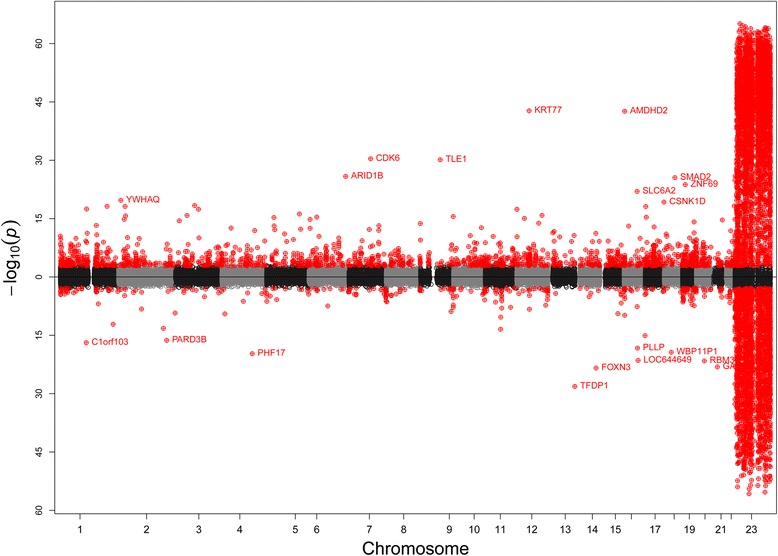
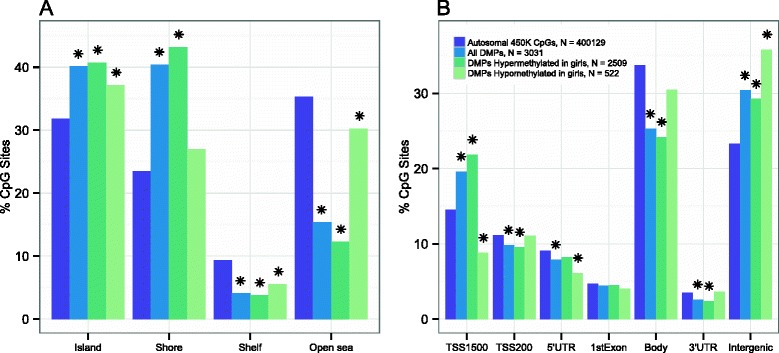
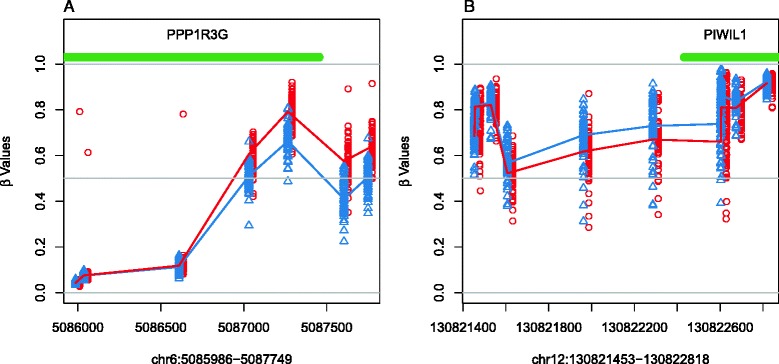
Verification
Claims the paper makes
The claims and statistics of this paper haven’t been checked yet.
Run the check — free, no account needed. It reads the open-access text and checks the sources it cites.
Claims other papers make about this one
Each is checked against this paper’s own text: does it say what the citing paper says it does?
The cited source says what the claim attributes to it.
In the citing paper
“Biological confounders known to affect epigenetic patterns such as age (Xiao, Wang, & Kong, 2019), sex (Yousefi et al., 2015), ethnicity (Fraser, Lam, Neumann, & Kobor, 2012), body mass index (Sayols-Baixeras et al., 2017), smoking behavior (Li et al., 2018) or nutritional aspects (Gadecka & Bielak-Zmijewska, 2019) may introduce critical biases limiting the interpretation of epigenetic data.”
From The applied implications of epigenetics in anxiety, affective and stress-related disorders - A review and synthesis on psychosocial stress, psychotherapy and prevention (2020) · cites this paper as Yousefi et al., 2015
Self-check
Percentages, sums and reported differences re-computed from the paper’s own numbers.
The self-check needs the paper’s full text.
Citations
Cites
R: A Language and Environment for Statistical Computing
R Core Team (2000) · doi:10.32614/r.manuals · Cited by 355,893
Systematic and integrative analysis of large gene lists using DAVID bioinformatics resources
Huang, D. W., Sherman, B. T., & Lempicki, R. A. (2009) · Nature Protocols · doi:10.1038/nprot.2008.211 · Cited by 35,890
Huang, D. W., Sherman, B. T., & Lempicki, R. A. (2009) · Nucleic Acids Research · doi:10.1093/nar/gkn923 · Cited by 14,108
REVIGO summarizes and visualizes long lists of gene ontology terms
Supek, F., Bošnjak, M., Škunca, N., & Šmuc, T. (2011) · PLoS ONE · doi:10.1371/journal.pone.0021800 · Cited by 6,264
limma: Linear Models for Microarray Data
Smyth, G. K. (2005) · Statistics for Biology and Health · doi:10.1007/0-387-29362-0_23 · Cited by 5,796
An Approximate Distribution of Estimates of Variance Components
Satterthwaite, F. E. (1946) · Biometrics Bulletin · doi:10.2307/3002019 · Cited by 4,373
DNA methylation arrays as surrogate measures of cell mixture distribution
Houseman, E. A., Accomando, W. P., Koestler, D. C., Christensen, B. C., Marsit, C. J., Nelson, H. H., Wiencke, J. K., & Kelsey, K. T. (2012) · BMC Bioinformatics · doi:10.1186/1471-2105-13-86 · Cited by 3,175
More powerful procedures for multiple significance testing
Hochberg, Y., & Benjamini, Y. (1990) · Statistics in Medicine · doi:10.1002/sim.4780090710 · Cited by 2,715
Du, P., Zhang, X., Huang, C.-C., Jafari, N., Kibbe, W. A., Hou, L., & Lin, S. M. (2010) · BMC Bioinformatics · doi:10.1186/1471-2105-11-587 · Cited by 2,136
In utero programming of chronic disease
BARKER, D. J. P. (1998) · Clinical Science · doi:10.1042/cs0950115 · Cited by 1,765
Research works printed but not linked: 1
- Turgeon ML. Clinical hematology. 5th ed. Philadelphia: Lippincott Williams & Wilkins; 2011. p. 40–5.
Cited by
Sorted by citations
Sex differences in cancer mechanisms
Rubin, J. B., Lagas, J. S., Broestl, L., Sponagel, J., Rockwell, N., Rhee, G., Rosen, S. F., Chen, S., Klein, R. S., Imoukhuede, P. I., et al. (2020) · Biology of Sex Differences · doi:10.1186/s13293-020-00291-x · Cited by 391
Aref‐Eshghi, E., Kerkhof, J., Pedro, V. P., Barat‐Houari, M., Pallarès-Ruiz, N., Andrau, J., Lacombe, D., Van‐Gils, J., Fergelot, P., Dubourg, C., et al. (2020) · The American Journal of Human Genetics · doi:10.1016/j.ajhg.2020.01.019 · Cited by 324
Breton, C. V., Marsit, C. J., Faustman, E. M., Nadeau, K. C., Goodrich, J. M., Dolinoy, D. C., Herbstman, J. B., Holland, N., LaSalle, J. M., Schmidt, R. J., et al. (2017) · Environmental Health Perspectives · doi:10.1289/ehp595 · Cited by 271
Self-citationDNA methylation in the pathogenesis of type 2 diabetes in humans
Davegårdh, C., García-Calzón, S., Bacos, K., & Ling, C. (2018) · Molecular Metabolism · doi:10.1016/j.molmet.2018.01.022 · Cited by 200
Mulder, R. H., Neumann, A., Cecil, C. A. M., Walton, E., Houtepen, L. C., Simpkin, A. J., Rijlaarsdam, J., Heijmans, B. T., Gaunt, T. R., Felix, J. F., et al. (2021) · Human Molecular Genetics · doi:10.1093/hmg/ddaa280 · Cited by 165
Metadata
- Authors
- Yousefi, P., Huen, K., Davé, V., Barcellos, L., Eskenazi, B., & Holland, N.
- Affiliations
- University of California, Berkeley (US)
- Corresponding author
- Holland, Nina
- Venue
- BMC Genomics
- Published
- 2015-11-09
- Volume
- 16
- Issue
- 1
- Pages
- 911-911
- ISSN
- 1471-2164 (ISSN-L)
- PMC
- PMC4640166
- OpenAlex
- W2112500414
- Cited by
- 205
- References
- 50
- Citations by year
- 2026: 10 · 2025: 13 · 2024: 17 · 2023: 25 · 2022: 32 · 2021: 36 · 2020: 19 · 2019: 14 · 2018: 15 · 2017: 15 · 2016: 9
- FWCI
- 5.65
- Type
- journal article
- Language
- en
- Open access
- gold
- doi.org
- Locations
- BMC Genomics (publishedVersion, cc-by)
- Europe PMC (PubMed Central) (publishedVersion, cc-by)
- PubMed Central (publishedVersion, cc-by)
- PubMed (publishedVersion)
- eScholarship (California Digital Library) (submittedVersion)
- eScholarship (California Digital Library) (submittedVersion, cc-by)
- Funders
- U.S. Environmental Protection Agency (RD83451301)
- National Institute of Environmental Health Sciences (ES009605, R01ES021369)
- Topics
- Life Sciences › Biochemistry, Genetics and Molecular Biology › Molecular Biology › Epigenetics and DNA Methylation
- Life Sciences › Biochemistry, Genetics and Molecular Biology › Genetics › Genetic Syndromes and Imprinting
- Health Sciences › Medicine › Pediatrics, Perinatology and Child Health › Birth, Development, and Health
- Keywords
- DNA methylation, sex differences, neonates, umbilical cord blood, differentially methylated regions, hypermethylation, brain development, epigenome-wide association study, Mexican-American population
- MeSH terms
- Female, Humans, Infant, Newborn, Male, CpG Islands, DNA Methylation, Epigenesis, Genetic, Genome-Wide Association Study, Epigenomics
About these checks
Registry, retraction, Cites and statistics results are computed, not judged, with one exception: a printed reference that no index lists is read once by a model before it counts as a citation error. Claims are extracted by a model and kept only when their quote appears verbatim in the text; each cited source is then checked, with a model’s help, for whether it says what the claim relies on. Those verdicts can be wrong — read the claim’s quote and the cited source before relying on one.
Statistics and arithmetic are recomputed, not judged.
Confidence bands are shown only for fields calibrated on our annotated test set. None is calibrated yet, so no band is shown.
What counts as a claim ›How we measure confidence ›How we check this ›
Are you an author, or do you see a problem with this page? Request a review
