

Motif oriented high-resolution analysis of ChIP-seq data reveals the topological order of CTCF and cohesin proteins on DNA
Open accessThe DOI matches its Crossref record; 47 of the 47 references it cites were found in a registry or an index.
Abstract
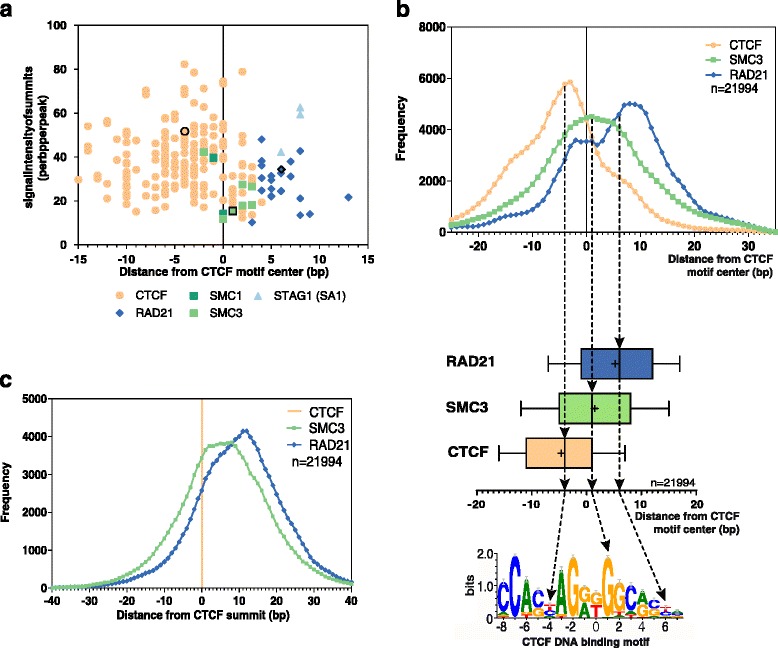
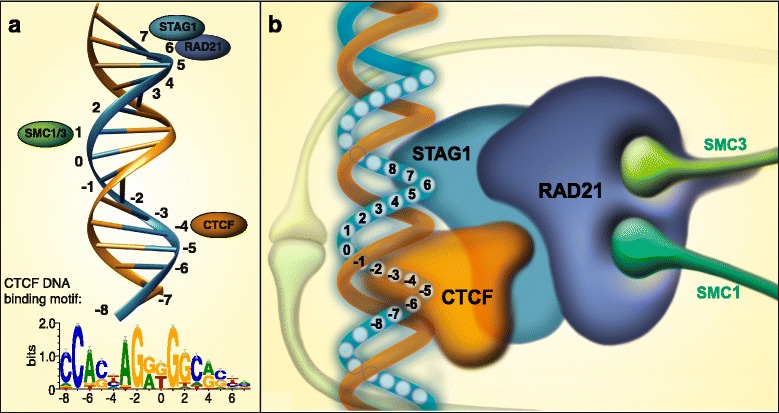
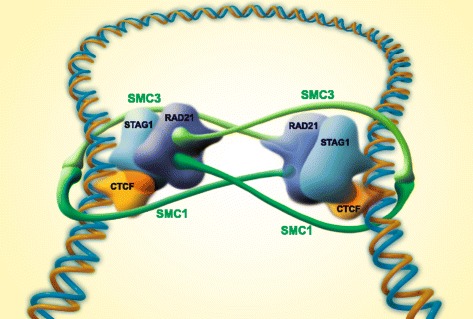
BACKGROUND: ChIP-seq provides a wealth of information on the approximate location of DNA-binding proteins genome-wide. It is known that the targeted motifs in most cases can be found at the peak centers. A high resolution mapping of ChIP-seq peaks could in principle allow the fine mapping of the protein constituents within protein complexes, but the current ChIP-seq analysis pipelines do not target the basepair resolution strand specific mapping of peak summits. RESULTS: The approach proposed here is based on i) locating regions that are bound by a sufficient number of proteins constituting a complex; ii) determining the position of the underlying motif using either a direct or a de novo motif search approach; and iii) determining the exact location of the peak summits with respect to the binding motif in a strand specific manner. We applied this method for analyzing the CTCF/cohesin complex, which holds together DNA loops. The relative positions of the constituents of the complex were determined with one-basepair estimated accuracy. Mapping the positions on a 3D model of DNA made it possible to deduce the approximate local topology of the complex that allowed us to predict how the CTCF/cohesin complex locks the DNA loops. As the positioning of the proteins was not compatible with previous models of loop closure, we proposed a plausible "double embrace" model in which the DNA loop is held together by two adjacent cohesin rings in such a way that the ring anchored by CTCF to one DNA duplex encircles the other DNA double helix and vice versa. CONCLUSIONS: A motif-centered, strand specific analysis of ChIP-seq data improves the accuracy of determining peak positions. If a genome contains a large number of binding sites for a given protein complex, such as transcription factor heterodimers or transcription factor/cofactor complexes, the relative position of the constituent proteins on the DNA can be established with an accuracy that allow one to deduce the local topology of the protein complex. The proposed high resolution mapping approach of ChIP-seq data is applicable for detecting the contact topology of DNA-binding protein complexes.
Overview
The claims and statistics of this paper haven’t been checked yet.
Free: it reads the open-access text and checks the first 5 claims that cite a source we can check. Create a free account to check every claim.
Integrity signals
Registry
Cites
Statistics
Figures
Verification
Claims the paper makes
The claims and statistics of this paper haven’t been checked yet.
Free: it reads the open-access text and checks the first 5 claims that cite a source we can check. Create a free account to check every claim.
Claims other papers make about this one
Each is checked against this paper’s own text: does it say what the citing paper says it does?
The check wasn’t confident either way, so it gives no verdict — never disputed.
In the citing paper
“Loop formation by the related condensin complex appears to involve a DNA anchoring function of its HEAT-repeat subunit Ycg1, a paralogue of SA2/Scc340–42.”
From The structural basis for cohesin–CTCF-anchored loops (2020) · cites this paper as [40]
Experimental — accuracy not yet measured
Self-check
Percentages, sums and reported differences re-computed from the paper’s own numbers.
The self-check needs the paper’s full text.
Citations
Cites
Fast and accurate short read alignment with Burrows-Wheeler transform
Li, H., & Durbin, R. (2009) · Bioinformatics · doi:10.1093/bioinformatics/btp324 · Cited by 58,607
BEDTools: a flexible suite of utilities for comparing genomic features
Quinlan, A. R., & Hall, I. M. (2010) · Bioinformatics · doi:10.1093/bioinformatics/btq033 · Cited by 27,437
Model-based Analysis of ChIP-Seq (MACS)
Zhang, Y., Liu, T., Meyer, C. A., Eeckhoute, J., Johnson, D. S., Bernstein, B. E., Nusbaum, C., Myers, R. M., Brown, M., Li, W., et al. (2008) · Genome Biology · doi:10.1186/gb-2008-9-9-r137 · Cited by 18,386
An integrated encyclopedia of DNA elements in the human genome
The ENCODE Project Consortium (2012) · Nature · doi:10.1038/nature11247 · Cited by 18,072
Robinson, J. T., Thorvaldsdóttir, H., Winckler, W., Guttman, M., Lander, E. S., Getz, G., & Mesirov, J. P. (2011) · Nature Biotechnology · doi:10.1038/nbt.1754 · Cited by 15,390 · cited 1×
“[38 – 41].”
Heinz, S., Benner, C., Spann, N., Bertolino, E., Lin, Y. C., Laslo, P., Cheng, J. X., Murre, C., Singh, H., & Glass, C. K. (2010) · Molecular Cell · doi:10.1016/j.molcel.2010.05.004 · Cited by 13,382
Fast and accurate long-read alignment with Burrows-Wheeler transform.
Li, H., & Durbin, R. (2010) · Bioinformatics · doi:10.1093/bioinformatics/btp698 · Cited by 12,063 · cited 1×
“[38 – 41].”
Database resources of the National Center for Biotechnology Information: update
Wheeler, D. L. (2004) · Nucleic Acids Research · doi:10.1093/nar/gkh073 · Cited by 10,641
A 3D Map of the Human Genome at Kilobase Resolution Reveals Principles of Chromatin Looping
Rao, S. S. P., Huntley, M. H., Durand, N. C., Stamenova, E. K., Bochkov, I. D., Robinson, J. T., Sanborn, A. L., Machol, I., Omer, A. D., Lander, E. S., et al. (2014) · Cell · doi:10.1016/j.cell.2014.11.021 · Cited by 9,212 · cited 3×
“For example, models suggested in current studies [22, 24] consistently depict the ring in a distal position with respect to the loop and the anchoring CTCF molecules.”
BackgroundResultChIP–seq: advantages and challenges of a maturing technology
Park, P. J. (2009) · Nature Reviews Genetics · doi:10.1038/nrg2641 · Cited by 2,217 · cited 1×
“Peak summits are known to more-or-less coincide with the corresponding DNA elements [1].”
Background
Cited by
Organizational principles of 3D genome architecture
Rowley, M. J., & Corces, V. G. (2018) · Nature Reviews Genetics · doi:10.1038/s41576-018-0060-8 · Cited by 1,171
The structural basis for cohesin–CTCF-anchored loops
Li, Y., Haarhuis, J. H. I., Sedeño Cacciatore, Á., Oldenkamp, R., van Ruiten, M. S., Willems, L., Teunissen, H., Muir, K. W., de Wit, E., Rowland, B. D., et al. (2020) · Nature · doi:10.1038/s41586-019-1910-z · Cited by 459
CTCF mediates chromatin looping via N-terminal domain-dependent cohesin retention
Pugacheva, E. M., Kubo, N., Loukinov, D., Tajmul, M., Kang, S., Kovalchuk, A. L., Strunnikov, A. V., Zentner, G. E., Ren, B., & Lobanenkov, V. V. (2020) · Proceedings of the National Academy of Sciences · doi:10.1073/pnas.1911708117 · Cited by 220
“A role for the N terminus of CTCF in cohesin retention is consistent with high-resolution ChIP-seq analysis showing that cohesin binding tends to be shifted toward the N terminus of CTCF (37).”
BackgroundLoop extrusion: theory meets single-molecule experiments
Banigan, E. J., & Mirny, L. A. (2020) · Current Opinion in Cell Biology · doi:10.1016/j.ceb.2020.04.011 · Cited by 161
Chromosome organization by one-sided and two-sided loop extrusion
Banigan, E. J., van den Berg, A. A., Brandão, H. B., Marko, J. F., & Mirny, L. A. (2020) · eLife · doi:10.7554/elife.53558 · Cited by 146
Integrative characterization of G-Quadruplexes in the three-dimensional chromatin structure
Hou, Y., Li, F., Zhang, R., Li, S., Liu, H., Qin, Z. S., & Sun, X. S. (2019) · Epigenetics · doi:10.1080/15592294.2019.1621140 · Cited by 133
CTCF as a boundary factor for cohesin-mediated loop extrusion: evidence for a multi-step mechanism
Hansen, A. S. (2020) · Nucleus · doi:10.1080/19491034.2020.1782024 · Cited by 107
Structural basis of dimerization and dual W-box DNA recognition by rice WRKY domain
Cheng, X., Zhao, Y., Jiang, Q., Yang, J., Zhao, W., Taylor, I. A., Peng, Y., Wang, D., & Liu, J. (2019) · Nucleic Acids Research · doi:10.1093/nar/gkz113 · Cited by 100
Romero‐Pérez, L., Surdez, D., Brunet, E., Delattre, O., & Grünewald, T. G. P. (2019) · Trends in cancer · doi:10.1016/j.trecan.2019.07.001 · Cited by 65
On the choreography of genome folding: A grand pas de deux of cohesin and CTCF
van Ruiten, M. S., & Rowland, B. D. (2021) · Current Opinion in Cell Biology · doi:10.1016/j.ceb.2020.12.001 · Cited by 57
Nanobiotechnology in health sciences: Current applications and future perspectives
Qamar, S. A., Asgher, M., Khalid, N., & Sadaf, M. (2019) · Biocatalysis and Agricultural Biotechnology · doi:10.1016/j.bcab.2019.101388 · Cited by 56
Functional roles of CTCF in breast cancer
Oh, S., Oh, C., & Yoo, K. H. (2017) · BMB Reports · doi:10.5483/bmbrep.2017.50.9.108 · Cited by 55
Tam, P. L. F., Cheung, M. F., Chan, L. Y., & Leung, D. (2024) · Nature Communications · doi:10.1038/s41467-023-44578-0 · Cited by 53
Smc5/6 silences episomal transcription by a three-step function
Abdul, F., Diman, A., Baechler, B., Ramakrishnan, D., Kornyeyev, D., Beran, R. K., Fletcher, S. P., & Strubin, M. (2022) · Nature Structural & Molecular Biology · doi:10.1038/s41594-022-00829-0 · Cited by 35
Many facades of CTCF unified by its coding for three-dimensional genome architecture
Wu, Q., Liu, P., & Wang, L. (2020) · Journal of genetics and genomics/Journal of Genetics and Genomics · doi:10.1016/j.jgg.2020.06.008 · Cited by 27
Czipa, E., Schiller, M., Nagy, T., Kontra, L., Steiner, L., Koller, J., Szén, O. P., & Barta, E. (2020) · Database · doi:10.1093/database/baz141 · Cited by 23
Self-citationNagy, G., Bojcsuk, D., Tzerpos, P., Cseh, T., & Nagy, L. (2024) · Nucleic Acids Research · doi:10.1093/nar/gkae088 · Cited by 18
Self-citationThe dynamic role of cohesin in maintaining human genome architecture
Agarwal, A., Korsak, S., Choudhury, A., & Plewczyński, D. (2023) · BioEssays · doi:10.1002/bies.202200240 · Cited by 14
7C: Computational Chromosome Conformation Capture by Correlation of ChIP-seq at CTCF motifs
Ibn-Salem, J., & Andrade-Navarro, M. A. (2019) · BMC Genomics · doi:10.1186/s12864-019-6088-0 · Cited by 12
On the problem of confounders in modeling gene expression
Schmidt, F., & Schulz, M. H. (2018) · Bioinformatics · doi:10.1093/bioinformatics/bty674 · Cited by 12
Czimmerer, Z., Horváth, A., Dániel, B., Nagy, G., Cuaranta‐Monroy, I., Kiss, M., Kolostyák, Z., Póliska, S., Steiner, L., Giannakis, N., et al. (2017) · Biochimica et Biophysica Acta (BBA) - Gene Regulatory Mechanisms · doi:10.1016/j.bbagrm.2017.11.003 · Cited by 9
Self-citationChromatin Organization and Transcriptional Programming of Breast Cancer Cell Identity
Bobbitt, J. R., Seachrist, D. D., & Keri, R. A. (2023) · Endocrinology · doi:10.1210/endocr/bqad100 · Cited by 9
Multi-disturbance identification from mine wind-velocity data based on MSSW and WPT-GBDT
Shang, W., Deng, L., Liu, J., & Zhou, Y. (2023) · PLoS ONE · doi:10.1371/journal.pone.0284316 · Cited by 4
Wasserman, H., Chi, B., Bohm, K. A., Duan, M., Sahay, H., Safi, A., Crawford, G. E., Mao, P., Wyrick, J. J., Pufall, M. A., et al. (2026) · Nature Communications · doi:10.1038/s41467-026-75115-4 · Cited by 3
Cell Culture Models and Nanobiotechnology for Advanced Drug Delivery Research
Khalid, R., Mahmood, S., Hilles, A. R., Hashim, N. M., & Khodapanah, N. (2024) · Interdisciplinary biotechnological advances · doi:10.1007/978-981-97-2843-5_5 · Cited by 1
Genome folding in evolution and disease
Ibn-Salem, J. (2018) · Gutenberg Open Science · doi:10.25358/openscience-4186 · Cited by 1
Regulation of fission yeast cohesin by the Cyclin Dependent Kinase PeF1
Birot, A. (2016) · theses.fr (ABES) · doi:10.70675/985ad2c1ze5fdz44bfz94c3z4ea2cd04d00c · Cited by 1
Defining the Cellular Consequences of Loss of the Cohesin Complex Subunit STAG2 in Cancer Cells
Richardson, A. (2018) · eScholarship (California Digital Library)
Faculty Opinions recommendation of Organizational principles of 3D genome architecture.
Goll, M. G. (2020) · Faculty Opinions – Post-Publication Peer Review of the Biomedical Literature · doi:10.3410/f.734288427.793573571
Joly Beauparlant, C. (2017) · Corpus Université Laval (Université Laval)
Roles of meiotic and mitotic cohesin in stem cell gene regulation and genome stability
Cho, S. M., Kim, Y. E., & Choi, E.-H. (2026) · Molecular Therapy — Nucleic Acids · doi:10.1016/j.omtn.2026.103100
A Magyar Tudományos Akadémia kutatóhelyeinek 2016. évi tudományos eredményei II.
(2017) · REAL-EOD (Library of the Hungarian Academy of Sciences and the Information Center Oriental Collection)
Metadata
- Authors
- Nagy, G., Czipa, E., Steiner, L., Nagy, T., Pongor, S., Nagy, L., & Barta, E.
- Affiliations
- University of Debrecen (HU)
- UD-GenoMed (Hungary) (HU)
- Wellcome Sanger Institute (GB)
- Pázmány Péter Catholic University (HU)
- Corresponding author
- Barta, Endre
- Venue
- BMC Genomics
- Published
- 2016-08-15
- Volume
- 17
- Issue
- 1
- Pages
- 637-637
- ISSN
- 1471-2164 (ISSN-L)
- PMC
- PMC4986361
- OpenAlex
- W2513604103
- Cited by
- 27
- References
- 47
- Citations by year
- 2026: 1 · 2024: 3 · 2023: 3 · 2022: 1 · 2021: 1 · 2020: 7 · 2019: 6 · 2018: 2 · 2017: 2 · 2016: 1
- FWCI
- 1.91
- Type
- journal article
- Language
- en
- Open access
- gold
- doi.org
- Licence
- cc-by
- Locations
- BMC Genomics (publishedVersion, cc-by)
- Europe PMC (PubMed Central) (publishedVersion, cc-by)
- PubMed Central (publishedVersion, cc-by)
- PubMed (publishedVersion)
- Repository of the Academy's Library (Library of the Hungarian Academy of Sciences) (acceptedVersion)
- University of Debrecen Electronic Archive (University of Debrecen) (submittedVersion, other-oa)
- University of Debrecen Electronic Archive (University of Debrecen) (submittedVersion)
- University of Debrecen Electronic Archive (University of Debrecen) (submittedVersion, cc-by)
- Funders
- Hungarian Ministry of Agriculture (NAIK-MBK/M71411)
- Nemzeti Fejlesztési Minisztérium (TÁMOP-4.2.2.C-11/1/KONV-2012-0010)
- Topics
- Life Sciences › Biochemistry, Genetics and Molecular Biology › Molecular Biology › Genomics and Chromatin Dynamics
- Life Sciences › Biochemistry, Genetics and Molecular Biology › Molecular Biology › Chromatin Remodeling and Cancer
- Life Sciences › Biochemistry, Genetics and Molecular Biology › Molecular Biology › Genomics and Phylogenetic Studies
- Keywords
- CTCF, cohesin, cohesin ring
- MeSH terms
- CCCTC-Binding Factor, Cohesins, Animals, Binding Sites, Chromosomal Proteins, Non-Histone, DNA, Humans, Nuclear Proteins, Nucleic Acid Conformation, Protein Binding, Repressor Proteins, Sequence Analysis, DNA, Cell Cycle Proteins, Chromatin Immunoprecipitation, Mice, High-Throughput Nucleotide Sequencing
About these checks
Registry, retraction, Cites and statistics results are computed, not judged, with one exception: a printed reference that no index lists is read once by a model before it counts as a citation error. Claims are extracted by a model and kept only when their quote appears verbatim in the text; each cited source is then checked, with a model’s help, for whether it says what the claim relies on. Those verdicts can be wrong — read the claim’s quote and the cited source before relying on one.
Statistics and arithmetic are recomputed, not judged.
Confidence bands are shown only for fields calibrated on our annotated test set. None is calibrated yet, so no band is shown.
What counts as a claim ›How we measure confidence ›How we check this ›
Are you an author, or do you see a problem with this page? Request a review
Data sources
Bibliographic data: Semantic Scholar, OpenAlex, Crossref.
Contains information from the Semantic Scholar Academic Graph Datasets, made available under the ODC Attribution License (ODC-BY 1.0).
Semantic Scholar’s data is described in: Kinney, R., et al. (2023). The Semantic Scholar Open Data Platform. arXiv:2301.10140.
