

Motif oriented high-resolution analysis of ChIP-seq data reveals the topological order of CTCF and cohesin proteins on DNA
Open accessThe DOI matches its Crossref record; 47 of the 47 references it cites were found in a registry or an index.
Abstract
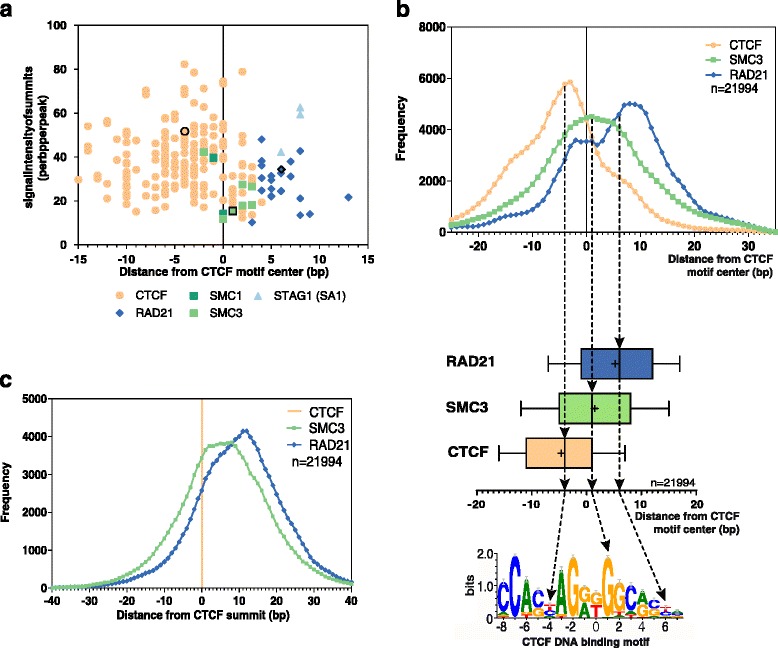
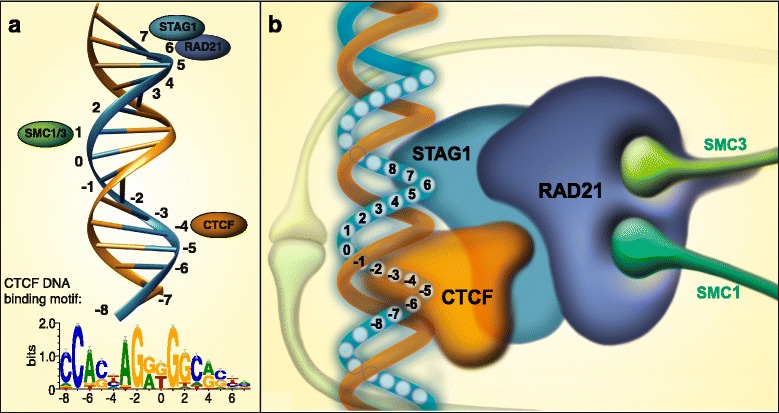
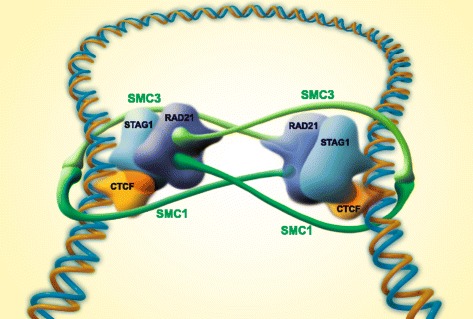
BACKGROUND: ChIP-seq provides a wealth of information on the approximate location of DNA-binding proteins genome-wide. It is known that the targeted motifs in most cases can be found at the peak centers. A high resolution mapping of ChIP-seq peaks could in principle allow the fine mapping of the protein constituents within protein complexes, but the current ChIP-seq analysis pipelines do not target the basepair resolution strand specific mapping of peak summits. RESULTS: The approach proposed here is based on i) locating regions that are bound by a sufficient number of proteins constituting a complex; ii) determining the position of the underlying motif using either a direct or a de novo motif search approach; and iii) determining the exact location of the peak summits with respect to the binding motif in a strand specific manner. We applied this method for analyzing the CTCF/cohesin complex, which holds together DNA loops. The relative positions of the constituents of the complex were determined with one-basepair estimated accuracy. Mapping the positions on a 3D model of DNA made it possible to deduce the approximate local topology of the complex that allowed us to predict how the CTCF/cohesin complex locks the DNA loops. As the positioning of the proteins was not compatible with previous models of loop closure, we proposed a plausible "double embrace" model in which the DNA loop is held together by two adjacent cohesin rings in such a way that the ring anchored by CTCF to one DNA duplex encircles the other DNA double helix and vice versa. CONCLUSIONS: A motif-centered, strand specific analysis of ChIP-seq data improves the accuracy of determining peak positions. If a genome contains a large number of binding sites for a given protein complex, such as transcription factor heterodimers or transcription factor/cofactor complexes, the relative position of the constituent proteins on the DNA can be established with an accuracy that allow one to deduce the local topology of the protein complex. The proposed high resolution mapping approach of ChIP-seq data is applicable for detecting the contact topology of DNA-binding protein complexes.
Overview
The claims and statistics of this paper haven’t been checked yet.
Free: it reads the open-access text and checks the first 5 claims that cite a source we can check. Create a free account to check every claim.
Integrity signals
Registry
Cites
Statistics
Figures
Verification
Claims the paper makes
The claims and statistics of this paper haven’t been checked yet.
Free: it reads the open-access text and checks the first 5 claims that cite a source we can check. Create a free account to check every claim.
Claims other papers make about this one
Each is checked against this paper’s own text: does it say what the citing paper says it does?
The check wasn’t confident either way, so it gives no verdict — never disputed.
In the citing paper
“Loop formation by the related condensin complex appears to involve a DNA anchoring function of its HEAT-repeat subunit Ycg1, a paralogue of SA2/Scc340–42.”
From The structural basis for cohesin–CTCF-anchored loops (2020) · cites this paper as [40]
Experimental — accuracy not yet measured
Self-check
Percentages, sums and reported differences re-computed from the paper’s own numbers.
The self-check needs the paper’s full text.
Citations
Cites
Fast and accurate short read alignment with Burrows-Wheeler transform
Li, H., & Durbin, R. (2009) · Bioinformatics · doi:10.1093/bioinformatics/btp324 · Cited by 58,607
BEDTools: a flexible suite of utilities for comparing genomic features
Quinlan, A. R., & Hall, I. M. (2010) · Bioinformatics · doi:10.1093/bioinformatics/btq033 · Cited by 27,437
Model-based Analysis of ChIP-Seq (MACS)
Zhang, Y., Liu, T., Meyer, C. A., Eeckhoute, J., Johnson, D. S., Bernstein, B. E., Nusbaum, C., Myers, R. M., Brown, M., Li, W., et al. (2008) · Genome Biology · doi:10.1186/gb-2008-9-9-r137 · Cited by 18,386
An integrated encyclopedia of DNA elements in the human genome
The ENCODE Project Consortium (2012) · Nature · doi:10.1038/nature11247 · Cited by 18,072
Robinson, J. T., Thorvaldsdóttir, H., Winckler, W., Guttman, M., Lander, E. S., Getz, G., & Mesirov, J. P. (2011) · Nature Biotechnology · doi:10.1038/nbt.1754 · Cited by 15,390 · cited 1×
“[38 – 41].”
Heinz, S., Benner, C., Spann, N., Bertolino, E., Lin, Y. C., Laslo, P., Cheng, J. X., Murre, C., Singh, H., & Glass, C. K. (2010) · Molecular Cell · doi:10.1016/j.molcel.2010.05.004 · Cited by 13,382
Fast and accurate long-read alignment with Burrows-Wheeler transform.
Li, H., & Durbin, R. (2010) · Bioinformatics · doi:10.1093/bioinformatics/btp698 · Cited by 12,063 · cited 1×
“[38 – 41].”
Database resources of the National Center for Biotechnology Information: update
Wheeler, D. L. (2004) · Nucleic Acids Research · doi:10.1093/nar/gkh073 · Cited by 10,641
A 3D Map of the Human Genome at Kilobase Resolution Reveals Principles of Chromatin Looping
Rao, S. S. P., Huntley, M. H., Durand, N. C., Stamenova, E. K., Bochkov, I. D., Robinson, J. T., Sanborn, A. L., Machol, I., Omer, A. D., Lander, E. S., et al. (2014) · Cell · doi:10.1016/j.cell.2014.11.021 · Cited by 9,212 · cited 3×
“For example, models suggested in current studies [22, 24] consistently depict the ring in a distal position with respect to the loop and the anchoring CTCF molecules.”
BackgroundResultChIP–seq: advantages and challenges of a maturing technology
Park, P. J. (2009) · Nature Reviews Genetics · doi:10.1038/nrg2641 · Cited by 2,217 · cited 1×
“Peak summits are known to more-or-less coincide with the corresponding DNA elements [1].”
BackgroundFormation of chromosomal domains by loop extrusion
Fudenberg, G., Imakaev, M., Lu, C., Goloborodko, A., Abdennur, N., & Mirny, L. A. (2016) · Cell Reports · doi:10.1016/j.celrep.2016.04.085 · Cited by 2,003
Sanborn, A. L., Rao, S. S. P., Huang, S.-C., Durand, N. C., Huntley, M. H., Jewett, A. I., Bochkov, I. D., Chinnappan, D., Cutkosky, A., Li, J., et al. (2015) · Proceedings of the National Academy of Sciences · doi:10.1073/pnas.1518552112 · Cited by 1,730 · cited 2×
“This semi-fixed or free gliding is also in accordance with the loop extrusion model in which cohesin ring(s) are moving along the loop until finding the anchor points [30].”
MethodResultAnalysis of the Vertebrate Insulator Protein CTCF-Binding Sites in the Human Genome
Kim, T. H., Abdullaev, Z. K., Smith, A. D., Ching, K. A., Loukinov, D. I., Green, R. D., Zhang, M. Q., Lobanenkov, V. V., & Ren, B. (2007) · Cell · doi:10.1016/j.cell.2006.12.048 · Cited by 1,033
Database resources of the National Center for Biotechnology Information
Wheeler, D. L., Barrett, T., Benson, D. A., Bryant, S. H., Canese, K., Chetvernin, V., Church, D. M., DiCuccio, M., Edgar, R., Federhen, S., et al. (2007) · Nucleic Acids Research · doi:10.1093/nar/gkm1000 · Cited by 1,007
CTCF-Mediated Human 3D Genome Architecture Reveals Chromatin Topology for Transcription
Tang, Z., Luo, O. J., Li, X., Zheng, M., Zhu, J. J., Szalaj, P., Trzaskoma, P., Magalska, A., Wlodarczyk, J., Ruszczycki, B., et al. (2015) · Cell · doi:10.1016/j.cell.2015.11.024 · Cited by 982
Cohesin: Its Roles and Mechanisms
Nasmyth, K., & Haering, C. H. (2009) · Annual Review of Genetics · doi:10.1146/annurev-genet-102108-134233 · Cited by 974
CRISPR Inversion of CTCF Sites Alters Genome Topology and Enhancer/Promoter Function
Guo, Y., Xu, Q., Canzio, D., Shou, J., Li, J., Gorkin, D. U., Jung, I., Wu, H., Zhai, Y., Tang, Y., et al. (2015) · Cell · doi:10.1016/j.cell.2015.07.038 · Cited by 958 · cited 2×
“In particular, our model supports the recent findings of Rao et al. [22] and Guo et al. [25] who showed that the two CTS anchor sites flanking a DNA loop must align in a convergent orientation.”
BackgroundResultMolecular Architecture of SMC Proteins and the Yeast Cohesin Complex
Haering, C. H., Löwe, J., Hochwagen, A., & Nasmyth, K. (2002) · Molecular Cell · doi:10.1016/s1097-2765(02)00515-4 · Cited by 729
Activity-Induced DNA Breaks Govern the Expression of Neuronal Early-Response Genes
Madabhushi, R., Gao, F., Pfenning, A. R., Pan, L., Yamakawa, S., Seo, J., Rueda, R., Phan, T. X., Yamakawa, H., Pao, P.-C., et al. (2015) · Cell · doi:10.1016/j.cell.2015.05.032 · Cited by 700 · cited 1×
“For example, models suggested in current studies [22, 24] consistently depict the ring in a distal position with respect to the loop and the anchoring CTCF molecules.”
BackgroundInsulators: many functions, many mechanisms
West, A. G., Gaszner, M., & Felsenfeld, G. (2002) · Genes & Development · doi:10.1101/gad.954702 · Cited by 631
Chromosomal Cohesin Forms a Ring
Gruber, S., Haering, C. H., & Nasmyth, K. (2003) · Cell · doi:10.1016/s0092-8674(03)00162-4 · Cited by 603
CTCF is a uniquely versatile transcription regulator linked to epigenetics and disease
Ohlsson, R., Renkawitz, R., & Lobanenkov, V. (2001) · Trends in Genetics · doi:10.1016/s0168-9525(01)02366-6 · Cited by 591 · cited 1×
“CCCTC-binding factor (CTCF) is an 11-zinc finger protein, which binds to specific recognition sites (CTSs) on the DNA [13 – 15] that are supposed to serve as insulator elements [11, 16].”
Database resources of the National Center for Biotechnology Information
Wheeler, D. L. (2000) · Nucleic Acids Research · doi:10.1093/nar/28.1.10 · Cited by 582
Cohesins form chromosomal cis-interactions at the developmentally regulated IFNG locus
Hadjur, S., Williams, L. M., Ryan, N. K., Cobb, B. S., Sexton, T., Fraser, P., Fisher, A. G., & Merkenschlager, M. (2009) · Nature · doi:10.1038/nature08079 · Cited by 525
CTCF physically links cohesin to chromatin
Rubio, E. D., Reiss, D. J., Welcsh, P. L., Disteche, C. M., Filippova, G. N., Baliga, N. S., Aebersold, R., Ranish, J. A., & Krumm, A. (2008) · Proceedings of the National Academy of Sciences · doi:10.1073/pnas.0801273105 · Cited by 511
The cohesin ring concatenates sister DNA molecules
Haering, C. H., Farcas, A.-M., Arumugam, P., Metson, J., & Nasmyth, K. (2008) · Nature · doi:10.1038/nature07098 · Cited by 494
CTCF and Cohesin: Linking Gene Regulatory Elements with Their Targets
Merkenschlager, M., & Odom, D. T. (2013) · Cell · doi:10.1016/j.cell.2013.02.029 · Cited by 345
Evidence that Loading of Cohesin Onto Chromosomes Involves Opening of Its SMC Hinge
Gruber, S., Arumugam, P., Katou, Y., Kuglitsch, D., Helmhart, W., Shirahige, K., & Nasmyth, K. (2006) · Cell · doi:10.1016/j.cell.2006.08.048 · Cited by 287
Closing the cohesin ring: Structure and function of its Smc3-kleisin interface
Gligoris, T. G., Scheinost, J. C., Bürmann, F., Petela, N., Chan, K.-L., Uluocak, P., Beckouët, F., Gruber, S., Nasmyth, K., & Löwe, J. (2014) · Science · doi:10.1126/science.1256917 · Cited by 268
Single-molecule imaging reveals a collapsed conformational state for DNA-bound cohesin
Stigler, J., Çamdere, G. Ö., Koshland, D. E., & Greene, E. C. (2016) · Cell Reports · doi:10.1016/j.celrep.2016.04.003 · Cited by 229 · cited 1×
“Current models disagree even on fundamental points such as the number of DNA duplexes enclosed within a cohesin ring [4, 8, 9, 11, 12, 19 – 23].”
BackgroundChromatin Insulators: Linking Genome Organization to Cellular Function
Phillips-Cremins, J. E., & Corces, V. G. (2013) · Molecular Cell · doi:10.1016/j.molcel.2013.04.018 · Cited by 213
Piper, J., Elze, M. C., Cauchy, P., Cockerill, P. N., Bonifer, C., & Ott, S. (2013) · Nucleic Acids Research · doi:10.1093/nar/gkt850 · Cited by 202
Xiao, T., Wallace, J., & Felsenfeld, G. (2011) · Molecular and Cellular Biology · doi:10.1128/mcb.05093-11 · Cited by 182
A handcuff model for the cohesin complex
Zhang, N., Kuznetsov, S. G., Sharan, S. K., Li, K., Rao, P. H., & Pati, D. (2008) · The Journal of Cell Biology · doi:10.1083/jcb.200801157 · Cited by 181
Does CTCF mediate between nuclear organization and gene expression?
Ohlsson, R., Lobanenkov, V., & Klenova, E. (2010) · BioEssays · doi:10.1002/bies.200900118 · Cited by 167
DNA analysis servers: plot.it, bend.it, model.it and IS
Vlahoviček, K., Kaján, L., & Pongor, S. (2003) · Nucleic Acids Research · doi:10.1093/nar/gkg559 · Cited by 150
Self-citationCohesin, a chromatin engagement ring
Remeseiro, S., & Losada, A. (2012) · Current Opinion in Cell Biology · doi:10.1016/j.ceb.2012.10.013 · Cited by 125
Starick, S. R., Ibn-Salem, J., Jurk, M., Hernandez, C., Love, M. I., Chung, H.-R., Vingron, M., Thomas-Chollier, M., & Meijsing, S. H. (2015) · Genome Research · doi:10.1101/gr.185157.114 · Cited by 123
The genomic landscape of cohesin-associated chromatin interactions
DeMare, L. E., Leng, J., Cotney, J., Reilly, S. K., Yin, J., Sarro, R., & Noonan, J. P. (2013) · Genome Research · doi:10.1101/gr.156570.113 · Cited by 114
Getting the genome in shape: the formation of loops, domains and compartments
Bouwman, B. A., & de Laat, W. (2015) · Genome Biology · doi:10.1186/s13059-015-0730-1 · Cited by 113
The active enhancer network operated by liganded RXR supports angiogenic activity in macrophages
Daniel, B., Nagy, G., Hah, N., Horvath, A., Czimmerer, Z., Poliska, S., Gyuris, T., Keirsse, J., Gysemans, C., Van Ginderachter, J. A., et al. (2014) · Genes & Development · doi:10.1101/gad.242685.114 · Cited by 97 · cited 1×
“Earlier, we assigned the RXR-activated enhancers to induced genes in bone marrow derived macrophages through the use of regions bordered by active insulators that were bound both by CTCF and RAD21 [26].”
BackgroundSelf-citationMACE: model based analysis of ChIP-exo
Wang, L., Chen, J., Wang, C., Uusküla-Reimand, L., Chen, K., Medina-Rivera, A., Young, E. J., Zimmermann, M. T., Yan, H., Sun, Z., et al. (2014) · Nucleic Acids Research · doi:10.1093/nar/gku846 · Cited by 77
Cohesin: a regulator of genome integrity and gene expression
Feeney, K. M., Wasson, C. W., & Parish, J. L. (2010) · Biochemical Journal · doi:10.1042/bj20100151 · Cited by 46
Command line analysis of ChIP-seq results
Barta, E. (2011) · EMBnet.journal · doi:10.14806/ej.17.1.209 · Cited by 39
Self-citationCohesin-mediated chromatin interactions--into the third dimension of gene regulation
Sofueva, S., & Hadjur, S. (2012) · Briefings in Functional Genomics · doi:10.1093/bfgp/elr048 · Cited by 24
How are cohesin rings opened and closed?
Shintomi, K., & Hirano, T. (2007) · Trends in Biochemical Sciences · doi:10.1016/j.tibs.2007.02.002 · Cited by 23
ATPase-dependent auto-phosphorylation of the open condensin hinge diminishes DNA binding
Akai, Y., Kanai, R., Nakazawa, N., Ebe, M., Toyoshima, C., & Yanagida, M. (2014) · Open Biology · doi:10.1098/rsob.140193 · Cited by 8
Cited by
Organizational principles of 3D genome architecture
Rowley, M. J., & Corces, V. G. (2018) · Nature Reviews Genetics · doi:10.1038/s41576-018-0060-8 · Cited by 1,171
The structural basis for cohesin–CTCF-anchored loops
Li, Y., Haarhuis, J. H. I., Sedeño Cacciatore, Á., Oldenkamp, R., van Ruiten, M. S., Willems, L., Teunissen, H., Muir, K. W., de Wit, E., Rowland, B. D., et al. (2020) · Nature · doi:10.1038/s41586-019-1910-z · Cited by 459
CTCF mediates chromatin looping via N-terminal domain-dependent cohesin retention
Pugacheva, E. M., Kubo, N., Loukinov, D., Tajmul, M., Kang, S., Kovalchuk, A. L., Strunnikov, A. V., Zentner, G. E., Ren, B., & Lobanenkov, V. V. (2020) · Proceedings of the National Academy of Sciences · doi:10.1073/pnas.1911708117 · Cited by 220
Loop extrusion: theory meets single-molecule experiments
Banigan, E. J., & Mirny, L. A. (2020) · Current Opinion in Cell Biology · doi:10.1016/j.ceb.2020.04.011 · Cited by 161
Chromosome organization by one-sided and two-sided loop extrusion
Banigan, E. J., van den Berg, A. A., Brandão, H. B., Marko, J. F., & Mirny, L. A. (2020) · eLife · doi:10.7554/elife.53558 · Cited by 146
Metadata
- Authors
- Nagy, G., Czipa, E., Steiner, L., Nagy, T., Pongor, S., Nagy, L., & Barta, E.
- Affiliations
- University of Debrecen (HU)
- UD-GenoMed (Hungary) (HU)
- Wellcome Sanger Institute (GB)
- Pázmány Péter Catholic University (HU)
- Corresponding author
- Barta, Endre
- Venue
- BMC Genomics
- Published
- 2016-08-15
- Volume
- 17
- Issue
- 1
- Pages
- 637-637
- ISSN
- 1471-2164 (ISSN-L)
- PMC
- PMC4986361
- OpenAlex
- W2513604103
- Cited by
- 27
- References
- 47
- Citations by year
- 2026: 1 · 2024: 3 · 2023: 3 · 2022: 1 · 2021: 1 · 2020: 7 · 2019: 6 · 2018: 2 · 2017: 2 · 2016: 1
- FWCI
- 1.91
- Type
- journal article
- Language
- en
- Open access
- gold
- doi.org
- Licence
- cc-by
- Locations
- BMC Genomics (publishedVersion, cc-by)
- Europe PMC (PubMed Central) (publishedVersion, cc-by)
- PubMed Central (publishedVersion, cc-by)
- PubMed (publishedVersion)
- Repository of the Academy's Library (Library of the Hungarian Academy of Sciences) (acceptedVersion)
- University of Debrecen Electronic Archive (University of Debrecen) (submittedVersion, other-oa)
- University of Debrecen Electronic Archive (University of Debrecen) (submittedVersion)
- University of Debrecen Electronic Archive (University of Debrecen) (submittedVersion, cc-by)
- Funders
- Hungarian Ministry of Agriculture (NAIK-MBK/M71411)
- Nemzeti Fejlesztési Minisztérium (TÁMOP-4.2.2.C-11/1/KONV-2012-0010)
- Topics
- Life Sciences › Biochemistry, Genetics and Molecular Biology › Molecular Biology › Genomics and Chromatin Dynamics
- Life Sciences › Biochemistry, Genetics and Molecular Biology › Molecular Biology › Chromatin Remodeling and Cancer
- Life Sciences › Biochemistry, Genetics and Molecular Biology › Molecular Biology › Genomics and Phylogenetic Studies
- Keywords
- CTCF, cohesin, cohesin ring
- MeSH terms
- CCCTC-Binding Factor, Cohesins, Animals, Binding Sites, Chromosomal Proteins, Non-Histone, DNA, Humans, Nuclear Proteins, Nucleic Acid Conformation, Protein Binding, Repressor Proteins, Sequence Analysis, DNA, Cell Cycle Proteins, Chromatin Immunoprecipitation, Mice, High-Throughput Nucleotide Sequencing
About these checks
Registry, retraction, Cites and statistics results are computed, not judged, with one exception: a printed reference that no index lists is read once by a model before it counts as a citation error. Claims are extracted by a model and kept only when their quote appears verbatim in the text; each cited source is then checked, with a model’s help, for whether it says what the claim relies on. Those verdicts can be wrong — read the claim’s quote and the cited source before relying on one.
Statistics and arithmetic are recomputed, not judged.
Confidence bands are shown only for fields calibrated on our annotated test set. None is calibrated yet, so no band is shown.
What counts as a claim ›How we measure confidence ›How we check this ›
Are you an author, or do you see a problem with this page? Request a review
Data sources
Bibliographic data: Semantic Scholar, OpenAlex, Crossref.
Contains information from the Semantic Scholar Academic Graph Datasets, made available under the ODC Attribution License (ODC-BY 1.0).
Semantic Scholar’s data is described in: Kinney, R., et al. (2023). The Semantic Scholar Open Data Platform. arXiv:2301.10140.
