

Single-cell mRNA isoform diversity in the mouse brain
Open accessThe DOI matches its Crossref record; 30 of the 30 references it cites were found in a registry or an index.
Abstract
BACKGROUND: Alternative mRNA isoform usage is an important source of protein diversity in mammalian cells. This phenomenon has been extensively studied in bulk tissues, however, it remains unclear how this diversity is reflected in single cells. RESULTS: Here we use long-read sequencing technology combined with unique molecular identifiers (UMIs) to reveal patterns of alternative full-length isoform expression in single cells from the mouse brain. We found a surprising amount of isoform diversity, even after applying a conservative definition of what constitutes an isoform. Genes tend to have one or a few isoforms highly expressed and a larger number of isoforms expressed at a low level. However, for many genes, nearly every sequenced mRNA molecule was unique, and many events affected coding regions suggesting previously unknown protein diversity in single cells. Exon junctions in coding regions were less prone to splicing errors than those in non-coding regions, indicating purifying selection on splice donor and acceptor efficiency. CONCLUSIONS: Our findings indicate that mRNA isoform diversity is an important source of biological variability also in single cells.
Overview
The claims and statistics of this paper haven’t been checked yet.
Free: it reads the open-access text and checks the first 5 claims that cite a source we can check. Create a free account to check every claim.
Integrity signals
Registry
Cites
Statistics
Figures
Verification
Claims the paper makes
The claims and statistics of this paper haven’t been checked yet.
Free: it reads the open-access text and checks the first 5 claims that cite a source we can check. Create a free account to check every claim.
Claims other papers make about this one
Each is checked against this paper’s own text: does it say what the citing paper says it does?
In the citing paper
“applying this technology to single cells has proven to be difficult, with less than ten single-cell transcriptomes having been analyzed thus far 12,13”
From Single-cell isoform RNA sequencing characterizes isoforms in thousands of cerebellar cells (2018) · cites this paper as [12]
Self-check
Percentages, sums and reported differences re-computed from the paper’s own numbers.
The self-check needs the paper’s full text.
Citations
Cites
Landscape of transcription in human cells
Djebali, S., Davis, C. A., Merkel, A., Dobin, A., Lassmann, T., Mortazavi, A., Tanzer, A., Lagarde, J., Lin, W., Schlesinger, F., et al. (2012) · Nature · doi:10.1038/nature11233 · Cited by 5,187 · cited 1×
“A recent paper [14] from the Encode consortium combining RNA-seq, CAGE and paired end tags found that cell lines tend to express genes as multiple isoforms simultaneously and that the number of isoforms per gene grew with increased number of annotated isoforms.”
BackgroundAlternative isoform regulation in human tissue transcriptomes
Wang, E. T., Sandberg, R., Luo, S., Khrebtukova, I., Zhang, L., Mayr, C., Kingsmore, S. F., Schroth, G. P., & Burge, C. B. (2008) · Nature · doi:10.1038/nature07509 · Cited by 5,181 · cited 1×
“With the introduction of mRNA sequencing technology, today we know that more than 90% of all multi-exon genes in humans are alternatively spliced [3, 4].”
BackgroundPan, Q., Shai, O., Lee, L. J., Frey, B. J., & Blencowe, B. J. (2008) · Nature Genetics · doi:10.1038/ng.259 · Cited by 3,951 · cited 2×
“With the introduction of mRNA sequencing technology, today we know that more than 90% of all multi-exon genes in humans are alternatively spliced [3, 4].”
BackgroundReal-Time DNA Sequencing from Single Polymerase Molecules
Eid, J., Fehr, A., Gray, J., Luong, K., Lyle, J., Otto, G., Peluso, P., Rank, D., Baybayan, P., Bettman, B., et al. (2009) · Science · doi:10.1126/science.1162986 · Cited by 3,732
Cell types in the mouse cortex and hippocampus revealed by single-cell RNA-seq
Zeisel, A., Muñoz-Manchado, A. B., Codeluppi, S., Lönnerberg, P., La Manno, G., Juréus, A., Marques, S., Munguba, H., He, L., Betsholtz, C., et al. (2015) · Science · doi:10.1126/science.aaa1934 · Cited by 3,124
Self-citationEnhancements and modifications of primer design program Primer3
Koressaar, T., & Remm, M. (2007) · Bioinformatics · doi:10.1093/bioinformatics/btm091 · Cited by 2,603 · cited 1×
“Primers were designed with Primer3 software [31].”
GMAP: A genomic mapping and alignment program for mRNA and EST sequences
Wu, T. D., & Watanabe, C. K. (2005) · Bioinformatics · doi:10.1093/bioinformatics/bti310 · Cited by 2,354 · cited 1×
“genome with GMAP (version 2014-10-22) and only uniquely aligned molecules were kept [29].”
MethodExpansion of the eukaryotic proteome by alternative splicing
Nilsen, T. W., & Graveley, B. R. (2010) · Nature · doi:10.1038/nature08909 · Cited by 2,197 · cited 2×
“Alternative isoform usage has also been shown to have functional importance [7] and to be dysregulated in disease, e.”
BackgroundA promoter-level mammalian expression atlas
The FANTOM Consortium and the RIKEN PMI and CLST (DGT) (2014) · Nature · doi:10.1038/nature13182 · Cited by 1,982
Single-cell transcriptomics reveals bimodality in expression and splicing in immune cells
Shalek, A. K., Satija, R., Adiconis, X., Gertner, R. S., Gaublomme, J. T., Raychowdhury, R., Schwartz, S., Yosef, N., Malboeuf, C., Lu, D., et al. (2013) · Nature · doi:10.1038/nature12172 · Cited by 1,190 · cited 1×
“, 3′ polyadenylation [9] and exon-cassette inclusion [10], but not yet full-length isoforms.”
BackgroundQuantitative single-cell RNA-seq with unique molecular identifiers
Islam, S., Zeisel, A., Joost, S., La Manno, G., Zajac, P., Kasper, M., Lönnerberg, P., & Linnarsson, S. (2014) · Nature Methods · doi:10.1038/nmeth.2772 · Cited by 1,183 · cited 2×
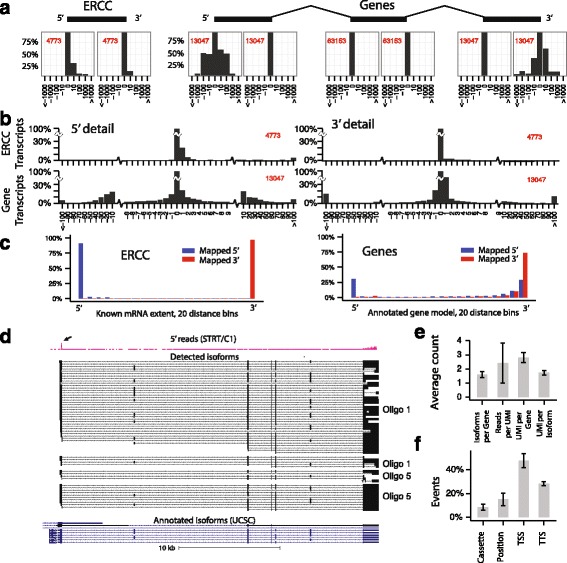
“The cDNA was previously prepared using STRT/C1 [23], which resulted in fulllength cDNA normally sequenced from the 5′ end, to indicate only the transcription start site.”
MethodSelf-citationDetection and quantification of rare mutations with massively parallel sequencing
Kinde, I., Wu, J., Papadopoulos, N., Kinzler, K. W., & Vogelstein, B. (2011) · Proceedings of the National Academy of Sciences · doi:10.1073/pnas.1105422108 · Cited by 1,144 · cited 1×
“This technology was instrumental since it allowed both identification and counting of individual cDNA molecules [19], and correct sequencing errors [20, 21].”
Counting absolute numbers of molecules using unique molecular identifiers
Kivioja, T., Vähärautio, A., Karlsson, K., Bonke, M., Enge, M., Linnarsson, S., & Taipale, J. (2012) · Nature Methods · doi:10.1038/nmeth.1778 · Cited by 1,010
Self-citationA large-scale analysis of mRNA polyadenylation of human and mouse genes
Tian, B. (2005) · Nucleic Acids Research · doi:10.1093/nar/gki158 · Cited by 956 · cited 1×
“Alternative isoform usage has been studied at the 5′ end [5]; for exon splicing [3] and at the 3′ end [6].”
BackgroundCharacterization of the single-cell transcriptional landscape by highly multiplex RNA-seq
Islam, S., Kjällquist, U., Moliner, A., Zajac, P., Fan, J.-B., Lönnerberg, P., & Linnarsson, S. (2011) · Genome Research · doi:10.1101/gr.110882.110 · Cited by 949 · cited 1×
“This was in agreement with our previous finding that endogenous genes tend to be truncated at their 5′ ends, probably partly representing ongoing mRNA degradation [25], partly the presence of unannotated alternative transcription start sites, and partly due to strand invasion during reverse transcription, which has be…”
ResultSelf-citationTwo mRNAs can be produced from a single immunoglobulin μ gene by alternative RNA processing pathways
Early, P. (1980) · Cell · doi:10.1016/0092-8674(80)90617-0 · Cited by 874
A single-molecule long-read survey of the human transcriptome
Sharon, D., Tilgner, H., Grubert, F., & Snyder, M. (2013) · Nature Biotechnology · doi:10.1038/nbt.2705 · Cited by 701 · cited 2×
“Similarly, a study using long-read sequencing showed that the majority of genes are alternatively spliced [15].”
MethodAlt, F. (1980) · Cell · doi:10.1016/0092-8674(80)90615-7 · Cited by 562
Extensive transcriptional heterogeneity revealed by isoform profiling
Pelechano, V., Wei, W., & Steinmetz, L. M. (2013) · Nature · doi:10.1038/nature12121 · Cited by 451 · cited 7×
“Alternative TSS and TTS variation represented more than 70% of all isoform-generating events (Fig.”
BackgroundInfluentialTowards error-free profiling of immune repertoires
Shugay, M., Britanova, O. V., Merzlyak, E. M., Turchaninova, M. A., Mamedov, I. Z., Tuganbaev, T. R., Bolotin, D. A., Staroverov, D. B., Putintseva, E. V., Plevova, K., et al. (2014) · Nature Methods · doi:10.1038/nmeth.2960 · Cited by 428 · cited 1×
“This technology was instrumental since it allowed both identification and counting of individual cDNA molecules [19], and correct sequencing errors [20, 21].”
BackgroundPredicting the molecular complexity of sequencing libraries
Daley, T., & Smith, A. D. (2013) · Nature Methods · doi:10.1038/nmeth.2375 · Cited by 374 · cited 2×
“Preseq was originally intended to measure the complexity of libraries from the number of unique positions and read depth and to get an estimation of how deep the library would need to be sequenced in order to reach the intended coverage [27].”
BackgroundMethodTwine, N. A., Janitz, K., Wilkins, M. R., & Janitz, M. (2011) · PLoS ONE · doi:10.1371/journal.pone.0016266 · Cited by 288 · cited 1×
“, in cancer [16] and Alzheimer’s disease [17].”
BackgroundAlternative transcription initiation leads to expression of a novel ALK isoform in cancer
Wiesner, T., Lee, W., Obenauf, A. C., Ran, L., Murali, R., Zhang, Q. F., Wong, E. W. P., Hu, W., Scott, S. N., Shah, R. H., et al. (2015) · Nature · doi:10.1038/nature15258 · Cited by 248 · cited 1×
“, in cancer [16] and Alzheimer’s disease [17].”
BackgroundTilgner, H., Jahanbani, F., Blauwkamp, T., Moshrefi, A., Jaeger, E., Chen, F., Harel, I., Bustamante, C. D., Rasmussen, M., & Snyder, M. P. (2015) · Nature Biotechnology · doi:10.1038/nbt.3242 · Cited by 223
Thu, C. A., Chen, W. V., Rubinstein, R., Chevee, M., Wolcott, H. N., Felsovalyi, K. O., Tapia, J. C., Shapiro, L., Honig, B., & Maniatis, T. (2014) · Cell · doi:10.1016/j.cell.2014.07.012 · Cited by 214
Determining exon connectivity in complex mRNAs by nanopore sequencing
Bolisetty, M. T., Rajadinakaran, G., & Graveley, B. R. (2015) · Genome Biology · doi:10.1186/s13059-015-0777-z · Cited by 137 · cited 2×
“38,000 isoforms [12] and is required for neurite selfavoidance in the wiring of the Drosophila nervous system.”
BackgroundCell‐to‐cell variability of alternative RNA splicing
Waks, Z., Klein, A. M., & Silver, P. A. (2011) · Molecular Systems Biology · doi:10.1038/msb.2011.32 · Cited by 106 · cited 1×
“Currently the most common approach to study alternative isoform usage is by second generation sequencing, but some studies have also been performed using imaging [8].”
Tang, D. T. P., Plessy, C., Salimullah, M., Suzuki, A. M., Calligaris, R., Gustincich, S., & Carninci, P. (2013) · Nucleic Acids Research · doi:10.1093/nar/gks1128 · Cited by 72 · cited 1×
“This was in agreement with our previous finding that endogenous genes tend to be truncated at their 5′ ends, probably partly representing ongoing mRNA degradation [25], partly the presence of unannotated alternative transcription start sites, and partly due to strand invasion during reverse transcription, which has be…”
ResultCounting absolute number of molecules using unique molecular identifiers
Kivioja, T., Vähärautio, A., Karlsson, K., Bonke, M., Linnarsson, S., & Taipale, J. (2011) · Nature Precedings · doi:10.1038/npre.2011.5903.1 · Cited by 58
Self-citationSingle‐cell polyadenylation site mapping reveals 3′ isoform choice variability
Velten, L., Anders, S., Pekowska, A., Järvelin, A. I., Huber, W., Pelechano, V., & Steinmetz, L. M. (2015) · Molecular Systems Biology · doi:10.15252/msb.20156198 · Cited by 58
Research works printed but not linked: 1
- Primer Blast. [ http://www.ncbi.nlm.nih.gov/tools/primer-blast/] (2016). Accessed 17 July 2016.
Cited by
Opportunities and challenges in long-read sequencing data analysis
Amarasinghe, S. L., Su, S., Dong, X., Zappia, L., Ritchie, M. E., & Gouil, Q. (2020) · Genome Biology · doi:10.1186/s13059-020-1935-5 · Cited by 2,530
Karst, S. M., Ziels, R. M., Kirkegaard, R. H., Sørensen, E. A., McDonald, D., Zhu, Q., Knight, R., & Albertsen, M. (2021) · Nature Methods · doi:10.1038/s41592-020-01041-y · Cited by 423
Byrne, A., Beaudin, A. E., Olsen, H. E., Jain, M., Cole, C., Palmer, T., DuBois, R. M., Forsberg, E. C., Akeson, M., & Vollmers, C. (2017) · Nature Communications · doi:10.1038/ncomms16027 · Cited by 379
Single-cell isoform RNA sequencing characterizes isoforms in thousands of cerebellar cells
Gupta, I., Collier, P. G., Haase, B., Mahfouz, A., Joglekar, A., Floyd, T., Koopmans, F., Barres, B., Smit, A. B., Sloan, S. A., et al. (2018) · Nature Biotechnology · doi:10.1038/nbt.4259 · Cited by 343
Identifying cell populations with scRNASeq
Andrews, T. S., & Hemberg, M. (2018) · Molecular Aspects of Medicine · doi:10.1016/j.mam.2017.07.002 · Cited by 248
“These studies include various regions of the brain (Darmanis et al., 2015; Karlsson and Linnarsson, 2017; Liu et al., 2016; Tasic et al., 2016; Zeisel et al., 2015), retina ((Baron et al., 2016; Jaitin et al., 2014; Macosko et al., 2015; Zheng et al., 2017)), pancreas (Baron et al., 2016;…”
Background
Metadata
- Authors
- Karlsson, K., & Linnarsson, S.
- Affiliations
- Stanford Medicine (US)
- Karolinska Institutet (SE)
- Corresponding author
- Linnarsson, Sten
- Venue
- BMC Genomics
- Published
- 2017-02-03
- Volume
- 18
- Issue
- 1
- Pages
- 126-126
- ISSN
- 1471-2164 (ISSN-L)
- PMC
- PMC5291953
- OpenAlex
- W2583748529
- Cited by
- 76
- References
- 30
- Citations by year
- 2026: 4 · 2025: 8 · 2024: 9 · 2023: 3 · 2022: 3 · 2021: 14 · 2020: 11 · 2019: 6 · 2018: 10 · 2017: 8
- FWCI
- 3.91
- Type
- journal article
- Language
- en
- Open access
- gold
- doi.org
- Licence
- cc-by
- Locations
- BMC Genomics (publishedVersion, cc-by)
- PubMed Central (publishedVersion, cc-by)
- PubMed (publishedVersion)
- Funders
- Swedish Research Council (STARGET)
- European Research Council (261063)
- Topics
- Life Sciences › Biochemistry, Genetics and Molecular Biology › Molecular Biology › RNA Research and Splicing
- Life Sciences › Biochemistry, Genetics and Molecular Biology › Molecular Biology › Single-cell and spatial transcriptomics
- Life Sciences › Biochemistry, Genetics and Molecular Biology › Molecular Biology › Genomics and Phylogenetic Studies
- Keywords
- alternative splicing, single-cell transcriptomics, mouse brain, long-read sequencing, unique molecular identifiers, exon-exon junctions, purifying selection, protein diversity
- MeSH terms
- Animals, Brain, RNA, Messenger, Alternative Splicing, Genetic Heterogeneity, Computational Biology, Mice, Single-Cell Analysis, High-Throughput Nucleotide Sequencing, RNA Isoforms
About these checks
Registry, retraction, Cites and statistics results are computed, not judged, with one exception: a printed reference that no index lists is read once by a model before it counts as a citation error. Claims are extracted by a model and kept only when their quote appears verbatim in the text; each cited source is then checked, with a model’s help, for whether it says what the claim relies on. Those verdicts can be wrong — read the claim’s quote and the cited source before relying on one.
Statistics and arithmetic are recomputed, not judged.
Confidence bands are shown only for fields calibrated on our annotated test set. None is calibrated yet, so no band is shown.
What counts as a claim ›How we measure confidence ›How we check this ›
Are you an author, or do you see a problem with this page? Request a review
Data sources
Bibliographic data: Semantic Scholar, OpenAlex, Crossref.
Contains information from the Semantic Scholar Academic Graph Datasets, made available under the ODC Attribution License (ODC-BY 1.0).
Semantic Scholar’s data is described in: Kinney, R., et al. (2023). The Semantic Scholar Open Data Platform. arXiv:2301.10140.
