

Single-cell mRNA isoform diversity in the mouse brain
Open accessThe DOI matches its Crossref record; 30 of the 30 references it cites were found in a registry or an index.
Abstract
BACKGROUND: Alternative mRNA isoform usage is an important source of protein diversity in mammalian cells. This phenomenon has been extensively studied in bulk tissues, however, it remains unclear how this diversity is reflected in single cells. RESULTS: Here we use long-read sequencing technology combined with unique molecular identifiers (UMIs) to reveal patterns of alternative full-length isoform expression in single cells from the mouse brain. We found a surprising amount of isoform diversity, even after applying a conservative definition of what constitutes an isoform. Genes tend to have one or a few isoforms highly expressed and a larger number of isoforms expressed at a low level. However, for many genes, nearly every sequenced mRNA molecule was unique, and many events affected coding regions suggesting previously unknown protein diversity in single cells. Exon junctions in coding regions were less prone to splicing errors than those in non-coding regions, indicating purifying selection on splice donor and acceptor efficiency. CONCLUSIONS: Our findings indicate that mRNA isoform diversity is an important source of biological variability also in single cells.
Overview
The claims and statistics of this paper haven’t been checked yet.
Free: it reads the open-access text and checks the first 5 claims that cite a source we can check. Create a free account to check every claim.
Integrity signals
Registry
Cites
Statistics
Figures
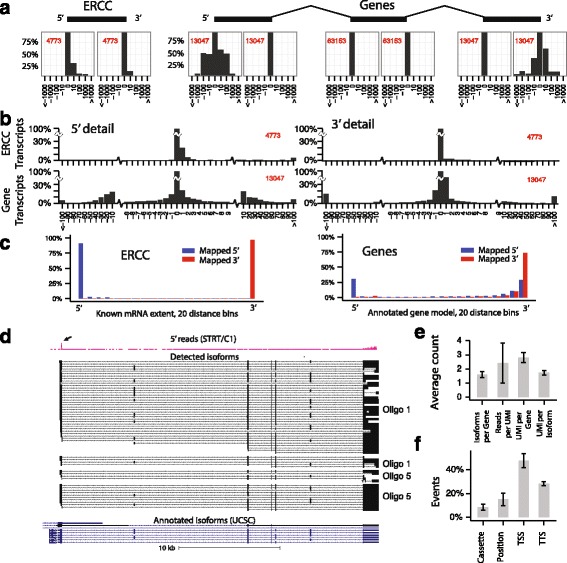
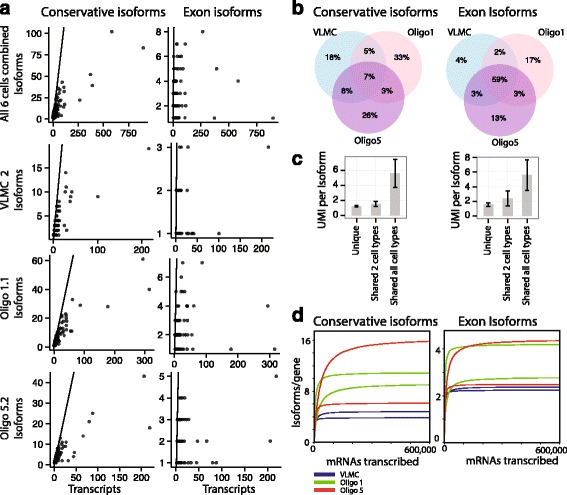
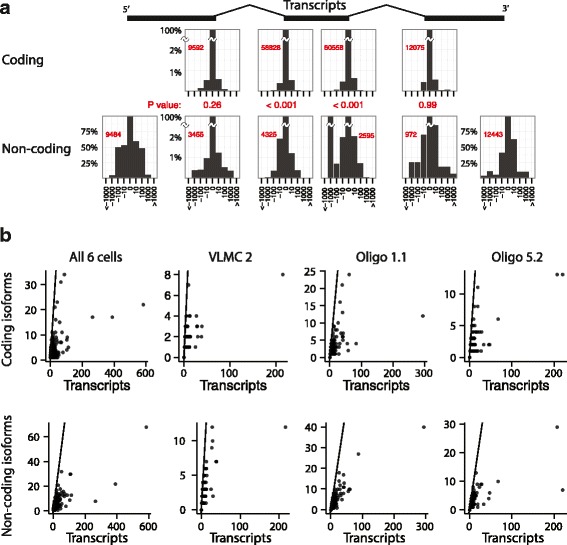
Verification
Claims the paper makes
The claims and statistics of this paper haven’t been checked yet.
Free: it reads the open-access text and checks the first 5 claims that cite a source we can check. Create a free account to check every claim.
Claims other papers make about this one
Each is checked against this paper’s own text: does it say what the citing paper says it does?
In the citing paper
“applying this technology to single cells has proven to be difficult, with less than ten single-cell transcriptomes having been analyzed thus far 12,13”
From Single-cell isoform RNA sequencing characterizes isoforms in thousands of cerebellar cells (2018) · cites this paper as [12]
Self-check
Percentages, sums and reported differences re-computed from the paper’s own numbers.
The self-check needs the paper’s full text.
Citations
Cites
Landscape of transcription in human cells
Djebali, S., Davis, C. A., Merkel, A., Dobin, A., Lassmann, T., Mortazavi, A., Tanzer, A., Lagarde, J., Lin, W., Schlesinger, F., et al. (2012) · Nature · doi:10.1038/nature11233 · Cited by 5,187 · cited 1×
“A recent paper [14] from the Encode consortium combining RNA-seq, CAGE and paired end tags found that cell lines tend to express genes as multiple isoforms simultaneously and that the number of isoforms per gene grew with increased number of annotated isoforms.”
BackgroundAlternative isoform regulation in human tissue transcriptomes
Wang, E. T., Sandberg, R., Luo, S., Khrebtukova, I., Zhang, L., Mayr, C., Kingsmore, S. F., Schroth, G. P., & Burge, C. B. (2008) · Nature · doi:10.1038/nature07509 · Cited by 5,181 · cited 1×
“With the introduction of mRNA sequencing technology, today we know that more than 90% of all multi-exon genes in humans are alternatively spliced [3, 4].”
BackgroundPan, Q., Shai, O., Lee, L. J., Frey, B. J., & Blencowe, B. J. (2008) · Nature Genetics · doi:10.1038/ng.259 · Cited by 3,951 · cited 2×
“With the introduction of mRNA sequencing technology, today we know that more than 90% of all multi-exon genes in humans are alternatively spliced [3, 4].”
BackgroundReal-Time DNA Sequencing from Single Polymerase Molecules
Eid, J., Fehr, A., Gray, J., Luong, K., Lyle, J., Otto, G., Peluso, P., Rank, D., Baybayan, P., Bettman, B., et al. (2009) · Science · doi:10.1126/science.1162986 · Cited by 3,732
Cell types in the mouse cortex and hippocampus revealed by single-cell RNA-seq
Zeisel, A., Muñoz-Manchado, A. B., Codeluppi, S., Lönnerberg, P., La Manno, G., Juréus, A., Marques, S., Munguba, H., He, L., Betsholtz, C., et al. (2015) · Science · doi:10.1126/science.aaa1934 · Cited by 3,124
Self-citationEnhancements and modifications of primer design program Primer3
Koressaar, T., & Remm, M. (2007) · Bioinformatics · doi:10.1093/bioinformatics/btm091 · Cited by 2,603 · cited 1×
“Primers were designed with Primer3 software [31].”
GMAP: A genomic mapping and alignment program for mRNA and EST sequences
Wu, T. D., & Watanabe, C. K. (2005) · Bioinformatics · doi:10.1093/bioinformatics/bti310 · Cited by 2,354 · cited 1×
“genome with GMAP (version 2014-10-22) and only uniquely aligned molecules were kept [29].”
MethodExpansion of the eukaryotic proteome by alternative splicing
Nilsen, T. W., & Graveley, B. R. (2010) · Nature · doi:10.1038/nature08909 · Cited by 2,197 · cited 2×
“Alternative isoform usage has also been shown to have functional importance [7] and to be dysregulated in disease, e.”
BackgroundA promoter-level mammalian expression atlas
The FANTOM Consortium and the RIKEN PMI and CLST (DGT) (2014) · Nature · doi:10.1038/nature13182 · Cited by 1,982
Single-cell transcriptomics reveals bimodality in expression and splicing in immune cells
Shalek, A. K., Satija, R., Adiconis, X., Gertner, R. S., Gaublomme, J. T., Raychowdhury, R., Schwartz, S., Yosef, N., Malboeuf, C., Lu, D., et al. (2013) · Nature · doi:10.1038/nature12172 · Cited by 1,190 · cited 1×
“, 3′ polyadenylation [9] and exon-cassette inclusion [10], but not yet full-length isoforms.”
Background
Research works printed but not linked: 1
- Primer Blast. [ http://www.ncbi.nlm.nih.gov/tools/primer-blast/] (2016). Accessed 17 July 2016.
Cited by
Opportunities and challenges in long-read sequencing data analysis
Amarasinghe, S. L., Su, S., Dong, X., Zappia, L., Ritchie, M. E., & Gouil, Q. (2020) · Genome Biology · doi:10.1186/s13059-020-1935-5 · Cited by 2,530
Karst, S. M., Ziels, R. M., Kirkegaard, R. H., Sørensen, E. A., McDonald, D., Zhu, Q., Knight, R., & Albertsen, M. (2021) · Nature Methods · doi:10.1038/s41592-020-01041-y · Cited by 423
Byrne, A., Beaudin, A. E., Olsen, H. E., Jain, M., Cole, C., Palmer, T., DuBois, R. M., Forsberg, E. C., Akeson, M., & Vollmers, C. (2017) · Nature Communications · doi:10.1038/ncomms16027 · Cited by 379
Single-cell isoform RNA sequencing characterizes isoforms in thousands of cerebellar cells
Gupta, I., Collier, P. G., Haase, B., Mahfouz, A., Joglekar, A., Floyd, T., Koopmans, F., Barres, B., Smit, A. B., Sloan, S. A., et al. (2018) · Nature Biotechnology · doi:10.1038/nbt.4259 · Cited by 343
Identifying cell populations with scRNASeq
Andrews, T. S., & Hemberg, M. (2018) · Molecular Aspects of Medicine · doi:10.1016/j.mam.2017.07.002 · Cited by 248
“These studies include various regions of the brain (Darmanis et al., 2015; Karlsson and Linnarsson, 2017; Liu et al., 2016; Tasic et al., 2016; Zeisel et al., 2015), retina ((Baron et al., 2016; Jaitin et al., 2014; Macosko et al., 2015; Zheng et al., 2017)), pancreas (Baron et al., 2016;…”
BackgroundTutorial: guidelines for the experimental design of single-cell RNA sequencing studies
Lafzi, A., Moutinho, C., Picelli, S., & Heyn, H. (2018) · Nature Protocols · doi:10.1038/s41596-018-0073-y · Cited by 218
“This limitation can be overcome using long-read sequencing technologies that do not need library fragmentation 46 .”
BackgroundThe Dimensions, Dynamics, and Relevance of the Mammalian Noncoding Transcriptome
Deveson, I. W., Hardwick, S. A., Mercer, T. R., & Mattick, J. S. (2017) · Trends in Genetics · doi:10.1016/j.tig.2017.04.004 · Cited by 210
“The latter features may explain, at least in part, a global reduction in splicing efficiency [46,87] and/or splice site selection [79] that more clearly distinguishes lncRNAs from protein-coding genes.”
BackgroundSingle-cell RNAseq for the study of isoforms—how is that possible?
Arzalluz-Luque, Á., & Conesa, A. (2018) · Genome biology · doi:10.1186/s13059-018-1496-z · Cited by 155
Ray, T. A., Cochran, K., Kozlowski, C., Wang, J., Alexander, G. C., Cady, M. A., Spencer, W. J., Ruzycki, P. A., Clark, B. S., Laeremans, A., et al. (2020) · Nature Communications · doi:10.1038/s41467-020-17009-7 · Cited by 136
Methodologies for Transcript Profiling Using Long-Read Technologies
Oikonomopoulos, S., Bayega, A., Fahiminiya, S., Djambazian, H. H. V., Bérubé, P., & Ragoussis, J. (2020) · Frontiers in Genetics · doi:10.3389/fgene.2020.00606 · Cited by 137
Single-nuclei isoform RNA sequencing unlocks barcoded exon connectivity in frozen brain tissue
Hardwick, S. A., Hu, W., Joglekar, A., Fan, L., Collier, P. G., Foord, C., Balacco, J., Lanjewar, S., Sampson, M. M., Koopmans, F., et al. (2022) · Nature Biotechnology · doi:10.1038/s41587-022-01231-3 · Cited by 119
Genomic mosaicism in the developing and adult brain
Rohrback, S., Siddoway, B., Liu, C. S., & Chun, J. (2018) · Developmental Neurobiology · doi:10.1002/dneu.22626 · Cited by 101
“In this vein, a remarkable degree of transcriptomic diversity has emerged from single-cell transcriptome studies throughout the neuraxis of mouse (Usoskin et al., 2015; Zeisel et al., 2015; La Manno et al., 2016; Poulin et al., 2016; Tasic et al., 2016; Chung et al., 2017; Karlsson and Linnarsson, 2017; Hochgerner et…”
BackgroundIsoform cell-type specificity in the mouse primary motor cortex
Booeshaghi, A. S., Yao, Z., van Velthoven, C., Smith, K., Tasic, B., Zeng, H., & Pachter, L. (2021) · Nature · doi:10.1038/s41586-021-03969-3 · Cited by 84
Defining Cell Identity with Single‐Cell Omics
Mincarelli, L., Lister, A., Lipscombe, J., & Macaulay, I. C. (2018) · PROTEOMICS · doi:10.1002/pmic.201700312 · Cited by 82
Quantitative single-cell transcriptomics
Ziegenhain, C., Vieth, B., Parekh, S., Hellmann, I., & Enard, W. (2018) · Briefings in Functional Genomics · doi:10.1093/bfgp/ely009 · Cited by 61
“We will not discuss issues related to allele-specific expression [3], alternative splicing [33] and multi-omic measurements [34, 35] nor cover aspects related to more downstream analyses such as clustering, cell-type identification or pseudotime analyses (for detailed reviews, see [36–39]).”
Isoform Age - Splice Isoform Profiling Using Long-Read Technologies
Paoli‐Iseppi, R. D., Gleeson, J., & Clark, M. B. (2021) · Frontiers in Molecular Biosciences · doi:10.3389/fmolb.2021.711733 · Cited by 73
Current and Future Methods for mRNA Analysis: A Drive Toward Single Molecule Sequencing
Bayega, A., Fahiminiya, S., Oikonomopoulos, S., & Ragoussis, J. (2018) · Methods in molecular biology · doi:10.1007/978-1-4939-7834-2_11 · Cited by 70
Getting the Entire Message: Progress in Isoform Sequencing
Hardwick, S. A., Joglekar, A., Flicek, P., Frankish, A., & Tilgner, H. (2019) · Frontiers in Genetics · doi:10.3389/fgene.2019.00709 · Cited by 65
“The year 2017 saw the first long-read strategies for a few (~101) single cells (Byrne et al., 2017; Karlsson and Linnarsson, 2017), and in 2018, we and others introduced the first applications of long-read technologies to ~102 (Volden et al., 2018) and 103–104 (Gupta et al., 2018) individual cells…”
BackgroundNegligible senescence in naked mole rats may be a consequence of well-maintained splicing regulation
Lee, B. P., Smith, M., Buffenstein, R., & Harries, L. W. (2020) · GeroScience · doi:10.1007/s11357-019-00150-7 · Cited by 64
Advances in single-cell long-read sequencing technologies
Gupta, P., O’Neill, H., Wolvetang, E. J., Chatterjee, A., & Gupta, I. (2024) · NAR Genomics and Bioinformatics · doi:10.1093/nargab/lqae047 · Cited by 60
Karst, S. M., Ziels, R. M., Kirkegaard, R. H., Sørensen, E. A., McDonald, D. T., Zhu, Q., Knight, R. D., & Albertsen, M. (2019) · bioRxiv (Cold Spring Harbor Laboratory) · doi:10.1101/645903 · Cited by 55
“Despite the benefits, the combination of UMIs with long-read sequencing is relatively unexplored, and only recently has it been applied with PacBio sequencing, but without profiling the error of the generated consensus sequences 23,24 .”
Single-cell long-read targeted sequencing reveals transcriptional variation in ovarian cancer
Byrne, A., Le, D., Sereti, K., Menon, H., Vaidya, S., Patel, N., Lund, J. M., Xavier‐Magalhães, A., Shi, M., Liang, Y., et al. (2024) · Nature Communications · doi:10.1038/s41467-024-51252-6 · Cited by 53
Alternative Splicing in Genetic Diseases: Improved Diagnosis and Novel Treatment Options
Bergsma, A. J., van der Wal, E., Broeders, M., van der Ploeg, A. T., & Pijnappel, W. W. M. P. (2017) · International review of cytology · doi:10.1016/bs.ircmb.2017.07.008 · Cited by 52
Can single-cell RNA sequencing crack the mystery of cells?
Wang, W. Y., Gao, D., & Wang, X. (2017) · Cell Biology and Toxicology · doi:10.1007/s10565-017-9404-y · Cited by 49
Tian, Y., Wen, H., Qi, X., Zhang, X., Liu, S., Li, B., Sun, Y., Li, J., He, F., Yang, W., et al. (2019) · Frontiers in Genetics · doi:10.3389/fgene.2019.01126 · Cited by 44
“…3 plays a role in maintaining elevating fructose2,6-bisphosphate levels, which is considered as the major regulator controlling carbon flux through glycolysis (Sakakibara et al., 1997; Chesney et al., 1999; Alexander et al., 2002; Kawaguchi et al., 2015).”
BackgroundThe Human Cell Atlas: Technical approaches and challenges
Hon, C.-C., Shin, J. W., Carninci, P., & Stubbington, M. J. T. (2018) · Briefings in Functional Genomics · doi:10.1093/bfgp/elx029 · Cited by 43
“Long-read sequencing using the PacBio instrument allows the profiling of RNA isoforms expressed from individual genes [34].”
MethodApproaches for single-cell RNA sequencing across tissues and cell types
Sant, P., Rippe, K., & Mallm, J. (2023) · Transcription · doi:10.1080/21541264.2023.2200721 · Cited by 39
“While PacBio provides sufficient read quality to use most of the cellular barcodes, its throughput of several million reads per chip is somewhat low to capture the full transcriptome variation beyond cell types [91,92].”
BackgroundElucidating the cellular dynamics of the brain with single-cell RNA sequencing
Cardona‐Alberich, A., Tourbez, M., Pearce, S. F., & Sibley, C. R. (2021) · RNA Biology · doi:10.1080/15476286.2020.1870362 · Cited by 34
“However, current ONT-based studies have reported error rates that preclude accurate transcript quantification using UMIs [20], whilst the more accurate but lower throughput PacBio platform has required increasing depths of sequencing to ensure analysis extends beyond a limited number of genes [36,37].”
BackgroundThe Protein‐Coding Human Genome: Annotating High‐Hanging Fruits
Hatje, K., Mühlhausen, S., Simm, D., & Kollmar, M. (2019) · BioEssays · doi:10.1002/bies.201900066 · Cited by 34
Ku, C., & Sebé-Pedrós, A. (2019) · Philosophical Transactions of the Royal Society B Biological Sciences · doi:10.1098/rstb.2019.0098 · Cited by 34
“Future developments in PacBio- or Oxford Nanopore-based scRNA-seq methods [64,65] may provide a solution for obtaining tagged full-length transcripts.”
MethodThe variables on RNA molecules: concert or cacophony? Answers in long-read sequencing
Foord, C., Hsu, J., Jarroux, J., Hu, W., Belchikov, N., Pollard, S., He, Y., Joglekar, A., & Tilgner, H. (2023) · Nature Methods · doi:10.1038/s41592-022-01715-9 · Cited by 33
Alternative TSSs are co‐regulated in single cells in the mouse brain
Karlsson, K., Lönnerberg, P., & Linnarsson, S. (2017) · Molecular Systems Biology · doi:10.15252/msb.20167374 · Cited by 32
“Full-length single oligodendrocyte mRNA sequencing data were taken from previously published data (Karlsson & Linnarsson, 2017, Gene Expression Omnibus www.ncbi.nlm.nih.gov/geo under accession code GSE76026).”
MethodSelf-citationBelchikov, N., Hsu, J., Li, X. J., Jarroux, J., Hu, W., Joglekar, A., & Tilgner, H. (2024) · Genome Research · doi:10.1101/gr.279640.124 · Cited by 33
NanoSINC-seq dissects the isoform diversity in subcellular compartments of single cells
Oguchi, Y., Ozaki, Y., Abdelmoez, M. N., & Shintaku, H. (2021) · Science Advances · doi:10.1126/sciadv.abe0317 · Cited by 27
“Alternative isoform usage in the cytoplasm is essential for the diversification of protein molecules, even in isogenic cell populations (1, 2).”
BackgroundYuan, Z., Ge, L., Sun, J., Zhang, W., Wang, S., Cao, X., & Sun, W. (2021) · PeerJ · doi:10.7717/peerj.12454 · Cited by 26
Alternative splicing across the C. elegans nervous system
Weinreb, A., Varol, E., Barrett, A., McWhirter, R. M., Taylor, S. R., Courtney, I. G., Basavaraju, M., Poff, A., Tipps, J. A., Collings, B., et al. (2025) · Nature Communications · doi:10.1038/s41467-025-58293-5 · Cited by 26
Qu, W., Gurdziel, K., Piqué-Regi, R., & Ruden, D. M. (2018) · Frontiers in Genetics · doi:10.3389/fgene.2018.00395 · Cited by 26
“We anticipate that scRNA-seq of Drosophila brains, as well as other model organisms such as mouse (Zeisel et al., 2015; Karlsson and Linnarsson, 2017; Rosenberg et al., 2018), will identify specific neuronal and glial cell types that are most deleteriously affected by Pb exposure.”
BackgroundSingle-cell alternative splicing analysis reveals dominance of single transcript variant
Liu, W., & Zhang, X. (2020) · Genomics · doi:10.1016/j.ygeno.2020.01.014 · Cited by 24
Single-cell omics sequencing technologies: the long-read generation
Wen, L., & Tang, F. (2025) · Trends in Genetics · doi:10.1016/j.tig.2025.07.012 · Cited by 22
The use of single-cell RNA-seq to study heterogeneity at varying levels of virus–host interactions
Swaminath, S., & Russell, A. B. (2024) · PLoS Pathogens · doi:10.1371/journal.ppat.1011898 · Cited by 22
“This methodology has been termed “ISOseq” (ScISOr-Seq in single cells) and has been used to annotate isoform differences in both bulk and single-cell sequencing [42,43].”
MethodFrom words to complete phrases: insight into single-cell isoforms using short and long reads
Joglekar, A., Foord, C., Jarroux, J., Pollard, S., & Tilgner, H. (2023) · Transcription · doi:10.1080/21541264.2023.2213514 · Cited by 18
“…[16–18], later studies using Pacific Biosciences (PacBio) long-read sequencing for a few individual cells from the oligodendrocytic lineage revealed important biological insight into the vast transcript diversity of single cells and argued against the aforementioned bimodality argument [19].”
MethodWen, W. X., Mead, A. J., & Thongjuea, S. (2020) · Computational and Structural Biotechnology Journal · doi:10.1016/j.csbj.2020.01.009 · Cited by 20
“Instead, custom scripts were developed by individual studies [28,62].”
BackgroundMethodInfluentialMulti-omics approach to identifying isoform variants as therapeutic targets in cancer patients
Shaw, T. I., Zhao, B., Li, Y., Wang, H., Wang, L., Manley, B. J., Stewart, P. A., & Karolak, A. M. (2022) · Frontiers in Oncology · doi:10.3389/fonc.2022.1051487 · Cited by 19
“To overcome this junction coverage problem, long-read RNA sequencing or single-module RNA sequencing (50, 51) can be applied to capture the complete assembly of the transcript isoform and their alternative splice sites.”
MethodKhalyfa, A., Warren, W. C., Andrade, J., Bottoms, C. A., Rice, E. S., Cortese, R., Gozal, D., & Gozal, D. (2020) · International Journal of Molecular Sciences · doi:10.3390/ijms22010261 · Cited by 16
“snRNA-seq has been used to study different organs [68–70] including various regions of the brain [71,72], immune cells [73], and hematopoiesis [74], as well as interrogate and classify aortic macrophage heterogeneity at the single-cell level in atherosclerosis [75].”
MethodDeep Survey of GABAergic Interneurons: Emerging Insights From Gene-Isoform Transcriptomics
Que, L., Winterer, J., & Földy, C. (2019) · Frontiers in Molecular Neuroscience · doi:10.3389/fnmol.2019.00115 · Cited by 16
“Consequently, it has been shown that different gene-isoforms can correlate with cell type identity (Fuccillo et al., 2015; Tasic et al., 2016; Karlsson and Linnarsson, 2017; Nguyen et al., 2016; Wamsley et al., 2018).”
BackgroundIsoform-level gene expression patterns in single-cell RNA-sequencing data
Vu, T. N., Wills, Q. F., Kalari, K. R., Niu, N., Wang, L., Pawitan, Y., & Rantalainen, M. (2018) · Bioinformatics · doi:10.1093/bioinformatics/bty100 · Cited by 15
Landscape of transcript isoforms in single T cells infiltrating in non-small-cell lung cancer
Li, J., Comeau, H. Y., Zhang, Z., & Ren, X. (2020) · Journal of genetics and genomics/Journal of Genetics and Genomics · doi:10.1016/j.jgg.2020.06.006 · Cited by 12
Beyond the gene: decoding alternative isoforms
Mattioli, K., & Bulyk, M. L. (2025) · Trends in Genetics · doi:10.1016/j.tig.2025.11.003 · Cited by 11
Interneuron FGF13 regulates seizure susceptibility via a sodium channel-independent mechanism
Lin, S., Gade, A. R., Wang, H., Niemeyer, J. E., Galante, A., DiStefano, I. A., Towers, P., Nunez, J., Matsui, M., Schwartz, T. H., et al. (2025) · eLife · doi:10.7554/elife.98661.3 · Cited by 11
Unique transcriptomes of sensory and non-sensory neurons: insights from Splicing Regulatory States
Ciampi, L., Serrano, L., & Irimia, M. (2024) · Molecular Systems Biology · doi:10.1038/s44320-024-00020-1 · Cited by 10
“…especially those employing long-read sequencing techniques, are starting to enable exploring the dynamics of neuronal CTS AS in single cells (Feng et al, 2021; Song et al, 2017; Karlsson and Linnarsson, 2017; Joglekar et al, 2021; Gupta et al, 2018; Joglekar et al, 2023; Parada et al, 2021).”
BackgroundSequencing technologies to measure translation in single cells
VanInsberghe, M. A., & van Oudenaarden, A. (2025) · Nature Reviews Molecular Cell Biology · doi:10.1038/s41580-024-00822-z · Cited by 9
“…58,59 to specifically measuring transcription start sites (TSSs) 60,61 (see the figure, part a ), sequencing full-length transcripts using long-read sequencing technologies 62,63 , identifying alternative polyadenylation sites 64,65 and measuring poly(A) tail lengths 66 (see the figure, part f ).”
Alternative splicing in autism spectrum disorder: Recent insights from mechanisms to therapy
Zheng, M., Bao, N., Wang, Z., Song, C., & Jin, Y. (2025) · Asian Journal of Psychiatry · doi:10.1016/j.ajp.2025.104501 · Cited by 8
Partridge, L., & Carter, D. (2017) · Scientific Reports · doi:10.1038/s41598-017-10535-3 · Cited by 8
Griffith, P., Raley, C., Sun, D., Zhao, Y., Sun, Z., Mehta, M., Tran, B. Q., & Wu, X. (2018) · bioRxiv (Cold Spring Harbor Laboratory) · doi:10.1101/245241 · Cited by 8
“Recent studies of mRNA isoform diversity have reignited this concern regarding the PacBio platform, where detailed analysis of long reads demonstrated that 33% of all analyzed reads were concatamers of shorter fragments (Karlsson & Linnarsson, 2017).”
BackgroundSehgal, P. D., Naqvi, A. S., Higgins, M., Liu, J., Harvey, K., Jarroux, J., Kim, T. W., Mankaliye, B., Mishra, P., Watterson, G., et al. (2025) · Cell Reports · doi:10.1016/j.celrep.2025.116099 · Cited by 6
Chowdhury, L. M., Maurya, R. K., Singh, R. K., Mishra, S., Chauhan, N., Jena, J. K., & Mohindra, V. (2021) · Molecular Biology Reports · doi:10.1007/s11033-021-06735-w · Cited by 5
Byrne, A., Felton, C., & Stephenson, W. (2026) · Frontiers in Oncology · doi:10.3389/fonc.2026.1800370 · Cited by 2
“Initial single-cell long-read sequencing efforts, using ONT and PacBio only evaluated a few cells (7, 8).”
Beyond gene expression: Single-cell transcriptomics at isoform resolution
Wang, F., Xing, Y., & Lin, L. (2026) · Trends in Genetics · doi:10.1016/j.tig.2026.05.013 · Cited by 2
Single-cell transcriptomic profiling provides insights into retinal endothelial barrier properties.
Watson, M. I., Barabás, P., McGahon, M. K., McMahon, M., Fuchs, M., Curtis, T. M., & Simpson, D. A. C. (2020) · Research Portal (Queen's University Belfast) · Cited by 2
Wang, Y., Li, C., Gong, X., Chen, X., Liu, C., Zhang, H., Li, S., & Luo, Y. (2022) · Frontiers in Cell and Developmental Biology · doi:10.3389/fcell.2022.822934 · Cited by 2
“To date, several studies demonstrated that single-cell RNA-seq has provided valuable insights into cell-type-specific AS events (Li et al., 2015; Zhang et al., 2016; Karlsson and Linnarsson, 2017; Gupta et al., 2018; Booeshaghi et al., 2021).”
BackgroundInfluentialOmics wise analysis of RNA splicing
Modestov, A., Buzdin, A. A., & Prassolov, V. (2025) · Elsevier eBooks · doi:10.1016/b978-0-443-19110-7.00012-4 · Cited by 1
Optimized Levenshtein distance for clustering third-generation sequencing data
Logan, R. (2021) · Digital Repository Service (Northeastern University) · doi:10.17760/d20416556 · Cited by 1
Interneuron FGF13 regulates seizure susceptibility via a sodium channel-independent mechanismPreprint
Lin, S., Gade, A. R., Wang, H.-G., Niemeyer, J. E., Galante, A., DiStefano, I. A., Towers, P., Nunez, J., Schwartz, T. H., Rajadhyaksha, A. M., et al. (2024) · eLife · doi:10.7554/elife.98661.1 · Cited by 1
Next Generation Sequencing Methods: Pushing the Boundaries
Finnegan, L. A., Crispie, F., Claesson, M. J., Cotter, P. D., & Kenny, J. G. (2020) · Elsevier eBooks · doi:10.1016/b978-0-08-100596-5.22688-7
Treating the cell: advancing gene therapy for hearing loss
Ranum, P. T. (2017) · doi:10.17077/etd.005242
Interneuron FGF13 regulates seizure susceptibility via a sodium channel-independent mechanismPreprint
Lin, S., Gade, A. R., Wang, H., Niemeyer, J. E., Galante, A., DiStefano, I. A., Towers, P., Nunez, J., Matsui, M., Schwartz, T. H., et al. (2024) · eLife · doi:10.7554/elife.98661.2
Methods and lessons in long-read proteogenomics
Salz, R. (2024) · Radboud Repository (Radboud University)
Transcriptome-Wide Alternative Splicing Analysis Implicates Complex Events in Bipolar DisorderPreprint
Martínez-Jiménez, M., García-Ortiz, I., Romero‐Miguel, D., Kavanagh, T., Marshall, L. L., Sousa, R. A. B., Sánchez-Alonso, S., García, R. Á., López, S. B., Stasio, E. D., et al. (2026) · medRxiv · doi:10.64898/2026.04.19.26351209
Zuppelli, T., Orlando, L., Conti, G., Lombardo, S. P., Longhitano, L., Chisari, G., Giallongo, C., Bellia, F., SABINI, M. G., Mele, S., et al. (2026) · Non-Coding RNA · doi:10.3390/ncrna12040031
“By capturing entire mRNA molecules, LR-RNA-seq enables the comprehensive identification of novel isoforms and complex splicing events that are frequently missed by shorter reads [17,18].”
Metadata
- Authors
- Karlsson, K., & Linnarsson, S.
- Affiliations
- Stanford Medicine (US)
- Karolinska Institutet (SE)
- Corresponding author
- Linnarsson, Sten
- Venue
- BMC Genomics
- Published
- 2017-02-03
- Volume
- 18
- Issue
- 1
- Pages
- 126-126
- ISSN
- 1471-2164 (ISSN-L)
- PMC
- PMC5291953
- OpenAlex
- W2583748529
- Cited by
- 76
- References
- 30
- Citations by year
- 2026: 4 · 2025: 8 · 2024: 9 · 2023: 3 · 2022: 3 · 2021: 14 · 2020: 11 · 2019: 6 · 2018: 10 · 2017: 8
- FWCI
- 3.91
- Type
- journal article
- Language
- en
- Open access
- gold
- doi.org
- Licence
- cc-by
- Locations
- BMC Genomics (publishedVersion, cc-by)
- PubMed Central (publishedVersion, cc-by)
- PubMed (publishedVersion)
- Funders
- Swedish Research Council (STARGET)
- European Research Council (261063)
- Topics
- Life Sciences › Biochemistry, Genetics and Molecular Biology › Molecular Biology › RNA Research and Splicing
- Life Sciences › Biochemistry, Genetics and Molecular Biology › Molecular Biology › Single-cell and spatial transcriptomics
- Life Sciences › Biochemistry, Genetics and Molecular Biology › Molecular Biology › Genomics and Phylogenetic Studies
- Keywords
- alternative splicing, single-cell transcriptomics, mouse brain, long-read sequencing, unique molecular identifiers, exon-exon junctions, purifying selection, protein diversity
- MeSH terms
- Animals, Brain, RNA, Messenger, Alternative Splicing, Genetic Heterogeneity, Computational Biology, Mice, Single-Cell Analysis, High-Throughput Nucleotide Sequencing, RNA Isoforms
About these checks
Registry, retraction, Cites and statistics results are computed, not judged, with one exception: a printed reference that no index lists is read once by a model before it counts as a citation error. Claims are extracted by a model and kept only when their quote appears verbatim in the text; each cited source is then checked, with a model’s help, for whether it says what the claim relies on. Those verdicts can be wrong — read the claim’s quote and the cited source before relying on one.
Statistics and arithmetic are recomputed, not judged.
Confidence bands are shown only for fields calibrated on our annotated test set. None is calibrated yet, so no band is shown.
What counts as a claim ›How we measure confidence ›How we check this ›
Are you an author, or do you see a problem with this page? Request a review
Data sources
Bibliographic data: Semantic Scholar, OpenAlex, Crossref.
Contains information from the Semantic Scholar Academic Graph Datasets, made available under the ODC Attribution License (ODC-BY 1.0).
Semantic Scholar’s data is described in: Kinney, R., et al. (2023). The Semantic Scholar Open Data Platform. arXiv:2301.10140.
