

Foliar application of chitosan-silicon nanoparticles and salicylic acid enhances salinity tolerance and yield of common bean (Phaseolus vulgaris L.) under field conditions
Open accessThe DOI matches its Crossref record; 81 of the 81 references it cites were found in a registry or an index; none of the 75 sources its claims cite is checked for support yet.
Abstract
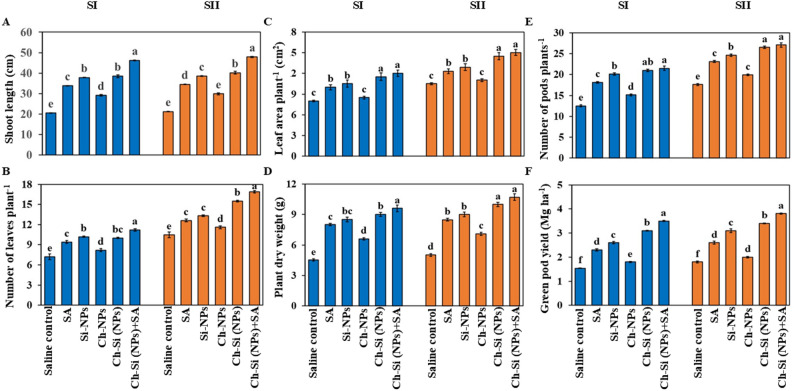
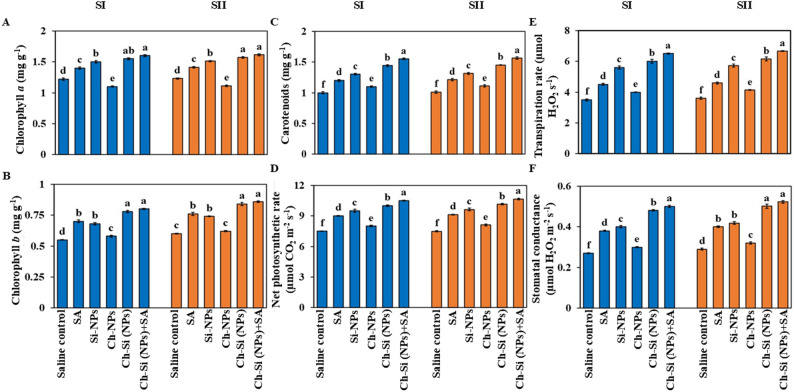
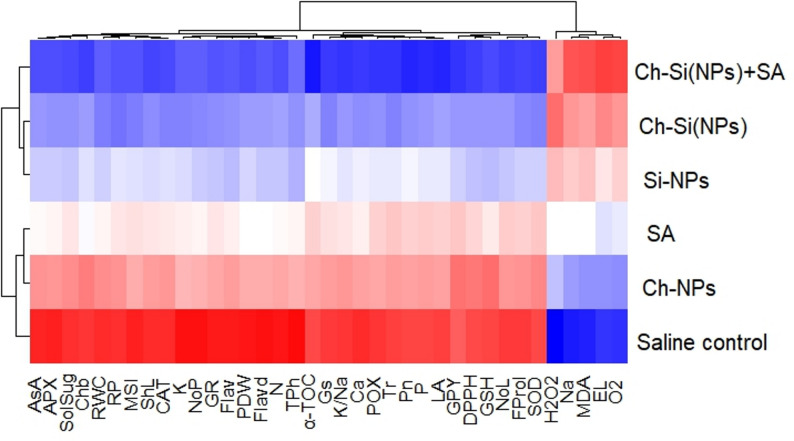
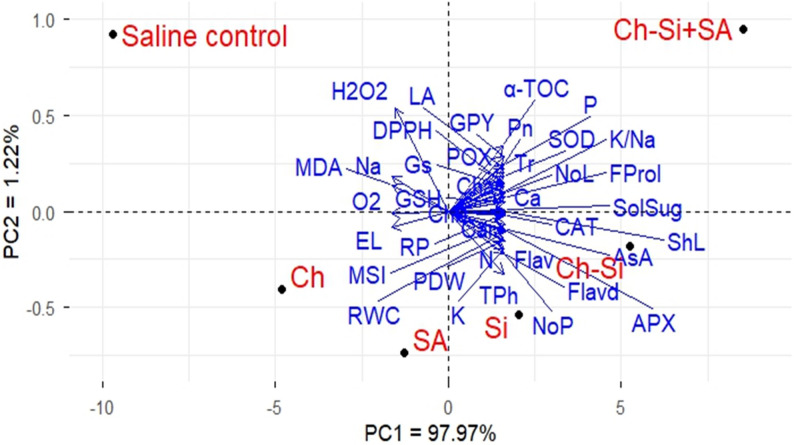
BACKGROUND: Salinity stress restricts the growth and productivity of common bean (Phaseolus vulgaris L.), a salt-sensitive legume. This study evaluated the foliar application of nanoparticle (NP) formulations to alleviate salt stress under moderate soil salinity (EC 7.71-7.83 dS m⁻¹). A two-season field experiment tested foliar sprays with salicylic acid (SA), silicon nanoparticles (Si-NPs), chitosan nanoparticles (Ch-NPs), chitosan-silicon nanoparticles [Ch-Si (NPs)], and Ch-Si (NPs) + SA. Growth parameters, photosynthetic pigments, gas exchange, oxidative stress markers, antioxidant enzyme activities, osmoprotectants, nutrient content, and pod yield were measured. RESULTS: Salinity stress reduced plant growth, photosynthetic efficiency, and nutrient balance while increasing oxidative damage. All treatments mitigated these effects, with Ch-Si (NPs) + SA showing the greatest improvement. Compared with the saline control, this treatment increased shoot dry weight and green pod yield by approximately twofold and enhanced net photosynthetic rate by about 40%. Leaf K⁺/Na⁺ ratios increased by 113.9%-126.3%, while Na⁺ content decreased by 37.2%-39.9%, electrolyte leakage by 44.7%-46.7%, and malondialdehyde by 55.8%-59.0% across both seasons. Ch-Si (NPs) + SA also increased activities of enzymatic antioxidants (catalase, peroxidase, ascorbate peroxidase, superoxide dismutase, glutathione reductase) and levels of non-enzymatic antioxidants (proline, ascorbate, glutathione, α-tocopherol) compared with the control. CONCLUSIONS: Foliar application of Ch-Si (NPs) + SA was associated with improved physiological performance, oxidative balance, and yield of common bean grown under saline field conditions. This combination may offer a promising biostimulant strategy for legume production in salt-affected soils, though further research is needed to establish broader applicability and long-term effects.
Overview
CoChat Summary
TL;DR
In a two-season field experiment under moderate salinity (EC 7.71–7.83 dS m⁻¹), foliar Ch-Si (NPs) + SA was associated with the greatest improvements in common bean growth, photosynthesis, ion homeostasis, antioxidant defense, and green pod yield compared with saline control and single/dual treatments. The authors conclude this nanocomposite + SA spray may be a promising biostimulant strategy for salt-affected legume production, pending further validation.
Key findings
- Ch-Si (NPs) + SA increased shoot dry weight and green pod yield by approximately twofold and net photosynthetic rate by about 40% versus the saline control; shoot length increased by 125.4% and 125.6%, leaf number by 55.6% and 61.0%, leaf area by 50.3% and 43.0%, pod number by 72.0% and 53.7%, and green pod yield by 127.3% and 111.7% in 2024 and 2025, respectively.
- Ion homeostasis improved: leaf K⁺/Na⁺ ratio increased by 113.9% and 126.3%, Na⁺ content decreased by 37.2% and 39.9%, K⁺ increased by 33.1% and 35.0%, Ca²⁺ by 87.7% and 86.7%, N by 29.3% and 31.4%, and P by 31.9% and 38.5% across the two seasons.
- Oxidative damage and membrane leakage were reduced: electrolyte leakage decreased by 44.7% and 46.7%, MDA by 55.8% and 59.0%, H₂O₂ by 36.9% and 37.8%, and O₂•⁻ by 51.8% and 57.7%; RWC increased by 11.2% and 11.0% and MSI by 39.8% and 36.6%.
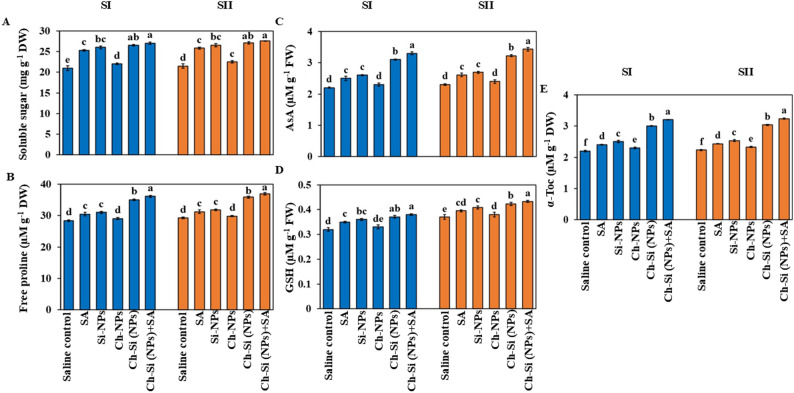
- Antioxidant and osmoprotectant responses were higher: CAT increased by 29.1% and 28.0%, POX by 72.9% and 59.0%, APX by 20.2% and 19.9%, SOD by 46.8% and 42.3%, and GR by 33.4% and 30.9%; TSS increased by 28.6% and 28.4%, proline by 27.1% and 26.4%, AsA by 50.0% and 49.1%, GSH by 18.8% and 17.0%, and α-tocopherol by 45.5% and 45.0%.
Methods
- Two field experiments were conducted in the 2024 and 2025 growing seasons at Al-Husayniyah, Sharqia Governorate, Egypt, on moderately saline soil with paste-extract EC of 7.71 and 7.83 dS m⁻¹; common bean cv. Bronco was grown in a randomized complete block design with three replicates and six foliar treatments: saline control (tap water), SA (70 mg L⁻¹), Si-NPs (100 mg L⁻¹), Ch-NPs (100 mg L⁻¹), Ch-Si (NPs) (100 mg L⁻¹ each), and Ch-Si (NPs) + SA.
- Foliar sprays were applied three times per season at 20, 30, and 40 days after sowing; measured traits included growth and yield components, photosynthetic pigments and gas exchange, leaf water relations and oxidative stress markers, osmoprotectants, non-enzymatic and enzymatic antioxidants, phenolic compounds, and leaf nutrient content.
- Data were analyzed separately by season using two-way ANOVA for an RCB design with three replicates, LSD test at P ≤ 0.05, and principal component analysis plus hierarchical clustering; comparisons between seasons were not performed.
Limitations
- Stated by the authors: mechanistic interpretations are inferred from physiological and biochemical measurements rather than direct molecular evidence (e.g., no qPCR, Western blotting, proteomics, or direct ion-flux/gene-expression data); only one concentration was tested per treatment, so no dose–response was established; experiments were at a single location over two seasons, requiring multi-location trials; long-term NP accumulation in edible pods, effects on soil microbial communities, off-target movement, and economic feasibility were not assessed.
- Evident from the text: between-season comparisons were not performed by design, and the discussion notes that improved root architecture/mycorrhizal colonization and SOS1/NHX1 involvement were not directly measured.
Model-written summary. Check it against the paper before relying on it.
Integrity signals
Registry
Cites
Statistics
Figures
Verification
Claims the paper makes
0 Valid · 0 Not valid · 47 Not checked · 135 Own results and interpretations
None of the sources cited for this claim could be matched to a paper, so there is nothing to check it against.
In the paper
“The soil at the site (Table S1) was moderately saline, with paste-extract electrical conductivities (EC) of 7.71 dS m⁻¹ and 7.83 dS m⁻¹ in 2024 and 2025, respectively, following Black [39] and Jackson [40].”
§ Foliar application of chitosan-silicon nanoparticles and salicylic acid enhances salinity tolerance and yield of common bean (Phaseolus vulgaris L.) under field conditions > Materials and methods > Experimental layout
What the sources say
- Not matchedcites [39] Black CA. Soil Plant Relationships. Second Edition. Hoboken, New Jersey, USA: Wiley; 1968. p. 792.
Its entry has no title and year that we can search by.
- Not matchedcites [40] Jackson ML. Soil Chemical Analysis. New Delhi, India. Prentice Hall. Pvt. Ltd.; 1973. 498 p.
Its entry has no title and year that we can search by.
plain- Asserted: passes — The authors put it forward as true.
- Checkable: passes — It can be checked against evidence.
- Load-bearing: passes — The paper’s conclusions depend on it.
- Based: passes — The paper gives a reason why it holds.
- Not matched
A result the paper reports from its own data — it cites no other source for it, so there is none to check. The quote shows it is in the paper.
In the paper
“Across the two seasons, this treatment showed N higher by 29.3% and 31.4%, P higher by 31.9% and 38.5%, K⁺ higher by 33.1% and 35.0%, Ca2⁺ higher by 87.7% and 86.7%, and K⁺/Na⁺ ratio higher by 113.9% and 126.3% in the 2024 and 2025 seasons, respectively, compared to the salinity control.”
§ Foliar application of chitosan-silicon nanoparticles and salicylic acid enhances salinity tolerance and yield of common bean (Phaseolus vulgaris L.) under field conditions > Results > Effect of foliar applications on nutrient content of P. vulgaris
plainstates a causen = 3- Asserted: passes — The authors put it forward as true.
- Checkable: passes — It can be checked against evidence.
- Load-bearing: passes — The paper’s conclusions depend on it.
- Based: passes — The paper gives a reason why it holds.
A result the paper reports from its own data — it cites no other source for it, so there is none to check. The quote shows it is in the paper.
In the paper
“Compared with the salinity control, this treatment increased chlorophyll a by 31.1% and 31.1%, chlorophyll b by 45.5% and 43.0%, and carotenoids by 55.0% and 54.5% during the 2024 and 2025 seasons, respectively.”
§ Foliar application of chitosan-silicon nanoparticles and salicylic acid enhances salinity tolerance and yield of common bean (Phaseolus vulgaris L.) under field conditions > Results > Effect of foliar applications on leaf photosynthetic pigments and photosynthetic efficiency of P. vulgaris
plainstates a cause- Asserted: passes — The authors put it forward as true.
- Checkable: passes — It can be checked against evidence.
- Load-bearing: passes — The paper’s conclusions depend on it.
- Based: passes — The paper gives a reason why it holds.
A result the paper reports from its own data — it cites no other source for it, so there is none to check. The quote shows it is in the paper.
In the paper
“Ch-Si (NPs) + SA also increased activities of enzymatic antioxidants (catalase, peroxidase, ascorbate peroxidase, superoxide dismutase, glutathione reductase) and levels of non-enzymatic antioxidants (proline, ascorbate, glutathione, α-tocopherol) compared with the control.”
§ Foliar application of chitosan-silicon nanoparticles and salicylic acid enhances salinity tolerance and yield of common bean (Phaseolus vulgaris L.) under field conditions > Abstract > Results
plainstates a cause- Asserted: passes — The authors put it forward as true.
- Checkable: passes — It can be checked against evidence.
- Load-bearing: passes — The paper’s conclusions depend on it.
- Based: passes — The paper gives a reason why it holds.
A result the paper reports from its own data — it cites no other source for it, so there is none to check. The quote shows it is in the paper.
In the paper
“Compared with the control, Ch-Si (NPs) + SA treatment showed RWC that was higher by 11.2% and 11.0% and MSI higher by 39.8% and 36.6%, while EL was lower by 44.7% and 46.7%, MDA lower by 55.8% and 59.0%, H2O2 lower by 36.9% and 37.8%, and O₂•⁻ lower by 51.8% and 57.7% in the two seasons, respectively (Table 1).”
§ Foliar application of chitosan-silicon nanoparticles and salicylic acid enhances salinity tolerance and yield of common bean (Phaseolus vulgaris L.) under field conditions > Results > Effect of foliar applications on leaf integrity and oxidative stress markers in P. vulgaris
plainstates a causen = 3- Asserted: passes — The authors put it forward as true.
- Checkable: passes — It can be checked against evidence.
- Load-bearing: passes — The paper’s conclusions depend on it.
- Based: passes — The paper gives a reason why it holds.
99 more claims
Create a free account to see all 182 claims and to verify the 73 references still open.
- It may state two separate claims as one. 65
- The quote only partly states this claim. 2
- Probably not a substantial claim. 18
Self-check
Percentages, sums and reported differences re-computed from the paper’s own numbers.
Each contradiction between two passages listed here was confirmed by an independent check.
Rated minor: it would not touch a result — a value no result rests on, a p-value that stays on the same side of the significance level, or a conflict that is clerical, resolved elsewhere in the paper, or outside its own findings.
In the paper
§ Foliar application of chitosan-silicon nanoparticles and salicylic acid enhances salinity tolerance and yield of common bean (Phaseolus vulgaris L.) under field conditions > Materials and methods > Statistical analysis
“Within each season, treatment means were compared using the least significant difference (LSD) test at P ≤ 0.05%.”
§ Foliar application of chitosan-silicon nanoparticles and salicylic acid enhances salinity tolerance and yield of common bean (Phaseolus vulgaris L.) under field conditions > Results > Effect of foliar applications on growth and yield of P. vulgaris
“Different letters above bars indicate significant differences among treatments within the same season according to the LSD test at P ≤ 0.05”
Rated minor: it would not touch a result — a value no result rests on, a p-value that stays on the same side of the significance level, or a conflict that is clerical, resolved elsewhere in the paper, or outside its own findings.
In the paper
§ Foliar application of chitosan-silicon nanoparticles and salicylic acid enhances salinity tolerance and yield of common bean (Phaseolus vulgaris L.) under field conditions > Results > Effect of foliar applications on nutrient content of P. vulgaris
“| Treatment | N (%) | N (%) | K (%) | Ca2+ (%) | Na⁺ (%) | K⁺/Na⁺ ratio |”
§ Foliar application of chitosan-silicon nanoparticles and salicylic acid enhances salinity tolerance and yield of common bean (Phaseolus vulgaris L.) under field conditions > Results > Effect of foliar applications on nutrient content of P. vulgaris
“Across the two seasons, this treatment showed N higher by 29.3% and 31.4%, P higher by 31.9% and 38.5%”
Rated minor: it would not touch a result — a value no result rests on, a p-value that stays on the same side of the significance level, or a conflict that is clerical, resolved elsewhere in the paper, or outside its own findings.
In the paper
§ Foliar application of chitosan-silicon nanoparticles and salicylic acid enhances salinity tolerance and yield of common bean (Phaseolus vulgaris L.) under field conditions > Results > Effect of foliar applications on leaf integrity and oxidative stress markers in P. vulgaris
“All foliar treatments were associated with lower oxidative stress markers than the salinity control, with Ch-Si (NPs) + SA showing the lowest values.”
§ Foliar application of chitosan-silicon nanoparticles and salicylic acid enhances salinity tolerance and yield of common bean (Phaseolus vulgaris L.) under field conditions > Results > Effect of foliar applications on leaf integrity and oxidative stress markers in P. vulgaris
“| Ch-Si (NPs) | 89.8 ± 0.53 ab | 57.4 ± 0.51 b | 8.90 ± 0.42 de | 1.24 ± 0.047 e | 7.40 ± 0.20 e | 0.393 ± 0.008 e | | Ch-Si (NPs) + SA | 90.6 ± 0.84 a | 59.2 ± 0.72 a | 7.63 ± 0.30 e | 1.00 ± 0.04 f | 7.95 ± 0.23 de | 0.323 ± 0.005 f |”
Citations
Cites
Use of a Free Radical Method to Evaluate Antioxidant Activity
Brand-Williams, W., Cuvelier, M. E., & Berset, C. (1995) · LWT - Food Science and Technology · doi:10.1016/s0023-6438(95)80008-5 · Cited by 25,994 · cited 1×
“The antioxidant potential was assessed using 2,2-diphenyl-1-picrylhydrazyl (DPPH) radical-scavenging activity [64] and reducing power [65].”
Colorimetry of Total Phenolics with Phosphomolybdic-Phosphotungstic Acid Reagents
Singleton, V. L., & Rossi, J. A. (1965) · American Journal of Enology and Viticulture · doi:10.5344/ajev.1965.16.3.144 · Cited by 24,852
Rapid determination of free proline for water-stress studies
Bates, L. S., Waldren, R. P., & Teare, I. D. (1973) · Plant and Soil · doi:10.1007/bf00018060 · Cited by 20,967 · cited 1×
“The method described by Bates et al. [55] was used to determine proline accumulation in bean leaves.”
Photoperoxidation in isolated chloroplasts
Heath, R. L., & Packer, L. (1968) · Archives of Biochemistry and Biophysics · doi:10.1016/0003-9861(68)90654-1 · Cited by 11,413
Hydrogen Peroxide is Scavenged by Ascorbate-specific Peroxidase in Spinach Chloroplasts
Nakano, Y., & Asada, K. (1981) · Plant and Cell Physiology · doi:10.1093/oxfordjournals.pcp.a076232 · Cited by 10,809 · cited 1×
“APX was assayed spectrophotometrically as described by Nakano and Asada [69].”
Oyaizu, M. (1986) · The Japanese Journal of Nutrition and Dietetics · doi:10.5264/eiyogakuzashi.44.307 · Cited by 7,697
Griffith, O. W. (1980) · Analytical Biochemistry · doi:10.1016/0003-2697(80)90139-6 · Cited by 4,602
A Re-Examination of the Relative Turgidity Technique for Estimating Water Deficits in Leaves
Barrs, H., & Weatherley, P. (1962) · Australian Journal of Biological Sciences · doi:10.1071/bi9620413 · Cited by 3,628
The Assay of Catalases and Peroxidases
Maehly, A. C. (1954) · Methods of Biochemical Analysis · doi:10.1002/9780470110171.ch14 · Cited by 3,303
Test of an Ascorbic Acid Method for Determining Phosphorus in Water and NaHCO 3 Extracts from Soil
Watanabe, F. S., & Olsen, S. R. (1965) · Soil Science Society of America Journal · doi:10.2136/sssaj1965.03615995002900060025x · Cited by 2,485
Baliyan, S., Mukherjee, R., Priyadarshini, A., Vibhuti, A., Gupta, A., Pandey, R. P., & Chang, C.-M. (2022) · Molecules · doi:10.3390/molecules27041326 · Cited by 1,485
Mukherjee, S. P., & Choudhuri, M. A. (1983) · Physiologia Plantarum · doi:10.1111/j.1399-3054.1983.tb04162.x · Cited by 1,474
Irigoyen, J. J., Einerich, D. W., & Sánchez‐Díaz, M. (1992) · Physiologia Plantarum · doi:10.1111/j.1399-3054.1992.tb08764.x · Cited by 1,415
Ultraviolet-B- and Ozone-Induced Biochemical Changes in Antioxidant Enzymes of Arabidopsis thaliana
Rao, M. V., Paliyath, G., & Ormrod, D. P. (1996) · Plant Physiology · doi:10.1104/pp.110.1.125 · Cited by 1,362
Sairam, R. K., Rao, K. V., & Srivastava, G. C. (2002) · Plant Science · doi:10.1016/s0168-9452(02)00278-9 · Cited by 1,262
In vitro antioxidant activities of methanol extracts of five Phyllanthus species from India
Kumaran, A., & Joel Karunakaran, R. (2007) · LWT - Food Science and Technology · doi:10.1016/j.lwt.2005.09.011 · Cited by 1,189
A comprehensive system of leaf analyses and its use for diagnosing crop nutrient status
Wolf, B. (1982) · Communications in Soil Science and Plant Analysis · doi:10.1080/00103628209367332 · Cited by 1,180
Extraction and Determination of Ascorbate and Dehydroascorbate from Plant Tissue
Kampfenkel, K., Vanmontagu, M., & Inze, D. (1995) · Analytical Biochemistry · doi:10.1006/abio.1995.1127 · Cited by 1,066
Rajput, V. D., Harish, Singh, R. K., Verma, K. K., Sharma, L., Quiroz-Figueroa, F. R., Meena, M., Gour, V. S., Minkina, T., Sushkova, S., et al. (2021) · Biology · doi:10.3390/biology10040267 · Cited by 994
Plants’ Response Mechanisms to Salinity Stress
Balasubramaniam, T., Shen, G., Esmaeili, N., & Zhang, H. (2023) · Plants · doi:10.3390/plants12122253 · Cited by 740
Potassium in plants: Growth regulation, signaling, and environmental stress tolerance
Johnson, R., Vishwakarma, K., Hossen, M. S., Kumar, V., Shackira, A. M., Puthur, J. T., Abdi, G., Sarraf, M., & Hasanuzzaman, M. (2022) · Plant Physiology and Biochemistry · doi:10.1016/j.plaphy.2022.01.001 · Cited by 535
Tarolli, P., Luo, J., Park, E., Barcaccia, G., & Masin, R. (2024) · iScience · doi:10.1016/j.isci.2024.108830 · Cited by 456
Rao, M. J., Duan, M., Zhou, C., Jiao, J., Cheng, P., Yang, L., Wei, W., Shen, Q., Ji, P., Yang, Y., et al. (2025) · Horticulturae · doi:10.3390/horticulturae11050477 · Cited by 446
Bahorun, T., Gressier, B., Trotin, F., Brunet, C., Dine, T., Luyckx, M., Vasseur, J., CAZIN, M., Cazin, J. C., & Pinkas, M. (1996) · PubMed · Cited by 445
Antioxidant enzymes responses to cadmium in radish tissues
Vitória, Â. P., Lea, P. J., & Azevedo, R. A. (2001) · Phytochemistry · doi:10.1016/s0031-9422(01)00130-3 · Cited by 442
Premachandra, G. S., Saneoka, H., & Ogata, S. (1990) · The Journal of Agricultural Science · doi:10.1017/s0021859600073925 · Cited by 350
Dionisio-Sese, M. L., & Tobita, S. (2000) · Journal of Plant Physiology · doi:10.1016/s0176-1617(00)80135-2 · Cited by 228
Kubiś, J. (2007) · Journal of Plant Physiology · doi:10.1016/j.jplph.2007.02.005 · Cited by 225
Location and Properties of Chloroplasts and Pigment Determination in Roots
Fadeel, A. A. (1962) · Physiologia Plantarum · doi:10.1111/j.1399-3054.1962.tb07994.x · Cited by 162
Changes in Soluble and Bound Peroxidase—IAA Oxidase During Tomato Fruit Development
Thomas, R. L., Jen, J. J., & Morr, C. V. (1982) · Journal of Food Science · doi:10.1111/j.1365-2621.1982.tb11048.x · Cited by 157
Mechanisms of Silicon-Mediated Amelioration of Salt Stress in Plants
Liu, B., Soundararajan, P., & Manivannan, A. (2019) · Plants · doi:10.3390/plants8090307 · Cited by 143
Hassan, F. A. S., Ali, E., Gaber, A., Fetouh, M. I., & Mazrou, R. (2021) · Plant Physiology and Biochemistry · doi:10.1016/j.plaphy.2021.03.004 · Cited by 141
Kumaran, A., & Karunakaran, R. J. (2005) · Food Chemistry · doi:10.1016/j.foodchem.2005.09.051 · Cited by 130
Cannea, F. B., & Padiglia, A. (2025) · Life · doi:10.3390/life15081293 · Cited by 130
Konings, E. J. M., Roomans, H. H. S., & Beljaars, P. R. (1996) · Journal of AOAC International · doi:10.1093/jaoac/79.4.902 · Cited by 97
Gupta, A., Bharati, R., Kubes, J., Popelkova, D., Praus, L., Yang, X., Severova, L., Skalicky, M., & Brestic, M. (2024) · Frontiers in Plant Science · doi:10.3389/fpls.2024.1432258 · Cited by 97
Use of Biostimulants as a New Approach for the Improvement of Phytoremediation Performance—A Review
Bartucca, M. L., Cerri, M., Del Buono, D., & Forni, C. (2022) · Plants · doi:10.3390/plants11151946 · Cited by 92
Dawood, M. F. A., Zaid, A., & Latef, A. A. H. A. (2022) · Journal of Plant Growth Regulation · doi:10.1007/s00344-021-10381-8 · Cited by 76
Havre, G. N. (1961) · Analytica Chimica Acta · doi:10.1016/0003-2670(61)80134-7 · Cited by 72
Alenazi, M. M., El-Ebidy, A. M., El-shehaby, O. A., Seleiman, M. F., Aldhuwaib, K. J., & Abdel-Aziz, H. M. M. (2024) · Plants · doi:10.3390/plants13030398 · Cited by 71
Boruah, S., & Dutta, P. (2021) · Indian Phytopathology · doi:10.1007/s42360-020-00289-w · Cited by 62
Abiotic stresses in soils, their effects on plants, and mitigation strategies: a literature review
Rahim, H. U., Ali, W., Uddin, M., Ahmad, S., Khan, K., Bibi, H., & Alatalo, J. M. (2025) · Chemistry and Ecology · doi:10.1080/02757540.2024.2439830 · Cited by 62
Ahmad, F., Kamal, A., Singh, A., Ashfaque, F., Alamri, S., & Siddiqui, M. H. (2022) · Journal of Plant Growth Regulation · doi:10.1007/s00344-020-10271-5 · Cited by 61
The Role of Neglected Grain Legumes in Food and Nutrition Security and Human Health
Vilakazi, B., Mafongoya, P., Odindo, A. O., & Phophi, M. M. (2025) · Sustainability · doi:10.3390/su17010350 · Cited by 58
Rojas-Pirela, M., Carillo, P., Lárez-Velásquez, C., & Romanazzi, G. (2024) · Frontiers in Plant Science · doi:10.3389/fpls.2024.1423949 · Cited by 53
Quitadamo, F., De Simone, V., Beleggia, R., & Trono, D. (2021) · Plants · doi:10.3390/plants10071365 · Cited by 52
Liu, R., Wang, S., & Song, J. (2026) · Frontiers in Plant Science · doi:10.3389/fpls.2026.1774033 · Cited by 38
The role of potassium under salinity stress in crop plants
Praveen, A., & Singh, S. (2024) · Cereal Research Communications · doi:10.1007/s42976-023-00393-3 · Cited by 35
Mapodzeke, J. M., Adil, M. F., Wei, D., Joan, H. I., Ouyang, Y., & Shamsi, I. H. (2021) · Plants · doi:10.3390/plants10010087 · Cited by 31
Arruda, T. F. D. L., Lima, G. S. D., Silva, A. A. R. D., Azevedo, C. A. V. D., Souza, A. R. D., Soares, L. A. D. A., Gheyi, H. R., Lima, V. L. A. D., Fernandes, P. D., Silva, F. D. A. D., et al. (2023) · Plants · doi:10.3390/plants12152783 · Cited by 29
Gulzar, R. M. A., Munir, R., Yi, Z. R., Jan, N., Rauf, A., Kaleem, Z., Javaid, M. H., Saand, M. A., El-Keblawy, A., Sheteiwy, M. S., et al. (2025) · BMC Plant Biology · doi:10.1186/s12870-025-06759-5 · Cited by 25
Carlini, B., Lucini, C., & Velázquez, J. (2024) · Sustainability · doi:10.3390/su16073081 · Cited by 23
Srivastava, R. K., Yetgin, A., & Srivastava, S. (2025) · Soil and Tillage Research · doi:10.1016/j.still.2025.106656 · Cited by 23
Kwon, E.-H., Adhikari, A., Imran, M., Lee, D.-S., Lee, C.-Y., Kang, S.-M., & Lee, I.-J. (2023) · Plants · doi:10.3390/plants12020310 · Cited by 20
Msarie, M. W., Methela, N. J., Islam, M. S., An, T. H., Das, A. K., Lee, D.-S., Mun, B.-G., & Yun, B.-W. (2025) · International Journal of Molecular Sciences · doi:10.3390/ijms26020609 · Cited by 20
Ji, H., Wang, J., Xue, A., Chen, F., Guo, H., Xiao, Z., & Wang, Z. (2023) · Environmental Science: Nano · doi:10.1039/d3en00234a · Cited by 19
Beyond essentiality: silicon as a systems regulator of photosynthesis under stress scenarios
Mukarram, M., Zehra, A., Afzal, S., Sliacka Konôpková, A., Khan, K. A., Alqahtani, A. R., El-Mekkawy, H. I., Kurjak, D., Lux, A., Chen, R., et al. (2026) · Frontiers in Plant Science · doi:10.3389/fpls.2025.1690421 · Cited by 19
Falouti, M., Ellouzi, H., Amraoui, S., Hemissi, I., Bounaouara, F., Rabhi, M., Abdelly, C., Zorrig, W., & Slama, I. (2025) · Journal of Plant Growth Regulation · doi:10.1007/s00344-024-11556-9 · Cited by 18
(2019) · Novel Research in Microbiology Journal · doi:10.21608/nrmj.2019.66747 · Cited by 16
Co-application of potassium and thiourea for mitigating salinity stress in wheat seedlings
Abbas, K., Javed, M., Aslam, S., Butt, F. R., Al-Ansari, M. M., Elshikh, M. S., Ijaz, M. K., Ali, H., Aziz, M., Mahmood, U., et al. (2025) · Scientific Reports · doi:10.1038/s41598-025-98878-0 · Cited by 15
Salinity stress in rice: mechanisms and molecular approaches to mitigation
Aycan, M. (2026) · Planta · doi:10.1007/s00425-026-04964-6 · Cited by 14
Jēkabsone, A., Karlsons, A., Osvalde, A., & Ievinsh, G. (2024) · Plants · doi:10.3390/plants13020190 · Cited by 13
Raggi, L., Caproni, L., Ciancaleoni, S., D’Amato, R., Businelli, D., & Negri, V. (2024) · Scientific Reports · doi:10.1038/s41598-024-55403-z · Cited by 12
EL-BELTAGI, H. S., El-Nady, M. F., Ismail, A. M., & Metwaly, M. M. S. (2025) · Plant Protection Science · doi:10.17221/127/2024-pps · Cited by 12
Beleggia, R., Iannucci, A., Menga, V., Quitadamo, F., Suriano, S., Citti, C., Pecchioni, N., & Trono, D. (2023) · Plants · doi:10.3390/plants12213692 · Cited by 11
Zhang, M., Pan, M., Li, H., Liu, B., Qiao, S., Ma, C., Mu, H., Zhao, W., & Guo, J. (2025) · Plant and Soil · doi:10.1007/s11104-025-07760-5 · Cited by 11
Amna, Yasmine, R., Ahmad, J., Qamar, S., & Qureshi, M. I. (2023) · Engineered Nanomaterials for Sustainable Agricultural Production, Soil Improvement and Stress Management · doi:10.1016/b978-0-323-91933-3.00022-2 · Cited by 10
Production and overall importance of common bean ( Phaseolus vulgaris L. ) in Ethiopia
Asrat, U., & Abera, D. (2025) · Cogent Food & Agriculture · doi:10.1080/23311932.2025.2548619 · Cited by 10
Coêlho, E. D. S., Ribeiro, J. E. D. S., Oliveira, P. H. D. A., da Silva, E. F., da Silva, A. G. C., de Oliveira, A. K. S., dos Santos, G. L., da Silva, T. I., Rodriguez, R. M., Bezerra, A. L., et al. (2025) · Journal of Plant Growth Regulation · doi:10.1007/s00344-025-11735-2 · Cited by 7
Soltani, R., Pazoki, A., & Monem, R. (2024) · Journal of Plant Growth Regulation · doi:10.1007/s00344-023-11176-9 · Cited by 6
Soil Salinity Dynamics in Arid Lands and Impact on Agriculture for Food Security
Shahid, S. A., Alkandari, A. J., & Alnajdi, F. M. (2026) · Advances in Global Change Research · doi:10.1007/978-3-031-98490-7_7 · Cited by 6
Nanoparticle-enabled enhancement of plant photosynthesis: Mechanisms and applications
Tran, T. L. C., Kong, L., Yang, W., & Cahill, D. (2026) · Nano Today · doi:10.1016/j.nantod.2026.103003 · Cited by 6
Semmoudi, O., Cheggour, M., Farouk, S., Lamtaai, H., El Modafar, C., & Chakhchar, A. (2025) · Biocatalysis and Agricultural Biotechnology · doi:10.1016/j.bcab.2025.103819 · Cited by 5
Effect of Salt Stress on the Morphological Attributes of Common Bean
(2024) · Trends in Animal and Plant Sciences · doi:10.62324/taps/2024.042 · Cited by 4
Abdulhameed, A. S., Abdullah, S., Al-Masud, A. A., Abualhaija, M., & Algburi, S. (2025) · Cellulose · doi:10.1007/s10570-025-06712-7 · Cited by 4
Mild-NaCl stress increases protein and nitrogen contents of common bean (Phaselous vulgaris) grains
Hernández, L., Lorente, G., Companioni, B., Martínez, J., Escalante, D., Zevallos-Bravo, B. E., Hajari, E., Acosta, Y., & Lorenzo, J. C. (2024) · Vegetos · doi:10.1007/s42535-024-00907-2 · Cited by 2
Salinity Tolerance in Legumes: Classical and Molecular Breeding Perspectives
Sulthana Jafarullakhan, S., Vijayakumar, V., Veer Singh, K., Ananthan Saravanan, N., Seshadri, G., Chockalingam, V., Muthurajan, R., Rathinavelu, S., & Rajaprakasam, S. (2024) · Agricultural Sciences · doi:10.5772/intechopen.114944 · Cited by 2
Legume Production Under the Changing Climate
Kiyani, A., Lei, M., Rabbani, G., Sardar, M. M., Ilyas, M. K., Iqbal, U., & Tahir, A. T. (2025) · Climate Smart Agriculture for Future Food Security · doi:10.1007/978-981-96-4499-5_22 · Cited by 2
Nosek, M., Gawrońska, K., Rozpądek, P., Chmura, K., & Kornaś, A. (2025) · Plant Physiology and Biochemistry · doi:10.1016/j.plaphy.2025.110272 · Cited by 2
Ateeq, M., Yasir, T. A., Hu, Y.-G., & Chen, L. (2026) · International Journal of Phytoremediation · doi:10.1080/15226514.2025.2587329 · Cited by 2
Espinoza, S., Catenacci-Aguilera, G., Gallo, B. A., & del Pozo, A. (2026) · Grass and Forage Science · doi:10.1111/gfs.70031 · Cited by 1
Research works printed but not linked: 5
- Chouikh A, Chenguel A, Ali AB. Understanding the role of free radicals, oxidative stress, and antioxidants: A comprehensive review. Lett Appl NanoBioSci. 2025;14:66. 10.33263/LIANBS142.066. · doi:10.33263/lianbs142.066
- Black CA. Soil Plant Relationships. Second Edition. Hoboken, New Jersey, USA: Wiley; 1968. p. 792.
- Jackson ML. Soil Chemical Analysis. New Delhi, India. Prentice Hall. Pvt. Ltd.; 1973. 498 p.
- Dahnke WC, Whitney DA. Measurement of soil salinity. In: Dahnke WC, editor. Recommended Chemical Soil Test Procedures for the North Central Region. North Central Regional Publication Number 221. North Dakota Agricultural Experiment Station Bulletin 499. 1988; pp. 32–4.
- Sullivan CY, Ross WM. Selecting the drought and heat resistance in grain sorghum. In: Mussel H, Staples RC, editors. Stress Physiology of Crop Plants. New York, USA.: Wiley; 1979. pp. 263–81.
Cited by
Almas, H. I., Haider, F. U., Nian, L., Sajid, M. S., Batool, A., Rasul, F., Zulfiqar, U., Alqahtani, M. D., & Gururani, M. A. (2026) · Environmental Technology & Innovation · doi:10.1016/j.eti.2026.105109 · Cited by 3
Abdalla, M. A., Perez, K. M. A., Sulieman, S., & Mühling, K. H. (2026) · Journal of Agronomy and Crop Science · doi:10.1111/jac.70262
Metadata
- Authors
- Desoky, E.-S. M., Alotaibi, M. S., El-Saadony, M. T., Al-Najjar, M. A. A., Alhashmi, F. I., Mathew, B. T., El-Tarabily, K. A., AbuQamar, S. F., & Rady, M. M.
- Affiliations
- Zagazig University (EG)
- Taif University (SA)
- United Arab Emirates University (AE)
- Fayoum University (EG)
- Corresponding author
- El-Tarabily, Khaled A.
- AbuQamar, Synan F.
- Venue
- BMC Plant Biology
- Published
- 2026-06-22
- Volume
- 26
- Issue
- 1
- ISSN
- 1471-2229 (ISSN-L)
- PMC
- PMC13307410
- OpenAlex
- W7165537464
- Semantic Scholar
- 11d0b6398ebda129b212da6210293d9d32892d45
- Cited by
- 2
- References
- 81
- Citations by year
- 2026: 2
- FWCI
- 5.51
- Type
- journal article
- Language
- en
- Open access
- gold
- doi.org
- Licence
- cc-by-nc-nd
- creativecommons.org/licenses/by-nc-nd/4.0 (tdm)
- creativecommons.org/licenses/by-nc-nd/4.0 (vor, 3 d)
- Locations
- BMC Plant Biology (publishedVersion, cc-by-nc-nd)
- PubMed (publishedVersion)
- PubMed Central (publishedVersion, cc-by-nc-nd)
- Murdoch University Research Portal (submittedVersion, cc-by-nc-nd)
- DOAJ (DOAJ: Directory of Open Access Journals) (submittedVersion)
- Funders
- UAEU program of Advanced Research (12S169, 12S273)
- Khalifa Center for Genetic Engineering & Biotechnology-UAEU (12R255)
- Topics
- Life Sciences › Agricultural and Biological Sciences › Plant Science › Plant Stress Responses and Tolerance
- Life Sciences › Agricultural and Biological Sciences › Plant Science › Silicon Effects in Agriculture
- Life Sciences › Agricultural and Biological Sciences › Plant Science › Plant Growth Enhancement Techniques
- Keywords
- Phaseolus vulgaris, salt stress, silicon nanoparticles, chitosan nanoparticles, salicylic acid, foliar application, salt tolerance, oxidative stress, antioxidant enzymes, osmoprotectants, pod yield, salt-affected soils, biostimulants, photosynthesis
- MeSH terms
- Antioxidants, Photosynthesis, Silicon, Oxidative Stress, Plant Leaves, Salicylic Acid, Phaseolus, Chitosan, Nanoparticles, Salt Tolerance
About these checks
Registry, retraction, Cites and statistics results are computed, not judged, with one exception: a printed reference that no index lists is read once by a model before it counts as a citation error. Claims are extracted by a model and kept only when their quote appears verbatim in the text; each cited source is then checked, with a model’s help, for whether it says what the claim relies on. Those verdicts can be wrong — read the claim’s quote and the cited source before relying on one.
A language model drew the claims from the paper on 2026-11-17, under version 3 of the claim definition (model deepseek-v4.1-flash, prompt extract-v3).
A second model labelled each claim on 2026-11-17 (model jev-1.13-20260917, definition revision gold-guideline-v0.2).
Statistics and arithmetic are recomputed, not judged.
Confidence bands are shown only for fields calibrated on our annotated test set. None is calibrated yet, so no band is shown.
What counts as a claim ›How we measure confidence ›How we check this ›
Are you an author, or do you see a problem with this page? Request a review
Data sources
Bibliographic data: Semantic Scholar, OpenAlex, Crossref.
Contains information from the Semantic Scholar Academic Graph Datasets, made available under the ODC Attribution License (ODC-BY 1.0).
Semantic Scholar’s data is described in: Kinney, R., et al. (2023). The Semantic Scholar Open Data Platform. arXiv:2301.10140.
