

Relationship key factor of inflammation and the development of complications in the late period of myocardial infarction in patients with visceral obesity
Open accessThe DOI matches its Crossref record; 27 of the 27 references it cites were found in a registry or an index.
Abstract
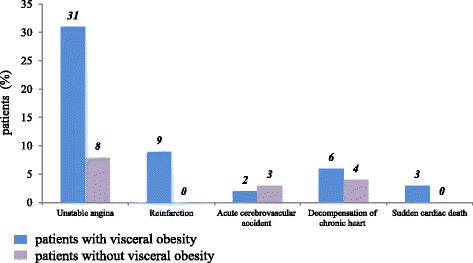
BACKGROUND: Cytokines play an significant role in regulating non-specific inflammatory response involved in many pathological processes. The current study tested the hypothesis that myocardial infarction in patients with obesity can lead to increased production of proinflammatory cytokines and unfavorable course of the pathological process. METHODS: The study recruited 232 male patients with ST-elevated myocardial infarction. The mean age of the patients was 58.7 (52.2-69.9) years. All the patients were assigned to two groups according to the computed tomography findings: 1 (n = 160) patients with visceral obesity (VO), and 2 (n = 72) patients without VO. Interleukins were measured in blood serum on days 1 and 12 after MI. RESULTS: All patients with MI demonstrated elevated levels of proinflammatory markers and reduced anti-inflammatory markers in the in-hospital period. The results suggested that among all studied inflammatory markers IL-6 (OR 1.9; 95% CI (1.6-2.8) and CRP (OR 1.3; 95% CI (1.1-1.8) were closely related to VO. One year after MI adverse cardiovascular outcome frequently occurred in patients with VO. There were two cardiac deaths (3.1%), 6 cases (9.3%) of recurrent MI, 19 cases (29.6%) of repeated hospitalizations for unstable angina, whereas only 2 patients without VO (6.6%) were hospitalized for unstable angina. The results of the logistic regression analysis demonstrated that IL-6, IL-12, and IL-10 had the highest predictive value for occurrence of adverse cardiovascular events in patients with VO. CONCLUSION: Cytokine profile in MI patients with VO is characterized by an imbalance caused by elevated pro-inflammatory interleukins and decreased anti-inflammatory interleukins. Obesity in patients was associated with a marked increase in IL-6 and CRP levels.
Overview
The claims and statistics of this paper haven’t been checked yet.
Free: it reads the open-access text and checks the first 5 claims that cite a source we can check. Create a free account to check every claim.
Integrity signals
Registry
Cites
Statistics
Figures
Verification
Claims the paper makes
The claims and statistics of this paper haven’t been checked yet.
Free: it reads the open-access text and checks the first 5 claims that cite a source we can check. Create a free account to check every claim.
Claims other papers make about this one
Each is checked against this paper’s own text: does it say what the citing paper says it does?
The cited source says what the claim attributes to it.
In the citing paper
“Among patients with myocardial infarction, those with visceral obesity had elevated levels of proinflammatory cytokines, such as TNF-α, IL-1b, IL-6, IL-8, IL-12, and CRP than those without visceral obesity [112].”
From Sarcopenic obesity, insulin resistance, and their implications in cardiovascular and metabolic consequences (2020) · cites this paper as [112]
Self-check
Percentages, sums and reported differences re-computed from the paper’s own numbers.
The self-check needs the paper’s full text.
Citations
Cites
Obesity is associated with macrophage accumulation in adipose tissue
Weisberg, S. P., McCann, D., Desai, M., Rosenbaum, M., Leibel, R. L., & Ferrante, A. W. (2003) · Journal of Clinical Investigation · doi:10.1172/jci200319246 · Cited by 10,041
Inflammation and insulin resistance
Shoelson, S. E. (2006) · Journal of Clinical Investigation · doi:10.1172/jci29069 · Cited by 4,769
Adipokines in inflammation and metabolic disease
Ouchi, N., Parker, J. L., Lugus, J. J., & Walsh, K. (2011) · Nature Reviews Immunology · doi:10.1038/nri2921 · Cited by 4,625 · cited 1×
“Cytokines are produced mainly by immune system cells and adipocytes [3].”
BackgroundInflammatory Mechanisms in Obesity
Gregor, M. F., & Hotamisligil, G. S. (2011) · Annual Review of Immunology · doi:10.1146/annurev-immunol-031210-101322 · Cited by 3,754
Kim, H. J., Park, S. Y., Choi, Y. J., Han, S. J., Lee, K. W., & Kim, D. J. (2013) · Hormone Research in Paediatrics · doi:10.1159/000348848 · Cited by 3,048
Macrophages, inflammation, and insulin resistance
Olefsky, J. M., & Glass, C. K. (2010) · Annual Review of Physiology · doi:10.1146/annurev-physiol-021909-135846 · Cited by 2,733 · cited 4×
“The expression of the anti-inflammatory cytokines is stimulated in adipose tissue of healthy subjects, while large quantities of pro-inflammatory cytokine are secreted in patients with CVD [4].”
BackgroundInfluentialThe inflammatory response in myocardial infarction
Frangogiannis, N. (2002) · Cardiovascular Research · doi:10.1016/s0008-6363(01)00434-5 · Cited by 2,011
TNF-R1 Signaling: A Beautiful Pathway
Chen, G., & Goeddel, D. V. (2002) · Science · doi:10.1126/science.1071924 · Cited by 1,927
Fain, J. N., Madan, A. K., Hiler, M. L., Cheema, P., & Bahouth, S. W. (2004) · Endocrinology · doi:10.1210/en.2003-1336 · Cited by 1,572
Makki, K., Froguel, P., & Wolowczuk, I. (2013) · ISRN Inflammation · doi:10.1155/2013/139239 · Cited by 1,085 · cited 7×
“Visceral adipose tissue (VAT) and subcutaneous adipose tissue (SAT) areas as well as the ratio of VAT to SAT were measured.”
BackgroundInfluentialINFLAMMATION AND ATHEROSCLEROSIS
Hansson, G. K., Robertson, A.-K. L., & Söderberg-Nauclér, C. (2006) · Annual Review of Pathology: Mechanisms of Disease · doi:10.1146/annurev.pathol.1.110304.100100 · Cited by 1,046
DAMPening Inflammation by Modulating TLR Signalling
Piccinini, A. M., & Midwood, K. S. (2010) · Mediators of Inflammation · doi:10.1155/2010/672395 · Cited by 973
Pleiotropic actions of insulin resistance and inflammation in metabolic homeostasis
Odegaard, J. I., & Chawla, A. (2013) · Science · doi:10.1126/science.1230721 · Cited by 643 · cited 1×
“White adipose tissue (WAT) is the key site mediating systemic inflammation since it is virtually around all organs and tissues, and occupies a large area in obese people [8].”
BackgroundBruun, J. M., Lihn, A. S., Pedersen, S. B., & Richelsen, B. (2005) · The Journal of Clinical Endocrinology & Metabolism · doi:10.1210/jc.2004-1696 · Cited by 535
Lee, J. Y., Zhao, L., Youn, H. S., Weatherill, A. R., Tapping, R., Feng, L., Lee, W. H., Fitzgerald, K. A., & Hwang, D. H. (2004) · Journal of Biological Chemistry · doi:10.1074/jbc.m312990200 · Cited by 493
Takeda, K., & Akira, S. (2007) · Current Protocols in Immunology · doi:10.1002/0471142735.im1412s77 · Cited by 378
Kohsaka, S. (2005) · Archives of Internal Medicine · doi:10.1001/archinte.165.14.1643 · Cited by 343
Visceral adipose tissue as a source of inflammation and promoter of atherosclerosis
Alexopoulos, N., Katritsis, D., & Raggi, P. (2014) · Atherosclerosis · doi:10.1016/j.atherosclerosis.2013.12.023 · Cited by 332
Bruun, J. M., Lihn, A. S., Madan, A. K., Pedersen, S. B., Schiøtt, K. M., Fain, J. N., & Richelsen, B. (2004) · American Journal of Physiology-Endocrinology and Metabolism · doi:10.1152/ajpendo.00269.2003 · Cited by 215
Moschen, A. R., Molnar, C., Enrich, B., Geiger, S., Ebenbichler, C. F., & Tilg, H. (2011) · Molecular Medicine · doi:10.2119/molmed.2010.00108 · Cited by 184
Sjöström, L. (1991) · PubMed · Cited by 182
Ahmad, R., Al-Mass, A., Atizado, V., Al-Hubail, A., Al-Ghimlas, F., Al-Arouj, M., Bennakhi, A., Dermime, S., & Behbehani, K. (2012) · Journal of Inflammation · doi:10.1186/1476-9255-9-48 · Cited by 175
Heat Shock Proteins and Toll-Like Receptors
Asea, A. A. A. (2007) · Handbook of experimental pharmacology · doi:10.1007/978-3-540-72167-3_6 · Cited by 161
Satoh, M., Shimoda, Y., Akatsu, T., Ishikawa, Y., Minami, Y., & Nakamura, M. (2006) · European Journal of Heart Failure · doi:10.1016/j.ejheart.2006.03.004 · Cited by 107
D’Ascenzo, F., Cerrato, E., Appleton, D. L., Moretti, C., Calcagno, A., Abouzaki, N. A., Vetrovec, G. W., Lhermusier, T., Carrié, D., Neves, B. D., et al. (2014) · Thrombosis Research · doi:10.1016/j.thromres.2014.05.037 · Cited by 45
Fain, J. N., Bahouth, S. W., & Madan, A. K. (2005) · Biochemical Pharmacology · doi:10.1016/j.bcp.2005.02.009 · Cited by 42
Учасова, Е. Г., Gruzdeva, Belik, E. V., Шурыгина, Барбараш, О. Л., & Dyleva, Y. A. (2013) · Diabetes Metabolic Syndrome and Obesity · doi:10.2147/dmso.s46627 · Cited by 11
Self-citation
Cited by
Hong, S.-H., & Choi, K. M. (2020) · International Journal of Molecular Sciences · doi:10.3390/ijms21020494 · Cited by 390
“Among patients with myocardial infarction, those with visceral obesity had elevated levels of proinflammatory cytokines, such as TNF-α, IL-1b, IL-6, IL-8, IL-12, and CRP than those without visceral obesity [112].”
BackgroundThe Role of Macrophages in the Infarcted Myocardium: Orchestrators of ECM Remodeling
O’Rourke, S. A., Dunne, A., & Monaghan, M. G. (2019) · Frontiers in Cardiovascular Medicine · doi:10.3389/fcvm.2019.00101 · Cited by 146
Management of inflammation in cardiovascular diseases
Goswami, S. K., Ranjan, P., Dutta, R. K., & Verma, S. K. (2021) · Pharmacological Research · doi:10.1016/j.phrs.2021.105912 · Cited by 120
Liu, Y., Shao, Y., Zhang, J.-M., Wang, Y., Zhou, M. L., Li, H., Zhang, C., Yu, P.-J., Gao, S., Wang, X., et al. (2023) · Signal Transduction and Targeted Therapy · doi:10.1038/s41392-023-01635-w · Cited by 55
Yamashita, M., Kamiya, K., Matsunaga, A., Kitamura, T., Hamazaki, N., Matsuzawa, R., Nozaki, K., Tanaka, S., Nakamura, T., Maekawa, E., et al. (2019) · Journal of Cardiology · doi:10.1016/j.jjcc.2019.02.010 · Cited by 34
Metadata
- Authors
- Gruzdeva, O., Uchasova, E., Dyleva, Y., Akbasheva, O., Matveeva, V., Karetnikova, V., Kokov, A., & Barbarash, O.
- Affiliations
- Research Institute of Complex Problems of Cardiovascular Disease Russian Academy of Medical Sciences (RU)
- Venue
- BMC Cardiovascular Disorders
- Published
- 2017-01-19
- Volume
- 17
- Issue
- 1
- Pages
- 36-36
- ISSN
- 1471-2261 (ISSN-L)
- PMC
- PMC5244541
- OpenAlex
- W2577859776
- Cited by
- 13
- References
- 27
- Citations by year
- 2026: 2 · 2025: 1 · 2024: 1 · 2023: 2 · 2022: 2 · 2021: 1 · 2020: 1 · 2019: 3
- FWCI
- 0.84
- Type
- journal article
- Language
- en
- Open access
- gold
- doi.org
- Licence
- cc-by
- Locations
- BMC Cardiovascular Disorders (publishedVersion, cc-by)
- PubMed Central (publishedVersion, cc-by)
- PubMed (publishedVersion)
- Topics
- Health Sciences › Medicine › Cardiology and Cardiovascular Medicine › Cardiac Fibrosis and Remodeling
- Health Sciences › Medicine › Cardiology and Cardiovascular Medicine › Acute Myocardial Infarction Research
- Health Sciences › Medicine › Endocrinology, Diabetes and Metabolism › Adipokines, Inflammation, and Metabolic Diseases
- Keywords
- visceral obesity, myocardial infarction, inflammation, inflammatory cytokines, interleukin-6, C-reactive protein, IL-12, IL-10, cardiovascular adverse events, reinfarction, unstable angina, post-infarction complications
- MeSH terms
- Aged, Humans, Inflammation, Interleukins, Male, Middle Aged, Myocardial Infarction, Obesity, Patient Readmission, Prognosis, Recurrence, Risk Factors, Time Factors, Biomarkers, Up-Regulation, Logistic Models, Odds Ratio, Disease Progression, Inflammation Mediators, Intra-Abdominal Fat, Adiposity
About these checks
Registry, retraction, Cites and statistics results are computed, not judged, with one exception: a printed reference that no index lists is read once by a model before it counts as a citation error. Claims are extracted by a model and kept only when their quote appears verbatim in the text; each cited source is then checked, with a model’s help, for whether it says what the claim relies on. Those verdicts can be wrong — read the claim’s quote and the cited source before relying on one.
Statistics and arithmetic are recomputed, not judged.
Confidence bands are shown only for fields calibrated on our annotated test set. None is calibrated yet, so no band is shown.
What counts as a claim ›How we measure confidence ›How we check this ›
Are you an author, or do you see a problem with this page? Request a review
Data sources
Bibliographic data: Semantic Scholar, OpenAlex, Crossref.
Contains information from the Semantic Scholar Academic Graph Datasets, made available under the ODC Attribution License (ODC-BY 1.0).
Semantic Scholar’s data is described in: Kinney, R., et al. (2023). The Semantic Scholar Open Data Platform. arXiv:2301.10140.
