

‘Gearing Up’ to improve interprofessional collaboration in primary care: a systematic review and conceptual framework
Open accessThe DOI matches its Crossref record; 47 of the 49 references it cites were found in a registry or an index; 3 of the 51 sources its claims cite were checked for support.
Abstract
BACKGROUND: Interprofessional Primary Care Teams (IPCTs) have been shown to benefit health systems and patients, particularly those patients with complex care needs. The literature suggests a wide range of factors that may influence collaboration in IPCTs, however the evidence base is unclear for many of these factors.
Overview
CoChat Summary
TL;DR
This systematic review found 9 studies over a 25-year period that linked 18 factors to interprofessional collaboration in primary care teams, with most evidence concentrated at the team (micro) level. The authors propose a “gears” conceptual model showing that collaboration can be improved through actions at the policy, organization, team, and individual levels, but note that higher-level factors were understudied.
Key findings
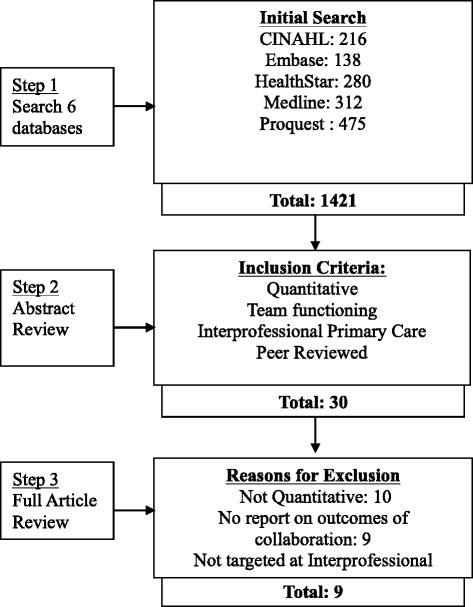
- The search yielded 1421 articles, of which 9 met inclusion criteria after full-text review; these included studies from Canada (Quebec, Alberta), Spain, the United Kingdom (Scotland, England), the United States, and Puerto Rico.
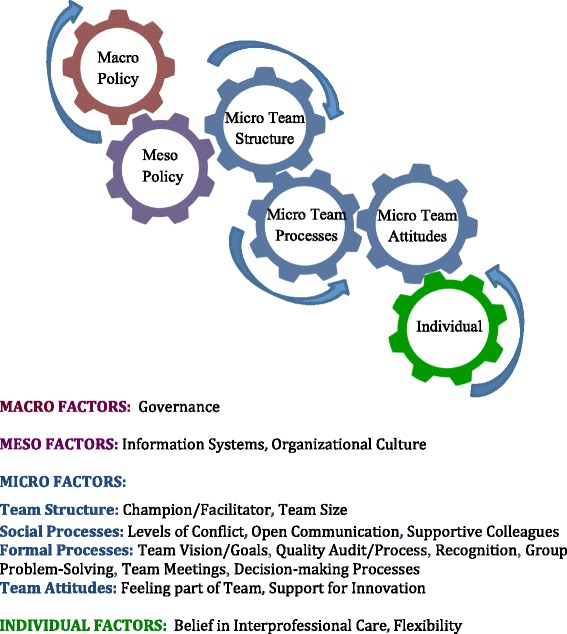
- Across the 9 studies, 18 unique factors were significantly associated with collaboration in at least one article; 13 of 18 were at the micro/team level.
- Factors identified in multiple studies included team vision/shared goals and quality audits/processes (3 studies each), plus team size, information systems, and feeling part of the team (2 studies each).
- The paper reports support for team-level formal and social processes, including open communication, supportive colleagues, group problem-solving, interprofessional team meetings, and a team champion/facilitator; team size showed a negative but nonlinear association with collaboration.
Methods
- The study used a systematic review guided by PRISMA, covering 25 years of peer-reviewed literature (January 1990 to June 2015).
- Searches were conducted in Medline, ProQuest subject, ProQuest abstract, CINAHL, HealthSTAR, and Embase, with reference-list hand searching; eligible studies were published in peer-reviewed journals, focused on interprofessional primary care teams, and reported significance of associations between factors and collaboration.
- Two authors independently reviewed abstracts and assessed quality; the team extracted study characteristics and statistical associations, and the analysis focused on associations between specified factors and collaboration, not effect sizes.
Limitations
- The paper states that the magnitude of associations was not comparable across studies, so it assessed only statistical significance.
- It states that only a limited number of studies were identified, and that more quantitative and qualitative research is needed; it also notes possible differences in how collaboration was measured across studies.
- Evident from the text: the evidence base was thin for macro/meso-level factors and for cross-level relationships, because few studies examined them.
Model-written summary. Check it against the paper before relying on it.
Integrity signals
Registry
Cites
Statistics
Figures
Verification
Claims the paper makes
3 Valid · 0 Not valid · 26 Not checked · 34 Own results and interpretations
The cited sources support only part of this claim — read each source’s verdict below.
In the paper
“The broad categories of factors and their relative importance within the gears model as portrayed here are consistent with reviews that primarily identified qualitative studies that examine factors that influence IPCT collaboration [4, 20, 55, 56].”
§ ‘Gearing Up’ to improve interprofessional collaboration in primary care: a systematic review and conceptual framework > Discussion
What the sources say
- Not matchedcites [4] Conference Board of Canada Improving Primary Health Care through Collaboration. Briefing 2 – Barriers to Successful Interprofessional Teams 2012 Ottawa Conference Board of Canada
We searched by its title and found no matching paper.
- Not checked — no full text of the sourcecites [20] Gocan S Laplante MA Woodened AK Interprofessional Collaboration in Ontario’s Family Health Teams: A Review of the Literature J Res Interprof Pract Educ 2014 3 3 1 19 source
- Not checked yetcites [55] Xyrichis A Lowton K What fosters or prevents interprofessional teamworking in primary and community care? A literature review Int J Nurs Stud 2008 45 1 140 153 10.1016/j.ijnurstu.2007.01.015 17383655 source
Checked before — its earlier verdict is held back until a new check runs.
- Partly supportedcites [56] Legare F Stacey D Pouliot S Gauvin F-P Desroches S Kryworuchko J Interprofessionalism and shared decision-making in primary care: a stepwise approach towards a new model J Interprof Care 2011 25 18 25 10.3109/13561820.2010.490502 20795835 PMC3018136 sourceExperimental — accuracy not yet measured
The Identification of key concepts section (p. 3) says the authors drew on two systematic reviews to identify concepts relevant to interprofessionalism. It does not say those reviews primarily identified qualitative studies, or compare their findings with the gears model’s categories and relative importance. (LLM, conf=0.82)
plainstates an association- Asserted: passes — The authors put it forward as true.
- Checkable: passes — It can be checked against evidence.
- Load-bearing: unclear — It is unclear whether the paper’s conclusions depend on it.
- Based: passes — The paper gives a reason why it holds.
- Not matched
A result the paper reports from its own data — it cites no other source for it, so there is none to check. The quote shows it is in the paper.
In the paper
“Eighteen factors were significantly associated with collaboration in at least one article.”
§ ‘Gearing Up’ to improve interprofessional collaboration in primary care: a systematic review and conceptual framework > Abstract > Results
plainstates an association- Asserted: passes — The authors put it forward as true.
- Checkable: passes — It can be checked against evidence.
- Load-bearing: passes — The paper’s conclusions depend on it.
- Based: passes — The paper gives a reason why it holds.
- Rests on an assumption not shown here.
A result the paper states — it cites no source for it, so there is none to check. The quote shows it is in the paper.
In the paper
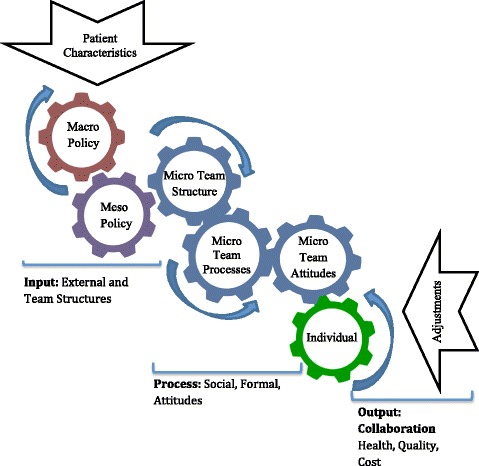
“The majority of factors identified in the review were within the micro gear, corresponding to team level decision making.”
§ ‘Gearing Up’ to improve interprofessional collaboration in primary care: a systematic review and conceptual framework > Discussion
plain- Asserted: passes — The authors put it forward as true.
- Checkable: passes — It can be checked against evidence.
- Load-bearing: unclear — It is unclear whether the paper’s conclusions depend on it.
- Based: passes — The paper gives a reason why it holds.
A claim is checked only against the cited paper’s full text, never its abstract, and none is available for its sources.
In the paper
“Having a team vision or shared goals and objective(s) [45, 51, 52] and the use of quality audits or processes [27, 45, 48] were identified in three articles each.”
§ ‘Gearing Up’ to improve interprofessional collaboration in primary care: a systematic review and conceptual framework > Results
What the sources say
- Not checked — no full text of the sourcecites [27] Sicotte C D’Amour D Moreault M Interdisciplinary Collaboration within Quebec Community Health Care Centres Soc Sci Med 2002 55 6 991 1003 10.1016/S0277-9536(01)00232-5 12220099 source
- Not checked — no full text of the sourcecites [45] Poulton V West M The Determinants of Effectiveness in Primary Health Care Teams J Interprof Care 1999 13 1 7 18 10.3109/13561829909025531 source
- Not checked — no full text of the sourcecites [48] McLean T Atkins E McLean K Quality Practice Award and Teamworking: the Perceptions of Primary Health Care Team Members in Scotland J Interprof Care 2005 19 2 149 155 10.1080/13561820400024084 15823889 source
plainstates an association- Asserted: passes — The authors put it forward as true.
- Checkable: passes — It can be checked against evidence.
- Load-bearing: passes — The paper’s conclusions depend on it.
- Based: passes — The paper gives a reason why it holds.
- Rests on an assumption not shown here.
A claim is checked only against the cited paper’s full text, never its abstract, and none is available for its sources.
In the paper
“There were two factors within the meso gear that were identified in the review: having formal information systems [27, 54] and an organizational culture that had a balance with respect to group culture, hierarchy, and focus on efficiency and achievement [52].”
§ ‘Gearing Up’ to improve interprofessional collaboration in primary care: a systematic review and conceptual framework > Results
What the sources say
- Not checked — no full text of the sourcecites [27] Sicotte C D’Amour D Moreault M Interdisciplinary Collaboration within Quebec Community Health Care Centres Soc Sci Med 2002 55 6 991 1003 10.1016/S0277-9536(01)00232-5 12220099 source
- Not checked — no full text of the sourcecites [54] Hern T Talen M Babiuch C Durazo-Arvizu R Patient Care Management Teams: Improving Continuity, Office Efficiency, and Teamwork in a Residency Clinic J Grad Med Educ 2009 1 67 72 10.4300/01.01.0011 21975709 PMC2931176 source
plainstates an association- Asserted: passes — The authors put it forward as true.
- Checkable: passes — It can be checked against evidence.
- Load-bearing: passes — The paper’s conclusions depend on it.
- Based: passes — The paper gives a reason why it holds.
- Rests on an assumption not shown here.
23 more claims
Create a free account to see all 63 claims and to verify the 10 references still open.
- Probably not a substantial claim. 25
- The quote only partly states this claim. 2
- It may state two separate claims as one. 17
Claims other papers make about this one
Each is checked against this paper’s own text: does it say what the citing paper says it does?
The source backs part of the claim, not all of it — or backs it for a different population, condition or comparison.
In the citing paper
“Their findings indicate that, at the team level, effective leadership plays a pivotal role in enhancing IPC through actions such as championing collaboration, articulating a shared vision and goals, minimising conflicts, and valuing the contributions of all team members.”
From Leadership of Nurses' Interprofessional Collaboration: A Mixed‐Methods Systematic Review (2026) · cites this paper as Mulvale et al. 2016
Experimental — accuracy not yet measuredThe cited source says what the claim attributes to it.
In the citing paper
“Perhaps not surprising given the interdisciplinary intervention, team-based factors were dominant, a finding also reported in a review of interprofessional collaboration in primary care [59].”
From Factors influencing sustainability and scale-up of rural primary healthcare memory clinics: perspectives of clinic team members (2022) · cites this paper as [59]
The cited source says what the claim attributes to it.
In the citing paper
“Similarly, Mulvale et al. (2016) stated that leaders' engagement at the team level, through formal and social processes, to minimise conflicts, can support more effective IPC.”
From Leadership of Nurses' Interprofessional Collaboration: A Mixed‐Methods Systematic Review (2026) · cites this paper as Mulvale et al. (2016)
Citations
Cites
Preferred Reporting Items for Systematic Reviews and Meta-Analyses: the PRISMA statement
Moher, D., Liberati, A., Tetzlaff, J., Altman, D. G., & for the PRISMA Group (2009) · BMJ · doi:10.1136/bmj.b2535 · Cited by 83,823
Preferred Reporting Items for Systematic Reviews and Meta-Analyses: The PRISMA Statement
Moher, D., Liberati, A., Tetzlaff, J., Altman, D. G., & The PRISMA Group (2009) · PLoS Medicine · doi:10.1371/journal.pmed.1000097 · Cited by 64,042 · cited 1×
“Methods The Preferred Reporting Items for Systematic Reviews and Meta-Analyses (PRISMA) was used as a reporting guide [43] for the systematic review of studies that measure associations among various factors and collaboration in IPCTs.”
MethodPreferred reporting items for systematic reviews and meta-analyses: the PRISMA Statement.
(2009) · PubMed Central · Cited by 44,859
Preferred Reporting Items for Systematic Reviews and Meta-Analyses: The PRISMA Statement
Moher, D., Liberati, A., Tetzlaff, J., & Altman, D. G. (2009) · Journal of Clinical Epidemiology · doi:10.1016/j.jclinepi.2009.06.005 · Cited by 19,575
Downs, S. H., & Black, N. (1998) · Journal of Epidemiology and Community Health · doi:10.1136/jech.52.6.377 · Cited by 8,252
What Makes Teams Work: Group Effectiveness Research from the Shop Floor to the Executive Suite
Cohen, S. G., & Bailey, D. E. (1997) · Journal of Management · doi:10.1177/014920639702300303 · Cited by 3,526 · cited 1×
“In the conceptual literature on interprofessional practice, collaborative factors are often portrayed using an input–output-processes approach [24, 27] that originated in the human resources literature [28].”
BackgroundThe conceptual basis for interprofessional collaboration: Core concepts and theoretical frameworks
D'Amour, D., Ferrada-Videla, M., San Martin Rodriguez, L., & Beaulieu, M.-D. (2005) · Journal of Interprofessional Care · doi:10.1080/13561820500082529 · Cited by 1,456
Zwarenstein, M., Goldman, J., & Reeves, S. (2009) · Cochrane Database of Systematic Reviews · doi:10.1002/14651858.cd000072.pub2 · Cited by 1,177 · cited 4×
“2) while recognizing that “interprofessional collaboration also involves issues that arise due to different professionals working together, such as problematic power dynamics, poor communication patterns, lack of understanding of one’s own and others’ roles and responsibilities, and conflicts due to varied approaches…”
BackgroundMethodInfluentialWhat Do We Know about Health Care Team Effectiveness? A Review of the Literature
Lemieux-Charles, L., & McGuire, W. L. (2006) · Medical Care Research and Review · doi:10.1177/1077558706287003 · Cited by 844 · cited 4×
“the patient and disease type, as well as clarity of rules and procedures [24].”
BackgroundInfluentialThe determinants of successful collaboration: A review of theoretical and empirical studies
San Martín-Rodríguez, L., Beaulieu, M.-D., D'Amour, D., & Ferrada-Videla, M. (2005) · Journal of Interprofessional Care · doi:10.1080/13561820500082677 · Cited by 815 · cited 1×
“When the findings are viewed within the proposed ‘gears’ conceptual model, empirical support is found for some factors within each of the macro, meso, micro and individual gears [25, 26, 38].”
Background
Research works printed but not linked: 14
- World Health Organization Framework for Action on Interprofessional Education & Collaborative Practice 2010 Geneva World Health Organization 21174039
- Beaulieu MD Denis JL D’Amour D Goudreau J Haggerty J Hudon E Jobin G Lamothe L Gilbert F Guay H Cyr G Lebeau R Implementing family medicine groups: The challenge in the reorganization of practice and interprofessional collaboration 2006 Montreal Doctor Sadok Besrour Chair in Family Medicine
- Conference Board of Canada Improving Primary Health Care through Collaboration Briefing 1 – Current Knowledge about Interprofessional Teams in Canada 2012 Ottawa Conference Board of Canada
- Conference Board of Canada Improving Primary Health Care through Collaboration. Briefing 2 – Barriers to Successful Interprofessional Teams 2012 Ottawa Conference Board of Canada
- Deber RB Baumann AO Barriers and Facilitators to Enhancing Interdisciplinary Collaboration in Primary Health Care 2005 Toronto Enhancing Interdisciplinary Collaboration in Primary Health Care
- Kirby MJ The Health of Canadians - The Federal Role, Final Report of the State of the Health Care System in Canada 2002 Ottawa Parliament of Canada Standing Senate Committee on Social Affairs, Science and Technology
- Scott C Lagendyk L Contexts and models in primary healthcare and their impact on interprofessional relationships 2012 Ottawa Canadian Health Services Research Foundation
- Watson D Wong S Canadian Policy Context: Interdisciplinary Collaboration in Primary Health Care 2005 Ottawa EICP/Conference Board of Canada
- Davies J Measuring the Performance of Interprofessional Collaboration:Impacts for Patients, Providers and the Health System 2012 Ottawa Janet Davies Group
- Dinh T Stonebridge C Theriault L Recommendations for action: Getting the most out of healthcare teams 2014 Ottawa Conference Board of Canada
- Virani T Interprofessional Collaborative Teams 2012 Ottawa Canadian Health Services Research Foundation
- Health Force Ontario Interprofessional Care Strategic Implementation Committee Implementing Interprofessional Care in Ontario: Final Report of the Interprofessional Care Strategic Implementation Committee 2010 Toronto Government of Ontario
- Mulvale G How does Context Influence Mix of Providers and Quality of Collaboration in Interdisciplinary Family Health Teams in Ontario? A Case Study of Emerging Family Health Teams in Ontario? A Case Study of Emerging Family Health Teams 2008 Toronto Ontario Ministry of Health and Long-Term Care
- Nelson S Turnbull J Bainbridge L Caufield T Hudon G Kendel D Mowat D Nasmith L Postl B Shamian J Sketris I Optimizing Scopes of Practice: New Models of Care for New Health Care System 2014 Ottawa Canadian Academy of Health Sciences
Cited by
Schot, E., Tummers, L., & Noordegraaf, M. (2020) · Journal of Interprofessional Care · doi:10.1080/13561820.2019.1636007 · Cited by 579
“This focus on necessary conditions has led others to argue that the part professionals themselves play in fostering collaboration is not yet well understood (Croker, Trede, & Higgs, 2012; Mulvale, Embrett, & Razavi, 2016; Nugus & Forero, 2011).”
An Overview of Reviews on Interprofessional Collaboration in Primary Care: Barriers and Facilitators
Rawlinson, C., Carron, T., Cohidon, C., Arditi, C., Hong, Q. N., Pluye, P., Peytremann-Bridevaux, I., & Gilles, I. (2021) · International Journal of Integrated Care · doi:10.5334/ijic.5589 · Cited by 329
Wranik, W. D., Price, S., Haydt, S. M., Edwards, J., Hatfield, K., Weir, J., & Doria, N. (2019) · Health Policy · doi:10.1016/j.healthpol.2019.03.015 · Cited by 188
Values of Integrated Care: A Systematic Review
Zonneveld, N., Driessen, N., Stüssgen, R. A. J., & Minkman, M. M. N. (2018) · International Journal of Integrated Care · doi:10.5334/ijic.4172 · Cited by 187
“[52, 62, 71] (N = 3) 23 Safe Care services that are safe for clients, their families and professionals, including privacy and confidentiality protection.”
The complexity, diversity, and science of primary care teams.
Fiscella, K., & McDaniel, S. H. (2018) · American Psychologist · doi:10.1037/amp0000244 · Cited by 155
Smith, T., McNeil, K., Mitchell, R., Boyle, B., & Ries, N. (2019) · BMC Nursing · doi:10.1186/s12912-019-0337-z · Cited by 135
“Mulvale G, Embret, M, Razavi SD. 'Gearing Up' to improve interprofessional collaboration in primary care: a systematic review and conceptual framework.”
MethodJolles, M. P., Richmond, J., & Thomas, K. C. (2019) · Patient Education and Counseling · doi:10.1016/j.pec.2019.02.003 · Cited by 134
Seaton, J. A., Jones, A., Johnston, C., & Francis, K. L. (2020) · Journal of Interprofessional Care · doi:10.1080/13561820.2020.1732311 · Cited by 149
“Subsequently, health practitioners working in primary health care might not share the same space or maintain face-to-face contact with members of their team and may only have limited opportunity for formal meetings to discuss specific patient cases (Mulvale et al., 2016).”
BackgroundInterprofessional primary care during COVID-19: a survey of the provider perspective
Donnelly, C. A., Ashcroft, R., Bobbette, N., Mills, C. M., Mofina, A., Tran, T., Vader, K., Williams, A., Gill, S., & Miller, J. (2021) · BMC Family Practice · doi:10.1186/s12875-020-01366-9 · Cited by 126
Compassionate collaborative care: an integrative review of quality indicators in end-of-life care
Pfaff, K., & Markaki, A. (2017) · BMC Palliative Care · doi:10.1186/s12904-017-0246-4 · Cited by 91
“According to the gears model, collaboration should extend beyond the team itself to include policy-makers, organizational leaders, team leaders and individual professionals [79].”
BackgroundInfluentialBuss, V. H., Shield, A., Kosari, S., & Naunton, M. (2018) · Journal of Pharmaceutical Policy and Practice · doi:10.1186/s40545-018-0149-7 · Cited by 92
A Scoping Review of Facilitators of Multi-Professional Collaboration in Primary Care
Sørensen, M., Stenberg, U., & Garnweidner-Holme, L. M. (2018) · International Journal of Integrated Care · doi:10.5334/ijic.3959 · Cited by 97
The role of the general practitioner in multidisciplinary teams: a qualitative study in elderly care
Grol, S. M., Molleman, G. R. M., Kuijpers, A., van der Sande, R., Fransen, G. A. J., Assendelft, W. J., & Schers, H. (2018) · BMC Family Practice · doi:10.1186/s12875-018-0726-5 · Cited by 93
Doekhie, K. D., Buljac‐Samardžić, M., Strating, M. M. H., & Paauwe, J. (2017) · BMC Family Practice · doi:10.1186/s12875-017-0685-2 · Cited by 69
“only patient satisfaction with care [6, 7], but also work satisfaction of professionals [8].”
BackgroundInfluentialEffective Strategies to Integrate Oral Health into Primary Care: A Systematic Review
Christian, B., George, A., Veginadu, P., Villarosa, A. R., Makino, Y., Kim, W. J., Masood, M., Martin, R. E., Harada, Y., & Mijares-Majini, M. C. (2022) · BMJ Open · doi:10.1136/bmjopen-2022-070622 · Cited by 97
Successful participation of patients in interprofessional team meetings: A qualitative study
van Dongen, J. J. J., Habets, I. G. J., Beurskens, A. J. H. M., & van Bokhoven, M. A. (2016) · Health Expectations · doi:10.1111/hex.12511 · Cited by 74
Communication and Interprofessional Collaboration in Primary Care: From Ideal to Reality in Practice
Fox, S., Gaboury, I., Chiocchio, F., & Vachon, B. (2019) · Health Communication · doi:10.1080/10410236.2019.1666499 · Cited by 79
Arvidsson, E., Dahlin, S., & Anell, A. (2021) · BMC Family Practice · doi:10.1186/s12875-021-01462-4 · Cited by 51
“In many countries, PC is trying to adapt by transforming into multidisciplinary team work, in particular to improve care for patients with chronic diseases and multimorbidity (5, 6).”
BackgroundGrant, A. K., Kontak, J. C. H., Jeffers, E., Lawson, B. J., MacKenzie, A., Burge, F., Boulos, L., Lackie, K., Marshall, E. G., Mireault, A., et al. (2024) · BMC Family Practice · doi:10.1186/s12875-023-02240-0 · Cited by 85
From uniprofessionality to interprofessionality: dual vs dueling identities in healthcare
Khalili, H., & Price, S. L. (2021) · Journal of Interprofessional Care · doi:10.1080/13561820.2021.1928029 · Cited by 79
“In healthcare, there are still regulations, policies and procedures that contribute to the hierarchal healthcare structures, causing some professions to view and be viewed as more important than others (Huq et al., 2017; Mulvale et al., 2016; Regan et al., 2015; Shortall, 2012).”
Background‘It benefits patient care’: the value of practice-based IPE in healthcare curriculums
O’Leary, N., Salmon, N., & Clifford, A. M. (2020) · BMC Medical Education · doi:10.1186/s12909-020-02356-2 · Cited by 69
Aggarwal, M., Hutchison, B. G., Abdelhalim, R., & Baker, G. R. (2023) · Milbank Quarterly · doi:10.1111/1468-0009.12674 · Cited by 66
Albassam, A., Almohammed, H., Alhujaili, M., Koshy, S., & Awad, A. I. (2020) · PLoS ONE · doi:10.1371/journal.pone.0236114 · Cited by 63
Conceptualizing collaboration in nursing
Emich, C. (2018) · Nursing Forum · doi:10.1111/nuf.12287 · Cited by 61
van der Veen, D. J., Döpp, C. M. E., Siemonsma, P. C., der Sanden, M. W. G. N., Swart, B. J. M. D., & Steultjens, E. M. J. (2019) · PLoS ONE · doi:10.1371/journal.pone.0220226 · Cited by 55
“Establishing a team vision and shared goals, formal quality indicators, information systems, and professionals feeling part of a team could facilitate inter-professional collaboration within primary care [50].”
BackgroundLabouring Together: Women's experiences of “Getting the care that I want and need” in maternity care
Watkins, V. J., Nagle, C., Kent, B., Street, M., & Hutchinson, A. M. (2022) · Midwifery · doi:10.1016/j.midw.2022.103420 · Cited by 46
A multilevel study of patient-centered care perceptions in mental health teams
Durand, F., & Fleury, M. (2021) · BMC Health Services Research · doi:10.1186/s12913-020-06054-z · Cited by 47
Setiadi, A. P., Wibowo, Y. I., Herawati, F., Irawati, S., Setiawan, E., Presley, B., Zaidi, M. A., & Sunderland, B. (2017) · Journal of Interprofessional Education & Practice · doi:10.1016/j.xjep.2017.06.002 · Cited by 54
Ho, J., See, M. T. A., Tan, A. J. Q., Levett-Jones, T. L., Lau, T. C., Zhou, W., & Liaw, S. Y. (2023) · Patient Education and Counseling · doi:10.1016/j.pec.2023.107965 · Cited by 60
Adults with intellectual disabilities and mental health disorders in primary care: a scoping review
Pouls, K. P., Leensen, M. C. J., Mastebroek, M., Leusink, G. L., & Assendelft, W. J. (2021) · British Journal of General Practice · doi:10.3399/bjgp.2021.0164 · Cited by 49
Kaiser, L., Bartz, S., Neugebauer, E. A. M., Pietsch, B., & Pieper, D. (2018) · Systematic Reviews · doi:10.1186/s13643-018-0797-3 · Cited by 47
Witti, M. J., Zottmann, J., Wershofen, B., Thistlethwaite, J. E., Fischer, F., & Fischer, M. R. (2023) · Frontiers in Medicine · doi:10.3389/fmed.2023.1213300 · Cited by 52
“(75) identified a number of studies that measured correlations between collaborative processes in interprofessional practice and structural and process factors.”
BackgroundExamining the extent and factors associated with interprofessional teamwork in primary care settings
Khan, A. I., Barnsley, J. M., Harris, J. K., & Wodchis, W. P. (2021) · Journal of Interprofessional Care · doi:10.1080/13561820.2021.1874896 · Cited by 45
“…al., 2013; Reeves et al., 2010; Xyrichis & Ream, 2008), 5) shared power and leadership support for interprofessional teamwork (Goldman et al., 2010; Mulvale et al., 2016; Orchard & Rykhoff, 2015), 6) CONTACT Anum Irfan Khan anumirfan.khan@mail.utoronto.ca Institute of Health Policy, Management…”
BackgroundKebe, N. N. M. K., Chiocchio, F., Bamvita, J., & Fleury, M. (2020) · BMC Family Practice · doi:10.1186/s12875-019-1076-7 · Cited by 45
Karam, M., Tricas‐Sauras, S., Darras, É., & Macq, J. (2017) · International Journal of Integrated Care · doi:10.5334/ijic.2520 · Cited by 31
“Therefore, multidisciplinary teams vary in the extent and effectiveness of collaboration [27].”
BackgroundMayo, C. D., Farzam‐kia, N., & Ghahari, S. (2021) · International Journal of MS Care · doi:10.7224/1537-2073.2020-026 · Cited by 41
Lette, M., Boorsma, M., Lemmens, L. C., Stoop, A., Nijpels, G., Baan, C. A., & de Bruin, S. R. (2019) · Health & Social Care in the Community · doi:10.1111/hsc.12901 · Cited by 40
“In this case, the research team had this role, and other studies have shown similar positive experiences with such ‘champions’ who facilitate boundary spanning and help create team vision and a sense of urgency (Greenhalgh et al., 2004; Mulvale et al., 2016; Rycroft-Malone et al., 2016).”
BackgroundResultDo not confuse multidisciplinary task management in nursing homes with interprofessional care!
Tsakitzidis, G., Anthierens, S., Timmermans, O., Truijen, S., Meulemans, H., & Royen, P. V. (2017) · Primary Health Care Research & Development · doi:10.1017/s146342361700024x · Cited by 39
Adults with intellectual disabilities and mental health disorders in primary care: a scoping review
Pouls, K. P. M., Koks-Leensen, M. C. J., Mastebroek, M., et al. (2022) · Radboud Repository (Radboud University) · Cited by 30
Girard, M. (2021) · Human Resources for Health · doi:10.1186/s12960-020-00549-w · Cited by 47
“[2] allows the conceptualization of the intricate relations among micro-, meso-, and macro-level aspects.”
BackgroundGrol, S. M., Molleman, G. R. M., Wensing, M., Kuijpers, A., Scholte, J. K., van den Muijsenbergh, M. E. T. C., Scherpbier, N. D., & Schers, H. (2020) · International Journal of Integrated Care · doi:10.5334/ijic.4721 · Cited by 35
Kebe, N. N. M. K., Chiocchio, F., Bamvita, J., & Fleury, M. (2018) · Journal of Interprofessional Care · doi:10.1080/13561820.2018.1515191 · Cited by 28
“Most research to date is based on conceptual models, qualitative investigations or quantitative descriptive findings with respect to individual or team-level variables related to IPC (Mulvale et al., 2016; O’Leary et al., 2012).”
BackgroundMethodResultInfluentialLovink, M. H., van Vught, A., Persoon, A., Schoonhoven, L., Koopmans, R. T. C. M., & Laurant, M. G. H. (2018) · BMC Family Practice · doi:10.1186/s12875-018-0746-1 · Cited by 30
“The Four-Dimensional Model of Collaboration, which consists of internalisation, shared goals and vision and governance [33, 34], and the Gears Model of Factors Affecting Interprofessional Collaboration, consisting of individual, micro, meso and maso factors [35].”
MethodEl‐Awaisi, A., Yakti, O., Elboshra, A. M., Jasim, K. H., AboAlward, A. F., Shalfawi, R. W., Awaisu, A., Rainkie, D. C., Mutawa, N. A., & Major, S. C. (2024) · BMC Family Practice · doi:10.1186/s12875-024-02537-8 · Cited by 55
“Participants’ ideas were categorized under four main domains adapted from the “Gears model” [7].”
MethodGaigl, G., Täumer, E., Merz, K., Zöscher, S., Wagner, S., Kösters, M., Falkai, P., Leucht, S., & Hasan, A. (2021) · Schizophrenia Research · doi:10.1016/j.schres.2021.01.010 · Cited by 33
Hughes, C. A., Breault, R. R., Hicks, D., & Schindel, T. J. (2017) · BMC Health Services Research · doi:10.1186/s12913-017-2734-x · Cited by 32
Dib, K., & Belrhiti, Z. (2025) · BMJ Open · doi:10.1136/bmjopen-2025-101702 · Cited by 64
Morgan, D., Kosteniuk, J., O’Connell, M. E., Seitz, D., Elliot, V., Bayly, M., Chow, A. F., & Cameron, C. (2022) · BMC Health Services Research · doi:10.1186/s12913-022-07550-0 · Cited by 20
Geriatric emergency medicine—a model for frailty friendly healthcare
Mooijaart, S. P., Carpenter, C. R., & Conroy, S. (2021) · Age and Ageing · doi:10.1093/ageing/afab280 · Cited by 27
Developing interprofessional collaborative practice competencies in rural primary health care teams
LaMothe, J., Hendricks, S. M., Halstead, J. A., et al. (2020) · Nursing Outlook · doi:10.1016/j.outlook.2020.12.001 · Cited by 27
Russell, A., de Wildt, G., Grut, M., Greenfield, S., & Clarke, J. L. (2022) · BMJ Open · doi:10.1136/bmjopen-2021-055955 · Cited by 31
Perron, Parent, Gaboury, & Bergeron (2022) · Rural and Remote Health · doi:10.22605/rrh7566 · Cited by 36
Individual-level determinants of interprofessional team collaboration in healthcare
Dellafiore, F., Caruso, R., Conte, G., Grugnetti, A. M., Bellani, S., & Arrigoni, C. (2019) · Journal of Interprofessional Care · doi:10.1080/13561820.2019.1594732 · Cited by 34
“A recent conceptual framework coming from a systematic review offers a real taxonomy of the main determinants of the ITC process, which are described as the ‘gears’ of ITC (Mulvale et al., 2016).”
BackgroundInfluentialExisting models of interprofessional collaborative practice in primary healthcare: a scoping review
McNaughton, S. M., Flood, B., Morgan, C. J., & Saravanakumar, P. (2021) · Journal of Interprofessional Care · doi:10.1080/13561820.2020.1830048 · Cited by 38
“Inclusion of these wider influences in models of interprofessional care has been recommended previously in the literature on IPE and interprofessional PHC (Cox et al., 2016; Mulvale et al., 2016; WHO, 2016).”
BackgroundThe integral role of nurses in primary care for transgender people: A qualitative descriptive study
Ziegler, E. (2020) · Journal of Nursing Management · doi:10.1111/jonm.13190 · Cited by 35
Triple aim improvement for individuals, services and society in dementia care
Nieuwboer, M. S., Richters, A., & van der Marck, M. A. (2017) · Zeitschrift für Gerontologie und Geriatrie · doi:10.1007/s00391-017-1196-4 · Cited by 24
“Recent researchfindings about interprofessional collaboration in primary care [13] support the importance of a team vision, shared goals, formal quality processes, information systems and shared team spirit; therefore, development of collaboration and communication skills including all these aspects and jointly sharin…”
BackgroundCare Integration in Primary Dementia Care Networks: A Longitudinal Mixed-Methods Study
Oostra, D. L., Harmsen, A., Nieuwboer, M. S., Rikkert, M. G. M. O., & Perry, M. (2021) · International Journal of Integrated Care · doi:10.5334/ijic.5675 · Cited by 30
El‐Awaisi, A., Awaisu, A., Aboelbaha, S., Abedini, Z. S., Johnson, J. M., & Abdulla, S. A. A. (2021) · Journal of Multidisciplinary Healthcare · doi:10.2147/jmdh.s286960 · Cited by 36
Domínguez-Cancino, K. A., Palmieri, P. A., & Martínez-Gutiérrez, M. S. (2020) · Journal of Primary Care & Community Health · doi:10.1177/2150132720924884 · Cited by 28
Stafyla, E., Kotsiou, O. S., Deskata, K., & Gourgoulianis, K. I. (2018) · International Journal of COPD · doi:10.2147/copd.s147628 · Cited by 31
“79 Better valuing of preventative medicine will help increase the motivation and effectiveness of PHC. Screening and case-finding strategies as well as validated questionnaires in identified cases 80 are the tools in achieving the goal of early diagnosis in COPD.”
Martin, P., Pighills, A., Burge, V., Argus, G., & Sinclair, L. B. (2021) · International Journal of Environmental Research and Public Health · doi:10.3390/ijerph18105162 · Cited by 20
Turner, A., Mulla, A., Booth, A., Aldridge, S., Stevens, S., Begum, M., & Malik, A. (2018) · Health Services and Delivery Research · doi:10.3310/hsdr06250 · Cited by 23
A Review of the Enablers and Barriers of Medical Student Participation in Research
Mayne, C., Bates, H., Desai, D. J., & Martin, P. (2024) · Medical Science Educator · doi:10.1007/s40670-024-02156-z · Cited by 25
“Previous research has utilised the micro, meso, and macro frameworks to unpack enablers and barriers of an investigated topic [11, 12].”
Kanno, N. D. P., Peduzzi, M., Germani, A. C. C. G., de Soárez, P. C., & da Silva, A. T. C. (2023) · Cadernos de Saúde Pública · doi:10.1590/0102-311xpt213322 · Cited by 82
Lennox-Chhugani, N. (2023) · International Journal of Integrated Care · doi:10.5334/ijic.7544 · Cited by 34
Ziegler, E., Valaitis, R. K., Risdon, C., Carter, N., & Yost, J. (2020) · Transgender Health · doi:10.1089/trgh.2019.0082 · Cited by 19
Kebe, N. N. M. K., Chiocchio, F., Bamvita, J., & Fleury, M. (2019) · SAGE Open Medicine · doi:10.1177/2050312119841467 · Cited by 23
Díaz, C., Abahuje, E. A. E., Berry, A. B. L., Rafferty, M. R., Amro, A., Tesorero, K., Shapiro, M., Ko, B., Jones, W. C., Slocum, J. D., et al. (2023) · BMJ Open · doi:10.1136/bmjopen-2023-075470 · Cited by 18
Watkins, V. J., Nagle, C., Kent, B., & Hutchinson, A. M. (2017) · BMJ Open · doi:10.1136/bmjopen-2016-014262 · Cited by 17
“vel organisational factors that may influence the effectiveness of the collaborative alliance.(42) Studies have also not measured the essential elements of collaboration in maternity practice from the perspectives of either clinicians or women, and the possible influences of organisational culture and context on effec…”
BackgroundNordmann, K., Sauter, S., Möbius-Lerch, P., Redlich, M.-C., Schaller, M., & Fischer, F. (2023) · JMIR Research Protocols · doi:10.2196/45179 · Cited by 25
Saha, S. K., Thursky, K., Kong, D. C. M., & Mazza, D. (2022) · Antibiotics · doi:10.3390/antibiotics11091158 · Cited by 16
“Although primary care patient services vary significantly by country, these services are ubiquitously less compliant with the concept of team-based patient care involving antimicrobial use [4].”
BackgroundMoecker, R., Weißenborn, M., Klingenberg, A., Wirbka, L., Fuchs, A., Eickhoff, C., Mueller, U., Schulz, M., Kaufmann-Kolle, P., ARMIN Study Group, et al. (2022) · BMC Health Services Research · doi:10.1186/s12913-022-08378-4 · Cited by 14
Fuentes, M. P., González, L. A., Aranda-Reneo, I., Crespo, C. C., Martos, J. A. F., & Santos, A. P. (2022) · BMC Health Services Research · doi:10.1186/s12913-022-07855-0 · Cited by 22
“These practices have been associated with fewer clinical errors [55] and better outcomes for patients and healthcare systems [53] – positively affecting work dynamics and limiting stress factors among co-workers [56, 57] As Bleakley [58] suggested, a more fluid dialogue at all levels within a group or institution can…”
BackgroundFukkink, R. G., & Lalihatu, E. S. (2020) · International Journal of Integrated Care · doi:10.5334/ijic.5482 · Cited by 28
Using an interprofessional team to provide refugee healthcare in an academic medical centre
Elmore, C. E., Tingen, J. M., Fredgren, K., Dalrymple, S. N., Compton, R. M., Carpenter, E. L., Allen, C. W., & Hauck, F. R. (2019) · Family Medicine and Community Health · doi:10.1136/fmch-2018-000091 · Cited by 16
“ConClusIon Interprofessional collaboration in primary care has been shown to benefit health systems and patients, particularly those with complex healthcare needs.(30) Individuals who arrive in the USA as refugees are a particularly vulnerable patient group and often require this team approach.”
Kobrai-Abkenar, F., Salimi, S., & Pourghane, P. (2024) · Iranian Journal of Nursing and Midwifery Research · doi:10.4103/ijnmr.ijnmr_336_22 · Cited by 15
“[25,35]”
BackgroundInfluentialSasagawa, M., & Amieux, P. S. (2019) · Journal of Multidisciplinary Healthcare · doi:10.2147/jmdh.s206526 · Cited by 17
“(p. 24)46 The interprofessional collaborative model proposed by Mulvale et al (2016) uses individual healthcare professionals as the foundation for making adjustments in different types of interprofessional collaborations, and the ability of the individual to make adjustments is mediated by team…”
MethodDavidson, A. R., Zigori, B. D., Ball, L., Morgan, M. A. J., Gala, D., & Reidlinger, D. P. (2023) · Health Expectations · doi:10.1111/hex.13828 · Cited by 16
Schimith, M. D., Cezár-Vaz, M. R., Xavier, D. M., & Cardoso, L. S. (2021) · Revista Latino-Americana de Enfermagem · doi:10.1590/1518-8345.4044.3390 · Cited by 36
“In addition, the professionals need to feel part of the team(13).”
BackgroundIrgens, E. L., Henriksen, N. O., & Moe, S. (2018) · Disability and Rehabilitation · doi:10.1080/09638288.2018.1544295 · Cited by 14
“Furthermore, few studies have paid attention to the influence of policy and organizational contexts on effectiveness of collaborative practice between health professionals [22], and most studies of coordinated care have been driven by specialist health care, with less relevance to the challenges experienced in primary…”
BackgroundDellafiore, F., Guardamagna, L., Haoufadi, S., Cicognani, A., Mola, A. D., Mazzone, B., Occhini, G., Brusini, A., & Artioli, G. (2025) · Healthcare · doi:10.3390/healthcare13212794 · Cited by 22
“Finally, collaborative dynamics were linked to tangible changes in practice, including improved care coordination, patient-centered approaches, and adaptive responses to complex cases [39,41,42,45].”
InfluentialNdateba, I., Wong, S. T., Beaumier, J., Burge, F., Martin‐Misener, R., Hogg, W. E., Wodchis, W. P., McGrail, K. M., & Johnston, S. (2022) · Journal of Interprofessional Care · doi:10.1080/13561820.2022.2099359 · Cited by 14
“, 2007), including a systematic review (Mulvale et al., 2016) where a negative association was found between team size and team climate in primary care practices.”
BackgroundResultBudtz, C. R., Rønn-Smidt, H., Thomsen, J. L., Hansen, R. P., & Christiansen, D. H. (2022) · Physical Therapy · doi:10.1093/ptj/pzac026 · Cited by 14
“29,30”
Cheng, M. K. W., Collins, S., Baron, R. B., & Boscardin, C. K. (2021) · Journal of Graduate Medical Education · doi:10.4300/jgme-d-20-01555.1 · Cited by 10
Furness, K., Huggins, C. E., Croagh, D. G., & Haines, T. P. (2021) · Nutrients · doi:10.3390/nu13031020 · Cited by 11
Collaborating on Early Detection of Frailty; a Multifaceted Challenge
Buist, Y., Rijken, M., Lemmens, L. C., Baan, C. A., & de Bruin, S. R. (2019) · International Journal of Integrated Care · doi:10.5334/ijic.4176 · Cited by 13
Cuidado colaborativo entre os Núcleos de Apoio à Saúde da Família e as equipes apoiadas
Júnior, J. P. B., & Moreira, D. C. (2018) · Physis Revista de Saúde Coletiva · doi:10.1590/s0103-73312018280310 · Cited by 30
Ashcroft, R., Bobbette, N., Moodie, S., Miller, J. D., Adamson, K., Smith, M. A., & Donnelly, C. A. (2024) · Healthcare Management Forum · doi:10.1177/08404704241266763 · Cited by 16
Williamson, G. R., Kane, A., Evans, S. F., et al. (2023) · BMC Nursing · doi:10.1186/s12912-023-01501-8 · Cited by 11
“…teamworking and cooperation amongst student nurses and other neophyte professionals [49], and so we argue that our GPN settings functioned as exemplars of how interprofessional care can be achieved because they fostered a team vision and shared goals, and sense of belonging to the team [50].”
BackgroundKosteniuk, J. G., Morgan, D., Elliot, V., Bayly, M., Chow, A. F., Boden, C., & O’Connell, M. E. (2023) · Journal of Interprofessional Care · doi:10.1080/13561820.2023.2204890 · Cited by 21
“Previous studies indicate that effective interprofessional collaboration requires clear team roles and responsibilities (Wranik et al., 2019) and processes for team problem solving and decision-making (Mulvale et al., 2016).”
BackgroundResultHow can we evaluate collaborative practices in inclusive schools? Challenges and proposed solutions
Ianni, L., Camden, C., & Anaby, D. (2022) · Journal of Occupational Therapy Schools & Early Intervention · doi:10.1080/19411243.2022.2054486 · Cited by 17
Fox, S., Breton, M., Faria, A., & Kilpatrick, K. (2022) · Health Communication · doi:10.1080/10410236.2022.2028367 · Cited by 16
“Some health policy and management scholars have called for studies that consider the interinfluences of macro (policy), meso (organizational), micro (team), and individual factors on interprofessional collaboration (Mulvale et al., 2016), yet most IP research considers communication in isolation at the micro level in…”
BackgroundEnhancing the value of clinical networks for rare diseases
Bolz-Johnson, M., Clément, L., Gahl, W. A., Padilla, C. D., Nishumura, Y., Yang, P., Sarfaty, L., Hoogerbrugge, N., Baynam, G. S., & Kenny, T. (2022) · Rare Disease and Orphan Drugs Journal · doi:10.20517/rdodj.2022.01 · Cited by 12
Arulappan, J., Matua, G. A., Zaabi, O. A., Vincent, S. C., Jayapal, S. K., Sabei, S. D. A., & Seshan, V. (2021) · Nurse Education Today · doi:10.1016/j.nedt.2021.104865 · Cited by 13
Horlait, M., Baes, S., Regge, M. D., & Leys, M. (2021) · Cancer Nursing · doi:10.1097/ncc.0000000000000923 · Cited by 21
“The elements retrieved about team “processes” in cancer care are in line with studies of other healthcare settings.(79) Both social processes—such as open communication, mutual respect, trust, status of team members, opportunity to speak, and language differences—as well as formal processes—such as leadership, shared…”
ResultYuliyanti, S., Utarini, A., & Trisnantoro, L. (2020) · BMC Health Services Research · doi:10.1186/s12913-020-05769-3 · Cited by 12
Haruta, J., Ozone, S., & Goto, R. (2019) · Family Medicine and Community Health · doi:10.1136/fmch-2019-000202 · Cited by 19
“All p values were two-sided and considered significant at p<0.05.”
InfluentialInterprofessional Teams: Lessons Learned From a Nurse-Led Clinic
Schentrup, D. M., Black, E. W., Blue, A. V., & Whalen, K. (2019) · The Journal for Nurse Practitioners · doi:10.1016/j.nurpra.2019.02.016 · Cited by 15
Law matters: How the legal context in Canada influences interprofessional collaboration
Ries, N. M. (2017) · Journal of Interprofessional Care · doi:10.1080/13561820.2017.1310495 · Cited by 12
Interprofessional collaboration in pharmacist-led primary care clinics
Wilbur, K., Kelly, D. V., & Jorgenson, D. J. (2025) · Canadian Pharmacists Journal / Revue des Pharmaciens du Canada · doi:10.1177/17151635241312423 · Cited by 11
Metadata
- Authors
- Mulvale, G., Embrett, M., & Razavi, S. D.
- Affiliations
- McMaster University (CA)
- Corresponding author
- Mulvale, Gillian
- Venue
- BMC Family Practice
- Published
- 2016-07-20
- Volume
- 17
- Issue
- 1
- Pages
- 83-83
- ISSN
- 1471-2296 (ISSN-L)
- PMC
- PMC4955241
- OpenAlex
- W2488363735
- Cited by
- 253
- References
- 49
- Citations by year
- 2026: 18 · 2025: 22 · 2024: 29 · 2023: 39 · 2022: 35 · 2021: 31 · 2020: 24 · 2019: 22 · 2018: 18 · 2017: 14 · 2016: 1
- FWCI
- 3.48
- Type
- journal article
- Language
- en
- Open access
- gold
- doi.org
- Licence
- cc-by
- Locations
- BMC Family Practice (publishedVersion, cc-by)
- PubMed Central (publishedVersion, cc-by)
- PubMed (publishedVersion)
- TSpace (University of Toronto) (submittedVersion, cc-by)
- Funders
- Health Canada (4500295507)
- Topics
- Health Sciences › Health Professions › General Health Professions › Interprofessional Education and Collaboration
- Health Sciences › Medicine › Public Health, Environmental and Occupational Health › Healthcare Systems and Technology
- Social Sciences › Arts and Humanities › History and Philosophy of Science › Interdisciplinary Research and Collaboration
- Keywords
- interprofessional collaboration, primary care, team factors, conceptual framework, team communication, team structure, quality audit, group problem solving, organizational culture, information systems, complex care needs
- MeSH terms
- Clinical Decision-Making, Attitude of Health Personnel, Communication, Cooperative Behavior, Group Processes, Humans, Interprofessional Relations, Medical Audit, Models, Theoretical, Patient Care Team, Primary Health Care, Problem Solving, Organizational Policy
About these checks
Registry, retraction, Cites and statistics results are computed, not judged, with one exception: a printed reference that no index lists is read once by a model before it counts as a citation error. Claims are extracted by a model and kept only when their quote appears verbatim in the text; each cited source is then checked, with a model’s help, for whether it says what the claim relies on. Those verdicts can be wrong — read the claim’s quote and the cited source before relying on one.
The claim verdicts this report counts are experimental: their accuracy is not yet measured.
A language model drew the claims from the paper on 2026-10-10, under version 3 of the claim definition (model deepseek-v4.1-flash, prompt extract-v3).
A second model labelled each claim on 2026-10-10 (model jev-1.13-20260917, definition revision gold-guideline-v0.2).
Cited sources are checked with a language model’s help (gpt-6-sol).
Statistics and arithmetic are recomputed, not judged.
Confidence bands are shown only for fields calibrated on our annotated test set. None is calibrated yet, so no band is shown.
What counts as a claim ›How we measure confidence ›How we check this ›
Are you an author, or do you see a problem with this page? Request a review
Data sources
Bibliographic data: Semantic Scholar, OpenAlex, Crossref.
Contains information from the Semantic Scholar Academic Graph Datasets, made available under the ODC Attribution License (ODC-BY 1.0).
Semantic Scholar’s data is described in: Kinney, R., et al. (2023). The Semantic Scholar Open Data Platform. arXiv:2301.10140.
