

'Doing the right thing': factors influencing GP prescribing of antidepressants and prescribed doses
Open accessThe DOI matches its Crossref record; 57 of the 57 references it cites were found in a registry or an index.
Abstract
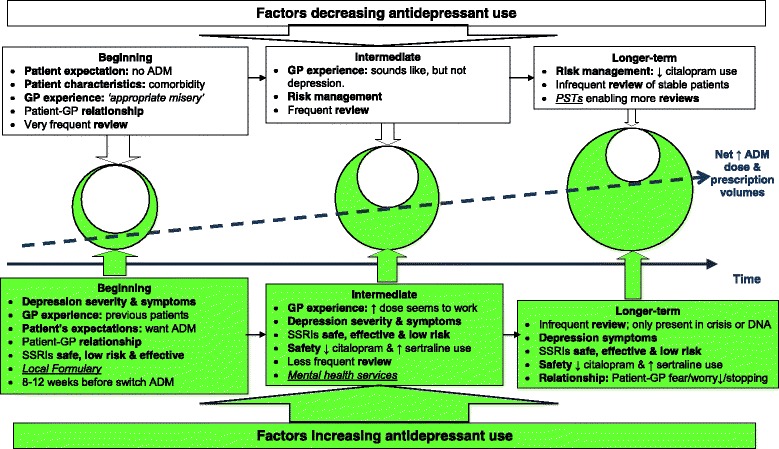
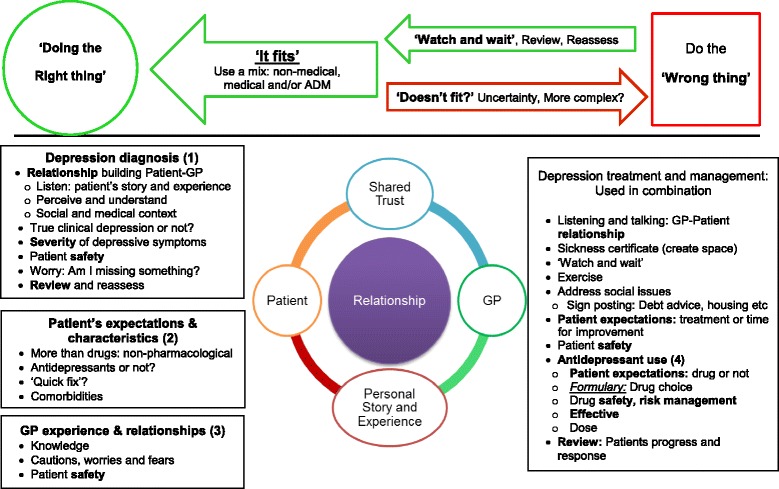
BACKGROUND: Antidepressant prescribing continues to increase, with 5-16% of adults receiving antidepressants annually. Total prescribing growth is due in part to increased long-term use, greater selective serotonin re-uptake inhibitor (SSRI) use and the use of higher SSRI doses. Evidence does not support routine use of higher SSRI doses for depression treatment, and factors influencing the use of such doses are not well known. The aim of this study was to explore factors influencing GPs' use of antidepressants and their doses to treat depression. METHODS: Semi-structured interviews with a purposive sample of 28 practising GPs; sampled by antidepressant prescribing volume, practice size and deprivation level. A topic guide drawing on past literature was used with enough flexibility to allow additional themes to emerge. Interviews were audio-recorded and transcribed verbatim. Framework analysis was employed. Constant comparison and disconfirmation were carried out across transcripts, with data collection being interspersed with analysis by three researchers. The thematic framework was then systematically applied to the data and conceptualised into an overarching explanatory model. RESULTS: Depression treatment involved ethical and professional imperatives of 'doing the right thing' for individuals by striving to achieve the 'right care fit'. This involved medicalised and non-medicalised patient-centred approaches. Factors influencing antidepressant prescribing and doses varied over time from first presentation, to antidepressant initiation and longer-term treatment. When faced with distressed patients showing symptoms of moderate to severe depression GPs were confident prescribing SSRIs which they considered as safe and effective medicines, and ethically and professionally appropriate. Many GPs were unaware that higher doses lacked greater efficacy and onset of action occurred within 1-2 weeks, preferring to wait 8-12 weeks before increasing or switching. Ongoing pressures to maintain prescribing (e.g. fear of depression recurrence), few perceived continuation problems (e.g. lack of safety concerns) and lack of proactive medication review (e.g. patients only present in crisis), all combine to further drive antidepressant prescribing growth over time. CONCLUSIONS: GPs strive to 'do the right thing' to help people. Antidepressants are only a single facet of depression treatment. However, increased awareness of drug limitations and regular proactive reviews may help optimise care.
Overview
The claims and statistics of this paper haven’t been checked yet.
Free: it reads the open-access text and checks the first 5 claims that cite a source we can check. Create a free account to check every claim.
Integrity signals
Registry
Cites
Statistics
Figures
Verification
Claims the paper makes
The claims and statistics of this paper haven’t been checked yet.
Free: it reads the open-access text and checks the first 5 claims that cite a source we can check. Create a free account to check every claim.
Claims other papers make about this one
Each is checked against this paper’s own text: does it say what the citing paper says it does?
The source backs part of the claim, not all of it — or backs it for a different population, condition or comparison.
In the citing paper
“however, discontinuation of long-term antidepressants could be considered in other contexts, for example, prescribing in the context of medicalising”
From Approaches for discontinuation versus continuation of long-term antidepressant use for depressive and anxiety disorders in adults (2021) · cites this paper as Johnson 2017
Experimental — accuracy not yet measuredThe cited source says what the claim attributes to it.
In the citing paper
“Research suggests that most antidepressants are prescribed by GPs (Johnson 2017)”
From Approaches for discontinuation versus continuation of long-term antidepressant use for depressive and anxiety disorders in adults (2021) · cites this paper as Johnson 2017
The cited source says what the claim attributes to it.
In the citing paper
“HPs reported fear of destabilising currently well patients by discontinuing antidepressants; a fear which has been evidenced in patients and GPs.19 20 33”
From Helping people discontinue long-term antidepressants: views of health professionals in UK primary care (2019) · cites this paper as [20]
The cited source says what the claim attributes to it.
In the citing paper
“This study is the first to explore HP’s perspectives of antidepressant discontinuation in UK primary care, with its larger sample consisting of a range of HP roles (including GPs, GP assistants, nurses, community mental health team workers and psychotherapists) which were lacking in previous research,20 21 33 40 41 and data reached saturation.”
From Helping people discontinue long-term antidepressants: views of health professionals in UK primary care (2019) · cites this paper as [20]
Self-check
Percentages, sums and reported differences re-computed from the paper’s own numbers.
The self-check needs the paper’s full text.
Citations
Cites
Interpreting Qualitative Data Methods for Analysing Talk, Text and Interaction
Kleinsasser, R. C., & Silverman, D. (1997) · The Modern Language Journal · doi:10.2307/329190 · Cited by 6,866
Qualitative data analysis for applied policy research
(2002) · Analyzing Qualitative Data · doi:10.4324/9780203413081-14 · Cited by 4,964 · cited 1×
“comparative technique was used [35] while adopting Framework analysis [36] as the broad structure for the analytical procedure.”
Method(1958) · Journal of the American Pharmaceutical Association (Scientific ed.) · doi:10.1002/jps.3030470133 · Cited by 2,489
Kirsch, I., Deacon, B. J., Huedo-Medina, T. B., Scoboria, A., Moore, T. J., & Johnson, B. T. (2008) · PLoS Medicine · doi:10.1371/journal.pmed.0050045 · Cited by 2,442
Selective publication of antidepressant trials and its influence on apparent efficacy
Turner, E. H., Matthews, A. M., Linardatos, E., Tell, R. A., & Rosenthal, R. (2008) · New England Journal of Medicine · doi:10.1056/nejmsa065779 · Cited by 2,435 · cited 1×
“of depressive illness [11]; ‘ghostwriting’ antidepressant studies [9, 10]; and more controversially, reporting bias, missing data [12], and antidepressant associated self-harm [13].”
BackgroundThe Loss of Sadness: How Psychiatry Transformed Normal Sorrow into Depressive Disorder
Horwitz, A. V., & Wakefield, J. C. (2007) · doi:10.1093/oso/9780195313048.001.0001 · Cited by 1,017
Qualitative Data Analysis for Applied Policy Research
Ritchie, J., & Spencer, L. (2002) · The Qualitative Researcher's Companion · doi:10.4135/9781412986274.n12 · Cited by 905
The National Collaborating Centre for Mental Health
Kendall, T., & Pilling, S. (2004) · UCL Discovery (University College London) · Cited by 840
Cleare, A., Pariante, C., Young, A., Anderson, I., Christmas, D., Cowen, P., Dickens, C., Ferrier, I., Geddes, J., Gilbody, S., et al. (2015) · Journal of Psychopharmacology · doi:10.1177/0269881115581093 · Cited by 759 · cited 4×
“Therefore, in order appropriately optimise antidepressant use for depression treatment it is important that prescribers are more aware that the greatest response occurs within the first 2 weeks of treatment [17, 31].”
BackgroundInfluential(2009) · PsycEXTRA Dataset · doi:10.1037/e671332011-001 · Cited by 753
British National Formulary: BNF
(2015) · doi:10.18578/bnf_147942626 · Cited by 641
Spijker, J., De Graaf, R., Bijl, R. V., Beekman, A. T. F., Ormel, J., & Nolen, W. A. (2002) · British Journal of Psychiatry · doi:10.1192/bjp.181.3.208 · Cited by 514
Wiles, N., Thomas, L., Abel, A., Ridgway, N., Turner, N., Campbell, J., Garland, A., Hollinghurst, S., Jerrom, B., Kessler, D., et al. (2013) · The Lancet · doi:10.1016/s0140-6736(12)61552-9 · Cited by 340
A Review of the Evidence for the Efficacy and Safety of Trazodone in Insomnia
Mendelson, W. B. (2005) · The Journal of Clinical Psychiatry · doi:10.4088/jcp.v66n0409 · Cited by 308
Moore, M., Yuen, H. M., Dunn, N., Mullee, M. A., Maskell, J., & Kendrick, T. (2009) · BMJ · doi:10.1136/bmj.b3999 · Cited by 287
The medicalisation of misery: A critical realist analysis of the concept of depression
BENTALL, D. P. (1999) · Journal of Mental Health · doi:10.1080/09638239917427 · Cited by 223
Bradley, C. (1992) · Europe PMC (PubMed Central) · Cited by 210
Barriers to GPs' use of evidence-based medicine: a systematic review
Zwolsman, S., te Pas, E., Hooft, L., Waard, M. W.-D., & van Dijk, N. (2012) · British Journal of General Practice · doi:10.3399/bjgp12x652382 · Cited by 208 · cited 1×
“In one systematic review such experience was identified as a barrier to the use of evidence-based medicine in practice [44].”
BackgroundThe Loss of Sadness: How Psychiatry Transformed Normal Sorrow Into Depressive Disorder
Seritan, A. L. (2007) · American Journal of Psychiatry · doi:10.1176/appi.ajp.2007.07081263 · Cited by 194
An overview of the clinical efficacy of mirtazapine
Benkert, O., Muller, M., & Szegedi, A. (2002) · Human Psychopharmacology: Clinical and Experimental · doi:10.1002/hup.397 · Cited by 179
Adli, M., Baethge, C., Heinz, A., Langlitz, N., & Bauer, M. (2005) · European Archives of Psychiatry and Clinical Neuroscience · doi:10.1007/s00406-005-0579-5 · Cited by 174
Secular trends in antidepressant prescribing in the UK, 1975-1998
Middleton, N., Gunnell, D., Whitley, E., Dorling, D., & Frankel, S. (2001) · Journal of Public Health · doi:10.1093/pubmed/23.4.262 · Cited by 168
Dowrick, C., & Frances, A. (2013) · BMJ · doi:10.1136/bmj.f7140 · Cited by 167
Which Factors Influence Psychiatrists’ Selection of Antidepressants?
Zimmerman, M., Posternak, M., Friedman, M., Attiullah, N., Baymiller, S., Boland, R., Berlowitz, S., Rahman, S., Uy, K., & Singer, S. (2004) · American Journal of Psychiatry · doi:10.1176/appi.ajp.161.7.1285 · Cited by 139
Mental health policy and practice across Europe : the future direction of mental health care
Knapp, M. R. J., McDaid, D., Mossialos, E. A., & Thornicroft, G. (2007) · Cited by 134
Lockhart, P., & Guthrie, B. (2011) · British Journal of General Practice · doi:10.3399/bjgp11x593848 · Cited by 123
Prevalence, duration and indications for prescribing of antidepressants in primary care
Petty, D. R., House, A., Knapp, P., Raynor, T., & Zermansky, A. (2006) · Age and Ageing · doi:10.1093/ageing/afl023 · Cited by 110
The Maudsley Prescribing Guidelines in Psychiatry, 12th ed
Jenkins, J. A., & Kontos, N. (2016) · The Journal of Clinical Psychiatry · doi:10.4088/jcp.16bk10716 · Cited by 107
Reviewing long-term antidepressants can reduce drug burden: a prospective observational cohort study
Johnson, C. F., Macdonald, H. J., Atkinson, P., Buchanan, A. I., Downes, N., & Dougall, N. (2012) · British Journal of General Practice · doi:10.3399/bjgp12x658304 · Cited by 105 · cited 6×
“MHRA citalopram/escitalopram warning, or as part of a local initiative [21], unnecessary treatment”
BackgroundInfluentialSelf-citationGreater incidence of depression with hypnotic use than with placebo
Kripke, D. F. (2007) · BMC Psychiatry · doi:10.1186/1471-244x-7-42 · Cited by 96
(2005) · Europe PMC (PubMed Central) · Cited by 96
Antidepressant dose, age, and the risk of deliberate self-harm
Miller, M., Swanson, S. A., Azrael, D., Pate, V., & Stürmer, T. (2014) · JAMA Internal Medicine · doi:10.1001/jamainternmed.2014.1053 · Cited by 92
Tolerability and safety aspects of mirtazapine
Nutt, D. J. (2002) · Human Psychopharmacology: Clinical and Experimental · doi:10.1002/hup.388 · Cited by 92
Utilization, price, and spending trends for antidepressants in the US Medicaid program
Chen, Y., Kelton, C. M. L., Jing, Y., Guo, J. J., Li, X., & Patel, N. C. (2008) · Research in Social and Administrative Pharmacy · doi:10.1016/j.sapharm.2007.06.019 · Cited by 83
Report on transport services in general practice. An experiment in five general practices.
Lance, H. (1971) · PubMed Central · Cited by 81
Toxicity and Adverse Consequences of Benzodiazepine Use
Ashton, H. (1995) · Psychiatric Annals · doi:10.3928/0048-5713-19950301-09 · Cited by 73
Sampson, R., Barbour, R. S., & Wilson, P. (2016) · BMC Family Practice · doi:10.1186/s12875-016-0442-y · Cited by 73
Patients' views of antidepressants: from first experiences to becoming expert
Schofield, P., Crosland, A., Waheed, W., Aseem, S., Gask, L., Wallace, A., Dickens, A., & Tylee, A. (2011) · British Journal of General Practice · doi:10.3399/bjgp11x567045 · Cited by 67
Munoz-Arroyo, R., Sutton, M., & Morrison, J. (2006) · Europe PMC (PubMed Central) · Cited by 61
Are antidepressants overprescribed? Yes
Spence, D. (2013) · BMJ · doi:10.1136/bmj.f191 · Cited by 59
Factors influencing variation in prescribing of antidepressants by general practices in Scotland
Morrison, J., Anderson, M.-J., Sutton, M., Munoz-Arroyo, R., McDonald, S., Maxwell, M., Power, A., Smith, M., & Wilson, P. (2009) · British Journal of General Practice · doi:10.3399/bjgp09x395076 · Cited by 56
Self-citationKoski, A., Vuori, E., & Ojanperä, I. A. (2005) · International Journal of Legal Medicine · doi:10.1007/s00414-005-0528-x · Cited by 51
Drug Firms, the Codification of Diagnostic Categories, and Bias in Clinical Guidelines
Cosgrove, L., & Wheeler, E. E. (2013) · The Journal of Law Medicine & Ethics · doi:10.1111/jlme.12074 · Cited by 50
‘A coal face option’: GPs' perspectives on the rise in antidepressant prescribing
Macdonald, S., Morrison, J., Maxwell, M., Munoz-Arroyo, R., Power, A., Smith, M., Sutton, M., & Wilson, P. (2009) · British Journal of General Practice · doi:10.3399/bjgp09x454106 · Cited by 43
Self-citationPrieto‐Alhambra, D., Petri, H., Goldenberg, J. S. B., Khong, T. P., Klungel, O. H., Robinson, N. J., & de Vries, F. (2014) · Osteoporosis International · doi:10.1007/s00198-013-2612-2 · Cited by 37
"A powerful intervention: general practitioners'; use of sickness certification in depression"
Macdonald, S., Maxwell, M., Wilson, P., Smith, M. S., William, W., Sutton, M., & Morrison, J. (2012) · BMC Family Practice · doi:10.1186/1471-2296-13-82 · Cited by 37
Self-citationWhy do patients discontinue antidepressant therapy early? A qualitative study
Jaffray, M., Cardy, A. H., Reid, I., & Cameron, I. M. (2013) · European Journal of General Practice · doi:10.3109/13814788.2013.838670 · Cited by 36
Saragoussi, D., Chollet, J., Bineau, S., Chalem, Y., & Milea, D. (2012) · International Journal of Clinical Practice · doi:10.1111/j.1742-1241.2012.03015.x · Cited by 30
Guthrie, B., Donnan, P. T., Murphy, D., Makubate, B., & Dreischulte, T. (2015) · BMJ Open · doi:10.1136/bmjopen-2015-008270 · Cited by 29
Sinclair, J. E., Aucott, L. S., Lawton, K., Reid, I. C., & Cameron, I. M. (2014) · Family Practice · doi:10.1093/fampra/cmu019 · Cited by 27
Laugharne, J. D. E., Waterreus, A. J., Castle, D. J., & Dragović, M. (2015) · Australasian Psychiatry · doi:10.1177/1039856215618521 · Cited by 26
Johnson, C. F. A., Dougall, N. J., Williams, B., MacGillivray, S. A., Buchanan, A. I., & Hassett, R. (2014) · BMC Family Practice · doi:10.1186/s12875-014-0210-9 · Cited by 25
Self-citationMalpass, A., Kessler, D. S., Sharp, D., & Shaw, A. R. G. (2011) · British Journal of General Practice · doi:10.3399/bjgp11x556218 · Cited by 25
Are antidepressants overprescribed? No
Reid, I. C. (2013) · BMJ · doi:10.1136/bmj.f190 · Cited by 22
THE PYRAMID AND THE PSYCHOTHERAPEUTIC RELATIONSHIP
Bálint, M. (1961) · The Lancet · doi:10.1016/s0140-6736(61)92536-3 · Cited by 18
The 25th anniversary of the launch of Prozac gives pause for thought: Where did we go wrong?
Shorter, E. (2014) · British Journal of Psychiatry · doi:10.1192/bjp.bp.113.129916 · Cited by 15
Antidepressants: Conundrums and Complexities of Efficacy Studies
Pies, R. W. (2015) · Journal of Clinical Psychopharmacology · doi:10.1097/jcp.0000000000000455 · Cited by 15
Research works printed but not linked: 3
- Parish PA The prescribing of psychotropic drugs in general practice J R Coll Gen Pract 1971 21 92 Suppl 4 1 77 5143711 PMC2635262
- Ministry of Health Patterns of antidepressant drug prescribing and intentional self-harm outcomes in New Zealand: an ecological study 2007 Wellington Ministry of Health 15
- Medicines and Healthcare products Regulatory Agency. Citalopram and escitalopram: QT interval prolongation—new maximum daily dose restrictions (including in elderly patients), contraindications, and warnings. Drug Safety Update. 2011;5(5):A1. http://www.mhra.gov.uk/Safetyinformation/DrugSafetyUpdate/CON137769. Accessed 13 June 2017.
Cited by
Bogowicz, P., Curtis, H. J., Walker, A. J., Cowen, P., Geddes, J., & Goldacre, B. (2021) · BJGP Open · doi:10.3399/bjgpo.2021.0020 · Cited by 216
“A recent Scottish qualitative study found that GP prescribing of antidepressants is influenced by GP anxiety in relation to recurrence of depression, having few concerns about drug safety, and a lack of routine medication reviews.(28)”
BackgroundPrepandemic psychotropic drug status in Portugal: a nationwide pharmacoepidemiological profile
Madeira, L., Queiroz, G., & Henriques, R. (2023) · Scientific Reports · doi:10.1038/s41598-023-33765-0 · Cited by 143
Off-label Uses of Selective Serotonin Reuptake Inhibitors (SSRIs)
Jannini, T. B., Lorenzo, G. D., Bianciardi, E., Niolu, C., Toscano, M., Ciocca, G., Jannini, E. A., & Siracusano, A. (2021) · Current Neuropharmacology · doi:10.2174/1570159x19666210517150418 · Cited by 98
Greenway, K. T., Garel, N., Jerome, L., & Feduccia, A. A. (2020) · Expert Review of Clinical Pharmacology · doi:10.1080/17512433.2020.1772054 · Cited by 94
“pressants are preferred and effective treatments for many patients [27,34,36–38], fit well into a medical model of mental healthcare [39,40], and are cost-effective treatments for anxiety and depression [41–43].”
BackgroundMaund, E., Dewar-Haggart, R., Williams, S., Bowers, H., Geraghty, A. W. A., Leydon, G., May, C., Dawson, S., & Kendrick, T. (2019) · Journal of Affective Disorders · doi:10.1016/j.jad.2018.10.107 · Cited by 90
Metadata
- Authors
- Johnson, C. F., Williams, B., MacGillivray, S. A., Dougall, N. J., & Maxwell, M.
- Affiliations
- NHS Greater Glasgow and Clyde (GB)
- Edinburgh Napier University (GB)
- University of Dundee (GB)
- University of Stirling (GB)
- Corresponding author
- Johnson, Chris F.
- Venue
- BMC Family Practice
- Published
- 2017-06-17
- Volume
- 18
- Issue
- 1
- Pages
- 72-72
- ISSN
- 1471-2296 (ISSN-L)
- PMC
- PMC5473964
- OpenAlex
- W2626826475
- Semantic Scholar
- 64b5e401b874364e82576706b380fab328336153
- Cited by
- 86
- References
- 57
- Citations by year
- 2026: 6 · 2025: 10 · 2024: 7 · 2023: 14 · 2022: 9 · 2021: 15 · 2020: 8 · 2019: 10 · 2018: 5 · 2017: 1
- FWCI
- 4.58
- Type
- journal article
- Language
- en
- Open access
- gold
- doi.org
- Licence
- cc-by
- Locations
- BMC Family Practice (publishedVersion, cc-by)
- Europe PMC (PubMed Central) (publishedVersion, cc-by)
- PubMed Central (publishedVersion, cc-by)
- PubMed (publishedVersion)
- Discovery Research Portal (University of Dundee) (submittedVersion, cc-by)
- DOAJ (DOAJ: Directory of Open Access Journals) (submittedVersion, cc-by-sa)
- Stirling Online Research Repository (University of Stirling) (submittedVersion, cc-by)
- Edinburgh Napier Research Repository (Edinburgh Napier University) (submittedVersion, cc-by)
- Funders
- NHS Health Scotland
- Scottish Government
- Topics
- Health Sciences › Medicine › Pharmacology (medical) › Treatment of Major Depression
- Health Sciences › Medicine › Psychiatry and Mental health › Mental Health Treatment and Access
- Social Sciences › Psychology › Experimental and Cognitive Psychology › Anxiety, Depression, Psychometrics, Treatment, Cognitive Processes
- Keywords
- antidepressant prescribing, depression, general practitioners, selective serotonin reuptake inhibitors, prescribing patterns, medication review, patient-centered care, medicalization, long-term antidepressant use
- MeSH terms
- Adult, Antidepressive Agents, Depression, Female, Humans, Interviews as Topic, Health Knowledge, Attitudes, Practice, Male, Middle Aged, Practice Patterns, Physicians', Drug Prescriptions, Selective Serotonin Reuptake Inhibitors, General Practitioners
About these checks
Registry, retraction, Cites and statistics results are computed, not judged, with one exception: a printed reference that no index lists is read once by a model before it counts as a citation error. Claims are extracted by a model and kept only when their quote appears verbatim in the text; each cited source is then checked, with a model’s help, for whether it says what the claim relies on. Those verdicts can be wrong — read the claim’s quote and the cited source before relying on one.
Statistics and arithmetic are recomputed, not judged.
Confidence bands are shown only for fields calibrated on our annotated test set. None is calibrated yet, so no band is shown.
What counts as a claim ›How we measure confidence ›How we check this ›
Are you an author, or do you see a problem with this page? Request a review
Data sources
Bibliographic data: Semantic Scholar, OpenAlex, Crossref.
Contains information from the Semantic Scholar Academic Graph Datasets, made available under the ODC Attribution License (ODC-BY 1.0).
Semantic Scholar’s data is described in: Kinney, R., et al. (2023). The Semantic Scholar Open Data Platform. arXiv:2301.10140.
