

Feasibility and effects of applying stochastic resonance whole-body vibration on untrained elderly: a randomized crossover pilot study
Open accessThe DOI matches its Crossref record; 41 of the 41 references it cites were found in a registry or an index.
Abstract
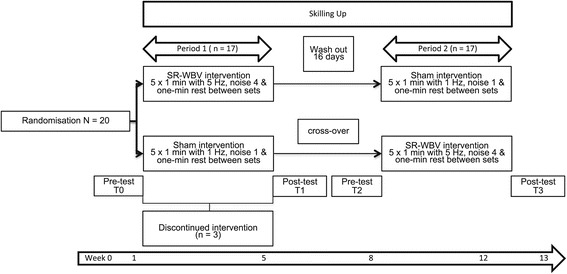
BACKGROUND: Aging is associated with loss of balance and activity in daily life. It impacts postural control and increases the risk of falls. The current study was conducted to determine the feasibility and long-term impact of stochastic resonance whole-body vibration (SR-WBV) on static and dynamic balance and reaction time among elderly individuals. METHODS: A randomized crossover pilot study with blinding of the participants. Twenty elderly were divided into group A (SR-WBV 5 Hz, Noise 4/SR-WBV 1 Hz, Noise 1) or group B (SR-WBV 1 Hz, Noise 1/SR-WBV 5 Hz, Noise 1). Feasibility outcomes included recruitment, compliance and safety. Secondary outcomes were Semi-Tandem Stand (STS), Functional Reach Test (FRT), Expanded Timed Get Up-and-Go (ETGUG), walking under single (ST) & dual task (DT) conditions, hand and foot reaction time (RTH/RTF). Puri and Sen Rank-Order L Statistics were used to analyse carry-over effects. To analyse SR-WBV effects Wilcoxon signed-ranked tests were used. RESULTS: With good recruitment rate (55%) and compliance (attrition 15%; adherence 85%) rates the intervention was deemed feasible. Three participants dropped out, two due to knee pain and one for personal reasons. ETGUG 0 to 2 m (p = 0.143; ES: 0.36) and ETGUG total time (p = 0.097; ES: 0.40) showed medium effect sizes. CONCLUSIONS: Stochastic resonance training is feasible in untrained elderly resulting in good recruitment and compliance. Low volume SR-WBV exercises over 12 training sessions with 5 Hz, Noise 4 seems a sufficient stimulus to improve ETGUG total time. The stimulation did not elicit changes in other outcomes. TRIAL REGISTRATION: This trial has been registered at the U.S. National Institutes of Health under ClinicalTrials.gov: NCT01045746.
Overview
The claims and statistics of this paper haven’t been checked yet.
Free: it reads the open-access text and checks the first 5 claims that cite a source we can check. Create a free account to check every claim.
Integrity signals
Registry
Cites
Statistics
Figures
Verification
Claims the paper makes
The claims and statistics of this paper haven’t been checked yet.
Free: it reads the open-access text and checks the first 5 claims that cite a source we can check. Create a free account to check every claim.
Claims other papers make about this one
Each is checked against this paper’s own text: does it say what the citing paper says it does?
The source backs part of the claim, not all of it — or backs it for a different population, condition or comparison.
In the citing paper
“Whole-body vibration therapy uses the transmission of mechanical stimuli through the person’s body365,366 to activate the primary ends of muscle spindles, which leads to neuromuscular activation367–369.”
From Sarcopenic obesity in older adults: aetiology, epidemiology and treatment strategies (2018) · cites this paper as [366]
Experimental — accuracy not yet measured
Self-check
Percentages, sums and reported differences re-computed from the paper’s own numbers.
The self-check needs the paper’s full text.
Citations
Cites
Developing and evaluating complex interventions: the new Medical Research Council guidance
Craig, P., Dieppe, P., Macintyre, S., Michie, S., Nazareth, I., & Petticrew, M. (2008) · BMJ · doi:10.1136/bmj.a1655 · Cited by 10,995 · cited 1×
“The aim of this pilot study was to perform a phase II trial according the model for complex interventions advocated by the British Medical Research Council [20] to test the feasibility and effects of a SR-WBV program in a group of untrained elderly.”
MethodRisk Factors for Falls among Elderly Persons Living in the Community
Tinetti, M. E., Speechley, M., & Ginter, S. F. (1988) · New England Journal of Medicine · doi:10.1056/nejm198812293192604 · Cited by 6,509 · cited 1×
“These limitations are, furthermore, most likely associated with risk of injury or risk of falls [4-6].”
BackgroundA tutorial on pilot studies: the what, why and how
Thabane, L., Ma, J., Chu, R., Cheng, J., Ismaila, A., Rios, L. P., Robson, R., Thabane, M., Giangregorio, L., & Goldsmith, C. H. (2010) · BMC Medical Research Methodology · doi:10.1186/1471-2288-10-1 · Cited by 3,384
Functional Reach: A New Clinical Measure of Balance
Duncan, P. W., Weiner, D. K., Chandler, J., & Studenski, S. (1990) · Journal of Gerontology · doi:10.1093/geronj/45.6.m192 · Cited by 2,873 · cited 2×
“The FRT ha s 11 been associated with an increased risk of falls and frailty in elderly unable t o reach 12 more than 15 cm forward [21].”
BackgroundMethodComfortable and maximum walking speed of adults aged 20—79 years: reference values and determinants
BOHANNON, R. W. (1997) · Age and Ageing · doi:10.1093/ageing/26.1.15 · Cited by 2,341 · cited 1×
“The measurement device and test ing 8 protocol have previously been described and identified as being reliable in older 9 adults [27].”
MethodUpdated Method Guidelines for Systematic Reviews in the Cochrane Collaboration Back Review Group
van Tulder, M., Furlan, A., Bombardier, C., & Bouter, L. (2003) · Spine · doi:10.1097/01.brs.0000065484.95996.af · Cited by 2,180
The two‐period cross‐over clinical trial.
Hills, M., & Armitage, P. (1979) · British Journal of Clinical Pharmacology · doi:10.1111/j.1365-2125.1979.tb05903.x · Cited by 1,395 · cited 1×
“The difference in mean fr om 5 period 1 minus period 2 was compared between the groups [32].”
ResultNonparametric Statistics for Non‐Statisticians: A Step‐by‐Step Approach
Corder, G. W., & Foreman, D. I. (2009) · Wiley eBooks · doi:10.1002/9781118165881 · Cited by 954
Postural Stability and Associated Physiological Factors in a Population of Aged Persons
Lord, S. R., Clark, R. D., & Webster, I. W. (1991) · Journal of Gerontology · doi:10.1093/geronj/46.3.m69 · Cited by 714 · cited 1×
“10 11 Simple reaction time was measured from both hand (RTH) and foot (RTF) to measure 12 psychomotor speed in milliseconds using a hand-held electronic timer and a light a s 13 the stimulus and depression of a switch by the finger and the foot as the responses 14 [28] [29].”
MethodFunctional Reach: A Marker of Physical Frailty
Weiner, D. K., Duncan, P. W., Chandler, J., & Studenski, S. A. (1992) · Journal of the American Geriatrics Society · doi:10.1111/j.1532-5415.1992.tb02068.x · Cited by 448 · cited 1×
“This test is 8 both valid and reliable [22] for the target population.”
BackgroundGoble, D. J., Coxon, J. P., Wenderoth, N., Van Impe, A., & Swinnen, S. P. (2009) · Neuroscience & Biobehavioral Reviews · doi:10.1016/j.neubiorev.2008.08.012 · Cited by 426 · cited 1×
“deficit of motor response functions and a reduction in the functioning of the vestibular and visual systems [2,3].”
BackgroundKinematic measures for assessing gait stability in elderly individuals: a systematic review
Hamacher, D., Singh, N. B., Van Dieën, J. H., Heller, M. O., & Taylor, W. R. (2011) · Journal of The Royal Society Interface · doi:10.1098/rsif.2011.0416 · Cited by 401
Posture control, aging, and attention resources: Models and posture-analysis methods
Lacour, M., Bernard-Demanze, L., & Dumitrescu, M. (2008) · Neurophysiologie Clinique/Clinical Neurophysiology · doi:10.1016/j.neucli.2008.09.005 · Cited by 396 · cited 1×
“Background 9 Postural balance skills of the elderly become increasingly limited due to normal r 10 pathological ageing [1].”
BackgroundMotivators and barriers for physical activity in the oldest old: A systematic review
Baert, V., Gorus, E., Mets, T., Geerts, C., & Bautmans, I. (2011) · Ageing Research Reviews · doi:10.1016/j.arr.2011.04.001 · Cited by 379 · cited 1×
“Despite the fact that physical activity (PA) for elderly is one of the major elements for general health prevention, too few elderly engage in PA [8].”
BackgroundPractical implementation of an exercise-based falls prevention programme
Gardner, M. M. (2001) · Age and Ageing · doi:10.1093/ageing/30.1.77 · Cited by 326 · cited 1×
“Elderly individua ls with 23 low baseline fitness and mobility levels who want to start a training progra m should 24 start with an exercise program that meets their physical capabilitie s [10].”
BackgroundThe Timed Get-up-and-Go test revisited: measurement of the component tasks.
Wall, J. C., Bell, C., Campbell, S., & Davis, J. (2000) · PubMed · Cited by 320
Aging, the Central Nervous System, and Mobility
Rosso, A. L., Studenski, S. A., Chen, W. G., Aizenstein, H. J., Alexander, N. B., Bennett, D. A., Black, S. E., Camicioli, R., Carlson, M. C., Ferrucci, L., et al. (2013) · The Journals of Gerontology: Series A · doi:10.1093/gerona/glt089 · Cited by 289 · cited 1×
“deficit of motor response functions and a reduction in the functioning of the vestibular and visual systems [2,3].”
BackgroundMoving against frailty: does physical activity matter?
Landi, F., Abbatecola, A. M., Provinciali, M., Corsonello, A., Bustacchini, S., Manigrasso, L., Cherubini, A., Bernabei, R., & Lattanzio, F. (2010) · Biogerontology · doi:10.1007/s10522-010-9296-1 · Cited by 248
Kawanabe, K., Kawashima, A., Sashimoto, I., Takeda, T., Sato, Y., & Iwamoto, J. (2007) · The Keio Journal of Medicine · doi:10.2302/kjm.56.28 · Cited by 231 · cited 1×
“20 Kawanabe and colleagues [35] indicated that effects of WBV training in the e lderly 21 may be expected after a two months study period.”
BackgroundLord, S. R., & Castell, S. (1994) · Archives of Physical Medicine and Rehabilitation · doi:10.1016/0003-9993(94)90187-2 · Cited by 193 · cited 1×
“10 11 Simple reaction time was measured from both hand (RTH) and foot (RTF) to measure 12 psychomotor speed in milliseconds using a hand-held electronic timer and a light a s 13 the stimulus and depression of a switch by the finger and the foot as the responses 14 [28] [29].”
MethodThibaud, M., Bloch, F., Tournoux‐Facon, C., Brèque, C., Rigaud, A.-S., Dugué, B., & Kemoun, G. (2011) · European Review of Aging and Physical Activity · doi:10.1007/s11556-011-0081-1 · Cited by 174 · cited 1×
“A sedentary lifestyle in elderly individuals further increases the risk of falling whereas physically active elderly have a reduced risk, especially for falls resulting in injuries [7].”
BackgroundSkelton, D. A., & Dinan, S. M. (1999) · Physiotherapy Theory and Practice · doi:10.1080/095939899307801 · Cited by 155 · cited 2×
“- 5 forms of training are implemented [5] in case their capabilities are low.”
BackgroundEffects of random whole-body vibration on postural control in Parkinson's disease
Turbanski, S., Haas, C. T., Schmidtbleicher, D., Friedrich, A., & Duisberg, P. (2005) · Research in Sports Medicine · doi:10.1080/15438620500222588 · Cited by 137 · cited 2×
“Turbanski S, Haas CT, Schmidtbleicher D, Friedrich A, Duisberg P. Effects of random whole-body vibration on postural control in Parkinson’s disease.”
BackgroundSelf-citationBotolfsen, P., Helbostad, J. L., Moe‐Nilssen, R., & Wall, J. C. (2008) · Physiotherapy Research International · doi:10.1002/pri.394 · Cited by 128 · cited 1×
“14 15 The Expanded Timed Get Up-and-Go (ETGUG), a reliable clinical assessme nt, 16 measured time series of functionally important tasks using a multimemory st opwatch 17 [23, 24].”
MethodPizzigalli, L., Filippini, A., Ahmaidi, S., Jullien, H., & Rainoldi, A. (2010) · The Journal of Strength and Conditioning Research · doi:10.1519/jsc.0b013e3181d32213 · Cited by 120 · cited 1×
“These limitations are, furthermore, most likely associated with risk of injury or risk of falls [4-6].”
BackgroundPhysical activity, exercise, and sarcopenia – future challenges
Freiberger, E., Sieber, C. C., & Pfeifer, K. (2011) · Wiener Medizinische Wochenschrift · doi:10.1007/s10354-011-0001-z · Cited by 115 · cited 1×
“Inactive or sed entary 20 elderly should, therefore, be motivated to increase their PA [9].”
BackgroundReliability and validity of physical fitness field tests for adults aged 55 to 70 years
Ritchie, C., Trost, S. G., Brown, W. J., & Armit, C. J. (2005) · Journal of science and medicine in sport · doi:10.1016/s1440-2440(05)80025-8 · Cited by 98 · cited 1×
“STS measurement with this approach has shown to be reliable [22].”
MethodRogan, S., Hilfiker, R., Herren, K., Radlinger, L., & de Bruin, E. D. (2011) · BMC Geriatrics · doi:10.1186/1471-2318-11-72 · Cited by 96 · cited 2×
“There are two types of WBV devices on the market [17]: sinusoidal (i.”
BackgroundSelf-citationWhole-body vibration and rehabilitation of chronic diseases: a review of the literature.
Chanou, K., Gerodimos, V., Καρατράντου, Κ., & Jamurtas, A. Z. (2012) · Europe PMC (PubMed Central) · Cited by 89
A Generalized Rank-Order Method for Nonparametric Analysis of Data from Exercise Science: A Tutorial
Thomas, J. R., Nelson, J. K., & Thomas, K. T. (1999) · Research Quarterly for Exercise and Sport · doi:10.1080/02701367.1999.10607726 · Cited by 89 · cited 2×
“Mann–Whitney U test assess baseline characteristics (T0) and treatment effects between group A and group B. Puri and Sen L Statistics for Ranked Data [32] analysed carry-over effects.”
BackgroundProphylaxis of Thromboembolism in Critical Care (PROTECT) Trial: a pilot study.
Cook, D., Rocker, G., Meade, M., Guyatt, G., Geerts, W., Anderson, D., Skrobik, Y., Hébert, P., Albert, M., Cooper, J., et al. (2005) · Journal of critical care · doi:10.1016/j.jcrc.2005.09.010 · Cited by 77 · cited 1×
“physiotherapists, willing to perform clinical trials [40] and may also be highly relevant for furthering the development of theory based rehabilitation [39].”
BackgroundStatistics Applied to Clinical Trials
Cleophas, T. J., Zwinderman, A. H., & Cleophas, T. F. (2006) · Springer eBooks · doi:10.1007/978-1-4020-4650-6 · Cited by 73
Nelson, A. J., Certo, L. J., Lembo, L. S., Lopez, D. A., Manfredonia, E. F., Vanichpong, S. K., & Zwick, D. (1999) · Neurorehabilitation · doi:10.3233/nre-1999-13303 · Cited by 53
Goldberg, E. (2000) · Asthma Magazine · doi:10.1016/s1088-0712(00)80076-x · Cited by 48
de Bruin, E. D., van het Reve, E., & Murer, K. (2013) · Clinical Rehabilitation · doi:10.1177/0269215512453352 · Cited by 44 · cited 2×
“Conclusions 20 We conclude that pilot studies with explicit feasibility objectives and success riteria 21 are important foundation steps in preparing for large trials [17] and for development 22 of Rehabilitation research programs [42].”
BackgroundRogan, S., Hilfiker, R., Schmid, S., & Radlinger, L. (2012) · Archives of Gerontology and Geriatrics · doi:10.1016/j.archger.2012.02.011 · Cited by 37 · cited 1×
“Pilot studies s howed that 8 an intervention with stochastic resonance WBV (SR-WBV) in the elderly is bot h safe 9 and feasible [14] and has positive effects on physical functioning [15].”
BackgroundSelf-citationRogan, S., Schmidtbleicher, D., & Radlinger, L. (2014) · Aging Clinical and Experimental Research · doi:10.1007/s40520-014-0212-4 · Cited by 19 · cited 1×
“Pilot studies showed that an intervention with stochastic resonance WBV (SR-WBV) in the elderly is both safe and feasible [13,14] and has positive effects on physical functioning [15].”
BackgroundSelf-citationHerren, K., Hängärtner, C. H., Oberli, A., & Radlinger, L. (2009) · physioscience · doi:10.1055/s-0028-1109140 · Cited by 19
Self-citationRogan, S., Radlinger, L., Schmid, S., Herren, K., Hilfiker, R., & de Bruin, E. D. (2012) · Ageing Research · doi:10.4081/ar.2012.e5 · Cited by 17 · cited 1×
“Pilot studies s howed that 8 an intervention with stochastic resonance WBV (SR-WBV) in the elderly is bot h safe 9 and feasible [14] and has positive effects on physical functioning [15].”
BackgroundSelf-citationTrainingsmethoden – Muskelkraftsteigerung durch Ganzkörpervibration – Kraft mit Hertz
Rogan, S., & Hilfiker, R. (2013) · Sportverletzung · Sportschaden · doi:10.1055/s-0032-1333364 · Cited by 9 · cited 1×
“with random vibration frequencies and harmonics) [18].”
Self-citationA life course approach to physical activity, health, and aging
Suominen, H., & Heikkinen, E. M. (2010) · European Review of Aging and Physical Activity · doi:10.1007/s11556-010-0075-4 · Cited by 8
Research works printed but not linked: 1
- Haas CT Schmidtbleicher D Potential of Stochastic Resonance in Neurorehabilitation Isokinetic Exerc Sci 2006 14 2 144 146
Cited by
Sarcopenic obesity in older adults: aetiology, epidemiology and treatment strategies
Batsis, J. A., & Villareal, D. T. (2018) · Nature Reviews Endocrinology · doi:10.1038/s41574-018-0062-9 · Cited by 1,382
Chang, S.-F., Lin, P.-C., Yang, R.-S., & Yang, R.-J. (2018) · BMC Geriatrics · doi:10.1186/s12877-018-0712-8 · Cited by 74
Rogan, S., Taeymans, J., Radlinger, L., Naepflin, S., Ruppen, S., Bruelhart, Y., & Hilfiker, R. (2017) · Archives of Gerontology and Geriatrics · doi:10.1016/j.archger.2017.07.022 · Cited by 65
Self-citationEffect of 8 months of whole-body vibration training on quality of life in elderly women
Santín-Medeiros, F., Santos‐Lozano, A., Cristi‐Montero, C., & Garatachea, N. (2016) · Research in Sports Medicine · doi:10.1080/15438627.2016.1258638 · Cited by 35
“neuromuscular system might be less trained for sustained high training loads and long training sessions (Rogan et al., 2015).”
BackgroundKo, M.-C., Wu, L.-S., Lee, S., Wang, C.-C., Lee, P.-F., Tseng, C.-Y., & Ho, C. (2017) · European Review of Aging and Physical Activity · doi:10.1186/s11556-017-0180-8 · Cited by 39
“These recommended values were based on a previous pilot study [19].”
Method
Metadata
- Authors
- Rogan, S., Radlinger, L., Hilfiker, R., Schmidtbleicher, D., de Bie, R. A., & de Bruin, E. D.
- Affiliations
- Bern University of Applied Sciences (CH)
- HES-SO University of Applied Sciences and Arts Western Switzerland (CH)
- Goethe University Frankfurt (DE)
- Venue
- BMC Geriatrics
- Published
- 2015-03-12
- Volume
- 15
- Issue
- 1
- Pages
- 25-25
- ISSN
- 1471-2318 (ISSN-L)
- PMC
- PMC4371632
- OpenAlex
- W2128572626
- Cited by
- 23
- References
- 41
- Citations by year
- 2026: 1 · 2024: 2 · 2023: 4 · 2022: 1 · 2021: 2 · 2019: 2 · 2018: 3 · 2017: 4 · 2016: 3 · 2015: 1
- FWCI
- 9.78
- Type
- journal article
- Language
- en
- Open access
- gold
- doi.org
- Locations
- BMC Geriatrics (publishedVersion, cc-by)
- Europe PMC (PubMed Central) (publishedVersion, cc-by)
- PubMed Central (publishedVersion, cc-by)
- PubMed (publishedVersion)
- Research Publications (Maastricht University) (publishedVersion, cc-by)
- ARBOR - Bern University of Applied Sciences Repository (submittedVersion, other-oa)
- Publication Server of Goethe University Frankfurt am Main (Goethe University Frankfurt) (submittedVersion, cc-by)
- Repository for Publications and Research Data (ETH Zurich) (submittedVersion, cc-by)
- Research Publications (Maastricht University) (submittedVersion, other-oa)
- ETH Zürich Research Collection (cc-by)
- Funders
- Berner Fachhochschule
- National Institutes of Health
- Topics
- Health Sciences › Health Professions › Physical Therapy, Sports Therapy and Rehabilitation › Balance, Gait, and Falls Prevention
- Health Sciences › Medicine › Orthopedics and Sports Medicine › Effects of Vibration on Health
- Health Sciences › Medicine › Rehabilitation › Stroke Rehabilitation and Recovery
- Keywords
- stochastic resonance, whole-body vibration, older adults, balance, postural control, falls, reaction time, dual-task walking, Timed Up and Go test, functional reach test, feasibility, residual effects
- MeSH terms
- Accidental Falls, Aged, Aged, 80 and over, Postural Balance, Feasibility Studies, Female, Humans, Male, Middle Aged, Pilot Projects, Vibration, Exercise, Cross-Over Studies
About these checks
Registry, retraction, Cites and statistics results are computed, not judged, with one exception: a printed reference that no index lists is read once by a model before it counts as a citation error. Claims are extracted by a model and kept only when their quote appears verbatim in the text; each cited source is then checked, with a model’s help, for whether it says what the claim relies on. Those verdicts can be wrong — read the claim’s quote and the cited source before relying on one.
Statistics and arithmetic are recomputed, not judged.
Confidence bands are shown only for fields calibrated on our annotated test set. None is calibrated yet, so no band is shown.
What counts as a claim ›How we measure confidence ›How we check this ›
Are you an author, or do you see a problem with this page? Request a review
Data sources
Bibliographic data: Semantic Scholar, OpenAlex, Crossref.
Contains information from the Semantic Scholar Academic Graph Datasets, made available under the ODC Attribution License (ODC-BY 1.0).
Semantic Scholar’s data is described in: Kinney, R., et al. (2023). The Semantic Scholar Open Data Platform. arXiv:2301.10140.
