

The impact of retirement on age related cognitive decline - a systematic review
Open accessThe DOI matches its Crossref record; 33 of the 34 references it cites were found in a registry or an index.
Abstract
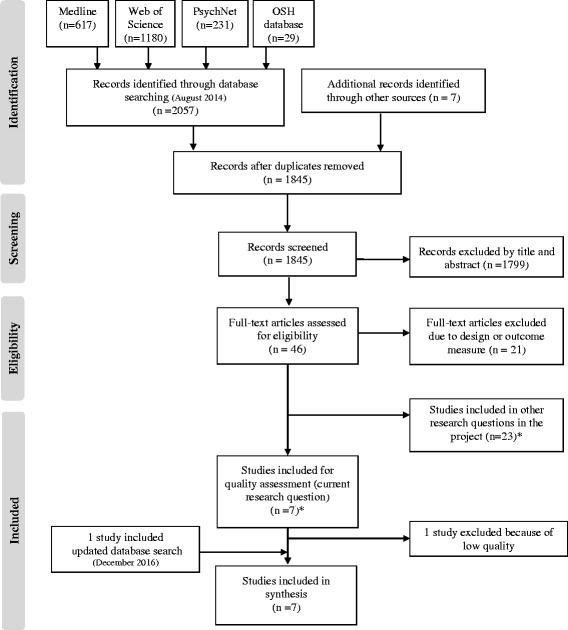
BACKGROUND: Knowledge on factors affecting the rate of cognitive decline and how to maintain cognitive functioning in old age becomes increasingly relevant. The purpose of the current study was to systematically review the evidence for the impact of retirement on cognitive functioning and on age related cognitive decline. METHOD: We conducted a systematic literature review, following the principles of the PRISMA statement, of longitudinal studies on the association between retirement and cognition. RESULTS: Only seven studies fulfilled the inclusion criteria. We found weak evidence that retirement accelerates the rate of cognitive decline in crystallised abilities, but only for individuals retiring from jobs high in complexity with people. The evidence of the impact of retirement on the rate of decline in fluid cognitive abilities is conflicting. CONCLUSION: The review revealed a major knowledge gap in regards to the impact of retirement on cognitive decline. More knowledge on the association between retirement and age related cognitive decline as well as knowledge on the mechanisms behind these associations is needed.
Overview
The claims and statistics of this paper haven’t been checked yet.
Free: it reads the open-access text and checks the first 5 claims that cite a source we can check. Create a free account to check every claim.
Integrity signals
Registry
Cites
Statistics
Figures
Verification
Claims the paper makes
The claims and statistics of this paper haven’t been checked yet.
Free: it reads the open-access text and checks the first 5 claims that cite a source we can check. Create a free account to check every claim.
Claims other papers make about this one
Each is checked against this paper’s own text: does it say what the citing paper says it does?
The cited source says what the claim attributes to it.
In the citing paper
“One systematic review of retirement and cognitive decline found conflicting evidence.45”
From Dementia prevention, intervention, and care: 2020 report of the Lancet Commission (2020) · cites this paper as [45]
Self-check
Percentages, sums and reported differences re-computed from the paper’s own numbers.
The self-check needs the paper’s full text.
Citations
Cites
Preferred Reporting Items for Systematic Reviews and Meta-Analyses: the PRISMA statement
Moher, D., Liberati, A., Tetzlaff, J., Altman, D. G., & for the PRISMA Group (2009) · BMJ · doi:10.1136/bmj.b2535 · Cited by 83,823
Preferred reporting items for systematic reviews and meta-analyses: the PRISMA Statement.
(2009) · PubMed Central · Cited by 44,859
Liberati, A., Altman, D. G., Tetzlaff, J., Mulrow, C., Gøtzsche, P. C., Ioannidis, J. P. A., Clarke, M., Devereaux, P. J., Kleijnen, J., & Moher, D. (2009) · PLoS Medicine · doi:10.1371/journal.pmed.1000100 · Cited by 28,164
Dermyshi, E., Wang, Y., Yan, C., Hong, W., Qiu, G., Gong, X., & Zhang, T. (2017) · Neonatology · doi:10.1159/000454668 · Cited by 24,451
Preferred Reporting Items for Systematic Reviews and Meta-Analyses: The PRISMA Statement
Moher, D., Liberati, A., Tetzlaff, J., & Altman, D. G. (2009) · Journal of Clinical Epidemiology · doi:10.1016/j.jclinepi.2009.06.005 · Cited by 19,575
Liberati, A., Altman, D. G., Tetzlaff, J., Mulrow, C., Gotzsche, P. C., Ioannidis, J. P. A., Clarke, M., Devereaux, P. J., Kleijnen, J., & Moher, D. (2009) · BMJ · doi:10.1136/bmj.b2700 · Cited by 17,648
Liberati, A., Altman, D. G., Tetzlaff, J., Mulrow, C., Gøtzsche, P. C., Ioannidis, J. P. A., Clarke, M., Devereaux, P. J., Kleijnen, J., & Moher, D. (2009) · Journal of Clinical Epidemiology · doi:10.1016/j.jclinepi.2009.06.006 · Cited by 10,578
Cognitive reserve in ageing and Alzheimer's disease
Stern, Y. (2012) · The Lancet Neurology · doi:10.1016/s1474-4422(12)70191-6 · Cited by 3,557 · cited 9×
“2) Cognitive reserve reflects the extent to which an individual uses neural networks or cognitive paradigms efficiently and flexibly rather than anatomic differences [5, 6].”
BackgroundInfluentialStern, Y. (2009) · Neuropsychologia · doi:10.1016/j.neuropsychologia.2009.03.004 · Cited by 2,943
Des Jarlais, D. C., Lyles, C., Crepaz, N., & the TREND Group (2004) · American Journal of Public Health · doi:10.2105/ajph.94.3.361 · Cited by 2,817
Research works printed but not linked: 2
- Tema Nord. The Ageing and the Labour Market in the Nordic Countries: A literature Review. Tema Nord 2004:538, Nordic Council of Ministers, Copenhagen.
- Ryan L H. The work environment and cognitive function across adulthood: Reciprocal relations and meaningful outcomes. A dissertation in human development and family studies. 2008. The Pennsylvania State University.
Cited by
Dementia prevention, intervention, and care: 2020 report of the Lancet Commission
Livingston, G., Huntley, J., Sommerlad, A., Ames, D., Ballard, C., Banerjee, S., Brayne, C., Burns, A., Cohen-Mansfield, J., Cooper, C., et al. (2020) · The Lancet · doi:10.1016/s0140-6736(20)30367-6 · Cited by 10,430
“45 Subsequently, a 12-year study of 1658 people found older retirement age but not number of years working, was associated with lower dementia risk.”
RetractedSocial participation and risk of developing dementia
Sommerlad, A., Kivimäki, M., Larson, E. B., Röhr, S., Shirai, K., Singh-Manoux, A., & Livingston, G. (2023) · Nature Aging · doi:10.1038/s43587-023-00387-0 · Cited by 207
Spotlight on the Challenges of Depression following Retirement and Opportunities for Interventions
Dang, L., Ananthasubramaniam, A., & Mezuk, B. R. (2022) · Clinical Interventions in Aging · doi:10.2147/cia.s336301 · Cited by 83
“Additionally, retirees are less frequently engaged in cognitively-engaged activities that involve memory and problem-solving, which may contribute to cognitive decline.(98,99) Overtime, these changes can result in cognitive and functional impairments,(100) which are associated with increased risk of depression.”
BackgroundLeisure engagement in older age is related to objective and subjective experiences of aging
Bone, J. K., Bu, F., Sonke, J. K., & Fancourt, D. E. (2024) · Nature Communications · doi:10.1038/s41467-024-45877-w · Cited by 57
“The transitionfromworkto retirement can leadto a lossofactivity,socialcontacts,andpurpose 20,21 andcognitivedecline 22 .”
BackgroundMorrison, B. A., Coventry, L., & Briggs, P. (2020) · Frontiers in Psychology · doi:10.3389/fpsyg.2020.00623 · Cited by 59
“We know that, regardless of chronological age, adults may show more rapid cognitive decline following departure from certain workplaces and that this is linked to the complexity of the work previously undertaken (Finkel et al., 2009; Meng et al., 2017).”
BackgroundHale, J. M., Bijlsma, M. J., & Lorenti, A. (2021) · SSM - Population Health · doi:10.1016/j.ssmph.2021.100855 · Cited by 45
Vigezzi, G. P., Barbati, C., Maggioni, E., Stenholm, S., Odone, A., Amerio, A., Ardito, C., Bertuccio, P., Costa, G., d’Errico, A., et al. (2025) · Social Science & Medicine · doi:10.1016/j.socscimed.2025.118049 · Cited by 51
“Three articles did not report any definition of retirement (Barnett et al., 2012a; Meng et al., 2017; Sharifi et al., 2023).”
InfluentialNemoto, Y., Takahashi, T., Nonaka, K., Hasebe, M., Koike, T., Minami, U., Murayama, H., Matsunaga, H., Kobayashi, E., & Fujiwara, Y. (2020) · Geriatrics and gerontology international/Geriatrics & gerontology international · doi:10.1111/ggi.13941 · Cited by 43
High turnover in clinical dietetics: a qualitative analysis
Hewko, S., Oyesegun, A., Clow, S., & VanLeeuwen, C. (2021) · BMC Health Services Research · doi:10.1186/s12913-020-06008-5 · Cited by 40
Williams, B. D., Pendleton, N., & Chandola, T. (2020) · SSM - Population Health · doi:10.1016/j.ssmph.2020.100656 · Cited by 33
Sarabia‐Cobo, C., Pérez, V. A. F., Hermosilla, C., & de Lorena, P. (2020) · Behavioral Sciences · doi:10.3390/bs10100151 · Cited by 30
The influence of old-age retirement on health: Causal evidence from the Finnish register data
Kuusi, T., Martikainen, P., & Valkonen, T. (2020) · The Journal of the Economics of Ageing · doi:10.1016/j.jeoa.2020.100257 · Cited by 32
Effect of retirement on cognitive function: a systematic review and meta-analysis
Álvarez‐Bueno, C., Cavero‐Redondo, I., Jiménez‐López, E., Visier‐Alfonso, M. E., Sequí‐Domínguez, I., & Martínez‐Vizcaíno, V. (2020) · Occupational and Environmental Medicine · doi:10.1136/oemed-2020-106892 · Cited by 32
Job Strain and Trajectories of Cognitive Change Before and After Retirement
Nilsen, C., Nelson, M. E., Andel, R., Crowe, M. G., Finkel, D., & Pedersen, N. L. (2021) · The Journals of Gerontology Series B · doi:10.1093/geronb/gbab033 · Cited by 27
Parrott, M. D., Carmichael, P., Laurin, D., Greenwood, C. E., Anderson, N. D., Ferland, G., Gaudreau, P., Belleville, S., Morais, J. A., Kergoat, M., et al. (2020) · The Journals of Gerontology Series B · doi:10.1093/geronb/gbaa178 · Cited by 23
“This limits the generalizability of study findings and limits the ability to model age-related cognitive decline and clinically meaningful impairment over a short period of time; Third, although the measurement of CSL was derived from past cognitive engagement and current social engagement, retirement status may affec…”
BackgroundStinchcombe, A., & Hammond, N. G. (2021) · The Journals of Gerontology Series B · doi:10.1093/geronb/gbab084 · Cited by 30
Sun, Z., Ping, P., Li, Y., Feng, L., Liu, F., Zhao, Y., Yao, Y., Zhang, P., & Fu, S. (2022) · Frontiers in Aging Neuroscience · doi:10.3389/fnagi.2022.870442 · Cited by 23
“Unfortunately, current drugs, such as acetylcholinesterase inhibitors and non-competitive NMDA receptor modulators, are still controversial for improving cognitive function (Meng et al., 2017).”
BackgroundGoodarzi, S., Jiang, J., Head, M. M., & Lu, X. (2023) · International Journal of Information Management · doi:10.1016/j.ijinfomgt.2023.102685 · Cited by 25
Carmel, S., & Tur‐Sinai, A. (2021) · Ageing and Society · doi:10.1017/s0144686x21000064 · Cited by 23
“However, two more recent meta-analyses (Meng et al., 2017; Zulka et al., 2019) report conflicting findings regarding the relationship between retirement and CD across large-scale international studies.”
Learning as an Important Privilege: A Life Span Perspective with Implications for Successful Aging
Wu, R., Zhao, J., Cheung, C. S.-S., Natsuaki, M. N., Rebok, G. W., & Strickland-Hughes, C. M. (2021) · Human Development · doi:10.1159/000514554 · Cited by 21
“These mixed results (e.g., Meng et al., 2017; Roberts et al., 2011; van der Heide et al., 2013; Zulka et al., 2019) are attributed largely to whether the changes from preretirement factors (e.g., stress, purpose, mental and physical demands, job complexity) to postretirement factors (e.g.,…”
ResultDoes Gender Differentiate the Effects of Retirement on Cognitive Health?
Oi, K. (2019) · Research on Aging · doi:10.1177/0164027519828062 · Cited by 21
Neurobehavioral performance of patients diagnosed with manganism and idiopathic Parkinson disease
Ellingsen, D. G., Shvartsman, G. I., Bast‐Pettersen, R., Chashchin, M. V., Thomassen, Y., & Chashchin, V. (2019) · International Archives of Occupational and Environmental Health · doi:10.1007/s00420-019-01415-6 · Cited by 15
Cognitive abilities among employed and unemployed middle-aged women – A systematic review
Madhavan, A., Bajaj, G., Bajaj, P. D., & D'Souza, D. F. (2022) · Clinical Epidemiology and Global Health · doi:10.1016/j.cegh.2022.101042 · Cited by 17
Retirement and decline in episodic memory: analysis from a prospective study of adults in England
Starke, K. R., Seidler, A., Hegewald, J., Klimová, A., & Palmer, K. (2019) · International Journal of Epidemiology · doi:10.1093/ije/dyz135 · Cited by 19
“A recent review stressed the need for further research on the impact of retirement on cognitive function, citing lack of prospective studies.(10) Our study aimed to examine the role of retirement on episodic memory decline.”
BackgroundImpact of Retirement on Cognitive Function: A Literature Review
Zulka, L. E., Hansson, I., & Hassing, L. B. (2019) · GeroPsych · doi:10.1024/1662-9647/a000215 · Cited by 18
Calatayud, E., Marcén-Román, Y., Rodríguez‐Roca, B., Salavera, C., Gasch‐Gallén, À., & Gómez‐Soria, I. (2023) · Medicina de Familia SEMERGEN · doi:10.1016/j.semerg.2023.101923 · Cited by 15
Baumann, I., Eyjólfsdóttir, H. S., Fritzell, J., Lennartsson, C., Darin‐Mattsson, A., Kåreholt, I., Andel, R., Dratva, J., & Agahi, N. (2020) · Ageing and Society · doi:10.1017/s0144686x20000847 · Cited by 15
“Cognitive reserve represents the sum of the lifetime use of neural networks (Meng et al., 2017).”
BackgroundPersonality, Retirement, and Cognitive Impairment: Moderating and Mediating Associations
Strickhouser, J. E., & Sutin, A. R. (2020) · Journal of Aging and Health · doi:10.1177/0898264320969080 · Cited by 10
“Also, similar to prior work on other samples (e.g., Meng et al., 2017), we found that people who were retired were at greater risk of cognitive impairment.”
BackgroundResultInfluentialJob Demands May Determine Cognitive and Physical Aging After Retirement
Calatayud, E., Lozano‐Berges, G., Peralta, P., Latorre, E., & Gómez‐Soria, I. (2022) · Journal of Applied Gerontology · doi:10.1177/07334648221120080 · Cited by 11
““Use it or lose it” hypothesis proposes that cognitive functioning deteriorates when we are not been challenged or mentally stimulated, as frequently occurs after retirement (Meng et al., 2017).”
BackgroundYan, S., Zhou, Y., & Zhang, Y. (2022) · Computational Intelligence and Neuroscience · doi:10.1155/2022/5870893 · Cited by 10
“+en, men will retire at the age of 65 at the rate of 1 year/6 years and women at the rate of twice that of men [23].”
BackgroundPredictors of Source Memory Success and Failure in Older Adults
Cansino, S., Torres-Trejo, F., Estrada-Manilla, C., Ramírez-Barajas, L., Pérez-Loyda, M., Nava-Chaparro, A., Hernández-Ladrón-deGuevara, M., & Ruiz‐Velasco, S. (2019) · Frontiers in Aging Neuroscience · doi:10.3389/fnagi.2019.00017 · Cited by 16
Retirement and cognitive aging in a racially diverse sample of older Americans
Andel, R., Veal, B. M., Howard, V. J., MacDonald, L. A., Judd, S. E., & Crowe, M. G. (2023) · Journal of the American Geriatrics Society · doi:10.1111/jgs.18475 · Cited by 9
Understanding the Link Between Retirement Timing and Cognition: A Scoping Review
Yauk, J., Veal, B. M., & Dobbs, D. (2023) · Journal of Applied Gerontology · doi:10.1177/07334648231213745 · Cited by 8
“Reviews focusing on retirement and cognition have found mixed results (Meng et al., 2017; Zulka et al., 2019).”
ResultModelling retirement resources, home environment and quality of marriage for greater well-being
Pang, M., Lai, M.-M., Chong, L., Lee, Y. L.-E., & Lau, S.-H. (2024) · Applied Research in Quality of Life · doi:10.1007/s11482-024-10366-1 · Cited by 7
“However, Meng et al. (2017) argued that cognitive reduction only happens to people who are retired from complex jobs.”
Retirement: A concept for nurses to consider
Sheppard, F. H. (2018) · Nursing Forum · doi:10.1111/nuf.12278 · Cited by 8
Occupational Determinants of Cognitive Decline and Dementia
Berr, C., & Letellier, N. (2020) · Springer eBooks · doi:10.1007/978-3-030-24334-0_11 · Cited by 8
Zotcheva, E., Strand, B. H., Bowen, C. E., Bratsberg, B., Jugessur, A., Engdahl, B., Selbæk, G., Kohler, H., Harris, J. R., Weiss, J., et al. (2023) · International Journal of Geriatric Psychiatry · doi:10.1002/gps.5967 · Cited by 9
“Conclusions from a recent systematic review emphasized the need for more knowledge on the association between retirement and age‐related cognitive decline.(11)”
Health, Working Conditions and Retirement
Ardito, C., & Fleischmann, M. S. (2022) · Life course research and social policies · doi:10.1007/978-3-031-11272-0_9 · Cited by 6
Occupational Determinants of Cognitive Decline and Dementia
Berr, C., & Letellier, N. (2019) · Springer eBooks · doi:10.1007/978-3-319-75381-2_11-1 · Cited by 8
Knisely, B. M., Vaughn-Cooke, M., Wagner, L.-A., & Fink, J. C. (2021) · User Modeling and User-Adapted Interaction · doi:10.1007/s11257-021-09305-8 · Cited by 7
“Age Age Continuous Age is associated with cognitive decline (Meng et al. 2017)”
BackgroundKnisely, B. M., Levine, C. S., Vaughn-Cooke, M., Wagner, L.-A., & Fink, J. C. (2021) · Safety Science · doi:10.1016/j.ssci.2021.105435 · Cited by 6
Factors affecting the working life lenght of older people in the European Union
Grmanová, E., & Bartek, J. (2022) · Journal of Entrepreneurship and Sustainability Issues · doi:10.9770/jesi.2022.10.1(3 · Cited by 5
Functioning Changes in Varying Ways After Retirement: A Scoping Review
Saha, P., Salmela, J., Lallukka, T. M., & Aho, A. L. (2023) · INQUIRY The Journal of Health Care Organization Provision and Financing · doi:10.1177/00469580221142477 · Cited by 6
Age-related behavioral resilience in smartphone touchscreen interaction dynamics
Ceolini, E., Ridderinkhof, K. R., & Ghosh, A. (2024) · Proceedings of the National Academy of Sciences · doi:10.1073/pnas.2311865121 · Cited by 5
Theory of Mind und altersassoziierte Egozentrizität
Förstl, H. (2020) · Psychotherapie im Alter · doi:10.30820/1613-2637-2020-4-417 · Cited by 4
Association between Economic Activity and Cognitive Health: A Population-Based Observational Study
Kim, J. H., & Kim, T. H. (2020) · International Journal of Mental Health Promotion · doi:10.32604/ijmhp.2020.010995 · Cited by 4
“, unemployment and income), often have a profound impact on cognitive function [6].”
BackgroundMandatory Retirement for Judges Improved Performance on U.S. State Supreme Courts
Ash, E., & MacLeod, W. B. (2020) · National Bureau of Economic Research · doi:10.3386/w28025 · Cited by 7
“36 36 Meng et al. (2017) review the mixed evidence about the cognitive impacts of retirement, noting that there is a “major knowledge gap in regards to the impact of retirement on cognitive decline.””
BackgroundRetirement is not associated with age‐related cognitive impairment in Korean adults
Hwang, I. C., Ahn, H. Y., & Suh, H. S. (2022) · American Journal of Industrial Medicine · doi:10.1002/ajim.23408 · Cited by 3
Knisely, B. M., & Vaughn-Cooke, M. (2021) · Journal of Mechanical Design · doi:10.1115/1.4052512 · Cited by 4
Exclusionary states in older age and their temporary effects on cognitive decline
Pavlidis, G. T. (2025) · BMC Psychology · doi:10.1186/s40359-025-02574-7 · Cited by 2
“Living alone, living without a partner, retirement, and social participation were also included under the scope of examination for the effects of ESR states on cognitive decline, as all have been associated with worse cognitive outcomes [18–21”
Retirement, reemployment, and bio-psycho-social health among older adults in Taiwan
Yen, W.-H., Cheng, W., Chuang, S., Wu, I., Chang, H., Cheng, C.-W., Tseng, W., Hsu, C.-C., Hsiung, C. A., & Wu, C. (2025) · Maturitas · doi:10.1016/j.maturitas.2025.108649 · Cited by 2
Wu, T.-K., Chiu, C., Ku, L. E., Chang, J., & Hu, S. C. (2025) · BMC Public Health · doi:10.1186/s12889-025-25325-0 · Cited by 2
Gyasi, R. M., Amoah, P. A., Agyemang, S., Siaw, L. P., Frempong, F., Rani, R., & Phillips, D. R. (2022) · Scientific Reports · doi:10.1038/s41598-022-17178-z · Cited by 3
Taniguchi, R., Ukawa, S., Zhao, W., Okabayashi, S., Kimura, T., Shan, Y., Ando, M., Wakai, K., Tsushita, K., Kawamura, T., et al. (2024) · Archives of Gerontology and Geriatrics Plus · doi:10.1016/j.aggp.2024.100013 · Cited by 3
Palmberg, L., Suorsa, K., Leskinen, T., Pasanen, J., Rovio, S., & Stenholm, S. (2025) · Medicine & Science in Sports & Exercise · doi:10.1249/mss.0000000000003801 · Cited by 2
“…or re-tirement which are accompanied with changes in above mentioned several years after retirement (5 – 9), but findings are inconclusive and may be moderated by factors, such as job strain and motivation, to maintain engagement to cognitively challenging activities after retirement (5,7).”
Nazar, G., Cabezas, M.-F., Reyes‐Molina, D., Castillo-Trecán, P., Diaz‐Toro, F., & Petermann-Rocha, F. E. (2025) · Health Psychology Review · doi:10.1080/17437199.2025.2508987 · Cited by 3
“The relationship between retirement and cognitive functioning has been increasingly studied (Alvarez-Bueno et al., 2021; Fisher et al., 2017; Meng et al., 2017).”
Lee, Y. J., Masaki, K., Chen, R., Martin, P., Gonzales, E. G., Whetung, C., Takemoto, K., & Willcox, B. J. (2025) · The Gerontologist · doi:10.1093/geront/gnaf174 · Cited by 3
The impact of retirement on quality of life and healthcare expenditure among Chinese elders
Cui, X., Cheng, Y., & Chen, P. (2025) · SHS Web of Conferences · doi:10.1051/shsconf/202522406001 · Cited by 1
Nakahara, K., Fujii, Y., Honda, N., Kusuda, K., Yamamoto, T., & Oba, J. (2025) · Cureus · doi:10.7759/cureus.99585 · Cited by 2
“This finding aligns with the existing body of literature that demonstrates a strong correlation between declining physical activity and a marked increase in frailty risk [29].”
Respiratory Function and Muscle Strength Vs. Past Work Type: a Cross-Sectional Study Among Retirees
Trzmiel, T., Pieczyńska, A., Zasadzka, E., & Pawlaczyk, M. (2021) · Canadian Geriatrics Journal · doi:10.5770/cgj.24.501 · Cited by 1
“Meng et al.(14) in their systematic review analyzed seven studies on the Respiratory Function and Muscle Strength Vs.”
BackgroundTitarenko, A. V., Shishkin, S. V., Щербакова, Л. В., Verevkin, E. G., Hubacek, J. A., Bobák, M., & Malyutina, S. K. (2020) · Russian Journal of Preventive Medicine · doi:10.17116/profmed20202303127 · Cited by 1
The effect of depression on cognitive decline among Korean retirees
Hwang, I.-C., & Ahn, H. Y. (2023) · Journal of Research in Medical Sciences · doi:10.4103/jrms.jrms_984_21 · Cited by 1
“Given that cognitive abilities depend on engagement in mentally stimulating activities,[1] retirement warrants particular attention as a feasible trigger of cognitive decline.[2] Continued mental stimulation after retirement is unarguably critical; however, other factors related to cognitive decline among retirees are…”
BackgroundMandatory Retirement for Judges Improved the Performance of US State Supreme Courts
Ash, E., & MacLeod, W. B. (2024) · American Economic Journal Economic Policy · doi:10.1257/pol.20210667 · Cited by 8
Life Course: Developmental and Transitional Events
Tampi, R. R., & Tampi, D. J. (2021) · Springer eBooks · doi:10.1007/978-3-030-58663-8_1
Hale, J. M., Bijlsma, M. J., & Lorenti, A. (2020) · doi:10.4054/mpidr-wp-2020-013
Bhattacharyya, K. K. (2021) · Springer eBooks · doi:10.1007/978-3-030-88870-1_3 · Cited by 1
Paleke, D. O., Salami, L. I., & Uko-Aviomoh, E. E. (2022) · Nigeria Journal of Home Economics · doi:10.61868/njhe.v10i6.103
“Retirement refers to the termination or end of employment or a career, especially due to aging, attained length of service, new role, or health reasons (Davies et al., 2017; Meng et al., 2017).”
BackgroundA French Adaptation and Validation of Retirement Semantic Differential (RSD)
Borel, L., Boller, B., Henning, G., & Vallet, G. T. (2024) · Behavioral Sciences · doi:10.3390/bs14100891
“Recent research, however, qualifies this relationship by suggesting the occurrence of a slight decline [18,19] or by finding both a protective and a detrimental effect on cognition, depending, for example, on the type of occupation [20].”
BackgroundDoes Retirement Improve Cognitive Functioning? Causal Evidence From Vietnam
Le, D. D., & Giang, L. T. (2025) · The Journals of Gerontology Series B · doi:10.1093/geronb/gbaf102 · Cited by 1
Teräs, T., Myllyntausta, S., Pentti, J., Pasanen, J., Rovio, S., & Stenholm, S. (2025) · European Journal of Ageing · doi:10.1007/s10433-025-00876-8 · Cited by 3
“…retirement including sex (Atalay et al. 2019; Hamm et al. 2020; Oi 2019), occupation (Carr et al. 2020; Finkel et al. 2009; Fisher et al. 2014; Meng et al. 2017), job strain (Nilsen et al. 2021), retirement age (Celidoni et al. 2017; Grotz et al. 2016; Hale et al. 2021), mental activities…”
Wu, T.-K., Chang, J., Ku, L. E., Chiu, C., & Hu, S. C. (2025) · Aging Neuropsychology and Cognition · doi:10.1080/13825585.2025.2555433
Shimokihara, S., Yokoyama, K., Makino, K., Ikeda, N., Matsuyama, K., Kashiwagi, T., Kawanishi, C., & Ihira, H. (2025) · Frontiers in Digital Health · doi:10.3389/fdgth.2025.1719318
Additional file 1 of High turnover in clinical dietetics: a qualitative analysis
Hewko, S., Oyesegun, A., Clow, S., & VanLeeuwen, C. (2021) · Figshare · doi:10.6084/m9.figshare.13534424
Rehel, S. (2019) · theses.fr (ABES) · doi:10.70675/b600c245z51b5z41bbz9b4cze94f8bfd6a4a · Cited by 2
MOHALLEM, M. D. L., Cipriano, J. B. V., Magalhães, D. D. H., & Reis, R. D. (2026) · Revista Brasileira de Geriatria e Gerontologia · doi:10.1590/1981-22562026029.250186.en
MOHALLEM, M. D. L., Cipriano, J. B. V., Magalhães, D. D. H., & Reis, R. D. (2026) · Revista Brasileira de Geriatria e Gerontologia · doi:10.1590/1981-22562026029.250186.pt
Adaptation and validation of bogus items scale: A Chinese version
Li, J., Chen, S., Xing, Y.-X., Li, C.-J., Ma, C., & Li, Y. M. (2026) · Applied Psychology · doi:10.1111/apps.70100
Kadowaki, N. (2026) · SSRN Electronic Journal · doi:10.2139/ssrn.7332558
Residential context and cognitive aging: Differences by urbanicity across the retirement transition
Hosseini, T. M., Hong, A., & Adkins, D. E. (2026) · The Journals of Gerontology Series B · doi:10.1093/geronb/gbag204
Metadata
- Authors
- Meng, A., Nexø, M. A., & Borg, V.
- Affiliations
- National Research Centre for the Working Environment (DK)
- Corresponding author
- Meng, Annette
- Venue
- BMC Geriatrics
- Published
- 2017-07-21
- Volume
- 17
- Issue
- 1
- Pages
- 160-160
- ISSN
- 1471-2318 (ISSN-L)
- PMC
- PMC5520232
- OpenAlex
- W2739056224
- Cited by
- 77
- References
- 34
- Citations by year
- 2026: 3 · 2025: 13 · 2024: 6 · 2023: 8 · 2022: 10 · 2021: 13 · 2020: 16 · 2019: 7 · 2018: 1
- FWCI
- 2.34
- Type
- journal article
- Language
- en
- Open access
- gold
- doi.org
- Licence
- cc-by
- Locations
- BMC Geriatrics (publishedVersion, cc-by)
- Europe PMC (PubMed Central) (publishedVersion, cc-by)
- PubMed Central (publishedVersion, cc-by)
- PubMed (publishedVersion)
- DOAJ (DOAJ: Directory of Open Access Journals) (submittedVersion, cc-by-sa)
- Funders
- The Danish Working Environment Research Fund ((20110038063).)
- Topics
- Social Sciences › Demography › Retirement, Disability, and Employment
- Health Sciences › Medicine › Psychiatry and Mental health › Dementia and Cognitive Impairment Research
- Social Sciences › Psychology › Developmental and Educational Psychology › Aging and Gerontology Research
- Keywords
- retirement, age-related cognitive decline, cognitive aging, crystallized intelligence, fluid intelligence, job complexity, older adults, cognitive function
- MeSH terms
- Aged, Aged, 80 and over, Aging, Cognition, Female, Humans, Longitudinal Studies, Male, Retirement, Randomized Controlled Trials as Topic, Cognitive Dysfunction, Observational Studies as Topic
About these checks
Registry, retraction, Cites and statistics results are computed, not judged, with one exception: a printed reference that no index lists is read once by a model before it counts as a citation error. Claims are extracted by a model and kept only when their quote appears verbatim in the text; each cited source is then checked, with a model’s help, for whether it says what the claim relies on. Those verdicts can be wrong — read the claim’s quote and the cited source before relying on one.
Statistics and arithmetic are recomputed, not judged.
Confidence bands are shown only for fields calibrated on our annotated test set. None is calibrated yet, so no band is shown.
What counts as a claim ›How we measure confidence ›How we check this ›
Are you an author, or do you see a problem with this page? Request a review
Data sources
Bibliographic data: Semantic Scholar, OpenAlex, Crossref.
Contains information from the Semantic Scholar Academic Graph Datasets, made available under the ODC Attribution License (ODC-BY 1.0).
Semantic Scholar’s data is described in: Kinney, R., et al. (2023). The Semantic Scholar Open Data Platform. arXiv:2301.10140.
