

The impact of retirement on age related cognitive decline - a systematic review
Open accessThe DOI matches its Crossref record; 33 of the 34 references it cites were found in a registry or an index.
Abstract
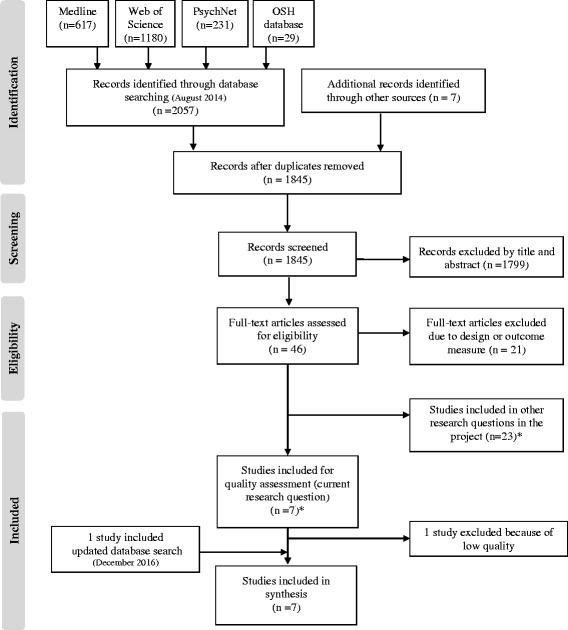
BACKGROUND: Knowledge on factors affecting the rate of cognitive decline and how to maintain cognitive functioning in old age becomes increasingly relevant. The purpose of the current study was to systematically review the evidence for the impact of retirement on cognitive functioning and on age related cognitive decline. METHOD: We conducted a systematic literature review, following the principles of the PRISMA statement, of longitudinal studies on the association between retirement and cognition. RESULTS: Only seven studies fulfilled the inclusion criteria. We found weak evidence that retirement accelerates the rate of cognitive decline in crystallised abilities, but only for individuals retiring from jobs high in complexity with people. The evidence of the impact of retirement on the rate of decline in fluid cognitive abilities is conflicting. CONCLUSION: The review revealed a major knowledge gap in regards to the impact of retirement on cognitive decline. More knowledge on the association between retirement and age related cognitive decline as well as knowledge on the mechanisms behind these associations is needed.
Overview
The claims and statistics of this paper haven’t been checked yet.
Free: it reads the open-access text and checks the first 5 claims that cite a source we can check. Create a free account to check every claim.
Integrity signals
Registry
Cites
Statistics
Figures
Verification
Claims the paper makes
The claims and statistics of this paper haven’t been checked yet.
Free: it reads the open-access text and checks the first 5 claims that cite a source we can check. Create a free account to check every claim.
Claims other papers make about this one
Each is checked against this paper’s own text: does it say what the citing paper says it does?
The cited source says what the claim attributes to it.
In the citing paper
“One systematic review of retirement and cognitive decline found conflicting evidence.45”
From Dementia prevention, intervention, and care: 2020 report of the Lancet Commission (2020) · cites this paper as [45]
Self-check
Percentages, sums and reported differences re-computed from the paper’s own numbers.
The self-check needs the paper’s full text.
Citations
Cites
Preferred Reporting Items for Systematic Reviews and Meta-Analyses: the PRISMA statement
Moher, D., Liberati, A., Tetzlaff, J., Altman, D. G., & for the PRISMA Group (2009) · BMJ · doi:10.1136/bmj.b2535 · Cited by 83,823
Preferred reporting items for systematic reviews and meta-analyses: the PRISMA Statement.
(2009) · PubMed Central · Cited by 44,859
Liberati, A., Altman, D. G., Tetzlaff, J., Mulrow, C., Gøtzsche, P. C., Ioannidis, J. P. A., Clarke, M., Devereaux, P. J., Kleijnen, J., & Moher, D. (2009) · PLoS Medicine · doi:10.1371/journal.pmed.1000100 · Cited by 28,164
Dermyshi, E., Wang, Y., Yan, C., Hong, W., Qiu, G., Gong, X., & Zhang, T. (2017) · Neonatology · doi:10.1159/000454668 · Cited by 24,451
Preferred Reporting Items for Systematic Reviews and Meta-Analyses: The PRISMA Statement
Moher, D., Liberati, A., Tetzlaff, J., & Altman, D. G. (2009) · Journal of Clinical Epidemiology · doi:10.1016/j.jclinepi.2009.06.005 · Cited by 19,575
Liberati, A., Altman, D. G., Tetzlaff, J., Mulrow, C., Gotzsche, P. C., Ioannidis, J. P. A., Clarke, M., Devereaux, P. J., Kleijnen, J., & Moher, D. (2009) · BMJ · doi:10.1136/bmj.b2700 · Cited by 17,648
Liberati, A., Altman, D. G., Tetzlaff, J., Mulrow, C., Gøtzsche, P. C., Ioannidis, J. P. A., Clarke, M., Devereaux, P. J., Kleijnen, J., & Moher, D. (2009) · Journal of Clinical Epidemiology · doi:10.1016/j.jclinepi.2009.06.006 · Cited by 10,578
Cognitive reserve in ageing and Alzheimer's disease
Stern, Y. (2012) · The Lancet Neurology · doi:10.1016/s1474-4422(12)70191-6 · Cited by 3,557 · cited 9×
“2) Cognitive reserve reflects the extent to which an individual uses neural networks or cognitive paradigms efficiently and flexibly rather than anatomic differences [5, 6].”
BackgroundInfluentialStern, Y. (2009) · Neuropsychologia · doi:10.1016/j.neuropsychologia.2009.03.004 · Cited by 2,943
Des Jarlais, D. C., Lyles, C., Crepaz, N., & the TREND Group (2004) · American Journal of Public Health · doi:10.2105/ajph.94.3.361 · Cited by 2,817
When does age-related cognitive decline begin?
Salthouse, T. A. (2009) · Neurobiology of Aging · doi:10.1016/j.neurobiolaging.2008.09.023 · Cited by 1,848
Systems to rate the strength of scientific evidence.
West, S. L., King, V., Carey, T. S., Lohr, K. N., Mckoy, N. A., Sutton, S. F., & Lux, L. J. (2002) · PubMed Central · Cited by 929
Consequences of Age-Related Cognitive Declines
Salthouse, T. (2012) · Annual Review of Psychology · doi:10.1146/annurev-psych-120710-100328 · Cited by 818
Health effects of employment: a systematic review of prospective studies
van der Noordt, M., IJzelenberg, H., Droomers, M., & Proper, K. I. (2014) · Occupational and Environmental Medicine · doi:10.1136/oemed-2013-101891 · Cited by 539
Does retirement affect cognitive functioning?
Bonsang, E., Adam, S., & Perelman, S. (2012) · Journal of Health Economics · doi:10.1016/j.jhealeco.2012.03.005 · Cited by 472 · cited 3×
“The fourth study [22] used a different outcome measure (cognitive functioning rather than rate of change in cognitive functioning) and was therefore not included in the same synthesis of evidence as the other three studies.”
BackgroundResultInfluentialRohwedder, S., & Willis, R. J. (2010) · Journal of Economic Perspectives · doi:10.1257/jep.24.1.119 · Cited by 434 · cited 2×
“To overcome this problem, Rohwedder and Willis [13] used cross sectional data from various countries with different retirement ages.”
MethodA life course approach to cognitive reserve: a model for cognitive aging and development?
Richards, M., & Deary, I. J. (2005) · Annals of Neurology · doi:10.1002/ana.20637 · Cited by 331 · cited 1×
“Cognitive reserve can be regarded as “the sum of its lifetime input” [7] (pp.”
BackgroundAgeing, cognitive abilities and retirement
Mazzonna, F., & Peracchi, F. (2012) · European Economic Review · doi:10.1016/j.euroecorev.2012.03.004 · Cited by 310 · cited 1×
“Results from cross sectional studies suggest that there is a negative association between retirement and cognitive functioning [8, 12].”
BackgroundSinger, T., Verhaeghen, P., Ghisletta, P., Lindenberger, U., & Baltes, P. B. (2003) · Psychology and Aging · doi:10.1037/0882-7974.18.2.318 · Cited by 289 · cited 2×
“The trajectories of the cognitive ageing depend on whether it is fluid or crystallised cognitive abilities [9].”
BackgroundMental work demands, retirement, and longitudinal trajectories of cognitive functioning.
Fisher, G. G., Stachowski, A., Infurna, F. J., Faul, J. D., Grosch, J., & Tetrick, L. E. (2014) · Journal of Occupational Health Psychology · doi:10.1037/a0035724 · Cited by 236 · cited 5×
“On the one hand we found results indicating a less steep decline in fluid cognitive abilities as well as higher cognitive functioning post retirement in participants retiring from jobs with high mental demands compared with participants retiring from jobs with low mental demands [24] and also, that participants retiri…”
BackgroundResultInfluentialDoes variability increase with age? An archival study of cognitive measures.
Morse, C. K. (1993) · Psychology and Aging · doi:10.1037//0882-7974.8.2.156 · Cited by 231 · cited 1×
“In addition, individual variance appears to increase with age for fluid but not crystallised cognitive ability [10, 11].”
BackgroundThe role of occupational complexity in trajectories of cognitive aging before and after retirement.
Finkel, D., Andel, R., Gatz, M., & Pedersen, N. L. (2009) · Psychology and Aging · doi:10.1037/a0015511 · Cited by 229 · cited 8×
“Synthesis of the evidence for the effect of retirement on rate of change in crystallised cognitive abilities One study of moderate quality [23] provides weak evidence for a negative effect of retirement on rate of decline in crystallised cognitive abilities indicating that retirement accelerates the rate of cognitive…”
BackgroundResultInfluentialAdam, S., Bonsang, É., Grotz, C., & Sergio, P. (2013) · Clinical Interventions in Aging · doi:10.2147/cia.s39921 · Cited by 173 · cited 2×
“617) and epidemiological studies suggest that educational level and occupational attainment can increase cognitive reserve [6, 8].”
BackgroundAiming for Efficiency Rather than Proficiency
Neal, D. (2010) · Journal of Economic Perspectives · doi:10.1257/jep.24.3.119 · Cited by 161
Age differences and interindividual variation in cognition in community-dwelling elderly.
Christensen, H., Mackinnon, A., Jorm, A. F., & Henderson, A. S. (1994) · Psychology and Aging · doi:10.1037//0882-7974.9.3.381 · Cited by 127 · cited 1×
“In addition, individual variance appears to increase with age for fluid but not crystallised cognitive ability [10, 11].”
BackgroundAndel, R., Infurna, F. J., Rickenbach, E. H., Crowe, M. G., Marchiondo, L. A., & Fisher, G. G. (2015) · Journal of Epidemiology & Community Health · doi:10.1136/jech-2014-204754 · Cited by 101 · cited 6×
“On the one hand we found results indicating a less steep decline in fluid cognitive abilities as well as higher cognitive functioning post retirement in participants retiring from jobs with high mental demands compared with participants retiring from jobs with low mental demands [24] and also, that participants retiri…”
BackgroundResultInfluentialIs Working Later in Life Good or Bad for Health? An Investigation of Multiple Health Outcomes
Wickrama, K. A. S., O’Neal, C. W., Kwag, K. H., & Lee, T. K. (2013) · The Journals of Gerontology Series B · doi:10.1093/geronb/gbt069 · Cited by 71 · cited 3×
“However, three of the studies [21, 24, 26] used different predictor variables and we therefore regarded their results as independent.”
BackgroundResultNexø, M. A., Meng, A., & Borg, V. (2016) · Occupational and Environmental Medicine · doi:10.1136/oemed-2016-103550 · Cited by 68 · cited 1×
“A review of longitudinal studies examining whether psychosocial work conditions can protect against cognitive decline did not find clear evidence that mental demands at work protect against cognitive decline (in neither crystallised nor fluid abilities) while still in the workforce [14], however, this study did not ex…”
BackgroundSelf-citationBaer, L. H., Tabri, N., Blair, M., Bye, D., Li, K., & Pushkar, D. (2012) · The Journals of Gerontology Series B · doi:10.1093/geronb/gbs112 · Cited by 59 · cited 1×
“The findings from Bear et al.[29] suggest that the motivational trait “need for cognition” has a protective effect on cognitive change post retirement.”
BackgroundDoes retirement influence cognitive performance? The Whitehall II Study
Roberts, B. A., Fuhrer, R., Marmot, M., & Richards, M. (2011) · Journal of Epidemiology and Community Health · doi:10.1136/jech.2010.111849 · Cited by 56 · cited 2×
“[25] compared retired and those still working on the difference between the baseline score and the follow-up score.”
BackgroundSabbath, E. L., Andel, R., Zins, M., Goldberg, M., & Berr, C. (2016) · Occupational and Environmental Medicine · doi:10.1136/oemed-2015-103352 · Cited by 40 · cited 1×
“The match between job tasks and which cognitive measures to include in studies, may be of importance [28].”
BackgroundAging, Cognitive Abilities and RetirementPreprint
Mazzonna, F., & Peracchi, F. (2009) · SSRN Electronic Journal · doi:10.2139/ssrn.1518440 · Cited by 25
P264 The danish version of the karolinska exhaustion disorder scale (KEDS)
Kristiansen, J., Friborg, M. K., Brandt, L., Eller, N. H., Glasscock, D., Persson, R., Besèr, A., & Åsberg, M. (2016) · doi:10.1136/oemed-2016-103951.580 · Cited by 1
Research works printed but not linked: 2
- Tema Nord. The Ageing and the Labour Market in the Nordic Countries: A literature Review. Tema Nord 2004:538, Nordic Council of Ministers, Copenhagen.
- Ryan L H. The work environment and cognitive function across adulthood: Reciprocal relations and meaningful outcomes. A dissertation in human development and family studies. 2008. The Pennsylvania State University.
Cited by
Dementia prevention, intervention, and care: 2020 report of the Lancet Commission
Livingston, G., Huntley, J., Sommerlad, A., Ames, D., Ballard, C., Banerjee, S., Brayne, C., Burns, A., Cohen-Mansfield, J., Cooper, C., et al. (2020) · The Lancet · doi:10.1016/s0140-6736(20)30367-6 · Cited by 10,430
“45 Subsequently, a 12-year study of 1658 people found older retirement age but not number of years working, was associated with lower dementia risk.”
RetractedSocial participation and risk of developing dementia
Sommerlad, A., Kivimäki, M., Larson, E. B., Röhr, S., Shirai, K., Singh-Manoux, A., & Livingston, G. (2023) · Nature Aging · doi:10.1038/s43587-023-00387-0 · Cited by 207
Spotlight on the Challenges of Depression following Retirement and Opportunities for Interventions
Dang, L., Ananthasubramaniam, A., & Mezuk, B. R. (2022) · Clinical Interventions in Aging · doi:10.2147/cia.s336301 · Cited by 83
“Additionally, retirees are less frequently engaged in cognitively-engaged activities that involve memory and problem-solving, which may contribute to cognitive decline.(98,99) Overtime, these changes can result in cognitive and functional impairments,(100) which are associated with increased risk of depression.”
BackgroundLeisure engagement in older age is related to objective and subjective experiences of aging
Bone, J. K., Bu, F., Sonke, J. K., & Fancourt, D. E. (2024) · Nature Communications · doi:10.1038/s41467-024-45877-w · Cited by 57
“The transitionfromworkto retirement can leadto a lossofactivity,socialcontacts,andpurpose 20,21 andcognitivedecline 22 .”
BackgroundMorrison, B. A., Coventry, L., & Briggs, P. (2020) · Frontiers in Psychology · doi:10.3389/fpsyg.2020.00623 · Cited by 59
“We know that, regardless of chronological age, adults may show more rapid cognitive decline following departure from certain workplaces and that this is linked to the complexity of the work previously undertaken (Finkel et al., 2009; Meng et al., 2017).”
Background
Metadata
- Authors
- Meng, A., Nexø, M. A., & Borg, V.
- Affiliations
- National Research Centre for the Working Environment (DK)
- Corresponding author
- Meng, Annette
- Venue
- BMC Geriatrics
- Published
- 2017-07-21
- Volume
- 17
- Issue
- 1
- Pages
- 160-160
- ISSN
- 1471-2318 (ISSN-L)
- PMC
- PMC5520232
- OpenAlex
- W2739056224
- Cited by
- 77
- References
- 34
- Citations by year
- 2026: 3 · 2025: 13 · 2024: 6 · 2023: 8 · 2022: 10 · 2021: 13 · 2020: 16 · 2019: 7 · 2018: 1
- FWCI
- 2.34
- Type
- journal article
- Language
- en
- Open access
- gold
- doi.org
- Licence
- cc-by
- Locations
- BMC Geriatrics (publishedVersion, cc-by)
- Europe PMC (PubMed Central) (publishedVersion, cc-by)
- PubMed Central (publishedVersion, cc-by)
- PubMed (publishedVersion)
- DOAJ (DOAJ: Directory of Open Access Journals) (submittedVersion, cc-by-sa)
- Funders
- The Danish Working Environment Research Fund ((20110038063).)
- Topics
- Social Sciences › Demography › Retirement, Disability, and Employment
- Health Sciences › Medicine › Psychiatry and Mental health › Dementia and Cognitive Impairment Research
- Social Sciences › Psychology › Developmental and Educational Psychology › Aging and Gerontology Research
- Keywords
- retirement, age-related cognitive decline, cognitive aging, crystallized intelligence, fluid intelligence, job complexity, older adults, cognitive function
- MeSH terms
- Aged, Aged, 80 and over, Aging, Cognition, Female, Humans, Longitudinal Studies, Male, Retirement, Randomized Controlled Trials as Topic, Cognitive Dysfunction, Observational Studies as Topic
About these checks
Registry, retraction, Cites and statistics results are computed, not judged, with one exception: a printed reference that no index lists is read once by a model before it counts as a citation error. Claims are extracted by a model and kept only when their quote appears verbatim in the text; each cited source is then checked, with a model’s help, for whether it says what the claim relies on. Those verdicts can be wrong — read the claim’s quote and the cited source before relying on one.
Statistics and arithmetic are recomputed, not judged.
Confidence bands are shown only for fields calibrated on our annotated test set. None is calibrated yet, so no band is shown.
What counts as a claim ›How we measure confidence ›How we check this ›
Are you an author, or do you see a problem with this page? Request a review
Data sources
Bibliographic data: Semantic Scholar, OpenAlex, Crossref.
Contains information from the Semantic Scholar Academic Graph Datasets, made available under the ODC Attribution License (ODC-BY 1.0).
Semantic Scholar’s data is described in: Kinney, R., et al. (2023). The Semantic Scholar Open Data Platform. arXiv:2301.10140.
