

Health economic evaluations of non-pharmacological interventions for persons with dementia and their informal caregivers: a systematic review
Open accessThe DOI matches its Crossref record; 56 of the 58 references it cites were found in a registry or an index.
Abstract
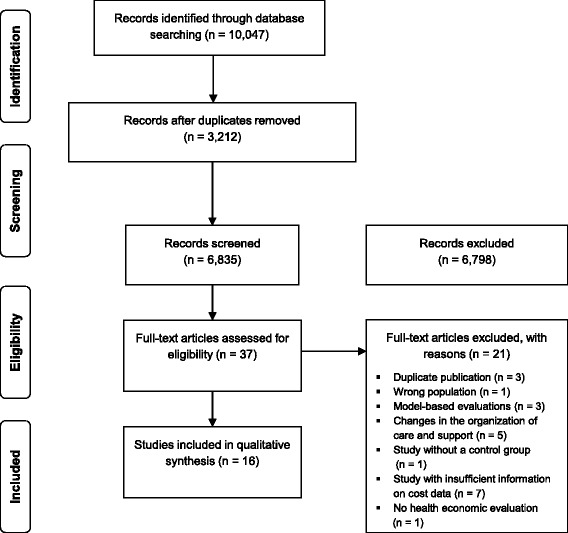
BACKGROUND: This systematic review aims to review the literature on trial-based economic evaluations of non-pharmacological interventions directly targeted at persons with dementia as well as persons with mild cognitive impairment and their respective caregivers. METHODS: A systematic literature research was conducted for the timeframe from 2010 to 2016 in the following databases: Centre for Reviews and Dissemination, EconLit, Embase, Cochrane Library, PsycINFO and PubMed. Study quality was assessed according to the Drummond criteria. RESULTS: In total sixteen publications were identified. Health economic evaluations indicated the cost-effectiveness of physical exercise interventions and occupational therapy. There was also evidence to suggest that psychological and behavioral therapies are cost-effective. Health economic studies investigating psychosocial interventions mainly targeted towards informal caregivers showed inconsistent results. CONCLUSIONS: Due to the increasing prevalence of dementia non-pharmacological interventions and their health economic impact are of increasing importance for health care decision-makers and HTA agencies.
Overview
The claims and statistics of this paper haven’t been checked yet.
Free: it reads the open-access text and checks the first 5 claims that cite a source we can check. Create a free account to check every claim.
Integrity signals
Registry
Cites
Statistics
Figures
Verification
Claims the paper makes
The claims and statistics of this paper haven’t been checked yet.
Free: it reads the open-access text and checks the first 5 claims that cite a source we can check. Create a free account to check every claim.
Claims other papers make about this one
Each is checked against this paper’s own text: does it say what the citing paper says it does?
The source backs part of the claim, not all of it — or backs it for a different population, condition or comparison.
In the citing paper
“although research that has evaluated both the costs and benefits of enhanced home support interventions is scant. 899 , 900”
From 2024 Alzheimer's disease facts and figures (2024) · cites this paper as [900]
Experimental — accuracy not yet measuredThe cited source says what the claim attributes to it.
In the citing paper
“In two systematic reviews of the cost‐effectiveness of enhanced home support interventions for individuals with dementia, researchers found some evidence to support occupational therapy, home‐based exercise, and some psychological and behavioral treatments as potentially cost‐effective approaches”
From 2024 Alzheimer's disease facts and figures (2024) · cites this paper as [900]
Self-check
Percentages, sums and reported differences re-computed from the paper’s own numbers.
The self-check needs the paper’s full text.
Citations
Cites
Methods for the Economic Evaluation of Health Care Programmes
Drummond, M. E., Sculpher, M. J., Torrance, G. W., O’Brien, B. J., & Stoddart, G. L. (2005) · doi:10.1093/oso/9780198529446.001.0001 · Cited by 13,648
Dementia prevention, intervention, and care
Livingston, G., Sommerlad, A., Orgeta, V., Costafreda, S. G., Huntley, J., Ames, D., Ballard, C., Banerjee, S., Burns, A., Cohen-Mansfield, J., et al. (2017) · The Lancet · doi:10.1016/s0140-6736(17)31363-6 · Cited by 6,072 · cited 1×
“However, these pharmacological interventions may provoke side-effects [4].”
BackgroundThe cochrane database of systematic reviews
Geddes, J. (1996) · Journal of Psychosomatic Research · doi:10.1016/s0022-3999(96)90063-x · Cited by 5,989
(2015) · HAL · Cited by 2,238
Alzheimer’s disease drug-development pipeline: Few candidates, frequent failures
Cummings, J. L., Morstorf, T., & Zhong, K. (2014) · Alzheimer's Research & Therapy · doi:10.1186/alzrt269 · Cited by 1,744 · cited 1×
“In the light of the comparably low success rate in the development of AD drugs [39] and the limited number of agents in the current pipeline [40], the development of effective non-pharmacological interventions is of particular importance in the treatment and care of PwDs and the support of informal caregivers.”
BackgroundThe Cochrane Database of Systematic Reviews
Handoll, H. H., Howe, T. E., & Madhok, R. (2002) · Physiotherapy · doi:10.1016/s0031-9406(05)60709-2 · Cited by 1,497
Nonpharmacological therapies in Alzheimer’s disease: a systematic review of efficacy
Olazarán, J., Reisberg, B., Clare, L., Cruz, I., Peña-Casanova, J., del Ser, T., Woods, B., Beck, C., Auer, S., Lai, C., et al. (2010) · Dementia and Geriatric Cognitive Disorders · doi:10.1159/000316119 · Cited by 937 · cited 2×
“Implications for future research There is evidence on the effectiveness of multicomponent psychosocial interventions on the maintenance of caregivers’ psychological health [55] and delayed institutionalization of PwDs [12].”
BackgroundExercise programs for people with dementia
Forbes, D., Forbes, S. C., Blake, C. M., Thiessen, E. J., & Forbes, S. (2015) · Cochrane Database of Systematic Reviews · doi:10.1002/14651858.cd006489.pub4 · Cited by 631
Groot, C., Hooghiemstra, A. M., Raijmakers, P. G. H. M., van Berckel, B. N. M., Scheltens, P., Scherder, E. J. A., van der Flier, W. M., & Ossenkoppele, R. (2016) · Ageing Research Reviews · doi:10.1016/j.arr.2015.11.005 · Cited by 616 · cited 1×
“Results of meta-analyses indicate that physical exercise interventions may have a positive effect on the rate of cognitive decline in AD [7] and suggest that there is a beneficial effect on cognitive functioning independent of the subtype of dementia [8].”
BackgroundVitamin D supplementation in pregnancy: a systematic review
Harvey, N. C., Holroyd, C., Ntani, G., Javaid, K., Cooper, P., Moon, R., Cole, Z., Tinati, T., Godfrey, K., Dennison, E., et al. (2014) · Health Technology Assessment · doi:10.3310/hta18450 · Cited by 352
Research works printed but not linked: 1
- Wimo A, Jönsson L, Winblad B: Health economic aspects of dementia. In: Dementia, Fifth Edition. Edited by David Ames, Alistair Burns, O'Brien JT, vol. 5. Boca Raton: CRC Press; 2017.
Cited by
2023 Alzheimer's disease facts and figures
(2023) · Alzheimer's & Dementia · doi:10.1002/alz.13016 · Cited by 3,212
2024 Alzheimer's disease facts and figures
(2024) · Alzheimer's & Dementia · doi:10.1002/alz.13809 · Cited by 2,536
2019 Alzheimer’s disease facts and figures.
Alzheimer's Association (2019) · Alzheimer's & Dementia · doi:10.1016/j.jalz.2019.01.010 · Cited by 2,461
2020 Alzheimer's disease facts and figures
(2020) · Alzheimer's & Dementia · doi:10.1002/alz.12068 · Cited by 2,353
2022 Alzheimer's disease facts and figures
(2022) · Alzheimer's & Dementia · doi:10.1002/alz.12638 · Cited by 2,341
2021 Alzheimer's disease facts and figures
(2021) · Alzheimer's & Dementia · doi:10.1002/alz.12328 · Cited by 2,201
2025 Alzheimer's disease facts and figures
(2025) · Alzheimer's & Dementia · doi:10.1002/alz.70235 · Cited by 474
Michalowsky, B., Xie, F., Eichler, T., Hertel, J., Kaczynski, A., Kilimann, I., Teipel, S., Wucherer, D., Zwingmann, I., Thyrian, J. R., et al. (2019) · Alzheimer's & Dementia · doi:10.1016/j.jalz.2019.05.008 · Cited by 89
“Several studies evaluated the cost-effectiveness of pharmacological and nonpharmacological treatments in dementia, reporting higher incremental cost per QALY between 32,000£ and 53,000£ for antidementia drug treatments [59] and 6695£ and 207,942£ per QALYgained for nonpharmacological and noninvasive intervention [60,6…”
BackgroundDementia care frameworks and assistive technologies for their implementation: a review
Koumakis, L., Chatzaki, C., Kazantzaki, E., Maniadi, E., & Tsiknakis, M. (2019) · IEEE Reviews in Biomedical Engineering · doi:10.1109/rbme.2019.2892614 · Cited by 64
“The findings reported in [133] indicate that the costeffectiveness of physical exercise interventions and occupational therapy is positive.”
BackgroundZheng, D., Wen, J., Kozak, M., Phau, I., Hou, H., & Wang, W. (2023) · Tourism Management · doi:10.1016/j.tourman.2023.104760 · Cited by 59
2026 Alzheimer's disease facts and figures
Alzheimer's, T. S. O. A. D. A. A. W. S. C. I. T. B. I., neurons, T. B. N. A. E. A. A. H. A. B. H. B. O., long, E. W., connections, B. E. T. E. E. I. N. T. F. C. W. O. N. A. S., synapses, C., memories, I. F. I. T. B. O. C. T. A. R. B. O. N. A. T. U. B. A. N. T. B. C. T. O. S. T. A. S. T. T. R. T. T. B. T. S. F. T. C. B. O., thoughts, sensations, emotions, & skills., M. A. (2026) · Alzheimer s & Dementia · doi:10.1002/alz.71345 · Cited by 124
Factors Related to the Quality of Life in Family Carers of People With Dementia: A Meta-Analysis
Contreras, M., Mioshi, E., & Kishita, N. (2020) · Journal of Geriatric Psychiatry and Neurology · doi:10.1177/0891988720924713 · Cited by 49
Eaglestone, G., Gkaintatzi, E., Jiang, H., Stoner, C. R., Pacella, R., & McCrone, P. (2023) · PharmacoEconomics - Open · doi:10.1007/s41669-023-00440-z · Cited by 35
“Previous reviews have also included interventions to improve the quality of life of carers as well as PwD [3, 12].”
BackgroundMoving family interventions into the real world: What matters to oncology stakeholders?
Ratcliff, C. G., Vinson, C. A., Milbury, K., & Badr, H. (2019) · Journal of Psychosocial Oncology · doi:10.1080/07347332.2018.1498426 · Cited by 31
Steinbeißer, K., Schwarzkopf, L., Graessel, E., & Seidl, H. (2020) · The European Journal of Health Economics · doi:10.1007/s10198-020-01175-y · Cited by 34
Economic Evaluation in Opioid Modeling: Systematic Review
Beaulieu, É., DiGennaro, C., Stringfellow, E. J., Connolly, A., Hamilton, A. D., Hyder, A., Cerdá, M., Keyes, K. M., & Jalali, M. S. (2020) · Value in Health · doi:10.1016/j.jval.2020.07.013 · Cited by 28
Guzzon, A., Rebba, V. S., Paccagnella, O., Rigon, M., & Boniolo, G. (2023) · PLoS ONE · doi:10.1371/journal.pone.0285305 · Cited by 29
Sousa, L., Neves, M. J., Moura, B., Schneider, J. M., & Fernandes, L. P. N. S. (2021) · International Journal of Geriatric Psychiatry · doi:10.1002/gps.5568 · Cited by 30
“But there is still a need for more robust evidence regarding effectivity((12)) and cost-effectiveness((22)) of specific non-pharmacological interventions.”
BackgroundHuo, Z., Chan, J. Y. C., Lin, J., Bat, B. K. K., Chan, T. K., Tsoi, K. K. F., & Yip, B. H. K. (2021) · Value in Health · doi:10.1016/j.jval.2021.05.011 · Cited by 20
Davis-Ajami, M. L., Lu, Z. K., & Wu, J. (2022) · Archives of Gerontology and Geriatrics · doi:10.1016/j.archger.2021.104536 · Cited by 20
Braun, A. L., Höfler, M., & Auer, S. (2024) · The Journal of Prevention of Alzheimer s Disease · doi:10.14283/jpad.2024.12 · Cited by 20
“Good prevention practice could be addressing: (i) reduction of risk factors of dementia, (ii) early detection of pre-clinical dementia, and (iii) social support of people with dementia (12, 14–19).”
Darab, M. G., Engel, L., Henzler, D., Lauerer, M., Nagel, E., Brown, V., & Mihalopoulos, C. (2024) · Applied Health Economics and Health Policy · doi:10.1007/s40258-024-00878-0 · Cited by 20
“…exercise, interventions to support and enhance cognitive abilities in people with dementia, for instance, reality orientation, reminiscence therapy or cognitive stimulation, psychological and behavioural therapies, occupational therapy [2, 14–16] and psychosocial interventions for carers [17].”
BackgroundAdjetey, C., Davis, J. C., Falck, R. S., Best, J. R., Dao, E. A., Bennett, K., Tai, D., McGuire, K., Eng, J. J., Hsiung, G. R., et al. (2023) · JAMA Network Open · doi:10.1001/jamanetworkopen.2023.45687 · Cited by 19
Ebrahem, A. S., & Oremus, M. (2018) · Expert Opinion on Pharmacotherapy · doi:10.1080/14656566.2018.1499727 · Cited by 17
“For example, when caregivers provide proxy measures of HRQoL in place of persons with dementia, they often allow their own health states and carer experiences to influence the proxy assessments [56].”
BackgroundBezold, J., Trautwein, S., Barisch‐Fritz, B., Scharpf, A., Krell‐Roesch, J., Nigg, C. R., & Wöll, A. (2021) · German Journal of Exercise and Sport Research · doi:10.1007/s12662-021-00760-4 · Cited by 15
Justo‐Henriques, S. I. (2021) · Revista de Enfermagem Referência · doi:10.12707/rv20100 · Cited by 11
Italian guidance on Dementia Day Care Centres: A position paper
Mossello, E., Baccini, M., Caramelli, F., Biagini, C. A., Cester, A., Vreese, L. P. D., Darvo, G., Vampini, C., Gotti, M., Fabbo, A., et al. (2023) · Aging Clinical and Experimental Research · doi:10.1007/s40520-023-02356-4 · Cited by 12
“The group of behaviour-, emotion- and sensory stimulationoriented interventions (Table 3b) has a crucial role for the treatment of BPSDs [50, 51] and should be considered as a first-line treatment in this setting [51], due to limited efficacy and increased risk of adverse events associated with antipsychotics.”
BackgroundVicente, M. M., Prieto, J. P., Domínguez, P. R., & Gusi, N. (2020) · Healthcare · doi:10.3390/healthcare8010054 · Cited by 15
“To the best of our knowledge, there is a lack of studies assessing the cost-utility of exercise-based programs provide in home-based contexts for caregivers of relatives [67].”
BackgroundPelone, F., Jacklin, P., Francis, J. M., & Purchase, B. (2021) · International Psychogeriatrics · doi:10.1017/s1041610220004111 · Cited by 9
Birkenhäger‐Gillesse, E. G., Achterberg, W. P., Janus, S. I. M., Zuidema, S. U., & van den Hout, W. B. (2022) · Alzheimer s & Dementia Translational Research & Clinical Interventions · doi:10.1002/trc2.12281 · Cited by 18
Sürer, H. K., Yaylagül, N. K., & Helvik, A. (2025) · Geriatrics and gerontology international/Geriatrics & gerontology international · doi:10.1111/ggi.70190 · Cited by 8
“Non-pharmacological interventions should include easily applicable and cost-effective practices to support caregivers' mental health [7].”
Tadokoro, K., Yamashita, T., Kawano, S., Sato, J., Omote, Y., Takemoto, M., Morihara, R., Nishiura, K., Sagawa, N., Tani, T., et al. (2021) · Journal of Alzheimer s Disease · doi:10.3233/jad-210284 · Cited by 8
Neal, D. P., Kučera, M., Munster, B. C. V., Ettema, T. P., Dijkstra, K., Muller, M., Dröes, R., & Bosmans, J. E. (2024) · Aging & Mental Health · doi:10.1080/13607863.2024.2345128 · Cited by 11
“Even factoring in the cost of the tablets used by participants in both arms of this study (€160 to €260 per dyad), FindMyApps would be less expensive than many psychosocial interventions (Huo et al., 2021; Nickel et al., 2018).”
Vargas‐Martínez, A. M. (2024) · Journal of Alzheimer s Disease · doi:10.1177/13872877241291070 · Cited by 9
Fan, Y., Chen, Q., Sun, H., Bärnighausen, T., Wang, C., Yang, T., & Chen, S. (2026) · npj Primary Care Respiratory Medicine · doi:10.1038/s41533-025-00467-1 · Cited by 7
“We assessed the methodological quality of all included economic evaluations using the Drummond 10-point checklist 30 , a widely used tool for appraising economic studies in health care 31 – 33 .”
Layton, N. A., LALOR, A. F., Slatyer, S., Lee, D. A., Bryant, C., Watson, M., Khushu, A., Burton, E., Oliveira, D., Brusco, N. K., et al. (2023) · Health Expectations · doi:10.1111/hex.13863 · Cited by 4
“28 31 Despite this research, there is very little evidence of translation of these approaches into routine practice.”
BackgroundPark, H. G., Perumean‐Chaney, S. E., & Bartolucci, A. A. (2022) · Dementia and Neurocognitive Disorders · doi:10.12779/dnd.2022.21.1.1 · Cited by 7
Lee, J.-E., Kang, H.-W., Jung, S.-A., Lee, S.-Y., Kim, J. Y., Lee, D. E., Jeong, J.-H., Jung, I. C., & Cho, E. (2022) · Integrative Medicine Research · doi:10.1016/j.imr.2022.100914 · Cited by 4
de Oliveira, I. A. G., Caetano, R., Steffen, R. E., & Biz, A. N. (2019) · Revista Brasileira de Geriatria e Gerontologia · doi:10.1590/1981-22562019022.190002 · Cited by 4
Gannon, B., Vo, V., Gitlin, L. N., & Bennett, S. H. (2025) · International Journal of Geriatric Psychiatry · doi:10.1002/gps.70049 · Cited by 4
“However, the majority of existing economic evaluation analyses are small short‐term, trial‐based studies which examine pharmacological interventions only and have variable and inconsistent conclusions [36].”
López‐Rodrigo, N., Moll‐Bertó, A., Montoro‐Pérez, N., Montejano‐Lozoya, R., López, M. I. M., & Alós, R. (2025) · Journal for Specialists in Pediatric Nursing · doi:10.1111/jspn.70009 · Cited by 5
The Benefits of Non-pharmacological Interventions
Ninot, G. (2020) · Springer eBooks · doi:10.1007/978-3-030-60971-9_4 · Cited by 2
Zhao, Q., Li, C., Zhang, Y., Tang, H., Wang, J., Yu, X., Zhao, Y., Xing, Y., Yu, J., Ye, J., et al. (2023) · International Journal of Geriatric Psychiatry · doi:10.1002/gps.5990 · Cited by 2
Eaglestone, G., Gkaintatzi, E., Stoner, C. R., Pacella, R., & McCrone, P. (2022) · medRxiv · doi:10.1101/2022.12.16.22283561 · Cited by 2
LALOR, A. F., Slatyer, S., Burton, E., Bryant, C., Oliveira, D., Khushu, A., Brusco, N. K., Layton, N. A., Lee, D. A., Cash, B., et al. (2025) · PLoS ONE · doi:10.1371/journal.pone.0326363 · Cited by 1
“Multi-component interventions (combining two or more approaches) have also been effective [23–25].”
Paterson, L., Elliott, R. A., Constantinidou, F., David, R., Dawes, P., Frison, É., Hann, M., Hussain, H., Leroi, I., Politis, A. M., et al. (2025) · International Journal of Geriatric Psychiatry · doi:10.1002/gps.70132 · Cited by 3
“There is some indication that interventions such as exercise programmes, or cognitive, psychological, or occupational therapy‐based interventions (not specifically focussed on independence) may be cost‐effective at improving some outcomes in people with dementia [43].”
Cost-benefit analysis of interventions for dementia: a scoping review
Comans, T. A., Dao‐Tran, T., Balasooriya, N. N., Simpson, D., Low, L., Barcenilla‐Wong, A., Vasquez, P., Zhou, J., & Nguyen, K. (2025) · Innovation in Aging · doi:10.1093/geroni/igaf084 · Cited by 3
Dixon, P., & Anderson, E. L. (2025) · Cost Effectiveness and Resource Allocation · doi:10.1186/s12962-025-00684-y · Cited by 2
Non-pharmacological treatments may improve cognition in mild cognitive impairment
Couch, E. (2022) · Evidence-Based Nursing · doi:10.1136/ebnurs-2022-103592 · Cited by 2
Lopez-Mendez, M., Iskandar, R., & Jutkowitz, E. (2023) · Applied Research in Quality of Life · doi:10.1007/s11482-023-10157-0 · Cited by 1
“A growing literature has also found that non-pharmacologic dementia care interventions are cost-effective (Gitlin et al., 2010a, b; Graff et al., 2008; Nickel et al., 2018; Shaw et al., 2021; Vandepitte et al., 2020).”
BackgroundWissen, was fehlt – Versorgungsforschung zur Demenz
Kolominsky‐Rabas, P. L. (2020) · Das Gesundheitswesen · doi:10.1055/a-1010-4857
“[10] Nickel F, Barth J, KolominskyRabas PL.”
BackgroundSelf-citationScheel, J., Graessel, E., & Donath, C. (2020) · Zeitschrift für Komplementärmedizin · doi:10.1055/a-1215-4491
A global view on physical activity recommendation for people with Alzheimer's disease
Cassuriaga, J., Feter, N., & Rombaldi, A. J. (2021) · Science & Sports · doi:10.1016/j.scispo.2020.10.008
The cost of dementia care in Greece: medical, social and informal care factors
Tsampalas, E., Karakatsani, E., Aravantinou-Fatorou, K., Zarakovitis, D., Chronopoulou, E., Lypiridou, M., Gamvroula, A., Dais, S., & Athanasios, A. (2022) · British Journal of Healthcare Management · doi:10.12968/bjhc.2020.0021
Mar, J., Ibarrondo, O., Larrañaga, I., Mar‐Barrutia, L., & Soto‐Gordoa, M. (2022) · Alzheimer s Research & Therapy · doi:10.1186/s13195-022-01111-7
“There are also a number of non-drug interventions that have demonstrated statistically and clinically meaningful benefits for people living with AD and their caregivers, including improving quality of life [9, 10].”
BackgroundVicente, M. M., González-Guerrero, J. L., Domínguez, P. R., & Gusi, N. (2023) · Journal of Sport and Health Research · doi:10.58727/jshr.86294
Dixon, P., & Anderson, E. L. (2023) · medRxiv · doi:10.1101/2023.12.09.23299763
Rantsi, M., Blankart, K. E., Lauri, K., Jyrkkä, J., & Hyttinen, V. (2024) · SSRN Electronic Journal · doi:10.2139/ssrn.4959345
Metadata
- Authors
- Nickel, F., Barth, J., & Kolominsky-Rabas, P. L.
- Affiliations
- Friedrich-Alexander-Universität Erlangen-Nürnberg (DE)
- Corresponding author
- Nickel, Franziska
- Venue
- BMC Geriatrics
- Published
- 2018-03-09
- Volume
- 18
- Issue
- 1
- Pages
- 69-69
- ISSN
- 1471-2318 (ISSN-L)
- PMC
- PMC5845149
- OpenAlex
- W2802216160
- Cited by
- 58
- References
- 58
- Citations by year
- 2026: 2 · 2025: 8 · 2024: 6 · 2023: 11 · 2022: 8 · 2021: 9 · 2020: 8 · 2019: 4 · 2018: 2
- FWCI
- 1.52
- Type
- journal article
- Language
- en
- Open access
- gold
- doi.org
- Licence
- cc-by
- creativecommons.org/licenses/by/4.0/ (tdm)
- Locations
- BMC Geriatrics (publishedVersion, cc-by)
- PubMed Central (publishedVersion, cc-by)
- PubMed (publishedVersion)
- OPUS FAU (Kooperativer Bibliotheksverbund Berlin-Brandenburg (KOBV), on behalf of the Universitätsbibliothek Erlangen-Nürnberg) (submittedVersion, cc-by)
- DOAJ (DOAJ: Directory of Open Access Journals) (submittedVersion, cc-by-sa)
- Funders
- Karl und Veronica Carstens-Stiftung
- Topics
- Social Sciences › Economics, Econometrics and Finance › Economics and Econometrics › Health Systems, Economic Evaluations, Quality of Life
- Health Sciences › Medicine › Psychiatry and Mental health › Dementia and Cognitive Impairment Research
- Life Sciences › Neuroscience › Cellular and Molecular Neuroscience › Alzheimer's disease research and treatments
- Keywords
- dementia, non-pharmacological treatment, informal caregivers, mild cognitive impairment, cost-effectiveness, economic evaluation, physical exercise intervention, occupational therapy, psychotherapy, behavior therapy, psychosocial interventions
- MeSH terms
- Behavior Therapy, Cost-Benefit Analysis, Dementia, Humans, Occupational Therapy, Caregivers
About these checks
Registry, retraction, Cites and statistics results are computed, not judged, with one exception: a printed reference that no index lists is read once by a model before it counts as a citation error. Claims are extracted by a model and kept only when their quote appears verbatim in the text; each cited source is then checked, with a model’s help, for whether it says what the claim relies on. Those verdicts can be wrong — read the claim’s quote and the cited source before relying on one.
Statistics and arithmetic are recomputed, not judged.
Confidence bands are shown only for fields calibrated on our annotated test set. None is calibrated yet, so no band is shown.
What counts as a claim ›How we measure confidence ›How we check this ›
Are you an author, or do you see a problem with this page? Request a review
Data sources
Bibliographic data: Semantic Scholar, OpenAlex, Crossref.
Contains information from the Semantic Scholar Academic Graph Datasets, made available under the ODC Attribution License (ODC-BY 1.0).
Semantic Scholar’s data is described in: Kinney, R., et al. (2023). The Semantic Scholar Open Data Platform. arXiv:2301.10140.
