

Family caregiving in the community up to 8-years after onset of dementia
Open accessThe DOI matches its Crossref record; 48 of the 48 references it cites were found in a registry or an index.
Abstract
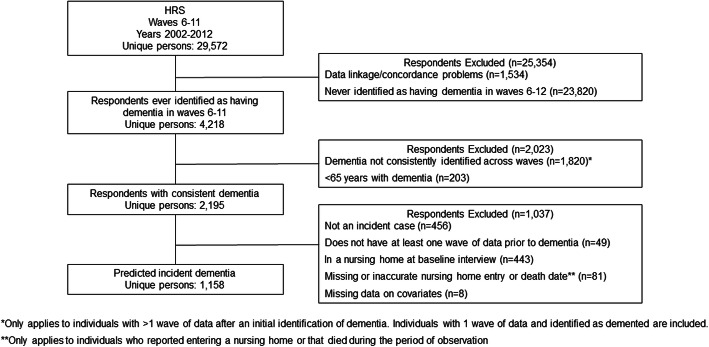
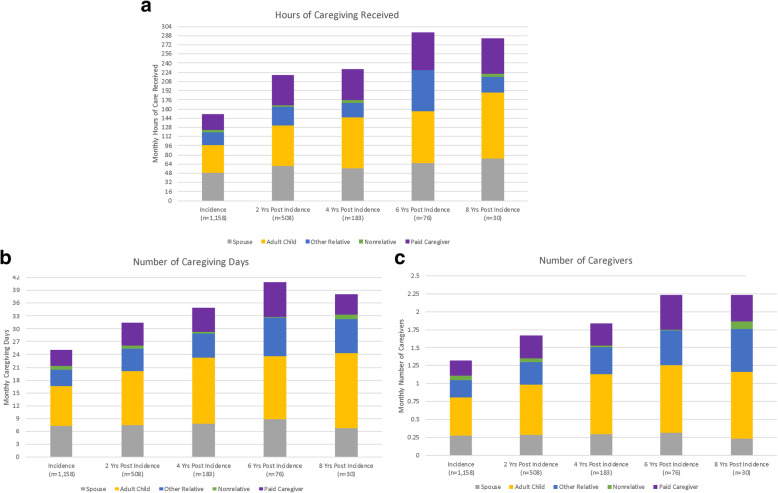
Background: Persons with Alzheimer’s disease and related dementias (ADRD) receive care from family/friends, but how care changes from the onset of dementia remains less understood. Methods: We used the Health and Retirement Study (2002–2012) to identify community-dwelling individuals predicted to have incident ADRD. We investigated the amount of caregiving received for activities of daily living in the 8-years after disease onset. Results: At incidence (n = 1158), persons with ADRD received 151 h (SD = 231) of caregiving a month, 25 (SD = 26) caregiving days a month and had 1.3 (SD = 1.4) caregivers a month. By 8-years post incidence, 187 (16%) individuals transitioned to a nursing home and 662 (57%) died in the community. Community-dwelling persons with ADRD at 8-years post incidence (n = 30) received 283 h (SD = 257) of caregiving, 38 (SD = 24) caregiving days, and had 2.2 (SD = 1.3) caregivers. Conclusions: Community-dwelling persons with ADRD receive a substantial amount of caregiving over the first 8-years after disease onset.
Overview
The claims and statistics of this paper haven’t been checked yet.
Free: it reads the open-access text and checks the first 5 claims that cite a source we can check. Create a free account to check every claim.
Integrity signals
Registry
Cites
Statistics
Figures
Verification
Claims the paper makes
The claims and statistics of this paper haven’t been checked yet.
Free: it reads the open-access text and checks the first 5 claims that cite a source we can check. Create a free account to check every claim.
Claims other papers make about this one
Each is checked against this paper’s own text: does it say what the citing paper says it does?
The source backs part of the claim, not all of it — or backs it for a different population, condition or comparison.
In the citing paper
“The amount of time required for caregiving increases as dementia progresses; one study showed that people with dementia required 151 hours of caregiving per month at the outset of dementia and increased to 283 hours per month eight years later.458”
From 2023 Alzheimer's disease facts and figures (2023) · cites this paper as [458]
Experimental — accuracy not yet measuredThe source backs part of the claim, not all of it — or backs it for a different population, condition or comparison.
In the citing paper
“one study showed that people with dementia required 151 hours of caregiving per month at the outset of dementia and this increased to 283 hours per month eight years later.”
From 2024 Alzheimer's disease facts and figures (2024) · cites this paper as [499]
Experimental — accuracy not yet measured
Self-check
Percentages, sums and reported differences re-computed from the paper’s own numbers.
The self-check needs the paper’s full text.
Citations
Cites
Hearing loss and cognitive decline in older adults
Lin, F. R., Yaffe, K., Xia, J., Xue, Q.-L., Harris, T. B., Purchase-Helzner, E., Satterfield, S., Ayonayon, H. N., Ferrucci, L., Simonsick, E. M., et al. (2013) · JAMA Internal Medicine · doi:10.1001/jamainternmed.2013.1868 · Cited by 4,017
The Meaning of "Aging in Place" to Older People
Wiles, J. L., Leibing, A., Guberman, N., Reeve, J., & Allen, R. E. S. (2012) · The Gerontologist · doi:10.1093/geront/gnr098 · Cited by 1,965
2018 Alzheimer's disease facts and figures
Alzheimer's Association (2018) · Alzheimer's & Dementia · doi:10.1016/j.jalz.2018.02.001 · Cited by 1,912
Family caregivers of people with dementia
Brodaty, H., & Donkin, M. (2009) · Dialogues in Clinical Neuroscience · doi:10.31887/dcns.2009.11.2/hbrodaty · Cited by 1,644
Monetary Costs of Dementia in the United States
Hurd, M. D., Martorell, P., Delavande, A., Mullen, K. J., & Langa, K. M. (2013) · New England Journal of Medicine · doi:10.1056/nejmsa1204629 · Cited by 1,484
An Overview of the Health and Retirement Study
Juster, F. T., & Suzman, R. (1995) · The Journal of Human Resources · doi:10.2307/146277 · Cited by 1,435
Families Caring for an Aging America
Committee on Family Caregiving for Older Adults, Board on Health Care Services, Division, H. A. M., & National Academies of Sciences, E. (2016) · National Academies Press eBooks · doi:10.17226/23606 · Cited by 1,246
Crimmins, E. M., Kim, J. K., Langa, K. M., & Weir, D. R. (2011) · The Journals of Gerontology Series B: Psychological Sciences and Social Sciences · doi:10.1093/geronb/gbr048 · Cited by 1,056
Ory, M. G., Hoffman, R. R., Yee, J. L., Tennstedt, S., & Schulz, R. (1999) · The Gerontologist · doi:10.1093/geront/39.2.177 · Cited by 991
Family caregivers of people with dementia.
Brodaty, H., & Donkin, M. (2009) · PubMed · Cited by 981
Research works printed but not linked: 2
- U. S Department of Health & Human Services. National Plan to Address Alzheimer’s Disease 2016
- Shirk C Rebalancing long-term care: the role of the Medicaid HCBS waiver Program. 2006 3 1 25
Cited by
2023 Alzheimer's disease facts and figures
(2023) · Alzheimer's & Dementia · doi:10.1002/alz.13016 · Cited by 3,212
2024 Alzheimer's disease facts and figures
(2024) · Alzheimer's & Dementia · doi:10.1002/alz.13809 · Cited by 2,536
2022 Alzheimer's disease facts and figures
(2022) · Alzheimer's & Dementia · doi:10.1002/alz.12638 · Cited by 2,341
2021 Alzheimer's disease facts and figures
(2021) · Alzheimer's & Dementia · doi:10.1002/alz.12328 · Cited by 2,201
2025 Alzheimer's disease facts and figures
(2025) · Alzheimer's & Dementia · doi:10.1002/alz.70235 · Cited by 474
Rahman, M., White, E. M., Thomas, K. S., & Jutkowitz, E. (2020) · JAMA Network Open · doi:10.1001/jamanetworkopen.2020.22111 · Cited by 101
Self-citation2026 Alzheimer's disease facts and figures
Alzheimer's, T. S. O. A. D. A. A. W. S. C. I. T. B. I., neurons, T. B. N. A. E. A. A. H. A. B. H. B. O., long, E. W., connections, B. E. T. E. E. I. N. T. F. C. W. O. N. A. S., synapses, C., memories, I. F. I. T. B. O. C. T. A. R. B. O. N. A. T. U. B. A. N. T. B. C. T. O. S. T. A. S. T. T. R. T. T. B. T. S. F. T. C. B. O., thoughts, sensations, emotions, & skills., M. A. (2026) · Alzheimer s & Dementia · doi:10.1002/alz.71345 · Cited by 126
Gitlin, L. N., Marx, K., Piersol, C. V., Hodgson, N. A., Huang, J., Roth, D. L., & Lyketsos, C. (2021) · BMC Geriatrics · doi:10.1186/s12877-021-02511-4 · Cited by 65
“As other studies have shown that increased functional dependence is a predictor of more hours caregiving, hospitalizations and nursing home placements [35], even a small decline in the rate of dependence over time may lessen caregiver burden and improve PLWD quality of life.”
BackgroundJutkowitz, E., Halladay, C., Tsai, J., Hooshyar, D., Quach, L., O'Toole, T., & Rudolph, J. L. (2022) · Alzheimer's & Dementia · doi:10.1002/alz.12476 · Cited by 29
Self-citationHan, E.-J., Lee, J., Cho, E., & Kim, H. (2021) · International Journal of Environmental Research and Public Health · doi:10.3390/ijerph18020376 · Cited by 21
“[33], the caregiving duration was 151 h a month at the diagnosis of dementia, which increased to 283 h a month in eight years.”
BackgroundSanjuán, M., Navarro, E., & Calero, M. D. (2022) · Journal of Clinical Nursing · doi:10.1111/jocn.16301 · Cited by 28
“Therefore, all the quality of life benefits that are supported by the scientific literature (Jutkowitz et al., 2020) can be extrapolated to older adults without dementia.”
BackgroundCaring for Dementia Caregivers: Psychosocial Factors Related to Engagement in Self-Care Activities
Lin, X. Y., Moxley, J. H., & Czaja, S. J. (2023) · Behavioral Sciences · doi:10.3390/bs13100851 · Cited by 26
“Dementia caregivers are more likely to be older adults, over 65 years or older, women, and the adult, child, or spouse of the individual with dementia who report spending more caregiving time compared to their counterparts [1,16].”
BackgroundOdell‐Miller, H., Blauth, L., Bloska, J., Bukowska, A. A., Clark, I. N., Crabtree, S., Engen, R. B., Knardal, S. E., Kvamme, T. S., McMahon, K., et al. (2022) · European Journal of Investigation in Health Psychology and Education · doi:10.3390/ejihpe12120127 · Cited by 24
Jutkowitz, E., Pizzi, L. T., Shewmaker, P., Alarid‐Escudero, F., Epstein‐Lubow, G., Prioli, K. M., Gaugler, J. E., & Gitlin, L. N. (2023) · Alzheimer's & Dementia · doi:10.1002/alz.12964 · Cited by 22
Self-citationReckrey, J. M., Li, L., Zhan, S., Wolff, J. L., Yee, C., & Ornstein, K. A. (2022) · The Journals of Gerontology Series B · doi:10.1093/geronb/gbac006 · Cited by 21
Pickett, A. C., Valdez, D., Sinclair, K. L., Kochell, W. J., Fowler, B., & Werner, N. E. (2024) · JMIR Aging · doi:10.2196/59294 · Cited by 22
“Therefore, the time spent on caregiving activities and the number of individuals providing care generally increase across the disease progression [2,3].”
BackgroundProfiles of Caregiving Arrangements of Community-dwelling People Living with Probable Dementia
Jutkowitz, E., Mitchell, L. L., Bardenheier, B. H., & Gaugler, J. E. (2021) · Journal of Aging & Social Policy · doi:10.1080/08959420.2021.1927613 · Cited by 18
Self-citationLosada‐Baltar, A., Falzarano, F. B., Hancock, D. W., Márquez‐González, M., Pillemer, K. A., Huertas‐Domingo, C., Jiménez‐Gonzalo, L., Fernándes-Pires, J., & Czaja, S. J. (2023) · Journal of Aging and Health · doi:10.1177/08982643231193579 · Cited by 17
“As the cohort of baby boomers is reaching old age, and life expectancy is generally increasing, it is predicted that the availability of family caregivers will decline (Feinberg & Spillman, 2019; Jutkowitz et al., 2020).”
Determinants of trajectories of informal caregiving in later life: evidence from England
Gessa, G. D., & Deindl, C. (2024) · European Journal of Ageing · doi:10.1007/s10433-024-00818-w · Cited by 15
“…heterogeneity in older people’s trajectories of frequency and intensity of care utilisation (Hu 2020), care receipt often increases over time after disease onset, particularly for those who suffer from degenerative conditions that require more assistance over time (Jutkowitz et al. 2020).”
BackgroundJutkowitz, E., Pizzi, L. T., Popp, J. H., Prioli, K. M., Scerpella, D. L., Marx, K., Samus, Q. M., Piersol, C. V., & Gitlin, L. N. (2021) · International Psychogeriatrics · doi:10.1017/s1041610221000089 · Cited by 14
“People living with dementia (PLwD) require extensive long-term care support and most of this care is provided by family caregivers (e.g., spouse or adult child) (Gaugler and Kane, 2015; Jutkowitz et al., 2020a, 2020b, 2017a).”
BackgroundSelf-citationRisk of dementia among veterans experiencing homelessness and housing instability
Roncarati, J. S., DeVone, F., Halladay, C. W., Tsai, J., & Jutkowitz, E. (2023) · Journal of the American Geriatrics Society · doi:10.1111/jgs.18680 · Cited by 11
Self-citationSmith, M. L., Southerland, J. L., Neelamegam, M., Han, G., Lee, S., Kew, C. L., Bacsu, J.-D., Couch, E., Kim, S., Brown, M. J., et al. (2025) · Frontiers in Public Health · doi:10.3389/fpubh.2025.1615187 · Cited by 11
“Caregivers of PLWD in more advanced stages of the disease are often involved in providing constant supervision for the safety of the care recipients and may spend more time assisting with communication and interpreting the needs of their care recipients (17, 21, 58, 59).”
Jutkowitz, E., DeVone, F., Halladay, C. W., Hooshyar, D., Tsai, J., & Rudolph, J. L. (2021) · PubMed · Cited by 10
Self-citationNi, C., Song, Q., Chen, Q., Song, L., Commiskey, P., Stratton, L., Malin, B., & Yin, Z. (2024) · JMIR Aging · doi:10.2196/60050 · Cited by 11
Introduction to ADRD Care in Context
Ajrouch, K. J., Webster, N. J., Zahodne, L. B., & Antonucci, T. C. (2022) · The Journals of Gerontology Series B · doi:10.1093/geronb/gbac181 · Cited by 9
Ingraham, B. C., Barthold, D., Fishman, P. A., & Coe, N. B. (2024) · Health Affairs Scholar · doi:10.1093/haschl/qxae020 · Cited by 8
“7,10 We also examined the relationship between characteristics of PLWD prior to dementia onset and receipt of family caregiving after onset.”
BackgroundThe Effects of Increasing State Minimum Wage on Family and Paid Caregiving
Jutkowitz, E., Lake, D. T., Shewmaker, P., & Gaugler, J. E. (2022) · Journal of Applied Gerontology · doi:10.1177/07334648221124913 · Cited by 7
Self-citationCare Partner Burden and Support Services in Dementia
Polsinelli, A. J. (2024) · CONTINUUM Lifelong Learning in Neurology · doi:10.1212/con.0000000000001502 · Cited by 6
Jang, S., & Chen, J. (2024) · American Journal of Geriatric Psychiatry · doi:10.1016/j.jagp.2024.03.011 · Cited by 5
Ascertaining Out-of-Pocket Costs of Dementia Care: Feasibility Study of a Web-Based Weekly Survey
Dawson, W. D., Mattek, N., Gothard, S., Kaye, J. A., & Lindauer, A. (2024) · JMIR Formative Research · doi:10.2196/56878 · Cited by 6
“Not only are ADRD care–related activities costly for care partners, but also they are often highly time-consuming and increase in duration along with disease progression [8,26].”
BackgroundPickett, A. C., Valdez, D., White, L. A., Loganathar, P., Linden, A. R., Boutilier, J. J., Caldwell, C., Elliott, C., Zuraw, M., & Werner, N. E. (2024) · JMIR Aging · doi:10.2196/67992 · Cited by 8
“AD/ADRD generally progresses slowly; however, as disease symptomology worsens, most people living with AD/ADRD require support from informal caregivers (ie, unpaid family or friends) [1-5].”
Ahmad, N., Kunicki, Z. J., Tambor, E. S., Epstein-Lubow, G. P., & Tremont, G. N. (2023) · Journal of Geriatric Psychiatry and Neurology · doi:10.1177/08919887231195217 · Cited by 5
Callahan, L. F., Samsell, B. J., DiBenedetti, D. B., Frangiosa, T. L., Slota, C., Biggar, V. S., Paulsen, R., Lappin, D. R., Herring, W. L., & DeMuro, C. (2023) · Neurology and Therapy · doi:10.1007/s40120-023-00558-6 · Cited by 5
Wyman, M. F., Jacobs, J., Stalter, L. N., Venkatesh, M., Voils, C. I., TRIVEDI, R. B., Gleason, C. E., & Byers, A. L. (2024) · American Journal of Geriatric Psychiatry · doi:10.1016/j.jagp.2024.06.010 · Cited by 5
Caregiving for Patients with Chronic Diseases: The Process of Caregiver Empowerment
Pashaeypoor, S., Yaghoobzadeh, A., Ong, F. S., Cheraghi, M. A., Khoshkesht, S., & Dehkordi, L. M. (2025) · Journal of Qualitative Research in Health Sciences · doi:10.34172/jqr.1324 · Cited by 5
“They engage in various tasks, including managing care needs and assisting with functional limitations (8).”
Baby Boomers Who Provide Informal Care for People Living with Dementia in the Community
Miyawaki, C. E., Bouldin, E. D., Taylor, C. A., & McGuire, L. C. (2021) · International Journal of Environmental Research and Public Health · doi:10.3390/ijerph18189694 · Cited by 4
Davila, H. W., O’Malley, K. A., Shin, M. H., Engle, R. L., Adjognon, O. L., & Sullivan, J. L. (2022) · Home Health Care Services Quarterly · doi:10.1080/01621424.2022.2027315 · Cited by 5
Balvert, S. C. E., Butterbrod, E., Sikkes, S. A. M., Scherder, E., Dröes, R., & Milders, M. V. (2025) · Alzheimer s & Dementia Behavior & Socioeconomics of Aging · doi:10.1002/bsa3.70017 · Cited by 3
The cost of non-drug interventions that improve function and reduce dementia-related behaviors
Jutkowitz, E., Pizzi, L. T., Shewmaker, P., Alarid‐Escudero, F., Epstein-Lubow, G. P., Gaugler, J. E., & Gitlin, L. N. (2025) · BMC Geriatrics · doi:10.1186/s12877-025-06532-1 · Cited by 1
“People with ADRD spend most of their lifetime with disease at home or in other home-like settings [2].”
Self-citationHarris, M., Errickson, J., Ha, J., & Hoffman, G. J. (2022) · Medical Care · doi:10.1097/mlr.0000000000001771 · Cited by 1
Zhang, H., Underwood, B. R., London, S., Zhao, H., Yu, J., Da, F., & Chen, S. (2025) · BMC Medicine · doi:10.1186/s12916-025-04264-y · Cited by 1
“A study conducted in the U.S., involving a sample of 1158 community-dwelling individuals, highlighted the substantial amount of caregiving required over the first eight years after the onset of dementia, with an average of 9 h per day of caregiving [11].”
Hung, A., & Hall, R. K. (2022) · Journal of the American Geriatrics Society · doi:10.1111/jgs.17948
“In the first year after diagnosis, community-dwelling ADRD populations already receive on average 25 caregiving days per month.(9) Caregiver burden can lead to decreased care provision, as well as physical and psychological health deterioration for the caregiver, with in-home caregiving being associated with greater p…”
BackgroundYuan, Y., & Chen, H. (2022) · Communications in computer and information science · doi:10.1007/978-3-031-06394-7_57
Nursing students’ perceptions of Alzheimer’s disease: A metaphor study
Aşiret, G. D., & Yüksel, A. (2025) · Educational Gerontology · doi:10.1080/03601277.2025.2575901
“As dementia progresses, the amount of time required for care increases, and Jutkowitz et al. (2020) reported that individuals with dementia needed 151 hours of care per month at disease onset, rising to 283 hours per month eight years later.”
Yuan, Y., Gu, D., Chen, H., & Yang, H. (2025) · Asia Pacific Journal of Social Work and Development · doi:10.1080/29949769.2025.2576033
“A longitudinal study discovered that caregiving hours increase from an average of 151 hours monthly at the onset of the disease to 283 hours monthly in subsequent years (Jutkowitz et al., 2020).”
Caregiving for Dementia and the Medicare Expenditures of Spouses of Persons with Dementia
Ingraham, B. C. (2023) · ResearchWorks at the University of Washington (University of Washington)
Sanjuán, M. (2021) · Institutional Repository of the University of Granada (University of Granada)
DiGrado, J. L. (2023) · ScholarWorks (Walden University)
Unraveling the Neurocognitive Effects of Caregiver Stress Recall: An fNIRS Investigation
Singer, K. J. (2024) · VTechWorks (Virginia Tech) · Cited by 1
Sakia, A. M. (2023) · LA Referencia (Red Federada de Repositorios Institucionales de Publicaciones Científicas)
Gitlin, L. N., Jutkowitz, E., Piersol, C. V., Koeuth, S., Sivori, T. T., Webster, M. J., Barnett, R. N., & Roth, D. L. (2026) · Contemporary Clinical Trials Communications · doi:10.1016/j.conctc.2026.101603
“Dementia is characterized by progressive decrements in cognition, function, and behavior such that individuals become increasingly dependent upon family members for daily support [2,3].”
Self-citationJutkowitz, E., Brown, D. L., Koeuth, S., Piersol, C. V., Cook, A., & Gitlin, L. N. (2026) · Journal of the American Medical Directors Association · doi:10.1016/j.jamda.2026.106186
Self-citationCaregiving for Older Adults within Community Settings
Southerland, J. L., Cohen, S. A., O’Sullivan, R., & Smith, M. L. (2026) · Frontiers research topics · doi:10.3389/978-2-8325-7725-7
Comparative long-term outcomes of home-based versus institutional care in Alzheimer's disease
Tan, Y., Liu, Q. Y., Wu, C., Zhang, C., Yao, Q., Li, J., Kang, Y., Huang, B., Gu, L., Lu, J., et al. (2026) · Journal of Alzheimer s Disease · doi:10.1177/13872877261451155
How do US states define person-centered and family-involved care in assisted living regulations
Carder, P., Smith, L., Bunker, J., Hua, C. L., Hsu, E.-C., Boun, I., Ainsworth, O. M., Thomas, K. S., & Jutkowitz, E. (2026) · Frontiers in Dementia · doi:10.3389/frdem.2026.1824907
Self-citationKim, H., Liu, E., Kajiyama, B., Song, J., Paun, O., Han, S. G., & Gallagher-Thompson, D. E. (2026) · Aging & Mental Health · doi:10.1080/13607863.2026.2693238 · Cited by 1
Siregar, R., & Siringoringo, A. (2026) · Juru Rawat Jurnal Update Keperawatan · doi:10.31983/juk.v6i2.15006
Innovations in Dementia Policies and Services
Canty, A. J., Dawson, W., Gelmon, S. B., Migeot, J., & O’Philbin, L. (2026) · Frontiers research topics · doi:10.3389/978-2-8325-8933-5
Metadata
- Authors
- Jutkowitz, E., Gaugler, J. E., Trivedi, A. N., Mitchell, L. L., & Gozalo, P.
- Affiliations
- Brown University (US)
- University of Minnesota (US)
- Minneapolis VA Health Care System (US)
- Corresponding author
- Jutkowitz, Eric
- Venue
- BMC Geriatrics
- Published
- 2020-06-19
- Volume
- 20
- Issue
- 1
- Pages
- 216-216
- ISSN
- 1471-2318 (ISSN-L)
- PMC
- PMC7304188
- OpenAlex
- W3036426896
- Cited by
- 50
- References
- 48
- Citations by year
- 2026: 6 · 2025: 8 · 2024: 10 · 2023: 7 · 2022: 10 · 2021: 8 · 2020: 1
- FWCI
- 4.74
- Type
- journal article
- Language
- en
- Open access
- gold
- doi.org
- Licence
- cc-by
- creativecommons.org/licenses/by/4.0 (tdm)
- creativecommons.org/licenses/by/4.0 (vor)
- Locations
- BMC Geriatrics (publishedVersion, cc-by)
- PubMed Central (publishedVersion, cc-by)
- PubMed (publishedVersion)
- DOAJ (DOAJ: Directory of Open Access Journals) (submittedVersion, cc-by-sa)
- Funders
- National Institute on Aging (1R21AG059623-01, 1R01AG060871-0)
- Topics
- Health Sciences › Medicine › Psychiatry and Mental health › Dementia and Cognitive Impairment Research
- Health Sciences › Nursing › Research and Theory › Nursing care and research
- Health Sciences › Medicine › Geriatrics and Gerontology › Geriatric Care and Nursing Homes
- Keywords
- family caregiving, Alzheimer's disease and related dementias, community-dwelling older adults, activities of daily living, caregiver burden, transition to nursing home, community deaths, long-term care
- MeSH terms
- Activities of Daily Living, Alzheimer Disease, Dementia, Humans, Caregivers, Independent Living
About these checks
Registry, retraction, Cites and statistics results are computed, not judged, with one exception: a printed reference that no index lists is read once by a model before it counts as a citation error. Claims are extracted by a model and kept only when their quote appears verbatim in the text; each cited source is then checked, with a model’s help, for whether it says what the claim relies on. Those verdicts can be wrong — read the claim’s quote and the cited source before relying on one.
Statistics and arithmetic are recomputed, not judged.
Confidence bands are shown only for fields calibrated on our annotated test set. None is calibrated yet, so no band is shown.
What counts as a claim ›How we measure confidence ›How we check this ›
Are you an author, or do you see a problem with this page? Request a review
Data sources
Bibliographic data: Semantic Scholar, OpenAlex, Crossref.
Contains information from the Semantic Scholar Academic Graph Datasets, made available under the ODC Attribution License (ODC-BY 1.0).
Semantic Scholar’s data is described in: Kinney, R., et al. (2023). The Semantic Scholar Open Data Platform. arXiv:2301.10140.
