

Health care transitions for persons living with dementia and their caregivers
Open accessThe DOI matches its Crossref record; 56 of the 58 references it cites were found in a registry or an index.
Abstract
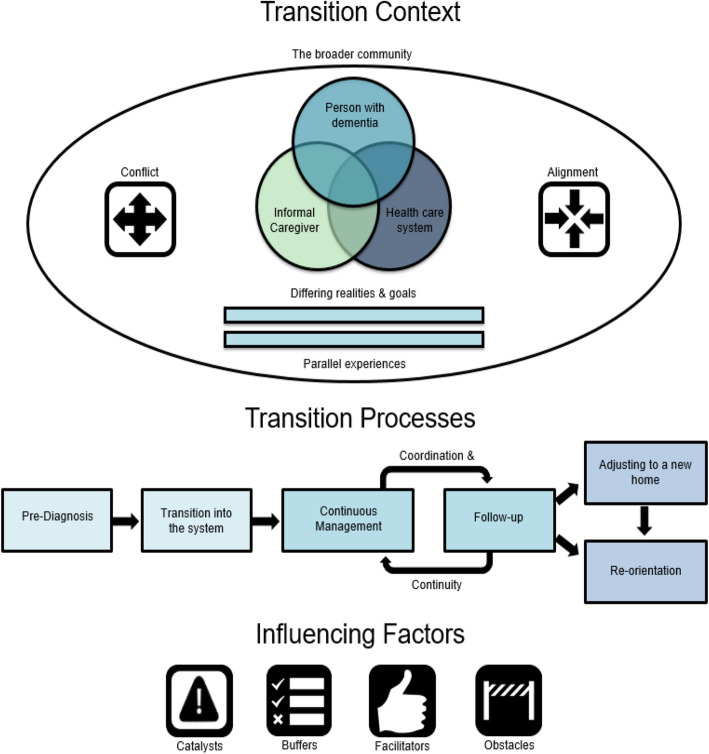
Background: Persons with dementia are likely to require care from various health care providers in multiple care settings, necessitating navigation through an often-fragmented care system. This study aimed to create a better understanding of care transition experiences from the perspectives of persons living with dementia and their caregivers in Ontario, Canada, through the development of a theoretical framework. Methods: Constructivist grounded theory guided the study. Seventeen individual caregiver interviews, and 12 dyad interviews including persons with dementia and their caregivers, were recorded and transcribed verbatim. The data were coded using NVivo 10 software; analysis occurred iteratively until saturation was reached. Results: A theoretical framework outlining the context, processes, and influencing factors of care transitions was developed and refined. Gaining an in-depth understanding of the complex care transitions of individuals with dementia and their caregivers is an important step in improving the quality of care and life for this population. Conclusion: The framework developed in this study provides a focal point for efforts to improve the health care transitions of persons living with dementia.
Overview
The claims and statistics of this paper haven’t been checked yet.
Free: it reads the open-access text and checks the first 5 claims that cite a source we can check. Create a free account to check every claim.
Integrity signals
Registry
Cites
Statistics
Figures
Verification
Claims the paper makes
The claims and statistics of this paper haven’t been checked yet.
Free: it reads the open-access text and checks the first 5 claims that cite a source we can check. Create a free account to check every claim.
Claims other papers make about this one
Each is checked against this paper’s own text: does it say what the citing paper says it does?
The source backs part of the claim, not all of it — or backs it for a different population, condition or comparison.
In the citing paper
“Key features of discharge planning included developing meaningful care plans, which were communicated to all involved in the transition, informed by the patient’s goals of care and provided opportunities for follow-up in the community [28, 39, 43–61].”
From Do hospital-to-home transitions work for older adults with multiple long-term conditions including dementia? A realist review (2025) · cites this paper as [43]
Experimental — accuracy not yet measuredThe source backs part of the claim, not all of it — or backs it for a different population, condition or comparison.
In the citing paper
“Inconsistencies in the standard of care from admission and during the hospital stay (potentially explained in part by a lack of standardised information exchange) were associated with reduced patient wellbeing and potential inequitable access to care, which increased the risk of readmission [28, 39–43].”
From Do hospital-to-home transitions work for older adults with multiple long-term conditions including dementia? A realist review (2025) · cites this paper as [43]
Experimental — accuracy not yet measuredThe source backs part of the claim, not all of it — or backs it for a different population, condition or comparison.
In the citing paper
“Carers’ knowledge (e.g., health literacy, the patient’s care needs) was linked to their experience of carer burden, and use of urgent care after returning home, and contributed to the ways they engaged with information provided at discharge [43, 44, 57, 59, 60, 64, 66, 67].”
From Do hospital-to-home transitions work for older adults with multiple long-term conditions including dementia? A realist review (2025) · cites this paper as [43]
Experimental — accuracy not yet measuredThe source backs part of the claim, not all of it — or backs it for a different population, condition or comparison.
In the citing paper
“This enabled information sharing between carers and HCPs, and improved understanding of patient needs, subsequently impacting their ability to tailor discharge planning (CMOC4) [43, 46, 52, 54, 75, 76].”
From Do hospital-to-home transitions work for older adults with multiple long-term conditions including dementia? A realist review (2025) · cites this paper as [43]
Experimental — accuracy not yet measuredThe source backs part of the claim, not all of it — or backs it for a different population, condition or comparison.
In the citing paper
“Analysis suggested that pressure to comply with the system-level focus on occupancy targets and minimising length of stay further fuelled these beliefs, as older adults with dementia typically stay longer in hospital [41, 43, 48, 50, 75, 78, 84, 89, 91–93].”
From Do hospital-to-home transitions work for older adults with multiple long-term conditions including dementia? A realist review (2025) · cites this paper as [43]
Experimental — accuracy not yet measured
15 more claims about this paper
Create a free account to see every claim other papers make about this one.
Self-check
Percentages, sums and reported differences re-computed from the paper’s own numbers.
The self-check needs the paper’s full text.
Citations
Cites
(2006) · Cited by 18,730
Constructing Grounded Theory. A Practical Guide Through Qualitative Analysis
(2006) · QMiP Bulletin · doi:10.53841/bpsqmip.2006.1.2.36 · Cited by 11,828
(1978) · Medical Entomology and Zoology · Cited by 6,077
The SAGE Handbook of Grounded Theory
Bryant, A., & Charmaz, K. (2007) · SAGE · doi:10.4135/9781848607941 · Cited by 2,798 · cited 1×
“Preferences for individual or dyad interviews (including a person with dementia and an informal caregiver) were respected [38, 39].”
BackgroundKripalani, S., LeFevre, F., Phillips, C. O., Williams, M. V., Basaviah, P., & Baker, D. W. (2007) · JAMA · doi:10.1001/jama.297.8.831 · Cited by 2,103
Transitions Theory: Middle Range and Situation Specific Theories in Nursing Research and Practice
Meleis, A. I. (2010) · Medical Entomology and Zoology · Cited by 1,977
The Care Transitions Intervention: Results of a Randomized Controlled Trial
Coleman, E. A., Parry, C., Chalmers, S., & Min, S.-J. (2006) · Archives of Internal Medicine · doi:10.1001/archinte.166.17.1822 · Cited by 1,937 · cited 1×
“Coleman et al’s [45] Care Transitions Intervention (CTI) is tailored to individual goals, indicating consideration of the multiplicity of goals in health care practice.”
BackgroundRethinking Methods in Psychology
Smith, J., Harré, R., & Langenhove, L. (1995) · SAGE Publications Ltd eBooks · doi:10.4135/9781446221792 · Cited by 1,915
Complexity and post-modernism: understanding complex systems
Cilliers, P., & Spurrett, D. (1999) · South African Journal of Philosophy · doi:10.1080/02580136.1999.10878187 · Cited by 1,913
The Incidence and Severity of Adverse Events Affecting Patients after Discharge from the Hospital
Forster, A. J., Murff, H. J., Peterson, J. F., Gandhi, T. K., & Bates, D. W. (2003) · Annals of Internal Medicine · doi:10.7326/0003-4819-138-3-200302040-00007 · Cited by 1,886
Research works printed but not linked: 5
- Gill SS Camacho X Poss JW Bronskill SE Camacho S Gruneir A Ho MM Community dwelling older adults with dementia Health system use by frail Ontario seniors: an in-depth examination of four vulnerable cohorts 2011 Toronto, ON Institute for Clinical Evaluative Sciences 47 69
- Creswell JW Qualitative inquiry and research design (2nd ed.) 2007 Thousand Oaks, CA Sage Publications
- Reid R Haggerty J McKendry R Defusing the confusion: concepts and measures of continuity of healthcare 2002 Canada Canadian health services research foundation, the Canadian Institute for Health Information, and the Advisory Committee on Health Services of the Federal/Provincial/Territorial Deputy Ministers of Health
- Cilliers P Complexity and postmodernism: understanding complex systems 1998 London Routledge
- Wiersma E Sameshima P Dupuis S Mapping the dementia journey 2014 Thunder Bay Centre for Education and Research on Aging and Health
Cited by
Emergency Department Care Transitions for Patients With Cognitive Impairment: A Scoping Review
Gettel, C. J., Falvey, J. R., Gifford, A., Hoang, L., Christensen, L., Hwang, U., Shah, M. N., Aggarawal, N. T., Allore, H. G., Aloysi, A. S., et al. (2022) · Journal of the American Medical Directors Association · doi:10.1016/j.jamda.2022.01.076 · Cited by 71
“42,48 Attention in the clinical realm could be directed toward considering personalized approaches to care transition interventions, in that a ‘one size fits all’ approach would be unlikely to be successful with varying disease stages, access to resources, and care partner abilities.”
A Systematic Review of the Needs of Dementia Caregivers Across Care Settings
Mueller, A. E., Thao, L. M., Condon, O., Liebzeit, D., & Fields, B. (2021) · Home Health Care Management & Practice · doi:10.1177/10848223211056928 · Cited by 32
“Caregivers in each care setting, except memory care, identified needs in all 3 of the following domains: (1) social support—formal and informal, (2) confidence, competence, and strengths in the caregiving role, and (3) values and preferences.”
BackgroundKim, B., Wister, A., Mitchell, B., Li, L., & Kadowaki, L. (2024) · BMC Health Services Research · doi:10.1186/s12913-024-11549-0 · Cited by 21
Houben, M., Brankaert, R., Gosen, M., Overloop, V. V., & IJsselsteijn, W. A. (2024) · CHI Conference on Human Factors in Computing Systems · doi:10.1145/3613904.3642556 · Cited by 25
“Research has highlighted how well-prepared and smooth transitions reduce stress and positively influence the quality of life of people with dementia and their families [6].”
BackgroundInterprofessional collaboration in palliative dementia care through the eyes of informal caregivers
Khemai, C., Meijers, J. M., Mujezinovic, I., Bolt, S. R., Pieters, S., Moser, A., Schols, J. M. G. A., & Janssen, D. J. A. (2022) · Dementia · doi:10.1177/14713012221098259 · Cited by 17
“…life care to informal caregivers (Goossens, Sevenants, Declercq, & Van Audenhove, 2020; White et al., 2018) and anticipating with informal caregivers on, for example, future transitions (Ashbourne et al., 2021; Lethin et al., 2016) are essential to enhance interprofessional shared decision-making.”
BackgroundRhodus, E. K., Hunter, E. G., Rowles, G. D., Bardach, S. H., Parsons, K., Barber, J. M., Thompson, M., & Jicha, G. A. (2022) · Gerontology and Geriatric Medicine · doi:10.1177/23337214211068290 · Cited by 22
“Further, communication of such preference, if relocation to institutional care is warranted, may improve transition and integration into the new living environment (Ashbourne et al., 2021).”
BackgroundToles, M., Leeman, J., Gwyther, L., Vu, M., Vu, T., & Hanson, L. C. (2022) · Journal of the American Medical Directors Association · doi:10.1016/j.jamda.2022.06.021 · Cited by 16
Carbone, S., Kokorelias, K. M., Berta, W. B., Law, S., & Kuluski, K. (2022) · BMJ Open · doi:10.1136/bmjopen-2021-059446 · Cited by 17
Toles, M., Leeman, J., McKay, M. H., Covington, J., & Hanson, L. C. (2022) · Geriatric Nursing · doi:10.1016/j.gerinurse.2022.09.016 · Cited by 16
Gibson, R. H., Helm, A., Ross, I., Gander, P. H., & Breheny, M. (2023) · Dementia · doi:10.1177/14713012231166744 · Cited by 15
“Key transitions of interest here include aiding decision making around care needs, assisting the movement of a family member into RAC, life after the transition, and bereavement (Ashbourne et al., 2021; Sury et al., 2013).”
BackgroundDementia caregiver burdens predict overnight hospitalization and hospice utilization
Sullivan, S. S., de Rosa, C. B., Li, C., & Chang, Y. (2022) · Palliative & Supportive Care · doi:10.1017/s1478951522001249 · Cited by 19
Saragosa, M., Kuluski, K., Okrainec, K., & Jeffs, L. (2023) · Journal of Aging Studies · doi:10.1016/j.jaging.2023.101132 · Cited by 13
Impact of Dementia on Long-Term Hip Fracture Surgery Outcomes: An Electronic Health Record Analysis
Xue, T. (., Pan, W., Tsumura, H., Wei, S., Lee, C., & McConnell, E. S. (2023) · Journal of the American Medical Directors Association · doi:10.1016/j.jamda.2022.11.006 · Cited by 12
Österholm, J., Larsson Ranada, Å., & Nedlund, A.-C. (2023) · Health & Social Care in the Community · doi:10.1155/2023/8858773 · Cited by 11
“Since dementia is a progressive condition, the assessment of the person’s needs of care must be continuously updated, discussed, and reported back to the patient and their signifcant others to ensure that relevant support is still provided [49, 53, 54, 60–62].”
Lawson, L., Cooper, M., Tolley, C., Hand, A., & Nazar, H. (2025) · BMC Geriatrics · doi:10.1186/s12877-025-06123-0 · Cited by 10
“Carers’ knowledge (e.g., health literacy, the patient’s care needs) was linked to their experience of carer burden, and use of urgent care after returning home, and contributed to the ways they engaged with information provided at discharge [43, 44, 57, 59, 60, 64, 66, 67].”
InfluentialRadcliffe, K. G., Halim, M., Ritchie, C. S., Maus, M., & Harrison, K. L. (2023) · American Journal of Hospice and Palliative Medicine® · doi:10.1177/10499091231155601 · Cited by 10
Greene, L., Brain, J., Watkins, P., Kafadar, A. H., Sabatini, S., Blundell, B., Bothe, E., Harper, K., Hersh, D., Morrisby, C., et al. (2026) · The Gerontologist · doi:10.1093/geront/gnaf275 · Cited by 9
Poulin, L. I. L., Colibaba, A., Skinner, M. W., Balfour, G., Byrne, D., & Dieleman, C. (2023) · BMC Geriatrics · doi:10.1186/s12877-023-03807-3 · Cited by 10
“This finding substantiates prior transitional care literature that affirms that patient advocacy is critical to reduce access barriers of complex older adults during transitions in care [43].”
ResultDombrowski, W., Mims, A. D., Kremer, I. N., Desandes, P. C., Rodrigo‐Herrero, S., Epps, F. R., Snow, T., Gutierrez, M., Nasta, A., Epperly, M., et al. (2024) · Journal of Alzheimer s Disease · doi:10.3233/jad-231491 · Cited by 10
“Regardless of the site of care, all care teams and care partners need to proactively manage care transitions [5, 15, 53, 112], coordinate care across settings [5, 6, 14, 31, 40], reconcile medication lists [20, 35, 58, 111], and set up medical follow up visits or calls [20, 53, 58].”
BackgroundPharmacological treatment for older adults with epilepsy and comorbid neurodegenerative disorders
O’Dwyer, R., Foster, E., Leppik, I. E., & Kwan, P. (2023) · Current Opinion in Neurology · doi:10.1097/wco.0000000000001143 · Cited by 7
Caregivers’ experience with Tele-Savvy Caregiver Program post-hospitalization
Kovaleva, M. A., Kleinpell, R., Dietrich, M. S., Jones, A. C., Boon, J. T., Duggan, M. C., Dennis, B. M., Lauderdale, J., & Maxwell, C. A. (2023) · Geriatric Nursing · doi:10.1016/j.gerinurse.2023.03.002 · Cited by 6
Davies, N., Barrado‐Martín, Y., Aworinde, J., Vickerstaff, V., Moore, K. J., Kenten, C., McMullen, S., Evans, C., & Sampson, E. L. (2025) · International Psychogeriatrics · doi:10.1016/j.inpsyc.2025.100068 · Cited by 7
Toles, M., Ulmer, C., & Leeman, J. (2024) · Journal of Gerontological Nursing · doi:10.3928/00989134-20240312-03 · Cited by 8
Ménard, A., O’Sullivan, T. L., Mulvey, M. S., Belanger, C., & Fraser, S. (2023) · The Gerontologist · doi:10.1093/geront/gnad155 · Cited by 4
Transitional Care of People With Dementia and Caregivers in the ADRD-PC Trial: A Mixed Methods Study
Toles, M., Ozier, E., Briell, L., Fender, M., & Hanson, L. C. (2024) · Journal of Pain and Symptom Management · doi:10.1016/j.jpainsymman.2024.07.026 · Cited by 4
Boamah, S. A., Herati, H., Akter, F., Havaei, F., Yous, M., & Kaasalainen, S. (2026) · Public health reviews · doi:10.3389/phrs.2026.1609117 · Cited by 5
“Importantly, caregivers stressed the need to be formally recognized as essential partners in collaborative care [27, 30, 32, 50, 57, 59, 60, 62, 67, 69, 74–76 , 78– “Families are an essential component in a resident’s level of care—we are part of the team, and we have a role to play.””
InfluentialYan, L., Wu, X., Liu, L., Wang, F., & Hu, X. (2024) · Journal of Clinical Nursing · doi:10.1111/jocn.17183 · Cited by 3
Wang, H., Takiue, K., Liu, X., Koujiya, E., Takeya, Y., & Yamakawa, M. (2024) · Journal of Gerontological Nursing · doi:10.3928/00989134-20240809-08 · Cited by 3
Exploring Interprofessional Collaboration and Patient-Centered Care for People Living With Dementia
Campbell, J. L. (2025) · Home Healthcare Now · doi:10.1097/nhh.0000000000001366 · Cited by 4
Khemai, C., Meijers, J. M. M., Bolt, S., Pieters, S., Janssen, D. J. A., & Schols, J. M. G. A. (2023) · Aging & Mental Health · doi:10.1080/13607863.2023.2226079 · Cited by 5
“This collaborative approach may optimise person-centred information transfer (Davies et al., 2022) and coordination of the move (Ashbourne et al., 2021; McDonald et al., 2007).”
BackgroundKawasaki, G., Kawabe, M., Suzuki, M., & Sugihara, T. (2026) · Journal of Cross-Cultural Gerontology · doi:10.1007/s10823-026-09563-2 · Cited by 2
“In addition, they reviewed the results of several studies (Coleman and Boult, 2003; Garvelink et al., 2019; Ashbourne et al., 2021; Groenvynck et al., 2021) and found the most effective transition to an optimal nursing home for a person with dementia.”
The Impact of Dementia Caregiving on the Health of the Spousal Caregiver
Raphael, D. D. L., Kasselman, L. J., Drewes, W., Wolff, I., Betlow, L., Leon, J. D., & Reiss, A. B. (2026) · Medicina · doi:10.3390/medicina62040796 · Cited by 3
Carbone, S., Berta, W. B., Law, S., & Kuluski, K. (2023) · PLoS ONE · doi:10.1371/journal.pone.0295865 · Cited by 2
“Earlier research has shown that stakeholders may hold differing perspectives and goals during care transitions, which can produce conflict [44, 45].”
BackgroundIncorporating advance care planning in dementia care
Giotas, D., & Dening, K. H. (2024) · Nursing Older People · doi:10.7748/nop.2024.e1463 · Cited by 1
Swaying Information about Care: Information-Sharing Challenges in Transitional Care of Older AdultsPreprint
Kawasaki, G., Kawabe, M., Suzuki, M., & Sugihara, T. (2024) · Research Square · doi:10.21203/rs.3.rs-4054640/v1 · Cited by 1
Khemai, C. (2023) · Research Publications (Maastricht University) · doi:10.26481/dis.20231115ck · Cited by 5
Idso, D., Johnson, A., Hudson, E., Nicholson, H., Garrett, S., Brown, R., Talley, K. M., Ratner, E. R., Mosher, H., Fink, H. A., et al. (2025) · Geriatric Nursing · doi:10.1016/j.gerinurse.2025.01.012 · Cited by 1
Emergency department discharge experiences of Hispanic older adults with dementia
Sandoval, J., Brook, J., Lien, Z., Monin, J. K., Gettel, C. J., Hagaman, A. K., & Hwang, U. (2025) · Alzheimer s & Dementia Behavior & Socioeconomics of Aging · doi:10.1002/bsa3.70039
Poulin, L. I. L., Colibaba, A., Skinner, M. W., Balfour, G., Byrne, D., & Dieleman, C. (2024) · Figshare · doi:10.6084/m9.figshare.26578388
Ingvarsson, E., Hagerman, H., Lindberg, C., Ekstedt, M., & Schildmeijer, K. G. I. (2026) · International Journal of Qualitative Studies on Health and Well-Being · doi:10.1080/17482631.2026.2615154
“We acknowledge, however, that older adults with cognitive impairments or dementia face distinct challenges during care transitions, particularly regarding communication and involvement (Ashbourne et al., 2021).”
Poisson, V. O., Poulos, R. G., Withall, A., Emerson, L., Stokes, K. L., & O’Connor, C. (2026) · Dementia · doi:10.1177/14713012261426701 · Cited by 1
McKay, M. H., Leeman, J., Fender, M., Ulmer, C., Towsley, G. L., & Toles, M. (2026) · Journal of Applied Gerontology · doi:10.1177/07334648261428750
Anthonisen, G., Luke, A., Charlton, P., & Doucet, S. A. (2026) · Sage Open Aging · doi:10.1177/30495334261446734
“They are also more likely to require the care of multiple providers and use health care services more frequently (Ashbourne et al., 2021).”
Building a Dementia-Ready Workforce in Malaysia: Family Caregivers’ Insights
Yeoh, E., Xavier, M., & Buffington-Bates, C. (2026) · Dementia · doi:10.1177/14713012261452907
“…therapies should be integrated more closely with geriatric clinic services to reduce fragmentation, minimize repeated appointments, and support meaningful engagement for both persons living with dementia and caregivers (Ashbourne et al., 2021; Prusaczyk et al., 2020; Surr et al., 2017).”
Bernuzzi, C., Piccardo, M. A., Civitarese, G., Bettini, C., Arighi, A., Galimberti, D., Florio, G., & Guglielmetti, C. (2026) · Safety Science · doi:10.1016/j.ssci.2026.107303
Kok, M. K., Burrows, S., & Etherton‐Beer, C. (2026) · Internal Medicine Journal · doi:10.1111/imj.70600
Suksatan, W. (2026) · Home Health Care Services Quarterly · doi:10.1080/01621424.2026.2717528
Mitchell, S. E., Greisner, S. A., DelPico, M., Ozdemir, Y. H., Austad, K., Lance, L. M. D., Williams, M. V., & Jack, B. W. (2026) · The Gerontologist · doi:10.1093/geront/gnag207
Family caregivers’ experiences in dementia villages: a model for sustainable and meaningful care
Bjørnnes, A. K., Grov, E. K., Hessevaagbakke, E., Lindeflaten, K., Tschudi-Madsen, C., Holmström, M. R., Tørris, C., Hovland, O. J., & Lillekroken, D. (2026) · Frontiers in Dementia · doi:10.3389/frdem.2026.1949032
“Because family caregivers often remain actively involved after institutionalization (Ashbourne et al., 2021), their experiences can offer important insights into trust, involvement, and perceptions of care quality in these contemporary care settings (Richardson et al., 2019).”
Metadata
- Authors
- Ashbourne, J., Boscart, V., Meyer, S., Tong, C. E., & Stolee, P.
- Affiliations
- University of Waterloo (CA)
- Corresponding author
- Stolee, Paul
- Venue
- BMC Geriatrics
- Published
- 2021-04-29
- Volume
- 21
- Issue
- 1
- Pages
- 285-285
- ISSN
- 1471-2318 (ISSN-L)
- PMC
- PMC8086075
- OpenAlex
- W3157650032
- Cited by
- 49
- References
- 58
- Citations by year
- 2026: 13 · 2025: 6 · 2024: 10 · 2023: 11 · 2022: 8 · 2021: 1
- FWCI
- 7.84
- Type
- journal article
- Language
- en
- Open access
- gold
- doi.org
- Licence
- cc-by
- creativecommons.org/licenses/by/4.0/ (tdm)
- creativecommons.org/licenses/by/4.0/ (vor)
- Locations
- BMC Geriatrics (publishedVersion, cc-by)
- PubMed Central (publishedVersion, cc-by)
- PubMed (publishedVersion)
- DOAJ (DOAJ: Directory of Open Access Journals) (submittedVersion, cc-by-sa)
- Funders
- Alzheimer Society
- University of Waterloo
- Topics
- Health Sciences › Nursing › Leadership and Management › Hospital Admissions and Outcomes
- Health Sciences › Medicine › Psychiatry and Mental health › Dementia and Cognitive Impairment Research
- Health Sciences › Medicine › Pediatrics, Perinatology and Child Health › Adolescent and Pediatric Healthcare
- Keywords
- dementia, care transitions, caregivers, theoretical framework, fragmented health care system, quality of care, lived experience, Ontario
- MeSH terms
- Dementia, Humans, Ontario, Patient Transfer, Caregivers, Transition to Adult Care
About these checks
Registry, retraction, Cites and statistics results are computed, not judged, with one exception: a printed reference that no index lists is read once by a model before it counts as a citation error. Claims are extracted by a model and kept only when their quote appears verbatim in the text; each cited source is then checked, with a model’s help, for whether it says what the claim relies on. Those verdicts can be wrong — read the claim’s quote and the cited source before relying on one.
Statistics and arithmetic are recomputed, not judged.
Confidence bands are shown only for fields calibrated on our annotated test set. None is calibrated yet, so no band is shown.
What counts as a claim ›How we measure confidence ›How we check this ›
Are you an author, or do you see a problem with this page? Request a review
Data sources
Bibliographic data: Semantic Scholar, OpenAlex, Crossref.
Contains information from the Semantic Scholar Academic Graph Datasets, made available under the ODC Attribution License (ODC-BY 1.0).
Semantic Scholar’s data is described in: Kinney, R., et al. (2023). The Semantic Scholar Open Data Platform. arXiv:2301.10140.
