

Health care transitions for persons living with dementia and their caregivers
Open accessThe DOI matches its Crossref record; 56 of the 58 references it cites were found in a registry or an index.
Abstract
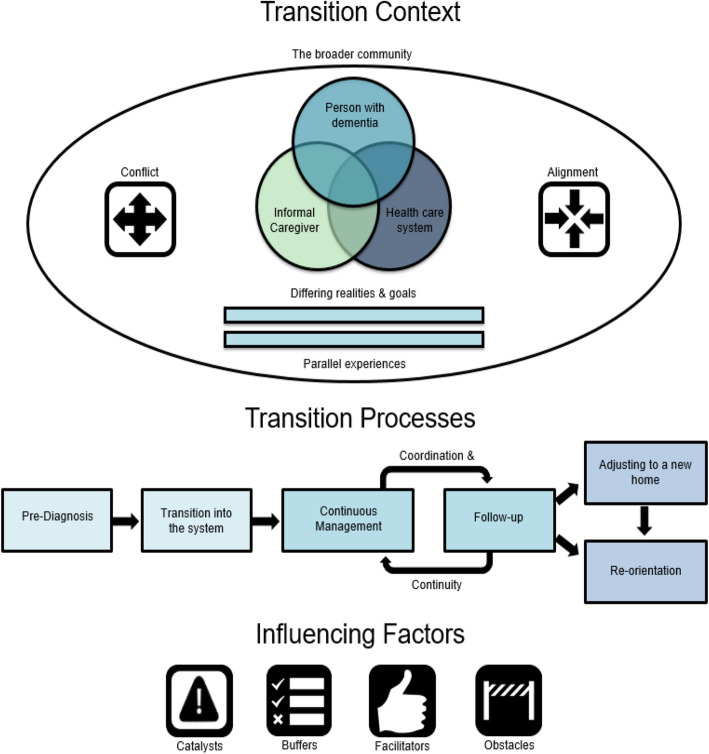
Background: Persons with dementia are likely to require care from various health care providers in multiple care settings, necessitating navigation through an often-fragmented care system. This study aimed to create a better understanding of care transition experiences from the perspectives of persons living with dementia and their caregivers in Ontario, Canada, through the development of a theoretical framework. Methods: Constructivist grounded theory guided the study. Seventeen individual caregiver interviews, and 12 dyad interviews including persons with dementia and their caregivers, were recorded and transcribed verbatim. The data were coded using NVivo 10 software; analysis occurred iteratively until saturation was reached. Results: A theoretical framework outlining the context, processes, and influencing factors of care transitions was developed and refined. Gaining an in-depth understanding of the complex care transitions of individuals with dementia and their caregivers is an important step in improving the quality of care and life for this population. Conclusion: The framework developed in this study provides a focal point for efforts to improve the health care transitions of persons living with dementia.
Overview
The claims and statistics of this paper haven’t been checked yet.
Free: it reads the open-access text and checks the first 5 claims that cite a source we can check. Create a free account to check every claim.
Integrity signals
Registry
Cites
Statistics
Figures
Verification
Claims the paper makes
The claims and statistics of this paper haven’t been checked yet.
Free: it reads the open-access text and checks the first 5 claims that cite a source we can check. Create a free account to check every claim.
Claims other papers make about this one
Each is checked against this paper’s own text: does it say what the citing paper says it does?
The source backs part of the claim, not all of it — or backs it for a different population, condition or comparison.
In the citing paper
“Key features of discharge planning included developing meaningful care plans, which were communicated to all involved in the transition, informed by the patient’s goals of care and provided opportunities for follow-up in the community [28, 39, 43–61].”
From Do hospital-to-home transitions work for older adults with multiple long-term conditions including dementia? A realist review (2025) · cites this paper as [43]
Experimental — accuracy not yet measuredThe source backs part of the claim, not all of it — or backs it for a different population, condition or comparison.
In the citing paper
“Inconsistencies in the standard of care from admission and during the hospital stay (potentially explained in part by a lack of standardised information exchange) were associated with reduced patient wellbeing and potential inequitable access to care, which increased the risk of readmission [28, 39–43].”
From Do hospital-to-home transitions work for older adults with multiple long-term conditions including dementia? A realist review (2025) · cites this paper as [43]
Experimental — accuracy not yet measuredThe source backs part of the claim, not all of it — or backs it for a different population, condition or comparison.
In the citing paper
“Carers’ knowledge (e.g., health literacy, the patient’s care needs) was linked to their experience of carer burden, and use of urgent care after returning home, and contributed to the ways they engaged with information provided at discharge [43, 44, 57, 59, 60, 64, 66, 67].”
From Do hospital-to-home transitions work for older adults with multiple long-term conditions including dementia? A realist review (2025) · cites this paper as [43]
Experimental — accuracy not yet measuredThe source backs part of the claim, not all of it — or backs it for a different population, condition or comparison.
In the citing paper
“This enabled information sharing between carers and HCPs, and improved understanding of patient needs, subsequently impacting their ability to tailor discharge planning (CMOC4) [43, 46, 52, 54, 75, 76].”
From Do hospital-to-home transitions work for older adults with multiple long-term conditions including dementia? A realist review (2025) · cites this paper as [43]
Experimental — accuracy not yet measuredThe source backs part of the claim, not all of it — or backs it for a different population, condition or comparison.
In the citing paper
“Analysis suggested that pressure to comply with the system-level focus on occupancy targets and minimising length of stay further fuelled these beliefs, as older adults with dementia typically stay longer in hospital [41, 43, 48, 50, 75, 78, 84, 89, 91–93].”
From Do hospital-to-home transitions work for older adults with multiple long-term conditions including dementia? A realist review (2025) · cites this paper as [43]
Experimental — accuracy not yet measured
15 more claims about this paper
Create a free account to see every claim other papers make about this one.
Self-check
Percentages, sums and reported differences re-computed from the paper’s own numbers.
The self-check needs the paper’s full text.
Citations
Cites
(2006) · Cited by 18,730
Constructing Grounded Theory. A Practical Guide Through Qualitative Analysis
(2006) · QMiP Bulletin · doi:10.53841/bpsqmip.2006.1.2.36 · Cited by 11,828
(1978) · Medical Entomology and Zoology · Cited by 6,077
The SAGE Handbook of Grounded Theory
Bryant, A., & Charmaz, K. (2007) · SAGE · doi:10.4135/9781848607941 · Cited by 2,798 · cited 1×
“Preferences for individual or dyad interviews (including a person with dementia and an informal caregiver) were respected [38, 39].”
BackgroundKripalani, S., LeFevre, F., Phillips, C. O., Williams, M. V., Basaviah, P., & Baker, D. W. (2007) · JAMA · doi:10.1001/jama.297.8.831 · Cited by 2,103
Transitions Theory: Middle Range and Situation Specific Theories in Nursing Research and Practice
Meleis, A. I. (2010) · Medical Entomology and Zoology · Cited by 1,977
The Care Transitions Intervention: Results of a Randomized Controlled Trial
Coleman, E. A., Parry, C., Chalmers, S., & Min, S.-J. (2006) · Archives of Internal Medicine · doi:10.1001/archinte.166.17.1822 · Cited by 1,937 · cited 1×
“Coleman et al’s [45] Care Transitions Intervention (CTI) is tailored to individual goals, indicating consideration of the multiplicity of goals in health care practice.”
BackgroundRethinking Methods in Psychology
Smith, J., Harré, R., & Langenhove, L. (1995) · SAGE Publications Ltd eBooks · doi:10.4135/9781446221792 · Cited by 1,915
Complexity and post-modernism: understanding complex systems
Cilliers, P., & Spurrett, D. (1999) · South African Journal of Philosophy · doi:10.1080/02580136.1999.10878187 · Cited by 1,913
The Incidence and Severity of Adverse Events Affecting Patients after Discharge from the Hospital
Forster, A. J., Murff, H. J., Peterson, J. F., Gandhi, T. K., & Bates, D. W. (2003) · Annals of Internal Medicine · doi:10.7326/0003-4819-138-3-200302040-00007 · Cited by 1,886
Coleman, E. A. (2003) · Journal of the American Geriatrics Society · doi:10.1046/j.1532-5415.2003.51185.x · Cited by 1,109
Coleman, E. A., & Boult, C. (2003) · Journal of the American Geriatrics Society · doi:10.1046/j.1532-5415.2003.51186.x · Cited by 922
Morse, J. M. (2015) · Qualitative Health Research · doi:10.1177/1049732315576699 · Cited by 795
The Fundamentals of Person-Centered Care for Individuals With Dementia
Fazio, S., Pace, D., Flinner, J., & Kallmyer, B. (2018) · The Gerontologist · doi:10.1093/geront/gnx122 · Cited by 647
Covinsky, K. E., Newcomer, R., Fox, P., Wood, J., Sands, L., Dane, K., & Yaffe, K. (2003) · Journal of General Internal Medicine · doi:10.1111/j.1525-1497.2003.30103.x · Cited by 567
Middel, B., & Van Sonderen, E. (2002) · International Journal of Integrated Care · doi:10.5334/ijic.65 · Cited by 464
Comorbidity and dementia: a scoping review of the literature
Bunn, F., Burn, A.-M., Goodman, C., Rait, G., Norton, S., Robinson, L., Schoeman, J., & Brayne, C. (2014) · BMC Medicine · doi:10.1186/s12916-014-0192-4 · Cited by 451 · cited 1×
“There is thus an urgent need for effective coordination of health care and community support services for individuals living with dementia and their informal caregivers [8].”
BackgroundAsking Questions of the Data: Memo Writing in the Grounded Theory Tradition
Lempert, L. B. (2007) · The SAGE Handbook of Grounded Theory · doi:10.4135/9781848607941.n12 · Cited by 387
Andersen, C. K., Wittrup-Jensen, K. U., Lolk, A., Andersen, K., & Kragh-Sørensen, P. (2004) · Health and Quality of Life Outcomes · doi:10.1186/1477-7525-2-52 · Cited by 365
Continuity of Care: The Transitional Care Model
Hirschman, K., Shaid, E., McCauley, K., Pauly, M., & Naylor, M. (2015) · OJIN: The Online Journal of Issues in Nursing · doi:10.3912/ojin.vol20no03man01 · Cited by 285
the EVIDEM-ED project, Koch, T., & Iliffe, S. (2010) · BMC Family Practice · doi:10.1186/1471-2296-11-52 · Cited by 275 · cited 1×
“reality of many practitioners as well [54, 55].”
Development and testing of a measure designed to assess the quality of care transitions
Coleman, E. A., Smith, J. D., Frank, J. C., Eilertsen, T. B., Thiare, J. N., & Kramer, A. M. (2002) · International Journal of Integrated Care · doi:10.5334/ijic.60 · Cited by 257
Transitions in Care for Older Adults with and without Dementia
Callahan, C. M., Arling, G., Tu, W., Rosenman, M. B., Counsell, S. R., Stump, T. E., & Hendrie, H. C. (2012) · Journal of the American Geriatrics Society · doi:10.1111/j.1532-5415.2012.03905.x · Cited by 253
Manderson, B., Mcmurray, J., Piraino, E., & Stolee, P. (2012) · Health & Social Care in the Community · doi:10.1111/j.1365-2524.2011.01032.x · Cited by 203
Self-citationMoving in: adjustment of people living with dementia going into a nursing home and their families
Sury, L., Burns, K., & Brodaty, H. (2013) · International Psychogeriatrics · doi:10.1017/s1041610213000057 · Cited by 198
Performance measurement: accelerating improvement
(2007) · Choice Reviews Online · doi:10.5860/choice.44-3316 · Cited by 174
Herbert, C. P. (2005) · Journal of Interprofessional Care · doi:10.1080/13561820500081539 · Cited by 160
Clarfield, A. M., Bergman, H., & Kane, R. (2001) · Journal of the American Geriatrics Society · doi:10.1046/j.1532-5415.2001.49285.x · Cited by 146
Evidence-Based Interventions for Transitions in Care for Individuals Living With Dementia
Hirschman, K. B., & Hodgson, N. A. (2018) · The Gerontologist · doi:10.1093/geront/gnx152 · Cited by 129 · cited 2×
“Most research on care transitions has overlooked older adults living with dementia [22].”
BackgroundArlt, S., Hornung, J., Eichenlaub, M., Jahn, H., Bullinger, M., & Petersen, C. (2007) · International Journal of Geriatric Psychiatry · doi:10.1002/gps.1946 · Cited by 120
Judge, K. S., Bass, D. M., Snow, A. L., Wilson, N. L., Morgan, R., Looman, W. J., McCarthy, C., & Kunik, M. E. (2011) · The Gerontologist · doi:10.1093/geront/gnq097 · Cited by 116
Family physicians and dementia in Canada: Part 2. Understanding the challenges of dementia care.
Pimlott, N., Persaud, M., Drummond, N., Cohen, C. A., Silvius, J. L., Seigel, K., Hollingworth, G. R., & Dalziel, W. B. (2009) · PubMed Central · Cited by 106
Cipher, D. J., & Clifford, P. A. (2004) · International Journal of Geriatric Psychiatry · doi:10.1002/gps.1155 · Cited by 102
Müller, C., Lautenschläger, S., Meyer, G., & Stephan, A. (2017) · International Journal of Nursing Studies · doi:10.1016/j.ijnurstu.2017.03.013 · Cited by 96
Fortinsky, R. H., & Downs, M. (2014) · Health Affairs · doi:10.1377/hlthaff.2013.1304 · Cited by 82 · cited 5×
“tions for persons with dementia not as events, but rather another aspect of their dementia journey [49].”
BackgroundInfluentialCare Coordination for Cognitively Impaired Older Adults and Their Caregivers
Naylor, M. D., Hirschman, K. B., Bowles, K. H., Bixby, M. B., Konick-McMahan, J., & Stephens, C. (2007) · Home Health Care Services Quarterly · doi:10.1300/j027v26n04_05 · Cited by 79
Involving people who have dementia in the evaluation of services: A review
Cheston, R. (2000) · Journal of Mental Health · doi:10.1080/09638230020005200 · Cited by 72
National Dementia Strategies: What Should Canada Learn?
Chow, S., Chow, R., Wan, A., Lam, H. R., Taylor, K., Bonin, K., Rowbottom, L., Lam, H., DeAngelis, C., & Herrmann, N. (2018) · Canadian Geriatrics Journal · doi:10.5770/cgj.21.299 · Cited by 66
Higgins-Steele, A., Waller, K., Fotso, J. C., & Vesel, L. (2015) · BMC Health Services Research · doi:10.1186/1472-6963-15-s1-s4 · Cited by 65
Kable, A., Chenoweth, L., Pond, D., & Hullick, C. (2015) · BMC Health Services Research · doi:10.1186/s12913-015-1227-z · Cited by 65
Dementia Home Care Resources: How Are We Managing?
Ward-Griffin, C., Hall, J., DeForge, R., St-Amant, O., McWilliam, C., Oudshoorn, A., Forbes, D., & Klosek, M. (2012) · Journal of Aging Research · doi:10.1155/2012/590724 · Cited by 62
Burdensome transitions at the end of life among long-term care residents with dementia
Aaltonen, M., Raitanen, J., Forma, L., Pulkki, J., Rissanen, P., & Jylhä, M. (2014) · Journal of the American Medical Directors Association · doi:10.1016/j.jamda.2014.04.018 · Cited by 60
Gilmore-Bykovskyi, A. L., Roberts, T. J., King, B. J., Kennelty, K. A., & Kind, A. J. H. (2017) · The Gerontologist · doi:10.1093/geront/gnw085 · Cited by 56 · cited 3×
“For example, Gilmore-Bykovskyi and colleagues [26] obtained nurses’ perspectives on transitions for persons living with dementia from hospitals to skilled-nursing facilities.”
BackgroundResultInfluentialTransitional care programs: who is left behind? A systematic review
Piraino, E., Heckman, G. A., Glenny, C., & Stolee, P. (2012) · International Journal of Integrated Care · doi:10.5334/ijic.805 · Cited by 52 · cited 2×
“In fact, a review of studies of transitional care programs [23] found that some studies purposefully excluded persons with dementia.”
BackgroundSelf-citationDementia Care: Intersecting Informal Family Care and Formal Care Systems
Singh, P., Hussain, R., Khan, A., Irwin, L., & Foskey, R. (2014) · Journal of Aging Research · doi:10.1155/2014/486521 · Cited by 47
The experience of family carers of people with dementia who are hospitalised
Bloomer, M., Digby, R., Tan, H., Crawford, K., & Williams, A. (2016) · Dementia · doi:10.1177/1471301214558308 · Cited by 42
A Framework for Supporting Post-acute Care Transitions of Older Patients With Hip Fracture
Stolee, P., Elliott, J. B., Byrne, K. M., Sims‐Gould, J., Tong, C., Chesworth, B. M., Egan, M. Y., Ceci, C., & Forbes, D. A. (2019) · Journal of the American Medical Directors Association · doi:10.1016/j.jamda.2019.01.147 · Cited by 42
Self-citationMcMurray, J., Hicks, E. M., Johnson, H., Elliott, J. B., Byrne, K. M., & Stolee, P. (2013) · Health Informatics Journal · doi:10.1177/1460458212467547 · Cited by 36
Self-citationThe role of caregivers in interfacility care transitions: a qualitative study
Jeffs, L. P., Saragosa, M., Law, M. P., Kuluski, K., Espin, S., & Merkley, J. (2017) · Patient Preference and Adherence · doi:10.2147/ppa.s136058 · Cited by 36
Family Medicine Professional Profile.
Charbonneau, G. (2018) · PubMed · Cited by 36
Zmora, R., Statz, T. L., Birkeland, R. W., McCarron, H. R., Finlay, J. M., Rosebush, C. E., & Gaugler, J. E. (2021) · Journal of Aging and Health · doi:10.1177/0898264320963588 · Cited by 36
Centeno, M. M., & Kahveci, K. L. (2014) · Critical Care Nursing Clinics of North America · doi:10.1016/j.ccell.2014.08.009 · Cited by 25
Richardson, A., Blenkinsopp, A., Downs, M., & Lord, K. (2019) · BMC Geriatrics · doi:10.1186/s12877-019-1220-1 · Cited by 25 · cited 2×
“[51], in a systematic review aiming to understand transition experiences of individuals with dementia from the perspectives of key stakeholders, found that the perspectives of individuals with dementia, their family members, and care providers did not always match.”
BackgroundA review of Canadian and international dementia strategies
Edick, C., Holland, N., Ashbourne, J., Elliott, J. B., & Stolee, P. (2016) · Healthcare Management Forum · doi:10.1177/0840470416664533 · Cited by 20
Self-citationPediatric Care Coordination: Lessons Learned and Future Priorities
CADY, R. G., Looman, W. S., Lindeke, L. L., LaPlante, B., Lundeen, B., Seeley, A., & Kautto, M. (2015) · OJIN The Online Journal of Issues in Nursing · doi:10.3912/ojin.vol20no03man03 · Cited by 16
Cause, Care, Cure: Research Priorities for Alzheimer’s Disease and Related Dementias
Stolee, P., Hillier, L. M., Cook, S., & Rockwood, K. J. (2011) · Canadian Journal on Aging / La Revue canadienne du vieillissement · doi:10.1017/s0714980811000523 · Cited by 14
Self-citation
Research works printed but not linked: 5
- Gill SS Camacho X Poss JW Bronskill SE Camacho S Gruneir A Ho MM Community dwelling older adults with dementia Health system use by frail Ontario seniors: an in-depth examination of four vulnerable cohorts 2011 Toronto, ON Institute for Clinical Evaluative Sciences 47 69
- Creswell JW Qualitative inquiry and research design (2nd ed.) 2007 Thousand Oaks, CA Sage Publications
- Reid R Haggerty J McKendry R Defusing the confusion: concepts and measures of continuity of healthcare 2002 Canada Canadian health services research foundation, the Canadian Institute for Health Information, and the Advisory Committee on Health Services of the Federal/Provincial/Territorial Deputy Ministers of Health
- Cilliers P Complexity and postmodernism: understanding complex systems 1998 London Routledge
- Wiersma E Sameshima P Dupuis S Mapping the dementia journey 2014 Thunder Bay Centre for Education and Research on Aging and Health
Cited by
Emergency Department Care Transitions for Patients With Cognitive Impairment: A Scoping Review
Gettel, C. J., Falvey, J. R., Gifford, A., Hoang, L., Christensen, L., Hwang, U., Shah, M. N., Aggarawal, N. T., Allore, H. G., Aloysi, A. S., et al. (2022) · Journal of the American Medical Directors Association · doi:10.1016/j.jamda.2022.01.076 · Cited by 71
“42,48 Attention in the clinical realm could be directed toward considering personalized approaches to care transition interventions, in that a ‘one size fits all’ approach would be unlikely to be successful with varying disease stages, access to resources, and care partner abilities.”
A Systematic Review of the Needs of Dementia Caregivers Across Care Settings
Mueller, A. E., Thao, L. M., Condon, O., Liebzeit, D., & Fields, B. (2021) · Home Health Care Management & Practice · doi:10.1177/10848223211056928 · Cited by 32
“Caregivers in each care setting, except memory care, identified needs in all 3 of the following domains: (1) social support—formal and informal, (2) confidence, competence, and strengths in the caregiving role, and (3) values and preferences.”
BackgroundKim, B., Wister, A., Mitchell, B., Li, L., & Kadowaki, L. (2024) · BMC Health Services Research · doi:10.1186/s12913-024-11549-0 · Cited by 21
Houben, M., Brankaert, R., Gosen, M., Overloop, V. V., & IJsselsteijn, W. A. (2024) · CHI Conference on Human Factors in Computing Systems · doi:10.1145/3613904.3642556 · Cited by 25
“Research has highlighted how well-prepared and smooth transitions reduce stress and positively influence the quality of life of people with dementia and their families [6].”
BackgroundInterprofessional collaboration in palliative dementia care through the eyes of informal caregivers
Khemai, C., Meijers, J. M., Mujezinovic, I., Bolt, S. R., Pieters, S., Moser, A., Schols, J. M. G. A., & Janssen, D. J. A. (2022) · Dementia · doi:10.1177/14713012221098259 · Cited by 17
“…life care to informal caregivers (Goossens, Sevenants, Declercq, & Van Audenhove, 2020; White et al., 2018) and anticipating with informal caregivers on, for example, future transitions (Ashbourne et al., 2021; Lethin et al., 2016) are essential to enhance interprofessional shared decision-making.”
Background
Metadata
- Authors
- Ashbourne, J., Boscart, V., Meyer, S., Tong, C. E., & Stolee, P.
- Affiliations
- University of Waterloo (CA)
- Corresponding author
- Stolee, Paul
- Venue
- BMC Geriatrics
- Published
- 2021-04-29
- Volume
- 21
- Issue
- 1
- Pages
- 285-285
- ISSN
- 1471-2318 (ISSN-L)
- PMC
- PMC8086075
- OpenAlex
- W3157650032
- Cited by
- 49
- References
- 58
- Citations by year
- 2026: 13 · 2025: 6 · 2024: 10 · 2023: 11 · 2022: 8 · 2021: 1
- FWCI
- 7.84
- Type
- journal article
- Language
- en
- Open access
- gold
- doi.org
- Licence
- cc-by
- creativecommons.org/licenses/by/4.0/ (tdm)
- creativecommons.org/licenses/by/4.0/ (vor)
- Locations
- BMC Geriatrics (publishedVersion, cc-by)
- PubMed Central (publishedVersion, cc-by)
- PubMed (publishedVersion)
- DOAJ (DOAJ: Directory of Open Access Journals) (submittedVersion, cc-by-sa)
- Funders
- Alzheimer Society
- University of Waterloo
- Topics
- Health Sciences › Nursing › Leadership and Management › Hospital Admissions and Outcomes
- Health Sciences › Medicine › Psychiatry and Mental health › Dementia and Cognitive Impairment Research
- Health Sciences › Medicine › Pediatrics, Perinatology and Child Health › Adolescent and Pediatric Healthcare
- Keywords
- dementia, care transitions, caregivers, theoretical framework, fragmented health care system, quality of care, lived experience, Ontario
- MeSH terms
- Dementia, Humans, Ontario, Patient Transfer, Caregivers, Transition to Adult Care
About these checks
Registry, retraction, Cites and statistics results are computed, not judged, with one exception: a printed reference that no index lists is read once by a model before it counts as a citation error. Claims are extracted by a model and kept only when their quote appears verbatim in the text; each cited source is then checked, with a model’s help, for whether it says what the claim relies on. Those verdicts can be wrong — read the claim’s quote and the cited source before relying on one.
Statistics and arithmetic are recomputed, not judged.
Confidence bands are shown only for fields calibrated on our annotated test set. None is calibrated yet, so no band is shown.
What counts as a claim ›How we measure confidence ›How we check this ›
Are you an author, or do you see a problem with this page? Request a review
Data sources
Bibliographic data: Semantic Scholar, OpenAlex, Crossref.
Contains information from the Semantic Scholar Academic Graph Datasets, made available under the ODC Attribution License (ODC-BY 1.0).
Semantic Scholar’s data is described in: Kinney, R., et al. (2023). The Semantic Scholar Open Data Platform. arXiv:2301.10140.
