

The prevalence of obstructive sleep apnea in mild cognitive impairment: a systematic review
Open accessPublished version of a preprint
The DOI matches its Crossref record; 51 of the 51 references it cites were found in a registry or an index.
Abstract
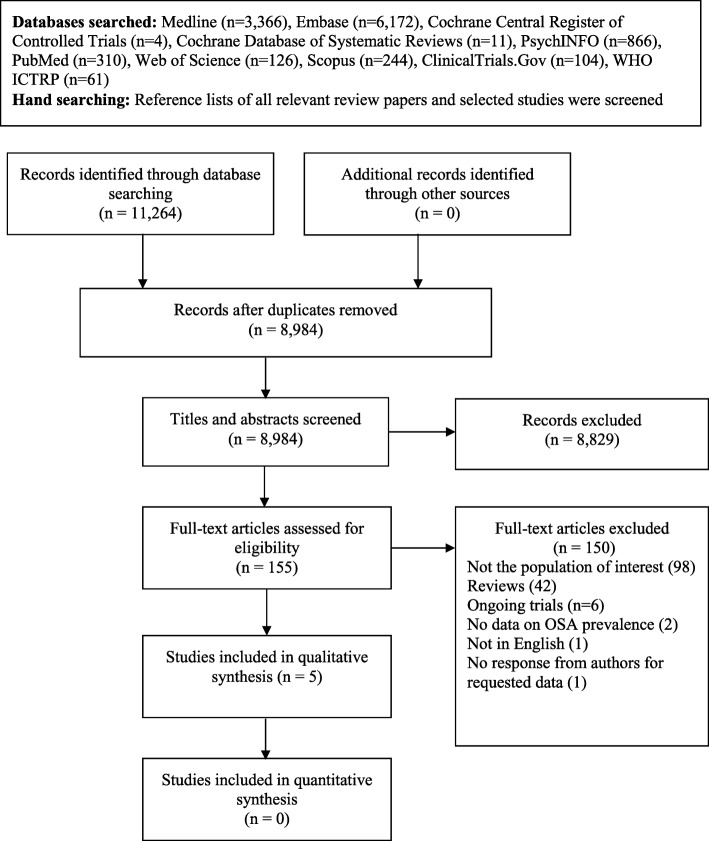
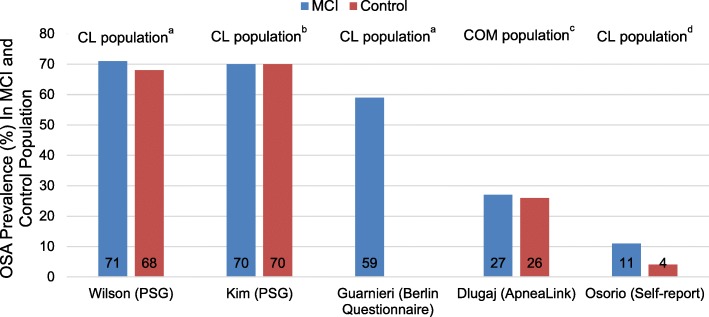
BACKGROUND: Previous studies have shown that obstructive sleep apnea (OSA) is associated with a higher risk of cognitive impairment or dementia in the elderly, leading to deleterious health effects and decreasing quality of life. This systematic review aims to determine the prevalence of OSA in patients with mild cognitive impairment (MCI) and examine whether an association between OSA and MCI exists. METHODS: We searched Medline, PubMed, Embase, Cochrane Central, Cochrane Database of Systematic Reviews, PsychINFO, Scopus, the Web of Science, ClinicalTrials.gov and the International Clinical Trials Registry Platform for published and unpublished studies. We included studies in adults with a diagnosis of MCI that reported on the prevalence of OSA. Two independent reviewers performed the abstract and full-text screening, data extraction and the study quality critical appraisal. RESULTS: Five studies were included in the systematic review. Overall, OSA prevalence rates in patients with MCI varied between 11 and 71% and were influenced by OSA diagnostic methods and patient recruitment locations (community or clinic based). Among studies using the following OSA diagnostic measures- self-report, Home Sleep Apnea Testing, Berlin Questionnaire and polysomnography- the OSA prevalence rates in MCI were 11, 27, 59 and 71%, respectively. In a community-based sample, the prevalence of OSA in patients with and without MCI was 27 and 26%, respectively. CONCLUSIONS: Based on limited evidence, the prevalence of OSA in patients with MCI is 27% and varies based upon OSA diagnostic methods and patient recruitment locations. Our findings provide an important framework for future studies to prospectively investigate the association between OSA and MCI among larger community-based cohorts and implement a standardized approach to diagnose OSA in memory clinics. PROSPERO REGISTRATION: CRD42018096577.
Overview
The claims and statistics of this paper haven’t been checked yet.
Free: it reads the open-access text and checks the first 5 claims that cite a source we can check. Create a free account to check every claim.
Integrity signals
Registry
Cites
Statistics
Figures
Verification
Claims the paper makes
The claims and statistics of this paper haven’t been checked yet.
Free: it reads the open-access text and checks the first 5 claims that cite a source we can check. Create a free account to check every claim.
Claims other papers make about this one
Each is checked against this paper’s own text: does it say what the citing paper says it does?
The cited source says what the claim attributes to it.
In the citing paper
“In MCI patients, the association is less clear, with a highly variable prevalence of OSA (11%–71%) based on OSA diagnostic methods and patient recruitment locations”
From International Consensus Statement on Obstructive Sleep Apnea (2023) · cites this paper as [834]
Self-check
Percentages, sums and reported differences re-computed from the paper’s own numbers.
The self-check needs the paper’s full text.
Citations
Cites
Preferred Reporting Items for Systematic Reviews and Meta-Analyses: the PRISMA statement
Moher, D., Liberati, A., Tetzlaff, J., Altman, D. G., & for the PRISMA Group (2009) · BMJ · doi:10.1136/bmj.b2535 · Cited by 83,823
Preferred reporting items for systematic reviews and meta-analyses: the PRISMA Statement.
(2009) · PubMed Central · Cited by 44,859
Preferred reporting items for systematic reviews and meta-analyses: The PRISMA statement
Moher, D., Liberati, A., Tetzlaff, J., Altman, D. G., & the PRISMA Group* (2009) · Annals of Internal Medicine · doi:10.7326/0003-4819-151-4-200908180-00135 · Cited by 37,554
McKhann, G. M., Knopman, D. S., Chertkow, H., Hyman, B. T., Jack, C. R., Kawas, C. H., Klunk, W. E., Koroshetz, W. J., Manly, J. J., Mayeux, R., et al. (2011) · Alzheimer's & Dementia · doi:10.1016/j.jalz.2011.03.005 · Cited by 18,657
Albert, M. S., DeKosky, S. T., Dickson, D., Dubois, B., Feldman, H. H., Fox, N. C., Gamst, A., Holtzman, D. M., Jagust, W. J., Petersen, R. C., et al. (2011) · Alzheimer's & Dementia · doi:10.1016/j.jalz.2011.03.008 · Cited by 10,152
Mild Cognitive Impairment: Clinical Characterization and Outcome
Petersen, R. C., Smith, G. E., Waring, S. C., Ivnik, R. J., Tangalos, E. G., & Kokmen, E. (1999) · Archives of Neurology · doi:10.1001/archneur.56.3.303 · Cited by 8,980
Mild cognitive impairment as a diagnostic entity
Petersen, R. C. (2004) · Journal of Internal Medicine · doi:10.1111/j.1365-2796.2004.01388.x · Cited by 7,864
Winblad, B., Palmer, K., Kivipelto, M., Jelic, V., Fratiglioni, L., Wahlund, L. ‐., Nordberg, A., Bäckman, L., Albert, M., Almkvist, O., et al. (2004) · Journal of Internal Medicine · doi:10.1111/j.1365-2796.2004.01380.x · Cited by 4,946
Current concepts in mild cognitive impairment
Petersen, R. C., Doody, R., Kurz, A., Mohs, R. C., Morris, J. C., Rabins, P. V., Ritchie, K., Rossor, M., Thal, L., & Winblad, B. (2001) · Archives of Neurology · doi:10.1001/archneur.58.12.1985 · Cited by 4,781
Increased Prevalence of Sleep-Disordered Breathing in Adults
Peppard, P. E., Young, T., Barnet, J. H., Palta, M., Hagen, E. W., & Hla, K. M. (2013) · American Journal of Epidemiology · doi:10.1093/aje/kws342 · Cited by 4,618
Cited by
International Consensus Statement on Obstructive Sleep Apnea
Chang, J. L., Goldberg, A. N., Alt, J. A., Mohammed, A., Ashbrook, L., Auckley, D., Ayappa, I., Bakhtiar, H., Barrera, J. E., Bartley, B. L., et al. (2023) · International Forum of Allergy & Rhinology · doi:10.1002/alr.23079 · Cited by 350
Sleep-disordered breathing and the risk of Alzheimer's disease
Liguori, C., Maestri, M., Spanetta, M., Placidi, F., Bonanni, E., Mercuri, N. B., & Guarnieri, B. (2020) · Sleep Medicine Reviews · doi:10.1016/j.smrv.2020.101375 · Cited by 165
Obstructive sleep apnea treatment and dementia risk in older adults
Dunietz, G. L., Chervin, R. D., Burke, J. F., Conceicao, A. S., & Braley, T. J. (2021) · Sleep · doi:10.1093/sleep/zsab076 · Cited by 133
“executive function, attention, and memory) [8–12], both incident dementia [13] and Alzheimer’s disease (AD) [14], as well as mild cognitive impairment (MCI) [15].”
BackgroundLal, C., Ayappa, I. A., Ayas, N., Beaudin, A. E., Hoyos, C. M., Kushida, C. A., Kamińska, M., Mullins, A. E., Naismith, S. L., Osorio, R. S., et al. (2022) · Annals of the American Thoracic Society · doi:10.1513/annalsats.202205-380st · Cited by 122
Self-citationCognitive Function in a Sleep Clinic Cohort of Patients with Obstructive Sleep Apnea
Beaudin, A. E., Raneri, J. K., Ayas, N., Skomro, R. P., Fox, N., Allen, A. J. M. H., Bowen, M. W., Nocon, A., Lynch, E. J., Wang, M., et al. (2020) · Annals of the American Thoracic Society · doi:10.1513/annalsats.202004-313oc · Cited by 81
Effects of Obstructive Sleep Apnea and CPAP on Cognitive Function
Seda, G., Matwiyoff, G. N., & Parrish, S. (2021) · Current Neurology and Neuroscience Reports · doi:10.1007/s11910-021-01123-0 · Cited by 70
Díaz-Román, M., Pulopulos, M. M., Baquero, M., Salvador, A., Cuevas, A., Ferrer, I., Ciopat, O., & Gómez, E. (2020) · SLEEP · doi:10.1093/sleep/zsaa133 · Cited by 50
“These values are in line with previous studies with MCI patients using PSG (for a review see [38]), and they reflect a greater prevalence of OSA than in epidemiological studies in the general population (AHI ≥ 15, 17.”
ResultShieu, M. M., Dunietz, G. L., Paulson, H. L., Chervin, R. D., & Braley, T. J. (2021) · Journal of Clinical Sleep Medicine · doi:10.5664/jcsm.9832 · Cited by 44
The Role of Sleep in Cognitive Function: The Value of a Good Night’s Rest
Gilley, R. R. (2022) · Clinical EEG and Neuroscience · doi:10.1177/15500594221090067 · Cited by 50
“Specifically, two studies utilizing a community clinic population (a primary care population, not one specific to a memory clinic) showed a prevalence of OSA in the range of 26 to 27%.(60,61) Another large analysis by Leng et al looked at a pooled population of approximately 4.”
BackgroundMethodRole of sleep in neurodegeneration: the consensus report of the 5th Think Tank World Sleep Forum
Ferini‐Strambi, L., Liguori, C., Lucey, B. P., Mander, B. A., Spira, A. P., Videnović, A., Baumann, C. R., Franco, O. H., Fernandes, M., Gnarra, O., et al. (2023) · Neurological Sciences · doi:10.1007/s10072-023-07232-7 · Cited by 36
“Among patients with MCI, OSA prevalence ranges from 11%, when measured by self-report, to 71%, when measured by PSG [97].”
Oliver, C., Li, H., Biswas, B., Woodstoke, D., Blackman, J., Butters, A. F., Drew, C. J. G., Gabb, V. G., Harding, S. A., Hoyos, C. M., et al. (2023) · Sleep Medicine Reviews · doi:10.1016/j.smrv.2023.101869 · Cited by 37
Hoyos, C. M., Cross, N. E., Terpening, Z., D'Rozario, A. L., Yee, B. J., LaMonica, H. M., Marshall, N. S., Grunstein, R. R., & Naismith, S. L. (2022) · American Journal of Respiratory and Critical Care Medicine · doi:10.1164/rccm.202111-2646le · Cited by 27
Nabavi, S. K., & Bhadra, S. (2021) · IEEE Transactions on Biomedical Circuits and Systems · doi:10.1109/tbcas.2021.3065824 · Cited by 23
“sults in several serious health complaints such as hypoxemia [1], hypertension [2], cardiovascular morbidity [3], and cognitive impairment [4].”
BackgroundTsai, C.-Y., Wu, S., Kuan, Y., Lin, Y.-T., Hsu, C.-R., Hsu, W.-H., Liu, Y.-S., Majumdar, A., Stettler, M. E. J., Yang, C., et al. (2022) · Frontiers in Neurology · doi:10.3389/fneur.2022.1038735 · Cited by 24
Yoon, E., Bae, S., & Park, H. (2022) · International Journal of Environmental Research and Public Health · doi:10.3390/ijerph19137625 · Cited by 20
Sleep disturbances and disorders in the memory clinic: Self-report, actigraphy, and polysomnography
Lam, A. K. F., Kong, S. D., D'Rozario, A. L., Ireland, C., Ahmed, R. M., Schrire, Z. M., Mowszowski, L., Michaelian, J. C., Grunstein, R. R., & Naismith, S. L. (2025) · Journal of Alzheimer s Disease · doi:10.1177/13872877251338065 · Cited by 19
Alterations of Limbic Structure Volumes in Patients with Obstructive Sleep Apnea
Park, K. M., & Kim, J. (2022) · Canadian Journal of Neurological Sciences / Journal Canadien des Sciences Neurologiques · doi:10.1017/cjn.2022.303 · Cited by 14
Durtette, A., Dargent, B., Gierski, F., Barbe, C., Deslée, G., Perotin, J., Henry, A., & Launois, C. (2024) · Sleep Medicine · doi:10.1016/j.sleep.2024.08.019 · Cited by 19
Lam, A. K. F., D'Rozario, A. L., Kong, S. D., Ireland, C., Mowszowski, L., LaMonica, H. M., Phillips, C. L., Hoyos, C. M., Grunstein, R. R., & Naismith, S. L. (2024) · Journal of Alzheimer s Disease · doi:10.1177/13872877241299458 · Cited by 14
“14 Using gold-standard polysomnography (PSG), our group 15 examined 37 control (recruited from community) and 37 MCI participants (recruited from memory clinic), and found rates of OSA were 68% and 71%, respectively.”
Mo, W., Liu, X., Yamakawa, M., Koujiya, E., Takeya, Y., Shigenobu, K., Adachi, H., & Ikeda, M. (2024) · Psychiatry Research · doi:10.1016/j.psychres.2024.116067 · Cited by 15
Lafrenière, A., Lina, J., Hernandez, J., Bouchard, M., Gosselin, N., & Carrier, J. (2022) · SLEEP · doi:10.1093/sleep/zsac246 · Cited by 15
Aryankhesal, A., Blake, J., Wong, G., Megson, M., Briscoe, S., Allan, L. M., Broomfield, N. M., Eastwood, Z., Greene, L., Hilton, A., et al. (2023) · British Journal of General Practice · doi:10.3399/bjgp.2023.0171 · Cited by 10
“9 12 In primary care, the assessment and management of sleep disturbance among PLwD or MCI is complex because of a lack of clear diagnostic criteria and this population’s characteristics, which typically comprises older people living with multiple comorbidities, and polypharmacy.”
Obstructive sleep apnea and dementia: A role to play?
Kinugawa, K. (2023) · Revue Neurologique · doi:10.1016/j.neurol.2023.08.006 · Cited by 12
Karstens, A. J., Maynard, T. R., & Tremont, G. N. (2023) · Journal of the International Neuropsychological Society · doi:10.1017/s1355617723000085 · Cited by 11
“…clinical samples likely to include AD, vascular, and Lewy body dementias (Taylor et al., 2020; Tensil et al., 2018; Wolters & Ikram, 2019), as well as premorbid or comorbid conditions affecting baseline cognitive performance or rate of progression (Albai et al., 2019; Mubashir et al., 2019).”
Song, J., Wang, T., Hong, J., Wang, Y., & Feng, J. (2025) · Cellular Signalling · doi:10.1016/j.cellsig.2025.111630 · Cited by 10
Sun, L., Li, K., Zhang, L., & Zhang, Y. (2022) · Nature and Science of Sleep · doi:10.2147/nss.s347658 · Cited by 11
“However, the association was also influenced by sleep apnea diagnostic methods and recruitment, which was identified in the previous study.(56) The inconsistent results for this study may be caused by the scale of Berlin Questionnaire and the sample of community residents.”
ResultTiara, T., & Fidiana, F. (2021) · Narra J · doi:10.52225/narra.v1i3.62 · Cited by 10
“7% [21] and a study found that MCI prevalence among those with high risk of OSA was ranging from 11-70%, slightly lower from our study (72.”
ResultObstructive Sleep Apnea Among Patients with Mild Cognitive Impairment
Schwerthöffer, D., Haselwarter, T., & Grimmer, T. (2024) · Journal of Alzheimer s Disease · doi:10.3233/jad-240251 · Cited by 9
Mubashir, T., Ahmad, H. S., Lai, H., Chaudhry, R., Maroufy, V., Balogh, J., Digbeu, B. D. E., Hwong, R., Chung, F. F., & Williams, G. W. (2022) · Neurocritical Care · doi:10.1007/s12028-022-01479-2 · Cited by 7
“Untreated OSA can lead to an increased risk of cerebrovascular events [2], cognitive impairment [3, 4], and cardiovascular disease [5].”
BackgroundSelf-citationWertman, E. (2024) · Journal of Clinical Medicine · doi:10.3390/jcm13144202 · Cited by 6
Ren, Y., Chen, S., Wang, H., Zou, C., Xie, Q., Wu, Y., Sun, D., Yang, Y., & Zhou, L. (2025) · Sleep Medicine · doi:10.1016/j.sleep.2025.106562 · Cited by 6
Greene, L., Aryankhesal, A., Megson, M., Blake, J., Wong, G., Briscoe, S., Hilton, A., Killett, A., Reeve, J. L., Allan, L. M., et al. (2022) · BMJ Open · doi:10.1136/bmjopen-2022-067424 · Cited by 7
Jurić, J. Š., Čerkez, M. G., Zubčić, Ž., Bašić, S., Bašić, I., Jandrić, S., Kralik, K., & Jurić, S. (2025) · Journal of Clinical Medicine · doi:10.3390/jcm14238319 · Cited by 5
“Indeed, previous population-based research has shown that between 6% and 20% of individuals over 60 years have MCI, and up to 27% of them also have OSA, reinforcing this relationship [30–32].”
Liu, T. H., & Ouyang, R. (2021) · PubMed Central · doi:10.11817/j.issn.1672-7347.2021.190600 · Cited by 4
Mo, W., Liu, X., & Yamakawa, M. (2023) · JBI Evidence Synthesis · doi:10.11124/jbies-22-00438 · Cited by 6
Gabryelska, A., Turkiewicz, S., Ditmer, M., Gajewski, A., Strzelecki, D., Białasiewicz, P., Chałubiński, M., & Sochal, M. (2024) · International Journal of Molecular Sciences · doi:10.3390/ijms25158469 · Cited by 5
Mekky, J. F., Yousof, S. M., Elsayed, I., Elsemelawy, R., Mahmoud, H., & Elweshahi, H. M. T. (2021) · Journal of Clinical Sleep Medicine · doi:10.5664/jcsm.9704 · Cited by 7
Summary of drug therapy to treat cognitive impairment-induced obstructive sleep apnea
He, D., Chen, J., Du, X., & Xu, L. (2023) · Frontiers in Cellular Neuroscience · doi:10.3389/fncel.2023.1222626 · Cited by 5
“For example, the prevalence rates of cognitive impairment in OSA were 11, 27, 59, and 71%, respectively detected by self-report, home sleep apnea testing, Berlin questionnaire and polysomnography (Mubashir et al., 2019).”
Reduced Oxygen Extraction Fraction as a Biomarker for Cognitive Deficits in Obstructive Sleep Apnea
Mohammadi, M., Samadi, S., Batouli, S. A. H., Pestehei, S. K., & Oghabian, M. A. (2025) · Brain and Behavior · doi:10.1002/brb3.70273 · Cited by 4
Kim, H., Pyo, J. Y., Moon, J.-Y., Lee, S., Kim, M., Choi, Y., Shin, D., & Park, B.-G. (2022) · Molecular & Cellular Toxicology · doi:10.1007/s13273-022-00309-y · Cited by 3
“In a study of mild cognitive impairment (MCI) and OSA prevalence, about 27% of OSA patients reported MCI (Mubashir et al. 2019).”
Risk factors and fraction of exhaled nitric oxide in obstructive sleep apnea in adults
Feng, X., Guo, X., Lin, J., Zhao, Z., & Tong, Z. (2020) · Journal of International Medical Research · doi:10.1177/0300060520926010 · Cited by 4
“Obstructive sleep apnea (OSA) is a breathing disorder disease, which causes temporary cessation of airflow for 10 s while continuing ventilation during patients’ sleeping.(1) OSA is present in 4% of men and in 2% of women.”
BackgroundSaini, B., Kong, S. D., Schrire, Z. M., Jacobson, L. H., Grunstein, R. R., & Naismith, S. L. (2025) · Pharmacological Reviews · doi:10.1016/j.pharmr.2025.100094 · Cited by 3
The relationships between obstructive sleep apnea and psychiatric disorders: a narrative review
Karakuła, K. H., Ryczkowski, A. J., Sitarz, R., Januszewski, J., & Juchnowicz, D. (2021) · Current Problems of Psychiatry · doi:10.2478/cpp-2021-0005 · Cited by 2
“6% [75] to 15% [66], cognitive impairment from 11% to 71% [32].”
BackgroundLuo, H., Ren, T., Zhang, R., Jie, J., Song, X., Li, Y., Huang, Y.-B., & Xu, X.-D. (2022) · European Archives of Oto-Rhino-Laryngology · doi:10.1007/s00405-022-07616-z · Cited by 2
“Although it has not yet become a globally quantitative norm yet, VEMP have presented great advantages as noninvasive and easy-testing methods for the objective detection of otolithic organs and their conduction pathways [3, 7], as well as the detection of central vestibular diseases and peripheral systemic diseases, s…”
BackgroundObstructive Sleep Apnea and Positive Airway Pressure Usage in Populations with Neurological Disease
Barone, D. A., & Segal, A. Z. (2022) · Sleep Medicine Clinics · doi:10.1016/j.jsmc.2022.07.007 · Cited by 2
D’Elia, E., Stamerra, C. A., Vecchi, A. L., Duino, V., Grosu, A., Abete, R., Baio, P., Gori, M., Gavazzi, A., Ferri, C., et al. (2020) · Internal and Emergency Medicine · doi:10.1007/s11739-020-02397-x · Cited by 3
Kirsh, L., Cox, R., Mongue‐Din, H., & Lawrence, R. J. (2022) · BJPsych Bulletin · doi:10.1192/bjb.2022.38 · Cited by 2
Understanding sleep apnea in older adults
Mohammedin, A. S., & Rohaiem, S. N. (2022) · Sleep Medicine · doi:10.1016/j.sleep.2022.02.016 · Cited by 3
Peng, C., Sun, X., Zhang, Z., Jia, M., Jin, J., He, Y., Zheng, W., Chen, J., Zhou, X., & Cai, X. (2026) · SLEEP · doi:10.1093/sleep/zsag182 · Cited by 2
McCloy, K., Duce, B., Hukins, C., & Abeyratne, U. R. (2022) · Physiological Measurement · doi:10.1088/1361-6579/ac77d2 · Cited by 1
“Some of the differences in these fi ndings are likely to be related to differences between-populations taken from the general community versus a tertiary sleep clinic, and in differences in accuracy of testing between In-laboratory versus ambulatory PSG ( Mubashir et al 2019 ) .”
Olsen, A., & Charlesworth, G. M. (2023) · FPOP Bulletin Psychology of Older People · doi:10.53841/bpsfpop.2023.1.161.17 · Cited by 1
Obstructive Sleep Apnea Syndrome (OSAS) Decrease Concentration Levels in Young Adults
Zivana, F. H., Susilaningsih, N., Marliyawati, D., & Yunika, K. (2020) · Diponegoro International Medical Journal · doi:10.14710/dimj.v1i2.9543 · Cited by 1
“11-71% of OSAS patients also have cognitive impairement.(7,8) The relationship between OSAS with inattention and concentration problems are associated with Excessive Daytime Sleepiness (EDS) caused by the intermittent hypoxia mechanism.”
BackgroundAvaliação de risco para desenvolvimento de distúrbios respiratórios do sono em pacientes idosos
de Oliveira, E. Q., Lobato, D. L., Rocha, I. S. D. S., Ferreira, M. J. S., Leite, M. M., Júnior, J. A. D. S., & da Silva, C. A. (2022) · Research Society and Development · doi:10.33448/rsd-v11i14.36561
The many faces of obstructive sleep apnea
Carter, G. L. (2023) · IntechOpen eBooks · doi:10.5772/intechopen.1003062
Giraldo, I. V. Q., Lopera, A., Carvajal-Castrillón, J., & García, S. F. (2023) · Revista Iberoamericana de Psicología · doi:10.33881/2027-1786.rip.16105 · Cited by 1
Clinicians should not avoid prescribing CPAP in older adults with cognitive impairment
Richards, K. C., & Gooneratne, N. S. (2023) · Sleep Medicine Reviews · doi:10.1016/j.smrv.2023.101896
Parsons, S. (2024) · International Journal of Clinical Case Reports and Reviews · doi:10.31579/2690-4861/428 · Cited by 1
Li, Y., Du, X., Lang, X., & Geng, Z. (2025) · BMC Medical Imaging · doi:10.1186/s12880-025-01678-1 · Cited by 1
“Evidence has shown that OSA is a risk factor for anxiety/ depression, cardio-cerebrovascular diseases, and cognitive impairment [5–7].”
Punina, A. A., & Gribova, N. P. (2025) · Бюллетень Восточно-Сибирского научного центра Сибирского отделения Российской академии медицинских наук · doi:10.29413/abs.2025-10.4.5
R, S., Doss, S. S., Ashok Vardhan, N., Varadharaju, B., & Rajaratnam, S. A. (2025) · Asian Journal of Pharmaceutical and Clinical Research · doi:10.22159/ajpcr.2025v18i11.56128
Zhao, Y., Shi, X., Shen, G., Zhang, H., Xu, Y., Gao, J., Zhao, Z., Chen, M., Zhang, W., Huang, G., et al. (2025) · Nature and Science of Sleep · doi:10.2147/nss.s542235
“48 Sleep plays a crucial role in neurogenesis, synapse formation, and memory consolidation and formation, with various aspects such as sleep continuity, slow wave sleep, rapid eye movement sleep, and sleep spindles contributing to these processes.”
Figueredo, L. F., Chen, J., Gaggi, N. L., Song, X., Jacobs, T., Silva-Albornoz, G., Pehel, S., Gonzalez, M., Giménez, S., Rosenzweig, I., et al. (2026) · Scientific Reports · doi:10.1038/s41598-026-39162-7
Self-citationGabb, V. G., Neary, C., Mair, D. C., Kendrick, A. H., Russell, G., Clayton, J., Begum, S., Huckstepp, R. T. R., Turner, N., & Coulthard, E. J. (2026) · Frontiers in Aging Neuroscience · doi:10.3389/fnagi.2026.1862599
Smitasiri, T., Pongpitakmetha, T., Thanprasertsuk, S., & Likitjaroen, Y. (2026) · Journal of Alzheimer s Disease · doi:10.1177/13872877261493065
Metadata
- Authors
- Mubashir, T., Abrahamyan, L., Niazi, A., Piyasena, D., Arif, A. A., Wong, J., Osorio, R. S., Ryan, C. M., & Chung, F.
- Affiliations
- University Health Network (CA)
- Trent University (CA)
- McMaster University (CA)
- University of Toronto (CA)
- NYU Langone Health (US)
- Corresponding author
- Chung, Frances
- Venue
- BMC Neurology
- Published
- 2019-08-15
- Volume
- 19
- Issue
- 1
- Pages
- 195-195
- ISSN
- 1471-2377 (ISSN-L)
- PMC
- PMC6694482
- OpenAlex
- W2967860037
- Cited by
- 65
- References
- 51
- Citations by year
- 2026: 4 · 2025: 10 · 2024: 7 · 2023: 11 · 2022: 18 · 2021: 8 · 2020: 7
- FWCI
- 0.97
- Type
- journal article
- Language
- en
- Open access
- gold
- doi.org
- Licence
- cc-by
- creativecommons.org/licenses/by/4.0/ (tdm)
- creativecommons.org/licenses/by/4.0/ (vor)
- Locations
- BMC Neurology (publishedVersion, cc-by)
- Research Square (acceptedVersion, cc-by)
- Europe PMC (PubMed Central) (publishedVersion, cc-by)
- PubMed Central (publishedVersion, cc-by)
- PubMed (publishedVersion)
- TSpace (University of Toronto) (submittedVersion, cc-by)
- DOAJ (DOAJ: Directory of Open Access Journals) (submittedVersion)
- Funders
- University Health Network Foundation and the Department of Anesthesia and Pain Medicine, Toronto Western Hospital, University Health Network, University of Toronto
- Topics
- Health Sciences › Medicine › Physiology (medical) › Obstructive Sleep Apnea Research
- Social Sciences › Psychology › Experimental and Cognitive Psychology › Sleep and related disorders
- Health Sciences › Medicine › Psychiatry and Mental health › Dementia and Cognitive Impairment Research
- Keywords
- obstructive sleep apnea, mild cognitive impairment, OSA prevalence, polysomnography, home sleep apnea testing, Berlin questionnaire, self-report, memory clinics
- MeSH terms
- Adult, Aged, Humans, Male, Prevalence, Sleep Apnea, Obstructive, Cognitive Dysfunction
About these checks
Registry, retraction, Cites and statistics results are computed, not judged, with one exception: a printed reference that no index lists is read once by a model before it counts as a citation error. Claims are extracted by a model and kept only when their quote appears verbatim in the text; each cited source is then checked, with a model’s help, for whether it says what the claim relies on. Those verdicts can be wrong — read the claim’s quote and the cited source before relying on one.
Statistics and arithmetic are recomputed, not judged.
Confidence bands are shown only for fields calibrated on our annotated test set. None is calibrated yet, so no band is shown.
What counts as a claim ›How we measure confidence ›How we check this ›
Are you an author, or do you see a problem with this page? Request a review
Data sources
Bibliographic data: Semantic Scholar, OpenAlex, Crossref.
Contains information from the Semantic Scholar Academic Graph Datasets, made available under the ODC Attribution License (ODC-BY 1.0).
Semantic Scholar’s data is described in: Kinney, R., et al. (2023). The Semantic Scholar Open Data Platform. arXiv:2301.10140.
