

Folic acid supplementation, dietary folate intake during pregnancy and risk for spontaneous preterm delivery: a prospective observational cohort study
Open accessThe DOI matches its Crossref record; 51 of the 51 references it cites were found in a registry or an index.
Abstract
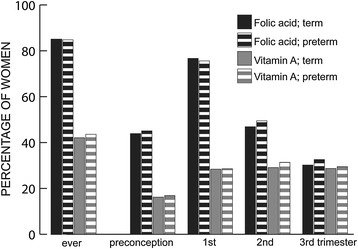
Health authorities in numerous countries recommend periconceptional folic acid supplementation to prevent neural tube defects. The objective of this study was to examine the association of dietary folate intake and folic acid supplementation during different periods of pregnancy with the risk of spontaneous preterm delivery (PTD). The Norwegian Mother and Child Cohort Study is a population-based prospective cohort study. A total of 66,014 women with singleton pregnancies resulting in live births in 2002–2009 were included. Folic acid supplementation was self-reported from 26 weeks before pregnancy until pregnancy week 24. At gestational week 22, the women completed a food frequency questionnaire, which allowed the calculation of their average total folate intake from foods and supplements for the first 4–5 months of pregnancy. Spontaneous PTD was defined as the spontaneous onset of delivery between weeks 22 +0 and 36 +6 (n = 1,755). The median total folate intake was 313 μg/d (interquartile range IQR 167–5558) in the overall population and 530 μg/d (IQR 355–5636) in the supplement users. Eighty-five percent reported any folic acid supplementation from <8 weeks before to 24 weeks after conception while only 44% initiated folic acid supplementation before pregnancy. Cox regression analysis showed that the amount of dietary folate intake (hazard ratio HR 1.00; confidence interval 95% CI 0.61-1.65) and supplemental folate intake (HR 1.00; CI 1.00-1.00) was not significantly associated with the risk of PTD. The initiation of folic acid supplementation more than 8 weeks before conception was associated with an increased risk for spontaneous PTD (HR 1.18; CI 1.05-1.32) compared to no folic acid supplementation preconception. There was no significant association with PTD when supplementation was initiated within 8 weeks preconception (HR 0.99; CI 0.87-1.13). All analyses were adjusted for maternal characteristics and socioeconomic, health and dietary variables. Our findings do not support a protective effect of dietary folate intake or folic acid supplementation on spontaneous PTD. Preconceptional folic acid supplementation starting more than 8 weeks before conception was associated with an increased risk of spontaneous PTD. These results require further investigation before discussing an expansion of folic acid supplementation guidelines.
Overview
The claims and statistics of this paper haven’t been checked yet.
Free: it reads the open-access text and checks the first 5 claims that cite a source we can check. Create a free account to check every claim.
Integrity signals
Registry
Cites
Statistics
Figures
Verification
Claims the paper makes
The claims and statistics of this paper haven’t been checked yet.
Free: it reads the open-access text and checks the first 5 claims that cite a source we can check. Create a free account to check every claim.
Self-check
Percentages, sums and reported differences re-computed from the paper’s own numbers.
The self-check needs the paper’s full text.
Citations
Cites
Proportional hazards tests and diagnostics based on weighted residuals
GRAMBSCH, P. M., & THERNEAU, T. M. (1994) · Biometrika · doi:10.1093/biomet/81.3.515 · Cited by 5,885
Prevention of neural tube defects: Results of the Medical Research Council Vitamin Study
(1991) · The Lancet · doi:10.1016/0140-6736(91)90133-a · Cited by 3,472 · cited 1×
“In the 1990s, large randomized trials demonstrated that periconceptional folic acid supplementation can prevent neural tube defects (NTDs) in the newborn infant [6-8].”
BackgroundCzeizel, A. E., & Dudás, I. (1992) · New England Journal of Medicine · doi:10.1056/nejm199212243272602 · Cited by 3,178
WHO estimates of the causes of death in children
Bryce, J., Boschi-Pinto, C., Shibuya, K., & Black, R. E. (2005) · The Lancet · doi:10.1016/s0140-6736(05)71877-8 · Cited by 2,096
Long-Term Medical and Social Consequences of Preterm Birth
Moster, D., Lie, R. T., & Markestad, T. (2008) · New England Journal of Medicine · doi:10.1056/nejmoa0706475 · Cited by 1,402
Cohort profile: The Norwegian Mother and Child Cohort Study (MoBa)
Magnus, P., Irgens, L. M., Haug, K., Nystad, W., Skjærven, R., & Stoltenberg, C. (2006) · International Journal of Epidemiology · doi:10.1093/ije/dyl170 · Cited by 1,027
Self-citationThe Medical Birth Registry of Norway. Epidemiological research and surveillance throughout 30 years
IRGENS, L. M. (2000) · Acta Obstetricia et Gynecologica Scandinavica · doi:10.1034/j.1600-0412.2000.079006435.x · Cited by 855
Self‐selection and bias in a large prospective pregnancy cohort in Norway
Nilsen, R. M., Vollset, S. E., Gjessing, H. K., Skjærven, R., Melve, K. K., Schreuder, P., Alsaker, E. R., Haug, K., Daltveit, A. K., & Magnus, P. (2009) · Paediatric and Perinatal Epidemiology · doi:10.1111/j.1365-3016.2009.01062.x · Cited by 835
Self-citationFolic acid: influence on the outcome of pregnancy
Scholl, T. O., & Johnson, W. G. (2000) · The American Journal of Clinical Nutrition · doi:10.1093/ajcn/71.5.1295s · Cited by 614
Romero, R., Nicolaides, K., Conde-Agudelo, A., Tabor, A., O'Brien, J. M., Cetingoz, E., Da Fonseca, E., Creasy, G. W., Klein, K., Rode, L., et al. (2012) · American Journal of Obstetrics and Gynecology · doi:10.1016/j.ajog.2011.12.003 · Cited by 580
Tamura, T., & Picciano, M. F. (2006) · The American Journal of Clinical Nutrition · doi:10.1093/ajcn/83.5.993 · Cited by 379
Brantsæter, A. L., Haugen, M., Alexander, J., & Meltzer, H. M. (2008) · Maternal & Child Nutrition · doi:10.1111/j.1740-8709.2007.00103.x · Cited by 287
Self-citationDietary and serum folate: their influence on the outcome of pregnancy
Scholl, T., Hediger, M., Schall, J., Khoo, C., & Fischer, R. (1996) · The American Journal of Clinical Nutrition · doi:10.1093/ajcn/63.4.520 · Cited by 282
Meltzer, H. M., Brantsæter, A. L., Ydersbond, T. A., Alexander, J., Haugen, M., & The MoBa Dietary Support Group (2008) · Maternal & Child Nutrition · doi:10.1111/j.1740-8709.2007.00104.x · Cited by 273
Self-citationBailey, R. L., Dodd, K. W., Gahche, J. J., Dwyer, J. T., McDowell, M. A., Yetley, E. A., Sempos, C. A., Burt, V. L., Radimer, K. L., & Picciano, M. F. (2010) · The American Journal of Clinical Nutrition · doi:10.3945/ajcn.2009.28427 · Cited by 254
Bergen, N., Jaddoe, V., Timmermans, S., Hofman, A., Lindemans, J., Russcher, H., Raat, H., Steegers‐Theunissen, R., & Steegers, E. (2012) · BJOG: An International Journal of Obstetrics & Gynaecology · doi:10.1111/j.1471-0528.2012.03321.x · Cited by 239
Folic acid supplementation during pregnancy for maternal health and pregnancy outcomes
Lassi, Z. S., Salam, R. A., Haider, B. A., & Bhutta, Z. A. (2013) · Cochrane Database of Systematic Reviews · doi:10.1002/14651858.cd006896.pub2 · Cited by 221
Folate intake in Europe: recommended, actual and desired intake
de Bree, A., van Dusseldorp, M., Brouwer, I., van het Hof, K., & Steegers-Theunissen, R. (1997) · European Journal of Clinical Nutrition · doi:10.1038/sj.ejcn.1600467 · Cited by 213
Czeizel, A. E., Dudás, I., & Métneki, J. (1994) · Archives of Gynecology and Obstetrics · doi:10.1007/bf02390940 · Cited by 206
Use of Multivitamin/Mineral Prenatal Supplements: Influence on the Outcome of Pregnancy
Scholl, T. O., Hediger, M. L., Bendich, A., Schall, J. I., Smith, W. K., & Krueger, P. M. (1997) · American Journal of Epidemiology · doi:10.1093/oxfordjournals.aje.a009244 · Cited by 205
Timmermans, S., Jaddoe, V. W. V., Hofman, A., Steegers-Theunissen, R. P. M., & Steegers, E. A. P. (2009) · British Journal of Nutrition · doi:10.1017/s0007114509288994 · Cited by 204
Preconceptional Folate Supplementation and the Risk of Spontaneous Preterm Birth: A Cohort Study
Bukowski, R., Malone, F. D., Porter, F. T., Nyberg, D. A., Comstock, C. H., Hankins, G. D. V., Eddleman, K., Gross, S. J., Dugoff, L., Craigo, S. D., et al. (2009) · PLoS Medicine · doi:10.1371/journal.pmed.1000061 · Cited by 174
Fekete, K., Berti, C., Trovato, M., Lohner, S., Dullemeijer, C., Souverein, O. W., Cetin, I., & Decsi, T. (2012) · Nutrition Journal · doi:10.1186/1475-2891-11-75 · Cited by 173
Reduction of Incidence of Prematurity by Folic Acid Supplementation in Pregnancy
Baumslag, N., Edelstein, T., & Metz, J. (1970) · BMJ · doi:10.1136/bmj.1.5687.16 · Cited by 172
Genetic epidemiologic studies of preterm birth: guidelines for research
Pennell, C. E., Jacobsson, B., Williams, S. M., Buus, R. M., Muglia, L. J., Dolan, S. M., Morken, N.-H., Ozcelik, H., Lye, S. J., & Relton, C. (2007) · American Journal of Obstetrics and Gynecology · doi:10.1016/j.ajog.2006.03.109 · Cited by 166
Self-citationHaugen, M. A., Brantsæter, A. L., Alexander, J., & Meltzer, H. M. (2008) · Annals of Nutrition and Metabolism · doi:10.1159/000146274 · Cited by 156
Self-citationProgesterone for the Prevention of Preterm Birth: A Systematic Review
Dodd, J. M., Flenady, V., Cincotta, R., & Crowther, C. A. (2008) · Obstetrics and Gynecology · doi:10.1097/aog.0b013e31817d0262 · Cited by 155
Nilsen, R. M., Vollset, S. E., Gjessing, H. K., Magnus, P., Meltzer, H. M., Haugen, M., & Ueland, P. M. (2006) · The American Journal of Clinical Nutrition · doi:10.1093/ajcn/84.5.1134 · Cited by 153 · cited 1×
“is well established that women with high levels of education, privileged socioeconomic status and healthier overall diets are more likely to use supplements during pregnancy [52-54] and less likely to experience PTD than women without these characteristics.”
BackgroundSelf-citationSecond trimester folate status and preterm birth
Siega‐Riz, A. M., Savitz, D. A., Zeisel, S. H., Thorp, J. M., & Herring, A. H. (2004) · American Journal of Obstetrics and Gynecology · doi:10.1016/j.ajog.2004.07.076 · Cited by 139
Catov, J. M., Bodnar, L. M., Olsen, J., Olsen, S. F., & Nohr, E. A. (2011) · American Journal of Clinical Nutrition · doi:10.3945/ajcn.111.012393 · Cited by 119
Predicting Premature Delivery — No Easy Task
Lockwood, C. J. (2002) · New England Journal of Medicine · doi:10.1056/nejm200201243460412 · Cited by 116
Charles, D. H. M., Ness, A. R., Campbell, D., Smith, G. D., Whitley, E., & Hall, M. H. (2005) · Paediatric and Perinatal Epidemiology · doi:10.1111/j.1365-3016.2005.00633.x · Cited by 115
Brantsæter, A. L., Haugen, M., Hagve, T.-A., Aksnes, L., Rasmussen, S. E., Julshamn, K., Alexander, J., & Meltzer, H. M. (2007) · Annals of Nutrition and Metabolism · doi:10.1159/000103275 · Cited by 102
Self-citationCzeizel, A. E., Horváth–Puhó, E., Langmár, Z., Ács, N., & Bánhidy, F. G. (2009) · European Journal of Obstetrics & Gynecology and Reproductive Biology · doi:10.1016/j.ejogrb.2009.10.016 · Cited by 97
Analysis of Self‐selection Bias in a Population‐based Cohort Study of Autism Spectrum Disorders
Nilsen, R. M., Surén, P., Gunnes, N., Alsaker, E. R., Bresnahan, M., Hirtz, D., Hornig, M., Lie, K. K., Lipkin, W. I., Reichborn‐Kjennerud, T., et al. (2013) · Paediatric and Perinatal Epidemiology · doi:10.1111/ppe.12077 · Cited by 88
Self-citationPapadopoulou, E., Stratakis, N., Roumeliotaki, T., Sarri, K. O., Merlo, D. F., Kogevinas, M., & Chatzi, L. (2012) · European Journal of Nutrition · doi:10.1007/s00394-012-0339-z · Cited by 78
THE VALUE OF FOLIC ACID SUPPLEMENTS IN PREGNANCY
Fletcher, J., Gurr, A., Fellingham, F. R., Prankerd, T. A. J., Brant, H. A., & Menzies, D. N. (1971) · BJOG: An International Journal of Obstetrics & Gynaecology · doi:10.1111/j.1471-0528.1971.tb00338.x · Cited by 72
Rolschau, J., Kristoffersen, K., Ulrich, M., Grinsted, P., Schaumburg, E., & Foged, N. (1999) · European Journal of Obstetrics & Gynecology and Reproductive Biology · doi:10.1016/s0301-2115(99)00084-6 · Cited by 72
Alwan, N. A., Greenwood, D. C., Simpson, N., McArdle, H. J., & Cade, J. E. (2010) · BJOG An International Journal of Obstetrics & Gynaecology · doi:10.1111/j.1471-0528.2010.02549.x · Cited by 67
Nilsen, R. M., Vollset, S. E., Monsen, A. L. B., Ulvik, A., Haugen, M. A., Meltzer, H. M., Magnus, P. M., & Ueland, P. M. (2010) · Journal of Nutrition · doi:10.3945/jn.109.118158 · Cited by 63
Self-citationLi, Z., Ye, R., Zhang, L., Li, H., Liu, J., & Ren, A. (2014) · International Journal of Epidemiology · doi:10.1093/ije/dyu020 · Cited by 61
Folic Acid Supplementation and Spontaneous Preterm Birth: Adding Grist to the Mill?
Callaway, L., Colditz, P. B., & Fisk, N. M. (2009) · PLoS Medicine · doi:10.1371/journal.pmed.1000077 · Cited by 58
Shaw, G. M., Carmichael, S. L., Nelson, V. E., Selvin, S., & Schaffer, D. (2004) · Public Health Reports · doi:10.1177/003335490411900210 · Cited by 53
Folic Acid Supplementation and Preterm Birth: Results from Observational Studies
Mantovani, E., Filippini, F., Bortolus, R., & Franchi, M. P. (2014) · BioMed Research International · doi:10.1155/2014/481914 · Cited by 50
Maternal Micronutrient Status and Preterm Versus Term Birth for Black and White US Women
Dunlop, A. L., Taylor, R. N., Tangpricha, V., Fortunato, S. J., & Menon, R. (2012) · Reproductive Sciences · doi:10.1177/1933719112438442 · Cited by 44
Maternal red blood cell folate concentration at 10–12 weeks gestation and pregnancy outcome
Furness, D., Yasin, N., Dekker, G., Thompson, S. D., & Roberts, C. T. (2011) · The Journal of Maternal-Fetal & Neonatal Medicine · doi:10.3109/14767058.2011.636463 · Cited by 43
The prevention of perinatal mortality and morbidity. Report of a WHO Expert Committee.
(1970) · PubMed · Cited by 29
Periconceptional Intake of Folic Acid and Food Folate and Risks of Preterm Delivery
Shaw, G. M., Carmichael, S. L., Yang, W., & Siega‐Riz, A. M. (2011) · American Journal of Perinatology · doi:10.1055/s-0031-1280855 · Cited by 27
MEGALOBLASTIC ANÆMIA OF PREGNANCY
Israëls, M. C. G., & Cunha, F. A. L. D. (1952) · The Lancet · doi:10.1016/s0140-6736(52)91546-8 · Cited by 26
Folic Acid Supplementation and Interpregnancy Interval
Nilsen, R. M., Mastroiacovo, P., Gunnes, N., Alsaker, E. R., Bjørke‐Monsen, A. L., Eussen, S. J. P. M., Haugen, M. A., Johannessen, A., Meltzer, H. M., Stoltenberg, C., et al. (2014) · Paediatric and Perinatal Epidemiology · doi:10.1111/ppe.12111 · Cited by 22
Self-citationPREGNANCY ANAEMIA, IRON AND FOLATE DEFICIENCY IN WESTERN AUSTRALIA
Fleming, A. F., Martin, J. D., & STENHOUSE, N. S. (1974) · The Medical Journal of Australia · doi:10.5694/j.1326-5377.1974.tb70933.x · Cited by 16
Research works printed but not linked: 1
- Rimestad AH Borgejordet A Vesterhus KN Sygnestveit K Løken EB Trygg K Pollestad ML Lund-Larsen K Omholt-Jensen G Nordbotten A Matvaretabellen (The Norwegian Food Table, in Norwegian) 2001 University of Oslo Norwegian Food Safety Authority; Norwegian Directorate of Health; Department of Nutrition
Cited by
Nordqvist, M., Jacobsson, B., Brantsæter, A.-L., Myhre, R., Nilsson, S., & Sengpiel, V. (2018) · BMJ Open · doi:10.1136/bmjopen-2017-018021 · Cited by 95
Self-citationGetachew, M., Abay, M., Zelalem, H., Gebremedhin, T., Grum, T., & Bayray, A. (2018) · BMC Pregnancy and Childbirth · doi:10.1186/s12884-018-1716-2 · Cited by 84
“Folic acid deficiency at conception and in early pregnancy is also associated with increased risk of neural tube defect, preeclampsia, fetal malformations and preterm delivery [7, 8].”
BackgroundNutrition, One-Carbon Metabolism and Neural Tube Defects: A Review
Li, K., Wahlqvist, M. L., & Li, D. (2016) · Nutrients · doi:10.3390/nu8110741 · Cited by 86
Lyoba, W. B., Mwakatoga, J. D., Festo, C., Mrema, J., & Elisaria, E. (2020) · International Journal of Reproductive Medicine · doi:10.1155/2020/3127245 · Cited by 66
“Anaemia leads to approximately 50,000 deaths during childbirth each year globally [9] and iron deficiency alone accounts for 22% of all anaemia deaths [7].”
BackgroundFolic Acid and Risk of Preterm Birth: A Meta-Analysis
Li, B., Zhang, X., Peng, X., Zhang, S., Wang, X., & Zhu, C. (2019) · Frontiers in Neuroscience · doi:10.3389/fnins.2019.01284 · Cited by 66
Metadata
- Authors
- Sengpiel, V., Bacelis, J., Myhre, R., Myking, S., Devold Pay, A. S., Haugen, M., Brantsæter, A.-L., Meltzer, H. M., Nilsen, R. M., Magnus, P., Vollset, S. E., Nilsson, S., & Jacobsson, B.
- Affiliations
- Sahlgrenska University Hospital (SE)
- Norwegian Institute of Public Health (NO)
- University of Bergen (NO)
- Chalmers University of Technology (SE)
- Corresponding author
- Sengpiel, Verena
- ORCID
- Venue
- BMC Pregnancy and Childbirth
- Published
- 2014-11-02
- Volume
- 14
- Issue
- 1
- ISSN
- 1471-2393 (ISSN-L)
- PMC
- PMC4240839
- OpenAlex
- W4317524002
- Cited by
- 46
- References
- 49
- Citations by year
- 2026: 1 · 2025: 3 · 2023: 4 · 2022: 5 · 2021: 4 · 2020: 8 · 2019: 5 · 2018: 3 · 2017: 6 · 2016: 2 · 2015: 4 · 2014: 1
- FWCI
- 3.59
- Type
- journal article
- Language
- en
- Open access
- gold
- doi.org
- Locations
- BMC Pregnancy and Childbirth (publishedVersion, cc-by)
- NORA - Norwegian Open Research Archives (submittedVersion, cc-by)
- NORA - Norwegian Open Research Archives (submittedVersion, other-oa)
- Chalmers Publication Library (Chalmers University of Technology) (submittedVersion)
- Chalmers Research (Chalmers University of Technology) (submittedVersion)
- Funders
- Norges Forskningsråd
- Sahlgrenska Universitetssjukhuset
- Svenska Läkaresällskapet (SLS 2008-21198)
- Topics
- Health Sciences › Nursing › Nutrition and Dietetics › Folate and B Vitamins Research
- Health Sciences › Medicine › Pediatrics, Perinatology and Child Health › Maternal and Neonatal Healthcare
- Health Sciences › Medicine › Public Health, Environmental and Occupational Health › Pregnancy and Medication Impact
- Keywords
- folic acid supplementation, folate intake, spontaneous preterm birth, periconceptional supplementation, pregnancy, preterm birth risk, Norwegian Mother and Child Cohort Study, food frequency questionnaire, maternal nutrition
About these checks
Registry, retraction, Cites and statistics results are computed, not judged, with one exception: a printed reference that no index lists is read once by a model before it counts as a citation error. Claims are extracted by a model and kept only when their quote appears verbatim in the text; each cited source is then checked, with a model’s help, for whether it says what the claim relies on. Those verdicts can be wrong — read the claim’s quote and the cited source before relying on one.
Statistics and arithmetic are recomputed, not judged.
Confidence bands are shown only for fields calibrated on our annotated test set. None is calibrated yet, so no band is shown.
What counts as a claim ›How we measure confidence ›How we check this ›
Are you an author, or do you see a problem with this page? Request a review
Data sources
Bibliographic data: Semantic Scholar, OpenAlex, Crossref.
Contains information from the Semantic Scholar Academic Graph Datasets, made available under the ODC Attribution License (ODC-BY 1.0).
Semantic Scholar’s data is described in: Kinney, R., et al. (2023). The Semantic Scholar Open Data Platform. arXiv:2301.10140.
