

Economic evaluation of emergency obstetric care training: a systematic review.
Open accessThe DOI matches its Crossref record; 63 of the 65 references it cites were found in a registry or an index.
Abstract
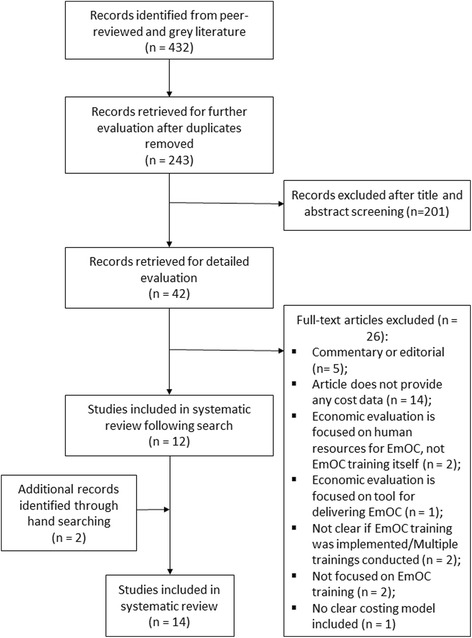
BACKGROUND: Training healthcare providers in Emergency Obstetric Care (EmOC) has been shown to be effective in improving their capacity to provide this critical care package for mothers and babies. However, little is known about the costs and cost-effectiveness of such training. Understanding costs and cost-effectiveness is essential in guaranteeing value-for-money in healthcare spending. This study systematically reviewed the available literature on cost and cost-effectiveness of EmOC trainings. METHODS: Peer-reviewed and grey literature was searched for relevant papers published after 1990. Studies were included if they described an economic evaluation of EmOC training and the training cost data were available. Two reviewers independently searched, screened, and selected studies that met the inclusion criteria, with disagreements resolved by a third reviewer. Quality of studies was assessed using the Consolidated Health Economic Evaluation Reporting Standards statement. For comparability, all costs in local currency were converted to International dollar (I$) equivalents using purchasing power parity conversion factors. The cost per training per participant was calculated. Narrative synthesis was used to summarise the available evidence on cost effectiveness. RESULTS: Fourteen studies (five full and nine partial economic evaluations) met the inclusion criteria. All five and two of the nine partial economic evaluations were of high quality. The majority of studies (13/14) were from low- and middle-income countries. Training equipment, per diems and resource person allowance were the most expensive components. Cost of training per person per day ranged from I$33 to I$90 when accommodation was required and from I$5 to I$21 when training was facility-based. Cost-effectiveness of training was assessed in 5 studies with differing measures of effectiveness (knowledge, skills, procedure cost and lives saved) making comparison difficult. CONCLUSIONS: Economic evaluations of EmOC training are limited. There is a need to scale-up and standardise processes that capture both cost and effectiveness of training and to agree on suitable economic evaluation models that allow for comparability across settings. TRIAL REGISTRATION: PROSPERO_CRD42016041911 .
Overview
The claims and statistics of this paper haven’t been checked yet.
Free: it reads the open-access text and checks the first 5 claims that cite a source we can check. Create a free account to check every claim.
Integrity signals
Registry
Cites
Statistics
Figures
Verification
Claims the paper makes
The claims and statistics of this paper haven’t been checked yet.
Free: it reads the open-access text and checks the first 5 claims that cite a source we can check. Create a free account to check every claim.
Claims other papers make about this one
Each is checked against this paper’s own text: does it say what the citing paper says it does?
The source backs part of the claim, not all of it — or backs it for a different population, condition or comparison.
In the citing paper
“A complete cost analysis has not been conducted but the cost of replacing mannequins far exceeds other facility-based course costs as instructors work on a voluntary basis 43 .”
From A mixed methods evaluation of Advanced Life Support in Obstetrics (ALSO) and Basic Life Support in Obstetrics (BLSO) in a resource-limited setting on the Thailand-Myanmar border (2021) · cites this paper as [43]
Experimental — accuracy not yet measured
Self-check
Percentages, sums and reported differences re-computed from the paper’s own numbers.
The self-check needs the paper’s full text.
Citations
Cites
Preferred Reporting Items for Systematic Reviews and Meta-Analyses: the PRISMA statement
Moher, D., Liberati, A., Tetzlaff, J., Altman, D. G., & for the PRISMA Group (2009) · BMJ · doi:10.1136/bmj.b2535 · Cited by 83,823
Preferred Reporting Items for Systematic Reviews and Meta-Analyses: The PRISMA Statement
Moher, D., Liberati, A., Tetzlaff, J., Altman, D. G., & The PRISMA Group (2009) · PLoS Medicine · doi:10.1371/journal.pmed.1000097 · Cited by 64,042
Preferred reporting items for systematic reviews and meta-analyses: The PRISMA statement
Moher, D., Liberati, A., Tetzlaff, J., Altman, D. G., & the PRISMA Group* (2009) · Annals of Internal Medicine · doi:10.7326/0003-4819-151-4-200908180-00135 · Cited by 37,554
Wang, G., Ma, R., Qiao, G., Wada, K., Aizawa, Y., & Satoh, T. (2015) · Integrative Medicine International · doi:10.1159/000368408 · Cited by 18,657
Methods for the Economic Evaluation of Health Care Programmes
Drummond, M. E., Sculpher, M. J., Torrance, G. W., O’Brien, B. J., & Stoddart, G. L. (2005) · doi:10.1093/oso/9780198529446.001.0001 · Cited by 13,648
Methods for the economic evaluation of health care programmes
Wilson, S. H. (1987) · Journal of Epidemiology and Community Health · doi:10.1136/jech.41.4.355-a · Cited by 4,275 · cited 2×
“The opportunity cost was taken to be the value of the best foregone alternative use of resources [24].”
BackgroundMacroeconomics and health: investing in health for economic development
Sachs, J. D. (2002) · Revista Panamericana de Salud Pública · doi:10.1590/s1020-49892002000800017 · Cited by 1,830 · cited 1×
“24 per DALY averted, which when compared with a GDP per person in Zambia of about US$1500 (WHO cost-effectiveness threshold for the country [50]), suggests that the EmOC training intervention could be considered to be good value-for-money [49].”
BackgroundConsolidated Health Economic Evaluation Reporting Standards (CHEERS) statement
Husereau, D., Drummond, M., Petrou, S., Carswell, C., Moher, D., Greenberg, D., Augustovski, F., Briggs, A. H., Mauskopf, J., Loder, E., et al. (2013) · BMJ · doi:10.1136/bmj.f1049 · Cited by 1,776
Frenkel, J. A. (1978) · Journal of International Economics · doi:10.1016/0022-1996(78)90021-1 · Cited by 557
The evidence for emergency obstetric care
Paxton, A., Maine, D., Freedman, L., Fry, D., & Lobis, S. (2005) · International Journal of Gynecology & Obstetrics · doi:10.1016/j.ijgo.2004.11.026 · Cited by 426 · cited 1×
“Evidence suggests that majority of these deaths could be prevented by timely and effective emergency obstetric care (EmOC) [6, 7].”
Background
Research works printed but not linked: 2
- Greenhill R, Prizzon A. Who foots the bill after 2015? Working paper 360: what new trends in development finance mean for the post-MDGs. London: ODI; 2012. https://www.odi.org/sites/odi.org.uk/files/odi-assets/ publications-opinion-files/7905.pdf
- Boulenger S, Dmytraczenko T. Cost of family care international's skilled care initiative in Kenya and Tanzania. Bethesda, MD: Abt Associates; 2007. http:// www.familycareintl.org/UserFiles/File/SCI%20Costing%20Analysis.pdf
Cited by
Rinaldi, G., Hijazi, A., & Haghparast-Bidgoli, H. (2020) · Diabetes Research and Clinical Practice · doi:10.1016/j.diabres.2020.108084 · Cited by 85
Cost of Utilising Maternal Health Services in Low- and Middle-Income Countries: A Systematic Review
Banke-Thomas, A. O., Ayomoh, F. I., Abejirinde, I. O., Banke-Thomas, O., Eboreime, E., & Ameh, C. (2020) · International Journal of Health Policy and Management · doi:10.34172/ijhpm.2020.104 · Cited by 84
Self-citationFlórez-Tanus, Á., Padilla, D. P., Zakzuk, J., Caraballo, L. R., & Alvis‐Guzmán, N. (2018) · World Allergy Organization Journal · doi:10.1186/s40413-018-0205-4 · Cited by 55
Banke-Thomas, A. O., Abejirinde, I. O., Ayomoh, F. I., Banke-Thomas, O., Eboreime, E., & Ameh, C. (2020) · BMJ Global Health · doi:10.1136/bmjgh-2020-002371 · Cited by 48
Self-citationAvoka, C. K., McArthur, E., & Banke-Thomas, A. O. (2022) · Tropical Medicine & International Health · doi:10.1111/tmi.13747 · Cited by 53
“Training such as these have been shown to be cost- effective [40] and guarantee value for money across multiple stakeholders [41].”
BackgroundSelf-citationUgwa, E. A., Kabue, M., Otolorin, E. '., Yenokyan, G., Adetiloye, O., Orji, B., Okoli, U., Enne, J., Alobo, G., Olisaekee, G., et al. (2020) · BMC Health Services Research · doi:10.1186/s12913-020-05450-9 · Cited by 43
“Health workers in Nigeria are usually trained using traditional lecture-based, offsite approach where limited number of health workers is trained from each facility at a time and the quality of care may not be improved to the desired level though the use of this approach [3].”
BackgroundSocial return on investment of emergency obstetric care training in Kenya
Banke-Thomas, A. O., Madaj, B., & van den Broek, N. R. (2019) · BMJ Global Health · doi:10.1136/bmjgh-2018-001167 · Cited by 23
“This is within the cost range of trainings in LMICs that require accommodation of trainers and/ or participants in the literature (I$33 and I$90).(15) Previous studies have shown that EmOC training is a cost-effective way of increasing knowledge and skills of healthcare providers,(29) 30 their productivity in terms of…”
BackgroundMethodResultInfluentialSelf-citationLarrea-Schiavon, S., Vázquez-Quesada, L. M., Bartlett, L. R., Lam-Cervantes, N., Sripad, P., Vieitez, I., & Coutiño-Escamilla, L. (2022) · Global Health: Science and Practice · doi:10.9745/ghsp-d-21-00418 · Cited by 18
“The 2 items associated with the highest expenditure were the hiring of personnel and the purchase of equipment (32% and 28% of the total budget, respectively).(51,52) A mention of the minimum budget required to implement and maintain these interventions in border areas and/ or with refugee andmigrant populations would…”
BackgroundPerspectives of stakeholders on emergency obstetric care training in Kenya: a qualitative study
Banke-Thomas, A. O., Maua, J., Madaj, B., Ameh, C., & van den Broek, N. R. (2019) · International Health · doi:10.1093/inthealth/ihz007 · Cited by 20
Self-citationStabnick, A., Yeboah, M., Arthur‐Komeh, J., Ankobea, F. K., Moyer, C. A., & Lawrence, E. R. (2022) · BMC Pregnancy and Childbirth · doi:10.1186/s12884-022-04535-z · Cited by 20
“likely outweigh the relatively small costs [26].”
BackgroundMcGready, R., Rijken, M. J., Turner, C., Than, H. H., Tun, N. W., Min, A. M., Hla, S., Wai, N. S., Proux, K., Min, T. H., et al. (2021) · Wellcome Open Research · doi:10.12688/wellcomeopenres.16599.2 · Cited by 22
“Results of the ALSO and BLSO courses Results on the skills component of ALSO have been consistently high, with a median score of 93 [35-100], and 98.”
Yau, C. W. H., Lenguerrand, E., Stephen Morris, A., Draycott, T. J., & Pizzo, E. (2021) · PLoS ONE · doi:10.1371/journal.pone.0249031 · Cited by 14
Rinaldi, G., Hijazi, A., & Haghparast-Bidgoli, H. (2019) · BMJ Open · doi:10.1136/bmjopen-2018-027490 · Cited by 12
Banke-Thomas, A. O., Abejirinde, I. O., Banke-Thomas, O., Maikano, A., & Ameh, C. (2019) · BMJ Open · doi:10.1136/bmjopen-2018-027822 · Cited by 13
“before totalling the direct financial cost of each service, as not all costing studies typically include it.(33) Comparison of service costs across countries will be performed.”
BackgroundMethodSelf-citationKeep it simple – Effective training in obstetrics for low- and middle-income countries
van den Broek, N. R. (2021) · Best Practice & Research Clinical Obstetrics & Gynaecology · doi:10.1016/j.bpobgyn.2021.10.007 · Cited by 13
Hanson, C., Atuhairwe, S., Atim, J. L., Marrone, G., Morris, J. L., & Kaharuza, F. M. (2020) · International Journal of Gynecology & Obstetrics · doi:10.1002/ijgo.13395 · Cited by 15
“We included an assessment of: (1) availability of equipment and supplies modelled on similar tools18; (2) knowledge and skills using objective structured clinical examination (OSCE)7; (3) health providers’ practices; and (4) outcomes abstracted from health records.”
BackgroundMethodJiao, L., Sui, Y., Gui-hua, Y., Wang, P., Li, Q., Chen, J. I.-H., Liu, L., & Yang, C. (2020) · Nursing Open · doi:10.1002/nop2.651 · Cited by 9
“…of training is very limited and it is necessary to expand and standardize the process and to select an appropriate economic evaluation model to capture the cost and benefit of training to achieve comparability of training effectiveness in different environments (Banke-Thomas et al., 2017).”
BackgroundNdwiga, C., Abuya, T., Okondo, C., Akinyi, S., Wickramanayake, A., & Warren, C. (2023) · BMC Women s Health · doi:10.1186/s12905-023-02740-2 · Cited by 9
“…of provider skills and competency interventions that incorporates mentorship, didactic training, drills, or simulation sessions improves provider knowledge and retention, respectful maternity care (RMC), and contributes towards reducing maternal and neonatal complications and deaths [16–18].”
Komolafe, A. O., Olowokere, A. E., & Irinoye, O. O. (2021) · PLoS ONE · doi:10.1371/journal.pone.0249334 · Cited by 10
Banke-Thomas, A. O., Nieuwenhuis, S., Ologun, A., Mortimore, G., & Mpakateni, M. (2019) · Evaluation and Program Planning · doi:10.1016/j.evalprogplan.2019.101725 · Cited by 7
Self-citationEze, I., Ogbu, M. A., Ossai, E., Ekenna, A. C., Okoronkwo, I., & Onwujekwe, O. E. (2023) · Nigerian Journal of Clinical Practice · doi:10.4103/njcp.njcp_576_22 · Cited by 2
Zhao, Q., Li, C., Zhang, Y., Tang, H., Wang, J., Yu, X., Zhao, Y., Xing, Y., Yu, J., Ye, J., et al. (2023) · International Journal of Geriatric Psychiatry · doi:10.1002/gps.5990 · Cited by 2
“For partial economic evaluations, we extracted the benefits after the e‐health intervention as an outcome indicator, such as health behavior change.(49) Types of full economic assessments include cost‐utility analysis (CUA), cost‐consequence analysis (CCA), cost‐benefit analysis (CBA), cost‐effectiveness analysis (CEA…”
MethodKong, C. W., & To, W. W. K. (2022) · Hong Kong Journal of Emergency Medicine · doi:10.1177/10249079211072403 · Cited by 2
Roy, K., Balogun, N., & Banke-Thomas, A. O. (2026) · PLOS Global Public Health · doi:10.1371/journal.pgph.0006254 · Cited by 2
“Training has been shown to be effective in improving capacity of SHPs to provide the care that pregnant women need in emergencies, and such training, if well implemented, guarantees value for money [123,124].”
Self-citationKandie, P., Kipmerewo, M., Mukabana, B., & Arudo, J. (2021) · Journal of Health Medicine and Nursing · doi:10.47604/jhmn.1217 · Cited by 2
Ugwa, E. A., Kabue, M., Otolorin, E. '., Yenokyan, G., Adetiloye, O., Orji, B., Okoli, U., Enne, J., Alobo, G., Olisaekee, G., et al. (2019) · doi:10.21203/rs.2.17089/v1
“Considering the high maternal and newborn mortality and morbidity figures in Nigeria, there is need to train birth attendants on high-impact interventions using competency-based approaches to improve the quality of maternal and newborn care and reduce maternal and perinatal/neonatal mortality [8-11].”
BackgroundSafety in the Obstetric Patient: Simulation Training for Anesthesiologists in the Obstetrics Field
Hernández-Pinto, P., Doueil, M. L., Carrancho, R. S., & Gómez, M. M. G. (2022) · Recent advances in anesthesiology · doi:10.2174/9789815041841122040004
A cost description of the setup costs of community-owned maternity waiting homes in rural Zambia
Juntunen, A., Scott, N., Kaiser, J. L., Vian, T., Ngoma, T., Mataka, K., Bwalya, M., Sakanga, V., Kalaba, D., Biemba, G., et al. (2023) · PLOS Global Public Health · doi:10.1371/journal.pgph.0000340
Cost-effectiveness evaluation of neonatal emergency transport organization in Italy
Bellini, C., Gente, M., Minghetti, D., & Ramenghi, L. A. (2025) · Global Pediatrics · doi:10.1016/j.gpeds.2025.100243
Banke-Thomas, A. O., Offosse, M.-J., Cissé, K., Gage, A. D., & Haakenstad, A. (2025) · Research Square · doi:10.21203/rs.3.rs-7463045/v1 · Cited by 1
Self-citationMaternity Training in the Twenty-First Century
Parris, D., & Siassakos, D. M. (2025) · Cambridge University Press eBooks · doi:10.1017/9781009497459.031
Ndwiga, C., Abuya, T., Okondo, C., Akinyi, S., Wickramanayake, A., & Warren, C. (2024) · Figshare · doi:10.6084/m9.figshare.26637501
Phan, H. T., Nguyen, B. T., Zhao, T., Phung, T. L., Keakabetse, T. R., Dinh, T. T. N., Nelson, M. R., Skinner, M., Perndt, H., & Palmer, A. J. (2026) · Injury · doi:10.1016/j.injury.2026.113433
Mohanty, I., Niyonsenga, T., Salvador‐Carulla, L., Woods, C., & Lukersmith, S. (2026) · PLoS ONE · doi:10.1371/journal.pone.0353179
“Banke-Thomas et al. [23] have advocated for the use of the societal perspective of ROI or Social Return on Investment (SROI) across healthcare.”
How do doctors build knowledge around obstetric emergencies? A scoping review
Stelling, H., Burford, B. C., Park, S. E., McGurk, L., Brown, M. E. L., & Vance, G. H. S. (2026) · BMJ Open · doi:10.1136/bmjopen-2026-119725
The cost of training a nurse and midwife in Africa: A scoping review
Kurui, D. K., Radol, A., Lepish, E., Jerop, L., Owuor, C., OTIENO, G. A., Kazungu, J., & Mwangi, N. (2026) · SSM - Health Systems · doi:10.1016/j.ssmhs.2026.100324
Rojas-Suárez, J. A., Durán, C., Lora, N., Briñez, L., Calderón, A., Annicchiarico-López, W., Alvis-Zakzuk, N., Laza, L., Peña, A., Correa, J. C., et al. (2026) · Annals of Global Health · doi:10.5334/aogh.5403
“…the real-world evaluation of a multi-component maternal safety and obstetric high-dependency care model in a resource-constrained middle-income region, the inclusion of three distinct organisational models, and the combined assessment of economic, clinical, and longitudinal quality indicators [25].”
Metadata
- Authors
- Banke-Thomas, A., Wilson-Jones, M., Madaj, B., & van den Broek, N.
- Affiliations
- Liverpool School of Tropical Medicine (GB)
- Venue
- BMC Pregnancy and Childbirth
- Published
- 2017-12
- Volume
- 17
- Issue
- 1
- Pages
- 403-403
- ISSN
- 1471-2393 (ISSN-L)
- PMC
- PMC5716021
- OpenAlex
- W2772362651
- Semantic Scholar
- d3346187a2406445603988bfd50009f046bfcf67
- Cited by
- 37
- References
- 65
- Citations by year
- 2026: 6 · 2025: 3 · 2024: 1 · 2023: 4 · 2022: 5 · 2021: 5 · 2020: 6 · 2019: 6 · 2018: 1
- FWCI
- 0.58
- Type
- journal article
- Language
- en
- Open access
- gold
- doi.org
- Licence
- cc-by
- Locations
- BMC Pregnancy and Childbirth (publishedVersion, cc-by)
- Europe PMC (PubMed Central) (publishedVersion, cc-by)
- PubMed Central (publishedVersion, cc-by)
- PubMed (publishedVersion)
- LSTM Online Archive (Liverpool School of Tropical Medicine) (acceptedVersion)
- Greenwich Academic Literature Archive (University of Greenwich) (acceptedVersion)
- LSHTM Research Online (London School of Hygiene and Tropical Medicine) (acceptedVersion)
- DOAJ (DOAJ: Directory of Open Access Journals) (submittedVersion, cc-by-sa)
- Funders
- Department for International Development (202945-101)
- Topics
- Health Sciences › Medicine › Public Health, Environmental and Occupational Health › Global Health and Surgery
- Health Sciences › Medicine › Pediatrics, Perinatology and Child Health › Global Maternal and Child Health
- Social Sciences › Economics, Econometrics and Finance › Economics and Econometrics › Health Systems, Economic Evaluations, Quality of Life
- Keywords
- emergency obstetric care, health professions education, cost-effectiveness, training costs, low- and middle-income countries, maternal health, economic evaluation
- MeSH terms
- Maternal-Child Health Services, Cost-Benefit Analysis, Education, Medical, Emergency Medical Services, Female, Humans, Infant, Newborn, Obstetrics, Pregnancy
About these checks
Registry, retraction, Cites and statistics results are computed, not judged, with one exception: a printed reference that no index lists is read once by a model before it counts as a citation error. Claims are extracted by a model and kept only when their quote appears verbatim in the text; each cited source is then checked, with a model’s help, for whether it says what the claim relies on. Those verdicts can be wrong — read the claim’s quote and the cited source before relying on one.
Statistics and arithmetic are recomputed, not judged.
Confidence bands are shown only for fields calibrated on our annotated test set. None is calibrated yet, so no band is shown.
What counts as a claim ›How we measure confidence ›How we check this ›
Are you an author, or do you see a problem with this page? Request a review
Data sources
Bibliographic data: Semantic Scholar, OpenAlex, Crossref.
Contains information from the Semantic Scholar Academic Graph Datasets, made available under the ODC Attribution License (ODC-BY 1.0).
Semantic Scholar’s data is described in: Kinney, R., et al. (2023). The Semantic Scholar Open Data Platform. arXiv:2301.10140.
