

Economic evaluation of emergency obstetric care training: a systematic review.
Open accessThe DOI matches its Crossref record; 63 of the 65 references it cites were found in a registry or an index.
Abstract
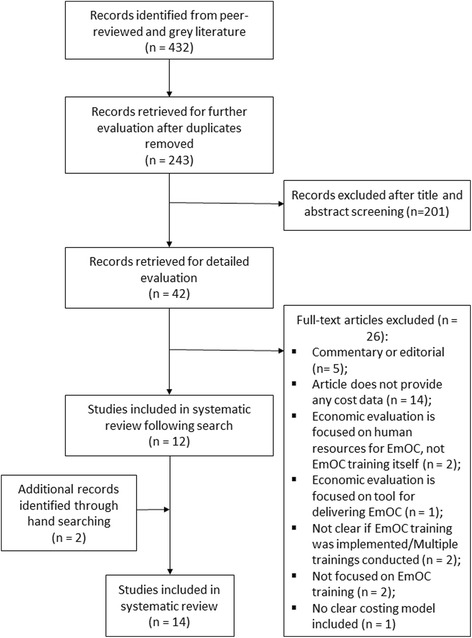
BACKGROUND: Training healthcare providers in Emergency Obstetric Care (EmOC) has been shown to be effective in improving their capacity to provide this critical care package for mothers and babies. However, little is known about the costs and cost-effectiveness of such training. Understanding costs and cost-effectiveness is essential in guaranteeing value-for-money in healthcare spending. This study systematically reviewed the available literature on cost and cost-effectiveness of EmOC trainings. METHODS: Peer-reviewed and grey literature was searched for relevant papers published after 1990. Studies were included if they described an economic evaluation of EmOC training and the training cost data were available. Two reviewers independently searched, screened, and selected studies that met the inclusion criteria, with disagreements resolved by a third reviewer. Quality of studies was assessed using the Consolidated Health Economic Evaluation Reporting Standards statement. For comparability, all costs in local currency were converted to International dollar (I$) equivalents using purchasing power parity conversion factors. The cost per training per participant was calculated. Narrative synthesis was used to summarise the available evidence on cost effectiveness. RESULTS: Fourteen studies (five full and nine partial economic evaluations) met the inclusion criteria. All five and two of the nine partial economic evaluations were of high quality. The majority of studies (13/14) were from low- and middle-income countries. Training equipment, per diems and resource person allowance were the most expensive components. Cost of training per person per day ranged from I$33 to I$90 when accommodation was required and from I$5 to I$21 when training was facility-based. Cost-effectiveness of training was assessed in 5 studies with differing measures of effectiveness (knowledge, skills, procedure cost and lives saved) making comparison difficult. CONCLUSIONS: Economic evaluations of EmOC training are limited. There is a need to scale-up and standardise processes that capture both cost and effectiveness of training and to agree on suitable economic evaluation models that allow for comparability across settings. TRIAL REGISTRATION: PROSPERO_CRD42016041911 .
Overview
The claims and statistics of this paper haven’t been checked yet.
Free: it reads the open-access text and checks the first 5 claims that cite a source we can check. Create a free account to check every claim.
Integrity signals
Registry
Cites
Statistics
Figures
Verification
Claims the paper makes
The claims and statistics of this paper haven’t been checked yet.
Free: it reads the open-access text and checks the first 5 claims that cite a source we can check. Create a free account to check every claim.
Claims other papers make about this one
Each is checked against this paper’s own text: does it say what the citing paper says it does?
The source backs part of the claim, not all of it — or backs it for a different population, condition or comparison.
In the citing paper
“A complete cost analysis has not been conducted but the cost of replacing mannequins far exceeds other facility-based course costs as instructors work on a voluntary basis 43 .”
From A mixed methods evaluation of Advanced Life Support in Obstetrics (ALSO) and Basic Life Support in Obstetrics (BLSO) in a resource-limited setting on the Thailand-Myanmar border (2021) · cites this paper as [43]
Experimental — accuracy not yet measured
Self-check
Percentages, sums and reported differences re-computed from the paper’s own numbers.
The self-check needs the paper’s full text.
Citations
Cites
Preferred Reporting Items for Systematic Reviews and Meta-Analyses: the PRISMA statement
Moher, D., Liberati, A., Tetzlaff, J., Altman, D. G., & for the PRISMA Group (2009) · BMJ · doi:10.1136/bmj.b2535 · Cited by 83,823
Preferred Reporting Items for Systematic Reviews and Meta-Analyses: The PRISMA Statement
Moher, D., Liberati, A., Tetzlaff, J., Altman, D. G., & The PRISMA Group (2009) · PLoS Medicine · doi:10.1371/journal.pmed.1000097 · Cited by 64,042
Preferred reporting items for systematic reviews and meta-analyses: The PRISMA statement
Moher, D., Liberati, A., Tetzlaff, J., Altman, D. G., & the PRISMA Group* (2009) · Annals of Internal Medicine · doi:10.7326/0003-4819-151-4-200908180-00135 · Cited by 37,554
Wang, G., Ma, R., Qiao, G., Wada, K., Aizawa, Y., & Satoh, T. (2015) · Integrative Medicine International · doi:10.1159/000368408 · Cited by 18,657
Methods for the Economic Evaluation of Health Care Programmes
Drummond, M. E., Sculpher, M. J., Torrance, G. W., O’Brien, B. J., & Stoddart, G. L. (2005) · doi:10.1093/oso/9780198529446.001.0001 · Cited by 13,648
Methods for the economic evaluation of health care programmes
Wilson, S. H. (1987) · Journal of Epidemiology and Community Health · doi:10.1136/jech.41.4.355-a · Cited by 4,275 · cited 2×
“The opportunity cost was taken to be the value of the best foregone alternative use of resources [24].”
BackgroundMacroeconomics and health: investing in health for economic development
Sachs, J. D. (2002) · Revista Panamericana de Salud Pública · doi:10.1590/s1020-49892002000800017 · Cited by 1,830 · cited 1×
“24 per DALY averted, which when compared with a GDP per person in Zambia of about US$1500 (WHO cost-effectiveness threshold for the country [50]), suggests that the EmOC training intervention could be considered to be good value-for-money [49].”
BackgroundConsolidated Health Economic Evaluation Reporting Standards (CHEERS) statement
Husereau, D., Drummond, M., Petrou, S., Carswell, C., Moher, D., Greenberg, D., Augustovski, F., Briggs, A. H., Mauskopf, J., Loder, E., et al. (2013) · BMJ · doi:10.1136/bmj.f1049 · Cited by 1,776
Frenkel, J. A. (1978) · Journal of International Economics · doi:10.1016/0022-1996(78)90021-1 · Cited by 557
The evidence for emergency obstetric care
Paxton, A., Maine, D., Freedman, L., Fry, D., & Lobis, S. (2005) · International Journal of Gynecology & Obstetrics · doi:10.1016/j.ijgo.2004.11.026 · Cited by 426 · cited 1×
“Evidence suggests that majority of these deaths could be prevented by timely and effective emergency obstetric care (EmOC) [6, 7].”
BackgroundMerién, A. E. R., van de Ven, J., Mol, B. W., Houterman, S., & Oei, S. G. (2010) · Obstetrics & Gynecology · doi:10.1097/aog.0b013e3181d9f4cd · Cited by 330 · cited 1×
“Similarly, especially where training is only one component of a larger implementation program, attribution is problematic [61, 62].”
BackgroundThe value of DALY life: problems with ethics and validity of disability adjusted life years
Arnesen, T., & Nord, E. (1999) · BMJ · doi:10.1136/bmj.319.7222.1423 · Cited by 325
Banke-Thomas, A. O., Madaj, B., Charles, A., & van den Broek, N. (2015) · BMC Public Health · doi:10.1186/s12889-015-1935-7 · Cited by 278 · cited 1×
“It is important to understand the costs and cost-effectiveness of training packages in order to aid decision-makers on the most efficient use of resources and to assess value-for-money [25, 26].”
BackgroundSelf-citationThe Safe Motherhood Initiative: why has it stalled?
Maine, D., & Rosenfield, A. (1999) · American Journal of Public Health · doi:10.2105/ajph.89.4.480 · Cited by 223 · cited 1×
“Unlike many other public health concerns, maternal and newborn mortality is significantly influenced by institutionally-based clinical interventions [4, 5].”
BackgroundSkilled birth attendance‐lessons learnt
Adegoke, A., & van den Broek, N. (2009) · BJOG: An International Journal of Obstetrics & Gynaecology · doi:10.1111/j.1471-0528.2009.02336.x · Cited by 205
Carande-Kulis, V. G., Maciosek, M. V., Briss, P. A., Teutsch, S. M., Zaza, S., Truman, B. I., Messonnier, M. L., Pappaioanou, M., Harris, J. R., & Fielding, J. (2000) · American Journal of Preventive Medicine · doi:10.1016/s0749-3797(99)00120-8 · Cited by 164 · cited 4×
“Methods In designing the methods for this review, we borrowed critical insights on best practices for conducting systematic reviews of economic evaluations from experts from the Centre for Reviews and Dissemination and the Task Force on Community Preventive Services [27, 28].”
MethodInfluentialProblems of using modelling in the economic evaluation of health care
Sheldon, T. (1996) · Health Economics · doi:10.1002/(sici)1099-1050(199601)5:1<13::aid-hec182>3.0.co;2-j · Cited by 163 · cited 1×
“Although this leads to higher overall costs, studies that fail to include opportunity costs are likely to report significantly favourable (rather than actual) cost-effectiveness [54].”
BackgroundKruk, M., Pereira, C., Vaz, F., Bergström, S., & Galea, S. (2007) · BJOG: An International Journal of Obstetrics & Gynaecology · doi:10.1111/j.1471-0528.2007.01443.x · Cited by 144 · cited 8×
“Most studies described training that lasted between 1 and 30 days (seven studies) [38, 42–46, 49], three medium-term ranging from 45 to 180 days [37, 41, 46], and three described long-term training that ranged from one to three years [36, 37, 48].”
BackgroundMethodInfluentialMangham-Jefferies, L., Pitt, C., Cousens, S., Mills, A., & Schellenberg, J. (2014) · BMC Pregnancy and Childbirth · doi:10.1186/1471-2393-14-243 · Cited by 136
Yakoob, M. Y., Ali, M. A., Ali, M. U., Imdad, A., Lawn, J. E., Van Den Broek, N., & Bhutta, Z. A. (2011) · BMC Public Health · doi:10.1186/1471-2458-11-s3-s7 · Cited by 134 · cited 2×
“can reduce intra-partum stillbirths by between 45% and 75%, [9] as well as reduce health facility-based maternal mortality by up to 50% [10].”
BackgroundMaking It Happen: Training health-care providers in emergency obstetric and newborn care
Ameh, C. A., & van den Broek, N. (2015) · Best Practice & Research Clinical Obstetrics & Gynaecology · doi:10.1016/j.bpobgyn.2015.03.019 · Cited by 123 · cited 1×
“Using volunteers, who have the requisite expertise to provide training and ensuring on-the-job training and continuous clinical education is an inherent part of senior staff roles and responsibilities, will save on ‘consultant’ fees [17].”
Backgroundvan Lonkhuijzen, L., Dijkman, A., van Roosmalen, J., Zeeman, G., & Scherpbier, A. (2010) · BJOG: An International Journal of Obstetrics & Gynaecology · doi:10.1111/j.1471-0528.2010.02561.x · Cited by 109
Ameh, C. A., Kerr, R., Madaj, B., Mdegela, M., Kana, T., Jones, S., Lambert, J., Dickinson, F., White, S., & van den Broek, N. (2016) · PLOS ONE · doi:10.1371/journal.pone.0167270 · Cited by 109
Self-citationWhat is the impact of multi-professional emergency obstetric and neonatal care training?
Bergh, A., Baloyi, S., & Pattinson, R. (2015) · Best Practice & Research Clinical Obstetrics & Gynaecology · doi:10.1016/j.bpobgyn.2015.03.017 · Cited by 103 · cited 1×
“A recent systematic review on impact of Emergency Obstetric Care training showed that there is gathering interest in, and preference for, ‘facility-based’ or ‘on-site’ or ‘in-house’ training [53].”
BackgroundFreeth, D., Ayida, G., Berridge, E. J., Mackintosh, N., Norris, B., Sadler, C., & Strachan, A. (2009) · Journal of Continuing Education in the Health Professions · doi:10.1002/chp.20018 · Cited by 102
Optimal search strategies for detecting health services research studies in MEDLINE
Wilczynski, N. L. (2004) · Canadian Medical Association Journal · doi:10.1503/cmaj.1040512 · Cited by 94 · cited 1×
“The search terms used were based on the optimal search strategy for retrieving cost and economic studies in health services research [30].”
MethodShoushtarian, M., Barnett, M., McMahon, F., & Ferris, J. (2014) · BJOG: An International Journal of Obstetrics & Gynaecology · doi:10.1111/1471-0528.12767 · Cited by 92
The Princeton Encyclopedia of the World Economy
Hannabuss, S. (2010) · Reference Reviews · doi:10.1108/09504121011021724 · Cited by 91
Consolidated Health Economic Evaluation Reporting Standards (CHEERS) statement
Husereau, D., Drummond, M., Petrou, S., Carswell, C., Moher, D., Greenberg, D., Augustovski, F., Briggs, A., Mauskopf, J., & Loder, E. (2013) · BJOG: An International Journal of Obstetrics & Gynaecology · doi:10.1111/1471-0528.12241 · Cited by 88
The global met need for emergency obstetric care: a systematic review
Holmer, H., Oyerinde, K., Meara, J., Gillies, R., Liljestrand, J., & Hagander, L. (2015) · BJOG: An International Journal of Obstetrics & Gynaecology · doi:10.1111/1471-0528.13230 · Cited by 85 · cited 1×
“However, recent evidence shows that more than half of all women with obstetric complications lack access to this life-saving intervention [8].”
BackgroundSummarising economic evaluations in systematic reviews: a new approach
Nixon, J., Khan, K. S., & Kleijnen, J. (2001) · BMJ · doi:10.1136/bmj.322.7302.1596 · Cited by 84 · cited 5×
“The Guide to Community Preventive Services.”
MethodInfluentialEvans, C. L., Johnson, P., Bazant, E., Bhatnagar, N., Zgambo, J., & Khamis, A. R. (2014) · International Journal of Gynecology & Obstetrics · doi:10.1016/j.ijgo.2014.02.021 · Cited by 75
Onsite training of doctors, midwives and nurses in obstetric emergencies, Zimbabwe
Crofts, J. F., Mukuli, T., Murove, B. T., Ngwenya, S., Mhlanga, S., Dube, M., Sengurayi, E., Winter, C., Jordan, S., Barnfield, S., et al. (2015) · Bulletin of the World Health Organization · doi:10.2471/blt.14.145532 · Cited by 73 · cited 8×
“In the two studies that provided information on number of trainers and trainees, trainee/trainer ratio ranged from 3:1 to 7:1 [42, 49].”
BackgroundInfluentialThe impact of emergency obstetric care training in Somaliland, Somalia
Ameh, C., Adegoke, A., Hofman, J., Ismail, F. M., Ahmed, F. M., & van den Broek, N. (2012) · International Journal of Gynecology & Obstetrics · doi:10.1016/j.ijgo.2012.01.015 · Cited by 67
Myths and realities of training in obstetric emergencies.
Draycott, T. J., Collins, K. J., Crofts, J. F., Siassakos, D., Winter, C., Weiner, C. P., & Donald, F. (2015) · Best Practice & Research Clinical Obstetrics & Gynaecology · doi:10.1016/j.bpobgyn.2015.07.003 · Cited by 64
Calvert, K. L., Mcgurgan, P. M., Debenham, E. M., Gratwick, F. J., & Maouris, P. (2013) · Australian and New Zealand Journal of Obstetrics and Gynaecology · doi:10.1111/ajo.12120 · Cited by 61
Improving essential obstetric and newborn care in resource-poor countries
Grady, K., Ameh, C., Adegoke, A., Kongnyuy, E., Dornan, J., Falconer, T., Islam, M., & van den Broek, N. (2011) · Journal of Obstetrics and Gynaecology · doi:10.3109/01443615.2010.533218 · Cited by 60
Cost-effectiveness of Essential Newborn Care Training in Urban First-Level Facilities
Manasyan, A., Chomba, E., McClure, E. M., Wright, L. L., Krzywanski, S., & Carlo, W. A. (2011) · PEDIATRICS · doi:10.1542/peds.2010-2158 · Cited by 56
Evans, C. L., Maine, D., McCloskey, L., Feeley, F. G., & Sanghvi, H. (2009) · International Journal of Gynecology & Obstetrics · doi:10.1016/j.ijgo.2009.09.006 · Cited by 45
Implementation of Emergency Obstetric Care Training in Bangladesh: Lessons Learned
Islam, M. T., Haque, Y. A., Waxman, R., & Bhuiyan, A. B. (2006) · Reproductive Health Matters · doi:10.1016/s0968-8080(06)27229-x · Cited by 43 · cited 4×
“Experience from Bangladesh: implementing emergency obstetric care as part of the reproductive health agenda.”
BackgroundInfluentialRana, T. G., Chataut, B. D., Shakya, G. M., Nanda, G., Pratt, A., & Sakai, S. (2007) · International Journal of Gynecology & Obstetrics · doi:10.1016/j.ijgo.2007.05.017 · Cited by 43 · cited 5×
“It was not possible to estimate costs per trainee per day for the other studies because the number of training days [40, 47] or the training implementation costs [39, 41, 42] were not provided.”
BackgroundMethodInfluentialThe FIGO Save the Mothers Initiative: the Ethiopia–Sweden collaboration
Mekbib, T.-A., Kassaye, E., Getachew, A., Tadesse, T., & Debebe, A. (2003) · International Journal of Gynecology & Obstetrics · doi:10.1016/s0020-7292(03)00071-7 · Cited by 42 · cited 7×
“The FIGO save the mothers initiative: the Ethiopia–Sweden collaboration.”
BackgroundInfluentialImproving emergency obstetric care in Mozambique: The story of Sofala
Santos, C., Diante, D., Baptista, A., Matediane, E., Bique, C., & Bailey, P. (2006) · International Journal of Gynecology & Obstetrics · doi:10.1016/j.ijgo.2006.05.024 · Cited by 41 · cited 4×
“Kruk ME, Pereira C, Vaz F, Bergström S, Galea S. Economic evaluation of surgically trained assistant medical officers in performing major obstetric surgery in Mozambique.”
BackgroundInfluentialGill, Z., & Ahmed, J. U. (2004) · International Journal of Gynecology & Obstetrics · doi:10.1016/j.ijgo.2004.01.004 · Cited by 41 · cited 8×
“Most studies described training that lasted between 1 and 30 days (seven studies) [38, 42–46, 49], three medium-term ranging from 45 to 180 days [37, 41, 46], and three described long-term training that ranged from one to three years [36, 37, 48].”
BackgroundMethodInfluentialBhuinneain, G. M. N., & McCarthy, F. P. (2014) · BJOG An International Journal of Obstetrics & Gynaecology · doi:10.1111/1471-0528.13218 · Cited by 40 · cited 1×
“can reduce intra-partum stillbirths by between 45% and 75%, [9] as well as reduce health facility-based maternal mortality by up to 50% [10].”
BackgroundBeasley, J. W. (1994) · Archives of Family Medicine · doi:10.1001/archfami.3.12.1037 · Cited by 36 · cited 1×
“At the time, EmOC training courses such as the Advanced Life Support in Obstetrics (ALSO) and Managing Obstetric Emergencies and Trauma (MOET) were developed to meet this need in high income settings [13, 14].”
BackgroundUtz, B., Kana, T., & van den Broek, N. R. (2014) · Midwifery · doi:10.1016/j.midw.2014.11.010 · Cited by 33
Improving emergency obstetric care at a state referral hospital, Kebbi State, Nigeria
Oyesola, R., Shehu, D. J., lkeh, A. T., Maru, I., & (The Sokoto PMM Team) (1997) · International Journal of Gynecology & Obstetrics · doi:10.1016/s0020-7292(97)00150-1 · Cited by 32 · cited 12×
“Chukudebelu W, Ikeme A, Okaro J, Egbuciem P, Onah B, Okeke V, et al. Involving the private sector in improving obstetric care, Anambra state, Nigeria.”
BackgroundMethodInfluentialSustaining simulation training programmes – experience from maternity care
Ayres‐de‐Campos, D., Deering, S. H., & Siassakos, D. M. (2011) · BJOG An International Journal of Obstetrics & Gynaecology · doi:10.1111/j.1471-0528.2011.03177.x · Cited by 31 · cited 1×
“In view of this, training for healthcare providers was recommended [11, 12].”
BackgroundPenny, S. (2000) · Health Policy and Planning · doi:10.1093/heapol/15.4.386 · Cited by 31
Frank, K., Lombaard, H. A., & Pattinson, R. C. (2009) · UpSpace Institutional Repository (University of Pretoria) · doi:10.7196/sajog.175 · Cited by 29
Johanson, R., Cox, C. W. F. M., O'Donnell, E., Grady, K. M., Howell, C. J., & Jones, P. M. (1999) · The Obstetrician & Gynaecologist · doi:10.1576/toag.1999.1.2.46 · Cited by 26 · cited 1×
“At the time, EmOC training courses such as the Advanced Life Support in Obstetrics (ALSO) and Managing Obstetric Emergencies and Trauma (MOET) were developed to meet this need in high income settings [13, 14].”
BackgroundThe cost of local, multi‐professional obstetric emergencies training
Yau, C. W. H., Pizzo, E., Stephen Morris, A., Odd, D., Winter, C., & Draycott, T. (2016) · Acta Obstetricia Et Gynecologica Scandinavica · doi:10.1111/aogs.12956 · Cited by 25 · cited 6×
“Applying the costs quality criteria to all studies, two partial economic evaluation [39, 44] and all five full economic evaluations [45, 49] were assessed as high quality.”
BackgroundMethodInfluentialInvolving the private sector in improving obstetric care, Anambra State, Nigeria
Chukudebelu, W. O., Ikeme, A. C. C., Okaro, J. M., Egbuciem, P., Onah, B. I., Okeke, V., Nwakoby, B., Akpala, O., Nwagbo, D. F. E., Ikeagu, A., et al. (1997) · International Journal of Gynecology & Obstetrics · doi:10.1016/s0020-7292(97)00154-9 · Cited by 19 · cited 9×
“Chukudebelu W, Ikeme A, Okaro J, Egbuciem P, Onah B, Okeke V, et al. Involving the private sector in improving obstetric care, Anambra state, Nigeria.”
BackgroundMethodInfluentialDisability adjusted life years (DALYS) and reproductive health: a critical analysis
AbouZahr, C. (1999) · Reproductive Health Matters · doi:10.1016/s0968-8080(99)90012-5 · Cited by 19 · cited 1×
“It is methodologically challenging to measure this [59, 60].”
BackgroundMaternal-fetal nutritional relationships.
Smith, C. A., Worcester, J., & Burke, B. (1953) · PubMed · Cited by 17
Understanding and Using the Economic Evidence
(2005) · Oxford University Press eBooks · doi:10.1093/acprof:oso/9780195151091.003.0011 · Cited by 15 · cited 2×
“2005 [32] (including provision of full costs breakdown and inclusion of opportunity costs) to create an eight-item costs focused quality checklist.”
Method[Simulation training in the management of obstetric emergencies. A review of the literature].
Bogne, V., Kirkpatrick, C. J., & Englert, Y. (2015) · PubMed · Cited by 14
An economic analysis of midwifery training programmes in South Kalimantan, Indonesia.
Walker, D. G., McDermott, J. M., Fox-Rushby, J. A., Tanjung, M., Nadjib, M., Widiatmoko, D., & Achadi, E. L. (2002) · Europe PMC (PubMed Central) · Cited by 10
Saronga, H. P., Dalaba, M. A., Dong, H., Leshabari, M. T., Sauerborn, R., Sukums, F. K., Blank, A., Kaltschmidt, J., & Loukanova, S. (2015) · BMC Health Services Research · doi:10.1186/s12913-015-0780-9 · Cited by 9 · cited 1×
“There is value in estimating both financial and economic costs since the former is the basis for budgeting and the latter is useful for robust full economic evaluations [56].”
BackgroundOsei, I., Garshong, B., Go, B., Gyapong, J. O., & Tapsoba, P. (2005) · Cited by 9
Improving the Ghanaian Safe Motherhood Programme
Osei, I., Garshong, B., Banahene, G., Gyapong, J., Tapsoba, P., Askew, I., Ahiadeke, C., Killian, R., Bonku, E., Combary, P., et al. (2005) · doi:10.31899/rh4.1146 · Cited by 8 · cited 12×
“Ten studies were stand-alone economic evaluations [36, 37, 39–45], while four were reported as part of quasi-experimental studies of training effectiveness [38, 46, 47, 49].”
BackgroundMethodInfluentialSkills and drills: are they worth the effort?
Collins, K. J., & Draycott, T. (2015) · Obstetrics Gynaecology & Reproductive Medicine · doi:10.1016/j.ogrm.2015.09.003 · Cited by 5 · cited 1×
“In this respect, the wider health, social and economic benefits resulting from relatively small investments in training can be substantial, suggesting that these investments are likely to be good value-for-money [63].”
Background
Research works printed but not linked: 2
- Greenhill R, Prizzon A. Who foots the bill after 2015? Working paper 360: what new trends in development finance mean for the post-MDGs. London: ODI; 2012. https://www.odi.org/sites/odi.org.uk/files/odi-assets/ publications-opinion-files/7905.pdf
- Boulenger S, Dmytraczenko T. Cost of family care international's skilled care initiative in Kenya and Tanzania. Bethesda, MD: Abt Associates; 2007. http:// www.familycareintl.org/UserFiles/File/SCI%20Costing%20Analysis.pdf
Cited by
Rinaldi, G., Hijazi, A., & Haghparast-Bidgoli, H. (2020) · Diabetes Research and Clinical Practice · doi:10.1016/j.diabres.2020.108084 · Cited by 85
Cost of Utilising Maternal Health Services in Low- and Middle-Income Countries: A Systematic Review
Banke-Thomas, A. O., Ayomoh, F. I., Abejirinde, I. O., Banke-Thomas, O., Eboreime, E., & Ameh, C. (2020) · International Journal of Health Policy and Management · doi:10.34172/ijhpm.2020.104 · Cited by 84
Self-citationFlórez-Tanus, Á., Padilla, D. P., Zakzuk, J., Caraballo, L. R., & Alvis‐Guzmán, N. (2018) · World Allergy Organization Journal · doi:10.1186/s40413-018-0205-4 · Cited by 55
Banke-Thomas, A. O., Abejirinde, I. O., Ayomoh, F. I., Banke-Thomas, O., Eboreime, E., & Ameh, C. (2020) · BMJ Global Health · doi:10.1136/bmjgh-2020-002371 · Cited by 48
Self-citationAvoka, C. K., McArthur, E., & Banke-Thomas, A. O. (2022) · Tropical Medicine & International Health · doi:10.1111/tmi.13747 · Cited by 53
“Training such as these have been shown to be cost- effective [40] and guarantee value for money across multiple stakeholders [41].”
BackgroundSelf-citation
Metadata
- Authors
- Banke-Thomas, A., Wilson-Jones, M., Madaj, B., & van den Broek, N.
- Affiliations
- Liverpool School of Tropical Medicine (GB)
- Venue
- BMC Pregnancy and Childbirth
- Published
- 2017-12
- Volume
- 17
- Issue
- 1
- Pages
- 403-403
- ISSN
- 1471-2393 (ISSN-L)
- PMC
- PMC5716021
- OpenAlex
- W2772362651
- Semantic Scholar
- d3346187a2406445603988bfd50009f046bfcf67
- Cited by
- 37
- References
- 65
- Citations by year
- 2026: 6 · 2025: 3 · 2024: 1 · 2023: 4 · 2022: 5 · 2021: 5 · 2020: 6 · 2019: 6 · 2018: 1
- FWCI
- 0.58
- Type
- journal article
- Language
- en
- Open access
- gold
- doi.org
- Licence
- cc-by
- Locations
- BMC Pregnancy and Childbirth (publishedVersion, cc-by)
- Europe PMC (PubMed Central) (publishedVersion, cc-by)
- PubMed Central (publishedVersion, cc-by)
- PubMed (publishedVersion)
- LSTM Online Archive (Liverpool School of Tropical Medicine) (acceptedVersion)
- Greenwich Academic Literature Archive (University of Greenwich) (acceptedVersion)
- LSHTM Research Online (London School of Hygiene and Tropical Medicine) (acceptedVersion)
- DOAJ (DOAJ: Directory of Open Access Journals) (submittedVersion, cc-by-sa)
- Funders
- Department for International Development (202945-101)
- Topics
- Health Sciences › Medicine › Public Health, Environmental and Occupational Health › Global Health and Surgery
- Health Sciences › Medicine › Pediatrics, Perinatology and Child Health › Global Maternal and Child Health
- Social Sciences › Economics, Econometrics and Finance › Economics and Econometrics › Health Systems, Economic Evaluations, Quality of Life
- Keywords
- emergency obstetric care, health professions education, cost-effectiveness, training costs, low- and middle-income countries, maternal health, economic evaluation
- MeSH terms
- Maternal-Child Health Services, Cost-Benefit Analysis, Education, Medical, Emergency Medical Services, Female, Humans, Infant, Newborn, Obstetrics, Pregnancy
About these checks
Registry, retraction, Cites and statistics results are computed, not judged, with one exception: a printed reference that no index lists is read once by a model before it counts as a citation error. Claims are extracted by a model and kept only when their quote appears verbatim in the text; each cited source is then checked, with a model’s help, for whether it says what the claim relies on. Those verdicts can be wrong — read the claim’s quote and the cited source before relying on one.
Statistics and arithmetic are recomputed, not judged.
Confidence bands are shown only for fields calibrated on our annotated test set. None is calibrated yet, so no band is shown.
What counts as a claim ›How we measure confidence ›How we check this ›
Are you an author, or do you see a problem with this page? Request a review
Data sources
Bibliographic data: Semantic Scholar, OpenAlex, Crossref.
Contains information from the Semantic Scholar Academic Graph Datasets, made available under the ODC Attribution License (ODC-BY 1.0).
Semantic Scholar’s data is described in: Kinney, R., et al. (2023). The Semantic Scholar Open Data Platform. arXiv:2301.10140.
