

Enablers and barriers to physical activity in overweight and obese pregnant women: an analysis informed by the theoretical domains framework and COM-B model
Open accessThe DOI matches its Crossref record; 71 of the 71 references it cites were found in a registry or an index.
Abstract
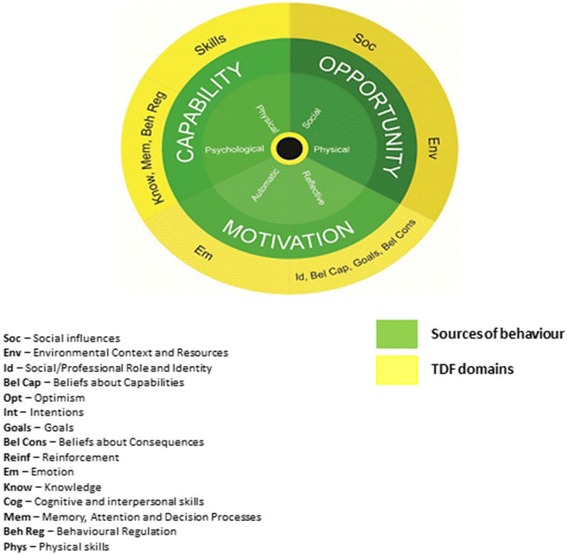
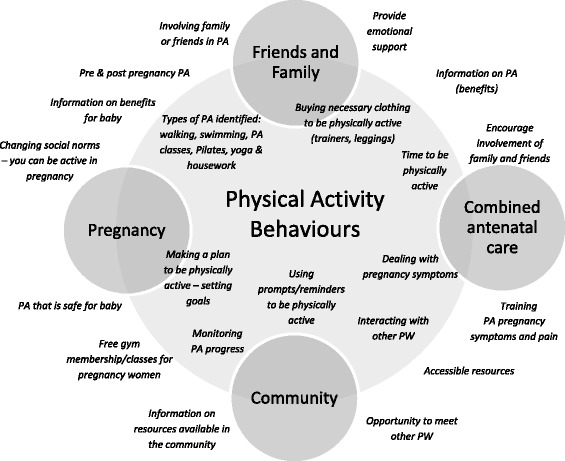
BACKGROUND: Obesity during pregnancy is associated with increased risk of gestational diabetes mellitus (GDM) and other complications. Physical activity is a modifiable lifestyle factor that may help to prevent these complications but many women reduce their physical activity levels during pregnancy. Interventions targeting physical activity in pregnancy are on-going but few identify the underlying behaviour change mechanisms by which the intervention is expected to work. To enhance intervention effectiveness, recent tools in behavioural science such as the Theoretical Domains Framework (TDF) and COM-B model (capability, opportunity, motivation and behaviour) have been employed to understand behaviours for intervention development. Using these behaviour change methods, this study aimed to identify the enablers and barriers to physical activity in overweight and obese pregnant women. METHODS: Semi-structured interviews were conducted with a purposive sample of overweight and obese women at different stages of pregnancy attending a public antenatal clinic in a large academic maternity hospital in Cork, Ireland. Interviews were recorded and transcribed into NVivo V.10 software. Data analysis followed the framework approach, drawing on the TDF and the COM-B model. RESULTS: Twenty one themes were identified and these mapped directly on to the COM-B model of behaviour change and ten of the TDF domains. Having the social opportunity to engage in physical activity was identified as an enabler; pregnant women suggested being active was easier when supported by their partners. Knowledge was a commonly reported barrier with women lacking information on safe activities during pregnancy and describing the information received from their midwife as 'limited'. Having the physical capability and physical opportunity to carry out physical activity were also identified as barriers; experiencing pain, a lack of time, having other children, and working prevented women from being active. CONCLUSION: A wide range of barriers and enablers were identified which influenced women's capability, motivation and opportunity to engage in physical activity with "knowledge" as the most commonly reported barrier. This study is a theoretical starting point in making a 'behavioural diagnoses' and the results will be used to inform the development of an intervention to increase physical activity levels among overweight and obese pregnant women.
Overview
The claims and statistics of this paper haven’t been checked yet.
Free: it reads the open-access text and checks the first 5 claims that cite a source we can check. Create a free account to check every claim.
Integrity signals
Registry
Cites
Statistics
Figures
Verification
Claims the paper makes
The claims and statistics of this paper haven’t been checked yet.
Free: it reads the open-access text and checks the first 5 claims that cite a source we can check. Create a free account to check every claim.
Claims other papers make about this one
Each is checked against this paper’s own text: does it say what the citing paper says it does?
The source backs part of the claim, not all of it — or backs it for a different population, condition or comparison.
In the citing paper
“the use of goal setting [18, 24, 28, 32, 34]”
From Identifying the factors affecting ‘patient engagement’ in exercise rehabilitation (2022) · cites this paper as [28]
Experimental — accuracy not yet measuredThe source backs part of the claim, not all of it — or backs it for a different population, condition or comparison.
In the citing paper
“it is apparent that simply prescribing the exercise is unlikely to result in high levels of adherence by the majority of patients.”
From Identifying the factors affecting ‘patient engagement’ in exercise rehabilitation (2022) · cites this paper as [28]
Experimental — accuracy not yet measuredThe source backs part of the claim, not all of it — or backs it for a different population, condition or comparison.
In the citing paper
“Since, unlike participants involved in clinical research trials who may receive enabling access to optimal resources and services, members of the general population commonly face multiple environmental barriers to their engagement in rehabilitation, such as: a lack of access to resources and services as an opportunity barrier [20, 21, 28, 30], high costs of resources and service [21, 26, 28, 30, 3”
From Identifying the factors affecting ‘patient engagement’ in exercise rehabilitation (2022) · cites this paper as [28]
Experimental — accuracy not yet measuredThe source backs part of the claim, not all of it — or backs it for a different population, condition or comparison.
In the citing paper
“In addition, twelve studies [15, 18, 20, 21, 24–28, 30–32, 34] found high perceived personal relevance to be associated with increased determination to engage in exercise behaviour.”
From Identifying the factors affecting ‘patient engagement’ in exercise rehabilitation (2022) · cites this paper as [28]
Experimental — accuracy not yet measuredThe cited source says what the claim attributes to it.
In the citing paper
“Multiple studies involving patients and clinicians identified a lack of access to resources and services as an opportunity barrier [20, 21, 28, 30, 34].”
From Identifying the factors affecting ‘patient engagement’ in exercise rehabilitation (2022) · cites this paper as [28]
10 more claims about this paper
Create a free account to see every claim other papers make about this one.
Self-check
Percentages, sums and reported differences re-computed from the paper’s own numbers.
The self-check needs the paper’s full text.
Citations
Cites
Michie, S., van Stralen, M. M., & West, R. (2011) · Implementation Science · doi:10.1186/1748-5908-6-42 · Cited by 13,697 · cited 2×
“The COM-B model forms the hub of the Behaviour Change Wheel (BCW) which provides a systematic and transparent way to conduct a behavioural assessment, identify the target behaviour, select intervention functions and to develop theory based intervention strategies [45].”
MethodDeveloping and evaluating complex interventions: the new Medical Research Council guidance
Craig, P., Dieppe, P., Macintyre, S., Michie, S., Nazareth, I., & Petticrew, M. (2008) · BMJ · doi:10.1136/bmj.a1655 · Cited by 10,995 · cited 1×
“Using theory to identify the determinants of behaviour can increase the likelihood that an intervention will be effective [40, 41].”
BackgroundGale, N. K., Heath, G., Cameron, E., Rashid, S., & Redwood, S. (2013) · BMC Medical Research Methodology · doi:10.1186/1471-2288-13-117 · Cited by 10,865 · cited 1×
“analysis followed a framework approach [57].”
‘Small Changes' to Diet and Physical Activity Behaviors for Weight Management
Hills, A. P., Byrne, N. M., Lindstrom, R., & Hill, J. O. (2013) · Obesity Facts · doi:10.1159/000345030 · Cited by 9,493
Health benefits of physical activity: the evidence
Warburton, D. E. R. (2006) · Canadian Medical Association Journal · doi:10.1503/cmaj.051351 · Cited by 8,007 · cited 2×
“However, research has shown that being physical active in early pregnancy can reduce these symptoms [11, 12].”
Background(2014) · Cited by 2,276
Using Pedometers to Increase Physical Activity and Improve Health: A Systematic Review
Bravata, D. M., Smith-Spangler, C., Sundaram, V., Gienger, A. L., Lin, N., Lewis, R., Stave, C. D., Olkin, I., & Sirard, J. R. (2007) · JAMA · doi:10.1001/jama.298.19.2296 · Cited by 2,064
Michie, S., Johnston, M., Francis, J., Hardeman, W., & Eccles, M. (2008) · Applied Psychology · doi:10.1111/j.1464-0597.2008.00341.x · Cited by 1,789 · cited 1×
“Using theory to identify the determinants of behaviour can increase the likelihood that an intervention will be effective [40, 41].”
BackgroundFrench, S. D., Green, S. E., O’Connor, D. A., McKenzie, J. E., Francis, J. J., Michie, S., Buchbinder, R., Schattner, P., Spike, N., & Grimshaw, J. M. (2012) · Implementation Science · doi:10.1186/1748-5908-7-38 · Cited by 1,338
Reducing and meta-analysing estimates from distributed lag non-linear models
Gasparrini, A., & Armstrong, B. (2013) · BMC Medical Research Methodology · doi:10.1186/1471-2288-13-1 · Cited by 1,081
Cited by
Items 101–200 of 218
Rubber Dam Isolation Survey (RDIS) for adhesive restorative treatments
Abreu‐Placeres, N., Fragoso, P. Y., Aponte, P. C., & Garrido, L. E. (2020) · European Journal Of Dental Education · doi:10.1111/eje.12562 · Cited by 7
Phonyiam, R. (2022) · Current Diabetes Reviews · doi:10.2174/1573399819666220627111430 · Cited by 7
Lamadah, S. M., Ahmed, A. H., maged, M. A. E., & Taman, A. H. S. (2021) · Tanta Scientific Nursing Journal · doi:10.21608/tsnj.2021.210727 · Cited by 9
Lange, L., Schulz, H., Suck, I., & Bleich, C. (2024) · JMIR Formative Research · doi:10.2196/51865 · Cited by 7
Predictors of physical activity among pregnant women in Harare, Zimbabwe
Hove, A. R., Sithambuli, E. N., Ncube, W. P., Doyce, S. R., Mukwekwe, S. N., Mapuranga, T., Tirivanhu, K., Chibanda, D., & Dambi, J. M. (2025) · PLOS Global Public Health · doi:10.1371/journal.pgph.0003470 · Cited by 5
Lelorain, S., Deruelle, P., Behal, H., Machet, E., Thiblet, M., Lengagne-Piedbois, C., Deken-Delannoy, V., & Pigeyre, M. (2024) · BMC Pregnancy and Childbirth · doi:10.1186/s12884-024-06648-z · Cited by 5
“…in challenging socio-economic contexts, a lack of time and support from their partners, which are widely recognized as -2.0 (-5.9 to 1.9) -0.6 (-5.2 to 3.9) 1.4 (-2.6 to 5.3) 0.50 Change (postpartum –baseline) # -3.4 (-7.6 to 0.9) -0.7 significant barriers to PA [38–40], may also be an issue.”
BackgroundInfluentialNguyen‐Hoang, A., Eades, C. E., Harris, F., & Cheyne, H. (2024) · Appetite · doi:10.1016/j.appet.2024.107710 · Cited by 7
Application of Implementation Science to OB/GYN Quality Improvement Efforts
Rosenstein, M. G. (2019) · Clinical Obstetrics & Gynecology · doi:10.1097/grf.0000000000000474 · Cited by 4
Makaruk, B., Grantham, W., Forczek, W., & Płaszewski, M. (2025) · Healthcare · doi:10.3390/healthcare13070727 · Cited by 8
“Structured group exercise programmes are particularly beneficial, providing professional guidance, social connections, and emotional reinforcement, which help reduce feelings of isolation and improve adherence [44].”
Liu, C., Wang, Y., Yang, X., Tao, T., & Jin, H. (2025) · Human Vaccines & Immunotherapeutics · doi:10.1080/21645515.2025.2550859 · Cited by 4
“14 It is widely used in health behavior, covering disease prevention, 23,24 health promotion, 25–28 public health, 29–31 and self-management.”
Li, Q., Tang, Y., Yang, X., Tingqiang, S. O. N. G., Wei, G., Gu, R., Pan, Y., Wang, J., Li, Y., & Wei, L. (2025) · BMC Pregnancy and Childbirth · doi:10.1186/s12884-025-08500-4 · Cited by 4
“…members, particularly spouses, can participate in GDM health education courses to provide effective supervision and support in the home environment [53], peer groups can utilize online pregnancy communities to share GDM prevention experiences, facilitating the exchange of reliable information and…”
Pathak, B. G., Vats, P., Jadaun, A. S., Garg, N., & Mazumder, S. (2026) · Frontiers in Global Women s Health · doi:10.3389/fgwh.2026.1695442 · Cited by 5
Livingston, R., Larkin, M., Olander, E. K., & Atkinson, L. (2024) · Journal of Reproductive and Infant Psychology · doi:10.1080/02646838.2024.2388165 · Cited by 3
“…information and encouragement from partners, family, friends, health and exercise professionals, exercising peers and other pregnant women (Cioffi et al., 2010; Evenson et al., 2009; Fieril et al., 2014; Flannery et al., 2018; Leiferman et al., 2011; Thornton et al., 2006; Whitaker et al., 2016).”
InfluentialColombage, U. N., Lin, K., Soh, S., Brennen, R., & Frawley, H. (2022) · Supportive Care in Cancer · doi:10.1007/s00520-022-07273-2 · Cited by 11
Mantzourani, E., James, D. H., Akthar, M. A., Brown, S. L., Yemm, R., Lehnbom, E. C., Hanrahan, J. R., & Seage, C. H. (2023) · Exploratory Research in Clinical and Social Pharmacy · doi:10.1016/j.rcsop.2023.100393 · Cited by 3
Gresham, P. E., Fields, S. A., Beebe, E., & Smallman, R. (2025) · Appetite · doi:10.1016/j.appet.2025.107953 · Cited by 2
Identifying The Factors Affecting ‘Patient Engagement’ In Exercise RehabilitationPreprint
Teo, J. L., Zheng, Z., & Bird, S. R. (2021) · Research Square · doi:10.21203/rs.3.rs-753800/v1 · Cited by 3
Power, S., Broom, D. R., Duncan, M. J., Biddle, S., & Rowley, N. (2024) · Obesity Science & Practice · doi:10.1002/osp4.774 · Cited by 4
“19 Participants reported that a key facilitator of exercise was awareness of the psychological and physiological benefits of participation.”
BackgroundNguyễn, T. N. Q., Tran, C. L., & Tran, N. H. M. (2025) · Y HOC TP HO CHI MINH · doi:10.32895/ump.mpr.9.2.18 · Cited by 2
Warne, S. J., Ainge, J. A., & Özakinci, G. (2025) · BMC Public Health · doi:10.1186/s12889-025-25007-x · Cited by 2
“The notion of opportunity, or a lack thereof, is often seen as one of the biggest perceived barriers to physical activity [35, 41], impacted by both physical and social elements.”
Warne, S. J., Brown, L. R., Barker, K., Carstairs, S. A., Cunningham, K. B., Duggal, S., Evans, I., Martin, A., Murray, A. H., Özakinci, G., et al. (2026) · BMC Family Practice · doi:10.1186/s12875-026-03180-1 · Cited by 2
Leonard, K. S., & Downs, D. S. (2022) · Obesity Research & Clinical Practice · doi:10.1016/j.orcp.2022.07.003 · Cited by 2
Population characteristics associated with adherence to prenatal group-based exercise programs
Nagpal, T. S., Sánchez‐Polán, M., da Silva, D. F., Souza, S. C. S., Peláez, M., Perales, M., Cordero, Y., Vargas‐Terrones, M., Adamo, K. B., & Barakat, R. (2022) · Journal of Sports Sciences · doi:10.1080/02640414.2022.2158011 · Cited by 4
Pico, M. L., Rangel-Osuna, F., Estrada, M. S., Granich-Armenta, A., Grunnet, L. G., Ramírez‐Silva, C. I., Ávila-Jiménez, L., Christensen, D. L., & Nielsen, K. K. (2024) · Nutrition · doi:10.1016/j.nut.2024.112493 · Cited by 3
Emmanuel, G., Adejimi, A., Ladi-Akinyemi, T., Sodeinde, K. J., & Oyewole, O. O. (2024) · Annals of Health Research (The Journal of the Medical and Dental Consultants Association of Nigeria OOUTH Sagamu Nigeria) · doi:10.30442/ahr.1002-02-230 · Cited by 2
“[3] 8] It is submitted, however, that pregnant women are not meeting this exercise recommendation.”
BackgroundMusendo, D. J., Zuurmond, M., Nkhonjera, T. A., Polack, S., & Patel, D. (2024) · Social Sciences · doi:10.3390/socsci13120654 · Cited by 6
Singh, S., Agarwal, M., Singh, P. K., & Prasad, I. (2025) · Cureus · doi:10.7759/cureus.76881 · Cited by 2
Koukamari, P. H., Ghaffari, M., Tavafian, S. S., & Ramezankhani, A. (2021) · Health Scope · doi:10.5812/jhealthscope.108354 · Cited by 4
“develop behavior change interventions in various contexts (38-40), but his behavior has not yet been applied in relation to improper sitting posture among employees.”
BackgroundMarital Age, Cigarette Exposure, Physical Activity, Sleep Duration, and Prenatal Depression
Syam, A., Ashar, H. M., Abrar, E. A., & Syam, A. (2022) · Disease Prevention and Public Health Journal (DPPHJ) · doi:10.12928/dpphj.v16i2.5374 · Cited by 3
Ramírez-Pérez, J. I., Lugo-González, I. V., Erazo, L. R., & Cabrera-Castañón, R. (2024) · Revista Mexicana de Trastornos Alimentarios/Mexican Journal of Eating Disorders · doi:10.22201/fesi.20071523e.2024.1.780 · Cited by 2
“Este proceso de análisis se ha reportado en estudios previos con poblaciones similares (Bhandari et al., 2021; Flannery et al., 2018).”
Fili, R., Nazmi, S., Behmanesh, F., Omrani, A., Nikbakht, H., & Amiri‐Farahani, L. (2024) · Journal of Client-centered Nursing Care · doi:10.32598/jccnc.10.3.596.1 · Cited by 1
Lewis, K., Roden-Lui, G., Faulkner, G., Gibbon, S., Hewitt, C. E., Hughes, E. A., Khan, W., Lucock, M. P., Singh, B., Walters, P., et al. (2024) · Mental health and physical activity · doi:10.1016/j.mhpa.2024.100663 · Cited by 1
Hewer, G., Akpa-Inyang, F. F., Mbona, S. V., Pillay, J. D., & Haffejee, F. (2025) · International Journal of Environmental Research and Public Health · doi:10.3390/ijerph22121798 · Cited by 1
“This study confirms these theoretical frameworks by revealing essential insights into such gaps within the context of Sub-Saharan Africa—a region where self-reported physical activity data may be unreliable due to various socio-economic and cultural dynamics [21].”
Al-Omary, H., Soltani, A., Stewart, D., & Nazar, Z. J. (2026) · International Journal of Clinical Pharmacy · doi:10.1007/s11096-025-02079-8 · Cited by 3
Gray, C. E., Lim, K., Palladino, J., Rowland, B., Wan, P., McVeigh, J. A., & Pang, B. (2026) · Journal of Health Psychology · doi:10.1177/13591053261434374 · Cited by 1
Barriers to physical activity in pregnant women: a cross-sectional study
Fili, R., Behmanesh, F., Omrani, A., Nikbakht, H., Nazmi, S., & Amiri‐Farahani, L. (2026) · BMC Pregnancy and Childbirth · doi:10.1186/s12884-026-09034-z · Cited by 1
“It is recommended that pregnant women perform 30 min of moderate-intensity PA daily [10].”
Ye, L., Wang, F., Li, L. J., Liao, Y., & Shang, X. (2026) · BMC Public Health · doi:10.1186/s12889-026-26418-0 · Cited by 1
“This may stem from emotional companionship from partners and family, which builds confidence in PA capabilities, thereby significantly increasing PA participation [20].”
Zhu, Z., Lin, X., Chen, Z., Li, H., & Lin, R. (2026) · JMIR Aging · doi:10.2196/79253 · Cited by 1
“Information from the literature [56,57] was used for the TDF and was mapped to the components of the COM-B model to develop a semistructured interview outline.”
Roland, C. B., Hernández‐Saavedra, D., Khan, A., Trôst, K., Möritz, T., Brændstrup, N., Knudsen, S. D. P., Jessen, A. D., Mølsted, S., Clausen, T. D., et al. (2026) · International Breastfeeding Journal · doi:10.1186/s13006-026-00857-2 · Cited by 1
“The proportion of nulliparous participants seemed to be higher in the EXE group, which could be a reason for the slightly higher physical activity level in EXE [54, 55].”
van Etten, S., Bal, M., Jansen, L., Dermody, B. J., de Wit, J. B. F., & Stok, F. M. (2026) · Appetite · doi:10.1016/j.appet.2026.108702 · Cited by 1
Factors Influencing Physical Activity in Pregnancy: A Systematic Review
Nawi, A. M. (2022) · Medicine & health · doi:10.17576/mh.2022.1701.05 · Cited by 1
“Social factors such as support from friends and family also played an important role in encouraging pregnant women to be physically active (Bauer et al. 2018; Flannery et al. 2018; Hoodbhoy et al. 2018; Muzigaba et al. 2014; Richardsen et al. 2016; Van Mulken et al. 2016).”
Influentialden Harink, T., Hoek, A., Groen, H., Roseboom, T. J., & van Deutekom, A. W. (2022) · BMJ Open · doi:10.1136/bmjopen-2021-057694 · Cited by 1
da Silva, M. P., Sá, A. M., Bastos, M., Bilharva, C., Marques, E., & da Silva, D. F. (2023) · Preventive Medicine · doi:10.1016/j.ypmed.2023.107818 · Cited by 1
Cummins, H., & Byrne, M. (2024) · HRB Open Research · doi:10.12688/hrbopenres.13827.1 · Cited by 1
Self-citationProfiles of adults most likely to become a foster family: A latent profile analysis
Magalhães, E., Costa, P., d'Eça, L., Matoso, M., Pinto, V. S., Ferreira, S., Baptista, J., & Graça, J. (2025) · Child Abuse & Neglect · doi:10.1016/j.chiabu.2025.107486 · Cited by 4
“Interventions are more likely to succeed when based on thorough behavioral analysis and supported by evidence-based theoretical frameworks (Flannery et al., 2018).”
Pettersson, A., Modin, S., Hasson, H., & Krakau, I. (2019) · BMC Family Practice · doi:10.1186/s12875-019-1007-7 · Cited by 1
Ramírez-Martínez, S., & Mesa, S. L. R. (2021) · Revista Colombiana de Obstetricia y Ginecología · doi:10.18597/rcog.3740 · Cited by 1
INTRODUCTION TO SLOWING DOWN APPROXIMATIONS IN NEUTRON TRANSPORT THEORY. Research Bulletin 2
Roy, D. H., & Murray, R. L. (1962) · OSTI OAI (U.S. Department of Energy Office of Scientific and Technical Information) · Cited by 2
Sediva, H., Cartwright, T., Robertson, C. A., & Deb, S. (2022) · doi:10.2196/preprints.37234
Rethinking Prenatal Exercise Trials: How Can We Improve Translation?
Weissgerber, T. L., & Garovic, V. D. (2019) · Mayo Clinic Proceedings · doi:10.1016/j.mayocp.2019.08.017
Radzi, A. M., Norfahmi, A. M., & Hamid, C. H. C. (2021) · International Journal of Science and Healthcare Research · doi:10.52403/ijshr.20210772
Lee, C., Chi, L., Huang, J., & Lin, C. (2020) · doi:10.2196/preprints.20340
Timlin, D., Giannantoni, B., McCormack, J. M., Polito, A., Ciarapica, D., Azzini, E., Giles, M., & Simpson, E. E. A. (2020) · Research Square · doi:10.21203/rs.3.rs-26417/v1
Tafreshi, M. (2022) · PsyArXiv (OSF Preprints) · doi:10.31234/osf.io/t56kj
Auliawati, S., & Tahun, O. D. (2022) · INFLUENCE International Journal of Science Review · doi:10.54783/influencejournal.v4i3.78
“This can lead to respiratory failure in pregnant women (Flannery et al., 2018; Kilich et al., 2020; Bivia et al., 2020).”
Mohammed-Durosinlorun, A. A., Sani, F., Abubakar, R., Egwu, F., Mohammed, C., & Taingson, M. (2022) · Nigerian Journal of Basic and Clinical Sciences. · doi:10.4103/njbcs.njbcs_11_21
Adipositas und Schwangerschaft – Rolle der körperlichen Aktivität
Ferrari, N., & Joisten, C. (2023) · Adipositas - Ursachen Folgeerkrankungen Therapie · doi:10.1055/a-1973-8808
Ruart, S., Sinnapah, S., Hüe, O., Janky, E., & Antoine‐Jonville, S. (2023) · Journal of Obstetrics and Gynaecology Canada · doi:10.1016/j.jogc.2023.05.025 · Cited by 2
Safaryan, P., Jamshidimanesh, M., & Haghani, S. (2023) · Avicenna Journal of Nursing and Midwifery Care · doi:10.32592/ajnmc.31.3.217
Alsairi, R. (2024) · Queensland University of Technology · doi:10.5204/thesis.eprints.248232
Gradidge, P. J.-L., Alsop, T., Palmeira, A. L., Gordon, N. F., & Gomersall, S. R. (2024) · Journal of Occupational and Environmental Medicine · doi:10.1097/jom.0000000000003198
“12 This finding suggests that interventions targeting this population should prioritize providing education and support about the benefits of and appropriate ways to engage in physical activity.”
Mitra, S., & Jadhav, P. (2024) · Indian Journal of Physical Therapy and Research · doi:10.4103/ijptr.ijptr_100_23
Okafor, U. B., Goon, D. T., & Niekerk, R. L. V. (2025) · Methods and Protocols · doi:10.3390/mps8020026
Ndupu, L. B., Walker, N., Evans, H., & Hands, A. (2025) · Research Square · doi:10.21203/rs.3.rs-6289218/v1
Innovative exergaming program for antenatal exercise: Pregnant women’s views and experiences
Wirtu, G. K., Duffield, R., Garcia, J. A., Salisbury, J., & Fox, D. J. (2025) · Midwifery · doi:10.1016/j.midw.2025.104491
Proebstl, S., Vogel, C., Lawrence, W. T., Strömmer, S., Inskip, H. M., Hammond, J., Hart, K., McGill, K., Harvey, N. C., Barker, M. E., et al. (2025) · PLoS ONE · doi:10.1371/journal.pone.0319224
“Women living with overweight and obesity might be concerned about exercising safely and also experience lack of time and opportunity to exercise [48].”
Song, Y., Zhang, J., Yang, X. M., Wang, J., & Wang, X.-Z. (2025) · Frontiers in Sports and Active Living · doi:10.3389/fspor.2025.1594501
Pigeon, S., Lardon, A., & Bussières, A. (2025) · BMC Complementary Medicine and Therapies · doi:10.1186/s12906-025-05115-2
Schoonakker, M. P., van den Burg, E. L., Sturm, C. A., Lamb, H. J., Pijl, H., Numans, M. E., Adriaanse, M. A., & van Peet, P. G. (2026) · Clinical Nutrition Open Science · doi:10.1016/j.nutos.2026.100730
Car, J., Pekošak, L., Arechvo, A., & Davenport, M. H. (2025) · The Lancet Obstetrics Gynaecology & Women s Health · doi:10.1016/j.lanogw.2025.100041 · Cited by 2
Sánchez, T. E., Meaney, S., O’Connor, C. D., Linehan, L. A., O’Donoghue, K., Byrne, M., & Matvienko‐Sikar, K. (2022) · Figshare · doi:10.6084/m9.figshare.20968409
Self-citationOliwa, J. N., Nzinga, J., Masini, E., van Hensbroek, M. B., Jones, C., English, M., & Hoog, A. H. V. (2020) · Figshare · doi:10.6084/m9.figshare.13291009
Sánchez, T. E., Meaney, S., O’Connor, C., Linehan, L. A., O’Donoghue, K., Byrne, M., & Matvienko‐Sikar, K. (2022) · Figshare · doi:10.6084/m9.figshare.20968415
Self-citationLelorain, S., Deruelle, P., Béhal, H., Machet, E., Thiblet, M., Lengagne-Piedbois, C., Deken-Delannoy, V., & Pigeyre, M. (2024) · Figshare · doi:10.6084/m9.figshare.26740775
Grailey, K., Hussain, R., Wylleman, E., Ezzat, A., Huf, S. W., & Franklin, B. D. (2024) · Figshare · doi:10.6084/m9.figshare.26626255
Thøgersen‐Ntoumani, C., Kritz, M., Grunseit, A., Chau, J., Ahmadi, M., Holtermann, A., Koster, A., Tudor‐Locke, C., Johnson, N., Sherrington, C., et al. (2024) · Figshare · doi:10.6084/m9.figshare.26602000
Thøgersen‐Ntoumani, C., Kritz, M., Grunseit, A., Chau, J., Ahmadi, M., Holtermann, A., Koster, A., Tudor‐Locke, C., Johnson, N., Sherrington, C., et al. (2024) · Figshare · doi:10.6084/m9.figshare.26602003
Lelorain, S., Deruelle, P., Béhal, H., Machet, E., Thiblet, M., Lengagne-Piedbois, C., Deken-Delannoy, V., & Pigeyre, M. (2024) · Figshare · doi:10.6084/m9.figshare.26129828
Murphy, K., Berk, J., Muhwava, L. S., Booley, S., Harbron, J., Ware, L., Norris, S. A., Zarowsky, C., Lambert, E. V., & Levitt, N. S. (2023) · Figshare · doi:10.6084/m9.figshare.22826962
Murphy, K., Berk, J., Muhwava, L. S., Booley, S., Harbron, J., Ware, L., Norris, S. A., Zarowsky, C., Lambert, E. V., & Levitt, N. S. (2023) · Figshare · doi:10.6084/m9.figshare.22826974
Garnweidner-Holme, L., Henriksen, L., Bjerkan, K. K., Lium, J., & Lukasse, M. (2022) · Figshare · doi:10.6084/m9.figshare.17798313
Sánchez, T. E., Meaney, S., O’Connor, C. D., Linehan, L. A., O’Donoghue, K., Byrne, M., & Matvienko‐Sikar, K. (2022) · Figshare · doi:10.6084/m9.figshare.20968406
Self-citationGrailey, K., Hussain, R., Wylleman, E., Ezzat, A., Huf, S. W., & Franklin, B. D. (2023) · Figshare · doi:10.6084/m9.figshare.24303271
Teo, J. L., Zheng, Z., & Bird, S. R. (2022) · Figshare · doi:10.6084/m9.figshare.19135984
Grailey, K., Hussain, R., Wylleman, E., Ezzat, A., Huf, S. W., & Franklin, B. D. (2024) · Figshare · doi:10.6084/m9.figshare.24303438
Oliwa, J. N., Nzinga, J., Masini, E., van Hensbroek, M. B., Jones, C., English, M., & Hoog, A. H. V. (2020) · Figshare · doi:10.6084/m9.figshare.13291000
Oliwa, J. N., Nzinga, J., Masini, E., van Hensbroek, M. B., Jones, C., English, M., & Hoog, A. H. V. (2020) · Figshare · doi:10.6084/m9.figshare.13291006
Pearse, B. L., Keogh, S., Rickard, C. M., & Fung, Y. L. (2021) · Figshare · doi:10.6084/m9.figshare.14738753
Ndupu, L. B., Staples, V., Lipka, S., Faghy, M. A., Bessadet, N., & Bussell, C. (2024) · Figshare · doi:10.6084/m9.figshare.26581571
Ndupu, L. B., Staples, V., Lipka, S., Faghy, M. A., Bessadet, N., & Bussell, C. (2024) · Figshare · doi:10.6084/m9.figshare.26581574
Oliwa, J. N., Nzinga, J., Masini, E., van Hensbroek, M. B., Jones, C., English, M., & Hoog, A. H. V. (2020) · Figshare · doi:10.6084/m9.figshare.13290997
Murphy, K., Berk, J., Muhwava, L. S., Booley, S., Harbron, J., Ware, L., Norris, S. A., Zarowsky, C., Lambert, E. V., & Levitt, N. S. (2023) · Figshare · doi:10.6084/m9.figshare.22826971
Pearse, B. L., Keogh, S., Rickard, C. M., & Fung, Y. L. (2021) · Figshare · doi:10.6084/m9.figshare.14738756
van den Burg, E. L., Schoonakker, M. P., Korpershoek, B., Sommeling, L. E., Sturm, C. A., Lamb, H. J., Pijl, H., Numans, M. E., Adriaanse, M. A., & van Peet, P. G. (2024) · Figshare · doi:10.6084/m9.figshare.25744416
Murphy, K., Berk, J., Muhwava, L. S., Booley, S., Harbron, J., Ware, L., Norris, S. A., Zarowsky, C., Lambert, E. V., & Levitt, N. S. (2023) · Figshare · doi:10.6084/m9.figshare.22826965
Oliwa, J. N., Nzinga, J., Masini, E., van Hensbroek, M. B., Jones, C., English, M., & Hoog, A. H. V. (2020) · Figshare · doi:10.6084/m9.figshare.13291003
Sánchez, T. E., Meaney, S., O’Connor, C. D., Linehan, L. A., O’Donoghue, K., Byrne, M., & Matvienko‐Sikar, K. (2022) · Figshare · doi:10.6084/m9.figshare.20968403
Self-citationLelorain, S., Deruelle, P., Béhal, H., Machet, E., Thiblet, M., Lengagne-Piedbois, C., Deken-Delannoy, V., & Pigeyre, M. (2024) · Figshare · doi:10.6084/m9.figshare.26129675
Thøgersen‐Ntoumani, C., Kritz, M., Grunseit, A., Chau, J., Ahmadi, M., Holtermann, A., Koster, A., Tudor‐Locke, C., Johnson, N., Sherrington, C., et al. (2024) · Figshare · doi:10.6084/m9.figshare.26602006
Grailey, K., Hussain, R., Wylleman, E., Ezzat, A., Huf, S. W., & Franklin, B. D. (2024) · Figshare · doi:10.6084/m9.figshare.26626258
Metadata
- Authors
- Flannery, C., McHugh, S., Anaba, A. E., Clifford, E., O’Riordan, M., Kenny, L. C., McAuliffe, F. M., Kearney, P. M., & Byrne, M.
- Affiliations
- Ollscoil na Gaillimhe – University of Galway (IE)
- University College Cork (IE)
- South Infirmary Victoria University Hospital (IE)
- University of Liverpool (GB)
- University College Dublin (IE)
- Corresponding author
- Flannery, C.
- Venue
- BMC Pregnancy and Childbirth
- Published
- 2018-05-21
- Volume
- 18
- Issue
- 1
- Pages
- 178-178
- ISSN
- 1471-2393 (ISSN-L)
- PMC
- PMC5963099
- OpenAlex
- W2806148862
- Semantic Scholar
- f85c1c46ed684eb8a63377b2a8d76517065d115d
- Cited by
- 218
- References
- 71
- Citations by year
- 2026: 26 · 2025: 24 · 2024: 39 · 2023: 27 · 2022: 38 · 2021: 26 · 2020: 31 · 2019: 6
- FWCI
- 10.80
- Type
- journal article
- Language
- en
- Open access
- gold
- doi.org
- Licence
- cc-by
- creativecommons.org/licenses/by/4.0/ (tdm)
- Locations
- BMC Pregnancy and Childbirth (publishedVersion, cc-by)
- Europe PMC (PubMed Central) (publishedVersion, other-oa)
- PubMed Central (publishedVersion, cc-by)
- PubMed (publishedVersion)
- Arrow@dit (Dublin Institute of Technology) (acceptedVersion)
- Arrow@dit (Dublin Institute of Technology) (submittedVersion)
- ARAN (University of Galway Research Repository) (Ollscoil na Gaillimhe – University of Galway) (submittedVersion, cc-by-nc-nd)
- Cork Open Research Archive (University College Cork, Ireland) (submittedVersion, cc-by)
- DOAJ (DOAJ: Directory of Open Access Journals) (submittedVersion, cc-by-sa)
- Lenus, The Irish Health Repository (Dr Steevens Hospital Library) (submittedVersion, cc-by)
- Funders
- Health Research Board (SPHeRE/2013/1)
- Topics
- Health Sciences › Medicine › Public Health, Environmental and Occupational Health › Physical Activity and Health
- Social Sciences › Psychology › Applied Psychology › Behavioral Health and Interventions
- Health Sciences › Medicine › Obstetrics and Gynecology › Gestational Diabetes Research and Management
- Keywords
- exercise during pregnancy, maternal obesity, overweight in pregnancy, barriers and facilitators, behavior change, Theoretical Domains Framework, COM-B model, gestational diabetes prevention, prenatal care, partner support, physical abilities, motivation, intervention development
- MeSH terms
- Adult, Attitude to Health, Female, Humans, Ireland, Models, Theoretical, Motivation, Obesity, Pregnancy, Pregnancy Complications, Health Behavior, Exercise, Qualitative Research, Pregnant People, Overweight, Young Adult
About these checks
Registry, retraction, Cites and statistics results are computed, not judged, with one exception: a printed reference that no index lists is read once by a model before it counts as a citation error. Claims are extracted by a model and kept only when their quote appears verbatim in the text; each cited source is then checked, with a model’s help, for whether it says what the claim relies on. Those verdicts can be wrong — read the claim’s quote and the cited source before relying on one.
Statistics and arithmetic are recomputed, not judged.
Confidence bands are shown only for fields calibrated on our annotated test set. None is calibrated yet, so no band is shown.
What counts as a claim ›How we measure confidence ›How we check this ›
Are you an author, or do you see a problem with this page? Request a review
Data sources
Bibliographic data: Semantic Scholar, OpenAlex, Crossref.
Contains information from the Semantic Scholar Academic Graph Datasets, made available under the ODC Attribution License (ODC-BY 1.0).
Semantic Scholar’s data is described in: Kinney, R., et al. (2023). The Semantic Scholar Open Data Platform. arXiv:2301.10140.
