

Insluin and epithelial growth factor (EGF) promote programmed death ligand 1(PD-L1) production and transport in colon cancer stem cells
Open accessThe DOI matches its Crossref record; 48 of the 49 references it cites were found in a registry or an index.
Abstract
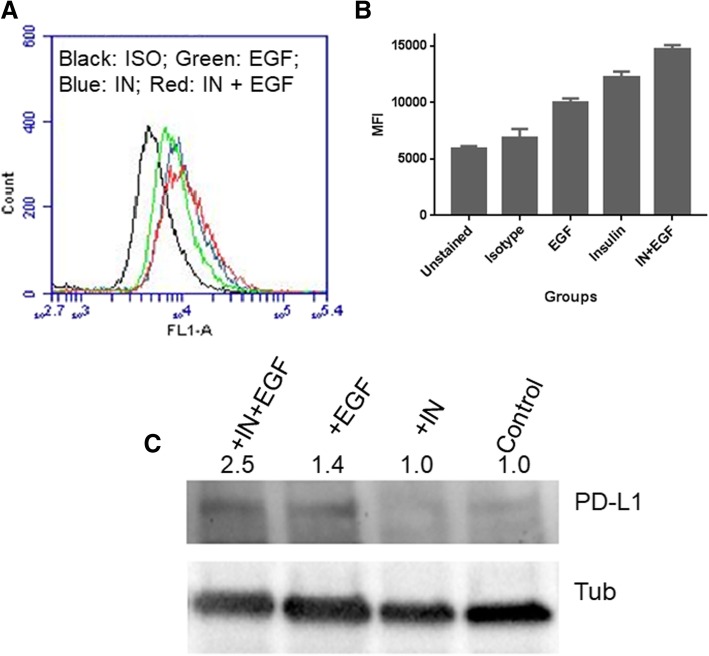
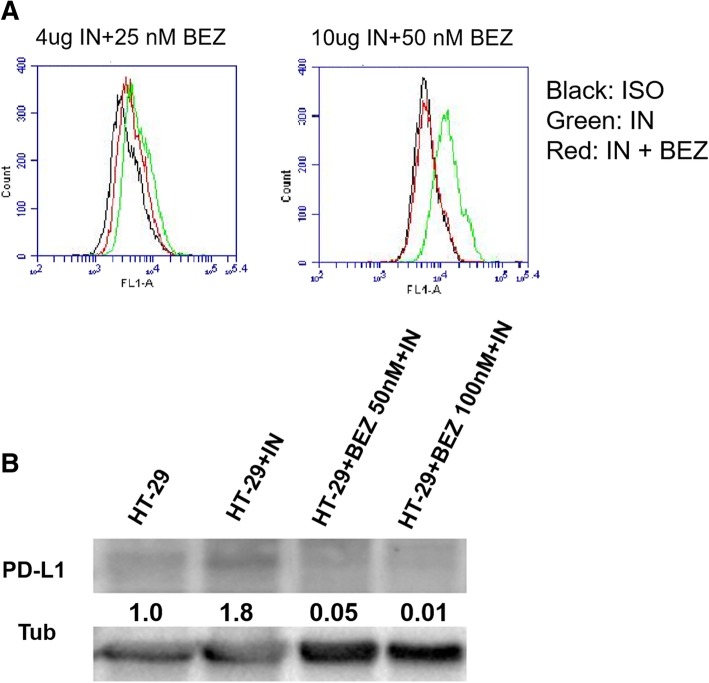
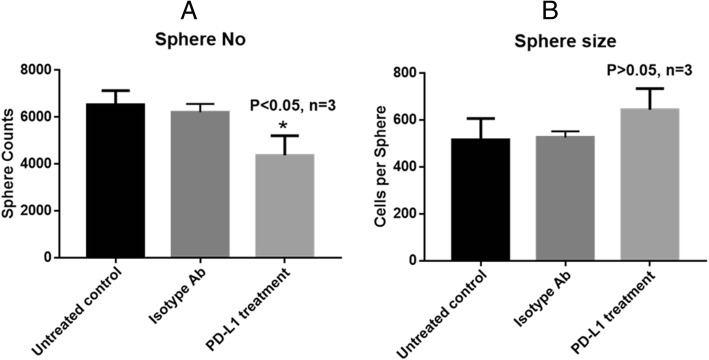
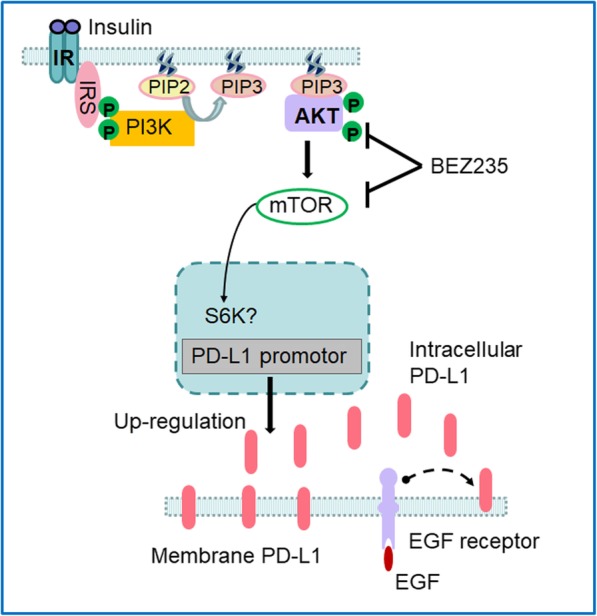
BACKGROUND: Programmed cell death ligand 1 (PD-L1) is an important immune-inhibitory protein expressed on cancer cells to mediate cancer escape through interaction with PD-1 expressed on activated T lymphocytes (T cells). Previously, we reported that colon and breast cancer stem cells (CSCs) expressed much higher levels of PD-L1 than their parental cells, suggesting they will be more resistant to immune attack. METHODS: We investigated the underlining mechanism of PD-L1 increase in colon CSCs, with a special focus on the effect of insulin and epithelial growth factor (EGF), the two fundamental components to sustain the metabolism and stemness in the culture of CSCs. RESULTS: We found that insulin increased the total and surface PD-L1 levels through PI3K/Akt/mTOR pathway as the increase could be inhibited by the dual inhibitor of the pathway, BEZ235. EGF didn't affect the total PD-L1 levels of CSCs but increased the cell surface protein levels by flow cytometry analysis, indicating EGF promotes the transport of PD-L1 to the cell surface. Blocking cell surface PD-L1 with a specific antibody resulted in a significant reduction of tumour sphere formation but didn't interfere with the sphere growth, suggesting that cell surface PD-L1 may act as an adhering molecule for CSCs. CONCLUSIONS: Apart from the essential roles in metabolism and stemness, insulin and EGF involve in up-regulation of PD-L1 expression in colon CSCs, therefore the inhibition of insulin and EGF/EGFR pathways can be considered for cancer immunotherapy or combined with PD-1/PD-L1 antibody-based cancer immunotherapy to eliminate CSCs.
Overview
The claims and statistics of this paper haven’t been checked yet.
Free: it reads the open-access text and checks the first 5 claims that cite a source we can check. Create a free account to check every claim.
Integrity signals
Registry
Cites
Statistics
Figures
Verification
Claims the paper makes
The claims and statistics of this paper haven’t been checked yet.
Free: it reads the open-access text and checks the first 5 claims that cite a source we can check. Create a free account to check every claim.
Claims other papers make about this one
Each is checked against this paper’s own text: does it say what the citing paper says it does?
In the citing paper
“A series of preclinical studies has shown that PI3K/AKT induces high expression of PD-L1 in colon cancer stem cells and mediates immune escape [226,227].”
From Drug Resistance in Colorectal Cancer: From Mechanism to Clinic (2022) · cites this paper as [227]
Self-check
Percentages, sums and reported differences re-computed from the paper’s own numbers.
The self-check needs the paper’s full text.
Citations
Cites
PD-1 and PD-L1 Immune Checkpoint Blockade to Treat Breast Cancer
Hartkopf, A. D., Taran, F.-A., Wallwiener, M., Walter, C. B., Krämer, B., Grischke, E.-M., & Brucker, S. Y. (2016) · Breast Care · doi:10.1159/000453569 · Cited by 30,845
Safety and activity of anti-PD-L1 antibody in patients with advanced cancer
Brahmer, J. R., Tykodi, S. S., Chow, L. Q. M., Hwu, W.-J., Topalian, S. L., Hwu, P., Drake, C. G., Camacho, L. H., Kauh, J., Odunsi, K., et al. (2012) · New England Journal of Medicine · doi:10.1056/nejmoa1200694 · Cited by 7,945
Insulin signalling and the regulation of glucose and lipid metabolism
Saltiel, A. R., & Kahn, C. R. (2001) · Nature · doi:10.1038/414799a · Cited by 5,326
The future of immune checkpoint therapy
Sharma, P., & Allison, J. P. (2015) · Science · doi:10.1126/science.aaa8172 · Cited by 4,878
Safety and Tumor Responses with Lambrolizumab (Anti–PD-1) in Melanoma
Hamid, O., Robert, C., Daud, A., Hodi, F. S., Hwu, W.-J., Kefford, R., Wolchok, J. D., Hersey, P., Joseph, R. W., Weber, J. S., et al. (2013) · New England Journal of Medicine · doi:10.1056/nejmoa1305133 · Cited by 3,392
Iwai, Y., Ishida, M., Tanaka, Y., Okazaki, T., Honjo, T., & Minato, N. (2002) · Proceedings of the National Academy of Sciences · doi:10.1073/pnas.192461099 · Cited by 3,203
Mechanism-driven biomarkers to guide immune checkpoint blockade in cancer therapy
Topalian, S. L., Taube, J. M., Anders, R. A., & Pardoll, D. M. (2016) · Nature Reviews Cancer · doi:10.1038/nrc.2016.36 · Cited by 2,733
In vitro propagation and transcriptional profiling of human mammary stem/progenitor cells
Dontu, G., Abdallah, W. M., Foley, J. M., Jackson, K. W., Clarke, M. F., Kawamura, M. J., & Wicha, M. S. (2003) · Genes & Development · doi:10.1101/gad.1061803 · Cited by 2,406
PD-L1 expression as a predictive biomarker in cancer immunotherapy
Patel, S. P., & Kurzrock, R. (2015) · Molecular Cancer Therapeutics · doi:10.1158/1535-7163.mct-14-0983 · Cited by 2,291
Exploiting the PI3K/AKT Pathway for Cancer Drug Discovery
Hennessy, B. T., Smith, D. L., Ram, P. T., Lu, Y., & Mills, G. B. (2005) · Nature Reviews Drug Discovery · doi:10.1038/nrd1902 · Cited by 2,185
The cancer stem cell: premises, promises and challenges
Clevers, H. (2011) · Nature Medicine · doi:10.1038/nm.2304 · Cited by 1,923
let-7 Regulates Self Renewal and Tumorigenicity of Breast Cancer Cells
Yu, F., Yao, H., Zhu, P., Zhang, X., Pan, Q., Gong, C., Huang, Y., Hu, X., Su, F., Lieberman, J., et al. (2007) · Cell · doi:10.1016/j.cell.2007.10.054 · Cited by 1,910
Alsaab, H. O., Sau, S., Alzhrani, R., Tatiparti, K., Bhise, K., Kashaw, S. K., & Iyer, A. K. (2017) · Frontiers in Pharmacology · doi:10.3389/fphar.2017.00561 · Cited by 1,707
Jordan, C. T., Guzman, M. L., & Noble, M. (2006) · New England Journal of Medicine · doi:10.1056/nejmra061808 · Cited by 1,702
Hamanishi, J., Mandai, M., Iwasaki, M., Okazaki, T., Tanaka, Y., Yamaguchi, K., Higuchi, T., Yagi, H., Takakura, K., Minato, N., et al. (2007) · Proceedings of the National Academy of Sciences · doi:10.1073/pnas.0611533104 · Cited by 1,378
Targeting the PI3K-Akt pathway in human cancer
Luo, J., Manning, B. D., & Cantley, L. C. (2003) · Cancer Cell · doi:10.1016/s1535-6108(03)00248-4 · Cited by 1,290
Glycosylation and stabilization of programmed death ligand-1 suppresses T-cell activity
Li, C.-W., Lim, S.-O., Xia, W., Lee, H.-H., Chan, L.-C., Kuo, C.-W., Khoo, K.-H., Chang, S.-S., Cha, J.-H., Kim, T., et al. (2016) · Nature Communications · doi:10.1038/ncomms12632 · Cited by 1,091
Self-citationCMTM6 maintains the expression of PD-L1 and regulates anti-tumour immunity
Burr, M. L., Sparbier, C. E., Chan, Y.-C., Williamson, J. C., Woods, K., Beavis, P. A., Lam, E. Y. N., Henderson, M. A., Bell, C. C., Stolzenburg, S., et al. (2017) · Nature · doi:10.1038/nature23643 · Cited by 946
Combination cancer immunotherapies tailored to the tumour microenvironment
Smyth, M. J., Ngiow, S. F., Ribas, A., & Teng, M. W. L. (2016) · Nature Reviews Clinical Oncology · doi:10.1038/nrclinonc.2015.209 · Cited by 944
Gao, Q., Wang, X.-Y., Qiu, S.-J., Yamato, I., Sho, M., Nakajima, Y., Zhou, J., Li, B.-Z., Shi, Y.-H., Xiao, Y.-S., et al. (2009) · Clinical Cancer Research · doi:10.1158/1078-0432.ccr-08-1608 · Cited by 813
Regulation of PD-L1: a novel role of pro-survival signalling in cancer.
Chen, J., Jiang, C. C., Jin, L., & Zhang, X. D. (2016) · Annals of Oncology · doi:10.1093/annonc/mdv615 · Cited by 767
Single-cell cloning of colon cancer stem cells reveals a multi-lineage differentiation capacity
Vermeulen, L., Todaro, M., de Sousa Mello, F., Sprick, M. R., Kemper, K., Perez Alea, M., Richel, D. J., Stassi, G., & Medema, J. P. (2008) · Proceedings of the National Academy of Sciences · doi:10.1073/pnas.0805706105 · Cited by 724
Kiyasu, J., Miyoshi, H., Hirata, A., Arakawa, F., Ichikawa, A., Niino, D., Sugita, Y., Yufu, Y., Choi, I., Abe, Y., et al. (2015) · Blood · doi:10.1182/blood-2015-02-629600 · Cited by 464
Common and Distinct Elements in Cellular Signaling via EGF and FGF Receptors
Schlessinger, J. (2004) · Science · doi:10.1126/science.1105396 · Cited by 443
Bellucci, R., Martin, A., Bommarito, D., Wang, K., Hansen, S. H., Freeman, G. J., & Ritz, J. (2015) · OncoImmunology · doi:10.1080/2162402x.2015.1008824 · Cited by 307
Tang, Y., Fang, W., Zhang, Y., Hong, S., Kang, S., Yan, Y., Chen, N., Zhan, J., He, X., Qin, T., et al. (2015) · Oncotarget · doi:10.18632/oncotarget.3694 · Cited by 243
Almozyan, S., Colak, D., Mansour, F., Alaiya, A., Al‐Harazi, O., Qattan, A., Al‐Mohanna, F., Al‐Alwan, M., & Ghebeh, H. (2017) · International Journal of Cancer · doi:10.1002/ijc.30834 · Cited by 238
Ghebeh, H., Lehe, C., Barhoush, E., Al-Romaih, K., Tulbah, A., Al-Alwan, M., Hendrayani, S.-F., Manogaran, P., Alaiya, A., Al-Tweigeri, T., et al. (2010) · Breast Cancer Research · doi:10.1186/bcr2605 · Cited by 234
Satelli, A., Batth, I. S., Brownlee, Z., Rojas, C., Meng, Q. H., Kopetz, S., & Li, S. (2016) · Scientific Reports · doi:10.1038/srep28910 · Cited by 203
Immunotherapy for pancreatic cancer — science driving clinical progress
Laheru, D., & Jaffee, E. M. (2005) · Nature Reviews Cancer · doi:10.1038/nrc1630 · Cited by 202
Chowdhury, S., Veyhl, J., Jessa, F., Polyakova, O., Alenzi, A., MacMillan, C., Ralhan, R., & Walfish, P. G. (2016) · Oncotarget · doi:10.18632/oncotarget.8698 · Cited by 193
PD-L1 expression is regulated by hypoxia inducible factor in clear cell renal cell carcinoma
Ruf, M., Moch, H., & Schraml, P. (2016) · International Journal of Cancer · doi:10.1002/ijc.30077 · Cited by 179
Okita, R., Maeda, A., Shimizu, K., Nojima, Y., Saisho, S., & Nakata, M. (2017) · Cancer Immunology Immunotherapy · doi:10.1007/s00262-017-1986-y · Cited by 159
The Emerging Role of Insulin and Insulin-Like Growth Factor Signaling in Cancer Stem Cells
Malaguarnera, R., & Belfiore, A. (2014) · Frontiers in Endocrinology · doi:10.3389/fendo.2014.00010 · Cited by 143
Zhang, Z., Dong, Z., Lauxen, I. S., Filho, M. S., & Nor, J. E. (2014) · Cancer Research · doi:10.1158/0008-5472.can-13-2032 · Cited by 136
Ukpo, O. C., Thorstad, W. L., & Lewis, J. S. (2012) · Head and Neck Pathology · doi:10.1007/s12105-012-0406-z · Cited by 131
Increased PD ‐L1 expression in breast and colon cancer stem cells
Wu, Y., Chen, M., Wu, P., Chen, C., Xu, Z. P., & Gu, W. (2017) · Clinical and Experimental Pharmacology and Physiology · doi:10.1111/1440-1681.12732 · Cited by 111
Self-citationPI 3K/Akt/ mTOR pathway dual inhibitor BEZ 235 suppresses the stemness of colon cancer stem cells
Chen, J., Shao, R., Li, F., Monteiro, M. J., Liu, J., Xu, Z. P., & Gu, W. (2015) · Clinical and Experimental Pharmacology and Physiology · doi:10.1111/1440-1681.12493 · Cited by 102
Self-citationMagner, N. L., Jung, Y., Wu, J., Nolta, J. A., Zern, M. Α., & Zhou, P. (2013) · Stem Cells · doi:10.1002/stem.1478 · Cited by 95
Gu, W., Yeo, E., McMillan, N. A. J., & Yu, C. (2011) · Cancer Gene Therapy · doi:10.1038/cgt.2011.58 · Cited by 71
Self-citationB7-H1 expression is associated with expansion of regulatory T cells in colorectal carcinoma
Hua, D., Sun, J., Mao, Y., Chen, L.-J., Wu, Y.-Y., & 张学光 (2012) · World Journal of Gastroenterology · doi:10.3748/wjg.v18.i9.971 · Cited by 54
Self-citationJinesh, G. G., Manyam, G. C., Mmeje, C., Baggerly, K., & Kamat, A. M. (2017) · Scientific Reports · doi:10.1038/s41598-017-08796-z · Cited by 54
Liang, M., Hui, Y., & Fu, J. (2008) · Cancer Letters · doi:10.1016/j.canlet.2008.10.028 · Cited by 48
Zhang, W., Pang, Q., Yan, C., Wang, Q., Yang, J., Yu, S., Liu, X., Yuan, Z., Wang, P., & Xiao, Z. (2017) · OncoTargets and Therapy · doi:10.2147/ott.s118982 · Cited by 41
Insulin resistance in vascular endothelial cells promotes intestinal tumour formation
Wang, X., Häring, M.-F., Rathjen, T., Lockhart, S. M., Sørensen, D., Ussar, S., Rasmussen, L. M., Bertagnolli, M. M., Kahn, C. R., & Rask‐Madsen, C. (2017) · Oncogene · doi:10.1038/onc.2017.107 · Cited by 41
Precision medicine in immune checkpoint blockade therapy for non‐small cell lung cancer
Liu, X., & Cho, W. C. S. (2017) · Clinical and Translational Medicine · doi:10.1186/s40169-017-0136-7 · Cited by 41
Gu, W., Chen, J., Yang, L., & Zhao, K. (2012) · The Scientific World JOURNAL · doi:10.1100/2012/621969 · Cited by 10
Self-citationmiR-4317, a promising player tuning the anti-tumor armamentarium against breast cancer
Youness, R. A., Assal, R. A., Abdelmotaal, A. A., & Gad, M. Z. (2018) · Annals of Oncology · doi:10.1093/annonc/mdy315.003 · Cited by 3
Cited by
Yao, X., Tu, Y., Xu, Y., Guo, Y., Yao, F., & Zhang, X. (2020) · Journal of Cellular and Molecular Medicine · doi:10.1111/jcmm.15367 · Cited by 183
Drug Resistance in Colorectal Cancer: From Mechanism to Clinic
Wang, Q., Shen, X., Chen, G., & Du, J. (2022) · Cancers · doi:10.3390/cancers14122928 · Cited by 160
Immune evasion by cancer stem cells
Tsuchiya, H., & Shiota, G. (2021) · Regenerative Therapy · doi:10.1016/j.reth.2021.02.006 · Cited by 160
Jabbarzadeh Kaboli, P., Salimian, F., Aghapour, S., Xiang, S., Zhao, Q., Li, M., Wu, X., Du, F., Zhao, Y., Shen, J., et al. (2020) · Pharmacological Research · doi:10.1016/j.phrs.2020.104806 · Cited by 159
Li, W., Wu, F., Zhao, S., Shi, P., Wang, S., & Cui, D. (2022) · Cytokine & Growth Factor Reviews · doi:10.1016/j.cytogfr.2022.07.004 · Cited by 158
Metadata
- Authors
- Chen, M., Sharma, A., Lin, Y., Wu, Y., He, Q., Gu, Y., Xu, Z. P., Monteiro, M., & Gu, W.
- Affiliations
- The University of Queensland (AU)
- Corresponding author
- Gu, Wenyi
- Venue
- BMC Cancer
- Published
- 2019-02-15
- Volume
- 19
- Issue
- 1
- Pages
- 153-153
- ISSN
- 1471-2407 (ISSN-L)
- PMC
- PMC6377751
- OpenAlex
- W2919282928
- Cited by
- 53
- References
- 49
- Citations by year
- 2026: 4 · 2025: 2 · 2024: 13 · 2023: 7 · 2022: 9 · 2021: 7 · 2020: 6 · 2019: 5
- FWCI
- 2.82
- Type
- journal article
- Language
- en
- Open access
- gold
- doi.org
- Licence
- cc-by
- creativecommons.org/licenses/by/4.0/ (tdm)
- Locations
- BMC Cancer (publishedVersion, cc-by)
- Europe PMC (PubMed Central) (publishedVersion, other-oa)
- PubMed Central (publishedVersion, cc-by)
- PubMed (publishedVersion)
- DOAJ (DOAJ: Directory of Open Access Journals) (submittedVersion, cc-by-sa)
- Funders
- University of Queensland
- Topics
- Health Sciences › Medicine › Oncology › Cancer Immunotherapy and Biomarkers
- Health Sciences › Medicine › Oncology › Cancer Cells and Metastasis
- Life Sciences › Immunology and Microbiology › Immunology › Immunotherapy and Immune Responses
- Keywords
- PD-L1, colon cancer stem cells, insulin, epithelial growth factor, EGFR signaling, PI3K/AKT/mTOR pathway, BEZ235, tumor immunosuppression, cancer immunotherapy, PD-1/PD-L1 blockade
- MeSH terms
- Phosphoinositide-3 Kinase Inhibitors, Antibodies, Monoclonal, Antineoplastic Agents, Cell Membrane, Colonic Neoplasms, Cytoplasm, Epidermal Growth Factor, Humans, Imidazoles, Immunotherapy, Insulin, Quinolines, Neoplastic Stem Cells, Up-Regulation, HT29 Cells, Phosphatidylinositol 3-Kinases, Proto-Oncogene Proteins c-akt, B7-H1 Antigen, Antibodies, Monoclonal, Humanized
About these checks
Registry, retraction, Cites and statistics results are computed, not judged, with one exception: a printed reference that no index lists is read once by a model before it counts as a citation error. Claims are extracted by a model and kept only when their quote appears verbatim in the text; each cited source is then checked, with a model’s help, for whether it says what the claim relies on. Those verdicts can be wrong — read the claim’s quote and the cited source before relying on one.
Statistics and arithmetic are recomputed, not judged.
Confidence bands are shown only for fields calibrated on our annotated test set. None is calibrated yet, so no band is shown.
What counts as a claim ›How we measure confidence ›How we check this ›
Are you an author, or do you see a problem with this page? Request a review
Data sources
Bibliographic data: Semantic Scholar, OpenAlex, Crossref.
Contains information from the Semantic Scholar Academic Graph Datasets, made available under the ODC Attribution License (ODC-BY 1.0).
Semantic Scholar’s data is described in: Kinney, R., et al. (2023). The Semantic Scholar Open Data Platform. arXiv:2301.10140.
