

The DOI matches its Crossref record; 43 of the 43 references it cites were found in a registry or an index.
Pedigree investigation, clinical characteristics, and prognosis analysis of haematological disease patients with germline TET2 mutation
Abstract
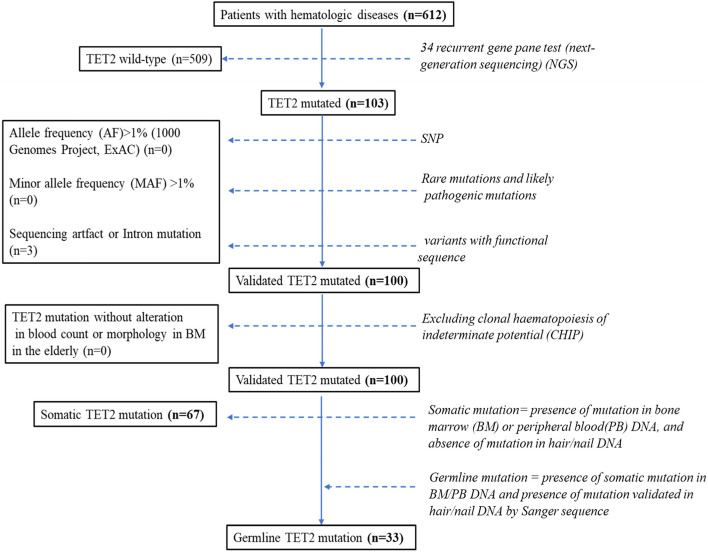
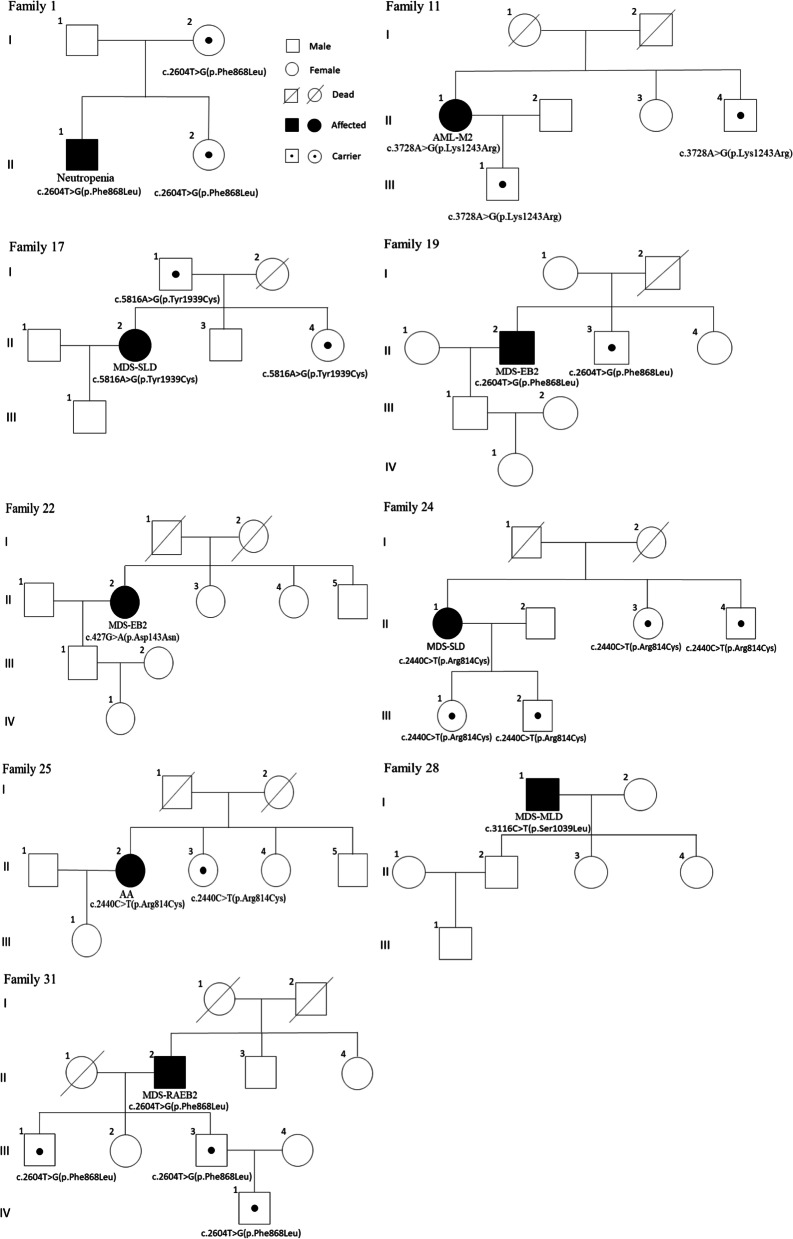
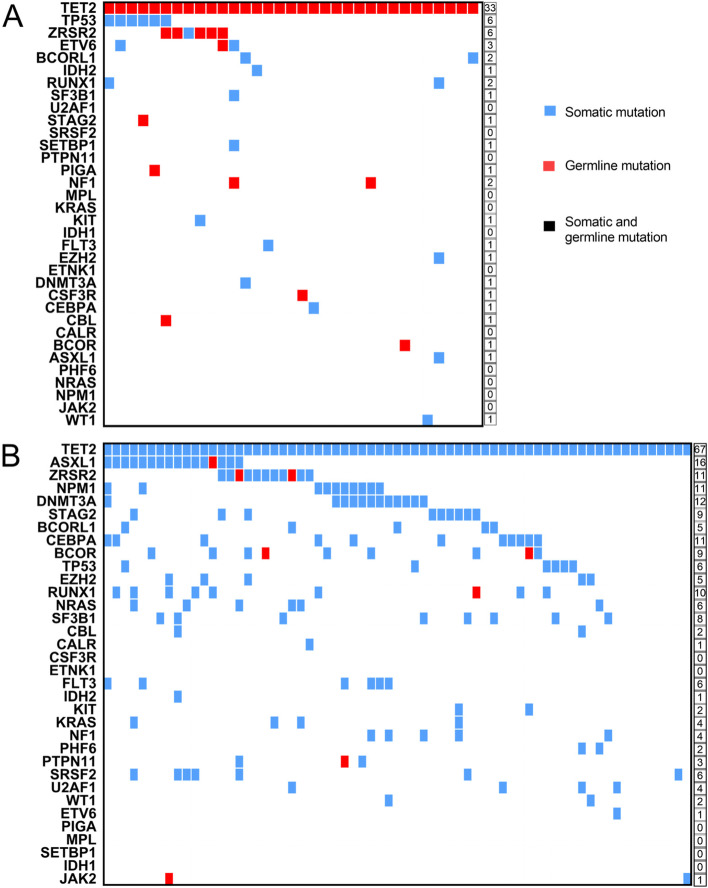
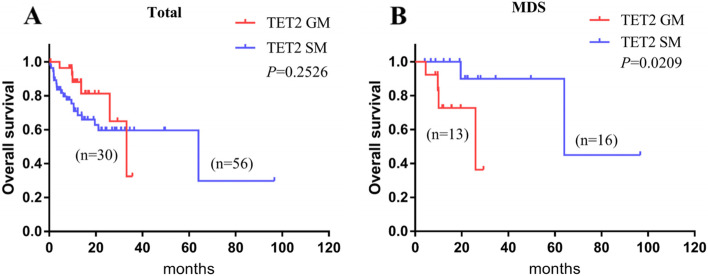
Background: Increasing germline gene mutations have been discovered in haematological malignancies with the development of next-generation sequencing (NGS), which is critical for proper clinical management and long-term follow-up of affected individuals. Tet methylcytosine dioxygenase 2 (TET2) is one of the most common mutations in haematological neoplasms. We aimed to compare the clinical characteristics of patients with germline and somatic TET2 mutations in haematological diseases and to analyse whether germline TET2 mutations have a family aggregation and tumour predisposition. Methods: Out of 612 patients who underwent NGS of 34 recurrently mutated genes in haematological diseases, 100 haematological patients with TET2 mutations were selected for further study. Somatic mutations were detected by NGS in bone marrow/peripheral blood genomic DNA (gDNA). Germline TET2 mutations were validated in nail/hair gDNA by Sanger sequencing. Digital data were extracted from the haematology department of the West China Hospital of Sichuan University. TET2 mutation results were analysed by referencing online public databases (COSMIC and ClinVar). Results: One hundred patients were studied, including 33 patients with germline and 67 patients with somatic TET2 mutations. For germline TET2 mutations, the variant allele frequency (VAF) was more stable (50.58% [40.5–55], P < 0.0001), and mutation sites recurrently occurred in three sites, unlike somatic TET2 mutations. Patients with germline TET2 mutations were younger (median age 48, 16–82 years) (P = 0.0058) and mainly suffered from myelodysplastic syndromes (MDS) (n = 13, 39.4%), while patients with somatic TET2 mutations were mainly affected by acute myeloid leukemia (AML) (n = 26, 38.8%) (P = 0.0004). Germline TET2 mutation affected the distribution of cell counts in the peripheral blood and bone marrow (P < 0.05); it was a poor prognostic factor for MDS patients via univariate analysis (HR = 5.3, 95% CI: 0.89–32.2, P = 0.0209) but not in multivariate analysis using the Cox regression model (P = 0.062). Conclusions: Germline TET2 mutation might have a family aggregation, and TET2 may be a predisposition gene for haematological malignancy under the other gene mutations as the second hit. Germline TET2 mutation may play a role in the proportion of blood and bone marrow cells and, most importantly, may be an adverse factor for MDS patients.
Overview
The claims and statistics of this paper haven’t been checked yet.
Run the check — free, no account needed. It reads the open-access text and checks the sources it cites.
Integrity signals
Registry
Cites
Statistics
Figures
Verification
Claims the paper makes
The claims and statistics of this paper haven’t been checked yet.
Run the check — free, no account needed. It reads the open-access text and checks the sources it cites.
Claims other papers make about this one
Each is checked against this paper’s own text: does it say what the citing paper says it does?
In the citing paper
“Interestingly, families with germline heterozygous TET2 or DNMT3A mutations develop predominantly myeloid neoplasms [234][235][236][237][238] , whereas rare individuals with germline homozygous TET2 mutations develop either B or T cell lymphomas along with a lymphoproliferative syndrome characterized by autoimmune cytopenias and immunodeficiency 239 .”
From Clonal haematopoiesis and dysregulation of the immune system (2023) · cites this paper as [235]
Self-check
Percentages, sums and reported differences re-computed from the paper’s own numbers.
The self-check needs the paper’s full text.
Citations
Cites
Arber, D. A., Orazi, A., Hasserjian, R., Thiele, J., Borowitz, M. J., Le Beau, M. M., Bloomfield, C. D., Cazzola, M., & Vardiman, J. W. (2016) · Blood · doi:10.1182/blood-2016-03-643544 · Cited by 10,119
Mutation in TET2 in Myeloid Cancers
Delhommeau, F., Dupont, S., Valle, V. D., James, C., Trannoy, S., Massé, A., Kosmider, O., Le Couedic, J.-P., Robert, F., Alberdi, A., et al. (2009) · New England Journal of Medicine · doi:10.1056/nejmoa0810069 · Cited by 1,776
Clinical Effect of Point Mutations in Myelodysplastic Syndromes
Bejar, R., Stevenson, K., Abdel-Wahab, O., Galili, N., Nilsson, B., Garcia-Manero, G., Kantarjian, H., Raza, A., Levine, R. L., Neuberg, D., et al. (2011) · New England Journal of Medicine · doi:10.1056/nejmoa1013343 · Cited by 1,627
Tet2 loss leads to increased hematopoietic stem cell self-renewal and myeloid transformation
Moran-Crusio, K., Reavie, L., Shih, A., Abdel-Wahab, O., Ndiaye-Lobry, D., Lobry, C., Figueroa, M. E., Vasanthakumar, A., Patel, J., Zhao, X., et al. (2011) · Cancer Cell · doi:10.1016/j.ccr.2011.06.001 · Cited by 1,339
Clonal hematopoiesis in human aging and disease
Jaiswal, S., & Ebert, B. L. (2019) · Science · doi:10.1126/science.aan4673 · Cited by 1,156 · cited 2×
“All 100 patients with TET2 mutations in our study had significant alterations in blood count to exclude the possibility of CHIP.”
BackgroundSong, W.-J., Sullivan, M. G., Legare, R. D., Hutchings, S., Tan, X., Kufrin, D., Ratajczak, J., Resende, I. C., Haworth, C., Hock, R., et al. (1999) · Nature Genetics · doi:10.1038/13793 · Cited by 1,100
Pathogenic Germline Variants in 10,389 Adult Cancers
Huang, K.-L., Mashl, R. J., Wu, Y., Ritter, D. I., Wang, J., Oh, C., Paczkowska, M., Reynolds, S., Wyczalkowski, M. A., Oak, N., et al. (2018) · Cell · doi:10.1016/j.cell.2018.03.039 · Cited by 833
Self-citationRecurrent somatic TET2 mutations in normal elderly individuals with clonal hematopoiesis
Busque, L., Patel, J. P., Figueroa, M. E., Vasanthakumar, A., Provost, S., Hamilou, Z., Mollica, L., Li, J., Viale, A., Heguy, A., et al. (2012) · Nature Genetics · doi:10.1038/ng.2413 · Cited by 830
Genetic characterization of TET1, TET2, and TET3 alterations in myeloid malignancies
Abdel-Wahab, O., Mullally, A., Hedvat, C., Garcia-Manero, G., Patel, J., Wadleigh, M., Malinge, S., Yao, J., Kilpivaara, O., Bhat, R., et al. (2009) · Blood · doi:10.1182/blood-2009-03-210039 · Cited by 727
Acquired mutations in TET2 are common in myelodysplastic syndromes
Langemeijer, S. M. C., Kuiper, R. P., Berends, M., Knops, R., Aslanyan, M. G., Massop, M., Stevens-Linders, E., van Hoogen, P., van Kessel, A. G., Raymakers, R. A. P., et al. (2009) · Nature Genetics · doi:10.1038/ng.391 · Cited by 680
Hahn, C. N., Chong, C.-E., Carmichael, C. L., Wilkins, E. J., Brautigan, P. J., Li, X.-C., Babic, M., Lin, M., Carmagnac, A., Lee, Y. K., et al. (2011) · Nature Genetics · doi:10.1038/ng.913 · Cited by 606
Itzykson, R., Kosmider, O., Cluzeau, T., Mas, V. M., Dreyfus, F., Beyne‐Rauzy, O., Quesnel, B., Vey, N., Gelsi‐Boyer, V., Raynaud, S., et al. (2011) · Leukemia · doi:10.1038/leu.2011.71 · Cited by 480
Statistical analysis strategies for association studies involving rare variants
Bansal, V., Libiger, O., Torkamani, A., & Schork, N. J. (2010) · Nature Reviews Genetics · doi:10.1038/nrg2867 · Cited by 455
Inherited and Somatic Defects in DDX41 in Myeloid Neoplasms
Polprasert, C., Schulze, I., Sekeres, M. A., Makishima, H., Przychodzen, B., Hosono, N., Singh, J., Padgett, R. A., Gu, X., Phillips, J. G., et al. (2015) · Cancer Cell · doi:10.1016/j.ccell.2015.03.017 · Cited by 434
Tefferi, A., Pardanani, A., Lim, K.-H., Abdel-Wahab, O., Lasho, T. L., Patel, J., Gangat, N., Finke, C. M., Schwager, S., Mullally, A., et al. (2009) · Leukemia · doi:10.1038/leu.2009.47 · Cited by 425
A landscape of germ line mutations in a cohort of inherited bone marrow failure patients
Bluteau, O., Sebert, M., Leblanc, T., Peffault de Latour, R., Quentin, S., Lainey, E., Hernandez, L., Dalle, J.-H., Sicre de Fontbrune, F., Lengline, E., et al. (2018) · Blood · doi:10.1182/blood-2017-09-806489 · Cited by 355
Jankowska, A. M., Szpurka, H., Tiu, R. V., Makishima, H., Afable, M., Huh, J., O'Keefe, C. L., Ganetzky, R., McDevitt, M. A., & Maciejewski, J. P. (2009) · Blood · doi:10.1182/blood-2009-02-205690 · Cited by 331
Noris, P., Perrotta, S., Seri, M., Pecci, A., Gnan, C., Loffredo, G., Pujol‐Moix, N., Zecca, M., Scognamiglio, F., Rocco, D. D., et al. (2011) · Blood · doi:10.1182/blood-2011-02-336537 · Cited by 300
The Ten-Eleven Translocation-2 (TET2) gene in hematopoiesis and hematopoietic diseases
Solary, E., Bernard, O. A., Tefferi, A., Fuks, F., & Vainchenker, W. (2014) · Leukemia · doi:10.1038/leu.2013.337 · Cited by 288
TET2 mutation is an independent favorable prognostic factor in myelodysplastic syndromes (MDSs)
Kosmider, O., Gelsi-Boyer, V., Cheok, M., Grabar, S., Della-Valle, V., Picard, F., Viguié, F., Quesnel, B., Beyne-Rauzy, O., Solary, E., et al. (2009) · Blood · doi:10.1182/blood-2009-04-215814 · Cited by 276
Landscape of TET2 mutations in acute myeloid leukemia
Weissmann, S., Alpermann, T., Grossmann, V, Kowarsch, A., Nadarajah, N., Eder, C., Dicker, F., Fasan, A., Haferlach, C., Haferlach, T., et al. (2012) · Leukemia · doi:10.1038/leu.2011.326 · Cited by 261
TET2 gene mutation is a frequent and adverse event in chronic myelomonocytic leukemia
Kosmider, O., Gelsi‐Boyer, V., Ciudad, M., Racoeur, C., Jooste, V., Vey, N., Quesnel, B., Fenaux, P., Bastie, J.-N., Beyne‐Rauzy, O., et al. (2009) · Haematologica · doi:10.3324/haematol.2009.011205 · Cited by 255
Frequent TET2 mutations in systemic mastocytosis: clinical, KITD816V and FIP1L1-PDGFRA correlates
Tefferi, A., Levine, R., Lim, K., Abdel-Wahab, O., Lasho, T., Patel, J., Finke, C., Mullally, A., Li, C.-Y., Pardanani, A., et al. (2009) · Leukemia · doi:10.1038/leu.2009.37 · Cited by 251
Kobayashi, Y., Yang, S., Nykamp, K., Garcia, J., Lincoln, S. E., & Topper, S. (2017) · Genome Medicine · doi:10.1186/s13073-017-0403-7 · Cited by 234
Yurgelun, M. B., Chittenden, A. B., Morales-Oyarvide, V., Rubinson, D. A., Dunne, R. F., Kozak, M. M., Qian, Z. R., Welch, M. W., Brais, L. K., Da Silva, A., et al. (2019) · Genetics in Medicine · doi:10.1038/s41436-018-0009-5 · Cited by 217
Disease evolution and outcomes in familial AML with germline CEBPA mutations
Tawana, K., Wang, J., Renneville, A., Bödör, C., Hills, R. K., Loveday, C., Savić, A., van Delft, F. W., Treleaven, J. G., Georgiades, P., et al. (2015) · Blood · doi:10.1182/blood-2015-05-647172 · Cited by 212
Germline DDX41 mutations define a significant entity within adult MDS/AML patients
Sébert, M., Passet, M., Raimbault, A., Rahmé, R., Raffoux, E., de Fontbrune, F. S., Cerrano, M., Quentin, S., Vasquez, N., Costa, M. D., et al. (2019) · Blood · doi:10.1182/blood.2019000909 · Cited by 212
Pronier, E., Almire, C., Mokrani, H., Vasanthakumar, A., Simon, A., Monte-Mór, B. D. C. R., Massé, A., Couedic, J. P. L., Pendino, F., Carbonne, B., et al. (2011) · Blood · doi:10.1182/blood-2010-12-324707 · Cited by 204
Nibourel, O., Kosmider, O., Cheok, M. H.-C., Boissel, N., Renneville, A., Philippe, N., Dombret, H., Dreyfus, F., Quesnel, B., Geffroy, S., et al. (2010) · Blood · doi:10.1182/blood-2009-07-234484 · Cited by 140
Tet2 loss leads to hypermutagenicity in haematopoietic stem/progenitor cells
Pan, F., Wingo, T. S., Zhao, Z., Gao, R., Makishima, H., Qu, G., Lin, L., Yu, M., Ortega, J. R., Wang, J., et al. (2017) · Nature Communications · doi:10.1038/ncomms15102 · Cited by 117
Inherited Predisposition to Acute Myeloid Leukemia
Godley, L. A. (2014) · Seminars in Hematology · doi:10.1053/j.seminhematol.2014.08.001 · Cited by 107
Antony‐Debré, I., Duployez, N., Bucci, M., Geffroy, S., Micol, J.-B., Renneville, A., Boissel, N., Dhédin, N., Réa, D., Nelken, B., et al. (2015) · Leukemia · doi:10.1038/leu.2015.236 · Cited by 102
Germline ETV6 mutations and predisposition to hematological malignancies
Feurstein, S. K., & Godley, L. A. (2017) · International Journal of Hematology · doi:10.1007/s12185-017-2259-4 · Cited by 97
Kanagal‐Shamanna, R., Loghavi, S., Dinardo, C. D., Medeiros, L. J., Garcia‐Manero, G., Jabbour, E. J., Routbort, M. J., Luthra, R., Bueso-Ramos, C., & Khoury, J. D. (2017) · Haematologica · doi:10.3324/haematol.2017.167726 · Cited by 85
Distinct roles for TET family proteins in regulating human erythropoiesis
Yan, H., Wang, Y., Qu, X., Li, J., Hale, J., Huang, Y., An, C., Papoin, J., Guo, X., Chen, L., et al. (2017) · Blood · doi:10.1182/blood-2016-08-736587 · Cited by 77
Extended dosing with CC‐486 (oral azacitidine) in patients with myeloid malignancies
Savona, M. R., Kolibaba, K. S., Conkling, P., Kingsley, E. C., Becerra, C. R., Morris, J. C., Rifkin, R. M., Laille, E. J., Kellerman, A. J., Ukrainskyj, S. M., et al. (2018) · American Journal of Hematology · doi:10.1002/ajh.25216 · Cited by 59
MDS-associated mutations in germline GATA2 mutated patients with hematologic manifestations
McReynolds, L. J., Yang, Y., Wong, H. Y., Tang, J., Zhang, Y., Mulè, M. P., Daub, J. R., Palmer, C. L., Foruraghi, L., Liu, Q., et al. (2018) · Leukemia Research · doi:10.1016/j.leukres.2018.11.013 · Cited by 47
Dinardo, C. D., Routbort, M. J., Bannon, S. A., Benton, C. B., Takahashi, K., Kornblau, S. M., Luthra, R., Kanagal‐Shamanna, R., Medeiros, L. J., Garcia‐Manero, G., et al. (2018) · Cancer · doi:10.1002/cncr.31331 · Cited by 46
DNA Demethylating Agents and Histone Deacetylase Inhibitors in Hematologic Malignancies
Fandy, T. E., Carraway, H. E., & Gore, S. D. (2007) · The Cancer Journal · doi:10.1097/ppo.0b013e31803c7359 · Cited by 35
Zhao, Z., Chen, S., Zhu, X., Pan, F., Li, R. P., Zhou, Y. L., Yuan, W., Ni, H., Yang, F.-C., & Xu, M. (2016) · Leukemia · doi:10.1038/leu.2016.56 · Cited by 28
High-Quality DNA from Fingernails for Genetic Analysis
Preuner, S., Danzer, M., Pröll, J., Pötschger, U., Lawitschka, Á., Gabriel, C., & Lion, T. (2014) · Journal of Molecular Diagnostics · doi:10.1016/j.jmoldx.2014.02.004 · Cited by 22
Abstract 5359: Regulatory germline variants in 10,389 adult cancers
Huang, K., Weerasinghe, A., Wu, Y., Liang, W.-W., Mashl, R. J., Reynolds, S. M., Houlahan, K. E., Oak, N., Atlas, T. C. G., Lazar, A. J., et al. (2018) · Cancer Research · doi:10.1158/1538-7445.am2018-5359 · Cited by 11
Kakadia, P. M., de Water, N. V., Browett, P., & Bohlander, S. K. (2018) · Scientific Reports · doi:10.1038/s41598-018-31503-5 · Cited by 10
Research works printed but not linked: 1
- Tawana K, Wang J, Renneville A, Bödör C, Hills R, Loveday C et al. Disease evolution and outcomes in familial AML with germline CEBPA mutations. Blood 2015;126(10):1214–1223. · DOI
Cited by
Clonal haematopoiesis and dysregulation of the immune system
Belizaire, R., Wong, W. J., Robinette, M. L., & Ebert, B. L. (2023) · Nature Reviews Immunology · doi:10.1038/s41577-023-00843-3 · Cited by 161
Metadata
- Authors
- Wu, X., Deng, J., Zhang, N., Liu, X., Zheng, X., Yan, T., Ye, W., & Gong, Y.
- ORCID
- Gong, Yuping
- Venue
- BMC Cancer
- Published
- 2022-03-12
- Volume
- 22
- Issue
- 1
- ISSN
- 1471-2407
- PMC
- PMC8917718
- Cited by
- 10
- References
- 43
- Language
- en
- Licence
- creativecommons.org/licenses/by/4.0 (tdm)
- creativecommons.org/licenses/by/4.0 (vor)
- Funders
- Sichuan Province Science and Technology Support Program (2019YFS0026)
About these checks
Registry, retraction, Cites and statistics results are computed, not judged, with one exception: a printed reference that no index lists is read once by a model before it counts as a citation error. Claims are extracted by a model and kept only when their quote appears verbatim in the text; each cited source is then checked, with a model’s help, for whether it says what the claim relies on. Those verdicts can be wrong — read the claim’s quote and the cited source before relying on one.
Statistics and arithmetic are recomputed, not judged.
Confidence bands are shown only for fields calibrated on our annotated test set. None is calibrated yet, so no band is shown.
What counts as a claim ›How we measure confidence ›How we check this ›
Are you an author, or do you see a problem with this page? Request a review
Data sources
Bibliographic data: Semantic Scholar, OpenAlex, Crossref.
Contains information from the Semantic Scholar Academic Graph Datasets, made available under the ODC Attribution License (ODC-BY 1.0).
Semantic Scholar’s data is described in: Kinney, R., et al. (2023). The Semantic Scholar Open Data Platform. arXiv:2301.10140.
