

Effects of mental health self-efficacy on outcomes of a mobile phone and web intervention for mild-to-moderate depression, anxiety and stress: secondary analysis of a randomised controlled trial
Open accessThe DOI matches its Crossref record; 51 of the 53 references it cites were found in a registry or an index.
Abstract
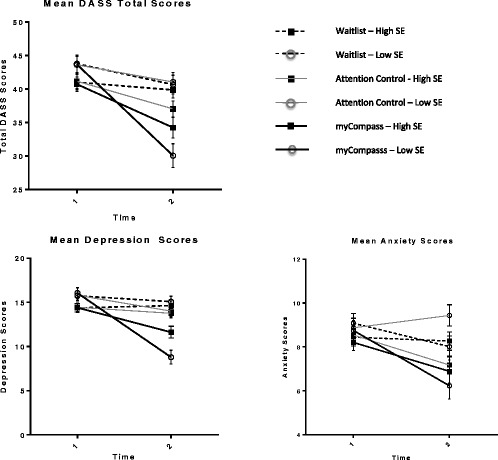
BACKGROUND: Online psychotherapy is clinically effective yet why, how, and for whom the effects are greatest remain largely unknown. In the present study, we examined whether mental health self-efficacy (MHSE), a construct derived from Bandura's Social Learning Theory (SLT), influenced symptom and functional outcomes of a new mobile phone and web-based psychotherapy intervention for people with mild-to-moderate depression, anxiety and stress. METHODS: STUDY I: Data from 49 people with symptoms of depression, anxiety and/or stress in the mild-to-moderate range were used to examine the reliability and construct validity of a new measure of MHSE, the Mental Health Self-efficacy Scale (MHSES). STUDY II: We conducted a secondary analysis of data from a recently completed randomised controlled trial (N = 720) to evaluate whether MHSE effected post-intervention outcomes, as measured by the Depression, Anxiety and Stress Scales (DASS) and Work and Social Adjustment Scale (WSAS), for people with symptoms in the mild-to-moderate range. RESULTS: STUDY I: The data established that the MHSES comprised a unitary factor, with acceptable internal reliability (Cronbach's alpha = .89) and construct validity. STUDY II: The intervention group showed significantly greater improvement in MHSE at post-intervention relative to the control conditions (p's < = .000). MHSE mediated the effects of the intervention on anxiety and stress symptoms. Furthermore, people with low pre-treatment MHSE reported the greatest post-intervention gains in depression, anxiety and overall distress. No effects were found for MHSE on work and social functioning. CONCLUSION: Mental health self-efficacy influences symptom outcomes of a self-guided mobile phone and web-based psychotherapeutic intervention and may itself be a worthwhile target to increase the effectiveness and efficiency of online treatment programs. TRIAL REGISTRATION: Australian New Zealand Clinical Trials Registry ACTRN12610000625077.
Overview
The claims and statistics of this paper haven’t been checked yet.
Free: it reads the open-access text and checks the first 5 claims that cite a source we can check. Create a free account to check every claim.
Integrity signals
Registry
Cites
Statistics
Figures
Verification
Claims the paper makes
The claims and statistics of this paper haven’t been checked yet.
Free: it reads the open-access text and checks the first 5 claims that cite a source we can check. Create a free account to check every claim.
Claims other papers make about this one
Each is checked against this paper’s own text: does it say what the citing paper says it does?
The source backs part of the claim, not all of it — or backs it for a different population, condition or comparison.
In the citing paper
“In contrast, low coping self-efficacy is associated with passive coping51, avoidance, lower treatment adherence52,53, substance use54, and other maladaptive coping strategies55 that may serve to increase risk or course of depression.”
From Psychobiological factors of resilience and depression in late life (2019) · cites this paper as [53]
Experimental — accuracy not yet measuredThe cited source says what the claim attributes to it.
In the citing paper
“While some apps have demonstrated efficacy in definitive trials [2-5], others have performed poorly [6-9].”
From A Library of Analytic Indicators to Evaluate Effective Engagement with Consumer mHealth Apps for Chronic Conditions: Scoping Review (2019) · cites this paper as [3]
The cited source says what the claim attributes to it.
In the citing paper
“The instrument shows a Cronbach's Alpha of 0.89 (71).”
The cited source says what the claim attributes to it.
In the citing paper
“They have been evaluated in many countries in general, student, and corporate populations [24-36].”
From Efficacy of Seren@ctif, a computer-based stress management program for patients with adjustment disorder with anxiety: Protocol for a controlled trial (2017) · cites this paper as [27]
In the citing paper
“Confidence in self-management of mental health issues was measured using the MHSES [51], which has 6 items that address confidence in managing stress, depression, and anxiety and are scored on a 10-point scale (1: not at all confident, 10: very confident).”
From Chatbot-Delivered Cognitive Behavioral Therapy in Adolescents With Depression and Anxiety During the COVID-19 Pandemic: Feasibility and Acceptability Study (2022) · cites this paper as [51]
Self-check
Percentages, sums and reported differences re-computed from the paper’s own numbers.
The self-check needs the paper’s full text.
Citations
Cites
Hu, L., & Bentler, P. M. (1999) · Structural Equation Modeling A Multidisciplinary Journal · doi:10.1080/10705519909540118 · Cited by 108,788 · cited 1×
“08 [41-43].”
Baron, R. M., & Kenny, D. A. (1986) · Journal of Personality and Social Psychology · doi:10.1037/0022-3514.51.6.1173 · Cited by 91,532 · cited 6×
“In light of recent evidence questioning the validity of the RMSEA in models with low degrees of freedom [Kenny DA, Kanisken B, McCoach D: The performance of RMSEA in models with small degrees of freedom.”
BackgroundResultInfluentialSelf-efficacy: Toward a unifying theory of behavioral change
Bandura, A. (1977) · Psychological Review · doi:10.1037/0033-295x.84.2.191 · Cited by 43,925
SPSS and SAS procedures for estimating indirect effects in simple mediation models
Preacher, K. J., & Hayes, A. F. (2004) · Behavior Research Methods, Instruments, & Computers · doi:10.3758/bf03206553 · Cited by 17,383 · cited 3×
“Preacher KJ, Hayes AF: SPSS and SAS procedures for estimating indirect effects in simple mediation models.”
BackgroundMethodLovibond, P. F., & Lovibond, S. H. (1995) · Behaviour Research and Therapy · doi:10.1016/0005-7967(94)00075-u · Cited by 14,523 · cited 11×
“Descriptive statistics were calculated for the DASS, WSAS and TIPI.”
MethodInfluentialAsymptotic Confidence Intervals for Indirect Effects in Structural Equation Models
Sobel, M. E. (1982) · Sociological Methodology · doi:10.2307/270723 · Cited by 12,810 · cited 1×
“In a second set of analyses, direct and indirect effects of MHSE on outcomes were examined using Preacher and Hayes’ [32] revised version of the Sobel test [36].”
MethodSelf-efficacy: Toward a unifying theory of behavioral change
Bandura, A. (1978) · Advances in Behaviour Research and Therapy · doi:10.1016/0146-6402(78)90002-4 · Cited by 10,586
Costello, A. B., & Osborne, J. (2005) · University of Massachusetts Amherst · doi:10.7275/jyj1-4868 · Cited by 10,297
Structural Equation Modelling: Guidelines for Determining Model Fit
Hooper, D., Coughlan, J., & Mullen, M. R. (2008) · Dublin Institute of Technology · doi:10.21427/d7cf7r · Cited by 8,746 · cited 1×
“08 [41-43].”
A very brief measure of the Big-Five personality domains
Gosling, S. D., Rentfrow, P. J., & Swann, W. B. (2003) · Journal of Research in Personality · doi:10.1016/s0092-6566(03)00046-1 · Cited by 8,307
Research works printed but not linked: 1
- 40. Nunnally J Psychometric Methods 1978 New York McGraw-Hill
Cited by
Items 101–138 of 138
Bjornstad, G. J., Sonthalia, S., Rouse, B., Freeman, L., Hessami, N., Dunne, J. H., & Axford, N. (2024) · Campbell Systematic Reviews · doi:10.1002/cl2.1376 · Cited by 8
The Impact of Two Brief Web-Based Psychological Interventions on Functional Outcomes
Morabito, D. M., Mathes, B. M., & Schmidt, N. B. (2020) · Cognitive Therapy and Research · doi:10.1007/s10608-020-10144-x · Cited by 3
Singh, P., & Mishra, N. (2022) · Psychological Reports · doi:10.1177/00332941221092657 · Cited by 4
From Telecytology to Mobile Cytopathology: Past, Present, and Future
Pouliakis, A., Archondakis, S. K., Margari, N., & Karakitsos, P. (2019) · IGI Global eBooks · doi:10.4018/978-1-7998-1204-3.ch096 · Cited by 3
Behr, S., García, L. M., Lucas, J., Kohlhase, E., Puetz, M., Boettcher, J., Schaeuffele, C., & Knaevelsrud, C. (2024) · doi:10.31234/osf.io/28knb · Cited by 3
Held, P., Pridgen, S. A., Szoke, D. R., Chen, Y., Akhtar, Z., & Amin, D. (2025) · Cognitive and Behavioral Practice · doi:10.1016/j.cbpra.2025.10.001 · Cited by 2
Svensén, S., Bolstad, I., Ødbehr, L. S., & Larsson, G. (2025) · European Journal of Psychotraumatology · doi:10.1080/20008066.2025.2582354 · Cited by 2
“…group of severely traumatized women are also in line with previous research showing that self-efficacy and perceptions of hassles and uplifts can be affected by psychotherapy, with an impact on the mental health of individuals with depression and anxiety (Clarke et al., 2014; Furman et al., 2024).”
Ngo, V. K., Vu, T. T., Levine, D., Punter, M. A., Beane, S. J., Weiss, M., Wyka, K., Florez-Arango, J. F., & Zhou, X. (2024) · BMC Public Health · doi:10.1186/s12889-024-20026-6 · Cited by 4
“…about mental health using the Mental Health Stigma Scale (MHSS-15) [71], self-efficacy using the adapted Mental Health Self Efficacy Scale (MHSES) [72], social needs with the Accountable Health Communities Health-Related Social Needs Screening Tool (AHC-HRSN) [73], social support using the…”
MethodThe Development of a Secure Hospital Messaging and Communication Platform
Moghimi, H., & Wickramasinghe, N. S. (2016) · Advances in healthcare information systems and administration book series · doi:10.4018/978-1-5225-0920-2.ch015 · Cited by 2
Gotkiewicz, D., & Goldstein, T. R. (2021) · Clinical Pediatrics · doi:10.1177/00099228211034644 · Cited by 3
“60(9-10) 389 –391 © The Author(s) 2021 Article reuse guidelines: sagepub.”
Population Health Management and the Science of Individuality in the Era of Quantum Computing
Moumtzoglou, A. S., & Pouliakis, A. (2021) · Advances in healthcare information systems and administration book series · doi:10.4018/978-1-7998-9198-7.ch002 · Cited by 2
Nicol, G. E., Wang, R., Graham, S. S., Dodd, S., & Garbutt, J. M. (2022) · doi:10.2196/preprints.40242 · Cited by 2
Developing Personal and Social Life Skills to Protect Children and Youth From Substance Addiction
Şimşek, M., Taçoy, S., & Karasalih, Ş. (2022) · The European Journal of Social & Behavioural Sciences · doi:10.15405/ejsbs.320 · Cited by 4
Duddeck, L., Stolz, T., Zottl, C., Berger, T., & Boettcher, J. (2025) · JMIR Formative Research · doi:10.2196/62781 · Cited by 1
“…Health Organization-Five Well-Being Index. h n=20. i n=6. j Brähler et al [46]. k MHSE: Mental Health Self-Efficacy Scale. l n=9. m Clarke et al [49]. n ASKU: Short Scale for General Self-efficacy Beliefs. o Beierlein et al [47]. p OSSS-3: Oslo Social Support Scale-3. q Kocalevent et al [50]. r…”
InfluentialDuddeck, L., Schulz, A., Renneberg, B., Berger, T., & Boettcher, J. (2025) · Cognitive Behaviour Therapy · doi:10.1080/16506073.2025.2521126 · Cited by 1
Pouliakis, A. (2019) · International Journal of Reliable and Quality E-Healthcare · doi:10.4018/ijrqeh.2019100104 · Cited by 1
Population Health Management, Emerging Technologies, and the Science of the Individual
Moumtzoglou, A. S., & Pouliakis, A. (2019) · Advances in medical diagnosis, treatment, and care (AMDTC) book series · doi:10.4018/978-1-7998-2390-2.ch002 · Cited by 1
Stages of recovery from depression in relation to clinical outcomes and consumer recovery processes
Low, B. C. Y., Lim, K., Wong, M., Ooi, S., Oades, L. G., & Yap, C. K. (2019) · International Journal of Community Medicine and Public Health · doi:10.18203/2394-6040.ijcmph20190572
“It has an acceptable factor structure, internal validity, and convergent validity.(33)”
BackgroundAn examination of the necessity and feasibility of web-based treatments for postpartum anxiety
Ashford, M. T. (2018) · City Research Online (City University London)
Influence of change expectancy and recovery processes on depression severity
Low, B. C. Y., Lim, K., Wong, M., Ooi, S., & Yap, C. K. (2019) · Australian Journal of Rehabilitation Counselling · doi:10.1017/jrc.2019.1
“Empowerment The Mental Health Self-Efficacy Scale was used to assess participants’ confidence in managing their stress, anxiety, or depression (Clarke et al., 2014).”
BackgroundMethodGoal-Directed Self-Tracking in the Management of Chronic Health Conditions
Schroeder, J. (2020) · ResearchWorks at the University of Washington (University of Washington) · Cited by 2
Population Health Management and the Science of Individuality
Moumtzoglou, A. S., & Pouliakis, A. (2019) · IGI Global eBooks · doi:10.4018/978-1-7998-1204-3.ch004
Mikeal, C. W., & Gillaspy, J. A. (2018) · Springer eBooks · doi:10.1007/978-3-319-70539-2_14 · Cited by 1
The Development of a Secure Hospital Messaging and Communication Platform
Moghimi, H., & Wickramasinghe, N. S. (2018) · IGI Global eBooks · doi:10.4018/978-1-5225-6198-9.ch015
Wilson, R. L. (2019) · Cambridge University Press eBooks · doi:10.1017/cbo9781316718285.011
Nicol, G. E., Jansen, M. O., Ricchio, A., Schweiger, J. A., Keenoy, K., Miller, J. P., Morrato, E. H., Guo, Z., Evanoff, B., Parks, J., et al. (2023) · JMIR Research Protocols · doi:10.2196/42114
“The Mental Health Self-Efficacy Scale assesses belief in one’s capability to perform behaviors related to mental health self-care and has been shown to predict response to mHealth interventions for mental health [27].”
Cho, M., Park, D., Choo, M., Han, D. H., & Kim, J. (2024) · doi:10.2196/preprints.66536
Liao, H.-A. (2024) · Atlantic Journal of Communication · doi:10.1080/15456870.2024.2441197
Adolescent Perceptions, Affect, and Self-Efficacy
Stewart, B. R. (2015) · OhioLink ETD Center (Ohio Library and Information Network)
McLaren, T., Peter, L.-J., Tomczyk, S., Muehlan, H., Schomerus, G., & Schmidt, S. (2023) · Figshare · doi:10.6084/m9.figshare.22613441
Park, C., Zhu, J., Man, R. H. C., Rosenblat, J. D., Iacobucci, M., Gill, H., Mansur, R. B., & McIntyre, R. S. (2019) · Annals of Clinical Psychiatry · doi:10.1177/154733251903100409
“38 This concept as well as other hypothesized mechanisms should be explored in future studies.”
Ahmadi, N., Sasangohar, F., Jones-wood, S., Moskowitz, J. T., & Phillips, R. (2025) · doi:10.2196/preprints.90531
Behr, S., Bohn, J., Fenski, F., Hammelrath, L., Bellu, L., Boettcher, J., Knaevelsrud, C., & Schaeuffele, C. (2026) · Psychotherapy Research · doi:10.1080/10503307.2026.2638268
Social media groups could foster mental health self-efficacy through social identification
de Siqueira, A. U. B., Montiel, C., Doré, I., & Cárdenas, D. (2026) · BMC Psychology · doi:10.1186/s40359-026-04319-6
Kuang, K., Liu, S., & Chen, R. (2026) · Health Communication · doi:10.1080/10410236.2026.2670547
Jeon, L., Li, S., Zhao, X., Byun, S., & Chapman, S. L. F. (2026) · Teaching and Teacher Education · doi:10.1016/j.tate.2026.105688
Cerazy, D., & Kraszewski, S. (2026) · doi:10.2196/preprints.115272
Metadata
- Authors
- Clarke, J., Proudfoot, J., Birch, M.-R., Whitton, A. E., Parker, G., Manicavasagar, V., Harrison, V., Christensen, H., & Hadzi-Pavlovic, D.
- Affiliations
- Black Dog Institute (AU)
- UNSW Sydney (AU)
- Corresponding author
- Clarke, Janine
- ORCID
- Venue
- BMC Psychiatry
- Published
- 2014-09-26
- Volume
- 14
- Issue
- 1
- Pages
- 272-272
- ISSN
- 1471-244X (ISSN-L)
- PMC
- PMC4189737
- OpenAlex
- W2106461288
- Semantic Scholar
- 17824bf89c40edcf21d97d1e3b455266caa227f7
- Cited by
- 138
- References
- 53
- Citations by year
- 2026: 5 · 2025: 10 · 2024: 8 · 2023: 17 · 2022: 11 · 2021: 22 · 2020: 11 · 2019: 18 · 2018: 14 · 2017: 9 · 2016: 11 · 2015: 2
- FWCI
- 11.35
- Type
- journal article
- Language
- en
- Open access
- gold
- doi.org
- Locations
- BMC Psychiatry (publishedVersion, cc-by)
- Europe PMC (PubMed Central) (publishedVersion, cc-by)
- PubMed Central (publishedVersion, cc-by)
- PubMed (publishedVersion)
- Open Research Online - ORO (The Open University) (acceptedVersion)
- UNSWorks (University of New South Wales, Sydney, Australia) (submittedVersion, cc-by-nc-nd)
- Funders
- Australian Government
- Medical Research Council
- National Health and Medical Research Council (510135)
- Topics
- Social Sciences › Psychology › Applied Psychology › Digital Mental Health Interventions
- Social Sciences › Psychology › Experimental and Cognitive Psychology › Anxiety, Depression, Psychometrics, Treatment, Cognitive Processes
- Health Sciences › Medicine › Public Health, Environmental and Occupational Health › Maternal Mental Health During Pregnancy and Postpartum
- Keywords
- online therapy, mild to moderate depression, anxiety, stress, social learning theory, mediation, self-guided intervention, work and social functioning
- MeSH terms
- Adolescent, Adult, Aged, Anxiety Disorders, Depressive Disorder, Female, Humans, Male, Middle Aged, Psychiatric Status Rating Scales, Social Adjustment, Stress, Psychological, Reproducibility of Results, Cognitive Behavioral Therapy, Telemedicine, Self Efficacy, Internet, Cell Phone, Young Adult
About these checks
Registry, retraction, Cites and statistics results are computed, not judged, with one exception: a printed reference that no index lists is read once by a model before it counts as a citation error. Claims are extracted by a model and kept only when their quote appears verbatim in the text; each cited source is then checked, with a model’s help, for whether it says what the claim relies on. Those verdicts can be wrong — read the claim’s quote and the cited source before relying on one.
Statistics and arithmetic are recomputed, not judged.
Confidence bands are shown only for fields calibrated on our annotated test set. None is calibrated yet, so no band is shown.
What counts as a claim ›How we measure confidence ›How we check this ›
Are you an author, or do you see a problem with this page? Request a review
Data sources
Bibliographic data: Semantic Scholar, OpenAlex, Crossref.
Contains information from the Semantic Scholar Academic Graph Datasets, made available under the ODC Attribution License (ODC-BY 1.0).
Semantic Scholar’s data is described in: Kinney, R., et al. (2023). The Semantic Scholar Open Data Platform. arXiv:2301.10140.
