

The DOI matches its Crossref record; 37 of the 38 references it cites were found in a registry or an index; none of the 4 sources its claims cite is checked for support yet.
Loneliness in the general population: prevalence, determinants and relations to mental health
Open accessAbstract
BACKGROUND: While loneliness has been regarded as a risk to mental and physical health, there is a lack of current community data covering a broad age range. This study used a large and representative German adult sample to investigate loneliness. METHODS: Baseline data of the Gutenberg Health Study (GHS) collected between April 2007 and April 2012 (N = 15,010; 35-74 years), were analyzed. Recruitment for the community-based, prospective, observational cohort study was performed in equal strata for gender, residence and age decades. Measures were provided by self-report and interview. Loneliness was used as a predictor for distress (depression, generalized anxiety, and suicidal ideation) in logistic regression analyses adjusting for sociodemographic variables and mental distress. RESULTS: A total of 10.5% of participants reported some degree of loneliness (4.9% slight, 3.9% moderate and 1.7% severely distressed by loneliness). Loneliness declined across age groups. Loneliness was stronger in women, in participants without a partner, and in those living alone and without children. Controlling for demographic variables and other sources of distress loneliness was associated with depression (OR = 1.91), generalized anxiety (OR = 1.21) and suicidal ideation (OR = 1.35). Lonely participants also smoked more and visited physicians more frequently. CONCLUSIONS: The findings support the view that loneliness poses a significant health problem for a sizeable part of the population with increased risks in terms of distress (depression, anxiety), suicidal ideation, health behavior and health care utilization.
Overview
AI snapshot
Written from the paper’s full text.
TL;DR
In a large German community sample aged 35–74, 10.5% reported some degree of loneliness, and loneliness was associated with depression, generalized anxiety, suicidal ideation, smoking, and greater health care use after adjustment. The authors conclude loneliness is a significant public health problem in this population.
Key findings
- Among 15,010 participants, 10.5% reported some loneliness: 4.9% slight, 3.9% moderate, and 1.7% severely distressed by loneliness; loneliness declined across age groups.
- Loneliness was more frequent in women, participants without a partner, those without children, and those living alone; SES declined with increasing loneliness.
- Adjusting for sociodemographic variables and other distress, loneliness predicted depression (OR = 1.91, 95% CI 1.74–2.09), generalized anxiety (OR = 1.21, 95% CI 1.09–1.34), and suicidal ideation (abstract/discussion report OR = 1.35; Table 2 lists OR = 1.31, 95% CI 1.19–1.44).
- Severe loneliness was associated with more smoking, physician visits (63% vs. 42% with no loneliness), inpatient treatment (21% vs. 13%), antidepressant use (24.8% vs. 4.5%), and anxiolytic use (3.3% vs. 0.8%).
Methods
- Cross-sectional baseline data from the Gutenberg Health Study (GHS), collected April 2007–April 2012: population-based, prospective, observational single-center cohort in Mainz and Mainz-Bingen, Germany; N = 15,010, aged 35–74, mean age 54.9 ± 11.1, 49.4% female.
- Recruitment was stratified in equal strata for gender, residence, and age decades; response rate was 60.3%, and 5.8% were excluded for insufficient German language or inability to participate.
- Loneliness was assessed by a single item about being frequently alone/having few contacts and suffering from it, recoded into no, slight, moderate, and severe loneliness; associations with depression (PHQ-8 ≥ 10), generalized anxiety (GAD-2 ≥ 3), and suicidal ideation were tested in multiple generalized linear models with binomial distribution and log link, adjusted for sociodemographic variables and mental distress.
Limitations
- The authors state the cross-sectional design does not permit causal conclusions; loneliness may contribute to distress and suicidality, but depression and anxiety may also lead to social withdrawal.
- The authors state they did not directly assess the size and quality of social networks, so they cannot estimate the effect of social isolation, a confounding variable when investigating loneliness.
- The authors state loneliness was measured with only a single item, and they recommend caution interpreting p-values because no adjustments for multiple testing were performed in this exploratory study; they also note that individuals under 35 years old were not studied. Evident from the text: the sample is from one German region and relies on self-report/interview measures, with a 60.3% response rate.
Model-written summary. Check it against the paper before relying on it.
Integrity signals
Registry
Cites
Statistics
Figures
Verification
Claims the paper makes
24 Own result · 9 Own method · 3 Not checked yet · 3 Own interpretation
A result the paper reports from its own data — it cites no other source for it, so there is none to check. The quote shows it is in the paper.
In the paper
“about 10-20% of the participants living alone indicated feeling lonely.”
§ Loneliness in the general population: prevalence, determinants and relations to mental health > Results
hedged- Asserted: passes — The authors put it forward as true.
- Checkable: passes — It can be checked against evidence.
- Load-bearing: unclear — It is unclear whether the paper’s conclusions depend on it.
- Based: passes — The paper gives a reason why it holds.
A result the paper reports from its own data — it cites no other source for it, so there is none to check. The quote shows it is in the paper.
In the paper
“Loneliness was stronger in women, in participants without a partner, and in those living alone and without children.”
- Also stated in: § Results · plain
“Loneliness was more frequent in women, in participants without a partner or without children.”
- Also stated in: § Discussion · plain
“Loneliness was more frequent in women, in participants without a partnership, without children and in those living alone.”
§ Loneliness in the general population: prevalence, determinants and relations to mental health > Abstract > Results
plaincorrelational- Asserted: passes — The authors put it forward as true.
- Checkable: passes — It can be checked against evidence.
- Load-bearing: unclear — It is unclear whether the paper’s conclusions depend on it.
- Based: passes — The paper gives a reason why it holds.
- Also stated in: § Results · plain
A result the paper reports from its own data — it cites no other source for it, so there is none to check. The quote shows it is in the paper.
In the paper
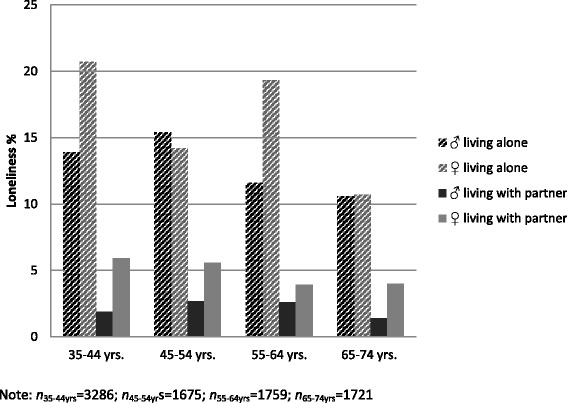
“In the age range of 45-54 years (14.2% vs. 15.4%) and 65-74 years (10.7% vs. 10.6%), no significant gender differences were observed when participant lived alone.”
§ Loneliness in the general population: prevalence, determinants and relations to mental health > Results
plain- Asserted: passes — The authors put it forward as true.
- Checkable: passes — It can be checked against evidence.
- Load-bearing: unclear — It is unclear whether the paper’s conclusions depend on it.
- Based: passes — The paper gives a reason why it holds.
A result the paper reports from its own data — it cites no other source for it, so there is none to check. The quote shows it is in the paper.
In the paper
“Type D increased considerably with the degree of loneliness.”
§ Loneliness in the general population: prevalence, determinants and relations to mental health > Results
plaindirect- Asserted: passes — The authors put it forward as true.
- Checkable: passes — It can be checked against evidence.
- Load-bearing: unclear — It is unclear whether the paper’s conclusions depend on it.
- Based: passes — The paper gives a reason why it holds.
A result the paper reports from its own data — it cites no other source for it, so there is none to check. The quote shows it is in the paper.
In the paper
“Loneliness was stronger in women, in participants without a partner, and in those living alone and without children.”
- Also stated in: § Results · plain
“Loneliness was more frequent in women, in participants without a partner or without children.”
- Also stated in: § Discussion · plain
“Loneliness was more frequent in women, in participants without a partnership, without children and in those living alone.”
§ Loneliness in the general population: prevalence, determinants and relations to mental health > Abstract > Results
plaincorrelational- Asserted: passes — The authors put it forward as true.
- Checkable: passes — It can be checked against evidence.
- Load-bearing: passes — The paper’s conclusions depend on it.
- Based: passes — The paper gives a reason why it holds.
- Also stated in: § Results · plain
A result the paper reports from its own data — it cites no other source for it, so there is none to check. The quote shows it is in the paper.
In the paper
“Loneliness declined across age groups.”
- Also stated in: § Discussion · plain
“loneliness declined with age.”
- Also stated in: § Results · plain
“Overall, mean age of lonely participants was lower.”
§ Loneliness in the general population: prevalence, determinants and relations to mental health > Abstract > Results
plaincorrelational- Asserted: passes — The authors put it forward as true.
- Checkable: passes — It can be checked against evidence.
- Load-bearing: unclear — It is unclear whether the paper’s conclusions depend on it.
- Based: passes — The paper gives a reason why it holds.
- Also stated in: § Discussion · plain
A result the paper reports from its own data — it cites no other source for it, so there is none to check. The quote shows it is in the paper.
In the paper
“few men (1.4 to 2.7%) reported feeling lonely, whereas more than twice as many women reported feeling lonely (up to 5.9%).”
- Also stated in: § Discussion · plain
“about twice as many women in partnerships (up to 5.9%) reported feeling lonely in comparison to men (1.4% to 2.7%).”
§ Loneliness in the general population: prevalence, determinants and relations to mental health > Results
plain- Asserted: passes — The authors put it forward as true.
- Checkable: passes — It can be checked against evidence.
- Load-bearing: unclear — It is unclear whether the paper’s conclusions depend on it.
- Based: passes — The paper gives a reason why it holds.
- Also stated in: § Discussion · plain
A result the paper reports from its own data — it cites no other source for it, so there is none to check. The quote shows it is in the paper.
In the paper
“SES declined with increasing loneliness.”
- Also stated in: § Discussion · plain
“Socioeconomic status declined with increasing loneliness.”
§ Loneliness in the general population: prevalence, determinants and relations to mental health > Results
plaincorrelational- Asserted: passes — The authors put it forward as true.
- Checkable: passes — It can be checked against evidence.
- Load-bearing: unclear — It is unclear whether the paper’s conclusions depend on it.
- Based: passes — The paper gives a reason why it holds.
- Also stated in: § Discussion · plain
A result the paper reports from its own data — it cites no other source for it, so there is none to check. The quote shows it is in the paper.
In the paper
“No significant increases were found for previous unemployment, although there was a descriptive trend of a positive link between feeling lonely and previous unemployment.”
§ Loneliness in the general population: prevalence, determinants and relations to mental health > Results
plain- Asserted: passes — The authors put it forward as true.
- Checkable: passes — It can be checked against evidence.
- Load-bearing: unclear — It is unclear whether the paper’s conclusions depend on it.
- Based: passes — The paper gives a reason why it holds.
A result the paper reports from its own data — it cites no other source for it, so there is none to check. The quote shows it is in the paper.
In the paper
“There was no association with BMI.”
- Also stated in: § Discussion · plain
“but not to other risk factors such as alcohol use or diet (BMI).”
§ Loneliness in the general population: prevalence, determinants and relations to mental health > Results
plain- Asserted: passes — The authors put it forward as true.
- Checkable: passes — It can be checked against evidence.
- Load-bearing: unclear — It is unclear whether the paper’s conclusions depend on it.
- Based: passes — The paper gives a reason why it holds.
- Also stated in: § Discussion · plain
- The quote only partly states this claim. 8
- It may state two separate claims as one. 8
- Probably not a substantial claim. 9
A result the paper reports from its own data — it cites no other source for it, so there is none to check. The quote shows it is in the paper.
In the paper
“Lonely participants also smoked more and visited physicians more frequently.”
- Also stated in: § Results · plain
“The majority of participants (63%) with a strong degree of loneliness had visited a physician (vs. 42% with no feelings of loneliness)”
- Also stated in: § Discussion · plain
“the majority of participants (63%) with a strong degree of loneliness had visited a physician (vs. 42% without loneliness)”
§ Loneliness in the general population: prevalence, determinants and relations to mental health > Abstract > Results
plaincorrelational- Asserted: passes — The authors put it forward as true.
- Checkable: passes — It can be checked against evidence.
- Load-bearing: unclear — It is unclear whether the paper’s conclusions depend on it.
- Based: passes — The paper gives a reason why it holds.
The quote only partly states this claim.
- Also stated in: § Results · plain
A result the paper reports from its own data — it cites no other source for it, so there is none to check. The quote shows it is in the paper.
In the paper
“The average alcohol consumption was negatively linked to loneliness.”
§ Loneliness in the general population: prevalence, determinants and relations to mental health > Results
plaincorrelational- Asserted: passes — The authors put it forward as true.
- Checkable: passes — It can be checked against evidence.
- Load-bearing: unclear — It is unclear whether the paper’s conclusions depend on it.
- Based: passes — The paper gives a reason why it holds.
The quote only partly states this claim.
A result the paper reports from its own data — it cites no other source for it, so there is none to check. The quote shows it is in the paper.
In the paper
“more than half of the loneliest participants were also depressed (vs. 5% in the group with feelings of loneliness), and over 40% in this group reported anxiety and suicidal ideation (which increased from 6% to 42%) and 30% panic attacks in the past 4 weeks.”
§ Loneliness in the general population: prevalence, determinants and relations to mental health > Results
plaincorrelational- Asserted: passes — The authors put it forward as true.
- Checkable: passes — It can be checked against evidence.
- Load-bearing: passes — The paper’s conclusions depend on it.
- Based: passes — The paper gives a reason why it holds.
It may state two separate claims as one.
A result the paper reports from its own data — it cites no other source for it, so there is none to check. The quote shows it is in the paper.
In the paper
“Among those living alone, the highest proportion of loneliness was found in the youngest group of women in the range from 35 to 44 years (20.7%), whereas men tended to report heightened loneliness in the range from 45 to 54 years (15.4%).”
§ Loneliness in the general population: prevalence, determinants and relations to mental health > Results
plaincorrelational- Asserted: passes — The authors put it forward as true.
- Checkable: passes — It can be checked against evidence.
- Load-bearing: unclear — It is unclear whether the paper’s conclusions depend on it.
- Based: passes — The paper gives a reason why it holds.
It may state two separate claims as one.
A result the paper reports from its own data — it cites no other source for it, so there is none to check. The quote shows it is in the paper.
In the paper
“there were strong increases in the intake of anxiolytics and antidepressants among lonely participants.”
§ Loneliness in the general population: prevalence, determinants and relations to mental health > Results
boostedcorrelational- Asserted: passes — The authors put it forward as true.
- Checkable: passes — It can be checked against evidence.
- Load-bearing: passes — The paper’s conclusions depend on it.
- Based: passes — The paper gives a reason why it holds.
The quote only partly states this claim.
A result the paper reports from its own data — it cites no other source for it, so there is none to check. The quote shows it is in the paper.
In the paper
“generalized anxiety (OR = 1.21)”
- Also stated in: § Results · plain
“loneliness also positively predicted anxiety (OR = 1.21)”
§ Loneliness in the general population: prevalence, determinants and relations to mental health > Abstract > Results
plaincorrelational- Asserted: passes — The authors put it forward as true.
- Checkable: passes — It can be checked against evidence.
- Load-bearing: passes — The paper’s conclusions depend on it.
- Based: passes — The paper gives a reason why it holds.
The quote only partly states this claim.
- Rests on an assumption: Non-response (response rate 60.3%) and exclusions (5.8%) did not substantially bias the prevalence and association estimates in the Gutenberg Health Study sample.
- Also stated in: § Results · plain
A result the paper reports from its own data — it cites no other source for it, so there is none to check. The quote shows it is in the paper.
In the paper
“A total of 10.5% of participants reported some degree of loneliness (4.9% slight, 3.9% moderate and 1.7% severely distressed by loneliness).”
- Also stated in: § Results · plain
“A total of 10.5% reported some degree of loneliness: 4.9% were slightly, 3.9% moderately and 1.7% severely distressed by feeling lonely.”
- Also stated in: § Discussion · plain
“we found that one in 10 (10.5%) participants reported some degree of loneliness.”
§ Loneliness in the general population: prevalence, determinants and relations to mental health > Abstract > Results
plain- Asserted: passes — The authors put it forward as true.
- Checkable: passes — It can be checked against evidence.
- Load-bearing: unclear — It is unclear whether the paper’s conclusions depend on it.
- Based: passes — The paper gives a reason why it holds.
It may state two separate claims as one.
- Rests on an assumption: Non-response (response rate 60.3%) and exclusions (5.8%) did not substantially bias the prevalence and association estimates in the Gutenberg Health Study sample.
- Also stated in: § Results · plain
A result the paper reports from its own data — it cites no other source for it, so there is none to check. The quote shows it is in the paper.
In the paper
“21% (vs. 13%) had had inpatient treatments.”
- Also stated in: § Discussion · plain
“21% had had inpatient treatments.”
§ Loneliness in the general population: prevalence, determinants and relations to mental health > Results
plaincorrelational- Asserted: passes — The authors put it forward as true.
- Checkable: passes — It can be checked against evidence.
- Load-bearing: unclear — It is unclear whether the paper’s conclusions depend on it.
- Based: passes — The paper gives a reason why it holds.
The quote only partly states this claim.
- Also stated in: § Discussion · plain
A result the paper reports from its own data — it cites no other source for it, so there is none to check. The quote shows it is in the paper.
In the paper
“loneliness was associated with depression (OR = 1.91)”
- Also stated in: § Results · plain
“Loneliness as one of the predictors of the first regression model almost doubled the likelihood of depression (OR = 1.91).”
§ Loneliness in the general population: prevalence, determinants and relations to mental health > Abstract > Results
plaincorrelational- Asserted: passes — The authors put it forward as true.
- Checkable: passes — It can be checked against evidence.
- Load-bearing: passes — The paper’s conclusions depend on it.
- Based: passes — The paper gives a reason why it holds.
The quote only partly states this claim.
- Rests on an assumption: Non-response (response rate 60.3%) and exclusions (5.8%) did not substantially bias the prevalence and association estimates in the Gutenberg Health Study sample.
- Also stated in: § Results · plain
A result the paper reports from its own data — it cites no other source for it, so there is none to check. The quote shows it is in the paper.
In the paper
“Lonely participants also smoked more and visited physicians more frequently.”
- Also stated in: § Results · plain
“The proportion of current smokers almost doubled with increasing loneliness.”
- Also stated in: § Discussion · plain
“Loneliness also contributed to smoking as an indicator for an unhealthy lifestyle”
§ Loneliness in the general population: prevalence, determinants and relations to mental health > Abstract > Results
plaincorrelational- Asserted: passes — The authors put it forward as true.
- Checkable: passes — It can be checked against evidence.
- Load-bearing: passes — The paper’s conclusions depend on it.
- Based: passes — The paper gives a reason why it holds.
The quote only partly states this claim.
- Also stated in: § Results · plain
A result the paper reports from its own data — it cites no other source for it, so there is none to check. The quote shows it is in the paper.
In the paper
“suicidal ideation (OR = 1.35)”
- Also stated in: § Results · plain
“Prediction of suicidal ideation by loneliness was also substantial (OR = 1.35)”
- Also stated in: § Discussion · plain
“for suicidal ideation and generalized anxiety, 1.35 and 1.21”
§ Loneliness in the general population: prevalence, determinants and relations to mental health > Abstract > Results
plaincorrelational- Asserted: passes — The authors put it forward as true.
- Checkable: passes — It can be checked against evidence.
- Load-bearing: passes — The paper’s conclusions depend on it.
- Based: passes — The paper gives a reason why it holds.
The quote only partly states this claim.
- Rests on an assumption: Non-response (response rate 60.3%) and exclusions (5.8%) did not substantially bias the prevalence and association estimates in the Gutenberg Health Study sample.
- Also stated in: § Results · plain
What the paper did — it cites no source for this, so there is none to check. The quote shows it is in the paper.
In the paper
“Interpretation of our findings is limited by the cross-sectional character of our study which does not permit causal conclusions.”
§ Loneliness in the general population: prevalence, determinants and relations to mental health > Discussion
plain- Asserted: passes — The authors put it forward as true.
- Checkable: passes — It can be checked against evidence.
- Load-bearing: passes — The paper’s conclusions depend on it.
- Based: passes — The paper gives a reason why it holds.
Probably not a substantial claim. It may state two separate claims as one.
What the paper did — it cites no source for this, so there is none to check. The quote shows it is in the paper.
In the paper
“We excluded 5.8% of the sample due to insufficient knowledge of German language, physical or mental inability to participate.”
§ Loneliness in the general population: prevalence, determinants and relations to mental health > Methods > Study sample
plain- Asserted: passes — The authors put it forward as true.
- Checkable: passes — It can be checked against evidence.
- Load-bearing: fails — The paper’s conclusions may not depend on it.
- Based: passes — The paper gives a reason why it holds.
Probably not a substantial claim. The paper’s conclusions may not depend on it.
In the paper
“According to [25], caseness was defined by a PHQ-8 sum score of ≥10, achieving a sensitivity of 88% and a specificity of 88% for major depression.”
§ Loneliness in the general population: prevalence, determinants and relations to mental health > Methods > Study sample
What the sources say
- Not checked yetcites [25] Löwe B, Kroenke K, Herzog W, Gräfe K. Measuring depression outcome with a brief self-report instrument: sensitivity to change of the Patient Health Questionnaire (PHQ-9). J Affect Disord. 2004;81(1):61–6. source
plain- Asserted: passes — The authors put it forward as true.
- Checkable: passes — It can be checked against evidence.
- Load-bearing: fails — The paper’s conclusions may not depend on it.
- Based: passes — The paper gives a reason why it holds.
Probably not a substantial claim. The paper’s conclusions may not depend on it.
What the paper did — it cites no source for this, so there is none to check. The quote shows it is in the paper.
In the paper
“Strengths of this study reside in the large sample size and the use of standardized self-report instruments to measure distress.”
§ Loneliness in the general population: prevalence, determinants and relations to mental health > Discussion
plain- Asserted: passes — The authors put it forward as true.
- Checkable: passes — It can be checked against evidence.
- Load-bearing: fails — The paper’s conclusions may not depend on it.
- Based: passes — The paper gives a reason why it holds.
Probably not a substantial claim. The paper’s conclusions may not depend on it. It may state two separate claims as one.
What the paper did — it cites no source for this, so there is none to check. The quote shows it is in the paper.
In the paper
“As we did not directly assess the size and quality of social networks, we cannot estimate the effect of social isolation in our study which is a confounding variable when investigating loneliness.”
§ Loneliness in the general population: prevalence, determinants and relations to mental health > Discussion
plain- Asserted: passes — The authors put it forward as true.
- Checkable: passes — It can be checked against evidence.
- Load-bearing: passes — The paper’s conclusions depend on it.
- Based: passes — The paper gives a reason why it holds.
It may state two separate claims as one.
What the paper did — it cites no source for this, so there is none to check. The quote shows it is in the paper.
In the paper
“Recruitment was performed stratified in equal strata for gender, residence and for age decades.”
§ Loneliness in the general population: prevalence, determinants and relations to mental health > Methods > Study sample
plain- Asserted: passes — The authors put it forward as true.
- Checkable: passes — It can be checked against evidence.
- Load-bearing: fails — The paper’s conclusions may not depend on it.
- Based: passes — The paper gives a reason why it holds.
Probably not a substantial claim. The paper’s conclusions may not depend on it.
What the paper did — it cites no source for this, so there is none to check. The quote shows it is in the paper.
In the paper
“No adjustments for multiple testing were performed, as this was an exploratory study.”
§ Loneliness in the general population: prevalence, determinants and relations to mental health > Methods > Study sample
plain- Asserted: passes — The authors put it forward as true.
- Checkable: passes — It can be checked against evidence.
- Load-bearing: passes — The paper’s conclusions depend on it.
- Based: passes — The paper gives a reason why it holds.
Probably not a substantial claim.
What the paper did — it cites no source for this, so there is none to check. The quote shows it is in the paper.
In the paper
“The sample was drawn at random from the local registries of the city of Mainz and the adjacent district of Mainz-Bingen.”
§ Loneliness in the general population: prevalence, determinants and relations to mental health > Methods > Study sample
plain- Asserted: passes — The authors put it forward as true.
- Checkable: passes — It can be checked against evidence.
- Load-bearing: passes — The paper’s conclusions depend on it.
- Based: passes — The paper gives a reason why it holds.
Probably not a substantial claim.
In the paper
“According to [27], the sum score of the answers (0 = not at all, 1 = several days, 2 = over half the days, and 3 = nearly every day) assesses generalized anxiety with good sensitivity (86%) and specificity (83%).”
§ Loneliness in the general population: prevalence, determinants and relations to mental health > Methods > Study sample
What the sources say
- Not checked yetcites [27] Michal M, Wiltink J, Till Y, Wild PS, Münzel T, Blankenberg S, et al. Type-D personality and depersonalization are associated with suicidal ideation in the German general population aged 35–74: results from the Gutenberg Heart Study. J Affect Disord. 2010;125(1):227–33. source
plain- Asserted: passes — The authors put it forward as true.
- Checkable: passes — It can be checked against evidence.
- Load-bearing: fails — The paper’s conclusions may not depend on it.
- Based: passes — The paper gives a reason why it holds.
Probably not a substantial claim. The paper’s conclusions may not depend on it. It may state two separate claims as one.
A conclusion the paper draws from its own results — it cites no other source for it, so there is none to check. The quote shows it is in the paper.
In the paper
“The findings support the view that loneliness poses a significant health problem for a sizeable part of the population with increased risks in terms of distress (depression, anxiety), suicidal ideation, health behavior and health care utilization.”
- Also stated in: § Conclusions · plain
“Our findings support the view that loneliness poses a significant health problem for a sizeable part of the population with increased risks in terms of distress (depression, anxiety), suicidal ideation, health behavior and health care utilization.”
§ Loneliness in the general population: prevalence, determinants and relations to mental health > Abstract > Conclusions
plaincorrelational- Asserted: passes — The authors put it forward as true.
- Checkable: passes — It can be checked against evidence.
- Load-bearing: passes — The paper’s conclusions depend on it.
- Based: passes — The paper gives a reason why it holds.
It may state two separate claims as one.
- Rests on an assumption: Non-response (response rate 60.3%) and exclusions (5.8%) did not substantially bias the prevalence and association estimates in the Gutenberg Health Study sample.
- Also stated in: § Conclusions · plain
What the paper did — it cites no source for this, so there is none to check. The quote shows it is in the paper.
In the paper
“The response rate amounted to 60.3%.”
§ Loneliness in the general population: prevalence, determinants and relations to mental health > Methods > Study sample
plain- Asserted: passes — The authors put it forward as true.
- Checkable: passes — It can be checked against evidence.
- Load-bearing: fails — The paper’s conclusions may not depend on it.
- Based: passes — The paper gives a reason why it holds.
Probably not a substantial claim. The paper’s conclusions may not depend on it.
The paper relies on this without support.
Non-response (response rate 60.3%) and exclusions (5.8%) did not substantially bias the prevalence and association estimates in the Gutenberg Health Study sample.
“The response rate amounted to 60.3%.”
“We excluded 5.8% of the sample due to insufficient knowledge of German language, physical or mental inability to participate.”
Claims other papers make about this one
Each is checked against this paper’s own text: does it say what the citing paper says it does?
The source backs part of the claim, not all of it — or backs it for a different population, condition or comparison.
In the citing paper
“associations between feelings of loneliness or lack of social support and anxiety, depression, suicidal ideation, and self-harming behaviours tend to be stronger among young females than among males (Beutel et al., 2017; Elbogen et al., 2021).”
From Pathways of association between disordered eating in adolescence and mental health outcomes in young adulthood during the COVID-19 pandemic (2023) · cites this paper as Beutel et al., 2017
Experimental — accuracy not yet measuredThe source backs part of the claim, not all of it — or backs it for a different population, condition or comparison.
In the citing paper
“The burden of mental illness in young adulthood often stems from factors experienced during adolescence, with loneliness being a significant, yet understudied factor [9, 10].”
From The prospective association of adolescent loneliness and low resilience with anxiety and depression in young adulthood: The HUNT study (2025) · cites this paper as [10]
Experimental — accuracy not yet measuredThe source backs part of the claim, not all of it — or backs it for a different population, condition or comparison.
In the citing paper
“Additionally, Beutel et al. [12] highlighted a strong association between loneliness and generalized anxiety and depression, especially among middle and late adulthood individuals.”
From The prospective association of adolescent loneliness and low resilience with anxiety and depression in young adulthood: The HUNT study (2025) · cites this paper as [12]
Experimental — accuracy not yet measuredThe cited source says what the claim attributes to it.
In the citing paper
“and is also associated with anxiety [12, 14].”
From The prospective association of adolescent loneliness and low resilience with anxiety and depression in young adulthood: The HUNT study (2025) · cites this paper as [12]
The cited source says what the claim attributes to it.
In the citing paper
“Research shows that loneliness represents a risk factor for depression [12, 13]”
From The prospective association of adolescent loneliness and low resilience with anxiety and depression in young adulthood: The HUNT study (2025) · cites this paper as [12]
In the citing paper
“Especially loneliness has been associated with an increased risk for several mental disorders and somatic diseases in general (Beutel et al., 2017; Holt-Lunstad et al., 2015; Valtorta et al., 2018; Luhmann and Hawkley, 2016) and during the current pandemic (Palgi et al., 2020; González-Sanguino et al., 2020; Luchetti et al., 2020).”
From Lockdown, quarantine measures, and social distancing: Associations with depression, anxiety and distress at the beginning of the COVID-19 pandemic among adults from Germany (2020) · cites this paper as Beutel et al., 2017
In the citing paper
“These prospective reviews have found loneliness to be a stronger predictor of later depression, when compared to anxiety or substance abuse as outcome variables”
From Loneliness as a predictor of suicidal ideation and behaviour: a systematic review and meta-analysis of prospective studies (2020) · cites this paper as Beutel et al., 2017
In the citing paper
“Collectively, the evidence points to no gender difference in the association between loneliness and SIB crosssectionally”
From Loneliness as a predictor of suicidal ideation and behaviour: a systematic review and meta-analysis of prospective studies (2020) · cites this paper as Beutel et al., 2017
In the citing paper
“in non-pandemic contexts, evidence suggests that the prevalence of loneliness ranges from 6–76%; with variations across demographic groups [5,13–17] and countries [18,19].”
From Loneliness in the UK during the COVID-19 pandemic: Cross-sectional results from the COVID-19 Psychological Wellbeing Study (2020) · cites this paper as [5]
In the citing paper
“Loneliness is associated with worse physical and mental health [5–8] and increases mortality risk [9,10].”
From Loneliness in the UK during the COVID-19 pandemic: Cross-sectional results from the COVID-19 Psychological Wellbeing Study (2020) · cites this paper as [5]
In the citing paper
“In non-pandemic contexts, geographical isolation, living alone, and lack of social engagement predicts loneliness in adult and older adult populations [5,13,15,20,29–31].”
From Loneliness in the UK during the COVID-19 pandemic: Cross-sectional results from the COVID-19 Psychological Wellbeing Study (2020) · cites this paper as [5]
Self-check
Percentages, sums and reported differences re-computed from the paper’s own numbers.
Each contradiction between two passages listed here was confirmed by an independent check.
Rated major: it would touch a result — a value a result rests on, reported and recomputed p-values on opposite sides of the significance level, two passages that conflict with no sign which is right, or a cited work retracted before this paper was published.
In the paper
§ Loneliness in the general population: prevalence, determinants and relations to mental health > Abstract > Methods
“Loneliness was used as a predictor for distress (depression, generalized anxiety, and suicidal ideation) in logistic regression analyses adjusting for sociodemographic variables and mental distress.”
§ Loneliness in the general population: prevalence, determinants and relations to mental health > Methods > Study sample
“loneliness was used as a predictor in multiple generalized linear models with a binominal distribution and a log link function adjusted for sociodemographic variables.”
Rated major: it would touch a result — a value a result rests on, reported and recomputed p-values on opposite sides of the significance level, two passages that conflict with no sign which is right, or a cited work retracted before this paper was published.
In the paper
§ Loneliness in the general population: prevalence, determinants and relations to mental health > Abstract > Results
“Controlling for demographic variables and other sources of distress loneliness was associated with depression (OR = 1.91), generalized anxiety (OR = 1.21) and suicidal ideation (OR = 1.35).”
§ Loneliness in the general population: prevalence, determinants and relations to mental health > Results
“| Loneliness | 1.91 | 1.74-2.09 | < 0.0001 | 1.21 | 1.09-1.34 | 0.0002 | 1.31 | 1.19-1.44 | <0.0001 |”
Rated minor: it would not touch a result — a value no result rests on, a p-value that stays on the same side of the significance level, or a conflict that is clerical, resolved elsewhere in the paper, or outside its own findings.
In the paper
§ Loneliness in the general population: prevalence, determinants and relations to mental health > Discussion
“On the other hand, middle-aged men (between 45 and 64 years) were slightly more affected than women.”
§ Loneliness in the general population: prevalence, determinants and relations to mental health > Results
“Women living alone in the age range 35-44 years (20.7% vs. 13.9%) and 55-64 years (19.3% vs. 11.6%) were considerably more affected by loneliness than men.”
Rated minor: it would not touch a result — a value no result rests on, a p-value that stays on the same side of the significance level, or a conflict that is clerical, resolved elsewhere in the paper, or outside its own findings.
In the paper
§ Loneliness in the general population: prevalence, determinants and relations to mental health > Results
“more than half of the loneliest participants were also depressed (vs. 5% in the group with feelings of loneliness)”
§ Loneliness in the general population: prevalence, determinants and relations to mental health > Methods > Study sample
“| Current depression (PHQ-8 ≥ 10) | 5.2 | 19.3 | 30.5 | 52.6 | < 0.0001 |”
Citations
Cites
The need to belong: Desire for interpersonal attachments as a fundamental human motivation.
Baumeister, R. F., & Leary, M. R. (1995) · Psychological Bulletin · doi:10.1037//0033-2909.117.3.497 · Cited by 23,245
Bundesgesundheitsblatt - Gesundheitsforschung - Gesundheitsschutz
(2013) · Bundesgesundheitsblatt - Gesundheitsforschung - Gesundheitsschutz · doi:10.1007/103.1437-1588 · Cited by 11,769
Spitzer, R. L. (1999) · JAMA · doi:10.1001/jama.282.18.1737 · Cited by 9,802
Social Relationships and Mortality Risk: A Meta-analytic Review
Holt-Lunstad, J., Smith, T. B., & Layton, J. B. (2010) · PLoS Medicine · doi:10.1371/journal.pmed.1000316 · Cited by 7,272 · cited 1×
“In a recent meta-analysis, lack of functional and structural social integration predicted a 50% increase in mortality, which is comparable to traditional risk factors [19].”
BackgroundJournal of social behavior and personality
(1986) · Personality and Individual Differences · doi:10.1016/0191-8869(86)90025-5 · Cited by 6,751
The Revised UCLA Loneliness Scale: concurrent and discriminant validity evidence
Russell, D., Peplau, L. A., & Cutrona, C. E. (1980) · Journal of Personality and Social Psychology · doi:10.1037/0022-3514.39.3.472 · Cited by 5,173 · cited 1×
“” to broadly used scales such as the original UCLA loneliness scale with 20 items [11] or the Loneliness scale by de Jong Gierveld and Van Tilburg [12] with 11 items.”
MethodLoneliness matters: a theoretical and empirical review of consequences and mechanisms
Hawkley, L. C., & Cacioppo, J. T. (2010) · Annals of Behavioral Medicine · doi:10.1007/s12160-010-9210-8 · Cited by 4,782 · cited 1×
“Research on loneliness over the life span concluded that loneliness was highest in late adolescence, gradually decreasing during middle adulthood, and then increasing for late adulthood [6, 7].”
BackgroundA Short Scale for Measuring Loneliness in Large Surveys: Results From Two Population-Based Studies
Hughes, M. E., Waite, L. J., Hawkley, L. C., & Cacioppo, J. T. (2004) · Research on Aging · doi:10.1177/0164027504268574 · Cited by 4,781 · cited 1×
“Social relationships and social integration are crucial for emotional fulfilment and development over the life span [1].”
BackgroundLöwe, B., Decker, O., Müller, S., Brähler, E., Schellberg, D., Herzog, W., & Herzberg, P. Y. (2008) · Medical Care · doi:10.1097/mlr.0b013e318160d093 · Cited by 4,527 · cited 2×
“screening items of the short form of the GAD-7 (Generalized Anxiety Disorder [GAD]-7 Scale; [26]).”
MethodSelf-citationJoiner, T. E. (2007) · Harvard University Press eBooks · doi:10.2307/j.ctvjghv2f · Cited by 2,891
Cited by
Sorted by citations
Items 601–700 of 1,000
Soledad en personas mayores de España y México: un análisis comparativo
Sánchez, R. I. G., Tovar, J. G., Rubio, L., & Dumitrache, C. G. (2020) · Acta Colombiana de Psicología · doi:10.14718/acp.2020.23.1.6 · Cited by 6
“Other studies show that in both sexes people between 60 and 75 years old experience less loneliness than people over 75 years old (Acosta et al., 2017), Also, it has been observed that loneliness decreases with age (Beutel et al., 2017).”
BackgroundResultInfluentialEntanglements of loneliness and mental ill health among young adult women
Rönkä, A. R., Sunnari, V., & Taanila, A. M. (2020) · International Journal of Qualitative Studies on Health and Well-Being · doi:10.1080/17482631.2020.1838101 · Cited by 9
“Many studies have found statistically significant associations or correlations between loneliness and depression in different age groups (Beutel et al., 2017; Page et al., 2010; Qualter et al., 2013; Russell et al., 1978; Rönkä et al., 2014; Shevlin et al., 2013).”
BackgroundLoneliness and Social Networks in Europe
Tonković, Ž., Cepić, D., & Puzek, I. (2021) · Revija za sociologiju · doi:10.5613/rzs.51.3.3 · Cited by 6
“Both findings are in line with previous research in which lower socioeconomic status and unemployment have been associated with loneliness (Hansen and Slagsvold, 2016; Mullen et al., 2019; Beutel et al., 2017).”
BackgroundResultInfluentialScierka, L. E., Mena‐Hurtado, C., Shishehbor, M. H., Spertus, J. A., Nagpal, S. V., BABROWSKI, T. A., Bunte, M. C., Politano, A. D., Humphries, M. D., Chung, J., et al. (2022) · IJC Heart & Vasculature · doi:10.1016/j.ijcha.2022.100971 · Cited by 6
Wohnen und Gesundheit im Alter
Teti, A., Nowossadeck, E., Fuchs, J., & Künemund, H. (2022) · Vechtaer Beiträge zur Gerontologie · doi:10.1007/978-3-658-34386-6 · Cited by 5
Hong, J., Park, C. H. K., Kim, H., Hong, Y., Ahn, J., Jun, J. Y., Park, J., Kim, J. H., Bang, Y. R., & Chung, S. (2023) · Psychiatry Investigation · doi:10.30773/pi.2022.0375 · Cited by 7
Prevalence and Risk Factors of Anxiety Among Adult Patients with Chronic Pharyngitis in Wuhu, China
Zha, Z.-H., Gao, S., Liu, S.-F., & Hu, G.-Q. (2023) · Neuropsychiatric Disease and Treatment · doi:10.2147/ndt.s415938 · Cited by 3
“In contrast, loneliness increases the risk of anxiety symptoms, leading to serious mental health problems.(31,32) Living alone was found to be a greater risk factor for high levels of anxiety than living with a family, and participants’ living conditions have been linked to high levels of anxiety.”
Suanrueang, P., Peltzer, K., Лхамсүрэн, З., & Yap, L. K. (2023) · Scientific Reports · doi:10.1038/s41598-023-39452-4 · Cited by 8
“Furthermore, loneliness, along with negative emotions, is a significant component of psychological distress that contributes to negative mental health outcomes, particularly depressive symptoms and suicidality 4 .”
BackgroundAbe, N., Oe, N., Tadaka, E., & Ojima, T. (2023) · PLoS ONE · doi:10.1371/journal.pone.0289571 · Cited by 6
Mečkovský, F., Fürstová, J., Košárková, A., Meier, Z., Tavel, P., & Maliňáková, K. (2023) · International Journal of Public Health · doi:10.3389/ijph.2023.1606537 · Cited by 7
“Similarly, the relationship between the frequency of alcohol consumption and loneliness remains ambiguous, as studies have reported mixed results: loneliness was connected to more frequent or risky alcohol use by [25] or [26], whereas [11] and [27] reported a negative link between these variables.”
Smith, L., Sánchez, G. F. L., Soysal, P., Veronese, N., Jacob, L., Kostev, K., Rahmati, M., Barnett, Y., Keyes, H., Gibson, P., et al. (2024) · The Journals of Gerontology Series B · doi:10.1093/geronb/gbae129 · Cited by 6
Miura, K. W., Sekiguchi, T., & Otake, M. (2024) · BMC Public Health · doi:10.1186/s12889-024-19965-x · Cited by 8
“Although the association between mental health and social isolation and loneliness is well established [4, 5], our work added that mental health is associated with the discrepancy between social isolation and loneliness, as loneliness and social isolation individually.”
BackgroundMartínez-Vispo, C., López‐Durán, A., Rodríguez‐Cano, R., del Río, E. F., Senra, C., & Becoña, E. (2019) · The Journal of Psychology · doi:10.1080/00223980.2019.1598929 · Cited by 5
“It has also been documented that loneliness is related to unhealthy behaviors such as, alcohol and substance use (Beutel et al., 2017; Lauder, Mummery, Jones, & Caperchione, 2006), including cigarette smoking (Habibi et al., 2018; Richard et al., 2017; Shankar et al., 2011).”
BackgroundThe intergenerational transmission of loneliness between parents and their adult children
Augustijn, L. (2021) · Journal of Family Research · doi:10.20377/jfr-365 · Cited by 6
“Moreover, there is evidence that feelings of loneliness are associated with suicidal ideation, and with an increased prevalence of health-impairing behaviors, such as eating disorders, alcohol abuse, and substance use (Beutel et al. 2017; Heinrich & Gullone 2006; Mushtaq et al. 2014).”
BackgroundInternet of Things Applied to Mental Health: Concepts, Applications, and Perspectives
Teles, A. S., Barros, F., de Moura, I. R., Barbosa, A., Silva, F., Coutinho, L., & Teixeira, S. S. (2020) · EAI/Springer Innovations in Communication and Computing · doi:10.1007/978-3-030-42934-8_4 · Cited by 6
Exploring Latent Profiles of Psychopathology in a Sample of Lonely People Seeking Treatment
Käll, A., Shafran, R., & Andersson, G. (2021) · Journal of Psychopathology and Behavioral Assessment · doi:10.1007/s10862-021-09870-7 · Cited by 6
“In addition to the frequency of loneliness, a study in the general population in Germany indicated that 3.9% were moderately distressed by their loneliness and that 1.7% were severely distressed (Beutel et al. 2017).”
BackgroundInfluentialAbrar, R., Bruce, I. A., O’Driscoll, M. P., Freeman, S. R. M., de Estibariz, U. M., & Stapleton, E. J. (2021) · The Journal of Laryngology & Otology · doi:10.1017/s002221512100219x · Cited by 6
Detecting Loneliness in People Using Technology
Qirtas, M. M. (2022) · The Boolean Snapshots of Doctoral Research at University College Cork · doi:10.33178/boolean.2022.1.17 · Cited by 6
Ferreiro, I. C., Haro, J. M., & Cuadra, M. A. R. (2020) · Journal of Psychosocial Nursing and Mental Health Services · doi:10.3928/02793695-20201203-02 · Cited by 8
Giovenco, D., Shook‐Sa, B. E., Hutson, B., Buchanan, L., Fisher, E. B., & Pettifor, A. E. (2022) · medRxiv · doi:10.1101/2021.12.31.21268596 · Cited by 6
Wang, J., Zhang, W., Song, P., Wang, T., Yao, Y., Chen, Y., Lin, H., Yang, X., Chen, X., & Fu, C. (2024) · Psychology Research and Behavior Management · doi:10.2147/prbm.s484113 · Cited by 6
Morris, J., & Hanna, P. (2023) · Journal of Veterans Studies · doi:10.21061/jvs.v9i3.458 · Cited by 6
Mouriño-Ruiz, R., Serral, G., Continente, X., López, M. J., Estella, C. L., & Puigpinós‐Riera, R. (2024) · Public Health · doi:10.1016/j.puhe.2024.02.024 · Cited by 6
Loneliness in acquired brain injury; a qualitative exploration of lived experience
Duffy, O., Pedlow, K., Pogue, J. A., Jordan, J., Dunlop, L., Agnew, R., Taylor, I., & Rauch, R. (2025) · Brain Injury · doi:10.1080/02699052.2025.2472190 · Cited by 5
Social Connection, Loneliness, and Solutions: Perceptions of Older Adults
White, J. H., Falcioni, D., Thomacos, N., Mackenzie, L., Noble, N., & Boyes, A. (2025) · Activities Adaptation & Aging · doi:10.1080/01924788.2025.2492991 · Cited by 6
“…Isolation Loneliness in Older Adults, 2020a), in addition to a 26% risk of early mortality (Cacioppo & Cacioppo, 2018), increased risk of cardiovascular disease and stroke (Valtorta et al., 2016), cognitive changes, depression, anxiety and suicidal ideation (Beutel et al., 2017; Park et al., 2020).”
Skoko, A., Seewer, N., Mund, M., & Krieger, T. (2025) · PLoS ONE · doi:10.1371/journal.pone.0321931 · Cited by 5
Perceived need for treatment for mental disorders: A review and critical evaluation
Kazdin, A. E. (2025) · Clinical Psychology Review · doi:10.1016/j.cpr.2025.102591 · Cited by 5
Iwasaki, S., Deguchi, Y., & Inoue, K. (2025) · Psychiatry and Clinical Neurosciences Reports · doi:10.1002/pcn5.70153 · Cited by 5
Jaworski, A., Szyszka, M., Sosińska, D., Tomaszewicz, N., Bednarchuk, R., Kulawik, K., & Piotrowski, P. (2025) · Frontiers in Public Health · doi:10.3389/fpubh.2025.1621003 · Cited by 7
“Loneliness is associated with depression, anxiety, suicidal ideation, and increased risk of addiction and substance use disorders (10, 11).”
Wan, L.-P., Zhao, Z., Liu, B.-P., Zhu, J.-H., Jia, C.-X., & Wang, X. (2025) · General Hospital Psychiatry · doi:10.1016/j.genhosppsych.2025.07.007 · Cited by 10
Birken, M., Ikhtabi, S., Steare, T., Johnson, S., Benedetto, G., Lin, F., Scott, H. R., Harju‐Seppänen, J., McCloud, T. L., Shafran, R., et al. (2025) · BMC Psychology · doi:10.1186/s40359-025-03639-3 · Cited by 5
“Given that there is a higher risk of loneliness for people with mental health problems than the general population [77], there is a need for further trials in populations of people with a range of mental health disorders.”
The Experience of Loneliness Among Gay Men in Israel: A Qualitative Study
Kromholz, G., & Barak, A. (2022) · Journal of Homosexuality · doi:10.1080/00918369.2022.2076575 · Cited by 6
“For instance, it was found that between the ages of 30–74, one in ten people in society at large experienced a certain feeling—mild to acute—of loneliness during their lives (Beutel et al., 2017).”
BackgroundWootton, A. R., Soled, K. R. S., Puckett, J. A., Walker, J. J., Hill, A. P., Delucio, K., & Veldhuis, C. B. (2023) · Psychology and Sexuality · doi:10.1080/19419899.2023.2241868 · Cited by 5
“Loneliness and social isolation can harm physical and emotional wellbeing, including heighten-ing risks for morbidity and mortality (Beutel et al., 2017; Yanguas et al., 2018).”
BackgroundBir Kamu Kurumunda Örgütsel Dedikodu ile İş Yeri Yalnızlığı Arasındaki İlişkinin İncelenmesi
Güneş, S., & Karaca, A. (2024) · Uluslararası Yönetim Akademisi Dergisi · doi:10.33712/mana.1343733 · Cited by 5
Resilience in Solitude: A Review of Loneliness and Its Impact on Nurses’ Wellbeing
Nashwan, A. J., Alsalamah, Y., Abu‐Mahfouz, M. S., Palanivelu, P., Masoud, A., Baker, R. A., & Fradelos, Ε. C. (2024) · Perspectives In Psychiatric Care · doi:10.1155/ppc/5225026 · Cited by 7
Yu, H., Bauermeister, J. A., Oyiborhoro, U., Villarruel, A. M., & Bonett, S. (2025) · International Journal for Equity in Health · doi:10.1186/s12939-025-02475-6 · Cited by 6
“Loneliness, as a psychological state, may contribute to mental health issues by increasing vulnerability to depression and anxiety [34].”
Griffin, S. C., Eshera, Y. M., & Burker, E. J. (2021) · The International Journal of Artificial Organs · doi:10.1177/0391398821997840 · Cited by 6
Wang, G., Fram, N. R., Carstensen, L. L., & Berger, J. (2022) · Frontiers in Sociology · doi:10.3389/fsoc.2022.848098 · Cited by 5
“Even prior to the pandemic, loneliness has been linked to significant psychological health problems and found to increase the risk of distress, depression, anxiety, and suicidal ideation (Beutel et al., 2017).”
BackgroundFrankenthal, D., Keinan‐Boker, L., & Bromberg, M. (2022) · Psychology Health & Medicine · doi:10.1080/13548506.2022.2057558 · Cited by 8
“…with the literature and include lower education (Harris & Sandal, 2021), obesity, and smoking (Avila et al., 2015; Kivimäki et al., 2009; Plurphanswat et al., 2017), chronic illness (Harris & Sandal, 2021), fear of the pandemic (Tzur Bitan et al., 2020), and loneliness (Beutel et al., 2017).”
BackgroundDevelopment and evaluation of interventions in social work practice research
Webber, M. (2022) · China Journal of Social Work · doi:10.1080/17525098.2022.2114137 · Cited by 6
“It too has a significant negative impact on mental health (Erzen and Çikrikci 2018; Beutel et al. 2017; Lim et al. 2018; Wang et al. 2018).”
BackgroundNarain, S., & Maheshwari, S. (2022) · The Family Journal · doi:10.1177/10664807221124261 · Cited by 6
Ling, S., Moss, B. P., Wang, Z., & Sullivan, A. B. (2022) · Multiple Sclerosis and Related Disorders · doi:10.1016/j.msard.2022.104186 · Cited by 5
Dworakowski, O., Huber, Z. M., Meier, T., Boyd, R. L., Martin, M., & Horn, A. B. (2022) · International Journal of Environmental Research and Public Health · doi:10.3390/ijerph192315699 · Cited by 6
“Feeling that we do not have any social support or feeling lonely are indicators of being isolated and were found to be predictive of psychological and physical health problems [33] as well as suicidal behavior [30] and have been connected to less positive social behavior [34].”
BackgroundWang, Y., Lin, P., Lin, Y., Lee, Y., Wang, J., Chen, Y., & Yang, S. (2022) · Psychogeriatrics · doi:10.1111/psyg.12927 · Cited by 7
Clingan, S. E., Cousins, S. J., Lin, C., Nguyen, T. E., Hser, Y., & Mooney, L. J. (2023) · Annals of Medicine · doi:10.1080/07853890.2023.2169342 · Cited by 5
Kelsall-Foreman, I., Bucks, R. S., Weinborn, M., & Badcock, J. C. (2023) · Cognitive Neuropsychiatry · doi:10.1080/13546805.2023.2174841 · Cited by 5
Wang, H., Yang, M. L., Fang, X., Hou, Y., Zhang, L., Deng, R., & Yao, J. (2023) · Geriatric Nursing · doi:10.1016/j.gerinurse.2023.01.011 · Cited by 10
Laighneach, A., Kelly, J. P., Desbonnet, L., Holleran, L., Kerr, D. M., McKernan, D. P., Donohoe, G. J., & Morris, D. W. (2023) · PLoS ONE · doi:10.1371/journal.pone.0295855 · Cited by 5
Lonely online: A social model of digital media addiction: A study in 21 countries
Błachnio, A., Przepiórka, A., Gorbaniuk, O., McNeill, M., Bendayan, R., Ben‐Ezra, M., Angeluci, A. C. B., Abreu, A. M., Blanca, M. J., Brkljačić, T., et al. (2024) · The Social Science Journal · doi:10.1080/03623319.2023.2228439 · Cited by 7
“Previous findings have established a link between loneliness and mental health, showing that more lonely people are at an increased risk of depression and anxiety (Beutel et al., 2017), which leads to lower flourishing.”
Ernst, M., Brähler, E., Beutel, M. E., Kruse, J., & Andreas, S. (2024) · Journal of Affective Disorders · doi:10.1016/j.jad.2024.06.109 · Cited by 7
Self-citationEinsamkeit bei Arbeitslosen mit psychischen Erkrankungen
Hussenoeder, F. S., Koschig, M., Conrad, I., Pabst, A., Gatzsche, K., Bieler, L., Alberti, M., Stengler, K., & Riedel-Heller, S. G. (2024) · Bundesgesundheitsblatt - Gesundheitsforschung - Gesundheitsschutz · doi:10.1007/s00103-024-03933-2 · Cited by 5
Nie, J., Wang, J., Yin, L., Wang, W., Zhang, G., & Wang, P. (2024) · Children and Youth Services Review · doi:10.1016/j.childyouth.2024.107878 · Cited by 8
Wicaksana, A. L., Apriliyasari, R. W., & Tsai, P. (2025) · Systematic Reviews · doi:10.1186/s13643-025-02850-y · Cited by 7
Loneliness or Materialism, Which Is a Better Predictor of Internet Addiction?
Manchiraju, S. (2018) · Social Networking · doi:10.4236/sn.2018.73011 · Cited by 5
Hooker, S. A., Stadem, P. S., Sherman, M. D., & Ricco, J. A. (2020) · Family Practice · doi:10.1093/fampra/cmaa065 · Cited by 5
Coticchia, J., & Putnam, S. P. (2021) · Journal of Offender Rehabilitation · doi:10.1080/10509674.2020.1863300 · Cited by 5
Loneliness and Health Outcomes Among Malaysian Older Adults
Hussein, S. Z., Ismail, A. H., & Bakar, S. H. A. (2021) · Makara Journal of Health Research · doi:10.7454/msk.v25i2.1277 · Cited by 9
“Moreover, a large-scale study identified that loneliness is significantly associated with depression and anxiety, as well as suicidal ideation.(24) According to Park et al.”
BackgroundEntwicklung des Einsamkeitsempfindens im Alter in Zeiten von COVID-19
Richter, L., & Heidinger, T. (2021) · Österreichische Zeitschrift für Soziologie · doi:10.1007/s11614-021-00461-0 · Cited by 4
“Unter anderem ist Einsamkeit mit psychischen Krankheiten wie Depression oder Angst (Beutel et al. 2017) und physischen Krankheiten wie Herz-Kreislauf-Erkrankungen (Valtorta et al. 2016) assoziiert und gilt – ähnlich wie Adipositas und Nikotinmissbrauch (Holt-Lunstad et al. 2015) als Mortalitätsrisiko (Lara et al. 2020…”
BackgroundPeng, C., Liu, Z., Lee, J.-Y., Liu, S., & Wen, F. (2022) · Frontiers in Psychology · doi:10.3389/fpsyg.2022.919928 · Cited by 5
“As an essential factor affecting people’s mental health, loneliness is closely related to negative emotions such as boredom and anxiety (Beutel et al., 2017).”
BackgroundThe Association Between Loneliness and Maladaptive Moods and Beliefs: A Pilot Study in U.S. Veterans
Lwi, S. J., Larsen, J., Jenkins, M., & Diane Swick, A. (2022) · Military Medicine · doi:10.1093/milmed/usac341 · Cited by 6
Lourie, A., Kennedy, S. J., Henshaw, E. J., & James, D. (2023) · PLoS ONE · doi:10.1371/journal.pone.0287792 · Cited by 5
Gouin, J., de la Torre‐Luque, A., Sánchez‐Carro, Y., Geoffroy, M., & Essau, C. A. (2023) · JCPP Advances · doi:10.1002/jcv2.12195 · Cited by 6
“Outside of a pandemic context, loneliness is associated with elevated psychological distress (Beutel et al., 2017).”
BackgroundHsieh, Y., & Gourneau, B. (2023) · Healthcare · doi:10.3390/healthcare12010097 · Cited by 5
Choi, H. W., Brazeal, M., Duggirala, L., & Lee, J. (2020) · International Journal of Social Psychiatry · doi:10.1177/0020764020978677 · Cited by 6
“Feelings of loneliness can negatively impact physical and mental health (Beutel et al., 2017; Luanaigh & Lawlor, 2008; Petitte et al., 2015).”
BackgroundCOVID-19 y su asociación con síntomas depresivos en población española
Casas, D. G., García, E. M., Castillo, A. I. C., & Elez, P. D. L. P. (2020) · Revista Habanera de Ciencias Médicas · Cited by 5
Loneliness during the COVID-19 Pandemic
Иоселиани, А. Д., & Anisimov�, E. (2021) · Manuscript · doi:10.30853/mns210162 · Cited by 5
OECD (2012) · Mental health and work · doi:10.1787/22257985 · Cited by 5
Edler, J.-S., Terhorst, Y., Pryss, R. C., Baumeister, H., & Cohrdes, C. (2024) · Journal of Medical Internet Research · doi:10.2196/45530 · Cited by 4
“One possible explanation is that prior studies examined individual or only a few nonsmartphone-based social interaction parameters; for example, loneliness is a well-established correlate of depressive symptoms [46-48].”
Tan, H., & Xiao, W. (2025) · PLoS ONE · doi:10.1371/journal.pone.0317310 · Cited by 4
Santini, S., Colombo, M. M., Guaita, A., Fabbietti, P., & Casanova, G. (2025) · BMC Geriatrics · doi:10.1186/s12877-025-05678-2 · Cited by 8
Development of the “Aging Together” Anti-Ageism Peer Support Intervention for Older Adults
Steward, A. T., Lee, Y., Keane, C. T. F., & Cho, Y. I. (2025) · Clinical Social Work Journal · doi:10.1007/s10615-025-01010-y · Cited by 4
“now considered a “behavioral epidemic” (Jeste et al., 2020) associated with higher rates of depression, anxiety, suicidal ideation (Beutel et al., 2017), a 59-percent increased risk of functional decline and 45-percent increased mortality risk (Perissinotto et al., 2012).”
Prolonged social media use is not fundamentally problematic in a Hungarian representative study
Zsila, Á., Bognár, B., & Shabahang, R. (2026) · Scientific Reports · doi:10.1038/s41598-026-36896-2 · Cited by 4
Huțul, T., Karner‐Huțuleac, A., & Huțul, A. (2024) · Entertainment Computing · doi:10.1016/j.entcom.2024.100649 · Cited by 4
Wenzel, J. G., Reichert, M., Zech, H., Wedemeyer, F., Deeken, F., Spitta, G., Bach, P., Lenz, B., Ebner‐Priemer, U., Kiefer, F., et al. (2024) · European Archives of Psychiatry and Clinical Neuroscience · doi:10.1007/s00406-024-01930-9 · Cited by 4
“Additionally, the pandemic-related increase in loneliness, for which women were among the most vulnerable [20], was associated with impaired mental health in general [49–51] and in women during pandemic in particular [52], which may have contributed to increased mental distress among women.”
Tang, C., Zhang, X., Zhou, C., Li, K., & Cai, Y. (2025) · Frontiers in Psychology · doi:10.3389/fpsyg.2025.1619694 · Cited by 6
“…work stress (Faragher et al., 2005; Geisler et al., 2019), social support (Kendler et al., 2005), weight stigma and discrimination, loneliness (Beutel et al., 2017; Liu et al., 2020), and unhealthy lifestyles (e.g., smoking and alcohol abuse) (Grant et al., 2004; Berg et al., 2019; Ranjit et…”
Kanter, J. W., Nash, M. G., Kuczynski, A. M., & Rosen, D. C. (2021) · Journal of Social and Clinical Psychology · doi:10.1521/jscp.2021.40.5.447 · Cited by 5
Prabhat, A., Kumar, A., & Bhardwaj, S. K. (2022) · Sleep and Vigilance · doi:10.1007/s41782-022-00200-9 · Cited by 5
Myntti, W. W., & Armstrong, S. B. (2022) · Journal of American College Health · doi:10.1080/07448481.2022.2135377 · Cited by 4
Marshall, N. D., Partridge, B. J., Mason, J., Purba, C., Sian, A., Tanner, J., & Martin, R. (2023) · Social Sciences · doi:10.3390/socsci12100567 · Cited by 4
Lee, S., Moon, H., Ko, J., Çankaya, B., Caine, E. D., & You, S. (2023) · PLoS ONE · doi:10.1371/journal.pone.0292219 · Cited by 4
Zheng, Q., Li, B., Wei-Wei, Y., Yu, Z., & Qi-Zhe, Z. (2023) · BMC Psychiatry · doi:10.1186/s12888-023-05443-y · Cited by 4
“Numerous studies confirm these feelings of loneliness, emptiness, coldness, and lack of vitality [38–40].”
BackgroundKuzminova, M. V., & Солохина, Т. А. (2024) · Psikhiatriya · doi:10.30629/2618-6667-2023-21-7-31-45 · Cited by 6
Smith, B. J., Lim, M. H., Manera, K., Phongsavan, P., & Owen, K. (2024) · Annals of Behavioral Medicine · doi:10.1093/abm/kaae043 · Cited by 4
“Efforts to understand and address loneliness and social isolation from a public health perspective have led to research about the demographic, psychological, and social factors with which they are related [7–9].”
BackgroundKosilek, R. P., Wendel, F., Zöllinger, I., Knecht, H. L., Blotenberg, I., Weise, S., Fankhänel, T., Döhring, J., Williamson, M., Luppa, M., et al. (2024) · Social Psychiatry and Psychiatric Epidemiology · doi:10.1007/s00127-024-02757-4 · Cited by 4
“Regarding the role of other covariates, depression was negatively associated with social participation, which is in line with our previous results and other research [ 15 , 25 ].”
Factors associated with loneliness in rural Australia: A web-based cross-sectional survey
Barton, J., Osuagwu, U. L., Cockrell-Reed, K., & Vines, R. F. (2024) · Social Sciences & Humanities Open · doi:10.1016/j.ssaho.2024.101154 · Cited by 4
Qi, X., Pei, Y., Li, G., Tang, W., Hall, B. J., & Wu, B. (2025) · Journal of Community & Applied Social Psychology · doi:10.1002/casp.70089 · Cited by 4
Dewender, S., & Kübler, R. V. (2025) · International Journal of Research in Marketing · doi:10.1016/j.ijresmar.2025.04.004 · Cited by 4
Modeling multivariate associations with parental loneliness via perceived closeness and support
Hall, H. K., Millear, P. M. R., & Summers, M. J. (2020) · Journal of Social and Personal Relationships · doi:10.1177/0265407520935193 · Cited by 3
“…predictors of loneliness include unemployment (Lauder et al., 2004; Yan et al., 2014), low education (Cohen-Mansfield & Parpura-Gill, 2007; Hector-Taylor & Adams, 1996), low income (Beutel et al., 2017; Cohen-Mansfield & Parpura-Gill, 2007), and marital status (Pinquart & Sorensen, 2001).”
Simonsen, S., & Bo, S. (2021) · Journal of Clinical Psychology · doi:10.1002/jclp.23136 · Cited by 5
Ikeda, S., Ueda, Y., Yagi, A., Taniguchi, M., Matsuzaki, S., Takiuchi, T., Miyoshi, A., Arahori, H., Hirai, K., & Kimura, T. (2022) · BMC Public Health · doi:10.1186/s12889-022-12877-8 · Cited by 4
“It has been pointed out that women constitute a greater risk group for loneliness than men [2].”
BackgroundThe Loneliness of Migraine Scale: A Development and Validation Study
Neumeier, M. S., Efthymiou, E., Gantenbein, A. R., Stattmann, M., & Pohl, H. (2022) · Clinical and Translational Neuroscience · doi:10.3390/ctn6020012 · Cited by 4
Koç, H., & Arslan, C. (2022) · Psycho-Educational Research Reviews · doi:10.52963/perr_biruni_v11.n1.07 · Cited by 4
A constructivist grounded study on children's perception of loneliness after parental divorce
Ramezanzadeh, S., Etemadi, O., & Asanjarani, F. (2022) · Qualitative Research Journal · doi:10.1108/qrj-02-2022-0027 · Cited by 7
Einsamkeit bei Jugendlichen vor dem Hintergrund der COVID-19-Pandemie: Ein Risikofaktor
Hillert, S., Naab, S., & Hillert, A. (2022) · Zeitschrift für Kinder- und Jugendpsychiatrie und Psychotherapie · doi:10.1024/1422-4917/a000889 · Cited by 4
Isolation, Loneliness and Mental Health
Ingram, I., & Kelly, P. J. (2022) · Springer eBooks · doi:10.1007/978-3-031-06932-1_7 · Cited by 4
Social isolation and the role of AgeTech in a post-COVID world
Clayton, D., & Astell, A. (2022) · Healthcare Management Forum · doi:10.1177/08404704221112023 · Cited by 4
“Loneliness occurs across the lifespan and has been linked to poorer mental health at all ages, particularly depression and anxiety.(6,7) The UK Campaign to End Loneliness proposed that “loneliness happens when the social connections that people want, don’t match their actual experience of relationships with others.”
BackgroundMeisters, R., Westra, D., Putrik, P., Bosma, H., Ruwaard, D., & Jansen, M. W. J. (2022) · TSG - Tijdschrift voor gezondheidswetenschappen · doi:10.1007/s12508-022-00369-4 · Cited by 4
Qirtas, M. M., White, E. B., Zafeiridi, E., & Pesch, D. (2023) · IEEE Access · doi:10.1109/access.2023.3305965 · Cited by 6
“experience loneliness as those in good mental health [4].”
BackgroundFactors associated with psychological distress of workers in the Finnish Evangelical Lutheran Church
Kuusi, T., Niemelä, K., & Viertiö, S. (2024) · BMC Public Health · doi:10.1186/s12889-024-18165-x · Cited by 4
“In our study sample the association of loneliness with distress was almost two times bigger in men than in women, but in a previous population-based study [20] the association was equal, and generally women report loneliness more commonly than men [72].”
Resultde Moura, I. R., Silva, F., Coutinho, L., & Teles, A. S. (2020) · Proceedings - IEEE Symposium on Computer-Based Medical Systems · doi:10.1109/cbms49503.2020.00052 · Cited by 4
“For example, social isolation is associated with symptoms of depression, anxiety, and suicidal ideation [2].”
Background
Metadata
- Authors
- Beutel, M. E., Klein, E. M., Brähler, E., Reiner, I., Jünger, C., Michal, M., Wiltink, J., Wild, P. S., Münzel, T., Lackner, K. J., & Tibubos, A. N.
- Affiliations
- University Medical Center of the Johannes Gutenberg University Mainz (DE)
- Johannes Gutenberg University Mainz (DE)
- Corresponding author
- Tibubos, Ana N.
- ORCID
- Venue
- BMC Psychiatry
- Published
- 2017-03-20
- Volume
- 17
- Issue
- 1
- Pages
- 97-97
- ISSN
- 1471-244X (ISSN-L)
- PMC
- PMC5359916
- OpenAlex
- W2602706681
- Cited by
- 1,223
- References
- 38
- Citations by year
- 2026: 99 · 2025: 173 · 2024: 182 · 2023: 179 · 2022: 201 · 2021: 196 · 2020: 118 · 2019: 47 · 2018: 21 · 2017: 4
- FWCI
- 57.57
- Type
- journal article
- Language
- en
- Open access
- gold
- doi.org
- Licence
- cc-by
- Locations
- BMC Psychiatry (publishedVersion, cc-by)
- PubMed Central (publishedVersion, cc-by)
- PubMed (publishedVersion)
- Funders
- Stiftung Rheinland-Pfalz für Innovation (AZ 961-386261/733)
- Wissen schafft Zukunft
- Center for Translational Vascular Biology (CTVB)
- Boehringer Ingelheim and PHILIPS Medical Systems
- Topics
- Social Sciences › Health › Health disparities and outcomes
- Social Sciences › Psychology › Clinical Psychology › COVID-19 and Mental Health
- Health Sciences › Medicine › Psychiatry and Mental health › Mental Health Treatment and Access
- Keywords
- loneliness, prevalence, mental health, depression, generalized anxiety disorder, suicidal ideation, living alone, singlehood, gender differences, age differences, smoking, health care utilization, Gutenberg Health Study
- MeSH terms
- Adult, Aged, Anxiety Disorders, Child, Cross-Sectional Studies, Depressive Disorder, Female, Germany, Humans, Loneliness, Male, Middle Aged, Population Surveillance, Risk Factors, Young Adult, Suicidal Ideation
About these checks
Registry, retraction, Cites and statistics results are computed, not judged, with one exception: a printed reference that no index lists is read once by a model before it counts as a citation error. Claims are extracted by a model and kept only when their quote appears verbatim in the text; each cited source is then checked, with a model’s help, for whether it says what the claim relies on. Those verdicts can be wrong — read the claim’s quote and the cited source before relying on one.
A language model drew the claims from the paper on 2026-10-06, under version 3 of the claim definition (model deepseek-v4.1-flash, prompt extract-v3).
A second model labelled each claim on 2026-10-06 (model jev-1.13-20260917, definition revision gold-guideline-v0.2).
Statistics and arithmetic are recomputed, not judged.
Confidence bands are shown only for fields calibrated on our annotated test set. None is calibrated yet, so no band is shown.
What counts as a claim ›How we measure confidence ›How we check this ›
Are you an author, or do you see a problem with this page? Request a review
