

The DOI matches its Crossref record; 37 of the 38 references it cites were found in a registry or an index; none of the 4 sources its claims cite is checked for support yet.
Loneliness in the general population: prevalence, determinants and relations to mental health
Open accessAbstract
BACKGROUND: While loneliness has been regarded as a risk to mental and physical health, there is a lack of current community data covering a broad age range. This study used a large and representative German adult sample to investigate loneliness. METHODS: Baseline data of the Gutenberg Health Study (GHS) collected between April 2007 and April 2012 (N = 15,010; 35-74 years), were analyzed. Recruitment for the community-based, prospective, observational cohort study was performed in equal strata for gender, residence and age decades. Measures were provided by self-report and interview. Loneliness was used as a predictor for distress (depression, generalized anxiety, and suicidal ideation) in logistic regression analyses adjusting for sociodemographic variables and mental distress. RESULTS: A total of 10.5% of participants reported some degree of loneliness (4.9% slight, 3.9% moderate and 1.7% severely distressed by loneliness). Loneliness declined across age groups. Loneliness was stronger in women, in participants without a partner, and in those living alone and without children. Controlling for demographic variables and other sources of distress loneliness was associated with depression (OR = 1.91), generalized anxiety (OR = 1.21) and suicidal ideation (OR = 1.35). Lonely participants also smoked more and visited physicians more frequently. CONCLUSIONS: The findings support the view that loneliness poses a significant health problem for a sizeable part of the population with increased risks in terms of distress (depression, anxiety), suicidal ideation, health behavior and health care utilization.
Overview
AI snapshot
Written from the paper’s full text.
TL;DR
In a large German community sample aged 35–74, 10.5% reported some degree of loneliness, and loneliness was associated with depression, generalized anxiety, suicidal ideation, smoking, and greater health care use after adjustment. The authors conclude loneliness is a significant public health problem in this population.
Key findings
- Among 15,010 participants, 10.5% reported some loneliness: 4.9% slight, 3.9% moderate, and 1.7% severely distressed by loneliness; loneliness declined across age groups.
- Loneliness was more frequent in women, participants without a partner, those without children, and those living alone; SES declined with increasing loneliness.
- Adjusting for sociodemographic variables and other distress, loneliness predicted depression (OR = 1.91, 95% CI 1.74–2.09), generalized anxiety (OR = 1.21, 95% CI 1.09–1.34), and suicidal ideation (abstract/discussion report OR = 1.35; Table 2 lists OR = 1.31, 95% CI 1.19–1.44).
- Severe loneliness was associated with more smoking, physician visits (63% vs. 42% with no loneliness), inpatient treatment (21% vs. 13%), antidepressant use (24.8% vs. 4.5%), and anxiolytic use (3.3% vs. 0.8%).
Methods
- Cross-sectional baseline data from the Gutenberg Health Study (GHS), collected April 2007–April 2012: population-based, prospective, observational single-center cohort in Mainz and Mainz-Bingen, Germany; N = 15,010, aged 35–74, mean age 54.9 ± 11.1, 49.4% female.
- Recruitment was stratified in equal strata for gender, residence, and age decades; response rate was 60.3%, and 5.8% were excluded for insufficient German language or inability to participate.
- Loneliness was assessed by a single item about being frequently alone/having few contacts and suffering from it, recoded into no, slight, moderate, and severe loneliness; associations with depression (PHQ-8 ≥ 10), generalized anxiety (GAD-2 ≥ 3), and suicidal ideation were tested in multiple generalized linear models with binomial distribution and log link, adjusted for sociodemographic variables and mental distress.
Limitations
- The authors state the cross-sectional design does not permit causal conclusions; loneliness may contribute to distress and suicidality, but depression and anxiety may also lead to social withdrawal.
- The authors state they did not directly assess the size and quality of social networks, so they cannot estimate the effect of social isolation, a confounding variable when investigating loneliness.
- The authors state loneliness was measured with only a single item, and they recommend caution interpreting p-values because no adjustments for multiple testing were performed in this exploratory study; they also note that individuals under 35 years old were not studied. Evident from the text: the sample is from one German region and relies on self-report/interview measures, with a 60.3% response rate.
Model-written summary. Check it against the paper before relying on it.
Integrity signals
Registry
Cites
Statistics
Figures
Verification
Claims the paper makes
24 Own result · 9 Own method · 3 Not checked yet · 3 Own interpretation
A result the paper reports from its own data — it cites no other source for it, so there is none to check. The quote shows it is in the paper.
In the paper
“about 10-20% of the participants living alone indicated feeling lonely.”
§ Loneliness in the general population: prevalence, determinants and relations to mental health > Results
hedged- Asserted: passes — The authors put it forward as true.
- Checkable: passes — It can be checked against evidence.
- Load-bearing: unclear — It is unclear whether the paper’s conclusions depend on it.
- Based: passes — The paper gives a reason why it holds.
A result the paper reports from its own data — it cites no other source for it, so there is none to check. The quote shows it is in the paper.
In the paper
“Loneliness was stronger in women, in participants without a partner, and in those living alone and without children.”
- Also stated in: § Results · plain
“Loneliness was more frequent in women, in participants without a partner or without children.”
- Also stated in: § Discussion · plain
“Loneliness was more frequent in women, in participants without a partnership, without children and in those living alone.”
§ Loneliness in the general population: prevalence, determinants and relations to mental health > Abstract > Results
plaincorrelational- Asserted: passes — The authors put it forward as true.
- Checkable: passes — It can be checked against evidence.
- Load-bearing: unclear — It is unclear whether the paper’s conclusions depend on it.
- Based: passes — The paper gives a reason why it holds.
- Also stated in: § Results · plain
A result the paper reports from its own data — it cites no other source for it, so there is none to check. The quote shows it is in the paper.
In the paper
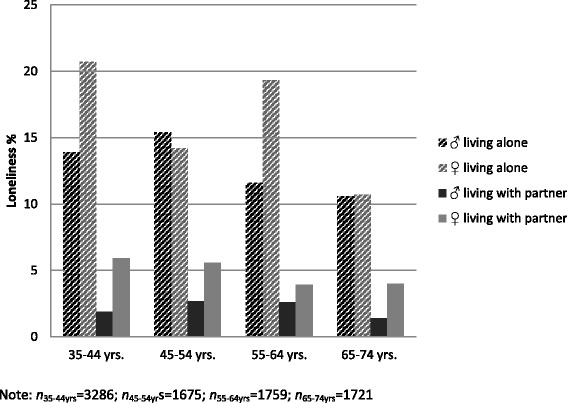
“In the age range of 45-54 years (14.2% vs. 15.4%) and 65-74 years (10.7% vs. 10.6%), no significant gender differences were observed when participant lived alone.”
§ Loneliness in the general population: prevalence, determinants and relations to mental health > Results
plain- Asserted: passes — The authors put it forward as true.
- Checkable: passes — It can be checked against evidence.
- Load-bearing: unclear — It is unclear whether the paper’s conclusions depend on it.
- Based: passes — The paper gives a reason why it holds.
A result the paper reports from its own data — it cites no other source for it, so there is none to check. The quote shows it is in the paper.
In the paper
“Type D increased considerably with the degree of loneliness.”
§ Loneliness in the general population: prevalence, determinants and relations to mental health > Results
plaindirect- Asserted: passes — The authors put it forward as true.
- Checkable: passes — It can be checked against evidence.
- Load-bearing: unclear — It is unclear whether the paper’s conclusions depend on it.
- Based: passes — The paper gives a reason why it holds.
A result the paper reports from its own data — it cites no other source for it, so there is none to check. The quote shows it is in the paper.
In the paper
“Loneliness was stronger in women, in participants without a partner, and in those living alone and without children.”
- Also stated in: § Results · plain
“Loneliness was more frequent in women, in participants without a partner or without children.”
- Also stated in: § Discussion · plain
“Loneliness was more frequent in women, in participants without a partnership, without children and in those living alone.”
§ Loneliness in the general population: prevalence, determinants and relations to mental health > Abstract > Results
plaincorrelational- Asserted: passes — The authors put it forward as true.
- Checkable: passes — It can be checked against evidence.
- Load-bearing: passes — The paper’s conclusions depend on it.
- Based: passes — The paper gives a reason why it holds.
- Also stated in: § Results · plain
A result the paper reports from its own data — it cites no other source for it, so there is none to check. The quote shows it is in the paper.
In the paper
“Loneliness declined across age groups.”
- Also stated in: § Discussion · plain
“loneliness declined with age.”
- Also stated in: § Results · plain
“Overall, mean age of lonely participants was lower.”
§ Loneliness in the general population: prevalence, determinants and relations to mental health > Abstract > Results
plaincorrelational- Asserted: passes — The authors put it forward as true.
- Checkable: passes — It can be checked against evidence.
- Load-bearing: unclear — It is unclear whether the paper’s conclusions depend on it.
- Based: passes — The paper gives a reason why it holds.
- Also stated in: § Discussion · plain
A result the paper reports from its own data — it cites no other source for it, so there is none to check. The quote shows it is in the paper.
In the paper
“few men (1.4 to 2.7%) reported feeling lonely, whereas more than twice as many women reported feeling lonely (up to 5.9%).”
- Also stated in: § Discussion · plain
“about twice as many women in partnerships (up to 5.9%) reported feeling lonely in comparison to men (1.4% to 2.7%).”
§ Loneliness in the general population: prevalence, determinants and relations to mental health > Results
plain- Asserted: passes — The authors put it forward as true.
- Checkable: passes — It can be checked against evidence.
- Load-bearing: unclear — It is unclear whether the paper’s conclusions depend on it.
- Based: passes — The paper gives a reason why it holds.
- Also stated in: § Discussion · plain
A result the paper reports from its own data — it cites no other source for it, so there is none to check. The quote shows it is in the paper.
In the paper
“SES declined with increasing loneliness.”
- Also stated in: § Discussion · plain
“Socioeconomic status declined with increasing loneliness.”
§ Loneliness in the general population: prevalence, determinants and relations to mental health > Results
plaincorrelational- Asserted: passes — The authors put it forward as true.
- Checkable: passes — It can be checked against evidence.
- Load-bearing: unclear — It is unclear whether the paper’s conclusions depend on it.
- Based: passes — The paper gives a reason why it holds.
- Also stated in: § Discussion · plain
A result the paper reports from its own data — it cites no other source for it, so there is none to check. The quote shows it is in the paper.
In the paper
“No significant increases were found for previous unemployment, although there was a descriptive trend of a positive link between feeling lonely and previous unemployment.”
§ Loneliness in the general population: prevalence, determinants and relations to mental health > Results
plain- Asserted: passes — The authors put it forward as true.
- Checkable: passes — It can be checked against evidence.
- Load-bearing: unclear — It is unclear whether the paper’s conclusions depend on it.
- Based: passes — The paper gives a reason why it holds.
A result the paper reports from its own data — it cites no other source for it, so there is none to check. The quote shows it is in the paper.
In the paper
“There was no association with BMI.”
- Also stated in: § Discussion · plain
“but not to other risk factors such as alcohol use or diet (BMI).”
§ Loneliness in the general population: prevalence, determinants and relations to mental health > Results
plain- Asserted: passes — The authors put it forward as true.
- Checkable: passes — It can be checked against evidence.
- Load-bearing: unclear — It is unclear whether the paper’s conclusions depend on it.
- Based: passes — The paper gives a reason why it holds.
- Also stated in: § Discussion · plain
- The quote only partly states this claim. 8
- It may state two separate claims as one. 8
- Probably not a substantial claim. 9
A result the paper reports from its own data — it cites no other source for it, so there is none to check. The quote shows it is in the paper.
In the paper
“Lonely participants also smoked more and visited physicians more frequently.”
- Also stated in: § Results · plain
“The majority of participants (63%) with a strong degree of loneliness had visited a physician (vs. 42% with no feelings of loneliness)”
- Also stated in: § Discussion · plain
“the majority of participants (63%) with a strong degree of loneliness had visited a physician (vs. 42% without loneliness)”
§ Loneliness in the general population: prevalence, determinants and relations to mental health > Abstract > Results
plaincorrelational- Asserted: passes — The authors put it forward as true.
- Checkable: passes — It can be checked against evidence.
- Load-bearing: unclear — It is unclear whether the paper’s conclusions depend on it.
- Based: passes — The paper gives a reason why it holds.
The quote only partly states this claim.
- Also stated in: § Results · plain
A result the paper reports from its own data — it cites no other source for it, so there is none to check. The quote shows it is in the paper.
In the paper
“The average alcohol consumption was negatively linked to loneliness.”
§ Loneliness in the general population: prevalence, determinants and relations to mental health > Results
plaincorrelational- Asserted: passes — The authors put it forward as true.
- Checkable: passes — It can be checked against evidence.
- Load-bearing: unclear — It is unclear whether the paper’s conclusions depend on it.
- Based: passes — The paper gives a reason why it holds.
The quote only partly states this claim.
A result the paper reports from its own data — it cites no other source for it, so there is none to check. The quote shows it is in the paper.
In the paper
“more than half of the loneliest participants were also depressed (vs. 5% in the group with feelings of loneliness), and over 40% in this group reported anxiety and suicidal ideation (which increased from 6% to 42%) and 30% panic attacks in the past 4 weeks.”
§ Loneliness in the general population: prevalence, determinants and relations to mental health > Results
plaincorrelational- Asserted: passes — The authors put it forward as true.
- Checkable: passes — It can be checked against evidence.
- Load-bearing: passes — The paper’s conclusions depend on it.
- Based: passes — The paper gives a reason why it holds.
It may state two separate claims as one.
A result the paper reports from its own data — it cites no other source for it, so there is none to check. The quote shows it is in the paper.
In the paper
“Among those living alone, the highest proportion of loneliness was found in the youngest group of women in the range from 35 to 44 years (20.7%), whereas men tended to report heightened loneliness in the range from 45 to 54 years (15.4%).”
§ Loneliness in the general population: prevalence, determinants and relations to mental health > Results
plaincorrelational- Asserted: passes — The authors put it forward as true.
- Checkable: passes — It can be checked against evidence.
- Load-bearing: unclear — It is unclear whether the paper’s conclusions depend on it.
- Based: passes — The paper gives a reason why it holds.
It may state two separate claims as one.
A result the paper reports from its own data — it cites no other source for it, so there is none to check. The quote shows it is in the paper.
In the paper
“there were strong increases in the intake of anxiolytics and antidepressants among lonely participants.”
§ Loneliness in the general population: prevalence, determinants and relations to mental health > Results
boostedcorrelational- Asserted: passes — The authors put it forward as true.
- Checkable: passes — It can be checked against evidence.
- Load-bearing: passes — The paper’s conclusions depend on it.
- Based: passes — The paper gives a reason why it holds.
The quote only partly states this claim.
A result the paper reports from its own data — it cites no other source for it, so there is none to check. The quote shows it is in the paper.
In the paper
“generalized anxiety (OR = 1.21)”
- Also stated in: § Results · plain
“loneliness also positively predicted anxiety (OR = 1.21)”
§ Loneliness in the general population: prevalence, determinants and relations to mental health > Abstract > Results
plaincorrelational- Asserted: passes — The authors put it forward as true.
- Checkable: passes — It can be checked against evidence.
- Load-bearing: passes — The paper’s conclusions depend on it.
- Based: passes — The paper gives a reason why it holds.
The quote only partly states this claim.
- Rests on an assumption: Non-response (response rate 60.3%) and exclusions (5.8%) did not substantially bias the prevalence and association estimates in the Gutenberg Health Study sample.
- Also stated in: § Results · plain
A result the paper reports from its own data — it cites no other source for it, so there is none to check. The quote shows it is in the paper.
In the paper
“A total of 10.5% of participants reported some degree of loneliness (4.9% slight, 3.9% moderate and 1.7% severely distressed by loneliness).”
- Also stated in: § Results · plain
“A total of 10.5% reported some degree of loneliness: 4.9% were slightly, 3.9% moderately and 1.7% severely distressed by feeling lonely.”
- Also stated in: § Discussion · plain
“we found that one in 10 (10.5%) participants reported some degree of loneliness.”
§ Loneliness in the general population: prevalence, determinants and relations to mental health > Abstract > Results
plain- Asserted: passes — The authors put it forward as true.
- Checkable: passes — It can be checked against evidence.
- Load-bearing: unclear — It is unclear whether the paper’s conclusions depend on it.
- Based: passes — The paper gives a reason why it holds.
It may state two separate claims as one.
- Rests on an assumption: Non-response (response rate 60.3%) and exclusions (5.8%) did not substantially bias the prevalence and association estimates in the Gutenberg Health Study sample.
- Also stated in: § Results · plain
A result the paper reports from its own data — it cites no other source for it, so there is none to check. The quote shows it is in the paper.
In the paper
“21% (vs. 13%) had had inpatient treatments.”
- Also stated in: § Discussion · plain
“21% had had inpatient treatments.”
§ Loneliness in the general population: prevalence, determinants and relations to mental health > Results
plaincorrelational- Asserted: passes — The authors put it forward as true.
- Checkable: passes — It can be checked against evidence.
- Load-bearing: unclear — It is unclear whether the paper’s conclusions depend on it.
- Based: passes — The paper gives a reason why it holds.
The quote only partly states this claim.
- Also stated in: § Discussion · plain
A result the paper reports from its own data — it cites no other source for it, so there is none to check. The quote shows it is in the paper.
In the paper
“loneliness was associated with depression (OR = 1.91)”
- Also stated in: § Results · plain
“Loneliness as one of the predictors of the first regression model almost doubled the likelihood of depression (OR = 1.91).”
§ Loneliness in the general population: prevalence, determinants and relations to mental health > Abstract > Results
plaincorrelational- Asserted: passes — The authors put it forward as true.
- Checkable: passes — It can be checked against evidence.
- Load-bearing: passes — The paper’s conclusions depend on it.
- Based: passes — The paper gives a reason why it holds.
The quote only partly states this claim.
- Rests on an assumption: Non-response (response rate 60.3%) and exclusions (5.8%) did not substantially bias the prevalence and association estimates in the Gutenberg Health Study sample.
- Also stated in: § Results · plain
A result the paper reports from its own data — it cites no other source for it, so there is none to check. The quote shows it is in the paper.
In the paper
“Lonely participants also smoked more and visited physicians more frequently.”
- Also stated in: § Results · plain
“The proportion of current smokers almost doubled with increasing loneliness.”
- Also stated in: § Discussion · plain
“Loneliness also contributed to smoking as an indicator for an unhealthy lifestyle”
§ Loneliness in the general population: prevalence, determinants and relations to mental health > Abstract > Results
plaincorrelational- Asserted: passes — The authors put it forward as true.
- Checkable: passes — It can be checked against evidence.
- Load-bearing: passes — The paper’s conclusions depend on it.
- Based: passes — The paper gives a reason why it holds.
The quote only partly states this claim.
- Also stated in: § Results · plain
A result the paper reports from its own data — it cites no other source for it, so there is none to check. The quote shows it is in the paper.
In the paper
“suicidal ideation (OR = 1.35)”
- Also stated in: § Results · plain
“Prediction of suicidal ideation by loneliness was also substantial (OR = 1.35)”
- Also stated in: § Discussion · plain
“for suicidal ideation and generalized anxiety, 1.35 and 1.21”
§ Loneliness in the general population: prevalence, determinants and relations to mental health > Abstract > Results
plaincorrelational- Asserted: passes — The authors put it forward as true.
- Checkable: passes — It can be checked against evidence.
- Load-bearing: passes — The paper’s conclusions depend on it.
- Based: passes — The paper gives a reason why it holds.
The quote only partly states this claim.
- Rests on an assumption: Non-response (response rate 60.3%) and exclusions (5.8%) did not substantially bias the prevalence and association estimates in the Gutenberg Health Study sample.
- Also stated in: § Results · plain
What the paper did — it cites no source for this, so there is none to check. The quote shows it is in the paper.
In the paper
“Interpretation of our findings is limited by the cross-sectional character of our study which does not permit causal conclusions.”
§ Loneliness in the general population: prevalence, determinants and relations to mental health > Discussion
plain- Asserted: passes — The authors put it forward as true.
- Checkable: passes — It can be checked against evidence.
- Load-bearing: passes — The paper’s conclusions depend on it.
- Based: passes — The paper gives a reason why it holds.
Probably not a substantial claim. It may state two separate claims as one.
What the paper did — it cites no source for this, so there is none to check. The quote shows it is in the paper.
In the paper
“We excluded 5.8% of the sample due to insufficient knowledge of German language, physical or mental inability to participate.”
§ Loneliness in the general population: prevalence, determinants and relations to mental health > Methods > Study sample
plain- Asserted: passes — The authors put it forward as true.
- Checkable: passes — It can be checked against evidence.
- Load-bearing: fails — The paper’s conclusions may not depend on it.
- Based: passes — The paper gives a reason why it holds.
Probably not a substantial claim. The paper’s conclusions may not depend on it.
In the paper
“According to [25], caseness was defined by a PHQ-8 sum score of ≥10, achieving a sensitivity of 88% and a specificity of 88% for major depression.”
§ Loneliness in the general population: prevalence, determinants and relations to mental health > Methods > Study sample
What the sources say
- Not checked yetcites [25] Löwe B, Kroenke K, Herzog W, Gräfe K. Measuring depression outcome with a brief self-report instrument: sensitivity to change of the Patient Health Questionnaire (PHQ-9). J Affect Disord. 2004;81(1):61–6. source
plain- Asserted: passes — The authors put it forward as true.
- Checkable: passes — It can be checked against evidence.
- Load-bearing: fails — The paper’s conclusions may not depend on it.
- Based: passes — The paper gives a reason why it holds.
Probably not a substantial claim. The paper’s conclusions may not depend on it.
What the paper did — it cites no source for this, so there is none to check. The quote shows it is in the paper.
In the paper
“Strengths of this study reside in the large sample size and the use of standardized self-report instruments to measure distress.”
§ Loneliness in the general population: prevalence, determinants and relations to mental health > Discussion
plain- Asserted: passes — The authors put it forward as true.
- Checkable: passes — It can be checked against evidence.
- Load-bearing: fails — The paper’s conclusions may not depend on it.
- Based: passes — The paper gives a reason why it holds.
Probably not a substantial claim. The paper’s conclusions may not depend on it. It may state two separate claims as one.
What the paper did — it cites no source for this, so there is none to check. The quote shows it is in the paper.
In the paper
“As we did not directly assess the size and quality of social networks, we cannot estimate the effect of social isolation in our study which is a confounding variable when investigating loneliness.”
§ Loneliness in the general population: prevalence, determinants and relations to mental health > Discussion
plain- Asserted: passes — The authors put it forward as true.
- Checkable: passes — It can be checked against evidence.
- Load-bearing: passes — The paper’s conclusions depend on it.
- Based: passes — The paper gives a reason why it holds.
It may state two separate claims as one.
What the paper did — it cites no source for this, so there is none to check. The quote shows it is in the paper.
In the paper
“Recruitment was performed stratified in equal strata for gender, residence and for age decades.”
§ Loneliness in the general population: prevalence, determinants and relations to mental health > Methods > Study sample
plain- Asserted: passes — The authors put it forward as true.
- Checkable: passes — It can be checked against evidence.
- Load-bearing: fails — The paper’s conclusions may not depend on it.
- Based: passes — The paper gives a reason why it holds.
Probably not a substantial claim. The paper’s conclusions may not depend on it.
What the paper did — it cites no source for this, so there is none to check. The quote shows it is in the paper.
In the paper
“No adjustments for multiple testing were performed, as this was an exploratory study.”
§ Loneliness in the general population: prevalence, determinants and relations to mental health > Methods > Study sample
plain- Asserted: passes — The authors put it forward as true.
- Checkable: passes — It can be checked against evidence.
- Load-bearing: passes — The paper’s conclusions depend on it.
- Based: passes — The paper gives a reason why it holds.
Probably not a substantial claim.
What the paper did — it cites no source for this, so there is none to check. The quote shows it is in the paper.
In the paper
“The sample was drawn at random from the local registries of the city of Mainz and the adjacent district of Mainz-Bingen.”
§ Loneliness in the general population: prevalence, determinants and relations to mental health > Methods > Study sample
plain- Asserted: passes — The authors put it forward as true.
- Checkable: passes — It can be checked against evidence.
- Load-bearing: passes — The paper’s conclusions depend on it.
- Based: passes — The paper gives a reason why it holds.
Probably not a substantial claim.
In the paper
“According to [27], the sum score of the answers (0 = not at all, 1 = several days, 2 = over half the days, and 3 = nearly every day) assesses generalized anxiety with good sensitivity (86%) and specificity (83%).”
§ Loneliness in the general population: prevalence, determinants and relations to mental health > Methods > Study sample
What the sources say
- Not checked yetcites [27] Michal M, Wiltink J, Till Y, Wild PS, Münzel T, Blankenberg S, et al. Type-D personality and depersonalization are associated with suicidal ideation in the German general population aged 35–74: results from the Gutenberg Heart Study. J Affect Disord. 2010;125(1):227–33. source
plain- Asserted: passes — The authors put it forward as true.
- Checkable: passes — It can be checked against evidence.
- Load-bearing: fails — The paper’s conclusions may not depend on it.
- Based: passes — The paper gives a reason why it holds.
Probably not a substantial claim. The paper’s conclusions may not depend on it. It may state two separate claims as one.
A conclusion the paper draws from its own results — it cites no other source for it, so there is none to check. The quote shows it is in the paper.
In the paper
“The findings support the view that loneliness poses a significant health problem for a sizeable part of the population with increased risks in terms of distress (depression, anxiety), suicidal ideation, health behavior and health care utilization.”
- Also stated in: § Conclusions · plain
“Our findings support the view that loneliness poses a significant health problem for a sizeable part of the population with increased risks in terms of distress (depression, anxiety), suicidal ideation, health behavior and health care utilization.”
§ Loneliness in the general population: prevalence, determinants and relations to mental health > Abstract > Conclusions
plaincorrelational- Asserted: passes — The authors put it forward as true.
- Checkable: passes — It can be checked against evidence.
- Load-bearing: passes — The paper’s conclusions depend on it.
- Based: passes — The paper gives a reason why it holds.
It may state two separate claims as one.
- Rests on an assumption: Non-response (response rate 60.3%) and exclusions (5.8%) did not substantially bias the prevalence and association estimates in the Gutenberg Health Study sample.
- Also stated in: § Conclusions · plain
What the paper did — it cites no source for this, so there is none to check. The quote shows it is in the paper.
In the paper
“The response rate amounted to 60.3%.”
§ Loneliness in the general population: prevalence, determinants and relations to mental health > Methods > Study sample
plain- Asserted: passes — The authors put it forward as true.
- Checkable: passes — It can be checked against evidence.
- Load-bearing: fails — The paper’s conclusions may not depend on it.
- Based: passes — The paper gives a reason why it holds.
Probably not a substantial claim. The paper’s conclusions may not depend on it.
The paper relies on this without support.
Non-response (response rate 60.3%) and exclusions (5.8%) did not substantially bias the prevalence and association estimates in the Gutenberg Health Study sample.
“The response rate amounted to 60.3%.”
“We excluded 5.8% of the sample due to insufficient knowledge of German language, physical or mental inability to participate.”
Claims other papers make about this one
Each is checked against this paper’s own text: does it say what the citing paper says it does?
The source backs part of the claim, not all of it — or backs it for a different population, condition or comparison.
In the citing paper
“associations between feelings of loneliness or lack of social support and anxiety, depression, suicidal ideation, and self-harming behaviours tend to be stronger among young females than among males (Beutel et al., 2017; Elbogen et al., 2021).”
From Pathways of association between disordered eating in adolescence and mental health outcomes in young adulthood during the COVID-19 pandemic (2023) · cites this paper as Beutel et al., 2017
Experimental — accuracy not yet measuredThe source backs part of the claim, not all of it — or backs it for a different population, condition or comparison.
In the citing paper
“The burden of mental illness in young adulthood often stems from factors experienced during adolescence, with loneliness being a significant, yet understudied factor [9, 10].”
From The prospective association of adolescent loneliness and low resilience with anxiety and depression in young adulthood: The HUNT study (2025) · cites this paper as [10]
Experimental — accuracy not yet measuredThe source backs part of the claim, not all of it — or backs it for a different population, condition or comparison.
In the citing paper
“Additionally, Beutel et al. [12] highlighted a strong association between loneliness and generalized anxiety and depression, especially among middle and late adulthood individuals.”
From The prospective association of adolescent loneliness and low resilience with anxiety and depression in young adulthood: The HUNT study (2025) · cites this paper as [12]
Experimental — accuracy not yet measuredThe cited source says what the claim attributes to it.
In the citing paper
“and is also associated with anxiety [12, 14].”
From The prospective association of adolescent loneliness and low resilience with anxiety and depression in young adulthood: The HUNT study (2025) · cites this paper as [12]
The cited source says what the claim attributes to it.
In the citing paper
“Research shows that loneliness represents a risk factor for depression [12, 13]”
From The prospective association of adolescent loneliness and low resilience with anxiety and depression in young adulthood: The HUNT study (2025) · cites this paper as [12]
In the citing paper
“Especially loneliness has been associated with an increased risk for several mental disorders and somatic diseases in general (Beutel et al., 2017; Holt-Lunstad et al., 2015; Valtorta et al., 2018; Luhmann and Hawkley, 2016) and during the current pandemic (Palgi et al., 2020; González-Sanguino et al., 2020; Luchetti et al., 2020).”
From Lockdown, quarantine measures, and social distancing: Associations with depression, anxiety and distress at the beginning of the COVID-19 pandemic among adults from Germany (2020) · cites this paper as Beutel et al., 2017
In the citing paper
“These prospective reviews have found loneliness to be a stronger predictor of later depression, when compared to anxiety or substance abuse as outcome variables”
From Loneliness as a predictor of suicidal ideation and behaviour: a systematic review and meta-analysis of prospective studies (2020) · cites this paper as Beutel et al., 2017
In the citing paper
“Collectively, the evidence points to no gender difference in the association between loneliness and SIB crosssectionally”
From Loneliness as a predictor of suicidal ideation and behaviour: a systematic review and meta-analysis of prospective studies (2020) · cites this paper as Beutel et al., 2017
In the citing paper
“in non-pandemic contexts, evidence suggests that the prevalence of loneliness ranges from 6–76%; with variations across demographic groups [5,13–17] and countries [18,19].”
From Loneliness in the UK during the COVID-19 pandemic: Cross-sectional results from the COVID-19 Psychological Wellbeing Study (2020) · cites this paper as [5]
In the citing paper
“Loneliness is associated with worse physical and mental health [5–8] and increases mortality risk [9,10].”
From Loneliness in the UK during the COVID-19 pandemic: Cross-sectional results from the COVID-19 Psychological Wellbeing Study (2020) · cites this paper as [5]
In the citing paper
“In non-pandemic contexts, geographical isolation, living alone, and lack of social engagement predicts loneliness in adult and older adult populations [5,13,15,20,29–31].”
From Loneliness in the UK during the COVID-19 pandemic: Cross-sectional results from the COVID-19 Psychological Wellbeing Study (2020) · cites this paper as [5]
Self-check
Percentages, sums and reported differences re-computed from the paper’s own numbers.
Each contradiction between two passages listed here was confirmed by an independent check.
Rated major: it would touch a result — a value a result rests on, reported and recomputed p-values on opposite sides of the significance level, two passages that conflict with no sign which is right, or a cited work retracted before this paper was published.
In the paper
§ Loneliness in the general population: prevalence, determinants and relations to mental health > Abstract > Methods
“Loneliness was used as a predictor for distress (depression, generalized anxiety, and suicidal ideation) in logistic regression analyses adjusting for sociodemographic variables and mental distress.”
§ Loneliness in the general population: prevalence, determinants and relations to mental health > Methods > Study sample
“loneliness was used as a predictor in multiple generalized linear models with a binominal distribution and a log link function adjusted for sociodemographic variables.”
Rated major: it would touch a result — a value a result rests on, reported and recomputed p-values on opposite sides of the significance level, two passages that conflict with no sign which is right, or a cited work retracted before this paper was published.
In the paper
§ Loneliness in the general population: prevalence, determinants and relations to mental health > Abstract > Results
“Controlling for demographic variables and other sources of distress loneliness was associated with depression (OR = 1.91), generalized anxiety (OR = 1.21) and suicidal ideation (OR = 1.35).”
§ Loneliness in the general population: prevalence, determinants and relations to mental health > Results
“| Loneliness | 1.91 | 1.74-2.09 | < 0.0001 | 1.21 | 1.09-1.34 | 0.0002 | 1.31 | 1.19-1.44 | <0.0001 |”
Rated minor: it would not touch a result — a value no result rests on, a p-value that stays on the same side of the significance level, or a conflict that is clerical, resolved elsewhere in the paper, or outside its own findings.
In the paper
§ Loneliness in the general population: prevalence, determinants and relations to mental health > Discussion
“On the other hand, middle-aged men (between 45 and 64 years) were slightly more affected than women.”
§ Loneliness in the general population: prevalence, determinants and relations to mental health > Results
“Women living alone in the age range 35-44 years (20.7% vs. 13.9%) and 55-64 years (19.3% vs. 11.6%) were considerably more affected by loneliness than men.”
Rated minor: it would not touch a result — a value no result rests on, a p-value that stays on the same side of the significance level, or a conflict that is clerical, resolved elsewhere in the paper, or outside its own findings.
In the paper
§ Loneliness in the general population: prevalence, determinants and relations to mental health > Results
“more than half of the loneliest participants were also depressed (vs. 5% in the group with feelings of loneliness)”
§ Loneliness in the general population: prevalence, determinants and relations to mental health > Methods > Study sample
“| Current depression (PHQ-8 ≥ 10) | 5.2 | 19.3 | 30.5 | 52.6 | < 0.0001 |”
Citations
Cites
The need to belong: Desire for interpersonal attachments as a fundamental human motivation.
Baumeister, R. F., & Leary, M. R. (1995) · Psychological Bulletin · doi:10.1037//0033-2909.117.3.497 · Cited by 23,245
Bundesgesundheitsblatt - Gesundheitsforschung - Gesundheitsschutz
(2013) · Bundesgesundheitsblatt - Gesundheitsforschung - Gesundheitsschutz · doi:10.1007/103.1437-1588 · Cited by 11,769
Spitzer, R. L. (1999) · JAMA · doi:10.1001/jama.282.18.1737 · Cited by 9,802
Social Relationships and Mortality Risk: A Meta-analytic Review
Holt-Lunstad, J., Smith, T. B., & Layton, J. B. (2010) · PLoS Medicine · doi:10.1371/journal.pmed.1000316 · Cited by 7,272 · cited 1×
“In a recent meta-analysis, lack of functional and structural social integration predicted a 50% increase in mortality, which is comparable to traditional risk factors [19].”
BackgroundJournal of social behavior and personality
(1986) · Personality and Individual Differences · doi:10.1016/0191-8869(86)90025-5 · Cited by 6,751
The Revised UCLA Loneliness Scale: concurrent and discriminant validity evidence
Russell, D., Peplau, L. A., & Cutrona, C. E. (1980) · Journal of Personality and Social Psychology · doi:10.1037/0022-3514.39.3.472 · Cited by 5,173
Loneliness matters: a theoretical and empirical review of consequences and mechanisms
Hawkley, L. C., & Cacioppo, J. T. (2010) · Annals of Behavioral Medicine · doi:10.1007/s12160-010-9210-8 · Cited by 4,782
A Short Scale for Measuring Loneliness in Large Surveys: Results From Two Population-Based Studies
Hughes, M. E., Waite, L. J., Hawkley, L. C., & Cacioppo, J. T. (2004) · Research on Aging · doi:10.1177/0164027504268574 · Cited by 4,781
Löwe, B., Decker, O., Müller, S., Brähler, E., Schellberg, D., Herzog, W., & Herzberg, P. Y. (2008) · Medical Care · doi:10.1097/mlr.0b013e318160d093 · Cited by 4,527
Self-citationJoiner, T. E. (2007) · Harvard University Press eBooks · doi:10.2307/j.ctvjghv2f · Cited by 2,891
Cited by
Sorted by citations
Items 301–400 of 1,000
Sha, S., Loveys, K., Qualter, P., Shi, H., Krpan, D., & Galizzi, M. M. (2024) · BMC Public Health · doi:10.1186/s12889-024-19153-x · Cited by 23
Kirby, J. N., Sampson, H., Day, J. J., Hayes, A. J., & Gilbert, P. (2019) · Psychology and Psychotherapy Theory Research and Practice · doi:10.1111/papt.12223 · Cited by 27
Alshammari, T. K., Alkhodair, A. M., Alhebshi, H. A., Rogowska, A. M., Albaker, A. B., Aldamri, N. T., Dayel, A. F. B., Alonazi, A. S., Al-Rasheed, N. M., & Alshammari, M. A. (2022) · International Journal of Environmental Research and Public Health · doi:10.3390/ijerph19106262 · Cited by 22
Barnett, M. D., Moore, J. M., & Archuleta, W. P. (2019) · Archives of Gerontology and Geriatrics · doi:10.1016/j.archger.2019.03.027 · Cited by 23
Grey, I. M., Arora, T., & Sanah, A. (2022) · Psychological Reports · doi:10.1177/00332941221079723 · Cited by 22
Kim, S., & Lee, K. (2022) · Journal of Personalized Medicine · doi:10.3390/jpm12040516 · Cited by 22
Otten, D., Ernst, M., Werner, A. M., Tibubos, A. N., Reiner, I., Brähler, E., Wiltink, J., Michal, M., Nagler, M., Wild, P. S., et al. (2022) · Psychological Medicine · doi:10.1017/s0033291722000861 · Cited by 21
Self-citationMurugan, Y., Nagarajan, P., Subrahmanyam, D., & Kattimani, S. (2022) · Asian Journal of Psychiatry · doi:10.1016/j.ajp.2022.103245 · Cited by 21
Loneliness in Elderly Inpatients
Just, S. A., Seethaler, M., Sarpeah, R., Waßmuth, N., Bermpohl, F., & Brandl, E. J. (2022) · Psychiatric Quarterly · doi:10.1007/s11126-022-10006-7 · Cited by 26
Sabaß, L., Buchenrieder, N., Rek, S. V., Nenov-Matt, T., Lange, J., Barton, B. B., Musil, R., Jobst, A., Padberg, F., & Reinhard, M. A. (2022) · Journal of Affective Disorders · doi:10.1016/j.jad.2022.06.021 · Cited by 22
Refaeli, T., & Achdut, N. (2021) · Sustainability · doi:10.3390/su13126942 · Cited by 20
Problems with Social Cognition and Decision-Making in Huntington’s Disease: Why Is it Important?
Mason, S., Schaepers, M., & Barker, R. A. (2021) · Brain Sciences · doi:10.3390/brainsci11070838 · Cited by 23
The Long-Term Public Health Impact of Social Distancing on Brain Health: Topical Review
Kumar, A., & Salinas, J. (2021) · International Journal of Environmental Research and Public Health · doi:10.3390/ijerph18147307 · Cited by 24
Ray, C. D., & Shebib, S. J. (2022) · Journal of Social and Personal Relationships · doi:10.1177/02654075221102632 · Cited by 23
Effectiveness of chronic disease self-management education (CDSME) programs to reduce loneliness
Smith, M. L., Chen, E., Lau, C. A., Davis, D., Simmons, W. J., & Merianos, A. L. (2022) · Chronic Illness · doi:10.1177/17423953221113604 · Cited by 23
Friesinger, J. G., Haugland, S. H., & Vederhus, J. (2022) · Health and Quality of Life Outcomes · doi:10.1186/s12955-022-02045-2 · Cited by 25
McGuire, A., Elmore, C., Szabo, Y. Z., Kurz, A. S., Mendoza, C., Umucu, E., & Creech, S. (2023) · PLoS ONE · doi:10.1371/journal.pone.0281575 · Cited by 19
Potashkin, J., Santiago, J., & Quinn, J. P. (2023) · International Journal of Molecular Sciences · doi:10.3390/ijms24065909 · Cited by 22
Social Risk Factors That Increase Cardiovascular and Breast Cancer Risk
Obeidat, O., Charles, K., Akhter, N., & Tong, A. T. (2023) · Current Cardiology Reports · doi:10.1007/s11886-023-01957-9 · Cited by 20
Travaglino, G. A., Li, Z., Zhang, X., Lu, X., & Choi, H. (2020) · British Journal of Social Psychology · doi:10.1111/bjso.12365 · Cited by 24
Drageset, J., & Haugan, G. (2021) · Geriatric Nursing · doi:10.1016/j.gerinurse.2021.04.001 · Cited by 20
Factors Related to Mental Health During the COVID-19 Lockdown in Spain
González, R. P., Vicario‐Molina, I., Ortega, E. G., & Picos, A. P. (2021) · Frontiers in Psychology · doi:10.3389/fpsyg.2021.715792 · Cited by 22
Lee, H., Yong, S. Y., Choi, H., Yoon, G. Y., & Koh, S. B. (2024) · Frontiers in Aging Neuroscience · doi:10.3389/fnagi.2024.1389476 · Cited by 21
Kambeitz, J. P., & Meyer‐Lindenberg, A. (2025) · npj Digital Medicine · doi:10.1038/s41746-024-01422-z · Cited by 25
Larsen, R. T., Korfitsen, C. B., Keller, C., Christensen, J., Andersen, H. B., Juhl, C. B., & Langberg, H. (2021) · European Review of Aging and Physical Activity · doi:10.1186/s11556-021-00269-7 · Cited by 23
“Live” Together with You: Livestream Views Mitigate the Effects of Loneliness on Well-being
Goh, Z. H., Tandoc, E. C., & Ng, B. (2021) · Journal of Broadcasting & Electronic Media · doi:10.1080/08838151.2021.1994970 · Cited by 19
Saporta, N., Scheele, D., Lieberz, J., Nevat, M., Kanterman, A., Hurlemann, R., & Shamay‐Tsoory, S. (2022) · Cerebral Cortex · doi:10.1093/cercor/bhac073 · Cited by 22
Loneliness and its correlates among Bangladeshi older adults during the COVID-19 pandemic
Mistry, S. K., Ali, A. M., Yadav, U. N., Huda, M. N., Ghimire, S., Saha, M., Sarwar, S., & Harris, M. (2022) · Scientific Reports · doi:10.1038/s41598-022-19376-1 · Cited by 22
Risk in childhood family environments and loneliness in college students: Implications for health
Counts, C. J., & John‐Henderson, N. A. (2019) · Journal of American College Health · doi:10.1080/07448481.2018.1557198 · Cited by 19
Linking cancer and mental health in men and women in a representative community sample.
Ernst, M., Wiltink, J., Tibubos, A., Brähler, E., Schulz, A., Wild, P., Burghardt, J., Münzel, T., König, J., Lackner, K., et al. (2019) · Journal of Psychosomatic Research · doi:10.1016/j.jpsychores.2019.109760 · Cited by 16
Self-citationHow COVID-19 has impacted integrated care practice: lessons from the frontlines
Cooper, Z., & Zerden, L. D. S. (2021) · Social Work in Health Care · doi:10.1080/00981389.2021.1904316 · Cited by 19
Leveraging belonging in response to global loneliness
Allen, K., & Furlong, M. J. (2021) · Australian Journal of Psychology · doi:10.1080/00049530.2021.1875532 · Cited by 20
Loneliness is linked to specific subregional alterations in hippocampus-default network covariation
Zajner, C., Spreng, R. N., & Bzdok, D. (2021) · Journal of Neurophysiology · doi:10.1152/jn.00339.2021 · Cited by 18
Seidler, Z. E., Wilson, M. J., Rice, S., Kealy, D., Oliffe, J. L., & Ogrodniczuk, J. S. (2020) · International Journal of Social Psychiatry · doi:10.1177/0020764020983836 · Cited by 26
Koné, A., Horter, L., Rose, C. E., Rao, C. Y., Orquiola, D., Thomas, I. M., Byrkit, R., Bryant-Genevier, J., & Lopes-Cardozo, B. (2022) · Annals of Epidemiology · doi:10.1016/j.annepidem.2022.07.001 · Cited by 18
Cimino, S. R., Cadel, L., Guilcher, S. J. T., Wasilewski, M. B., & Hitzig, S. L. (2022) · Journal of Spinal Cord Medicine · doi:10.1080/10790268.2022.2129170 · Cited by 19
Omran, A. J. A., Watanabe, S., Hong, E. C., Skinner, S. G., Zhang, M., Zhang, J., Shao, X. M., & Liang, J. (2022) · Neurobiology of Stress · doi:10.1016/j.ynstr.2022.100499 · Cited by 19
Zhang, X., Brown, A. M., & Rhubart, D. C. (2023) · International Journal of Behavioral Medicine · doi:10.1007/s12529-022-10151-0 · Cited by 20
Long, E., Thomson, M., Milicev, J., Goodfellow, C., Letina, S., Bradley, S. M., & McCann, M. (2024) · Journal of Public Health · doi:10.1007/s10389-024-02236-9 · Cited by 23
Prevalence and Determinants of Loneliness among Older Adults in Bangladesh
Rahman, M. S., Rahman, M. A., & Rahman, M. S. (2019) · International Journal of Emerging Trends in Social Sciences · doi:10.20448/2001.52.57.64 · Cited by 19
Marcotte, A. S., Kaufman, E. M., Campbell, J. T., Reynolds, T. A., Garcia, J. R., & Gesselman, A. N. (2021) · International Journal of Environmental Research and Public Health · doi:10.3390/ijerph18178924 · Cited by 19
Webber, M., Ngamaba, K. H., Moran, N. E., Pinfold, V., Boehnke, J. R., Knapp, M. R. J., Henderson, C., Rehill, A., & Morris, D. (2020) · The British Journal of Social Work · doi:10.1093/bjsw/bcaa159 · Cited by 17
Lonely for Touch? A Narrative Review on the Role of Touch in Loneliness
Noone, C., & McKenna-Plumley, P. E. (2022) · Behaviour Change · doi:10.1017/bec.2022.12 · Cited by 19
Schlüter, P. J., Généreux, M., Landaverde, E., Chan, E. Y. Y., Hung, K. K. C., Law, R. P., Mok, C. P. Y., Murray, V. S. G., O’Sullivan, T. L., Qadar, Z., et al. (2022) · Scientific Reports · doi:10.1038/s41598-022-16254-8 · Cited by 17
Chang, Y., Lee, Y., Chiang, T. C., & Liu, C. (2022) · International Journal of Mental Health and Addiction · doi:10.1007/s11469-022-00912-z · Cited by 17
Kristensen, S. M., Urke, H. B., Larsen, T. B., & Danielsen, A. G. (2022) · Research on Child and Adolescent Psychopathology · doi:10.1007/s10802-022-00995-1 · Cited by 21
Kim, M., Park, I. H., An, H., Yun, B., & Yoon, J. (2023) · International Journal of Environmental Research and Public Health · doi:10.3390/ijerph20021488 · Cited by 23
Ernst, M., Brähler, E., Kruse, J., Kampling, H., & Beutel, M. E. (2023) · Journal of Affective Disorders Reports · doi:10.1016/j.jadr.2023.100486 · Cited by 22
Self-citationLi, R., Huang, C., Guan, B., Du, J., Zhao, M., & Liu, S. (2023) · Journal of Affective Disorders · doi:10.1016/j.jad.2023.05.055 · Cited by 18
Lowman, G. H., Kessler, S. R., & Pindek, S. (2023) · Applied Psychology · doi:10.1111/apps.12510 · Cited by 20
The impact of extreme heat on older regional and rural Australians: A systematic review
Harvey, G., Bain‐Donohue, S., & Dewi, S. P. (2024) · Australian Journal of Rural Health · doi:10.1111/ajr.13094 · Cited by 19
Frerichs, J., Billings, J., Barber, N., Chhapia, A., Chipp, B., Shah, P., Shorten, A., Stefanidou, T., Johnson, S., Lloyd‐Evans, B., et al. (2020) · BMC Psychiatry · doi:10.1186/s12888-020-02961-x · Cited by 18
Andy, A. (2021) · JMIR Formative Research · doi:10.2196/28738 · Cited by 22
Kupcewicz, E., Mikla, M., Kadučáková, H., & Grochans, E. (2022) · International Journal of Environmental Research and Public Health · doi:10.3390/ijerph19052929 · Cited by 20
Morr, M., Noell, J., Sassin, D., Daniels, J., Philipsen, A., Becker, B., Stoffel‐Wagner, B., Hurlemann, R., & Scheele, D. (2022) · Advanced Science · doi:10.1002/advs.202105336 · Cited by 16
Petersen, J., Reinwarth, A. C., Beutel, M. E., Brähler, E., & Decker, O. (2024) · International Journal of Clinical and Health Psychology · doi:10.1016/j.ijchp.2024.100496 · Cited by 19
Self-citationBagchi, A. D. (2020) · Frontiers in Public Health · doi:10.3389/fpubh.2020.00210 · Cited by 17
Otel Çalışanlarında Algılanan Örgütsel Destek, İş Yeri Yalnızlığı Ve İş Tatmini İlişkisi
Dönmez, F. G., & Topaloğlu, C. (2020) · İş ve İnsan Dergisi · doi:10.18394/iid.703526 · Cited by 16
Suicide Rate, Depression and the Human Development Index: An Ecological Study From Mexico
Cabello-Rangel, H., Márquez-Caraveo, M. E., & Diaz‐Castro, L. (2020) · Frontiers in Public Health · doi:10.3389/fpubh.2020.561966 · Cited by 17
An ethnocultural perspective on loneliness in young adulthood: A population‐based study in Israel
Achdut, N., & Refaeli, T. (2021) · Sociology of Health & Illness · doi:10.1111/1467-9566.13277 · Cited by 16
Do Global Adolescents With Food Insecurity Feel Lonely?
Wu, H., Gu, Z., Zeng, L., & Guo, T. (2022) · Frontiers in Public Health · doi:10.3389/fpubh.2022.820444 · Cited by 16
The influences of depression and loneliness on A1C among middle-aged and older adults with diabetes
Huang, Y., Cho, E., Kuo, H., & García, A. A. (2022) · Psychology Health & Medicine · doi:10.1080/13548506.2022.2124287 · Cited by 15
Eugene, D., Nöthling, J., Tarsitani, L., Palantza, C., Papola, D., Barbui, C., Bryant, R. A., Panter‐Brick, C., Hall, B. J., Lam, A. I. F., et al. (2024) · Archives of Women s Mental Health · doi:10.1007/s00737-024-01497-3 · Cited by 28
Smith, C. V., Lair, E. C., & O'Brien, S. M. (2019) · Personality and Individual Differences · doi:10.1016/j.paid.2019.06.012 · Cited by 16
Ohi, K., Otowa, T., Shimada, M., Sugiyama, S., Muto, Y., Tanahashi, S., Kaiya, H., Nishimura, F., Sasaki, T., Tanii, H., et al. (2020) · European Neuropsychopharmacology · doi:10.1016/j.euroneuro.2020.11.003 · Cited by 16
Cigarette Smoking and Dating App Use: Findings from a Survey in a Sample of Adults in Italy
Flesia, L., Fietta, V., Foresta, C., & Monaro, M. (2021) · European Journal of Investigation in Health Psychology and Education · doi:10.3390/ejihpe11020040 · Cited by 15
Watanasriyakul, W. T., Scotti, M. L., Carter, C. S., McNeal, N., Colburn, W., Wardwell, J., & Grippo, A. J. (2022) · Autonomic Neuroscience · doi:10.1016/j.autneu.2022.102967 · Cited by 14
Matthaeus, H., Godara, M., Silveira, S., Hecht, M., Voelkle, M., & Singer, T. (2024) · International Journal of Environmental Research and Public Health · doi:10.3390/ijerph21050570 · Cited by 15
Kopilaš, V., Hasratian, A. M., Martinelli, L., Ivkić, G., Brajković, L., & Gajović, S. (2021) · Frontiers in Psychology · doi:10.3389/fpsyg.2021.621633 · Cited by 15
Chiappini, S., Sampogna, G., Ventriglio, A., Menculini, G., Ricci, V., Pettorruso, M., Volpe, U., & Martinotti, G. (2025) · Frontiers in Psychiatry · doi:10.3389/fpsyt.2025.1613251 · Cited by 26
Otsubo, T., Hokama, C., SANO, N., Watanabe, Y., Kikuchi, T., & Tanaka, K. (2021) · International Journal of Psychiatry in Clinical Practice · doi:10.1080/13651501.2021.1907415 · Cited by 16
Gregory, M. A., Legg, N. K., Senay, Z., Barden, J.-L., Phiri, P., Rathod, S., Turner, B. J., & Paterson, T. S. E. (2021) · Canadian Journal on Aging / La Revue canadienne du vieillissement · doi:10.1017/s0714980821000477 · Cited by 20
Hasan Suat, A. K. S. U., GÜNEŞ, S. G., & Kaya, A. (2022) · Turk Turizm Arastirmalari Dergisi · doi:10.26677/tr1010.2022.922 · Cited by 16
Loneliness and Health Indicators in Middle-Aged and Older Females and Males
Crespo-Sanmiguel, I., Zapater‐Fajarí, M., Garrido‐Chaves, R., Hidalgo, V., & Salvador, A. (2022) · Frontiers in Behavioral Neuroscience · doi:10.3389/fnbeh.2022.809733 · Cited by 18
Depression and loneliness may predict work inefficiency among professionally active adults
Mokros, Ł., Świtaj, P., Bieńkowski, P., Święcicki, Ł., & Sienkiewicz‐Jarosz, H. (2022) · International Archives of Occupational and Environmental Health · doi:10.1007/s00420-022-01869-1 · Cited by 15
Kuven, B. M., Drageset, J., & Haugan, G. (2023) · Journal of Clinical Nursing · doi:10.1111/jocn.16645 · Cited by 20
Does social media usage ameliorate loneliness in rural youth? A cross sectional pilot study
Gregory, L., Dutton, T., Osuagwu, U. L., & Vines, R. F. (2023) · BMC Psychiatry · doi:10.1186/s12888-023-04849-y · Cited by 19
Social participation, loneliness, and physical inactivity over time: evidence from SHARE
Torres, Z., Tomás, J. M., Sentandreu‐Mañó, T., Fernández, I., & Pla-Sanz, N. (2024) · International Psychogeriatrics · doi:10.1017/s1041610224000504 · Cited by 16
Usama, S. M., Kothari, Y. L., Karthikeyan, A., Khan, S. A., Sarraf, M., & Nagaraja, V. (2024) · Current Cardiology Reports · doi:10.1007/s11886-024-02066-x · Cited by 18
Winkler, K., Lincoln, T. M., Wiesjahn, M., Jung, E., & Schlier, B. (2024) · Schizophrenia Research · doi:10.1016/j.schres.2024.07.024 · Cited by 18
Gangguan Mental Emosional dan Kesepian pada Mahasiswa Baru
Padjadjaran, F. P. U., Prasetio, C. E., Rahman, T. A., & Padjadjaran, F. P. U. (2019) · Mediapsi · doi:10.21776/ub.mps.2019.005.02.4 · Cited by 26
Exploring the Relationship Between Social Ties and Resilience From Evolutionary Framework
Agashe, S., Kumar, S., & Rai, R. (2021) · Frontiers in Human Dynamics · doi:10.3389/fhumd.2021.683755 · Cited by 21
Smith, C. S., Kennedy, E. N., Quick, K. K., Carrico, C. K., & Saeed, S. G. (2021) · Journal of Dental Education · doi:10.1002/jdd.12822 · Cited by 17
Wang, L., Yang, N., Zhou, H., Mao, X., & Zhou, Y. (2022) · Frontiers in Psychology · doi:10.3389/fpsyg.2022.855545 · Cited by 17
Kupcewicz, E., Rachubińska, K., Gaworska‐Krzemińska, A., Andruszkiewicz, A., Kuźmicz, I. E., Kozieł, D., & Grochans, E. (2022) · Healthcare · doi:10.3390/healthcare10060971 · Cited by 16
Seewer, N., Skoko, A., Käll, A., Andersson, G., Luhmann, M., Berger, T., & Krieger, T. (2022) · JMIR Research Protocols · doi:10.2196/36358 · Cited by 14
A Longitudinal Study on Loneliness during the COVID-19 Pandemic in Japan
Lal, S., Nguyen, T. X. T., Sulemana, A.-S., Yuktadatta, P., Khan, M. S. R., & Kadoya, Y. (2022) · International Journal of Environmental Research and Public Health · doi:10.3390/ijerph191811248 · Cited by 15
Wang, S., Ni, Y., Gong, R., Shi, Y., Cai, Y., & Ma, J. (2020) · BMC Public Health · doi:10.1186/s12889-020-09404-y · Cited by 17
Salifu, L. D., & Yidana, A. (2024) · BMC Psychiatry · doi:10.1186/s12888-024-06155-7 · Cited by 14
Kervin, L. M., Teo, K., Churchill, R., Riadi, I., & Cosco, T. D. (2021) · BMJ Open · doi:10.1136/bmjopen-2020-043876 · Cited by 14
Generalized anxiety disorder among adults with attention deficit hyperactivity disorder
Fuller‐Thomson, E., Carrique, L., & MacNeil, A. (2021) · Journal of Affective Disorders · doi:10.1016/j.jad.2021.10.020 · Cited by 16
Hofman, A., Overberg, R. I., Schoenmakers, E., & Adriaanse, M. C. (2022) · Psychiatry Research · doi:10.1016/j.psychres.2022.114602 · Cited by 20
Comparing phenotypic, genetic, and environmental associations between personality and loneliness
Freilich, C. D., Mann, F. D., South, S. C., & Krueger, R. F. (2022) · Journal of Research in Personality · doi:10.1016/j.jrp.2022.104314 · Cited by 14
Older people with severe loneliness have an atrophied thalamus, hippocampus, and entorhinal cortex
Imai, A., Matsuoka, T., & Narumoto, J. (2022) · International Journal of Geriatric Psychiatry · doi:10.1002/gps.5845 · Cited by 15
Loneliness and depressive symptoms among men who have sex with men in China: A cross-sectional study
Liu, Y., Yang, Y., Fu, C., Lin, H., Wang, T., Wang, S., Kuang, J., Chen, X., & Wang, J. (2023) · Frontiers in Psychiatry · doi:10.3389/fpsyt.2023.1179703 · Cited by 15
Moustakopoulou, L., Αδαμακίδου, Θ., Plakas, S., Δρακοπούλου, Μ., Apostolara, P., Mantoudi, A., Mastrogiannis, D., Zartaloudi, A., Parissopoulos, S., Koreli, A., et al. (2023) · Healthcare · doi:10.3390/healthcare11091234 · Cited by 16
Lee, J., Chang, S. M., Hahm, B., Park, J. E., Seong, S. J., Hong, J. P., Jeon, H. J., An, H., & Kim, B. (2023) · Journal of Korean Medical Science · doi:10.3346/jkms.2023.38.e287 · Cited by 14
Loneliness and the risk of type 2 diabetes
Rosenkilde, S., Hoffmann, S. H., Thorsted, A. B., Horsbøl, T. A., Madsen, K. R., Lehn, S. F., Kofoed‐Enevoldsen, A., Iversen, P. B., Grønkjær, M. S., & Thygesen, L. C. (2024) · BMJ Open Diabetes Research & Care · doi:10.1136/bmjdrc-2023-003934 · Cited by 15
Loneliness during the COVID-19 pandemic: Evidence from five European countries
Rebechi, A., Lepinteur, A., Clark, A. E., Rohde, N., Vögele, C., & D’Ambrosio, C. (2024) · Economics & Human Biology · doi:10.1016/j.ehb.2024.101427 · Cited by 19
Can the REBT theory explain loneliness? Theoretical and clinical applications
Hyland, P., McGinty, G., Karatzias, T., Murphy, J., Vallières, F., & Power, J. M. (2018) · Cognitive Behaviour Therapy · doi:10.1080/16506073.2018.1475505 · Cited by 17
Metadata
- Authors
- Beutel, M. E., Klein, E. M., Brähler, E., Reiner, I., Jünger, C., Michal, M., Wiltink, J., Wild, P. S., Münzel, T., Lackner, K. J., & Tibubos, A. N.
- Affiliations
- University Medical Center of the Johannes Gutenberg University Mainz (DE)
- Johannes Gutenberg University Mainz (DE)
- Corresponding author
- Tibubos, Ana N.
- ORCID
- Venue
- BMC Psychiatry
- Published
- 2017-03-20
- Volume
- 17
- Issue
- 1
- Pages
- 97-97
- ISSN
- 1471-244X (ISSN-L)
- PMC
- PMC5359916
- OpenAlex
- W2602706681
- Cited by
- 1,223
- References
- 38
- Citations by year
- 2026: 99 · 2025: 173 · 2024: 182 · 2023: 179 · 2022: 201 · 2021: 196 · 2020: 118 · 2019: 47 · 2018: 21 · 2017: 4
- FWCI
- 57.57
- Type
- journal article
- Language
- en
- Open access
- gold
- doi.org
- Licence
- cc-by
- Locations
- BMC Psychiatry (publishedVersion, cc-by)
- PubMed Central (publishedVersion, cc-by)
- PubMed (publishedVersion)
- Funders
- Stiftung Rheinland-Pfalz für Innovation (AZ 961-386261/733)
- Wissen schafft Zukunft
- Center for Translational Vascular Biology (CTVB)
- Boehringer Ingelheim and PHILIPS Medical Systems
- Topics
- Social Sciences › Health › Health disparities and outcomes
- Social Sciences › Psychology › Clinical Psychology › COVID-19 and Mental Health
- Health Sciences › Medicine › Psychiatry and Mental health › Mental Health Treatment and Access
- Keywords
- loneliness, prevalence, mental health, depression, generalized anxiety disorder, suicidal ideation, living alone, singlehood, gender differences, age differences, smoking, health care utilization, Gutenberg Health Study
- MeSH terms
- Adult, Aged, Anxiety Disorders, Child, Cross-Sectional Studies, Depressive Disorder, Female, Germany, Humans, Loneliness, Male, Middle Aged, Population Surveillance, Risk Factors, Young Adult, Suicidal Ideation
About these checks
Registry, retraction, Cites and statistics results are computed, not judged, with one exception: a printed reference that no index lists is read once by a model before it counts as a citation error. Claims are extracted by a model and kept only when their quote appears verbatim in the text; each cited source is then checked, with a model’s help, for whether it says what the claim relies on. Those verdicts can be wrong — read the claim’s quote and the cited source before relying on one.
A language model drew the claims from the paper on 2026-10-06, under version 3 of the claim definition (model deepseek-v4.1-flash, prompt extract-v3).
A second model labelled each claim on 2026-10-06 (model jev-1.13-20260917, definition revision gold-guideline-v0.2).
Statistics and arithmetic are recomputed, not judged.
Confidence bands are shown only for fields calibrated on our annotated test set. None is calibrated yet, so no band is shown.
What counts as a claim ›How we measure confidence ›How we check this ›
Are you an author, or do you see a problem with this page? Request a review
