

Mental health training programmes for non-mental health trained professionals coming into contact with people with mental ill health: a systematic review of effectiveness
Open accessThe DOI matches its Crossref record; 46 of the 46 references it cites were found in a registry or an index.
Abstract
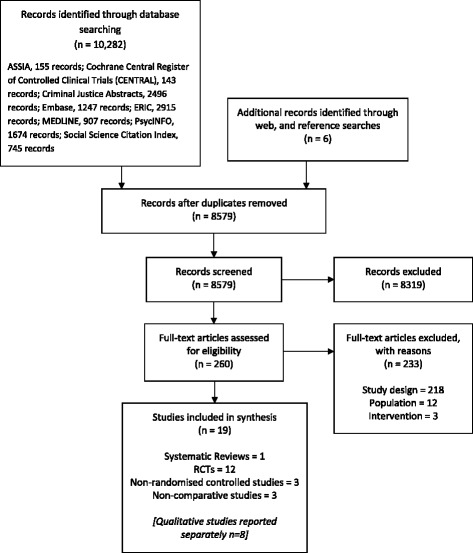
BACKGROUND: The police and others in occupations where they come into close contact with people experiencing/with mental ill health, often have to manage difficult and complex situations. Training is needed to equip them to recognise and assist when someone has a mental health issue or learning/intellectual disability. We undertook a systematic review of the effectiveness of training programmes aimed at increasing knowledge, changing behaviour and/or attitudes of the trainees with regard to mental ill health, mental vulnerability, and learning disabilities. METHODS: Databases searched from 1995 onwards included: ASSIA, Cochrane Central Register of Controlled Clinical Trials (CENTRAL), Criminal Justice Abstracts, Embase, ERIC, MEDLINE, PsycINFO, Social Science Citation Index. Courses, training, or learning packages aimed at helping police officers and others who interact with the public in a similar way to deal with people with mental health problems were included. Primary outcomes were change in practice and change in outcomes for the groups of people the trainees come into contact with. Systematic reviews, randomised controlled trials (RCTs) and non- randomised controlled trials (non-RCTs) were included and quality assessed. In addition non-comparative evaluations of training for police in England were included. RESULTS: From 8578 search results, 19 studies met the inclusion criteria: one systematic review, 12 RCTs, three prospective non-RCTs, and three non-comparative studies. The training interventions identified included broad mental health awareness training and packages addressing a variety of specific mental health issues or conditions. Trainees included police officers, teachers and other public sector workers. Some short term positive changes in behaviour were identified for trainees, but for the people the trainees came into contact with there was little or no evidence of benefit. CONCLUSIONS: A variety of training programmes exist for non-mental health professionals who come into contact with people who have mental health issues. There may be some short term change in behaviour for the trainees, but longer term follow up is needed. Research evaluating training for UK police officers is needed in which a number of methodological issues need to be addressed. TRIAL REGISTRATION: Protocol registration number: PROSPERO: CRD42015015981 .
Overview
The claims and statistics of this paper haven’t been checked yet.
Free: it reads the open-access text and checks the first 5 claims that cite a source we can check. Create a free account to check every claim.
Integrity signals
Registry
Cites
Statistics
Figures
Verification
Claims the paper makes
The claims and statistics of this paper haven’t been checked yet.
Free: it reads the open-access text and checks the first 5 claims that cite a source we can check. Create a free account to check every claim.
Claims other papers make about this one
Each is checked against this paper’s own text: does it say what the citing paper says it does?
In the citing paper
“and in another internet programmes were at least as effective as face-toface delivery in reducing personal stigma.190”
From The Lancet Commission on ending stigma and discrimination in mental health (2022) · cites this paper as [190]
In the citing paper
“MHFA used with police officers, teachers, and other public sector workers has shown positive changes in behaviour.190”
From The Lancet Commission on ending stigma and discrimination in mental health (2022) · cites this paper as [190]
Self-check
Percentages, sums and reported differences re-computed from the paper’s own numbers.
The self-check needs the paper’s full text.
Citations
Cites
The Cochrane Collaboration's tool for assessing risk of bias in randomised trials
Higgins, J. P. T., Altman, D. G., Gotzsche, P. C., Juni, P., Moher, D., Oxman, A. D., Savovic, J., Schulz, K. F., Weeks, L., Sterne, J. A. C., et al. (2011) · BMJ · doi:10.1136/bmj.d5928 · Cited by 33,817
Dermyshi, E., Wang, Y., Yan, C., Hong, W., Qiu, G., Gong, X., & Zhang, T. (2017) · Neonatology · doi:10.1159/000454668 · Cited by 24,451
(2014) · Medical Entomology and Zoology · Cited by 17,633
CONSORT 2010 Statement: updated guidelines for reporting parallel group randomised trials
the CONSORT Group, Schulz, K. F., Altman, D. G., & Moher, D. (2010) · BMC Medicine · doi:10.1186/1741-7015-8-18 · Cited by 13,371
Hoffmann, T. C., Glasziou, P. P., Boutron, I., Milne, R., Perera, R., Moher, D., Altman, D. G., Barbour, V., Macdonald, H., Johnston, M., et al. (2014) · BMJ · doi:10.1136/bmj.g1687 · Cited by 10,548 · cited 1×
“The Equator Network provides a single point of access to a range of useful documents [45] including the TIDierR checklist [46] and CONSORT statement [47] for the accurate reporting of interventions and RCTs respect-”
MethodCONSORT 2010 statement: updated guidelines for reporting parallel group randomised trials
Schulz, K. F., Altman, D. G., Moher, D., & for the CONSORT Group (2010) · PLoS Medicine · doi:10.1371/journal.pmed.1000251 · Cited by 2,296
ROBIS: A new tool to assess risk of bias in systematic reviews was developed
Whiting, P., Savović, J., Higgins, J. P. T., Caldwell, D. M., Reeves, B. C., Shea, B., Davies, P., Kleijnen, J., & Churchill, R. (2016) · Journal of Clinical Epidemiology · doi:10.1016/j.jclinepi.2015.06.005 · Cited by 2,272
An update of transformative learning theory: a critical review of the empirical research (1999–2005)
Taylor, E. W. (2007) · International Journal of Lifelong Education · doi:10.1080/02601370701219475 · Cited by 1,020
Hanisch, S. E., Twomey, C. D., Szeto, A. C. H., Birner, U. W., Nowak, D., & Sabariego, C. (2016) · BMC Psychiatry · doi:10.1186/s12888-015-0706-4 · Cited by 564
Purtle, J., Peters, R., & Brownson, R. C. (2015) · Implementation Science · doi:10.1186/s13012-015-0367-1 · Cited by 446
Haagsma, J. A., Polinder, S., Olff, M., Toet, H., Bonsel, G. J., & van Beeck, E. F. (2012) · BMC Psychiatry · doi:10.1186/1471-244x-12-1 · Cited by 421
Mental health first aid training for high school teachers: a cluster randomized trial
Jorm, A. F., Kitchener, B. A., Sawyer, M. G., Scales, H., & Cvetkovski, S. (2010) · BMC Psychiatry · doi:10.1186/1471-244x-10-51 · Cited by 349 · cited 24×
“Three of the RCTs used vignettes combined with a questionnaire to evaluate changes in practice [16], attitude [23], confidence [16], knowledge [25], and behaviour [16, 25].”
BackgroundMethodResultInfluentialA comprehensive review of extant research on Crisis Intervention Team (CIT) programs.
Compton, M. T., Bahora, M., Watson, A. C., & Oliva, J. R. (2008) · PubMed · Cited by 336
Effective in-service training design and delivery: evidence from an integrative literature review
Bluestone, J., Johnson, P., Fullerton, J., Carr, C., Alderman, J., & BonTempo, J. (2013) · Human Resources for Health · doi:10.1186/1478-4491-11-51 · Cited by 329
Möhler, R., Köpke, S., & Meyer, G. (2015) · Trials · doi:10.1186/s13063-015-0709-y · Cited by 317
Evaluating and researching the effectiveness of educational interventions
Hutchinson, L. (1999) · BMJ · doi:10.1136/bmj.318.7193.1267 · Cited by 264
A hierarchy of effective teaching and learning to acquire competence in evidenced-based medicine
Khan, K. S., & Coomarasamy, A. (2006) · BMC Medical Education · doi:10.1186/1472-6920-6-59 · Cited by 263
Evaluating educational interventions
Wilkes, M., & Bligh, J. (1999) · BMJ · doi:10.1136/bmj.318.7193.1269 · Cited by 207
Pinfold, V., Huxley, P., Thornicroft, G., Farmer, P., Toulmin, H., & Graham, T. (2003) · Social Psychiatry and Psychiatric Epidemiology · doi:10.1007/s00127-003-0641-4 · Cited by 200 · cited 5×
“(2003) [31] Reducing psychiatric stigma and discrimination: developed in house To communicate the ordinariness of mental ill-health and to address fear and misunderstanding surrounding experiences labelled ‘severe mental illness’.”
BackgroundMethodInfluentialMeasurement properties of tools measuring mental health knowledge: a systematic review
Wei, Y., McGrath, P. J., Hayden, J. A., & Kutcher, S. (2016) · BMC Psychiatry · doi:10.1186/s12888-016-1012-5 · Cited by 191 · cited 1×
“A recent systematic review of the measurement properties of tools measuring mental health knowledge recommends using tools with an evidence base which reach the threshold for positive ratings according to the COSMIN checklist [42].”
MethodGatekeeper training and access to mental health care at universities and colleges
Lipson, S. K., Speer, N., Brunwasser, S., Hahn, E., & Eisenberg, D. (2014) · Journal of Adolescent Health · doi:10.1016/j.jadohealth.2014.05.009 · Cited by 157 · cited 24×
“Three of the RCTs used vignettes combined with a questionnaire to evaluate changes in practice [16], attitude [23], confidence [16], knowledge [25], and behaviour [16, 25].”
BackgroundMethodResultInfluentialHansson, L., & Markström, U. (2014) · BMC Psychiatry · doi:10.1186/1471-244x-14-55 · Cited by 127 · cited 9×
“Hansson & Markstrom (2014) [27] the regular psychiatry course as part of officer training behaviour and attitudes towards people with mental illness introductory lecture on attitudes towards people with mental illness; a video of people with lived experience telling their story (2 h); two lectures by people with menta…”
BackgroundResultInfluentialThe international EQUATOR network: enhancing the quality and transparency of health care research
Pandis, N., & Fedorowicz, Z. (2011) · Journal of Applied Oral Science · doi:10.1590/s1678-77572011000500001 · Cited by 103
Improving the recognition of depression in adolescence: Can we teach the teachers?
Moor, S., Ann, M., Hester, M., Elisabeth, W. J., Robert, E., Robert, W., & Caroline, B. (2007) · Journal of Adolescence · doi:10.1016/j.adolescence.2005.12.001 · Cited by 96 · cited 4×
“(2007) [19] Percentage of pupils reported as depressed by teachers, using lists of class cohort Not measured Not measured Not measured Attitudes Questionnaire designed by the research team.”
BackgroundMethodResultInfluentialChild Welfare Caseworkers as Service Brokers for Youth in Foster Care
Dorsey, S., Kerns, S. E. U., Trupin, E. W., Conover, K. L., & Berliner, L. (2012) · Child Maltreatment · doi:10.1177/1077559511429593 · Cited by 81
Svensson, B., & Hansson, L. (2014) · PLoS ONE · doi:10.1371/journal.pone.0100911 · Cited by 81 · cited 25×
“Svensson & Hansson (2014) [16] MHFA translated and modified to suit the Swedish context To improve MH literacy among the general public and give the public the skills to be able to provide initial help to people with MH problems.”
BackgroundMethodResultInfluentialModels of Adult Learning: A Literature Review
Tusting, K., & Barton, D. (2006) · Lancaster EPrints (Lancaster University) · Cited by 80
Police attitudes toward people with intellectual disability: an evaluation of awareness training
Bailey, A., Barr, O., & Bunting, B. (2001) · Journal of Intellectual Disability Research · doi:10.1046/j.1365-2788.2001.00339.x · Cited by 78 · cited 9×
“Bailey et al. (2001) undertook a non-RCT of intellectual disabilities awareness training for probationary police officers [26].”
BackgroundMethodResultInfluentialWatson, A. C., & Fulambarker, A. J. (2012) · PubMed · Cited by 73
McVey, G., Gusella, J., Tweed, S., & Ferrari, M. (2008) · Eating Disorders · doi:10.1080/10640260802570064 · Cited by 68 · cited 5×
“(2008) [20] An online programme called “The student body: promoting health at any size an online programme” Help teachers and public health practitioners prevent the onset of disordered eating through the promotion of positive body image in children before they reach adolescence.”
BackgroundInfluentialTEMPO: A contemporary model for police education and training about mental illness
Coleman, T. G., & Cotton, D. H. G. (2014) · International Journal of Law and Psychiatry · doi:10.1016/j.ijlp.2014.02.002 · Cited by 61 · cited 3×
“Coleman and Cotton (2014), highlight the important role of the trainer in not only delivering effective training but in the success of implementing any related programme [37].”
BackgroundMethodInfluentialKolko, D. J., Baumann, B. L., Herschell, A. D., Hart, J. A., Holden, E. A., & Wisniewski, S. R. (2012) · Child Maltreatment · doi:10.1177/1077559511427346 · Cited by 60 · cited 5×
“(2012) [22] RCT Alternatives for Families: A Cognitive–Behavioral Therapy (AF-CBT).”
BackgroundResultInfluentialRandomized trial of law enforcement training on autism spectrum disorders
Teagardin, J., Dixon, D. R., Smith, M. N., & Granpeesheh, D. (2012) · Research in Autism · doi:10.1016/j.rasd.2012.02.002 · Cited by 58 · cited 4×
“(2012) [15] “Law Enforcement: Your Piece to the Autism Puzzle”: a video to educate law officers about Autism Spectrum Disorders (ASD) To help the recognition and identification of and attitudes towards people with ASD.”
BackgroundMethodInfluentialModerators of the Effectiveness of Adult Learning Method Practices
K. (2012) · Journal of Social Sciences · doi:10.3844/jssp.2012.143.148 · Cited by 58 · cited 2×
“reviewed 58 RCTs and found that training using a variety of presentation methods in groups of less than 40, in applied settings, over 20 h on multiple occasions was optimum for acquiring new knowledge or skills [36].”
BackgroundThe Crisis Intervention Team Model of Police Response to Mental Health Crises
Watson, A. C., & Fulambarker, A. J. (2012) · Best Practices in Mental Health · doi:10.70256/741919sjsqrr · Cited by 53
The impact of police training in mental health: an example from Australia
Herrington, V., & Pope, R. (2014) · Policing and Society · doi:10.1080/10439463.2013.784287 · Cited by 51 · cited 13×
“ceived quality of relationships between the police and other stakeholders [28].”
BackgroundMethodInfluentialLaMontagne, A. D., Milner, A. J., Allisey, A., Page, K. M., Reavley, N. J., Martin, A. J., Tchernitskaia, I., Noblet, A. J., Purnell, L. J., Witt, K., et al. (2016) · BMC Psychiatry · doi:10.1186/s12888-016-0741-9 · Cited by 50 · cited 1×
“Our searches found a protocol for a cluster RCT on an integrated workplace mental health intervention [32].”
Backgroundvan den Brink, R. H., Broer, J., Tholen, A. J., Winthorst, W. H., Visser, E., & Wiersma, D. (2012) · BMC Psychiatry · doi:10.1186/1471-244x-12-171 · Cited by 42 · cited 1×
“in the Netherlands linked police data with mental health care information [40].”
BackgroundÖstberg, M., & Rydell, A.-M. (2012) · Nordic Journal of Psychiatry · doi:10.3109/08039488.2011.641587 · Cited by 38 · cited 23×
“Three of the RCTs used vignettes combined with a questionnaire to evaluate changes in practice [16], attitude [23], confidence [16], knowledge [25], and behaviour [16, 25].”
BackgroundMethodInfluentialInvestigating the Impact of Technology on Pre-Service Teacher Knowledge of Autism Spectrum Disorder
Hart, J. E., & More, C. M. (2013) · Education and Training in Autism and Developmental Disabilities · doi:10.1177/215416471304800408 · Cited by 29 · cited 3×
“…follow-ups at 3, 7 and 9 months 8 campuses Other non-mental health trained professionals: Interventions with a specific mental health focus Hart & More (2013) [24] RCT Audio-visual synchronous podcast of information related to Autism Spectrum Disorder (ASD) with the aim of improving…”
BackgroundInfluentialThombs, D. L., González, J. M. R., Osborn, C. J., Rossheim, M. E., & Suzuki, S. (2014) · Prevention Science · doi:10.1007/s11121-014-0515-x · Cited by 26 · cited 5×
“(2015) [14] 12 item survey developed by study team measured the number of first aid efforts made over the previous 30 days Not measured Not measured Not measured Referral efficacy, scored on a 5point Likert scale Not measured Not measured”
BackgroundResultInfluentialPolice responses to persons with a mental illness: International perspectives
Chappell, D., & O'Brien, A. J. (2014) · International Journal of Law and Psychiatry · doi:10.1016/j.ijlp.2014.02.001 · Cited by 25 · cited 1×
“where but there is little robust evidence of its effectiveness [38, 39].”
BackgroundMarriott, B. R., Rodriguez, A. L., Landes, S. J., Lewis, C. C., & Comtois, K. A. (2015) · Implementation Science · doi:10.1186/s13012-016-0429-z · Cited by 17
Mental health training scheme for police officers.
Norris, C., & Cooke, E. (2000) · PubMed · Cited by 6
ANTI-STIGMA PROGRAMS: STIGMA IN CAMPUS POlICE OFFICERS
Rafacz, J. D. (2012) · ProQuest LLC eBooks · Cited by 4
Delivering mental health awareness training to police officers.
Forni, C., Caswell, N., & Spicer, J. (2009) · PubMed · Cited by 3
Research works printed but not linked: 2
- National Policing Improvement Agency on behalf of the Association of Chief Police Officers Guidance on responding to people with mental ill health or learning disabilities 2010
- Home Office The Stephen Lawrence inquiry (Macpherson report) 1999 London HMSO
Cited by
The Lancet Commission on ending stigma and discrimination in mental health
Thornicroft, G., Sunkel, C., Alikhon Aliev, A., Baker, S., Brohan, E., el Chammay, R., Davies, K., Demissie, M., Duncan, J., Fekadu, W., et al. (2022) · The Lancet · doi:10.1016/s0140-6736(22)01470-2 · Cited by 748
Mental Health in the Workplace
Kelloway, E. K., Dimoff, J. K., & Gilbert, S. (2023) · Annual Review of Organizational Psychology and Organizational Behavior · doi:10.1146/annurev-orgpsych-120920-050527 · Cited by 204
Mental health training programs for secondary school teachers: a systematic review
Anderson, M., Werner-Seidler, A., King, C., Gayed, A., Harvey, S. B., & O’Dea, B. (2019) · School Mental Health · doi:10.1007/s12310-018-9291-2 · Cited by 124
Utilization and Impact of Peer-Support Programs on Police Officers’ Mental Health
Milliard, B. (2020) · Frontiers in Psychology · doi:10.3389/fpsyg.2020.01686 · Cited by 129
“In contrast, Booth et al. (2017) examined mental health training geared towards police officers who have no history of mental health issues.”
BackgroundEdwards, A., & Kotera, Y. (2020) · International Journal of Mental Health and Addiction · doi:10.1007/s11469-019-00214-x · Cited by 128
Metadata
- Authors
- Booth, A., Scantlebury, A., Hughes-Morley, A., Mitchell, N., Wright, K., Scott, W., & McDaid, C.
- Affiliations
- University of York (GB)
- Corresponding author
- Booth, Alison
- Venue
- BMC Psychiatry
- Published
- 2017-05-25
- Volume
- 17
- Issue
- 1
- Pages
- 196-196
- ISSN
- 1471-244X (ISSN-L)
- PMC
- PMC5445268
- OpenAlex
- W2618932327
- Cited by
- 81
- References
- 46
- Citations by year
- 2026: 6 · 2025: 9 · 2024: 6 · 2023: 12 · 2022: 10 · 2021: 12 · 2020: 8 · 2019: 9 · 2018: 7 · 2017: 2
- FWCI
- 1.12
- Type
- journal article
- Language
- en
- Open access
- gold
- doi.org
- Licence
- cc-by
- Locations
- BMC Psychiatry (publishedVersion, cc-by)
- Europe PMC (PubMed Central) (publishedVersion, other-oa)
- PubMed Central (publishedVersion, cc-by)
- PubMed (publishedVersion)
- White Rose Research Online (University of Leeds, The University of Sheffield, University of York) (acceptedVersion)
- DOAJ (DOAJ: Directory of Open Access Journals) (submittedVersion, cc-by-sa)
- Newcastle University ePrints (Newcastle Univesity) (cc-by)
- Funders
- Higher Education Funding Council for England (GB) and the UK Home Office (J05)
- Topics
- Health Sciences › Medicine › Psychiatry and Mental health › Mental Health Treatment and Access
- Social Sciences › Political Science and International Relations › Policing Practices and Perceptions
- Social Sciences › Psychology › Applied Psychology › Human Resource Development and Performance Evaluation
- Keywords
- mental health training, non-mental health professionals, police officers, mental health awareness, learning disabilities, mental illness, training effectiveness, attitudes toward mental illness, teachers, public sector employees
- MeSH terms
- Mental Disorders, England, Health Promotion, Humans, Mental Health, Prospective Studies, Outcome Assessment, Health Care
About these checks
Registry, retraction, Cites and statistics results are computed, not judged, with one exception: a printed reference that no index lists is read once by a model before it counts as a citation error. Claims are extracted by a model and kept only when their quote appears verbatim in the text; each cited source is then checked, with a model’s help, for whether it says what the claim relies on. Those verdicts can be wrong — read the claim’s quote and the cited source before relying on one.
Statistics and arithmetic are recomputed, not judged.
Confidence bands are shown only for fields calibrated on our annotated test set. None is calibrated yet, so no band is shown.
What counts as a claim ›How we measure confidence ›How we check this ›
Are you an author, or do you see a problem with this page? Request a review
Data sources
Bibliographic data: Semantic Scholar, OpenAlex, Crossref.
Contains information from the Semantic Scholar Academic Graph Datasets, made available under the ODC Attribution License (ODC-BY 1.0).
Semantic Scholar’s data is described in: Kinney, R., et al. (2023). The Semantic Scholar Open Data Platform. arXiv:2301.10140.
