

Mental health training programmes for non-mental health trained professionals coming into contact with people with mental ill health: a systematic review of effectiveness
Open accessThe DOI matches its Crossref record; 46 of the 46 references it cites were found in a registry or an index.
Abstract
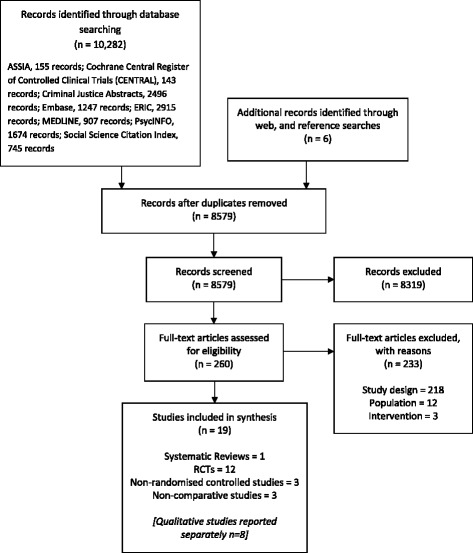
BACKGROUND: The police and others in occupations where they come into close contact with people experiencing/with mental ill health, often have to manage difficult and complex situations. Training is needed to equip them to recognise and assist when someone has a mental health issue or learning/intellectual disability. We undertook a systematic review of the effectiveness of training programmes aimed at increasing knowledge, changing behaviour and/or attitudes of the trainees with regard to mental ill health, mental vulnerability, and learning disabilities. METHODS: Databases searched from 1995 onwards included: ASSIA, Cochrane Central Register of Controlled Clinical Trials (CENTRAL), Criminal Justice Abstracts, Embase, ERIC, MEDLINE, PsycINFO, Social Science Citation Index. Courses, training, or learning packages aimed at helping police officers and others who interact with the public in a similar way to deal with people with mental health problems were included. Primary outcomes were change in practice and change in outcomes for the groups of people the trainees come into contact with. Systematic reviews, randomised controlled trials (RCTs) and non- randomised controlled trials (non-RCTs) were included and quality assessed. In addition non-comparative evaluations of training for police in England were included. RESULTS: From 8578 search results, 19 studies met the inclusion criteria: one systematic review, 12 RCTs, three prospective non-RCTs, and three non-comparative studies. The training interventions identified included broad mental health awareness training and packages addressing a variety of specific mental health issues or conditions. Trainees included police officers, teachers and other public sector workers. Some short term positive changes in behaviour were identified for trainees, but for the people the trainees came into contact with there was little or no evidence of benefit. CONCLUSIONS: A variety of training programmes exist for non-mental health professionals who come into contact with people who have mental health issues. There may be some short term change in behaviour for the trainees, but longer term follow up is needed. Research evaluating training for UK police officers is needed in which a number of methodological issues need to be addressed. TRIAL REGISTRATION: Protocol registration number: PROSPERO: CRD42015015981 .
Overview
The claims and statistics of this paper haven’t been checked yet.
Free: it reads the open-access text and checks the first 5 claims that cite a source we can check. Create a free account to check every claim.
Integrity signals
Registry
Cites
Statistics
Figures
Verification
Claims the paper makes
The claims and statistics of this paper haven’t been checked yet.
Free: it reads the open-access text and checks the first 5 claims that cite a source we can check. Create a free account to check every claim.
Claims other papers make about this one
Each is checked against this paper’s own text: does it say what the citing paper says it does?
In the citing paper
“and in another internet programmes were at least as effective as face-toface delivery in reducing personal stigma.190”
From The Lancet Commission on ending stigma and discrimination in mental health (2022) · cites this paper as [190]
In the citing paper
“MHFA used with police officers, teachers, and other public sector workers has shown positive changes in behaviour.190”
From The Lancet Commission on ending stigma and discrimination in mental health (2022) · cites this paper as [190]
Self-check
Percentages, sums and reported differences re-computed from the paper’s own numbers.
The self-check needs the paper’s full text.
Citations
Cites
The Cochrane Collaboration's tool for assessing risk of bias in randomised trials
Higgins, J. P. T., Altman, D. G., Gotzsche, P. C., Juni, P., Moher, D., Oxman, A. D., Savovic, J., Schulz, K. F., Weeks, L., Sterne, J. A. C., et al. (2011) · BMJ · doi:10.1136/bmj.d5928 · Cited by 33,817
Dermyshi, E., Wang, Y., Yan, C., Hong, W., Qiu, G., Gong, X., & Zhang, T. (2017) · Neonatology · doi:10.1159/000454668 · Cited by 24,451
(2014) · Medical Entomology and Zoology · Cited by 17,633
CONSORT 2010 Statement: updated guidelines for reporting parallel group randomised trials
the CONSORT Group, Schulz, K. F., Altman, D. G., & Moher, D. (2010) · BMC Medicine · doi:10.1186/1741-7015-8-18 · Cited by 13,371
Hoffmann, T. C., Glasziou, P. P., Boutron, I., Milne, R., Perera, R., Moher, D., Altman, D. G., Barbour, V., Macdonald, H., Johnston, M., et al. (2014) · BMJ · doi:10.1136/bmj.g1687 · Cited by 10,548 · cited 1×
“The Equator Network provides a single point of access to a range of useful documents [45] including the TIDierR checklist [46] and CONSORT statement [47] for the accurate reporting of interventions and RCTs respect-”
MethodCONSORT 2010 statement: updated guidelines for reporting parallel group randomised trials
Schulz, K. F., Altman, D. G., Moher, D., & for the CONSORT Group (2010) · PLoS Medicine · doi:10.1371/journal.pmed.1000251 · Cited by 2,296
ROBIS: A new tool to assess risk of bias in systematic reviews was developed
Whiting, P., Savović, J., Higgins, J. P. T., Caldwell, D. M., Reeves, B. C., Shea, B., Davies, P., Kleijnen, J., & Churchill, R. (2016) · Journal of Clinical Epidemiology · doi:10.1016/j.jclinepi.2015.06.005 · Cited by 2,272
An update of transformative learning theory: a critical review of the empirical research (1999–2005)
Taylor, E. W. (2007) · International Journal of Lifelong Education · doi:10.1080/02601370701219475 · Cited by 1,020
Hanisch, S. E., Twomey, C. D., Szeto, A. C. H., Birner, U. W., Nowak, D., & Sabariego, C. (2016) · BMC Psychiatry · doi:10.1186/s12888-015-0706-4 · Cited by 564
Purtle, J., Peters, R., & Brownson, R. C. (2015) · Implementation Science · doi:10.1186/s13012-015-0367-1 · Cited by 446
Research works printed but not linked: 2
- National Policing Improvement Agency on behalf of the Association of Chief Police Officers Guidance on responding to people with mental ill health or learning disabilities 2010
- Home Office The Stephen Lawrence inquiry (Macpherson report) 1999 London HMSO
Cited by
The Lancet Commission on ending stigma and discrimination in mental health
Thornicroft, G., Sunkel, C., Alikhon Aliev, A., Baker, S., Brohan, E., el Chammay, R., Davies, K., Demissie, M., Duncan, J., Fekadu, W., et al. (2022) · The Lancet · doi:10.1016/s0140-6736(22)01470-2 · Cited by 748
Mental Health in the Workplace
Kelloway, E. K., Dimoff, J. K., & Gilbert, S. (2023) · Annual Review of Organizational Psychology and Organizational Behavior · doi:10.1146/annurev-orgpsych-120920-050527 · Cited by 204
Mental health training programs for secondary school teachers: a systematic review
Anderson, M., Werner-Seidler, A., King, C., Gayed, A., Harvey, S. B., & O’Dea, B. (2019) · School Mental Health · doi:10.1007/s12310-018-9291-2 · Cited by 124
Utilization and Impact of Peer-Support Programs on Police Officers’ Mental Health
Milliard, B. (2020) · Frontiers in Psychology · doi:10.3389/fpsyg.2020.01686 · Cited by 129
“In contrast, Booth et al. (2017) examined mental health training geared towards police officers who have no history of mental health issues.”
BackgroundEdwards, A., & Kotera, Y. (2020) · International Journal of Mental Health and Addiction · doi:10.1007/s11469-019-00214-x · Cited by 128
Scantlebury, A., Parker, A., Booth, A., McDaid, C., & Mitchell, N. (2018) · PLoS ONE · doi:10.1371/journal.pone.0199746 · Cited by 78
“Given, the volume and richness of the qualitative data identified the review of quantitative studies of effectiveness are reported separately[8].”
BackgroundInfluentialSelf-citationEffectiveness of Mental Health First Aid: a meta-analysis
Maslowski, A. K., LaCaille, R. A., LaCaille, L. J., Reich, C. M., & Klingner, J. (2019) · Mental Health Review Journal · doi:10.1108/mhrj-05-2019-0016 · Cited by 73
Understanding the Mental Health Issues of International Students on Campus.
Williams, G. M., Case, R. E., & Roberts, C. W. (2018) · Cited by 61
Alves, L., Abreo, L., Petkari, E., & Pinto da Costa, M. (2023) · Journal of Affective Disorders · doi:10.1016/j.jad.2023.03.081 · Cited by 85
Scantlebury, A., Fairhurst, C. M., Booth, A., McDaid, C., Moran, N. E., Parker, A., Payne, R. L., Scott, W. J., Torgerson, D. J., Webber, M., et al. (2017) · PLoS ONE · doi:10.1371/journal.pone.0184377 · Cited by 51
Self-citationGatekeeper training for friends and family of individuals at risk of suicide: a systematic review
Morton, M., Wang, S., Tse, K., Chung, C., Bergmans, Y., Ceniti, A., Flam, S., Johannes, R., Schade, K., Terah, F., et al. (2021) · Journal of Community Psychology · doi:10.1002/jcop.22624 · Cited by 43
Simkiss, N. J., Gray, N. S., Kemp, A. H., Dunne, C., & Snowden, R. J. (2023) · BMC Public Health · doi:10.1186/s12889-023-15922-2 · Cited by 49
Mansfield, R., Humphrey, N., & Patalay, P. (2021) · Health Promotion International · doi:10.1093/heapro/daab010 · Cited by 46
McCann, T. V., Savic, M., Ferguson, N., Cheetham, A., Witt, K., Emond, K., Bosley, E., Smith, K. L., Roberts, L., & Lubman, D. I. (2018) · BMJ Open · doi:10.1136/bmjopen-2018-023860 · Cited by 40
“18 Indeed, recent evidence suggests that a significant proportion of their workload involves transporting clients with difficult and complex issues involving mental health, AOD and/or self-harm.(19) In Australia, 1-in-5(20) 21 to 1-in-10(22) ambulance presentations involve clients with these conditions.”
BackgroundTeachers at risk: Depressive symptoms, emotional intelligence, and burnout during COVID-19
Pujalte, L. S., Yepes, T. G., Etchezahar, E. D., & Mateu, D. N. (2023) · Frontiers in Public Health · doi:10.3389/fpubh.2023.1092839 · Cited by 38
The Management of Children and Youth With Pediatric Mental and Behavioral Health Emergencies
Saidinejad, M., Duffy, S. J., Wallin, D., Hoffmann, J. A., Joseph, M. M., Uhlenbrock, J. S., Brown, K., Waseem, M., Snow, S. K., Andrew, M., et al. (2023) · PEDIATRICS · doi:10.1542/peds.2023-063255 · Cited by 40
Gulati, G., Kelly, B. D., Cusack, A., Kilcommins, S., & Dunne, C. P. (2020) · International Journal of Law and Psychiatry · doi:10.1016/j.ijlp.2020.101614 · Cited by 31
“Notwithstanding the unique cognitive and communicative needs of suspects with ID in a police setting, awareness training has focused in recent years on developing models for addressing mental illness (as opposed to ID) in police interactions (Booth et al., 2017).”
BackgroundPolice-related triage interventions for mental health-related incidents: a rapid evidence synthesis
Rodgers, M., Thomas, S., Dalton, J., Harden, M., & Eastwood, A. J. (2019) · Health Services and Delivery Research · doi:10.3310/hsdr07200 · Cited by 32
Martens, N., Destoop, M., & Dom, G. (2021) · International Journal of Environmental Research and Public Health · doi:10.3390/ijerph18020462 · Cited by 29
O'Connell, J., Pote, H., & Shafran, R. (2021) · Early Intervention in Psychiatry · doi:10.1111/eip.12964 · Cited by 26
“…focused on specific professional groups such as school teachers (Anderson et al., 2018; Yamaguchi et al., 2019), police and public sector employees (Booth et al., 2017), health care workers (Liu et al., 2016), and sports coaches and athletes (Breslin, Shannon, Haughey, Donnelly, & Leavey, 2017).”
BackgroundEnsuring the rights of children with neurodevelopmental disabilities within child justice systems
Hughes, N., Sheahan, F., Williams, W. H., & Chitsabesan, P. (2020) · The Lancet Child & Adolescent Health · doi:10.1016/s2352-4642(19)30401-8 · Cited by 31
Co-development of a training programme on disability for healthcare workers in Uganda
Smythe, T., Ssemata, A. S., Slivesteri, S., Mbazzi, F. B., & Kuper, H. (2024) · BMC Health Services Research · doi:10.1186/s12913-024-10918-z · Cited by 25
Hacker, R. L., & Horan, J. J. (2019) · Journal of Experimental Criminology · doi:10.1007/s11292-019-09380-3 · Cited by 25
Lavelle, M., Reedy, G. B., Attoe, C., Simpson, T., & Anderson, J. E. (2019) · Advances in Simulation · doi:10.1186/s41077-019-0101-1 · Cited by 27
Police Perceptions of Training on Interactions with Persons with Mental Illness
Richmond, M., & Gibbs, J. C. (2020) · Journal of Police and Criminal Psychology · doi:10.1007/s11896-020-09409-8 · Cited by 24
A Behavioral Analysis of Two Strategies to Eliminate Racial Bias in Police Use of Force
Machado, M. A., & Lugo, A. M. (2021) · Behavior Analysis in Practice · doi:10.1007/s40617-021-00551-1 · Cited by 26
Responding to Acute Mental Health Crises in Black Youth: Is It Safe to Call 911?
Ramasamy, R., Thompson, A. D., & Simmons, S. (2022) · Community Mental Health Journal · doi:10.1007/s10597-022-00980-4 · Cited by 20
“1 3 Police training in recognizing and safely interacting with individuals experiencing a mental health crisis is inadequate despite police being the most likely first responders, and mental health training programs for police officers have not demonstrated sustained benefits for the public (Booth et al., 2017; Treatm…”
BackgroundExploring mental health challenges and implications for construction safety
Lawani, K. O., Hare, B., Tong, M. K., & Cameron, I. (2023) · Journal of Engineering Design and Technology · doi:10.1108/jedt-07-2023-0327 · Cited by 19
Investigating police officers' perceptions of their role in pathways to mental healthcare
Marsden, M., Nigam, J., Lemetyinen, H., & Edge, D. (2020) · Health & Social Care in the Community · doi:10.1111/hsc.12922 · Cited by 20
Enang, I., Murray, J., Dougall, N. J., Aston, E., Wooff, A., Heyman, I., & Grandison, G. (2021) · Policing & Society · doi:10.1080/10439463.2021.1927025 · Cited by 15
“Therefore, more research is required to develop and assess training for police officers, health professionals, and public sector workers in LEPH to improve knowledge and reduce uncertainty (Bomba 2006, Booth et al. 2017, Eadens et al. 2016).”
BackgroundInfluentialMaddox, S., Powell, N., Booth, A., Handley, T. E., Dalton, H. E., & Perkins, D. A. (2021) · Health Promotion Journal of Australia · doi:10.1002/hpja.515 · Cited by 15
Self-citationEvaluation of ‘the R-Model’ crisis intervention de-escalation training for law enforcement
Peterson, J., Densley, J., & Erickson, G. (2020) · The Police Journal: Theory, Practice and Principles · doi:10.1177/0032258x19864997 · Cited by 13
“…of the effectiveness of mental health training programs for nonmental health trained professionals, including law enforcement, reported wide variations in training design, delivery, and content and at best only short-term changes in attitudes and behavior for police officers (Booth et al., 2017).”
BackgroundUniversal mental health training for frontline professionals: evaluation of pilot trial in Ukraine
Горбунова, В., Klymchuk, V., Портницька, Н. Ф., Savychenko, О., Тичина, І. М., & Steffgen, G. (2024) · Open Research Europe · doi:10.12688/openreseurope.16941.2 · Cited by 13
Shi, K., & Tian, J. (2025) · Frontiers in Psychology · doi:10.3389/fpsyg.2025.1553716 · Cited by 13
Bennett, R. J., Donaldson, S., Mansourian, Y., Olaithe, M., Kelsall-Foreman, I., Badcock, J. C., & Eikelboom, R. H. (2021) · American Journal of Audiology · doi:10.1044/2021_aja-21-00048 · Cited by 15
Gulati, G. M., Cusack, A., Murphy, V., Kelly, B. D., Kilcommins, S., & Dunne, C. P. (2021) · Irish Journal of Psychological Medicine · doi:10.1017/ipm.2021.80 · Cited by 13
“A broader systematic review (Booth et al. 2017) found additional studies focusing on ‘ mental health awareness ’ for police officers that, however, incorporated only a single study specific to intellectual disabilities (Bailey et al. 2001).”
BackgroundThe Management of Children and Youth With Pediatric Mental and Behavioral Health Emergencies
Saidinejad, M., Duffy, S. J., Wallin, D., Hoffmann, J. A., Joseph, M. M., Uhlenbrock, J. S., Brown, K. M., Waseem, M., Snow, S. K., Andrew, M., et al. (2023) · Annals of Emergency Medicine · doi:10.1016/j.annemergmed.2023.06.003 · Cited by 12
Velykodna, M., Горбунова, В., Frankova, I., Deputatov, V., & Happell, B. (2023) · Issues in Mental Health Nursing · doi:10.1080/01612840.2023.2258217 · Cited by 13
“Research suggests knowledge and skill development can be achieved through mental health training (Booth et al., 2017) with at least a moderate impact on practice (Williams & Smith, 2017).”
BackgroundScantlebury, A., McDaid, C., Booth, A., Fairhurst, C. M., Parker, A., Payne, R. L., Reed, H., Scott, W. J., Torgerson, D. J., & Hewitt, C. E. (2017) · Trials · doi:10.1186/s13063-017-2369-6 · Cited by 12
“situations involving individuals with mental health problems, is being implemented in police forces across the USA [10] despite their being no high-quality evidence of the CIT’s effectiveness [11].”
BackgroundSelf-citationThe Management of Children and Youth With Pediatric Mental and Behavioral Health Emergencies
Saidinejad, M., Duffy, S. J., Wallin, D., Hoffmann, J. A., Joseph, M. M., Uhlenbrock, J. S., Brown, K. M., Waseem, M., Snow, S. K., Andrew, M., et al. (2023) · Journal of Emergency Nursing · doi:10.1016/j.jen.2023.07.005 · Cited by 12
Flumo, R., Valera, P. A., Malarkey, S., & Acevedo, S. (2023) · Journal of Police and Criminal Psychology · doi:10.1007/s11896-023-09620-3 · Cited by 11
The state of mental health training in basic police curricula: A national level examination
Cohen, G., & Bagwell, M. T. (2023) · Journal of Public Affairs Education · doi:10.1080/15236803.2023.2179235 · Cited by 12
“The literature is unequivocal that responding to mental health-related calls and interacting with PMIs is an integral facet of day-to-day police work (e.g., Bailey et al., 2022; Booth et al., 2017; Hacker & Horan, 2019; Marcus & Stergiopoulos, 2022).”
BackgroundEvaluating the impact of Mental Health First Aid (MHFA) training for UK construction workers
Janusonyte, G., Lawani, K. O., Hare, B., & Lawrence, M. (2019) · ResearchOnline · Cited by 10
MENtal health first aid in The wORkplace (MENTOR): a feasibility study
Narayanasamy, M. J., Geraghty, J., Coole, C., Nouri, F., Thomson, L., Callaghan, P., & Drummond, A. E. (2018) · Repository@Nottingham (University of Nottingham) · Cited by 12
Comparisons of beliefs in mental health stigma in communities and those who police them
Tartaro, C., Bonnan-White, J., Mastrangelo, M. A., Erbaugh, E. B., & Mulvihill, R. (2022) · International Journal of Law and Psychiatry · doi:10.1016/j.ijlp.2022.101853 · Cited by 8
Diagnosis and Management of Perinatal Depression
Rossi, N. M., & Radney, L. (2022) · Nursing for Women s Health · doi:10.1016/j.nwh.2022.05.007 · Cited by 8
Dimitropoulos, G., Cullen, E., Hews‐Girard, J., Patten, S. B., MacPherson, P., Shah, J. L., Friese, K., Wiens, K., Lipton-Bos, B., Vallianatos, H., et al. (2024) · Journal of American College Health · doi:10.1080/07448481.2024.2378291 · Cited by 6
“Compared to programs like Crisis Intervention Training (common in law enforcement 49 ) MHFA has been used to train post-secondary healthcare students 50 and includes a version designed for youth mental health issues.”
Brady, C. M., & Childs, K. K. (2022) · Behavioral Sciences & the Law · doi:10.1002/bsl.2558 · Cited by 8
What works? Collaborative Police and Health Interventions for Mental Health Distress
McGeough, E., & Foster, R. (2018) · Edinburgh Napier Research Repository (Edinburgh Napier University) · Cited by 7
Korhonen, J., Lahti, M., Kostadinov, K. R., Erjavec, K., Istomina, N., Ivanova, S., Lagiou, A., Lalova, V., Makutienė, M., Notara, V., et al. (2025) · International Journal of Environmental Research and Public Health · doi:10.3390/ijerph22030435 · Cited by 6
“Some initiatives promoting MHL among children and young people are not exclusively teacher-led [28], in contrast with adult MHL training programs that engage diverse professionals [29].”
(2021) · ADIKTOLOGIE Journal · doi:10.35198/01-2021-004-0004 · Cited by 5
Jung, H., Jaime, J. A., & Lee, S. (2021) · Qualitative Social Work · doi:10.1177/14733250211027630 · Cited by 4
“Previous studies report the availability and effectiveness of interventions to reduce stigma and improve mental health literacy to better help others with mental health issues (Booth et al., 2017; Jorm et al., 2005; Lipson et al., 2014; Morgan et al., 2018).”
BackgroundJoyner, V., Eady, M. J., & Dean, B. A. (2023) · Asia-Pacific Journal of Teacher Education · doi:10.1080/1359866x.2023.2228225 · Cited by 4
Using Virtual Reality to Examine Officer Decision-Making in Police Co-Response Interactions
Powelson, C., McLean, K. D., & Miller, B. L. (2025) · American Journal of Criminal Justice · doi:10.1007/s12103-025-09831-w · Cited by 4
“…studies have shown that CIT training may be effective for reducing officer stigma against individuals with mental health conditions, improving officers’ ability to recognize mental health symptoms, and understanding proper procedures (Booth et al., 2017; McLean et al., 2020; Puntis et al., 2018).”
Mandlate, F., Greene, M. C., Pereira, L. F., Sweetland, A. C., Kokonya, D., Duarte, C. S., Cournos, F., Oquendo, M. A., Wainberg, M. L., Sidat, M., et al. (2022) · Frontiers in Public Health · doi:10.3389/fpubh.2022.919827 · Cited by 3
“Notably, advocacy for mental health integration may also help to reduce HIV-associated stigma and discrimination and contribute to enhanced treatment outcomes among PWH (41).”
BackgroundMcDonald, S. (2024) · Social and Personality Psychology Compass · doi:10.1111/spc3.70031 · Cited by 3
Undergraduate paramedics' understanding of mental health insight placements
Green, A., & Pound, A. (2020) · Journal of Paramedic Practice · doi:10.12968/jpar.2020.12.10.397 · Cited by 3
Clegg, L. (2019) · UTAS Research Repository · doi:10.25959/100.00032637 · Cited by 4
Crisan, C., Dijk, P. A. V., Oxley, J. A., & de Silva, A. M. (2023) · BMC Public Health · doi:10.1186/s12889-023-17170-w · Cited by 2
“As COs rely heavily on untrained volun-teerism [17], initiatives such as ‘train-the-trainer’ could equip frontline CO staff to recognise the signs of work-related mental injury, have safe conversations, and provide referrals to specialised support [45].”
BackgroundSvetičič, J. (2020) · Griffith Research Online · doi:10.25904/1912/2699 · Cited by 2
Evaluation of an online study group on trauma and dissociation for psychotherapists in India
Adithy, A., de Wit, E. E., Bhatt, G., & Bunders, J. (2025) · Evaluation and Program Planning · doi:10.1016/j.evalprogplan.2025.102659 · Cited by 1
Mental health and routine police work: a systematic scoping review
Webber, M., Hughes, E., Kammersgaard, T., Lloyd, C., Papworth, A., & Yardımcı, Ö. (2026) · Health & Justice · doi:10.1186/s40352-026-00405-4 · Cited by 2
“Therefore, enhanced training of police is a limited solution to the social and structural drivers of mental ill health among people and the communities within which they live (Kane et al., 2018; Scantlebury et al., 2017).”
Education and training for health professionals on disability inclusion: a scoping review
Gölz, L., Rosenhan, J., Kamenov, K., & Prodinger, B. (2026) · BMC Medical Education · doi:10.1186/s12909-026-09492-1 · Cited by 1
“…170, 192], emphasis is placed on conducting assessments (50 publications) [23, 25–27, 46, 47, 51, 52, 54, 56– 58, 67, 80, 81, 90, 92, 93, 97, 99, 101, 102, 104, 110, 112, 113, 116–118, 122, 127, 129–132, 146, 148–150, 152–154, 167, 172, 175, 179, 183, 185, 191, 193], such as taking a patient’s…”
InfluentialSutan, R., Sallahuddin, S. N., Ahwan, N. A. M., Manaf, M. R. A., & Daud, F. (2026) · Discover Mental Health · doi:10.1007/s44192-026-00525-1 · Cited by 1
Extending the mental health expertise of school nurses: Evaluating a training programme
Abbott, S., Bryar, R. M., Cohen, R., Gibbons, J. L., & Marks, L. (2019) · British Journal of School Nursing · doi:10.12968/bjsn.2019.14.9.437 · Cited by 1
Hampole, S. R., Nguyen, S. H. S., & Woodhead, E. L. (2019) · Building Healthy Academic Communities Journal · doi:10.18061/bhac.v3i2.7063 · Cited by 1
“These types of trainings have been developed for non-mental health professionals who come into contact with people with mental health problems (e.g., police, teachers; Booth et al. 2017) and could be adapted to meet the needs of campus staff.”
BackgroundSturmey, P. (2022) · Springer eBooks · doi:10.1007/978-3-031-04386-4_11 · Cited by 1
Talley, R. M., & Belkin, G. S. (2022) · Springer eBooks · doi:10.1007/978-3-031-10239-4_14 · Cited by 1
Approaches to panic attack symptoms in cardiology outpatients
Örüm, D., Abuş, S., & Kapıcı, Y. (2025) · Scientific Reports · doi:10.1038/s41598-025-93701-2 · Cited by 1
“This training is gained directly through psychiatry residency and rotation, but in-service training related to psychiatry can also be used for this purpose 11–13 .”
Urwin, J., & Hine, J. (2018) · DMU Open Research Archive (De Montfort University) · doi:10.13140/rg.2.2.28731.31524
“Due to the broad application of MHFA training there have been a number of studies investigating its effectiveness and impact over time, with mixed results (Booth et al., 2017).”
BackgroundInfluentialPolice Officers’ Perceptions of Their Role in a Mental Health Magistrates’ Court Pathway
Wesson, C. J., & Chadwick, D. D. (2019) · Journal of Police and Criminal Psychology · doi:10.1007/s11896-019-09335-4 · Cited by 1
Zauhar, S. R.-J. (2019) · ScholarWorks (Walden University) · Cited by 2
Post-traumatic Stress Disorder in the Emergency Department
McDowell, A. K., & Simpson, S. A. (2021) · Springer eBooks · doi:10.1007/978-3-030-52520-0_11
The relationship between vulnerability and the criminal justice system
Ewin, R. D. (2021) · Insight (University of Cumbria) · doi:10.17635/lancaster/thesis/1288
Borgogna, N. C., McDermott, R. C., Brasil, K. M., Berry, A. T., & Smith, T. L. (2022) · Counselling Psychology Quarterly · doi:10.1080/09515070.2022.2073331
“Several previous researchers have highlighted the need to train RAs for student mental health crises (Booth et al., 2017; Grosz, 1990); however, these researchers primarily contextualized the intervention as an RA recognizing mental health symptoms in a student and then providing a referral to a mental health professi…”
BackgroundNoncommunicable diseases and mental health experiences before and after the COVID-19 pandemic
(2023) · Frontiers research topics · doi:10.3389/978-2-83252-095-6 · Cited by 1
Psychosocial work environment during the COVID-19 pandemic
(2023) · Frontiers research topics · doi:10.3389/978-2-8325-3498-4
The Silent Crisis: The impact of paediatric hospital social admissions
Team DFTB (2024) · Don't Forget The Bubbles · doi:10.31440/dftb.62117
Lin, Y., Zhong, N., Wang, Z., Xie, B., Xu, Y., Zhao, M., & Long, J. (2025) · Global Medical Education · doi:10.1515/gme-2024-0023
“Additionally, harnessing community resources [19] by involving individuals with lived experience [20] as co-educators and mentors can also provide students with valuable perspectives and practical learning experiences.”
Sturmey, P. (2025) · Springer eBooks · doi:10.1007/978-3-031-78661-7_11
The development and evaluation of training for NHS administration staff in handling difficult calls
Paricos, A., Edwards, H., Naidoo, R., Moghaddam, N. G., Harasemiuc, A., & Jackson, S. (2025) · Discover Psychology · doi:10.1007/s44202-025-00420-w
“Equally, a systematic review of nineteen studies assessing the effectiveness of MH training for non-mental health trained professionals found the majority were conducted with police officers or teachers, and none with administration staff [29].”
Ready or Not? Greek K-12 Teachers’ Psychological Readiness for Bringing the EU into the Classroom
Asderaki, F., Milienos, F. S., Rentzios, C., Mastrokoukou, S., & Karagiannopoulou, E. (2025) · Education Sciences · doi:10.3390/educsci15111474
Mental Health First Aid: A Scoping ReviewPreprint
Costa, T. F. O. (2019) · Portuguese National Funding Agency for Science, Research and Technology (RCAAP Project by FCT) · doi:10.17605/osf.io/bk6a9
Alves, L. A. O. (2022) · Portuguese National Funding Agency for Science, Research and Technology (RCAAP Project by FCT) · doi:10.34626/m8ch-2c68
Crisan, C., Dijk, P. V., Oxley, J. A., & De Silva, A. (2024) · Figshare · doi:10.6084/m9.figshare.26641156
Bateman, D. V. (2022) · Lancaster EPrints (Lancaster University) · doi:10.17635/lancaster/thesis/1890
A Quantitative Approach to Police and Mental Health Training
Dibeler (Bowland), C. K. (2021) · ScholarWorks (Walden University)
Hjörleifsson, V. F. (2021) · Skemman
Evaluating a Pilot Workshop for Employers on Personality Disorders in the Workplace
Desborough, L. (2024) · UCL Discovery (University College London)
De Raaij, F. (2021) · City Research Online (City University London)
Laver, K., Weldon, E., Curry, C., & Brady, F. (2026) · Psychiatry Psychology and Law · doi:10.1080/13218719.2026.2738357
Czaikowski, A. R. (2024) · TSpace (University of Toronto)
Implementing Mental Health Prevention and Promotion Programs: A Sustainable Approach, volume II
Gascón, S., Alacreu‐Crespo, A., Ordóñez-Carrasco, J. L., & de Carvalho, C. M. S. (2026) · Frontiers research topics · doi:10.3389/978-2-8325-7802-5
Gibson, K. N. (2026) · Digital Commons (Liberty University)
Kalita, R., & Deka, S. (2026) · International Journal For Multidisciplinary Research · doi:10.36948/ijfmr.2026.v08i03.80486
Davies, A. J., & Burnes, L. (2026) · Simulation & Gaming · doi:10.1177/10468781261440792
Crisis Intervention Team (CIT) Training for First Responders
Miller-Anguay, M., Spatola, B., Rodriguez, K., & Savage, S. (2026) · Springer eBooks · doi:10.1007/978-3-032-27978-1_7
Embedding neurodiversity-informed practices in the criminal justice system: a call for action
Walker, T., Fitzgerald, E. V., Harriott, P., & Riby, D. M. (2026) · Journal of Criminal Psychology · doi:10.1108/jcp-05-2026-0065
Dahiya, N., Das, R. P., Shivashankar, R., Kotwal, A., Chatterji, S., Kamboj, G., Johnson-Pradeep, R., Goyal, N., Kukreti, P., Shidhaye, R. R., et al. (2026) · BMJ Public Health · doi:10.1136/bmjph-2025-004832
Metadata
- Authors
- Booth, A., Scantlebury, A., Hughes-Morley, A., Mitchell, N., Wright, K., Scott, W., & McDaid, C.
- Affiliations
- University of York (GB)
- Corresponding author
- Booth, Alison
- Venue
- BMC Psychiatry
- Published
- 2017-05-25
- Volume
- 17
- Issue
- 1
- Pages
- 196-196
- ISSN
- 1471-244X (ISSN-L)
- PMC
- PMC5445268
- OpenAlex
- W2618932327
- Semantic Scholar
- 6ec86441a0b0c02f60f6d325b960db03942919d7
- Cited by
- 81
- References
- 46
- Citations by year
- 2026: 6 · 2025: 9 · 2024: 6 · 2023: 12 · 2022: 10 · 2021: 12 · 2020: 8 · 2019: 9 · 2018: 7 · 2017: 2
- FWCI
- 1.12
- Type
- journal article
- Language
- en
- Open access
- gold
- doi.org
- Licence
- cc-by
- Locations
- BMC Psychiatry (publishedVersion, cc-by)
- Europe PMC (PubMed Central) (publishedVersion, other-oa)
- PubMed Central (publishedVersion, cc-by)
- PubMed (publishedVersion)
- White Rose Research Online (University of Leeds, The University of Sheffield, University of York) (acceptedVersion)
- DOAJ (DOAJ: Directory of Open Access Journals) (submittedVersion, cc-by-sa)
- Newcastle University ePrints (Newcastle Univesity) (cc-by)
- Funders
- Higher Education Funding Council for England (GB) and the UK Home Office (J05)
- Topics
- Health Sciences › Medicine › Psychiatry and Mental health › Mental Health Treatment and Access
- Social Sciences › Political Science and International Relations › Policing Practices and Perceptions
- Social Sciences › Psychology › Applied Psychology › Human Resource Development and Performance Evaluation
- Keywords
- mental health training, non-mental health professionals, police officers, mental health awareness, learning disabilities, mental illness, training effectiveness, attitudes toward mental illness, teachers, public sector employees
- MeSH terms
- Mental Disorders, England, Health Promotion, Humans, Mental Health, Prospective Studies, Outcome Assessment, Health Care
About these checks
Registry, retraction, Cites and statistics results are computed, not judged, with one exception: a printed reference that no index lists is read once by a model before it counts as a citation error. Claims are extracted by a model and kept only when their quote appears verbatim in the text; each cited source is then checked, with a model’s help, for whether it says what the claim relies on. Those verdicts can be wrong — read the claim’s quote and the cited source before relying on one.
Statistics and arithmetic are recomputed, not judged.
Confidence bands are shown only for fields calibrated on our annotated test set. None is calibrated yet, so no band is shown.
What counts as a claim ›How we measure confidence ›How we check this ›
Are you an author, or do you see a problem with this page? Request a review
Data sources
Bibliographic data: Semantic Scholar, OpenAlex, Crossref.
Contains information from the Semantic Scholar Academic Graph Datasets, made available under the ODC Attribution License (ODC-BY 1.0).
Semantic Scholar’s data is described in: Kinney, R., et al. (2023). The Semantic Scholar Open Data Platform. arXiv:2301.10140.
