

The global prevalence of postpartum psychosis: a systematic review
Open accessThe DOI matches its Crossref record; 46 of the 48 references it cites were found in a registry or an index; 15 of the 57 sources its claims cite were checked for support.
Abstract
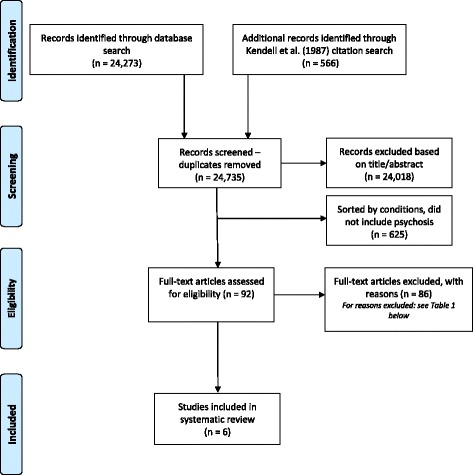
BACKGROUND: Mental health is a significant contributor to global burden of disease and the consequences of perinatal psychiatric morbidity can be substantial. We aimed to obtain global estimates of puerperal psychosis prevalence based on population-based samples and to understand how postpartum psychosis is assessed and captured among included studies. METHODS: In June 2014, we searched PubMed, CiNAHL, EMBASE, PsycINFO, Sociological Collections, and Global Index Medicus for publications since the year 1990. Criteria for inclusion in the systematic review were: use of primary data relevant to pre-defined mental health conditions, specified dates of data collection, limited to data from 1990 onwards, sample size >200 and a clear description of methodology. Data were extracted from published peer reviewed articles. RESULTS: The search yielded 24,273 publications, of which six studies met the criteria. Five studies reported incidence of puerperal psychosis (ranging from 0.89 to 2.6 in 1000 women) and one reported prevalence of psychosis (5 in 1000). Due to the heterogeneity of methodologies used across studies in definitions and assessments used to identify cases, data was not pooled to calculate a global estimate of risk. CONCLUSIONS: This review confirms the relatively low rate of puerperal psychosis; yet given the potential for serious consequences, this morbidity is significant from a global public health perspective. Further attention to consistent detection of puerperal psychosis can help provide appropriate treatment to prevent harmful consequences for both mother and baby.
Overview
CoChat Summary
TL;DR
This systematic review aimed to estimate the global prevalence/incidence of postpartum (puerperal) psychosis using population-based studies published from 1990 onward. It found only 6 eligible studies out of 24,273 records, with incidence ranging from 0.89 to 2.6 per 1,000 women and one prevalence estimate of 5 per 1,000, but it could not pool results because methods and definitions varied too much.
Key findings
- The search identified 24,273 publications, but only 6 studies met inclusion criteria.
- Among the 5 studies reporting incidence, estimates ranged from 0.89 to 2.6 per 1,000 women; 1 study reported prevalence of 5 per 1,000 women.
- The lowest incidence was 0.89 per 1,000 in Terp et al., based on a study with over 1.25 million women and assessment within 3 months postpartum.
- The highest incidence was 2.6 per 1,000 in Bang et al.; the paper notes this study had the smallest sample size (N = 772).
Methods
- Systematic review of published peer-reviewed studies, searched in June 2014 across PubMed, CiNAHL, EMBASE, PsycINFO, Sociological Collections, and Global Index Medicus, plus citation searching of a key article.
- Included studies had to use primary data, have specified data-collection dates, be from 1990 onward, have sample size >200, and provide a clear methodology; study designs could include cross-sectional, cohort/longitudinal, controlled trial, incidence/prevalence survey, or case-control studies with cases arm >200.
- Two reviewers independently screened, extracted data, and assessed study quality; because of heterogeneity in designs, measures, and definitions, no meta-analysis/pooling was performed.
Limitations
- The paper states that heterogeneity in definitions, instruments, and timeframes used to identify postpartum psychosis prevented pooling and a global summary estimate.
- The authors state they did not conduct a grey literature search, and they note possible publication bias despite the citation search.
- The text makes evident that the evidence base is very small (6 studies) and spans different countries, settings, and postpartum windows; the authors also state that some included studies assessed psychosis beyond the usual first month postpartum, which may mean some cases were not true postpartum psychosis.
Model-written summary. Check it against the paper before relying on it.
Integrity signals
Registry
Cites
Statistics
Figures
Verification
Claims the paper makes
13 Valid · 2 Not valid · 34 Not checked · 88 Own results and interpretations
The sources with a verdict support this claim; the rest weren’t checked yet, have no full text we could read, or their verdicts aren’t rated yet.
In the paper
“is a critical indicator of an underlying diagnosis of bipolar disorder [16, 19]”
§ The global prevalence of postpartum psychosis: a systematic review > Background
What the sources say
- Supportedcites [16] Sit D Rothschild AJ Wisner KL A Review of Postpartum Psychosis J Women's Health. 2006 15 352 68 10.1089/jwh.2006.15.352 PMC3109493 16724884 source
The Conclusions say that bipolar disorder is the primary psychiatric diagnosis to consider in early-onset postpartum psychosis. They also describe postpartum psychosis as most likely an overt presentation of bipolar illness, supporting the claim that it is an important indicator of underlying bipolar disorder. (LLM, conf=0.92)
- Not checked — no full text of the sourcecites [19] Reich T Winokur G Postpartum psychoses in patients with manic depressive disease J Nerv Ment Dis 1970 151 1 60 68 10.1097/00005053-197007000-00008 5426650 source
plainstates an association- Asserted: passes — The authors put it forward as true.
- Checkable: passes — It can be checked against evidence.
- Load-bearing: unclear — It is unclear whether the paper’s conclusions depend on it.
- Based: passes — The paper gives a reason why it holds.
- Supported
Every source the paper cites for this claim was checked and supports it.
In the paper
“As psychosis during the perinatal period typically occurs within the first 4 weeks of the postpartum period [16]”
§ The global prevalence of postpartum psychosis: a systematic review > Background
What the sources say
- Supportedcites [16] Sit D Rothschild AJ Wisner KL A Review of Postpartum Psychosis J Women's Health. 2006 15 352 68 10.1089/jwh.2006.15.352 PMC3109493 16724884 source
The Clinical Problem section states that postpartum psychosis occurs within the first 2–4 weeks after delivery. This supports the citing sentence’s timing claim. (LLM, conf=0.91)
plain- Asserted: passes — The authors put it forward as true.
- Checkable: passes — It can be checked against evidence.
- Load-bearing: passes — The paper’s conclusions depend on it.
- Based: passes — The paper gives a reason why it holds.
- Supported
The cited sources support only part of this claim — read each source’s verdict below.
In the paper
“While this review focused on estimates among a general population, prevalence among at-risk populations may be greater and also clinically meaningful.”
§ The global prevalence of postpartum psychosis: a systematic review > Discussion
What the sources say
- Not checked — no full text of the sourcecites [38] Mitsuhiro SS Chalem E Moraes Barros MC Guinsburg R Laranjeira R Brief report: prevalence of psychiatric disorders in pregnant teenagers J Adolesc 2009 32 3 747 752 10.1016/j.adolescence.2008.12.001 19349073 source
- Partly supportedcites [39] Di Florio A Jones L Forty L Gordon-Smith K Blackmore ER Heron J Craddock N Jones I Mood disorders and parity - a clue to the aetiology of the postpartum trigger J Affect Disord 2014 152-154 334 339 10.1016/j.jad.2013.09.034 24446553 PMC4025607 sourceExperimental — accuracy not yet measured
The Results (Sample characteristics; page unavailable) report substantial rates of perinatal mood episodes in women with mood disorders and say these rates exceeded those in a previous, less selectively recruited sample. The paper does not compare its at-risk sample with the general population, so it does not establish that specific comparison. (LLM, conf=0.82)
hedgedstates an association- Asserted: passes — The authors put it forward as true.
- Checkable: passes — It can be checked against evidence.
- Load-bearing: unclear — It is unclear whether the paper’s conclusions depend on it.
- Based: passes — The paper gives a reason why it holds.
The sources with a verdict support this claim; the rest weren’t checked yet, have no full text we could read, or their verdicts aren’t rated yet.
In the paper
“prevalence among at-risk populations may be greater and also clinically meaningful.”
§ The global prevalence of postpartum psychosis: a systematic review > Discussion
What the sources say
- Not checked — no full text of the sourcecites [38] Mitsuhiro SS Chalem E Moraes Barros MC Guinsburg R Laranjeira R Brief report: prevalence of psychiatric disorders in pregnant teenagers J Adolesc 2009 32 3 747 752 10.1016/j.adolescence.2008.12.001 19349073 source
- Supportedcites [39] Di Florio A Jones L Forty L Gordon-Smith K Blackmore ER Heron J Craddock N Jones I Mood disorders and parity - a clue to the aetiology of the postpartum trigger J Affect Disord 2014 152-154 334 339 10.1016/j.jad.2013.09.034 24446553 PMC4025607 source
The Results > Parity section reports higher rates of perinatal mood episodes after first pregnancies in women with bipolar I disorder. The Discussion > Implications for clinical practice section says this risk information can help guide decisions about pregnancy and childbirth, supporting its clinical relevance for this at-risk group. Page numbers are unavailable in our copy. (LLM, conf=0.86)
hedged- Asserted: passes — The authors put it forward as true.
- Checkable: passes — It can be checked against evidence.
- Load-bearing: unclear — It is unclear whether the paper’s conclusions depend on it.
- Based: passes — The paper gives a reason why it holds.
Every source the paper cites for this claim was checked and supports it.
In the paper
“Postpartum psychosis can also serve as a valuable first indicator of an underlying diagnosis of bipolar disorder [16]”
§ The global prevalence of postpartum psychosis: a systematic review > Discussion
What the sources say
- Supportedcites [16] Sit D Rothschild AJ Wisner KL A Review of Postpartum Psychosis J Women's Health. 2006 15 352 68 10.1089/jwh.2006.15.352 PMC3109493 16724884 source
The Conclusions say bipolar disorder is the primary diagnosis to consider in early-onset postpartum psychosis and report that half of the cases in a follow-up study were misdiagnosed at first presentation. The Prognosis passage also describes postpartum psychosis as most likely an overt presentation of bipolar illness. Page numbers were not provided. (LLM, conf=0.91)
plainstates an association- Asserted: passes — The authors put it forward as true.
- Checkable: passes — It can be checked against evidence.
- Load-bearing: unclear — It is unclear whether the paper’s conclusions depend on it.
- Based: passes — The paper gives a reason why it holds.
- Supported
58 more claims · 1 with their cited sources checked
Create a free account to see all 137 claims and every source verdict.
- Probably not a substantial claim. 68
- It may state two separate claims as one. 22
- The quote only partly states this claim. 1
Self-check
Percentages, sums and reported differences re-computed from the paper’s own numbers.
Each contradiction between two passages listed here was confirmed by an independent check.
Rated minor: it would not touch a result — a value no result rests on, a p-value that stays on the same side of the significance level, or a conflict that is clerical, resolved elsewhere in the paper, or outside its own findings.
In the paper
§ The global prevalence of postpartum psychosis: a systematic review > Abstract > Methods
“In June 2014, we searched PubMed, CiNAHL, EMBASE, PsycINFO, Sociological Collections, and Global Index Medicus for publications since the year 1990.”
§ The global prevalence of postpartum psychosis: a systematic review > Discussion
“First, we conducted a search of literature published within the past 15 years according to established WHO systematic review guidelines with the aim of including only the most recent studies.”
Citations
Cites
Preferred Reporting Items for Systematic Reviews and Meta-Analyses: the PRISMA statement
Moher, D., Liberati, A., Tetzlaff, J., Altman, D. G., & for the PRISMA Group (2009) · BMJ · doi:10.1136/bmj.b2535 · Cited by 83,823
Preferred Reporting Items for Systematic Reviews and Meta-Analyses: The PRISMA Statement
Moher, D., Liberati, A., Tetzlaff, J., Altman, D. G., & The PRISMA Group (2009) · PLoS Medicine · doi:10.1371/journal.pmed.1000097 · Cited by 64,042
Preferred reporting items for systematic reviews and meta-analyses: the PRISMA Statement.
(2009) · PubMed Central · Cited by 44,859
Kessler, R. C., Berglund, P., Demler, O., Jin, R., Merikangas, K. R., & Walters, E. E. (2005) · Archives of General Psychiatry · doi:10.1001/archpsyc.62.6.593 · Cited by 20,391 · cited 1×
“Across all regions, girls and women are disproportionately affected compared to boys or men; the prevalence of depression among women is approximately two times greater than among men [8].”
BackgroundWhiteford, H. A., Degenhardt, L., Rehm, J., Baxter, A. J., Ferrari, A. J., Erskine, H. E., Charlson, F. J., Norman, R. E., Flaxman, A. D., Johns, N., et al. (2013) · The Lancet · doi:10.1016/s0140-6736(13)61611-6 · Cited by 6,006
Diagnostic and Statistical Manual of Mental Disorders ( DSM ‐ IV ‐ TR )
Segal, D. L. (2010) · The Corsini Encyclopedia of Psychology · doi:10.1002/9780470479216.corpsy0271 · Cited by 4,666
Rates and risk of postpartum depression – a meta-analysis
O'hara, M. W., & Swain, A. M. (1996) · International Review of Psychiatry · doi:10.3109/09540269609037816 · Cited by 3,116
Fisher, J., Cabral de Mello, M., Patel, V., Rahman, A., Tran, T., Holton, S., & Holmes, W. (2012) · Bulletin of the World Health Organization · doi:10.2471/blt.11.091850 · Cited by 1,798
Treatment gap in mental health care.
Abramowitz, M. Z., Greenberg, D., & Levav, I. (2008) · PubMed · Cited by 1,484
The treatment gap in mental health care.
(2004) · Europe PMC (PubMed Central) · Cited by 1,419
Research works printed but not linked: 2
- United Nations Secretary-General The Global Strategy for Women’s, Children’s and Adolescents’ Health (2016-2030) 2015 New York United Nations
- Vanderkruik R, Tuncalp O, Chou D, Say L. Framing maternal morbidity: WHO scoping exercise. BMC Pregnancy Childbirth. 2013;13(213). PMC3840647 24252359 · DOI · Paper page
Cited by
Items 201–237 of 237
da Silva, A. C., Ribeiro, F. J. D. S. F., Brito, A. K. A., et al. (2024) · Caderno Pedagógico · doi:10.54033/cadpedv21n13-492
Christensen, D. D., Sheehan, D. V., Monson, M. A., & Christensen, R. D. (2025) · Open Journal of Obstetrics and Gynecology · doi:10.4236/ojog.2025.153035
Laufer, B., & Mun, N. (2025) · Psychosis · doi:10.1080/17522439.2025.2488941 · Cited by 2
“Participants may not report the full experience of their PPP. VanderKruik et al. (2017) noted that it was possible participants reported issues that were more comfortable for them, rather than more accurate (i.e. psychosis, hallucinations, and obsessional images).”
InfluentialSibling Psychiatric Diagnoses and Risk of Postpartum Psychosis: A Nationwide Cohort Study
Smout, S., Milazzo, F., Robakis, T. K., Bergink, V., & Mahjani, B. (2026) · The Journal of Clinical Psychiatry · doi:10.1101/2025.04.22.25326225
“We selected this three-month period to ensure comprehensive coverage of the typical onset window and to account for delayed diagnosis, consistent with previous epidemiological studies 3,4,19-21 .”
A 25-Year-Old Presents 1 Week after a Cesarean Delivery with Erratic Behavior
Metzgar, H. (2025) · Cambridge University Press eBooks · doi:10.1017/9781009413787.096
Singh, N., & Mujral, R. (2025) · Medical Humanities · doi:10.1136/medhum-2024-013183
“Postpartum psychosis is considered a fundamental indicator of the risk of future affective disorders, although there are major gaps in knowledge that demand attention (VanderKruik et al 2017).”
Complicaties in de kraamperiode
de Jonge, A., Verhoeven, C. J. M., Jong, E. F., van Dillen, J., & Bakker, P. (2025) · doi:10.1007/978-90-368-3142-0_12
Mulungu, C., Moyo, L. T., Nachimata, M., Sianchapa, C., & Maseka, A. K. Y. (2025) · Open Journal of Psychiatry · doi:10.4236/ojpsych.2025.154023
Psychosis in Pregnancy and the Neonatal Ripple Effect
Yeung, A., Suresh, D., & Hirschberg, C. I. (2025) · NeoReviews · doi:10.1542/neo.26-8-046
What delusions can tell us about the cognitive nature of belief
Connors, M. H., & Halligan, P. W. (2024) · The Conversation · doi:10.64628/ab.ss3uam4wr
Taşdemir, İ., Amil, B., Gümüş, S., et al. (2025) · Asian Journal of Psychiatry · doi:10.1016/j.ajp.2025.104677
Thomson, M., & Sharma, V. (2025) · Springer eBooks · doi:10.1007/978-3-031-99720-4_16
Grattan, R. E., London, S. M., & Hammond, M. D. (2025) · Frontiers in Psychiatry · doi:10.3389/fpsyt.2025.1586471
“Experiences of psychosis are also common in the postpartum period, with incidence ranging from 0.86 to 2.6 per 1,000 births (4).”
InfluentialUnderstanding Postpartum Disorders and Their Impact on the Family
Harway, M. (2025) · Springer eBooks · doi:10.1007/978-3-031-90006-8_4
Peripartalzeit in der psychotherapeutischen Praxis
Yamanaka, M., & Eisenegger, L. (2025) · Springer eBooks · doi:10.1007/978-3-662-72284-8_6
Psychische Störungen in der Schwangerschaft und nach der Geburt
Weidner, K., Backhausen, L. L., & Richter, L. (2025) · PiD - Psychotherapie im Dialog · doi:10.1055/a-2476-6633
Women’s Mental Health and the Latent Stage in Bipolar Disorder
Prasad, D., Gnielka, V., & Caropreso, L. (2025) · Springer eBooks · doi:10.1007/978-3-032-01297-5_8
Santé mentale et cerveau maternel
Ayala, K., & Rutherford, H. J. V. (2025) · Sages-Femmes · doi:10.1016/j.sagf.2025.11.009
Williams, K., Lobban, F. A., & Chamberlain, E. (2025) · JMIR Human Factors · doi:10.2196/80717
Fertility decision-making after an experience of first-onset postpartum psychosis
Arkle, P., Gupta, A., & Sanderson, C. (2026) · Journal of Reproductive and Infant Psychology · doi:10.1080/02646838.2026.2617338
Sanadi, R., Elangovan, A. R., Kuppusamy, C., Arasappa, R., & Chandra, P. S. (2026) · Archives of Women s Mental Health · doi:10.1007/s00737-025-01669-9 · Cited by 1
“Consistent with previous literature, postpartum psychosis emerges as a profoundly disruptive and traumatic condition with wide-reaching psychosocial consequences (Vanderkruik et al. 2017).”
Anikwe, C. C., Umeononihu, O. S., Anikwe, I. H., Ikeoha, C. C., Ikeotuonye, A. C., Nwabunwanne, O. V., Ofojebe, C. J., Enechukwu, C. I., OSUAGWU, C. P., Okeke, N. E., et al. (2026) · Frontiers in Psychiatry · doi:10.3389/fpsyt.2026.1580635
“The risk of postpartum psychosis is high (19), limiting mothers ’ ability to care for herself and their newborns.”
Near Miss: A Retrospective Study on Severe Acute Maternal Morbidity
Sahukar, S., & Pavanaganga, A. (2026) · Journal of South Asian Federation of Obstetrics and Gynaecology · doi:10.5005/jp-journals-10006-2851 · Cited by 1
The Perinatal Mental Health of Racial and Ethnic Minority Groups
Catalão, R., Codjoe, L., Das, P., Dyer, J., & Hatch, S. L. (2026) · Cambridge University Press eBooks · doi:10.1017/9781911623496.010
Staniforth, L., Gupta, A., Sanderson, C., & Cosquer, C. (2026) · Psychosis · doi:10.1080/17522439.2026.2642036
Postpartum psychosis is associated with elevated neuromelanin-MRI signal in the midbrain
McKenna, F., Vinke, L. N., Williams, M., Gaw, M. L., Dunk, M. M., Jacobs, H. I. L., Cohen, L., & Holt, D. J. (2026) · Molecular Psychiatry · doi:10.1038/s41380-026-03476-9 · Cited by 1
“Postpartum psychosis (PP) occurs following approximately 1-3/ 1000 births and presents with delusions, hallucinations and mood symptoms [1, 2].”
InfluentialSelf-citationA Critique on Maternal Insanity: A Case of Postpartum Psychosis and Infanticide
Hassan, A., Ullah, H., Yahya, A. W., Sagheer, A., Hassan, B., Qayyum, S. N., & Hotak, R. (2026) · Clinical Case Reports · doi:10.1002/ccr3.72534
“Although the absolute incidence of first-time presentation of postpartum psychosis is only 0.89–2.6 per 1000 births [4], the increased associated risk of maternal suicide makes it a psychiatric emergency.”
InfluentialPeschier, C., Noël, R., & Allard, M.-A. (2026) · Devenir · doi:10.3917/dev.261.0034
Bithalamic Infarction Presenting as Postpartum Psychosis: Case Report
Nkouonlack, C. D., Nkoké, C., Dongmo, S. F., et al. (2026) · Open Journal of Depression · doi:10.4236/ojd.2026.152003
Kamau, C., Gabrielsson, S., Makokha, F., Ntinina, T., Karimi, J., Munteiyan, L., Ekman, K., Öhlund, L., & Werneke, U. (2026) · BMC Public Health · doi:10.1186/s12889-026-28282-4
“In contrast, postpartum psychosis is rare with global incidence estimates ranging from 0.89 to 2.26 per 1000 births [4].”
InfluentialPostpartum OCD: Recognition and clinical discomfort among perinatal health care providers
Schofield, C. A., Siegel, I., Ponzini, G. T., & Kushner, S. (2026) · Journal of Obsessive-Compulsive and Related Disorders · doi:10.1016/j.jocrd.2026.101028 · Cited by 1
Enhancing support for postpartum psychosis through a socio-ecological lens: A qualitative analysis
Scalise, A. L., Yoon, H. E., Barest, P. E., Gaw, M. L., Freeman, M. P., Cohen, L. S., & Vanderkruik, R. C. (2026) · Journal of Health Psychology · doi:10.1177/13591053261460698
Self-citationPatra, S., Ghosh, S., Bhuyan, D., & Shyam, P. (2026) · Indian Journal of Psychiatry · doi:10.4103/indianjpsychiatry_980_25
Olanzapine Dosing in Women with First-Episode Psychosis: An Age-Based Proxy for Menopausal Status
Burke, T., O’Connor, K., Sommer, I. E., Keating, D., Duffy, R. T., Doherty, A. M., & O'Donoghue, B. N. (2026) · Schizophrenia Bulletin · doi:10.1093/schbul/sbag156
“16 , 17 As women transition through menopause, estrog en levels fluctuate significantly before declining, eventually reaching levels comparable to those observed in men.”
Mental disorders in uncomplicated pregnancy: a systematic review
Zhilin, V. O., Иванов, С. В., Chaika, Y. A., & Dyadin, E. S. (2026) · S S Korsakov Journal of Neurology and Psychiatry · doi:10.17116/jnevro202612608121
Contested Moral Logics of Care with Infanticidal Mothers: A Critical Nursing Research
Holmes, D., Domingue, J., Einboden, R., Kilty, J. M., Chartrand, J., & Hammond, C. (2026) · Issues in Mental Health Nursing · doi:10.1080/01612840.2026.2724409 · Cited by 1
Domingue, J., Holmes, D., Einboden, R., Kilty, J. M., Chartrand, J., & Hammond, C. (2026) · Journal of Forensic Nursing · doi:10.1097/jfn.0000000000000635
Metadata
- Authors
- on behalf of the Maternal Morbidity Working Group, VanderKruik, R., Barreix, M., Chou, D., Allen, T., Say, L., & Cohen, L. S.
- Affiliations
- University of Colorado Boulder (US)
- World Health Organization (CH)
- Massachusetts General Hospital (US)
- Corresponding author
- VanderKruik, Rachel
- Venue
- BMC Psychiatry
- Published
- 2017-07-28
- Volume
- 17
- Issue
- 1
- Pages
- 272-272
- ISSN
- 1471-244X (ISSN-L)
- PMC
- PMC5534064
- OpenAlex
- W2742151539
- Semantic Scholar
- 96e3b4b3feff1ab4a5bc20df7fd200c426ad3f13
- Cited by
- 238
- References
- 47
- Citations by year
- 2026: 23 · 2025: 29 · 2024: 34 · 2023: 31 · 2022: 31 · 2021: 27 · 2020: 19 · 2019: 30 · 2018: 12 · 2017: 2
- FWCI
- 2.80
- Type
- journal article
- Language
- en
- Open access
- gold
- doi.org
- Licence
- cc-by
- creativecommons.org/licenses/by/4.0/ (tdm)
- creativecommons.org/licenses/by/4.0/ (vor)
- Locations
- BMC Psychiatry (publishedVersion, cc-by)
- PubMed Central (publishedVersion, cc-by)
- PubMed (publishedVersion)
- DOAJ (DOAJ: Directory of Open Access Journals) (submittedVersion, cc-by-sa)
- Research Portal (King's College London) (submittedVersion, other-oa)
- UTS ePRESS (University of Technology Sydney) (submittedVersion)
- Funders
- Bill and Melinda Gates Foundation (OPP1033805)
- Topics
- Health Sciences › Medicine › Public Health, Environmental and Occupational Health › Maternal Mental Health During Pregnancy and Postpartum
- Social Sciences › Sociology and Political Science › Homicide, Infanticide, and Child Abuse
- Health Sciences › Medicine › Psychiatry and Mental health › Schizophrenia research and treatment
- Keywords
- postpartum psychosis, prevalence, incidence, perinatal mental health, global burden of disease, case finding
- MeSH terms
- Female, Humans, Pregnancy, Psychotic Disorders, Puerperal Disorders, Global Health, Incidence, Prevalence, Postpartum Period
About these checks
Registry, retraction, Cites and statistics results are computed, not judged, with one exception: a printed reference that no index lists is read once by a model before it counts as a citation error. Claims are extracted by a model and kept only when their quote appears verbatim in the text; each cited source is then checked, with a model’s help, for whether it says what the claim relies on. Those verdicts can be wrong — read the claim’s quote and the cited source before relying on one.
The claim verdicts this report counts are experimental: their accuracy is not yet measured.
A language model drew the claims from the paper on 2026-10-10, under version 3 of the claim definition (model deepseek-v4.1-flash, prompt extract-v3).
A second model labelled each claim on 2026-10-10 (model jev-1.13-20260917, definition revision gold-guideline-v0.2).
Cited sources are checked with a language model’s help (gpt-6-sol).
Statistics and arithmetic are recomputed, not judged.
Confidence bands are shown only for fields calibrated on our annotated test set. None is calibrated yet, so no band is shown.
What counts as a claim ›How we measure confidence ›How we check this ›
Are you an author, or do you see a problem with this page? Request a review
Data sources
Bibliographic data: Semantic Scholar, OpenAlex, Crossref.
Contains information from the Semantic Scholar Academic Graph Datasets, made available under the ODC Attribution License (ODC-BY 1.0).
Semantic Scholar’s data is described in: Kinney, R., et al. (2023). The Semantic Scholar Open Data Platform. arXiv:2301.10140.
