

The DOI matches its Crossref record; 69 of the 69 references it cites were found in a registry or an index.
The role of oxytocin receptor gene (OXTR) DNA methylation (DNAm) in human social and emotional functioning: a systematic narrative review
Open accessAbstract
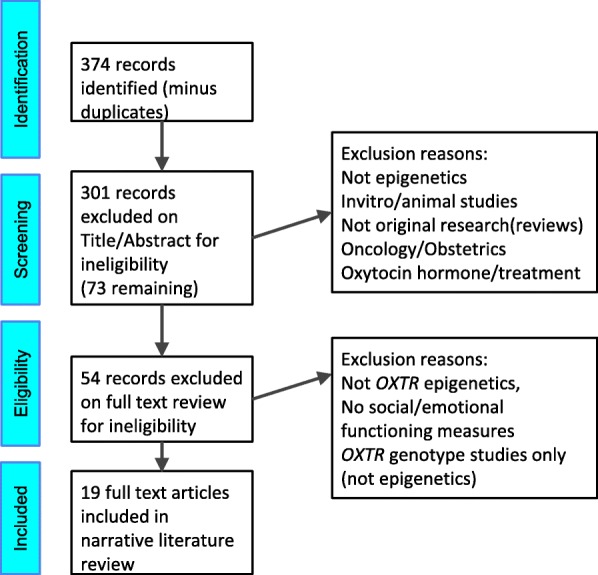
BACKGROUND: The neuropeptide Oxytocin (OXT) plays a central role in birthing, mother-infant bonding and a broad range of related social behaviours in mammals. More recently, interest has extended to epigenetic programming of genes involved in oxytocinergic neurotransmission. This review brings together early findings in a rapidly developing field of research, examining relationships between DNA methylation (DNAm) of the Oxytocin Receptor Gene (OXTR) and social and emotional behaviour in human populations. METHOD: A systematic search across Web of Knowledge/Science, Scopus, Medline and EMBASE captured all published studies prior to June 2017 examining the association between OXTR DNAm and human social and emotional outcomes. Search terms included 'oxytocin gene' or 'oxytocin receptor gene' and 'epigenetics' or 'DNA methylation'. Any article with a focus on social and emotional functioning was then identified from this set by manual review. RESULTS: Nineteen studies met eligibility criteria. There was considerable heterogeneity of study populations, tissue samples, instrumentation, measurement, and OXTR site foci. Only three studies examined functional consequences of OXTR DNAm on gene expression and protein synthesis. Increases in OXTR DNAm were associated with callous-unemotional traits in youth, social cognitive deficits in Autistic Spectrum Disorder (ASD), rigid thinking in anorexia nervosa, affect regulation problems, and problems with facial and emotional recognition. In contrast, reductions in DNAm were associated with perinatal stress, postnatal depression, social anxiety and autism in children. CONCLUSIONS: Consistent with an emerging field of inquiry, there is not yet sufficient evidence to draw conclusions about the role of OXTR DNAm in human social and emotional behaviour. However, taken together, findings point to increased OXTR DNAm in general impairments in social, cognitive and emotional functioning, and decreased OXTR DNAm in specific patterns of impairment related to mood and anxiety disorders (but not in all). Future progress in this field would be enhanced by adequately powered designs, greater phenotypic precision, and methodological improvements including longitudinal studies with multiple time-points to facilitate causal inference.
Overview
The claims and statistics of this paper haven’t been checked yet.
Run the check — free, no account needed. It reads the open-access text and checks the sources it cites.
Integrity signals
Registry
Cites
Statistics
Figures
Verification
Claims the paper makes
The claims and statistics of this paper haven’t been checked yet.
Run the check — free, no account needed. It reads the open-access text and checks the sources it cites.
Claims other papers make about this one
Each is checked against this paper’s own text: does it say what the citing paper says it does?
The cited source says what the claim attributes to it.
In the citing paper
“In the endocrine system, OXT is secreted by the posterior pituitary into the bloodstream to support reproductive processes like uterine contraction and lactation (Grewen et al., 2010; Maud et al., 2018).”
From Music's context-dependent influence on oxytocin, social bonding, and emotion regulation: a systematic review (2026) · cites this paper as Maud et al., 2018
Self-check
Percentages, sums and reported differences re-computed from the paper’s own numbers.
The self-check needs the paper’s full text.
Citations
Cites
Oxytocin increases trust in humans
Kosfeld, M., Heinrichs, M., Zak, P. J., Fischbacher, U., & Fehr, E. (2005) · Nature · doi:10.1038/nature03701 · Cited by 3,690 · cited 1×
“Further, intranasal OXT increased trust and willingness to accept social risks amongst healthy volunteers involved in an experimental game [11], as well as the reduction of the short-term stress response demonstrated by reduced cortisol release”
BackgroundThe oxytocin receptor system: structure, function, and regulation
Gimpl, G., & Fahrenholz, F. (2001) · Physiological Reviews · doi:10.1152/physrev.2001.81.2.629 · Cited by 3,089 · cited 1×
“The oxytocin receptor is a 389-amino acid G-protein coupled transmembrane receptor, enabling the activation of a number of different intracellular secondary messengers facilitating the oxytocin pathway [22].”
BackgroundBird, A. (2007) · Nature · doi:10.1038/nature05913 · Cited by 3,011
Boyd, A., Golding, J., Macleod, J., Lawlor, D. A., Fraser, A., Henderson, J., Molloy, L., Ness, A., Ring, S., & Davey Smith, G. (2013) · International Journal of Epidemiology · doi:10.1093/ije/dys064 · Cited by 2,996 · cited 1×
“longitudinal cohort studies for epigenetic analysis [63].”
Heinrichs, M., Baumgartner, T., Kirschbaum, C., & Ehlert, U. (2003) · Biological Psychiatry · doi:10.1016/s0006-3223(03)00465-7 · Cited by 2,091
Ainsworth, M. D. S., & Bell, S. M. (1970) · Child Development · doi:10.2307/1127388 · Cited by 1,764 · cited 1×
“using gold-standard protocols, for example, human attachment behaviour, within observational designs [65].”
MethodOxytocin and vasopressin in the human brain: social neuropeptides for translational medicine
Meyer-Lindenberg, A., Domes, G., Kirsch, P., & Heinrichs, M. (2011) · Nature Reviews Neuroscience · doi:10.1038/nrn3044 · Cited by 1,688 · cited 1×
“suprachiasmatic nucleus, bed nucleus of stria terminalis and brainstem - where they act as neuromodulators or neurotransmitters and thereby influence neurotransmission in these areas [19].”
BackgroundAn integrated model of emotion processes and cognition in social information processing
Lemerise, E. A., & Arsenio, W. F. (2000) · Child Development · doi:10.1111/1467-8624.00124 · Cited by 1,518 · cited 1×
“(2016) [44] 39 infants with mothers mean age 31.”
BackgroundIntranasal oxytocin improves emotion recognition for youth with autism spectrum disorders.
Guastella, A. J., Einfeld, S. L., Gray, K. M., Rinehart, N. J., Tonge, B. J., Lambert, T. J., & Hickie, I. B. (2010) · Biological Psychiatry · doi:10.1016/j.biopsych.2009.09.020 · Cited by 962 · cited 1×
“provements in adult social cognition [6] and youth emotional recognition [13].”
BackgroundNeumann, I. D., & Landgraf, R. (2012) · Trends in Neurosciences · doi:10.1016/j.tins.2012.08.004 · Cited by 954 · cited 1×
“proved emotional behaviours and mental health [15].”
Research works printed but not linked: 1
- Uvnas-Moberg K, Petersson M. Oxytocin, a mediator of anti-stress, well-being, social interaction, growth and healing. Z Psychosom Med Psychother. 2005;51(1):57–80.
Cited by
Sorted by citations
Items 101–151 of 151
Genetic contributions to the stability and satisfaction in Sexual Relationships
Eskandar, K. (2025) · Global Medical Genetics · doi:10.1016/j.gmg.2025.100043 · Cited by 2
“For instance, polymorphisms such as rs53576 in the OXTR gene are associated with differences in social cognition and stress reactivity [13].”
InfluentialIsnaeni, W., As’ád, S., Hatta, M., Syamsuddin, S., Andiwijaya, F. R., & Kadriyan, H. (2022) · The Indonesian Biomedical Journal · doi:10.18585/inabj.v14i4.2021 · Cited by 2
“This result was in line with the previous study (29,30,31), although, the neural mechanisms are not the subject of this current research.”
ResultBagasra, O., & Bagasra, A. B. (2019) · Advances in human services and public health (AHSPH) book series · doi:10.4018/978-1-5225-7635-8.ch003 · Cited by 2
OXTR Gene Polymorphisms and Event-Related Potentials in Humans: A Systematic Review
Rodríguez, D. A. L., Becerra, J., Mera, J. C. C., Cárdenas, F. P., Cotrina, J. M., & Canencio, D. M. A. (2024) · IntechOpen eBooks · doi:10.5772/intechopen.112631 · Cited by 1
Mazumder, P., Das, S. C., Mondol, S., Afif, I. K., Howlader, M., Gupta, S. D., Hossain, M. M., & Rahman, M. M. (2025) · Egyptian Journal of Medical Human Genetics · doi:10.1186/s43042-025-00680-0 · Cited by 1
“The human OXTR is made up of 389 amino acids and is extensively distributed in the ventromedial hypothalamus as well as peripheral tissues such as the ovary, testis, adrenals, uterus, corpus luteum, mammary gland, and heart [1, 6, 8].”
Wei, M., Chang, R., Li, C., Jiang, Y., & Zhang, J. (2025) · BMC Genomics · doi:10.1186/s12864-025-11406-2 · Cited by 1
“Firstly, previous research has predominantly focused on candidate genes, particularly those involved in the hypothalamic-pituitary-adrenal axis and serotoninergic system [17].”
Polk, R. J., Wright, K. A., Lin, T., Krol, K. M., Perkeybile, A. M., Nazarloo, H. P., Carter, C. S., Connelly, J. J., & Ebner, N. C. (2025) · Scientific Reports · doi:10.1038/s41598-025-07353-3 · Cited by 2
“3 ( OXTR ) 22 .”
Paul, S., Verma, J., & Mehan, S. (2026) · Neuropeptides · doi:10.1016/j.npep.2026.102597 · Cited by 1
Mascheroni, E., Butti, N., Mambretti, F., Cordolcini, L., Castagna, A., Maucci, V., Citterio, A., Bettinelli, A., & Montirosso, R. (2026) · Frontiers in Psychology · doi:10.3389/fpsyg.2026.1763938 · Cited by 1
“…include perinatal complications, medication use, maternal mental health, caregiving environment, socioeconomic conditions, 10.3389/fpsyg.2026.1763938 Frontiers in Psychology 10 frontiersin.org and psychosocial adversity (Galbally et al., 2018; Maud et al., 2018; Unternaehrer et al., 2015, 2016).”
InfluentialEarly life adversity, oxytocin system alterations, and addiction vulnerability: a narrative review
Saboory, E., Ahmadian-Moghadam, S., & Mehranfard, N. (2026) · Psychopharmacology · doi:10.1007/s00213-026-07027-6 · Cited by 2
Melino, S., & Mormone, E. (2022) · Frontiers in Neuroscience · doi:10.3389/fnins.2022.745138 · Cited by 1
“In fact, it was showed that increased OXTRm impairs social, cognitive, and emotional functioning, while decreased OXTRm would lead to specific patterns of impairment related to mood and anxiety disorders (Maud et al., 2018).”
BackgroundEarly-life stress exposure and epigenetic programming
Farrell, C. M. (2023) · Elsevier eBooks · doi:10.1016/b978-0-12-821785-6.00001-3 · Cited by 1
Prediction of autism spectrum disorder using epigenetic, brain, and sensory behavioral factors
Cheong, Y. J., Bae, J., Lee, S., Ro, J. H., Kosaka, H., Lyu, I., & Jung, M. (2024) · International Winter Conference on Brain-Computer Interface (BCI) · doi:10.1109/bci60775.2024.10480486 · Cited by 1
“By combining epigenetics and neuroscience, researchers have attempted to identify reliable biomarkers of ASD [1], [2].”
BackgroundMother's attitude to breastfeeding and its effect on oxytocin levels in mothers: a review article
Fikri, L. H., As’ád, S., Hatta, M., Syamsuddin, S., Prasetya, H., Maddeppungeng, M., Aminuddin, A., & Zainuddin, A. A. (2023) · Bali Medical Journal · doi:10.15562/bmj.v12i2.4574 · Cited by 1
Investigating the effects of neuropeptides on human sperm function and fertility
Tomova, A.-M. (2026) · e-space (Manchester Metropolitan University) · doi:10.83056/mmu.32477769 · Cited by 1
Niego, A., & Benítez‐Burraco, A. (2021) · Biolinguistics · doi:10.31234/osf.io/wh9qe · Cited by 1
Kaya, K., Önal, D., Kartal, Y., Budak, M. T., Karabulut, E., Oğuz, K. K., & Pehli̇vanoğlu, B. (2023) · bioRxiv (Cold Spring Harbor Laboratory) · doi:10.1101/2023.08.24.554569 · Cited by 1
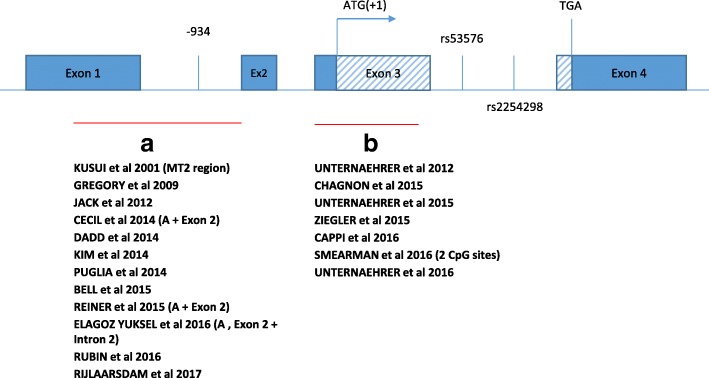
“3, spanning approximately 17 kilobytes, and contains four exons and three introns [Maud et al., 2018].”
BackgroundLudwig, B., Carlberg, L., Kienesberger, K., Swoboda, P., Mitschek, M. M. M., Bernegger, A., Inaner, M., Senft, B., Kapusta, N. D., Haslacher, H., et al. (2019) · European Neuropsychopharmacology · doi:10.1016/j.euroneuro.2019.01.017
Science Versus Society: Is Childcare for the Under Threes a Taboo Subject?
Gray, D. P., Dean, D., Dineen, M., & Dean, P. (2020) · Epigenomics · doi:10.2217/epi-2020-0141
How Diversity in Nature Impacts Political Psychology
Rabin, J. S. (2020) · Identity in a changing world · doi:10.1007/978-3-030-38270-4_4
Hutchinson, D. M., Manno, L. D., Fransquet, P., & Teague, S. J. (2021) · Elsevier eBooks · doi:10.1016/b978-0-12-815350-5.00006-1
Pharmacological Characterisation of Novel Oxytocin and Vasopressin Receptor Ligands
Gulliver, D. W. (2021) · The Sydney eScholarship Repository (The University of Sydney)
The Importance of Experimental Investigation of the CNS Oxytocin System
Boulton, K., & Guastella, A. J. (2021) · Methods in molecular biology · doi:10.1007/978-1-0716-1759-5_4
A quinta directiva e a indemnizaçao dos danos corporais no espaço ibérico
Cardoso, T. D. (2008) · Revista española de seguros: Publicación doctrinal de Derecho y Economía de los Seguros privados
Guoynes, C. D., & Marler, C. A. (2022) · bioRxiv (Cold Spring Harbor Laboratory) · doi:10.1101/2022.09.12.507587
“…Taylor et al., 2022; Taylor et al., 2017), and nonhuman and human primates (Taylor & French, 2015; Jarcho et al., 2011; Baxter et al., 2020; Crockford et al., 2013; Staes et al., 2015; Heinrichs et al., 2009; Skuse et al., 2014; Maud et al., 2018; Bredewold & Veneema, 2018; Zhuang et al., 2021).”
BackgroundEpigenetics and Forensics: Brightening the Future
Rezaei, B., Ahadi, M., & Astaraki, P. (2023) · Current Bioactive Compounds · doi:10.2174/1573407219666230815105041
Maeder, A. B., Bell, A. F., McFarlin, B. L., Park, C. G., Kominiarek, M. A., Toledo, P., Carter, C. S., Nazarloo, H., & Vonderheid, S. C. (2023) · Journal of Obstetric, Gynecologic & Neonatal Nursing · doi:10.1016/j.jogn.2023.11.003
The Pandemic of Autocracy: Societal Vulnerabilities to Authoritarianism
Dunbar, E. T. (2024) · International and cultural psychology/International and cultural psychology series · doi:10.1007/978-3-031-71122-0_1
The Role of Oxytocin in Autism Spectrum Disorder: Current Evidence and Therapeutic Implications
Bjørklund, G., & Bhat, R. S. (2024) · International journal for autism challenges & solution. · doi:10.54878/h8j48873 · Cited by 2
Ciolac, L., Andreescu, N. I., Farcaş, S. S., Bernad, E. S., Tudor, A., Nițu, D.-R., Popa, D. I., Maghiari, A. L., & Craina, M. L. (2025) · International Journal of Molecular Sciences · doi:10.3390/ijms26052129
“However, the effect of epigenetics of OXTR on social and emotional behavior in human populations is still a relatively new field of inquiry pending firmly conclusive evidence [39].”
The Association of OXT and OXTR Gene Variants with Obesity and Food Addiction in Turkish Adults
Avşar, O., Sancak, S., & Avcı, E. (2025) · Biology Bulletin · doi:10.1134/s1062359024609406
“The oxytocin receptor is a 389 amino acid G-protein coupled transmembrane receptor that activates several different intracellular second messengers that activate the oxytocin signaling pathway (Maud et al., 2018; Burmester et al., 2021).”
The epigenetic constellation of neurodevelopment disorders
Cacabelos, R. (2025) · Elsevier eBooks · doi:10.1016/b978-0-443-18722-3.00031-1
Mauri, M., Grazioli, S., Bonivento, C., Crippa, A., Giorda, R., Maggioni, E., Mambretti, F., Rosi, E., Squarcina, L., Tizzoni, F., et al. (2025) · Biomolecules · doi:10.3390/biom15081142
Genetic contributions to sexual relationship dynamics: A narrative review
Eskandar, K. (2025) · Сибирский научный медицинский журнал · doi:10.18699/ssmj20250407
Social Neuroscience: Bridging Social and Biological Levels of Analysis
Norman, G. J., Restrepo, A., & Berntson, G. G. (2025) · Handbooks of sociology and social research · doi:10.1007/978-3-031-95615-7_4
Ludwig, B., Carlberg, L., Kienesberger, K., Swoboda, P., Swoboda, M. M. M., Bernegger, A., Koller, R., Inaner, M., Fuxjäger, M., Zotter, M., et al. (2022) · Figshare · doi:10.6084/m9.figshare.20023196
Ludwig, B., Carlberg, L., Kienesberger, K., Swoboda, P., Swoboda, M. M. M., Bernegger, A., Koller, R., Inaner, M., Fuxjäger, M., Zotter, M., et al. (2022) · Figshare · doi:10.6084/m9.figshare.20023193
Ludwig, B., Carlberg, L., Kienesberger, K., Swoboda, P., Swoboda, M. M. M., Bernegger, A., Koller, R., Inaner, M., Fuxjäger, M., Zotter, M., et al. (2022) · Figshare · doi:10.6084/m9.figshare.20023190
The Thirsty Brain: Integrating Molecular Signals, Neural Circuit, and Behavior
Ma, X., Xu, L., Zheng, L., Shi, Q., Li, J., Sun, Y., Huang, C., Wang, Y., & Chen, Z. (2026) · Biological Psychiatry · doi:10.1016/j.biopsych.2026.01.017
Rewiring connection: The role of oxytocin in interactive media behavior
Marciano, L., Kubzansky, L. D., Montag, C., Bickham, D. S., Rich, M., & Becker, B. (2026) · Neuroscience & Biobehavioral Reviews · doi:10.1016/j.neubiorev.2026.106625 · Cited by 1
Kroll, C., Leibold, N. K., Vingerhoets, C., Kenis, G., van den Hove, D., Riedl, A. M., Schruers, K. R. J., & Hernaus, D. (2026) · Psychoneuroendocrinology · doi:10.1016/j.psyneuen.2026.107815
Cognitive Dysfunction and Suicide
Sunzeri, F. (2026) · Springer eBooks · doi:10.1007/978-3-032-14465-2_19
Augustinus, F., Hendrikse, S. C. F., & Jan Treur, A. (2026) · Studies in systems, decision and control · doi:10.1007/978-3-032-17029-3_12
Huisman, L., Ong, C., van de Werken, M., & Jan Treur, A. (2026) · Studies in systems, decision and control · doi:10.1007/978-3-032-17029-3_10
Santos, H. T. M., Marques, S. M., Moreira, A. L. E., Costa, V. A. F., Ribeiro, J. V. V., Mendonça, M. M., da Cruz, K. R., Colombari, E., Borges, C. L., Gomes, R. M., et al. (2026) · Neuropeptides · doi:10.1016/j.npep.2026.102636
Liao, K., Zhang, B., & Fang, R. (2026) · Pharmacological Research - Modern Chinese Medicine · doi:10.1016/j.prmcm.2026.100848
Adaptive Dynamical System Modeling of the Role of Epigenetics in Alexithymic Traits
Chowdhury, S. S., Hendrikse, S. C. F., & Jan Treur, A. (2026) · Lecture notes in networks and systems · doi:10.1007/978-3-032-24810-7_32
Kim, H.-J., Pae, C., Bang, M., Kim, I.-B., & Lee, S.-H. (2026) · Journal of Affective Disorders · doi:10.1016/j.jad.2026.122425
Markers of t he Maternal Oxytocin System and Mother-Infant Bonding during the First Postpartum Year.
Eckstein, M., Unternaehrer, E., Brenner, I., Schneider, E., Zipser, B., Moser, D., Quintana, D. S., Zietlow, A.-L., & Ditzen, B. (2026) · Progress in neurobiology · doi:10.1016/j.pneurobio.2026.102951
Genome-wide DNA methylation profiling of the zebrafish forebrain
Sorigue, P., Pinget, M., Costa, J., Teles, M. C., & Oliveira, R. F. (2026) · Scientific Data · doi:10.1038/s41597-026-08399-2
Epigenetic influences on affect and emotion regulation: Insights from the oxytocin system
GALLAGHER, R. C., Skyberg, A. M., MORRIS, J. P., & Connelly, J. J. (2026) · Handbook of clinical neurology · doi:10.1016/b978-0-443-19043-8.00016-5
Metadata
- Authors
- Maud, C., Ryan, J., McIntosh, J. E., & Olsson, C. A.
- Affiliations
- Deakin University (AU)
- Royal Children's Hospital (AU)
- Corresponding author
- Maud, Catherine
- Venue
- BMC Psychiatry
- Published
- 2018-05-29
- Volume
- 18
- Issue
- 1
- Pages
- 154-154
- ISSN
- 1471-244X (ISSN-L)
- PMC
- PMC5975530
- OpenAlex
- W2805059767
- Cited by
- 151
- References
- 68
- Citations by year
- 2026: 19 · 2025: 17 · 2024: 15 · 2023: 20 · 2022: 19 · 2021: 24 · 2020: 22 · 2019: 9 · 2018: 5
- FWCI
- 2.27
- Type
- journal article
- Language
- en
- Open access
- gold
- doi.org
- Licence
- Locations
- BMC Psychiatry (publishedVersion, cc-by)
- PubMed Central (publishedVersion, cc-by)
- PubMed (publishedVersion)
- Monash University Research Portal (Monash University) (submittedVersion, other-oa)
- Minerva Access (University of Melbourne) (submittedVersion, cc-by)
- DOAJ (DOAJ: Directory of Open Access Journals) (submittedVersion, cc-by-sa)
- Figshare (submittedVersion, cc-by)
- Topics
- Life Sciences › Neuroscience › Endocrine and Autonomic Systems › Neuroendocrine regulation and behavior
- Life Sciences › Biochemistry, Genetics and Molecular Biology › Molecular Biology › Epigenetics and DNA Methylation
- Life Sciences › Neuroscience › Cellular and Molecular Neuroscience › Neurotransmitter Receptor Influence on Behavior
- Keywords
- oxytocin receptor gene, oxytocin receptor, DNA methylation, epigenetics, oxytocin, social behavior, emotional functioning, callous-unemotional traits, autism spectrum disorder, anorexia nervosa, emotion regulation, perinatal stress, postpartum depression, social anxiety, mood disorders
- MeSH terms
- Cognition, Emotions, Humans, Synaptic Transmission, Oxytocin, Social Behavior, Receptors, Oxytocin, DNA Methylation, Gene Expression Profiling, Epigenomics
About these checks
Registry, retraction, Cites and statistics results are computed, not judged, with one exception: a printed reference that no index lists is read once by a model before it counts as a citation error. Claims are extracted by a model and kept only when their quote appears verbatim in the text; each cited source is then checked, with a model’s help, for whether it says what the claim relies on. Those verdicts can be wrong — read the claim’s quote and the cited source before relying on one.
Statistics and arithmetic are recomputed, not judged.
Confidence bands are shown only for fields calibrated on our annotated test set. None is calibrated yet, so no band is shown.
What counts as a claim ›How we measure confidence ›How we check this ›
Are you an author, or do you see a problem with this page? Request a review
