

A qualitative exploration of service user views about using digital health interventions for self-management in severe mental health problems
Open accessThe DOI matches its Crossref record; 59 of the 59 references it cites were found in a registry or an index.
Abstract
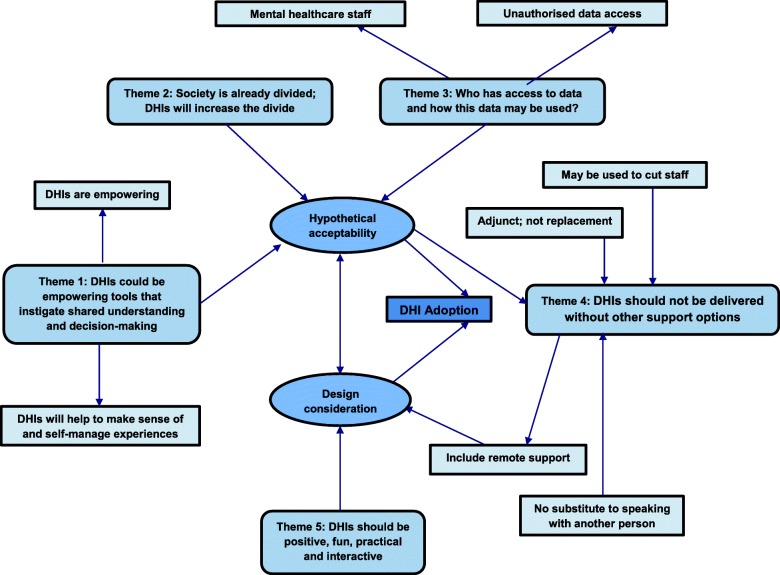
BACKGROUND: The development of digital health interventions (DHIs) for severe mental health problems is fast-paced. Researchers are beginning to consult service users to inform DHIs; however, much of this involvement has been limited to feedback on specific interventions post-DHI development. This study had two aims: 1. explore service user views towards DHIs for severe mental health problems; and 2. make recommendations for specific content within DHIs based on service user needs and suggestions. METHODS: Qualitative interviews with eighteen people with severe mental health problems focussed on two domains: 1) views about DHIs for severe mental health problems; and 2) ideas for future DHI content and design features. Data were analysed thematically. RESULTS: Participants responses were captured in five key themes: 1) DHIs could be empowering tools that instigate reflection and change; 2) society is already divided; DHIs will further increase this divide; 3) considerations must be made about who has access to DHI data and how this data may be used; 4) DHIs should not be delivered without other support options; and 5) DHIs should provide a positive, fun, practical and interactive method for self-management. CONCLUSIONS: Participants found DHIs acceptable due to the empowering nature of self-management and ability to take ownership of their own healthcare needs. However, concerns included the potential for digital exclusion, privacy and confidentiality and fears about DHIs being used to replace other mental health services. Service users want tools to help them self-manage their mental health, but also provide positive and recovery-focussed content that can be used in conjunction with other support options.
Overview
The claims and statistics of this paper haven’t been checked yet.
Free: it reads the open-access text and checks the first 5 claims that cite a source we can check. Create a free account to check every claim.
Integrity signals
Registry
Cites
Statistics
Figures
Verification
Claims the paper makes
The claims and statistics of this paper haven’t been checked yet.
Free: it reads the open-access text and checks the first 5 claims that cite a source we can check. Create a free account to check every claim.
Claims other papers make about this one
Each is checked against this paper’s own text: does it say what the citing paper says it does?
The source backs part of the claim, not all of it — or backs it for a different population, condition or comparison.
In the citing paper
“However, even if people acknowledged a perceived need for help and were willing to seek help, engagement with a particular intervention was then affected by a person’s preconceived belief about whether a digital intervention would be effective [79,104,110-112].”
From Barriers to and facilitators of user engagement with digital mental health interventions: Systematic review (2021) · cites this paper as [104]
Experimental — accuracy not yet measuredThe source backs part of the claim, not all of it — or backs it for a different population, condition or comparison.
In the citing paper
“Depending on the type and severity of a person’s mental health symptoms, studies that involved health care providers supporting digital intervention use reported that there was sometimes a need for face-to-face contact, as issues could be difficult to address remotely via a digital platform [102-104].”
From Barriers to and facilitators of user engagement with digital mental health interventions: Systematic review (2021) · cites this paper as [104]
Experimental — accuracy not yet measuredThe source backs part of the claim, not all of it — or backs it for a different population, condition or comparison.
In the citing paper
“Participants’ mental health literacy [123], digital literacy [88,103,104,122,124-127], and digital health literacy [103,127] influenced the extent to which they were able to adapt and engage with DMHIs: for each type of literacy; higher literacy was associated with higher engagement.”
From Barriers to and facilitators of user engagement with digital mental health interventions: Systematic review (2021) · cites this paper as [104]
Experimental — accuracy not yet measuredThe source backs part of the claim, not all of it — or backs it for a different population, condition or comparison.
In the citing paper
“In 6 studies, a noted barrier among both users and service providers was a concern about social avoidance, that is, a concern that people might use self-guided interventions in lieu of coming into a clinic in person and engaging in therapy or group sessions [78,104,122,133,138,195].”
From Barriers to and facilitators of user engagement with digital mental health interventions: Systematic review (2021) · cites this paper as [104]
Experimental — accuracy not yet measuredThe source backs part of the claim, not all of it — or backs it for a different population, condition or comparison.
In the citing paper
“Two other studies found that participants engaged more with an intervention if they were just starting treatment [104,178].”
From Barriers to and facilitators of user engagement with digital mental health interventions: Systematic review (2021) · cites this paper as [104]
Experimental — accuracy not yet measured
9 more claims about this paper
Create a free account to see every claim other papers make about this one.
Self-check
Percentages, sums and reported differences re-computed from the paper’s own numbers.
The self-check needs the paper’s full text.
Citations
Cites
Using thematic analysis in psychology
Braun, V., & Clarke, V. (2006) · Qualitative Research in Psychology · doi:10.1191/1478088706qp063oa · Cited by 194,414 · cited 1×
“Interviews were audio-recorded, transcribed verbatim by the lead author and subject to thematic analysis, as described by Braun and Clarke (2006) [41].”
MethodChecklists for improving rigour in qualitative research: a case of the tail wagging the dog?
Barbour, R. S. (2001) · BMJ · doi:10.1136/bmj.322.7294.1115 · Cited by 2,613
Semi-Structured Interviewing and Qualitative Analysis
Smith, J. A. (1995) · Rethinking Methods in Psychology · doi:10.4135/9781446221792.n2 · Cited by 1,346 · cited 1×
“Interviews were administered using a topic guide (Appendix A) developed for the study based on review of the literature and informed by Smith’s (1995) guidelines [40] and questioning was focused on participant perceptions of self-guided interventions delivered via websites and smartphone apps.”
MethodSerious Games and Gamification for Mental Health: Current Status and Promising Directions
Fleming, T. M., Bavin, L., Stasiak, K., Hermansson-Webb, E., Merry, S. N., Cheek, C., Lucassen, M., Lau, H. M., Pollmuller, B., & Hetrick, S. (2017) · Frontiers in Psychiatry · doi:10.3389/fpsyt.2016.00215 · Cited by 582 · cited 1×
“For example, some participants suggested gamification strategies, which have previously shown some promise in improving engagement with DHIs [59, 60].”
BackgroundLloyd-Evans, B., Mayo-Wilson, E., Harrison, B., Istead, H., Brown, E., Pilling, S., Johnson, S., & Kendall, T. (2014) · BMC Psychiatry · doi:10.1186/1471-244x-14-39 · Cited by 558 · cited 1×
“Peer support can provide hope for recovery and empowerment [56] and is recommended by NICE [1, 2].”
BackgroundMember Checking With Older Women: A Framework for Negotiating Meaning
Doyle, S. (2007) · Health Care for Women International · doi:10.1080/07399330701615325 · Cited by 449 · cited 1×
“interpretation, analyses and drafts [62].”
Relapse prediction in schizophrenia through digital phenotyping: a pilot study
Barnett, I., Torous, J., Staples, P., Sandoval, L., Keshavan, M., & Onnela, J.-P. (2018) · Neuropsychopharmacology · doi:10.1038/s41386-018-0030-z · Cited by 422 · cited 1×
“Additionally, researchers are beginning to explore how relapse can be predicted via passively collected smartphone data (digital phenotyping) [61].”
BackgroundTechnological innovations in mental healthcare: harnessing the digital revolution
Hollis, C., Morriss, R., Martin, J., Amani, S., Cotton, R., Denis, M., & Lewis, S. (2015) · British Journal of Psychiatry · doi:10.1192/bjp.bp.113.142612 · Cited by 375 · cited 1×
“support options due to their widespread availability, reduced reliance of direct input from clinicians and potential to empower individuals with treatment choice and control [14].”
BackgroundFirth, J., Cotter, J., Torous, J., Bucci, S., Firth, J. A., & Yung, A. R. (2016) · Schizophrenia Bulletin · doi:10.1093/schbul/sbv132 · Cited by 351 · cited 1×
“A meta-analysis of mobile phone ownership rates in people experiencing psychosis reported a narrowing gap in ownership in comparison with the general population [46].”
BackgroundSelf-citationEmerging mHealth and eHealth interventions for serious mental illness: a review of the literature
Naslund, J. A., Marsch, L. A., McHugo, G. J., & Bartels, S. J. (2015) · Journal of Mental Health · doi:10.3109/09638237.2015.1019054 · Cited by 327
Research works printed but not linked: 1
- National Institute for Health and Care Excellence (NICE). Psychosis and schizophrenia in adults: prevention and management. 2014. https://www.nice.org.uk/guidance/cg178/chapter/1-Recommendations. Accessed 3 Oct 2017. 32207892
Cited by
Items 101–184 of 184
Beyond Pharmacotherapy for Bipolar Disorder: The Role of Adjunctive Psychological Treatments
Fletcher, K., & Murray, G. (2019) · Psychiatric Annals · doi:10.3928/00485713-20190808-01 · Cited by 5
Chang, K.-H., Hung, C.-H., Lin, T., Lin, H., & Chen, Y.-L. (2022) · Journal of Healthcare Engineering · doi:10.1155/2022/9732355 · Cited by 5
RetractedHanafi, I. I., Alhabsji, T., Hidayat, K., & Dаrmаwаn, А. (2025) · International Journal of Pharmaceutical and Healthcare Marketing · doi:10.1108/ijphm-02-2025-0015 · Cited by 4
Heydarian, S., Shakiba, A., & Kalhori, S. R. N. (2023) · Journal of Healthcare Informatics Research · doi:10.1007/s41666-023-00134-5 · Cited by 6
“…apps may help with daily mood screening, symptom identification, and quick response provision, leading to better self-care for the affected patient [15].mHealth apps have been developed and evaluated for different targets for monitoring within behavioral health and have positive impacts such as…”
BackgroundBourboulis, S., Kemp, E., the Finding My Way-Advanced Authorship Group, & Beatty, L. (2025) · Supportive Care in Cancer · doi:10.1007/s00520-025-09379-9 · Cited by 6
“Self-pacing is evidently an important aspect of online interventions, with research demonstrating it fosters a sense of empowerment over one’s healthcare needs (40).”
Storm, M., Venegas, M. D. R. A., Gocinski, A., Myers, A., Brooks, J., & Fortuna, K. L. (2021) · IEEE Global Humanitarian Technology Conference (GHTC) · doi:10.1109/ghtc53159.2021.9612444 · Cited by 4
Ganapathy, A., Casey, L. M., Rowland, D. P., Grady, A. B., Sotheren, K. V., & Clough, B. A. (2023) · Advances in Mental Health · doi:10.1080/18387357.2023.2254864 · Cited by 7
Coomans, S. K., Virtanen, L., Kaihlanen, A., Rantanen, T., Clemens, T., & Heponiemi, T. (2024) · Discover Mental Health · doi:10.1007/s44192-024-00088-z · Cited by 4
Des repères pour la conception des apps ?
Khazaal, Y., Potvin, S., Pennou, A., Djomo, W., Borgeat, F., & Lecomte, T. (2021) · Santé mentale au Québec · doi:10.7202/1081512ar · Cited by 5
Skjærpe, J. N., Fjellså, H. M. H., Fortuna, K. L., Wang, B., & Storm, M. (2025) · Digital Health · doi:10.1177/20552076251380648 · Cited by 3
Mokhwelepa, L. W., Sumbane, G. O., & Mukhinindi, R. (2025) · General Hospital Psychiatry · doi:10.1016/j.genhosppsych.2025.11.007 · Cited by 3
Altun, A., Oxlad, M., Hine, R. H., Reupert, A. E., Slewa‐Younan, S., Ansari, D., D’Souza, L., Syed, S., Kadwadkar, M., Skouteris, H., et al. (2025) · International Journal for Equity in Health · doi:10.1186/s12939-025-02715-9 · Cited by 4
Digital Mental Health Interventions: A Comprehensive Systematic Review
7450 Summit Cir, D., & Alnaher, S. (2023) · Journal of Sociology Psychology & Religious Studies · doi:10.53819/81018102t4236 · Cited by 3
Perceptions and Experiences of Renew: an Exposure-Based Mobile App for Posttraumatic Stress
Miller, M. L., Davis, C. A., & McLean, C. P. (2023) · Journal of Technology in Behavioral Science · doi:10.1007/s41347-023-00358-7 · Cited by 3
“This is consistent with findings from Berry et al. (2019) who found a lack of judgement as a commonly reported advantage of digital mental health tools.”
COVID-19 and Psychological Distress in Africa: Communitarian Perspectives
Ndasauka, Y. (2023) · Routledge eBooks · doi:10.4324/9781003425861 · Cited by 5
Michalak, E. E., Morton, E. E., Meyer, D., Murray, G., O'Brien, H. L., & Barnes, S. J. (2026) · Bipolar Disorders · doi:10.1111/bdi.70096 · Cited by 2
How Online Counselling Is Utilised, Evaluated, and Received
Agathokleous, G., & Taiwo, A. O. (2021) · Advances in psychology, mental health, and behavioral studies (APMHBS) book series · doi:10.4018/978-1-7998-7991-6.ch011 · Cited by 4
la Cruz-Torralva, K. D., Escobar-Agreda, S., Lopez, P. A. R., Amaro, J., Reátegui-Rivera, C. M., & Rojas-Mezarina, L. (2024) · JMIR Formative Research · doi:10.2196/54005 · Cited by 2
Forte, C., Grey, E., Jessiman, P., McLeod, H., Salway, R., Rejon, C. S., Harkes, R., Stokes, P., de Vocht, F., Campbell, R. M., et al. (2025) · BMJ Open · doi:10.1136/bmjopen-2024-090492 · Cited by 3
Eid, L., Kenny, A., Taher, R., Jacobsen, P. C., Hsu, C.-W., & Yiend, J. (2025) · JMIR Human Factors · doi:10.2196/70181 · Cited by 2
“%) reported concerns about data protection, which is common in the context of using DHTs in similar populations [33].”
InfluentialKnight-Agarwal, C. R., Bushell, M., Hooper, M., Joseph, J., Atchan, M., Shield, A., Douglas, A., Saleh, A., Mohammadian, M., Khan, M. I., et al. (2025) · JMIR Diabetes · doi:10.2196/65328 · Cited by 1
“Stakeholders may include individuals with lived experience of the phenomenon in question, HPs, and academics [31].”
Lawrence‐Sidebottom, D., McAlister, K. L., Roots, M., & Huberty, J. (2025) · Digital Health · doi:10.1177/20552076251331885 · Cited by 1
Driving User Engagement: A Mixed‐Method Marketing Approach for Digital Mental Health Intervention
Jena, R. K., Botella-Carrubí, D., & Móstoles, R. C. (2025) · Psychology and Marketing · doi:10.1002/mar.70060 · Cited by 1
Nursyafaat, A., & Sriati, A. (2025) · RIGGS Journal of Artificial Intelligence and Digital Business · doi:10.31004/riggs.v4i4.3365 · Cited by 1
Transforming mental health conversations on X: content and sentiment analysis from Indonesia
Susanto, A., Sukendar, M. U., & Licia, R. (2026) · Media Asia · doi:10.1080/01296612.2026.2634217 · Cited by 1
“This tendency aligns with studies suggesting that affective discourse in digital spaces plays a critical role in shaping public attitudes toward mental health (Berry et al., 2019).”
Martin, C., Eisner, E., & Wittkowski, A. (2026) · Frontiers in Psychiatry · doi:10.3389/fpsyt.2026.1743614 · Cited by 1
Occupational Health and Safety in the Healthcare Sector
Modenese, A., & Gobba, F. (2022) · MDPI eBooks · doi:10.3390/books978-3-0365-4593-6 · Cited by 1
Jørgensen, S. W., Petersen, E. N., Klausen, S. H., Lee, K., & Nørgaard, B. (2023) · International Journal of Mental Health Nursing · doi:10.1111/inm.13221 · Cited by 1
Miller, M. J., Eberhart, L. G., Heliste, J. L., & Tripuraneni, B. R. (2024) · JMIR Formative Research · doi:10.2196/59831 · Cited by 1
Potentials of Digital Healthcare for Healthy Aging: Empowerment for Self-Management
Ramachandran, A., Bassi, S., & Sinha, A. (2024) · Advances in healthcare information systems and administration book series · doi:10.4018/979-8-3693-8552-4.ch008 · Cited by 1
Agathokleous, G. (2020) · Wolverhampton Intellectual Repository and E-Theses (University of Wolverhampton) · Cited by 4
Lin, H., Wu, P.-Y., Lin, C., Wu, P., Zhang, S., Li, Q., Shen, C., & Chen, Y.-L. (2023) · SSRN Electronic Journal · doi:10.2139/ssrn.4495136 · Cited by 1
The role of digital mental health programs in improving mental healthcare provision
Harwood, N., & Skinner, S. (2024) · British Journal of Healthcare Management · doi:10.12968/bjhc.2024.0016 · Cited by 1
Lusinga, S. (2019) · Open University of Cape Town (University of Cape Town) · Cited by 3
Buitenweg, D. C. (2020) · Tilburg University Research Portal
Tecnologias de autoatendimento na área da saúde: um Mapeamento Sistemático
Gralha, S. R., Pfeiffer, B. F., Pedroso, R., & da Silveira, J. M. D. M. (2022) · Research Society and Development · doi:10.33448/rsd-v11i9.31926 · Cited by 1
Self-service technologies in the health area: a systematic mapping
Pfeiffer, B. F., da Silveira, J. M. D. M., Pedroso, R., & Gralha, S. R. (2023) · Seven Editora eBooks · doi:10.56238/tfisdwv1-110
Borghouts, J. W., Eikey, E. V., Leon, C. D., Schueller, S. M., Schneider, M. L., Stadnick, N. A., Zheng, K., Mukamel, D. B., & Sorkin, D. H. (2023) · doi:10.2196/preprints.53161
Lin, H., Perng, Y., Shen, C., Lin, C., Li, Q., Tsai, I.-E., Hsu, C.-W., & Hsu, C.-H. (2023) · SSRN Electronic Journal · doi:10.2139/ssrn.4594608
Positive or Negative? The Effect of Emerging Technologies and Products on Mental Health
Guo, C., Gilmour, S., Song, P., & Fang, A. (2023) · Frontiers research topics · doi:10.3389/978-2-8325-3558-5
Health Worker Experiences of Using Digital Resources for the Improvement of Mental Well-Being
Lamba, T., Jamu, E. S., Kokota, D., Maliwichi, L., Zumazuma, A., Kleinau, E., Gorentz, K., Jaskiewicz, W., Rahimi, D., & Kapps, M. (2023) · Routledge eBooks · doi:10.4324/9781003425861-18
Koly, K. N. (2024) · Cambridge Prisms Global Mental Health · doi:10.1017/gmh.2024.30.pr4
(2024) · Cambridge Prisms Global Mental Health · doi:10.1017/gmh.2024.30.pr6
Koly, K. N. (2023) · Cambridge Prisms Global Mental Health · doi:10.1017/gmh.2024.30.pr1
(2024) · Cambridge Prisms Global Mental Health · doi:10.1017/gmh.2024.30.pr5
(2023) · Cambridge Prisms Global Mental Health · doi:10.1017/gmh.2024.30.pr2
(2024) · Cambridge Prisms Global Mental Health · doi:10.1017/gmh.2024.30.pr3
Aldiabat, K. M., Alshammari, M., Musa, M., & Alsrayheen, E. (2024) · Journal of Holistic Nursing Science · doi:10.31603/nursing.v11i1.10357 · Cited by 2
“Only a small number of studies have been related to the management of mental disorders (Berry et al., 2019; O’Keeffe et al., 2016; Swi tsers et al., 2018).”
BackgroundHealthcare Professionals' Attitudes Towards Digital Technology to Support Their Mental Wellbeing
Bonello, S., & Buttiġieġ, S. C. (2024) · Advances in human resources management and organizational development book series · doi:10.4018/979-8-3693-5991-4.ch010
Attoe, C., Szekely, R., Vega, M. O., Browne, E., Thomas, R., Kwan, T., Altchouler, P., De, A., Hariharan, N., Clay, G., et al. (2025) · doi:10.2196/preprints.73963
Yu, J., Li, M., Xue, H., Liu, Y., Fan, L., Zou, J., & Du, W. (2025) · International Journal of Risk & Safety in Medicine · doi:10.1177/09246479251360682 · Cited by 1
Attoe, C., Szekely, R., Vega, M. O., Browne, E., Thomas, R., Kwan, C. W. T., Altchouler, P., De, A., Hariharan, N., Clay, G., et al. (2025) · doi:10.2196/preprints.81498
Lim, Z. Z., Lim, S. Y., Lu, S., & Gutman, L. M. (2025) · JMIR Human Factors · doi:10.2196/71549
“Unclear or incoherent posts and replies can also affect users’ ability to understand and act on the information provided [66,67].”
Dahlberg, A., Kaartinen, T., Jukarainen, S., & Orre, P. (2025) · medRxiv · doi:10.1101/2025.11.06.25339651
User dissatisfaction with a mental health application: Insights from Google Reviews
Petersen, F., & Tom, S. L. (2025) · South African journal of information management · doi:10.4102/sajim.v27i1.2064
“Users seek content that matches their medical needs, cultural background and treatment objectives (Berry, Lobban & Bucci 2019).”
Koly, K. N., Saba, J., Christopher, E., Hossain, A. N. N., Akter, T., Rahman, Z., Ahmed, H. U., & Eaton, J. (2024) · Figshare · doi:10.6084/m9.figshare.25333372
Mair, J. L., Castro, Ó., Salamanca-Sanabria, A., Frese, B. F., von Wangenheim, F., Tai, E. S., Kowatsch, T., & Müller‐Riemenschneider, F. (2023) · Figshare · doi:10.6084/m9.figshare.22688898
Additional file 1 of Digital tools to support mental health: a survey study in psychosis
Eisner, E., Berry, N., & Bucci, S. (2024) · Figshare · doi:10.6084/m9.figshare.26624164
Self-citationMair, J. L., Castro, Ó., Salamanca-Sanabria, A., Frese, B. F., von Wangenheim, F., Tai, E. S., Kowatsch, T., & Müller‐Riemenschneider, F. (2023) · Figshare · doi:10.6084/m9.figshare.22688895
Mair, J. L., Castro, Ó., Salamanca-Sanabria, A., Frese, B. F., von Wangenheim, F., Tai, E. S., Kowatsch, T., & Müller‐Riemenschneider, F. (2023) · Figshare · doi:10.6084/m9.figshare.22688901
Zhang, X., Lewis, S., Chen, X., Zhou, J., Wang, X., & Bucci, S. (2024) · Figshare · doi:10.6084/m9.figshare.25572496
Self-citationExploring the experiences and perspectives of using mental health apps
Nasiri, F. (2023) · Lancaster EPrints (Lancaster University) · doi:10.17635/lancaster/thesis/2114
Digital health interventions for fear of recurrence
Khozoee, N. (2023) · Enlighten: Theses (The University of Glasgow) · doi:10.5525/gla.thesis.83863
Sroge, R. A. (2023) · ORCA Online Research @Cardiff (Cardiff University) · Cited by 1
Duprez, L. (2023) · HAL · Cited by 1
Användning av digitala verktyg för patienter inom psykosvården En litteraturöversikt
Ayoub, M., & Yahaghi, B. (2021) · Gothenburg University Publications Electronic Archive (Gothenburg University)
Mielenterveyskuntoutujat digitaalisten palveluiden käyttäjinä : integratiivinen kirjallisuuskatsaus
Eloranta, E. (2025) · Theseus (Ammattikorkeakoulujen)
Attoe, C., Szekely, R., Vega, M. O., Browne, E., Thomas, R. J., Kwan, C. W. T., Altchouler, P., De, A., Hariharan, N., Clay, G., et al. (2026) · Digital Health · doi:10.1177/20552076261428307
Nielsen, H. N., Guala, M. M., & Nielsen, A. S. (2026) · Journal of Eating Disorders · doi:10.1186/s40337-026-01577-y
“Within ED treat-ment, digital interventions have been discussed as potentially empowering tools that may support engagement and self-reflection, although evidence specific to serious games in ED populations remains limited [3, 17, 18].”
Guracho, Y. D., Thomas, S. J., & Win, K. T. (2026) · Discover Mental Health · doi:10.1007/s44192-026-00443-2
“They have been shown to promote patient empowerment and improve treatment adherence [11, 12].”
Samopraćenje između samoopterećenja i samooptimizacije
Malešević, A. (2025) · Revija za sociologiju · doi:10.5613/rzs.55.2.3
Modi, M. B. (2025) · University Of Wales Trinity Saint David Research Repository (University of Wales Trinity Saint David) · doi:10.82227/repository.uwtsd.ac.uk.00004256
Pham, T. T., Suwanbamrung, C., Aekwarangkoon, S., Tuấn, L. T., Nam, T. T., Tran, V. D., Nguyen, H. T., Phu, D. H., & Le, C. N. (2026) · Journal of Human Earth and Future · doi:10.28991/hef-2026-07-02-014
“Furthermore, users generally view unguided interventions as a complementary option rather than a substitute for face-to-face therapy [59].”
Fergusson, L. G. H., Hepworth, C., Jolley, S., & Lawlor, C. (2026) · Journal of Behavior Therapy and Experimental Psychiatry · doi:10.1016/j.jbtep.2026.102127
Wang, B., Mundal, I. P., Fortuna, K. L., Grønvik, C. K. U., Eines, T. F., & Storm, M. (2026) · Digital Health · doi:10.1177/20552076261469387
Kitay, B. M., Mohr, D. C., & Schueller, S. M. (2026) · Frontiers in Public Health · doi:10.3389/fpubh.2026.1817617
“Privacy of health data may also be of concern, particularly regarding what data are collected (especially from those with mental illness), who has access to the data, how data are used, and what data protection measures exist (36, 94, 95).”
Koly, K. N., Saba, J., Sarker, F., Rudhsarah, E., Billah, M. A., Muzaffar, R., Mosaddek, N., Mosaddek, A. S. M., & Reidpath, D. D. (2026) · PLOS mental health. · doi:10.1371/journal.pmen.0000715
“The standard PHQ-9 interpretation was slightly modified, combining the moderately severe [15–19] and severe [20–27] categories into a single severe category for analysis.”
Cheng, N., Yu, R., & Wang, X. (2026) · Ergonomics · doi:10.1080/00140139.2026.2748363
Chauhan, P., Gupta, S., Gupta, H., Singh, P., & Deb, K. S. (2026) · doi:10.2196/preprints.113988
(2026) · Frontiers research topics · doi:10.3389/978-2-8325-9007-2
Exploring new ways of examining age-related eye conditions in England
Rathore, M. (2026) · City Research Online (City University London)
Supporting information 1 of Learnings from user feedback of a novel digital mental health assessment
Funnell, E. L., Spadaro, B., Benacek, J., Martin-Key, N. A., Metcalfe, T., Olmert, T., Barton-Owen, G., & Bahn, S. (2022) · doi:10.3389/fpsyt.2022.1018095.s001
Livermon, S., Michel, A., Zhang, Y., Petz, K., Toner, E., Rucker, M., Boukhechba, M., Barnes, L. E., & Teachman, B. A. (2025) · doi:10.1371/journal.pdig.0000601.r003
Metadata
- Authors
- Berry, N., Lobban, F., & Bucci, S.
- Affiliations
- Manchester Academic Health Science Centre (GB)
- Lancaster University (GB)
- Greater Manchester Mental Health NHS Foundation Trust (GB)
- Corresponding author
- Berry, Natalie
- Venue
- BMC Psychiatry
- Published
- 2019-01-21
- Volume
- 19
- Issue
- 1
- Pages
- 35-35
- ISSN
- 1471-244X (ISSN-L)
- PMC
- PMC6341527
- OpenAlex
- W2912381274
- Semantic Scholar
- 141f0374f20f765d83d07ce12daaf8e201c93bde
- Cited by
- 170
- References
- 58
- Citations by year
- 2026: 10 · 2025: 28 · 2024: 38 · 2023: 28 · 2022: 26 · 2021: 21 · 2020: 13 · 2019: 6
- FWCI
- 18.64
- Type
- journal article
- Language
- en
- Open access
- gold
- doi.org
- Licence
- cc-by
- creativecommons.org/licenses/by/4.0/ (tdm)
- Locations
- BMC Psychiatry (publishedVersion, cc-by)
- Europe PMC (PubMed Central) (publishedVersion, other-oa)
- PubMed Central (publishedVersion, cc-by)
- PubMed (publishedVersion)
- Research Explorer (The University of Manchester) (publishedVersion, cc-by)
- DOAJ (DOAJ: Directory of Open Access Journals) (submittedVersion, cc-by-sa)
- Lancaster EPrints (Lancaster University) (submittedVersion)
- Funders
- Medical Research Council (MR/KD06665/1)
- Topics
- Social Sciences › Psychology › Applied Psychology › Digital Mental Health Interventions
- Health Sciences › Health Professions › General Health Professions › Mobile Health and mHealth Applications
- Health Sciences › Health Professions › General Health Professions › Mental Health and Patient Involvement
- Keywords
- digital health interventions, severe mental illness, self-management, service user perspectives, digital divide, data privacy and confidentiality, mental health integration
- MeSH terms
- Self-Management, Adult, Mental Disorders, Female, Humans, Male, Mental Health, Mental Health Services, Middle Aged, Referral and Consultation, Telemedicine, Qualitative Research
About these checks
Registry, retraction, Cites and statistics results are computed, not judged, with one exception: a printed reference that no index lists is read once by a model before it counts as a citation error. Claims are extracted by a model and kept only when their quote appears verbatim in the text; each cited source is then checked, with a model’s help, for whether it says what the claim relies on. Those verdicts can be wrong — read the claim’s quote and the cited source before relying on one.
Statistics and arithmetic are recomputed, not judged.
Confidence bands are shown only for fields calibrated on our annotated test set. None is calibrated yet, so no band is shown.
What counts as a claim ›How we measure confidence ›How we check this ›
Are you an author, or do you see a problem with this page? Request a review
Data sources
Bibliographic data: Semantic Scholar, OpenAlex, Crossref.
Contains information from the Semantic Scholar Academic Graph Datasets, made available under the ODC Attribution License (ODC-BY 1.0).
Semantic Scholar’s data is described in: Kinney, R., et al. (2023). The Semantic Scholar Open Data Platform. arXiv:2301.10140.
