

A qualitative exploration of service user views about using digital health interventions for self-management in severe mental health problems
Open accessThe DOI matches its Crossref record; 59 of the 59 references it cites were found in a registry or an index.
Abstract
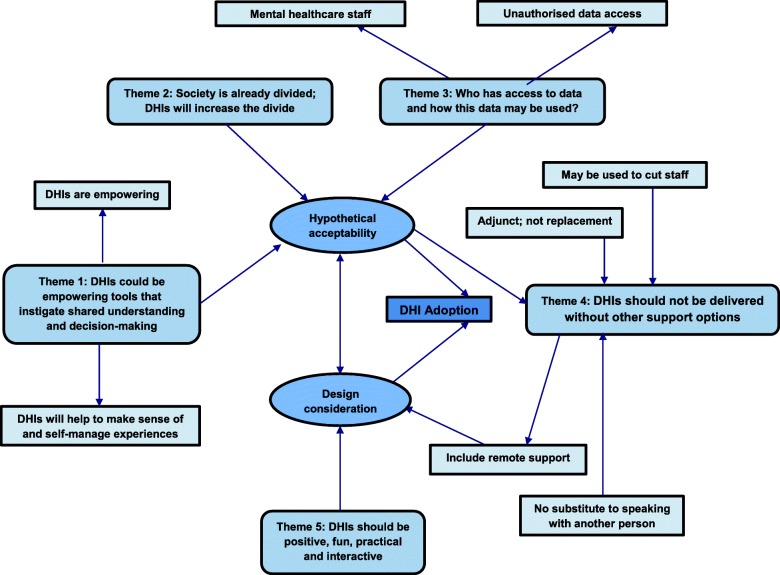
BACKGROUND: The development of digital health interventions (DHIs) for severe mental health problems is fast-paced. Researchers are beginning to consult service users to inform DHIs; however, much of this involvement has been limited to feedback on specific interventions post-DHI development. This study had two aims: 1. explore service user views towards DHIs for severe mental health problems; and 2. make recommendations for specific content within DHIs based on service user needs and suggestions. METHODS: Qualitative interviews with eighteen people with severe mental health problems focussed on two domains: 1) views about DHIs for severe mental health problems; and 2) ideas for future DHI content and design features. Data were analysed thematically. RESULTS: Participants responses were captured in five key themes: 1) DHIs could be empowering tools that instigate reflection and change; 2) society is already divided; DHIs will further increase this divide; 3) considerations must be made about who has access to DHI data and how this data may be used; 4) DHIs should not be delivered without other support options; and 5) DHIs should provide a positive, fun, practical and interactive method for self-management. CONCLUSIONS: Participants found DHIs acceptable due to the empowering nature of self-management and ability to take ownership of their own healthcare needs. However, concerns included the potential for digital exclusion, privacy and confidentiality and fears about DHIs being used to replace other mental health services. Service users want tools to help them self-manage their mental health, but also provide positive and recovery-focussed content that can be used in conjunction with other support options.
Overview
The claims and statistics of this paper haven’t been checked yet.
Free: it reads the open-access text and checks the first 5 claims that cite a source we can check. Create a free account to check every claim.
Integrity signals
Registry
Cites
Statistics
Figures
Verification
Claims the paper makes
The claims and statistics of this paper haven’t been checked yet.
Free: it reads the open-access text and checks the first 5 claims that cite a source we can check. Create a free account to check every claim.
Claims other papers make about this one
Each is checked against this paper’s own text: does it say what the citing paper says it does?
The source backs part of the claim, not all of it — or backs it for a different population, condition or comparison.
In the citing paper
“However, even if people acknowledged a perceived need for help and were willing to seek help, engagement with a particular intervention was then affected by a person’s preconceived belief about whether a digital intervention would be effective [79,104,110-112].”
From Barriers to and facilitators of user engagement with digital mental health interventions: Systematic review (2021) · cites this paper as [104]
Experimental — accuracy not yet measuredThe source backs part of the claim, not all of it — or backs it for a different population, condition or comparison.
In the citing paper
“Depending on the type and severity of a person’s mental health symptoms, studies that involved health care providers supporting digital intervention use reported that there was sometimes a need for face-to-face contact, as issues could be difficult to address remotely via a digital platform [102-104].”
From Barriers to and facilitators of user engagement with digital mental health interventions: Systematic review (2021) · cites this paper as [104]
Experimental — accuracy not yet measuredThe source backs part of the claim, not all of it — or backs it for a different population, condition or comparison.
In the citing paper
“Participants’ mental health literacy [123], digital literacy [88,103,104,122,124-127], and digital health literacy [103,127] influenced the extent to which they were able to adapt and engage with DMHIs: for each type of literacy; higher literacy was associated with higher engagement.”
From Barriers to and facilitators of user engagement with digital mental health interventions: Systematic review (2021) · cites this paper as [104]
Experimental — accuracy not yet measuredThe source backs part of the claim, not all of it — or backs it for a different population, condition or comparison.
In the citing paper
“In 6 studies, a noted barrier among both users and service providers was a concern about social avoidance, that is, a concern that people might use self-guided interventions in lieu of coming into a clinic in person and engaging in therapy or group sessions [78,104,122,133,138,195].”
From Barriers to and facilitators of user engagement with digital mental health interventions: Systematic review (2021) · cites this paper as [104]
Experimental — accuracy not yet measuredThe source backs part of the claim, not all of it — or backs it for a different population, condition or comparison.
In the citing paper
“Two other studies found that participants engaged more with an intervention if they were just starting treatment [104,178].”
From Barriers to and facilitators of user engagement with digital mental health interventions: Systematic review (2021) · cites this paper as [104]
Experimental — accuracy not yet measured
9 more claims about this paper
Create a free account to see every claim other papers make about this one.
Self-check
Percentages, sums and reported differences re-computed from the paper’s own numbers.
The self-check needs the paper’s full text.
Citations
Cites
Using thematic analysis in psychology
Braun, V., & Clarke, V. (2006) · Qualitative Research in Psychology · doi:10.1191/1478088706qp063oa · Cited by 194,414 · cited 1×
“Interviews were audio-recorded, transcribed verbatim by the lead author and subject to thematic analysis, as described by Braun and Clarke (2006) [41].”
MethodChecklists for improving rigour in qualitative research: a case of the tail wagging the dog?
Barbour, R. S. (2001) · BMJ · doi:10.1136/bmj.322.7294.1115 · Cited by 2,613
Semi-Structured Interviewing and Qualitative Analysis
Smith, J. A. (1995) · Rethinking Methods in Psychology · doi:10.4135/9781446221792.n2 · Cited by 1,346 · cited 1×
“Interviews were administered using a topic guide (Appendix A) developed for the study based on review of the literature and informed by Smith’s (1995) guidelines [40] and questioning was focused on participant perceptions of self-guided interventions delivered via websites and smartphone apps.”
MethodSerious Games and Gamification for Mental Health: Current Status and Promising Directions
Fleming, T. M., Bavin, L., Stasiak, K., Hermansson-Webb, E., Merry, S. N., Cheek, C., Lucassen, M., Lau, H. M., Pollmuller, B., & Hetrick, S. (2017) · Frontiers in Psychiatry · doi:10.3389/fpsyt.2016.00215 · Cited by 582 · cited 1×
“For example, some participants suggested gamification strategies, which have previously shown some promise in improving engagement with DHIs [59, 60].”
BackgroundLloyd-Evans, B., Mayo-Wilson, E., Harrison, B., Istead, H., Brown, E., Pilling, S., Johnson, S., & Kendall, T. (2014) · BMC Psychiatry · doi:10.1186/1471-244x-14-39 · Cited by 558 · cited 1×
“Peer support can provide hope for recovery and empowerment [56] and is recommended by NICE [1, 2].”
BackgroundMember Checking With Older Women: A Framework for Negotiating Meaning
Doyle, S. (2007) · Health Care for Women International · doi:10.1080/07399330701615325 · Cited by 449 · cited 1×
“interpretation, analyses and drafts [62].”
Relapse prediction in schizophrenia through digital phenotyping: a pilot study
Barnett, I., Torous, J., Staples, P., Sandoval, L., Keshavan, M., & Onnela, J.-P. (2018) · Neuropsychopharmacology · doi:10.1038/s41386-018-0030-z · Cited by 422 · cited 1×
“Additionally, researchers are beginning to explore how relapse can be predicted via passively collected smartphone data (digital phenotyping) [61].”
BackgroundTechnological innovations in mental healthcare: harnessing the digital revolution
Hollis, C., Morriss, R., Martin, J., Amani, S., Cotton, R., Denis, M., & Lewis, S. (2015) · British Journal of Psychiatry · doi:10.1192/bjp.bp.113.142612 · Cited by 375 · cited 1×
“support options due to their widespread availability, reduced reliance of direct input from clinicians and potential to empower individuals with treatment choice and control [14].”
BackgroundFirth, J., Cotter, J., Torous, J., Bucci, S., Firth, J. A., & Yung, A. R. (2016) · Schizophrenia Bulletin · doi:10.1093/schbul/sbv132 · Cited by 351 · cited 1×
“A meta-analysis of mobile phone ownership rates in people experiencing psychosis reported a narrowing gap in ownership in comparison with the general population [46].”
BackgroundSelf-citationEmerging mHealth and eHealth interventions for serious mental illness: a review of the literature
Naslund, J. A., Marsch, L. A., McHugo, G. J., & Bartels, S. J. (2015) · Journal of Mental Health · doi:10.3109/09638237.2015.1019054 · Cited by 327
Smartphone Apps for Schizophrenia: A Systematic Review
Firth, J., & Torous, J. (2015) · JMIR mHealth and uHealth · doi:10.2196/mhealth.4930 · Cited by 268
Berry, N., Lobban, F., Emsley, R., & Bucci, S. (2016) · Journal of Medical Internet Research · doi:10.2196/jmir.5250 · Cited by 230 · cited 3×
“However, evidence regarding service user views towards DHIs and ideas for future developments is limited and survey-based designs have not gathered in-depth and detailed information that can be yielded qualitatively [36].”
BackgroundSelf-citation#WhyWeTweetMH: Understanding why people use twitter to discuss mental health problems
Berry, N., Lobban, F., Belousov, M., Emsley, R., Nenadic, G., & Bucci, S. (2017) · Journal of Medical Internet Research · doi:10.2196/jmir.6173 · Cited by 228 · cited 1×
“Additionally, some individuals already report discussing their mental health online to receive support from others with lived experience [57].”
BackgroundSelf-citationGame-based digital interventions for depression therapy: a systematic review and meta-analysis
Li, J., Theng, Y.-L., & Foo, S. (2014) · Cyberpsychology, Behavior, and Social Networking · doi:10.1089/cyber.2013.0481 · Cited by 219 · cited 1×
“For example, some participants suggested gamification strategies, which have previously shown some promise in improving engagement with DHIs [59, 60].”
BackgroundActissist: Proof-of-Concept Trial of a Theory-Driven Digital Intervention for Psychosis
Bucci, S., Barrowclough, C., Ainsworth, J., Machin, M., Morris, R., Berry, K., Emsley, R., Lewis, S., Edge, D., Buchan, I., et al. (2018) · Schizophrenia Bulletin · doi:10.1093/schbul/sby032 · Cited by 196 · cited 1×
“Additionally, preliminary evidence suggests small improvements in: quality of life and recovery [19]; community functioning [20]; negative symptoms, general psychotic symptoms and mood [21]; positive symptoms, excitement, general psychopathology and disorganisation [22]; and wellbeing [23] after the delivery of DHIs.”
BackgroundSelf-citationPalmier-Claus, J. E., Ainsworth, J., Machin, M., Barrowclough, C., Dunn, G., Barkus, E., Rogers, A., Wykes, T., Kapur, S., Buchan, I., et al. (2012) · BMC Psychiatry · doi:10.1186/1471-244x-12-172 · Cited by 189
Bell, I. H., Lim, M. H., Rossell, S. L., & Thomas, N. (2017) · Psychiatric Services · doi:10.1176/appi.ps.201600523 · Cited by 189
Smartphone data as objective measures of bipolar disorder symptoms
Faurholt-Jepsen, M., Frost, M., Vinberg, M., Christensen, E. M., Bardram, J. E., & Kessing, L. V. (2014) · Psychiatry Research · doi:10.1016/j.psychres.2014.03.009 · Cited by 185
Do We Still Have a Digital Divide in Mental Health? A Five-Year Survey Follow-up
Robotham, D., Satkunanathan, S., Doughty, L., & Wykes, T. (2016) · Journal of Medical Internet Research · doi:10.2196/jmir.6511 · Cited by 184 · cited 1×
“However, some people remain digitally excluded [47] and participant concerns in the context of the current political environment must Berry et al.”
BackgroundInce, P., Haddock, G., & Tai, S. (2016) · Psychology and Psychotherapy: Theory, Research and Practice · doi:10.1111/papt.12084 · Cited by 181 · cited 1×
“However, factors including the costs of face-to-face therapy, lack of trained staff, and time and caseload pressures mean that timely access to support is not always available [3, 4].”
BackgroundBen-Zeev, D., Brian, R. M., Jonathan, G., Razzano, L., Pashka, N., Carpenter-Song, E., Drake, R. E., & Scherer, E. A. (2018) · Psychiatric Services · doi:10.1176/appi.ps.201800063 · Cited by 173 · cited 1×
“Additionally, preliminary evidence suggests small improvements in: quality of life and recovery [19]; community functioning [20]; negative symptoms, general psychotic symptoms and mood [21]; positive symptoms, excitement, general psychopathology and disorganisation [22]; and wellbeing [23] after the delivery of DHIs.”
BackgroundDigital Technology Use Among Individuals with Schizophrenia: Results of an Online Survey
Gay, K., Torous, J., Joseph, A., Pandya, A., & Duckworth, K. (2016) · JMIR Mental Health · doi:10.2196/mental.5379 · Cited by 161
Bipolar disorder: assessment and management.
Parker, G. B. (2007) · PubMed · Cited by 160
Palmier-Claus, J. E., Rogers, A., Ainsworth, J., Machin, M., Barrowclough, C., Laverty, L., Barkus, E., Kapur, S., Wykes, T., & Lewis, S. W. (2013) · BMC Psychiatry · doi:10.1186/1471-244x-13-34 · Cited by 159
Nicholas, J., Fogarty, A. S., Boydell, K., & Christensen, H. (2017) · Journal of Medical Internet Research · doi:10.2196/jmir.7273 · Cited by 158 · cited 2×
“Participants suggested the inclusion of terms and conditions regarding data use that are clearly presented and easy to understand, which contrasts with some mental health-related apps currently available for download [52].”
BackgroundStovell, D., Morrison, A. P., Panayiotou, M., & Hutton, P. (2016) · British Journal of Psychiatry · doi:10.1192/bjp.bp.114.158931 · Cited by 148
Antipsychotics: is it time to introduce patient choice?
Morrison, A. P., Hutton, P., Shiers, D., & Turkington, D. (2012) · British Journal of Psychiatry · doi:10.1192/bjp.bp.112.112110 · Cited by 125
Berry, N., Bucci, S., & Lobban, F. (2017) · JMIR Mental Health · doi:10.2196/mental.8311 · Cited by 112 · cited 1×
“matic transfer of symptom information [48]; however, these findings suggest service users should have control over information transfer, which echoes views expressed by staff [49] and individuals with bipolar disorder [50] and first episode psychosis [51].”
BackgroundSelf-citationTrends and perspectives of shared decision-making in schizophrenia and related disorders
Beitinger, R., Kissling, W., & Hamann, J. (2014) · Current Opinion in Psychiatry · doi:10.1097/yco.0000000000000057 · Cited by 109 · cited 2×
“health care staff alike [6, 7, 10, 11] and can be beneficial for treatment-related empowerment [12] and personal recovery [13].”
BackgroundNiendam, T. A., Tully, L. M., Iosif, A., Kumar, D., Nye, K. E., Denton, J. C., Zakskorn, L. N., Fedechko, T. L., & Pierce, K. M. (2017) · Journal of Psychiatric Research · doi:10.1016/j.jpsychires.2017.10.017 · Cited by 109
Lal, S., Dell'Elce, J., Tucci, N., Fuhrer, R., Tamblyn, R., & Malla, A. (2015) · JMIR Mental Health · doi:10.2196/mental.4400 · Cited by 108
Farrelly, S., Lester, H., Rose, D., Birchwood, M., Marshall, M., Waheed, W., Henderson, R. C., Szmukler, G., & Thornicroft, G. (2016) · Health Expectations · doi:10.1111/hex.12368 · Cited by 105
Killikelly, C., He, Z., Reeder, C., & Wykes, T. (2017) · JMIR mHealth and uHealth · doi:10.2196/mhealth.7088 · Cited by 105 · cited 1×
“Whilst there are limited studies that have compared the provision of remote support to no support, recent systematic reviews reported higher DHI acceptability and engagement when remote coaching and support were offered [36, 58].”
BackgroundSchlosser, D., Campellone, T., Kim, D., Truong, B., Vergani, S., Ward, C., & Vinogradov, S. (2016) · JMIR Research Protocols · doi:10.2196/resprot.5450 · Cited by 103
A qualitative study of online mental health information seeking behaviour by those with psychosis
Aref-Adib, G., O’Hanlon, P., Fullarton, K., Morant, N., Sommerlad, A., Johnson, S., & Osborn, D. (2016) · BMC Psychiatry · doi:10.1186/s12888-016-0952-0 · Cited by 98
Hidalgo-Mazzei, D., Mateu, A., Reinares, M., Matic, A., Vieta, E., & Colom, F. (2015) · Journal of Affective Disorders · doi:10.1016/j.jad.2015.08.005 · Cited by 92
Hidalgo-Mazzei, D., Reinares, M., Mateu, A., Nikolova, V. L., Bonnín, C. D. M., Samalin, L., García-Estela, A., Pérez-Solá, V., Young, A. H., Strejilevich, S., et al. (2018) · Journal of Affective Disorders · doi:10.1016/j.jad.2018.08.048 · Cited by 92 · cited 1×
“Additionally, preliminary evidence suggests small improvements in: quality of life and recovery [19]; community functioning [20]; negative symptoms, general psychotic symptoms and mood [21]; positive symptoms, excitement, general psychopathology and disorganisation [22]; and wellbeing [23] after the delivery of DHIs.”
BackgroundEarly Psychosis Service User Views on Digital Technology: Qualitative Analysis
Bucci, S., Morris, R., Berry, K., Berry, N., Haddock, G., Barrowclough, C., Lewis, S., & Edge, D. (2018) · JMIR Mental Health · doi:10.2196/10091 · Cited by 78
Self-citationTodd, N. J., Jones, S. H., & Lobban, F. A. (2013) · Clinical Psychology & Psychotherapy · doi:10.1002/cpp.1804 · Cited by 73
Self-citationDepp, C. A., Perivoliotis, D., Holden, J., Dorr, J., & Granholm, E. L. (2019) · Schizophrenia Bulletin · doi:10.1093/schbul/sby135 · Cited by 71 · cited 2×
“However, further large-scale studies exploring the specific mechanisms that may elicit change are warranted [20].”
BackgroundCommunication and decision-making in mental health: A systematic review focusing on Bipolar disorder
Fisher, A. C., Manicavasagar, V. L., Kiln, F., & Juraskova, I. (2016) · Patient Education and Counseling · doi:10.1016/j.pec.2016.02.011 · Cited by 64 · cited 1×
“However, factors including the costs of face-to-face therapy, lack of trained staff, and time and caseload pressures mean that timely access to support is not always available [3, 4].”
BackgroundKrzystanek, M., Borkowski, M., Skałacka, K., & Krysta, K. (2019) · Schizophrenia Research · doi:10.1016/j.schres.2018.08.016 · Cited by 49 · cited 1×
“Additionally, preliminary evidence suggests small improvements in: quality of life and recovery [19]; community functioning [20]; negative symptoms, general psychotic symptoms and mood [21]; positive symptoms, excitement, general psychopathology and disorganisation [22]; and wellbeing [23] after the delivery of DHIs.”
BackgroundFisher, A. C., Manicavasagar, V. L., Sharpe, L., Laidsaar‐Powell, R., & Juraskova, I. (2017) · Journal of Mental Health · doi:10.1080/09638237.2016.1276533 · Cited by 47 · cited 1×
“health care staff alike [6, 7, 10, 11] and can be beneficial for treatment-related empowerment [12] and personal recovery [13].”
BackgroundLiebherz, S., Tlach, L., Härter, M. C., & Dirmaier, J. (2015) · Patient Preference and Adherence · doi:10.2147/ppa.s78495 · Cited by 46
Zisman‐Ilani, Y., Roe, D., Elwyn, G. J., Kupermintz, H., Patya, N., Peleg, I., & Karnieli‐Miller, O. (2018) · Health Communication · doi:10.1080/10410236.2018.1431018 · Cited by 46 · cited 1×
“health care staff alike [6, 7, 10, 11] and can be beneficial for treatment-related empowerment [12] and personal recovery [13].”
BackgroundBeyond symptom monitoring: Consumer needs for bipolar disorder self-management using smartphones
Nicholas, J., Boydell, K., & Christensen, H. (2017) · European Psychiatry · doi:10.1016/j.eurpsy.2017.05.023 · Cited by 41
Bonet, L., Llácer, B., Hernandez-Viadel, M., Arce, D., Blanquer, I., Cañete, C., Escartí, M., González-Pinto, A. M., & Sanjuán, J. (2018) · JMIR Mental Health · doi:10.2196/mental.9950 · Cited by 39 · cited 1×
“Furthermore, recent survey-based studies have reported that many people with severe mental health problems are amenable to receiving technology-delivered support [31–33] and already use technology to facilitate self-management and assessment through activities such as information-seeking, symptom monitoring, medicatio…”
BackgroundStovell, D., Wearden, A. J., Morrison, A. P., & Hutton, P. (2016) · Psychosis · doi:10.1080/17522439.2016.1145730 · Cited by 36 · cited 1×
“People with severe mental health problems often describe feeling disempowered in healthcare choices and uninvolved in the decision-making process [42, 43].”
BackgroundTorous, J., & Roux, S. (2017) · JMIR Mental Health · doi:10.2196/mental.7911 · Cited by 36 · cited 1×
“Furthermore, recent survey-based studies have reported that many people with severe mental health problems are amenable to receiving technology-delivered support [31–33] and already use technology to facilitate self-management and assessment through activities such as information-seeking, symptom monitoring, medicatio…”
BackgroundLobban, F., Dodd, A. L., Sawczuk, A. P., Asar, O., Dagnan, D., Diggle, P. J., Griffiths, M., Honary, M., Knowles, D., Long, R., et al. (2017) · Journal of Medical Internet Research · doi:10.2196/jmir.7008 · Cited by 34
Self-citationUsers’ Perspectives on mHealth Self-Management of Bipolar Disorder: Qualitative Focus Group Study
Switsers, L., Dauwe, A., Vanhoudt, A., Van Dyck, H., Lombaerts, K., & Oldenburg, J. (2018) · JMIR mHealth and uHealth · doi:10.2196/mhealth.9529 · Cited by 33 · cited 1×
“matic transfer of symptom information [48]; however, these findings suggest service users should have control over information transfer, which echoes views expressed by staff [49] and individuals with bipolar disorder [50] and first episode psychosis [51].”
BackgroundThe Bipolar Interactive Psychoeducation (BIPED) study: trial design and protocol
Simpson, S., Barnes, E., Griffiths, E., Hood, K., Cohen, D., Craddock, N., Jones, I., & Smith, D. J. (2009) · BMC Psychiatry · doi:10.1186/1471-244x-9-50 · Cited by 31
Pedley, R., McWilliams, C., Lovell, K., Brooks, H. L., Rushton, K., Drake, R., Rumbold, B., Bell, V., & Bee, P. (2018) · BJPsych Open · doi:10.1192/bjo.2017.5 · Cited by 31 · cited 1×
“Recent qualitative and survey-based studies with service users and health care staff have highlighted a number of factors that are barriers to the shared decision-making process, including perceptions regarding service user capability and capacity, aetiological beliefs, current risk to self and others, quality of rese…”
BackgroundVelligan, D. I., Roberts, D. L., Sierra, C., Fredrick, M. M., & Roach, M. J. (2016) · Issues in Mental Health Nursing · doi:10.3109/01612840.2015.1132289 · Cited by 25 · cited 1×
“People with severe mental health problems often describe feeling disempowered in healthcare choices and uninvolved in the decision-making process [42, 43].”
BackgroundBucci, S., Lewis, S., Ainsworth, J., Haddock, G., Machin, M., Berry, K., Berry, N., Edge, D., & Emsley, R. (2018) · World Psychiatry · doi:10.1002/wps.20535 · Cited by 24 · cited 1×
“To create DHIs that are meaningful, acceptable and likely to be adopted by service users, there is the need to qualitatively explore end-users perspectives about how digital tools can be best used to deliver timely mental healthcare [36, 39].”
BackgroundSelf-citationLaine, A., Anttila, M., & Valimaki, M. A. (2015) · Informatics for Health and Social Care · doi:10.3109/17538157.2015.1008487 · Cited by 11
Terp, M., Bjørnes, C. D., Jørgensen, R., Mainz, J., & Laursen, B. S. (2017) · Open Journal of Nursing · doi:10.4236/ojn.2017.77056 · Cited by 8
Cowdrey, F. A., Hogg, L. I., & Chapman, K. (2018) · Mental Health Review Journal · doi:10.1108/mhrj-09-2017-0038 · Cited by 3 · cited 1×
“health care staff alike [6, 7, 10, 11] and can be beneficial for treatment-related empowerment [12] and personal recovery [13].”
BackgroundSwitsers, L., Dauwe, A., Vanhoudt, A., et al. (2017) · doi:10.2196/preprints.9529 · Cited by 1
Research works printed but not linked: 1
- National Institute for Health and Care Excellence (NICE). Psychosis and schizophrenia in adults: prevention and management. 2014. https://www.nice.org.uk/guidance/cg178/chapter/1-Recommendations. Accessed 3 Oct 2017. 32207892
Cited by
Borghouts, J., Eikey, E., Mark, G., De Leon, C., Schueller, S. M., Schneider, M., Stadnick, N., Zheng, K., Mukamel, D., & Sorkin, D. H. (2021) · Journal of Medical Internet Research · doi:10.2196/24387 · Cited by 1,069
“For example, being able to connect to peers or have regular contact with a personal therapist through DMHIs facilitated engagement in 18 studies [14,32,33,104,114,122,125, 133,156,184-194].”
BackgroundInfluentialKaihlanen, A.-M., Virtanen, L., Buchert, U., Safarov, N., Valkonen, P., Hietapakka, L., Hörhammer, I., Kujala, S., Kouvonen, A., & Heponiemi, T. (2022) · BMC Health Services Research · doi:10.1186/s12913-022-07584-4 · Cited by 298
“Previous research has found similar kind of results showing that lack of interaction poses challenges to digitalization especially in mental health services, where patient-profes-sional dialogue and interaction play a key role [53–55].”
Tremain, H., McEnery, C., Fletcher, K., & Murray, G. (2020) · JMIR Mental Health · doi:10.2196/17204 · Cited by 193
“Indeed, personal preference may mean that self-guided interventions are ideal for some [15].”
BackgroundBarriers to older adults’ uptake of mobile-based mental health interventions
Pywell, J., Vijaykumar, S., Dodd, A., & Coventry, L. (2020) · DIGITAL HEALTH · doi:10.1177/2055207620905422 · Cited by 152
“Qualitative literature in this area has consistently found concerns with privacy and confidentiality of information to be a potential barrier digital intervention use for people with mental health problems.(53,57) Given that privacy concerns have been identified as a reason for discontinuation of an intervention(58) f…”
BackgroundGilbey, D., Morgan, H., Lin, A., & Perry, Y. (2020) · Journal of Medical Internet Research · doi:10.2196/20158 · Cited by 112
“Self-guided digital health interventions are also cost- and resource-effective to access and disseminate, requiring less direct input from clinicians [34], giving consumers greater control and empowerment regarding their own health needs [35].”
Background
Metadata
- Authors
- Berry, N., Lobban, F., & Bucci, S.
- Affiliations
- Manchester Academic Health Science Centre (GB)
- Lancaster University (GB)
- Greater Manchester Mental Health NHS Foundation Trust (GB)
- Corresponding author
- Berry, Natalie
- Venue
- BMC Psychiatry
- Published
- 2019-01-21
- Volume
- 19
- Issue
- 1
- Pages
- 35-35
- ISSN
- 1471-244X (ISSN-L)
- PMC
- PMC6341527
- OpenAlex
- W2912381274
- Cited by
- 170
- References
- 58
- Citations by year
- 2026: 10 · 2025: 28 · 2024: 38 · 2023: 28 · 2022: 26 · 2021: 21 · 2020: 13 · 2019: 6
- FWCI
- 18.64
- Type
- journal article
- Language
- en
- Open access
- gold
- doi.org
- Licence
- cc-by
- creativecommons.org/licenses/by/4.0/ (tdm)
- Locations
- BMC Psychiatry (publishedVersion, cc-by)
- Europe PMC (PubMed Central) (publishedVersion, other-oa)
- PubMed Central (publishedVersion, cc-by)
- PubMed (publishedVersion)
- Research Explorer (The University of Manchester) (publishedVersion, cc-by)
- DOAJ (DOAJ: Directory of Open Access Journals) (submittedVersion, cc-by-sa)
- Lancaster EPrints (Lancaster University) (submittedVersion)
- Funders
- Medical Research Council (MR/KD06665/1)
- Topics
- Social Sciences › Psychology › Applied Psychology › Digital Mental Health Interventions
- Health Sciences › Health Professions › General Health Professions › Mobile Health and mHealth Applications
- Health Sciences › Health Professions › General Health Professions › Mental Health and Patient Involvement
- Keywords
- digital health interventions, severe mental illness, self-management, service user perspectives, digital divide, data privacy and confidentiality, mental health integration
- MeSH terms
- Self-Management, Adult, Mental Disorders, Female, Humans, Male, Mental Health, Mental Health Services, Middle Aged, Referral and Consultation, Telemedicine, Qualitative Research
About these checks
Registry, retraction, Cites and statistics results are computed, not judged, with one exception: a printed reference that no index lists is read once by a model before it counts as a citation error. Claims are extracted by a model and kept only when their quote appears verbatim in the text; each cited source is then checked, with a model’s help, for whether it says what the claim relies on. Those verdicts can be wrong — read the claim’s quote and the cited source before relying on one.
Statistics and arithmetic are recomputed, not judged.
Confidence bands are shown only for fields calibrated on our annotated test set. None is calibrated yet, so no band is shown.
What counts as a claim ›How we measure confidence ›How we check this ›
Are you an author, or do you see a problem with this page? Request a review
Data sources
Bibliographic data: Semantic Scholar, OpenAlex, Crossref.
Contains information from the Semantic Scholar Academic Graph Datasets, made available under the ODC Attribution License (ODC-BY 1.0).
Semantic Scholar’s data is described in: Kinney, R., et al. (2023). The Semantic Scholar Open Data Platform. arXiv:2301.10140.
