

Effectiveness of interventions for people bereaved through suicide: a systematic review of controlled studies of grief, psychosocial and suicide-related outcomes
Open accessThe DOI matches its Crossref record; 71 of the 72 references it cites were found in a registry or an index; 23 of the 129 sources its claims cite were checked for support.
Abstract
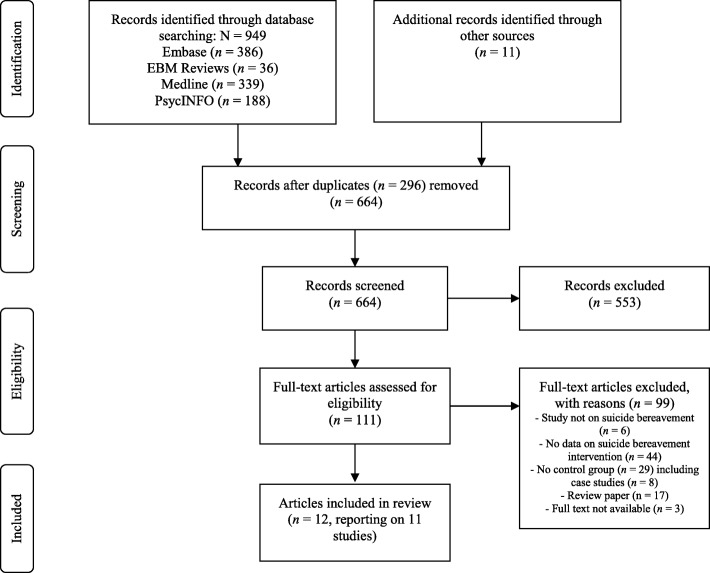
BACKGROUND: Suicide bereavement is a risk factor for adverse outcomes related to grief, social functioning, mental health and suicidal behaviour. Consequently, suicide bereavement support (i.e., postvention) has been identified as an important suicide prevention strategy. However, little is known about its effectiveness. To redress this gap, this review aimed to assess the evidence of effectiveness of interventions for people bereaved by suicide, and appraise the quality of the research in this field. METHODS: We conducted a systematic review according to PRISMA guidelines. Searches of peer-reviewed literature in Medline, PsycINFO, Embase and EBM Reviews identified 12 papers reporting on 11 relevant studies conducted between 1984 and 2018. RESULTS: Across studies, there was a wide variety of intervention modalities, study populations, control groups, and grief, psychosocial and suicide-related outcome measures. Overall, the quality of studies was weak. While there was some evidence of the effectiveness of interventions for uncomplicated grief, evidence of the effectiveness of complicated grief interventions was lacking. Based on this scant evidence, interventions which seem to show promise include supportive, therapeutic and educational approaches, involve the social environment of the bereaved, and comprise a series of sessions led by trained facilitators. CONCLUSIONS: There is a clear need for additional methodologically sound studies in this area. Specifically, selection procedures, sample sizes, randomization, and the use of appropriate measures are crucial. As people bereaved by suicide are at-risk of adverse grief, mental ill-health and suicidal behaviour, further research across the life-span is essential to prevent grief and mental health ramifications.
Overview
CoChat Summary
## TL;DR
This systematic review found only 12 papers reporting 11 controlled studies of interventions for people bereaved by suicide, with overall weak study quality. Evidence was scant and mixed: some interventions showed short-term benefits for uncomplicated grief and some psychosocial outcomes, but evidence for complicated grief interventions was lacking.
## Key findings
- The review included 12 papers reporting 11 studies conducted between 1984 and 2018; 8/11 studies were from the USA, and the rest were from the Netherlands, Australia, and Belgium.
- Overall methodological quality was weak: 9 studies were rated weak and 2 were rated moderate; weak components included selection bias, blinding, and withdrawals/dropouts.
- For grief outcomes, one 8-week support group program showed a greater decrease in grief feelings than passive control, and another writing-task intervention showed mixed findings with greater reduction in suicide-related grief aspects than control.
- For suicide-related outcomes, no study reported non-fatal or fatal suicidal behaviour; 3 studies assessed suicidal ideation, with 1 study finding a significant reduction and 2 finding no differences.
## Methods
- Systematic review conducted according to PRISMA; searches ran in August 2018 across Medline, PsycINFO, Embase, and EBM Reviews with no language or date limits.
- Included controlled intervention studies of people bereaved by suicide that reported empirical data on grief, mental health, and/or suicide-related outcomes and were published in peer-reviewed journals.
- Three researchers independently screened studies and extracted data; study quality was assessed using the Quality Assessment Tool for Quantitative Studies.
## Limitations
- The paper explicitly states that the review included only 12 papers / 11 studies, and that the overall study quality was weak; this limits confidence in the conclusions.
- The authors note that pre-1998 articles often lacked the information needed for quality assessment, and some newer studies also failed to report all quality criteria, so the true quality may have been higher than reported.
- Evident from the text: studies were highly heterogeneous in interventions, populations, control groups, outcomes, and measures, which makes it hard to compare results or draw firm conclusions.
Model-written summary. Check it against the paper before relying on it.
Integrity signals
Registry
Cites
Statistics
Figures
Verification
Claims the paper makes
18 Valid · 0 Not valid · 45 Not checked · 25 Own results and interpretations
Every source the paper cites for this claim was checked and supports it.
In the paper
“The three systematic reviews conducted to-date found some evidence of effectiveness of postvention interventions [24–26].”
§ Effectiveness of interventions for people bereaved through suicide: a systematic review of controlled studies of grief, psychosocial and suicide-related outcomes > Background
What the sources say
- Supportedcites [24] McDaid C Trowman R Golder S Hawton K Sowden A Interventions for people bereaved through suicide: systematic review: systematic review Br J Psychiatry 2008 193 438 443 19043143 source
The Method identifies this paper as a systematic review of interventions for people bereaved through suicide. The Conclusions state that it found some evidence of benefit, while cautioning that the evidence was not robust. This supports the finding attributed to this review; the citation does not independently establish the sentence’s count of three reviews. (LLM, conf=0.90)
- Supportedcites [25] Szumilas M Kutcher S Post-suicide intervention programs: a systematic review Can J Public Health 2011 102 18 29 21485962 PMC6973655 source
The Discussion reports promising results for gatekeeper training and two family-focused postvention strategies, supporting the claim that this systematic review found some evidence of effectiveness. It also cautions that no postvention program was shown to reduce suicide or suicide attempts; the claim does not assert that outcome. (LLM, conf=0.90)
- Supportedcites [26] Linde K Treml J Steinig J Nagl M Kersting A Grief interventions for people bereaved by suicide: a systematic review PLoS One 2017 12 e0179496 28644859 PMC5482439 source
The Abstract (Results) reports that five of seven interventions reduced grief intensity on at least one measure and concludes that there is some evidence of benefit. The Discussion (Conclusions) likewise describes preliminary positive effects, while cautioning that the studies have methodological limitations. This source supports the effectiveness finding attributed to it as one of the cited systematic reviews. (LLM, conf=0.92)
plainstates a possible cause- Asserted: passes — The authors put it forward as true.
- Checkable: passes — It can be checked against evidence.
- Load-bearing: passes — The paper’s conclusions depend on it.
- Based: passes — The paper gives a reason why it holds.
- Supported
The sources with a verdict support this claim; the rest weren’t checked yet, have no full text we could read, or their verdicts aren’t rated yet.
In the paper
“However, little is known about its effectiveness.”
- Also stated in: § Background · plain
“the effectiveness of postvention in terms of its impact on the grief process and mental health of bereaved individuals remains unclear [8].”
§ Effectiveness of interventions for people bereaved through suicide: a systematic review of controlled studies of grief, psychosocial and suicide-related outcomes > Abstract > Background
What the sources say
- Not checked — no full text of the sourcecites [8] Andriessen K Krysinska K Grad O Andriessen K Krysinska K Grad O Current understandings of suicide bereavement Postvention in action: the international handbook of suicide bereavement support. Göttingen 2017 Boston Hogrefe 3 16 source
- Supportedcites [24] McDaid C Trowman R Golder S Hawton K Sowden A Interventions for people bereaved through suicide: systematic review: systematic review Br J Psychiatry 2008 193 438 443 19043143 source
The review’s introductory passage says that little is known about the effects of providing support to people bereaved through suicide. The Conclusions likewise describe the evidence of benefit as not robust and call for further research. (LLM, conf=0.95)
- Supportedcites [26] Linde K Treml J Steinig J Nagl M Kersting A Grief interventions for people bereaved by suicide: a systematic review PLoS One 2017 12 e0179496 28644859 PMC5482439 source
The Introduction states directly that little is known about the effectiveness of grief interventions for people bereaved by suicide. The Abstract’s Limitation section reinforces this: methodological quality was low and the evidence for benefits was not robust. (LLM, conf=0.95)
plain- Asserted: passes — The authors put it forward as true.
- Checkable: passes — It can be checked against evidence.
- Load-bearing: passes — The paper’s conclusions depend on it.
- Based: passes — The paper gives a reason why it holds.
- Also stated in: § Background · plain
Every source the paper cites for this claim was checked and supports it.
In the paper
“Nonetheless, De Groot et al. [41] in a study of a family CBT grief counseling program did not report lower levels of complicated grief.”
§ Effectiveness of interventions for people bereaved through suicide: a systematic review of controlled studies of grief, psychosocial and suicide-related outcomes > Discussion
What the sources say
- Supportedcites [41] De Groot M de Keijser J Neeleman J Kerkhof A Nolen W Burger H Cognitive behaviour therapy to prevent complicated grief among relatives and spouses bereaved by suicide: cluster randomised controlled trial BMJ 2007 334 994 17449505 PMC1867884 source
The Abstract reports that the family-based cognitive behaviour grief counselling programme was not associated with a reduction in complicated grief. The Discussion likewise states that it had no beneficial effect on complicated grief reactions 13 months after the suicide. (LLM, conf=0.94)
plain- Asserted: passes — The authors put it forward as true.
- Checkable: passes — It can be checked against evidence.
- Load-bearing: unclear — It is unclear whether the paper’s conclusions depend on it.
- Based: passes — The paper gives a reason why it holds.
- Supported
Every source the paper cites for this claim was checked and supports it.
In the paper
“De Groot et al. [41] found no differences between family-based psychotherapy and treatment-as-usual on measures of suicidal ideation.”
§ Effectiveness of interventions for people bereaved through suicide: a systematic review of controlled studies of grief, psychosocial and suicide-related outcomes > Study findings > Suicide-related outcomes
What the sources say
- Supportedcites [41] De Groot M de Keijser J Neeleman J Kerkhof A Nolen W Burger H Cognitive behaviour therapy to prevent complicated grief among relatives and spouses bereaved by suicide: cluster randomised controlled trial BMJ 2007 334 994 17449505 PMC1867884 source
Table 3 (pp. 4–6) reports no statistically significant difference in suicidal ideation between the family-based counselling and usual-care groups (adjusted odds ratio 1.08, P=0.89). The Discussion likewise says the programme had no beneficial effect on suicidal ideation 13 months after the suicide. (LLM, conf=0.94)
plain- Asserted: passes — The authors put it forward as true.
- Checkable: passes — It can be checked against evidence.
- Load-bearing: unclear — It is unclear whether the paper’s conclusions depend on it.
- Based: passes — The paper gives a reason why it holds.
- Supported
The sources with a verdict support this claim; the rest weren’t checked yet, have no full text we could read, or their verdicts aren’t rated yet.
In the paper
“Other RCTs [40, 41] also failed to find positive effects on complicated grief outcomes.”
§ Effectiveness of interventions for people bereaved through suicide: a systematic review of controlled studies of grief, psychosocial and suicide-related outcomes > Discussion > Factors affecting effectiveness of interventions
What the sources say
- Not checked — no full text of the sourcecites [40] Zisook S Shear MK Reynolds CF Simon NM Mauro C Skritskaya NA Lebowitz B Wang Y Tal I Glorioso D Wetherell JL Iglewicz A Robinaugh D Qiu X Treatment of complicated grief in survivors of suicide loss: a HEAL report J Clin Psychiatry 2018 79 17m11592 29617064 source
- Supportedcites [41] De Groot M de Keijser J Neeleman J Kerkhof A Nolen W Burger H Cognitive behaviour therapy to prevent complicated grief among relatives and spouses bereaved by suicide: cluster randomised controlled trial BMJ 2007 334 994 17449505 PMC1867884 source
The Discussion (p. 4) states that the counselling programme had no beneficial effect on complicated grief reactions 13 months after the suicide. Table 3 (p. 4) likewise reports no significant effect on the complicated grief measure. The paper notes a trend toward fewer maladaptive grief reactions, but that does not change the finding for complicated grief. (LLM, conf=0.93)
plain- Asserted: passes — The authors put it forward as true.
- Checkable: passes — It can be checked against evidence.
- Load-bearing: unclear — It is unclear whether the paper’s conclusions depend on it.
- Based: passes — The paper gives a reason why it holds.
38 more claims · 1 with their cited sources checked
Create a free account to see all 88 claims and to verify the 4 references still open.
- It may state two separate claims as one. 29
- Probably not a substantial claim. 19
- The quote only partly states this claim. 1
Claims other papers make about this one
Each is checked against this paper’s own text: does it say what the citing paper says it does?
The source backs part of the claim, not all of it — or backs it for a different population, condition or comparison.
In the citing paper
“Overall, grief specific interventions seem to yield stronger effect than interventions targeting other outcomes (Andriessen et al., 2019).”
From Suicide Postvention Service Models and Guidelines 2014–2019: A Systematic Review (2019) · cites this paper as Andriessen et al., 2019
Experimental — accuracy not yet measuredThe cited source says what the claim attributes to it.
In the citing paper
“Our recent systematic review of grief and psychosocial interventions for people bereaved through suicide, which included only controlled studies, found mixed evidence of effectiveness of interventions (Andriessen et al., 2019).”
From Suicide Postvention Service Models and Guidelines 2014–2019: A Systematic Review (2019) · cites this paper as Andriessen et al., 2019
The cited source says what the claim attributes to it.
In the citing paper
“A recent systematic review of effectiveness of controlled studies of interventions for people bereaved by suicide identified 11 studies published between 1984 and 2018 (Andriessen et al., 2019).”
From Suicide Postvention Service Models and Guidelines 2014–2019: A Systematic Review (2019) · cites this paper as Andriessen et al., 2019
Citations
Cites
Preferred Reporting Items for Systematic Reviews and Meta-Analyses: the PRISMA statement
Moher, D., Liberati, A., Tetzlaff, J., Altman, D. G., & for the PRISMA Group (2009) · BMJ · doi:10.1136/bmj.b2535 · Cited by 83,823
The CES-D Scale: A Self-Report Depression Scale for Research in the General Population
Radloff, L. S. (1977) · Applied Psychological Measurement · doi:10.1177/014662167700100306 · Cited by 53,267
Preferred reporting items for systematic reviews and meta-analyses: the PRISMA Statement.
(2009) · PubMed Central · Cited by 44,859
Preferred reporting items for systematic reviews and meta-analyses: The PRISMA statement
Moher, D., Liberati, A., Tetzlaff, J., Altman, D. G., & the PRISMA Group* (2009) · Annals of Internal Medicine · doi:10.7326/0003-4819-151-4-200908180-00135 · Cited by 37,554
Impact of Event Scale: A Measure of Subjective Stress
Horowitz, M., Wilner, N., & Alvarez, W. (1979) · Psychosomatic Medicine · doi:10.1097/00006842-197905000-00004 · Cited by 7,813
Beck, A. T., Steer, R. A., & Brown, G. (2011) · PsycTESTS Dataset · doi:10.1037/t00742-000 · Cited by 7,535
The measurement of pessimism: the hopelessness scale
Beck, A. T., Weissman, A., Lester, D., & Trexler, L. (1974) · Journal of Consulting and Clinical Psychology · doi:10.1037/h0037562 · Cited by 5,494
Posner, K., Brown, G. K., Stanley, B., Brent, D. A., Yershova, K. V., Oquendo, M. A., Currier, G. W., Melvin, G. A., Greenhill, L., Shen, S., et al. (2011) · American Journal of Psychiatry · doi:10.1176/appi.ajp.2011.10111704 · Cited by 5,157
The Self-Efficacy Scale: Construction and Validation
Sherer, M., Maddux, J. E., Mercandante, B., Prentice-Dunn, S., Jacobs, B., & Rogers, R. W. (1982) · Psychological Reports · doi:10.2466/pr0.1982.51.2.663 · Cited by 4,028
(1991) · Cited by 3,844
Research works printed but not linked: 10
- World Health Organization Preventing suicide: a global imperative 2014 Geneva World Health Organization
- Effective Public Health Practice Project Quality Assessment Tool For Quantitative Studies 1998 Hamilton Effective Public Health Practice Project
- Sanders CM Mauger PA Strong PE A manual for the Grief Experience Inventory 1985 Palo Alto Consulting Psychological Press
- Derogatis LR The brief symptom inventory (BSI): administration, scoring & procedures manual-II 1992 Baltimore Clinical Psychometric Research
- Walker LO Sandor MK Sands D Competence building in adolescence: self-help workbooks as a primary prevention vehicle. (final report). Nursing research emphasis (NRE) Grant (#I R21 NR013 16–01) 1990 Washington DC National Center for Nursing Research, National Institutes for Health
- Kovacs M Children’s Depression Inventory Manual 1992 North Tonawanda Multi-Health Systems Inc
- Martin G Kuller NS Hazell P The effects on adolescents of completed suicide of another student Youth Studies Australia 1992 11 21 23
- Giel R Nienhuis FJ Schedules for clinical assessment in neuropsychiatry (Dutch version) 1996 Geneva/Groningen World Health Organization
- Harter S Manual for the self-perception profile for adolescents 1988 Denver University of Denver
- Schreurs PJG van de Willige G Brosschot JF Tellegen B Graus GMH The Utrecht coping list: UCL. [De Utrechtse coping Lijst: UCL] 1993 Lisse Swets & Zeitlinger
Cited by
Knipe, D., Padmanathan, P., Newton-Howes, G., Chan, L. F., & Kapur, N. (2022) · The Lancet · doi:10.1016/s0140-6736(22)00173-8 · Cited by 331
Hill, N. T. M., Robinson, J., Pirkis, J., Andriessen, K., Krysinska, K. E., Payne, A., Boland, A. K., Clarke, A., Milner, A. J., Witt, K., et al. (2020) · PLoS Medicine · doi:10.1371/journal.pmed.1003074 · Cited by 169
“A recent review by Andriessen and colleagues [74], for example, found 3 controlled studies [76–78] that investigated the effectiveness of an intervention on suicidal ideation and found no studies that included outcomes related to suicide or suicide attempt.”
Self-citationWeb-Based Bereavement Care: A Systematic Review and Meta-Analysis
Wagner, B., Rosenberg, N., Hofmann, L., & Maass, U. (2020) · Frontiers in Psychiatry · doi:10.3389/fpsyt.2020.00525 · Cited by 117
Suicide Postvention Service Models and Guidelines 2014–2019: A Systematic Review
Andriessen, K., Krysinska, K., Kõlves, K., & Reavley, N. (2019) · Frontiers in Psychology · doi:10.3389/fpsyg.2019.02677 · Cited by 129
Self-citationScott, H. R., Pitman, A., Kozhuharova, P., & Lloyd‐Evans, B. (2020) · BMC Psychiatry · doi:10.1186/s12888-020-02639-4 · Cited by 159
Lived experience peer support programs for suicide prevention: a systematic scoping review
Schlichthorst, M., Ozols, I., Reifels, L., & Morgan, A. (2020) · International Journal of Mental Health Systems · doi:10.1186/s13033-020-00396-1 · Cited by 113
Self-citationZuelke, A. E., Luppa, M., Löbner, M., Pabst, A., Schlapke, C., Stein, J., & Riedel-Heller, S. G. (2021) · JMIR Mental Health · doi:10.2196/29661 · Cited by 75
“Previous reviews and meta-analyses have reported beneficial treatment effects of face-to-face interventions, for example, grief counseling or cognitive behavioral therapy (CBT) against complicated grief [19,21,22].”
BackgroundLessons Learned: Forty Years of Clinical Work With Suicide Loss Survivors
Jordan, J. R. (2020) · Frontiers in Psychology · doi:10.3389/fpsyg.2020.00766 · Cited by 74
“Nor is it to proselytize for the one true and correct way to work with survivors (indeed, the empirical evidence base for working with all traumatic losses such as suicide is, in my opinion, woefully under-researched (Jordan and McMenamy, 2004; McDaid et al., 2008; Andriessen et al., 2019).”
BackgroundPreventing Clinician Suicide: A Call to Action During the COVID-19 Pandemic and Beyond
Moutier, C. Y., Myers, M. F., Feist, J. B., Feist, J. C., & Zisook, S. (2021) · Academic Medicine · doi:10.1097/acm.0000000000003972 · Cited by 68
Treml, J., Nagl, M., Linde, K., Kündiger, C., Peterhänsel, C., & Kersting, A. (2021) · European Journal of Psychotraumatology · doi:10.1080/20008198.2021.1926650 · Cited by 72
“Both reviews conclude that there is only scarce evidence of effective grief interventions for people bereaved by suicide and that future research should adapt and evaluate effective PGD interventions for people bereaved by suicide in need of support (Andriessen et al., 2019; Linde et al., 2017).”
Backgroundde Lyra, R. L., McKenzie, S., Every‐Palmer, S., & Jenkin, G. L. S. (2021) · PLoS ONE · doi:10.1371/journal.pone.0251038 · Cited by 77
“For every suicide, it has been estimated that between six and 20 people, usually family members and acquaintances of those who died, are adversely affected psychologically and emotionally [1, 2].”
BackgroundWagner, B., Hofmann, L., & Grafiadeli, R. (2021) · Journal of Clinical Psychology · doi:10.1002/jclp.23192 · Cited by 52
Kõlves, K., Zhao, Q., Ross, V., Hawgood, J., Spence, S. H., & de Leo, D. (2020) · Australian & New Zealand Journal of Psychiatry · doi:10.1177/0004867419882490 · Cited by 50
“Nevertheless, another review highlighted weakness of the current intervention studies and continued lack of evidence (Andriessen et al., 2019).”
BackgroundAddressing key risk factors for suicide at a societal level
Pirkis, J., Bantjes, J. R., Dandona, R., Knipe, D. W., Pitman, A., Robinson, J., Silverman, M. M., & Hawton, K. E. (2024) · The Lancet Public Health · doi:10.1016/s2468-2667(24)00158-0 · Cited by 79
Self-citationPreventing suicide, promoting resilience: Is this achievable from a global perspective?
Ivbijaro, G., Kolkiewicz, L., Goldberg, D. P., Riba, M., N'jie, I., Geller, J. L., Kallivayalil, R. A., Javed, A., Švab, I., Summergrad, P., et al. (2019) · Asia-Pacific Psychiatry · doi:10.1111/appy.12371 · Cited by 56
“…from another's suicide, substance misuse disorder, family difficulties, relationship difficulties, and other psychopathologies in order to decrease suicide rates in this age group (Berk, Starace, Black, & Avna, 2019; López‐Goñi, Fernández‐Montalvo, Areaga, & Haro, 2019, Andriessen et al., 2019).”
BackgroundKustanti, C. Y., Fang, H., Kang, X. L., Chiou, J., Wu, S., Yunitri, N., Chu, H., & Chou, K. (2021) · Journal of Nursing Scholarship · doi:10.1111/jnu.12630 · Cited by 52
Nelson, P. A., Cordingley, L., Kapur, N., Chew-Graham, C. A., Shaw, J., Smith, S., McGale, B., & McDonnell, S. (2020) · Frontiers in Psychology · doi:10.3389/fpsyg.2020.00722 · Cited by 38
Scoping Review of Peer-Led Support for People Bereaved by Suicide
Higgins, A., Hybholt, L., Meuser, O. A., Eustace Cook, J., Downes, C., & Morrissey, J. (2022) · International Journal of Environmental Research and Public Health · doi:10.3390/ijerph19063485 · Cited by 36
“In two of the reviews, only controlled studies were included [5,20] while Linde et al.”
BackgroundAndriessen, K., Krysinska, K. E., Rickwood, D., & Pirkis, J. (2020) · International Journal of Environmental Research and Public Health · doi:10.3390/ijerph17249356 · Cited by 55
Self-citationSuicide bereavement in the UK : Descriptive findings from a national survey
Mcdonnell, S., Flynn, S., Shaw, J. J., Smith, S., McGale, B., & Hunt, I. M. (2022) · Suicide and Life-Threatening Behavior · doi:10.1111/sltb.12874 · Cited by 49
Kaspersen, S. L., Kalseth, J., Stene‐Larsen, K., & Reneflot, A. (2022) · International Journal of Environmental Research and Public Health · doi:10.3390/ijerph191610016 · Cited by 39
“Andriessen et al. (2019) reviewed the evidence for the effectiveness of several interventions for people bereaved by suicide [26], while Lestienne et al. (2021) completed a systematic review of online resources and interventions for people bereaved by suicide [27].”
BackgroundInfluentialHospital-Based Interventions to Address Provider Grief: A Narrative Review
Yazdan, R., Corey, K., Messer, S. J., Kim, E. H., Roberts, K. E., Selwyn, P. A., & Weinberger, A. H. (2023) · Journal of Pain and Symptom Management · doi:10.1016/j.jpainsymman.2023.03.001 · Cited by 36
del Carpio, L., Paul, S., Paterson, A., & Rasmussen, S. A. (2021) · PLoS ONE · doi:10.1371/journal.pone.0254203 · Cited by 47
“postvention), as evidence for its effectiveness is still being established [23,24].”
BackgroundPitman, A., McDonald, K. C., Logeswaran, Y., Lewis, G., Cerel, J., & Erlangsen, A. (2022) · Acta Psychiatrica Scandinavica · doi:10.1111/acps.13493 · Cited by 35
“Evidence to support the effectiveness of postvention in reducing suicide-related outcomes is lacking, even if it does support effectiveness in reducing outcomes such as depression and anxiety.(41) These are all candidate mediators of increased suicide risk in suicide-bereaved relatives, alongside shared social adversi…”
ResultLigier, F., Rassy, J., Fortin, G., van Haaster, I., Doyon, C., Brouillard, C., Séguin, M., & Lesage, A. (2020) · BMC Public Health · doi:10.1186/s12889-020-09636-y · Cited by 25
Burrell, L. V., Mehlum, L. I., & Qin, P. (2021) · Child and Adolescent Mental Health · doi:10.1111/camh.12470 · Cited by 31
Grafiadeli, R., Glaesmer, H., Hofmann, L., Schäfer, T., & Wagner, B. (2021) · Journal of Psychiatric Research · doi:10.1016/j.jpsychires.2021.09.056 · Cited by 33
McGill, K., Bhullar, N., Batterham, P. J., Carrandi, A., Wayland, S., & Maple, M. J. (2022) · Death Studies · doi:10.1080/07481187.2022.2112318 · Cited by 22
Evaluating Postvention Services and the Acceptability of Models of Postvention: A Systematic Review
Abbate, L., Chopra, J., Poole, H. M., & Saini, P. (2022) · OMEGA - Journal of Death and Dying · doi:10.1177/00302228221112723 · Cited by 30
“Andriessen et al. (2019) de fi ned suicide postvention service model as a “ coordinated approach to providing support to people impacted by the death of a family member, friend or person in a network (such as a school, nursing home, workplace, etc.) through suicide.”
BackgroundInfluentialCauser, H., Bradley, E., Muse, K., & Smith, J. (2021) · PLoS ONE · doi:10.1371/journal.pone.0251369 · Cited by 23
“However, there is inconsistent evidence for the effectiveness of postvention support and positive indicators require further methodologically robust research [33,39,40].”
BackgroundHow best to provide help to bereaved adolescents: a Delphi consensus study
Ross, A., Krysinska, K. E., Rickwood, D., Pirkis, J., & Andriessen, K. (2021) · BMC Psychiatry · doi:10.1186/s12888-021-03591-7 · Cited by 26
“While the use of the recommendations does not guarantee effectiveness of the help, the recommendations may inspire development of designated adolescent grief interventions and contribute to much-needed evaluation research of such interventions [25].”
BackgroundSelf-citationWagner, B., Hofmann, L., & Maaß, U. (2020) · Trials · doi:10.1186/s13063-019-3891-5 · Cited by 27
Spirituality and Religiosity during Suicide Bereavement: A Qualitative Systematic Review
Čepulienė, A. A., Pučinskaitė, B., Spangelytė, K., Skruibis, P., & Gailienė, D. (2021) · Religions · doi:10.3390/rel12090766 · Cited by 29
“Bereavement is a difficult, painful but normal part of almost every human life (Andriessen et al. 2019).”
BackgroundA Narrative Evaluation of a Grief Support Camp for Families Affected by a Parent's Suicide
Hagström, A. S. (2021) · Frontiers in Psychiatry · doi:10.3389/fpsyt.2021.783066 · Cited by 26
“Instead, specialized programs led by trained facilitators that take aspects such as the social environment into account yield more promising results (22, 23).”
Efficacy of an online-group intervention after suicide bereavement: A randomized controlled trial
Wagner, B., Grafiadeli, R., Schäfer, T., & Hofmann, L. (2022) · Internet Interventions · doi:10.1016/j.invent.2022.100542 · Cited by 28
Andriessen, K., Krysinska, K. E., Rickwood, D., & Pirkis, J. (2021) · Death Studies · doi:10.1080/07481187.2021.1970049 · Cited by 26
Self-citationThe Role of Spirituality during Suicide Bereavement: A Qualitative Study
Čepulienė, A. A., & Skruibis, P. (2022) · International Journal of Environmental Research and Public Health · doi:10.3390/ijerph19148740 · Cited by 26
“Such loss is a painful experience that can negatively influence different aspects of life, such as psychological [3] and physical health [4] and relationships [5].”
BackgroundMehta, L. S., Churchwell, K., Coleman, D. M., Davidson, J. E., Furie, K. L., Ijioma, N., Katz, J. N., Moutier, C. Y., Rove, J. Y., Summers, R. L., et al. (2024) · Circulation · doi:10.1161/cir.0000000000001259 · Cited by 21
“95 70 A thoughtful postven-tion plan is usually conducted by a crisis response team over 2 to 4 weeks and should include disclosure that the death was by suicide (when permissible), avoidance of a description of the specific method, and promotion of connectedness, support, and treatment.”
BackgroundGriffin, E., O’Connell, S., Ruane‐McAteer, E., Corcoran, P. E., & Arensman, E. (2022) · International Journal of Environmental Research and Public Health · doi:10.3390/ijerph19074076 · Cited by 28
Grafiadeli, R., Glaesmer, H., & Wagner, B. (2022) · International Journal of Environmental Research and Public Health · doi:10.3390/ijerph191610277 · Cited by 28
“The increasing attention on the vulnerability of this population to forming maladaptive emotional reactions has led to the development of several psychological interventions over the past decade [1].”
BackgroundCreation and validation of a high-fidelity simulation scenario for suicide postvention
Pedrollo, L. F. S., Silva, A. C., Zanetti, A. C. G., & Vedana, K. G. G. (2022) · Revista Latino-Americana de Enfermagem · doi:10.1590/1518-8345.6034.3699 · Cited by 21
Suicide prevention: reflections on progress over the past decade
Hawton, K. E., & Pirkis, J. (2024) · The Lancet Psychiatry · doi:10.1016/s2215-0366(24)00105-6 · Cited by 22
Self-citationHybholt, L., Higgins, A., Buus, N., Berring, L. L., Connolly, T., Erlangsen, A., & Morrissey, J. (2022) · International Journal of Environmental Research and Public Health · doi:10.3390/ijerph19169898 · Cited by 21
“Qualitative research can contribute towards important findings regarding participants’ experiences of postvention, for instance, what is perceived as helpful or not [24].”
BackgroundKrysinska, K. E., Currier, D., & Andriessen, K. (2023) · Archives of Suicide Research · doi:10.1080/13811118.2023.2185559 · Cited by 17
“The study did not apply recruitment quota by gender, and it is not unusual that samples in studies on suicide bereavement support consist predominantly of female participants (Andriessen, Krysinska, et al., 2019).”
BackgroundSelf-citationSuicide postvention for staff and students on university campuses: a scoping review
Allie, S.-L. N., Bantjes, J. R., & Andriessen, K. (2023) · BMJ Open · doi:10.1136/bmjopen-2022-068730 · Cited by 16
Self-citationPitman, A., Logeswaran, Y., McDonald, K. C., Cerel, J., Lewis, G., & Erlangsen, A. (2023) · Epidemiology and Psychiatric Sciences · doi:10.1017/s2045796023000653 · Cited by 16
“However, such mechanisms are under-investigated, perhaps explaining why existing postvention interventions lack evidence for reducing suicidality even while they are effective at reducing depression and anxiety (Andriessen et al., 2019; Linde et al., 2017; McDaid et al., 2008; Szumilas et al., 2011).”
BackgroundHill, N. T. M., Walker, R., Andriessen, K., Bouras, H., Tan, S. R., Amaratia, P., Woolard, A. J., Strauss, P., Perry, Y., & Lin, A. P. (2022) · Frontiers in Public Health · doi:10.3389/fpubh.2022.1040323 · Cited by 20
Self-citationPeer-support groups for suicide loss survivors: a systematic review
Inostroza, C., Rubio-Ramírez, F., Bustos, C., Quijada, Y., Fernández, D., Vasily Buhring, S., Vargas, B., Riquelme-Bórquez, A., & Araya, M. P. (2023) · Social Work With Groups · doi:10.1080/01609513.2023.2249053 · Cited by 15
“…for postvention, within which peer-support groups for suicide loss survivors are identified as one more strategy, thereby limiting their analysis (Andriessen et al., 2019; Finlayson-Short et al., 2019; Journot-Reverbel et al., 2017; Linde et al., 2017; McDaid et al., 2008; Szumilas & Kutcher,…”
BackgroundFeigelman, W. T., Bottomley, J. S., & Titlestad, K. B. (2022) · Death Studies · doi:10.1080/07481187.2022.2081267 · Cited by 14
“The degree of shock or surprise in the death, has been reported in the bereavement literature as having deleterious effects on the survivors’ well-being and adjustment course (Andriessen et al., 2019; Reed, 1998; Sveen & Walby, 2008).”
BackgroundKalsås, Ø. R., Dyregrov, K., Fadnes, L. T., & Titlestad, K. B. (2022) · Death Studies · doi:10.1080/07481187.2022.2142329 · Cited by 17
“Since few studies have investigated early helping interventions to improve social health for bereaved people (Andriessen et al., 2019; Wittouck et al., 2011), we argue for both quantitative and qualitative studies on this topic.”
BackgroundMcdonnell, S., Nelson, P. A., Leonard, S., McGale, B., Chew-Graham, C. A., Kapur, N., Shaw, J. J., Smith, S., & Cordingley, L. (2020) · Crisis · doi:10.1027/0227-5910/a000646 · Cited by 21
“Postvention support is considered to be a key aspect of suicide prevention internationally (Andriessen et al., 2019; World Health Organization, 2018) since support/ training are protective factors (Castelli Dransart, Treven, Grad, & Andriessen, 2017).”
BackgroundAdshead, C., & Runacres, J. (2022) · OMEGA - Journal of Death and Dying · doi:10.1177/00302228211070152 · Cited by 17
“The aftermath of suicide bereavement is widely under researched with less than 5% of academic literature surrounding suicide relating to postvention (Andriessen, 2014; Andriessen et al., 2019; Dyregrov, 2011; Levi-Belz, 2019).”
BackgroundResultO’Connell, S., Troya, M. I., Arensman, E., & Griffin, E. (2023) · Death Studies · doi:10.1080/07481187.2023.2201922 · Cited by 17
Aluri, J., Haddad, J. M., Parke, S., Schwartz, V., Joshi, S. V., Menon, M., & Conrad, R. C. (2023) · Current Psychiatry Reports · doi:10.1007/s11920-023-01431-x · Cited by 16
Suicide exposure experience screener for use in therapeutic settings: A validation report
Maple, M. J., Cerel, J., Sanford, R., Shand, F., Batterham, P. J., & Bhullar, N. (2022) · Suicide and Life-Threatening Behavior · doi:10.1111/sltb.12894 · Cited by 11
Unveiling studies on self-healing practices for suicide loss survivors: A scoping review
Putri, A. K., Armstrong, G., Setiyawati, D., & Andriessen, K. (2024) · Death Studies · doi:10.1080/07481187.2024.2304773 · Cited by 18
“Existing studies exploring postvention effectiveness and service delivery in this population are scarce (Andriessen et al., 2019).”
InfluentialSelf-citationSuicide Postvention in Schools: What Evidence Supports Our Current National Recommendations?
Williams, D. Y., Wexler, L. M., & Mueller, A. S. (2022) · PubMed · Cited by 31
State of the Science: Psychotherapeutic Interventions for Prolonged Grief Disorder
LaPlante, C. D., Hardt, M. M., Maciejewski, P. K., & Prigerson, H. G. (2024) · Behavior Therapy · doi:10.1016/j.beth.2024.07.002 · Cited by 15
Hofmann, L., Putri, A. K., Pitman, A., Bantjes, J. R., Dransart, D. A. C., Causer, H., Cerel, J., Chow, A. Y. M., Leo, D. D., Feigelman, W. T., et al. (2024) · Crisis · doi:10.1027/0227-5910/a000978 · Cited by 20
Self-citationGalway, K., Forbes, T. L., Mallon, S. D., Santin, O., Best, P., Neff, J., Leavey, G., & Pitman, A. (2019) · International Journal of Environmental Research and Public Health · doi:10.3390/ijerph16224561 · Cited by 14
“Currently, the existing evidence suggests that a mixture of therapeutic, social, and educational interventions may be required [2].”
BackgroundQuayle, K., Jones, P., Simplicio, M. C. D., Kamboj, S. K., & Pitman, A. (2023) · PLoS ONE · doi:10.1371/journal.pone.0284897 · Cited by 17
Leaune, É., Lestienne, L., Grandgenèvre, P., Morgiève, M., Vaïva, G., Vieux, M., Chalancon, B., Laplace, N., Haesebaert, J., & Poulet, E. (2021) · Frontiers in Psychiatry · doi:10.3389/fpsyt.2021.770154 · Cited by 10
Cutrer‐Párraga, E. A., Cotton, C., Heath, M. A., Miller, E. E., Young, T. A., & Wilson, S. (2022) · Journal of Child and Family Studies · doi:10.1007/s10826-022-02308-y · Cited by 14
“Prevention efforts must prioritize the development of evidence-based postvention interventions for CSoPS (Andriessen, 2014, Andriessen et al., 2019a, 2019b; Andriessen et al., 2020; Hua et al., 2020; Hung & Rabin, 2009).”
BackgroundResultHow an academic’s death by suicide impacts coworkers and an organization
Sever, M., & Özdemir, S. (2019) · Death Studies · doi:10.1080/07481187.2019.1700572 · Cited by 10
“Although robust postvention practices for people bereaved by suicide have yet to be developed (Andriessen et al., 2019), it is clear that administrators should make psychosocial services for grieving employees available, regardless of the cause of death (Jordan, 2017).”
BackgroundItua, I., Shah, K., Galway, P., Chaudhry, F., Georgiadi, T., Rastogi, J., Naleer, S., & Knipe, D. W. (2024) · Archives of Suicide Research · doi:10.1080/13811118.2024.2322144 · Cited by 10
Effectiveness of suicide postvention service models and guidelines 2014–2024: A scoping review
Ramamurthy, C., Fraser, T., Krysinska, K. E., Hawgood, J. L., Kõlves, K., Reifels, L., Reavley, N. J., & Andriessen, K. (2025) · Preventive Medicine · doi:10.1016/j.ypmed.2025.108279 · Cited by 14
Self-citationGrief, bereavement and prolonged grief disorder: scoping and mapping the evidence
Raine, G., Khouja, C., Khatwa, M., Fulbright, H., Sutcliffe, K., & Sowden, A. J. (2025) · BJPsych Open · doi:10.1192/bjo.2025.10050 · Cited by 12
Bové, D. G., Sørensen, N., Timm, H. U., Herling, S. F., & Gjersøe, P. (2021) · Journal of Emergency Nursing · doi:10.1016/j.jen.2021.01.007 · Cited by 9
“Mean (SD) / Median (range) 350 71 (15) / 74 (18-102) 369 70 (14) / 73 (18-100) 719”
Pitman, A., McDonald, K. C., Logeswaran, Y., Lewis, G., Cerel, J., Lewis, G., & Erlangsen, A. (2024) · Psychological Medicine · doi:10.1017/s0033291724000448 · Cited by 11
Haylor, H., Sparkes, T., Armitage, G., Dawson-Jones, M., Double, K., & Edwards, L. (2024) · BJPsych Bulletin · doi:10.1192/bjb.2023.98 · Cited by 8
The Efficacy of Bereavement Interventions: A Systematic Umbrella Review
Avis, K. A., Missler, M. A., van Deursen, D. S., Lenferink, L. I. M., Stroebe, M., & Schut, H. A. W. (2025) · Harvard Review of Psychiatry · doi:10.1097/hrp.0000000000000426 · Cited by 9
Coping with suicide loss: a qualitative study in primary health care
Suija, K., Rooväli, L., Aksen, M., Pisarev, H., Uusküla, A., & Kiivet, R. (2022) · Primary Health Care Research & Development · doi:10.1017/s1463423622000263 · Cited by 12
“Based on the recent systematic review, interventions which show some effectiveness for people bereaved through suicide include supportive, therapeutic and educational approaches, and comprise a series of meetings led by trained facilitators; however, the methodological quality of available studies was poor (Andriessen…”
BackgroundHofmann, L., & Wagner, B. (2024) · Death Studies · doi:10.1080/07481187.2024.2369858 · Cited by 15
Scocco, P., Arbien, M., Totaro, S., Guadagnini, M., Nucci, M., SOPROXI Team, Bianchera, F., Facchini, S., Ferrari, A., Idotta, C., et al. (2022) · Mindfulness · doi:10.1007/s12671-022-01880-0 · Cited by 11
“To our knowledge and based on a recent systematic review (Andriessen et al., 2019), no studies have been conducted with a control group to assess the effectiveness of mindfulness and self-compassion–based programs in suicide postvention.”
BackgroundSurvivors bereaved by suicide and the possibilities of postvention within Brazilian public health
Dantas, E. S. O., Bredemeier, J., & Amorim, K. P. C. (2022) · Saúde e Sociedade · doi:10.1590/s0104-12902022210496en · Cited by 7
Romero-Moreno, J. C., Cantero-García, M., Arco, A. H.-D., Izquierdo-Sotorrío, E., Rueda-Extremera, M., & González-Moreno, J. (2024) · Behavioral Sciences · doi:10.3390/bs14090791 · Cited by 12
“In a systematic review conducted by Andriessen et al. [22], promising results were also found for cognitive-behavioral programs, although the review was conducted only a year after Linde et al.’s study [1], so they did not find many more publications regarding this type of program because of the…”
ResultWhitebrook, J., Lafarge, C., & Churchyard, J. S. (2025) · Frontiers in Public Health · doi:10.3389/fpubh.2025.1596961 · Cited by 12
“…been noted that the impact and management approaches of suicide bereavement interventions vary by gender, with the inadvertent emphasis on the effectiveness of postvention in largely female samples, thereby introducing a major gap in both postvention activities and the literature regarding men (18).”
Graham, F., Bartik, W. J., Wayland, S., & Maple, M. J. (2024) · Archives of Suicide Research · doi:10.1080/13811118.2024.2351101 · Cited by 8
“Secondly, for selective interventions offered for participants including children bereaved by parental suicide, Andriessen et al. (2019), reported significant effects for anxiety, depression; Bergman et al. (2017) described small effects for grief, anxiety, depression, externalizing, internalizing,…”
InfluentialBjornsdottir, E. A., Sigurdardottir, S., & Halldorsdottir, S. (2024) · Scandinavian Journal of Caring Sciences · doi:10.1111/scs.13289 · Cited by 5
Wirksamkeit von Interventionen für Hinterbliebene nach einem Suizid: ein Systematischer Review
Wagner, B., Hofmann, L., & Grafiadeli, R. (2020) · Psychiatrische Praxis · doi:10.1055/a-1182-2821 · Cited by 8
“[18] Andriessen K, Krysinska K, Hill NTM et al.”
BackgroundWhat is spirituality for women bereaved by a partner’s suicide: A qualitative study
Čepulienė, A. A., & Skruibis, P. (2023) · Cogent Psychology · doi:10.1080/23311908.2023.2183676 · Cited by 6
“A loss due to suicide is usually a traumatic experience (Bellini et al., 2018; Jordan, 2001), which may negatively affect mental health (Andriessen et al., 2019; Bellini et al., 2018), physical health (Spillane et al., 2017) and suicidal behavior (Agerbo, 2005; Maple et al., 2017; Young et al.,…”
BackgroundStrategies in suicide prevention
Wasserman, D. (2021) · doi:10.1093/med/9780198834441.003.0050 · Cited by 5
Honoré, F., Lestienne, L., Vieux, M., Bislimi, K., Chalancon, B., & Leaune, É. (2024) · Death Studies · doi:10.1080/07481187.2024.2355250 · Cited by 8
“Those exposed to suicide in the past year represent approximately 4% of the population and the lifetime prevalence of suicide exposure in the family is estimated to be 3.8% in the general population (Andriessen et al., 2019).”
InfluentialImplementation of suicide bereavement support: a scoping review
Nicholls, T., Krysinska, K. E., Reifels, L., Kartal, D., & Andriessen, K. (2024) · Frontiers in Public Health · doi:10.3389/fpubh.2024.1474641 · Cited by 8
Self-citationUphoff, E., Zamperoni, V., Yap, J., Simmonds, R., Rodgers, M., Dawson, S., Seymour, C., Kousoulis, A. A., & Churchill, R. C. (2022) · Journal of Mental Health · doi:10.1080/09638237.2022.2069724 · Cited by 12
“The others focussed on specific populations, such as individuals bereaved by homicide (Alves-Figure et al., 2019) or suicide (Andriessen et al., 2019).”
Perspectives on family-based suicide prevention and postvention
Krysinska, K. E., & Andriessen, K. (2022) · BJPsych Open · doi:10.1192/bjo.2022.532 · Cited by 4
Self-citationTerritories of mourning: Addressing submerged problems of grief through multidisciplinary care
Marano, G., & Mazza, M. (2025) · World Journal of Clinical Cases · doi:10.12998/wjcc.v13.i16.98271 · Cited by 4
Construção e validação de cenário de simulação de alta fidelidade para a posvenção do suicídio
Pedrollo, L. F. S., Silva, A. C., Zanetti, A. C. G., & Vedana, K. G. G. (2022) · Revista Latino-Americana de Enfermagem · doi:10.1590/1518-8345.6034.3700 · Cited by 3
Supporting Adolescents Bereaved by Suicide or Other Traumatic Death: The Views of Counselors
Andriessen, K., Snir, J. T., Krysinska, K. E., Rickwood, D., & Pirkis, J. (2024) · OMEGA - Journal of Death and Dying · doi:10.1177/00302228241246031 · Cited by 8
“This fi nding is highly corroborated by research with bereaved adolescents (Andriessen et al., 2019a, 2022), and a Delphi consensus study (Ross et al., 2021).”
InfluentialSelf-citationHofmann, L., Spieß, L., & Wagner, B. (2024) · BMC Medical Ethics · doi:10.1186/s12910-024-01099-9 · Cited by 4
“A suicide is a violent and sudden death, which often has long-term and far-reaching consequences for the bereaved [13–15].”
BackgroundPostvention as Prevention: Coping with Loss at School
Khalid, N., Zapparrata, N. M., Loughlin, K. R., & Albright, G. L. (2022) · International Journal of Environmental Research and Public Health · doi:10.3390/ijerph191811795 · Cited by 7
“Evidence exists supporting postvention programs in augmenting mental health outcomes for those impacted by suicide, sudden death, and tragic loss [29]; however, there are gaps in the literature for postvention, as well as for the general use of trauma-informed approaches in schools not specific to suicide postvention…”
BackgroundSchmidt, V., Treml, J., Deller, J., & Kersting, A. (2023) · Cognitive Therapy and Research · doi:10.1007/s10608-023-10383-8 · Cited by 7
“However, fear of stigmatization and poor availability may prevent bereaved from getting treatment (Andriessen et al., 2019).”
BackgroundAdshead, C., Runacres, J., & Kevern, P. (2023) · Illness Crisis & Loss · doi:10.1177/10541373231194174 · Cited by 6
“…is in alignment with a similar systematic review conducted by Abbate et al. (2022) assessing the evaluation of suicide bereavement postvention services fi nding that tailored and fl exible support services are the most appropriate for this target group (Ali & Lucock, 2020; Andriessen et al., 2019).”
Stories That Heal: Characterizing and Supporting Narrative for Suicide Bereavement
Doyle, D. T., Ghosh, J. K., Suchocki, R., Keegan, B., Voida, S., & Brubaker, J. R. (2024) · Proceedings of the International AAAI Conference on Web and Social Media · doi:10.1609/icwsm.v18i1.31319 · Cited by 10
“Across forums and virtual groups on platforms such as Reddit and Facebook, grieving users can find additional support beyond offline settings such as counseling or in-person support groups (Krysinska et al. 2019).”
BackgroundJackson, B., Wayland, S., Ball, S.-A., Lamperd, A., Potter, A., & Maple, M. J. (2024) · Death Studies · doi:10.1080/07481187.2024.2419618 · Cited by 4
“Research identifies a need for consistent usage of outcome measurements in suicide postvention, both within the service delivery sector and in the research context (Andriessen et al., 2019).”
Effectiveness of Grief Camps in Supporting Bereaved Individuals: A Systematic Review
Chi, J., Krysinska, K. E., & Andriessen, K. (2025) · OMEGA - Journal of Death and Dying · doi:10.1177/00302228251326146 · Cited by 3
Self-citationExamen des meilleures pratiques de postvention : méthode Delphi
Vachon, M., Nicolas, C., Notredame, C.-É., & Séguin, M. (2021) · Revue d Épidémiologie et de Santé Publique · doi:10.1016/j.respe.2021.05.049 · Cited by 4
Suicide Bereavement and Postvention: What Do We Know and What Should We Know?
Jiménez-Molina, Á., Güemes, F. O., Miranda, T. B., Venegas, J. P. P., & Morgiève, M. (2025) · Depression and personality · doi:10.1007/978-3-031-96037-6_10 · Cited by 2
Caring for Grievers: A Scoping Review of Bereavement Practice Approaches and Support Strategies
Bailey, L., Richardson, K., Paddock, N. L., Allan-Wiseman, S., & Arnone, M. (2025) · Journal of Social Work in End-of-Life & Palliative Care · doi:10.1080/15524256.2025.2588552 · Cited by 3
Anet, Á. A., Jones, P., Quayle, K., Simplicio, M. C. D., Kamboj, S. K., & Pitman, A. (2026) · Current Research in Behavioral Sciences · doi:10.1016/j.crbeha.2026.100211 · Cited by 3
Metadata
- Authors
- Andriessen, K., Krysinska, K., Hill, N. T. M., Reifels, L., Robinson, J., Reavley, N., & Pirkis, J.
- Affiliations
- The University of Melbourne (AU)
- Corresponding author
- Pirkis, Jane
- ORCID
- Venue
- BMC Psychiatry
- Published
- 2019-01-30
- Volume
- 19
- Issue
- 1
- Pages
- 49-49
- ISSN
- 1471-244X (ISSN-L)
- PMC
- PMC6354344
- OpenAlex
- W2947297338
- Semantic Scholar
- ba8ff4a7635240e209343f364536e364543abd66
- Cited by
- 172
- References
- 71
- Citations by year
- 2026: 15 · 2025: 27 · 2024: 26 · 2023: 16 · 2022: 37 · 2021: 27 · 2020: 16 · 2019: 8
- FWCI
- 3.47
- Type
- journal article
- Language
- en
- Open access
- gold
- doi.org
- Licence
- cc-by
- creativecommons.org/licenses/by/4.0/ (tdm)
- Locations
- BMC Psychiatry (publishedVersion, cc-by)
- Europe PMC (PubMed Central) (publishedVersion, other-oa)
- PubMed Central (publishedVersion, cc-by)
- PubMed (publishedVersion)
- UNSWorks (University of New South Wales, Sydney, Australia) (submittedVersion, cc-by-nc-nd)
- Minerva Access (University of Melbourne) (submittedVersion, cc-by)
- Lirias (submittedVersion, other-oa)
- DOAJ (DOAJ: Directory of Open Access Journals) (submittedVersion, cc-by-sa)
- Funders
- Australian Government Department of Health (n/a)
- National Health and Medical Research Council (NHMRC Career Development Fellowship (APP1142348))
- Topics
- Social Sciences › Psychology › Clinical Psychology › Grief, Bereavement, and Mental Health
- Social Sciences › Psychology › Clinical Psychology › Suicide and Self-Harm Studies
- Social Sciences › Anthropology › Death, Funerary Practices, and Mourning
- Keywords
- suicide bereavement, postvention, complicated grief, suicidal behavior, mental health outcomes, social functioning, suicide prevention, intervention effectiveness
- MeSH terms
- Bereavement, Female, Grief, Humans, Male, Risk Factors, Suicide, Treatment Outcome, Suicidal Ideation, Early Medical Intervention
About these checks
Registry, retraction, Cites and statistics results are computed, not judged, with one exception: a printed reference that no index lists is read once by a model before it counts as a citation error. Claims are extracted by a model and kept only when their quote appears verbatim in the text; each cited source is then checked, with a model’s help, for whether it says what the claim relies on. Those verdicts can be wrong — read the claim’s quote and the cited source before relying on one.
The claim verdicts this report counts are experimental: their accuracy is not yet measured.
A language model drew the claims from the paper on 2026-10-09, under version 3 of the claim definition (model deepseek-v4.1-flash, prompt extract-v3).
A second model labelled each claim on 2026-10-09 (model jev-1.13-20260917, definition revision gold-guideline-v0.2).
Cited sources are checked with a language model’s help (gpt-6-sol).
Statistics and arithmetic are recomputed, not judged.
Confidence bands are shown only for fields calibrated on our annotated test set. None is calibrated yet, so no band is shown.
What counts as a claim ›How we measure confidence ›How we check this ›
Are you an author, or do you see a problem with this page? Request a review
Data sources
Bibliographic data: Semantic Scholar, OpenAlex, Crossref.
Contains information from the Semantic Scholar Academic Graph Datasets, made available under the ODC Attribution License (ODC-BY 1.0).
Semantic Scholar’s data is described in: Kinney, R., et al. (2023). The Semantic Scholar Open Data Platform. arXiv:2301.10140.
