

Effectiveness of interventions for people bereaved through suicide: a systematic review of controlled studies of grief, psychosocial and suicide-related outcomes
Open accessThe DOI matches its Crossref record; 71 of the 72 references it cites were found in a registry or an index; 23 of the 129 sources its claims cite were checked for support.
Abstract
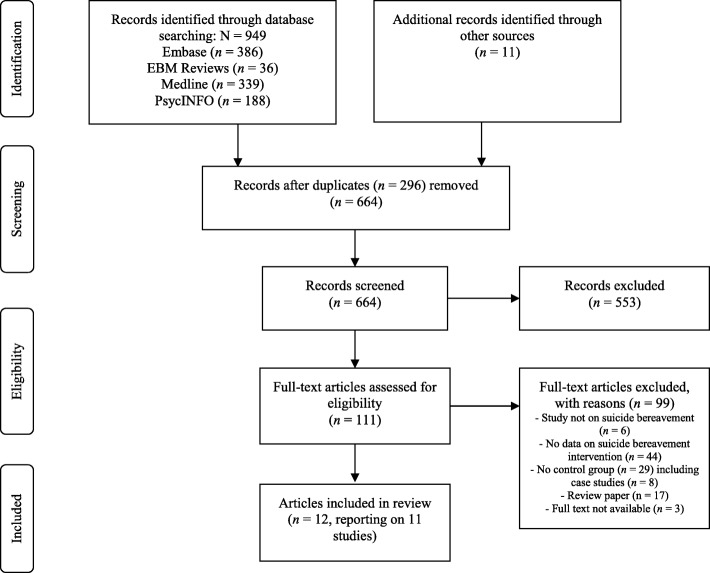
BACKGROUND: Suicide bereavement is a risk factor for adverse outcomes related to grief, social functioning, mental health and suicidal behaviour. Consequently, suicide bereavement support (i.e., postvention) has been identified as an important suicide prevention strategy. However, little is known about its effectiveness. To redress this gap, this review aimed to assess the evidence of effectiveness of interventions for people bereaved by suicide, and appraise the quality of the research in this field. METHODS: We conducted a systematic review according to PRISMA guidelines. Searches of peer-reviewed literature in Medline, PsycINFO, Embase and EBM Reviews identified 12 papers reporting on 11 relevant studies conducted between 1984 and 2018. RESULTS: Across studies, there was a wide variety of intervention modalities, study populations, control groups, and grief, psychosocial and suicide-related outcome measures. Overall, the quality of studies was weak. While there was some evidence of the effectiveness of interventions for uncomplicated grief, evidence of the effectiveness of complicated grief interventions was lacking. Based on this scant evidence, interventions which seem to show promise include supportive, therapeutic and educational approaches, involve the social environment of the bereaved, and comprise a series of sessions led by trained facilitators. CONCLUSIONS: There is a clear need for additional methodologically sound studies in this area. Specifically, selection procedures, sample sizes, randomization, and the use of appropriate measures are crucial. As people bereaved by suicide are at-risk of adverse grief, mental ill-health and suicidal behaviour, further research across the life-span is essential to prevent grief and mental health ramifications.
Overview
CoChat Summary
## TL;DR
This systematic review found only 12 papers reporting 11 controlled studies of interventions for people bereaved by suicide, with overall weak study quality. Evidence was scant and mixed: some interventions showed short-term benefits for uncomplicated grief and some psychosocial outcomes, but evidence for complicated grief interventions was lacking.
## Key findings
- The review included 12 papers reporting 11 studies conducted between 1984 and 2018; 8/11 studies were from the USA, and the rest were from the Netherlands, Australia, and Belgium.
- Overall methodological quality was weak: 9 studies were rated weak and 2 were rated moderate; weak components included selection bias, blinding, and withdrawals/dropouts.
- For grief outcomes, one 8-week support group program showed a greater decrease in grief feelings than passive control, and another writing-task intervention showed mixed findings with greater reduction in suicide-related grief aspects than control.
- For suicide-related outcomes, no study reported non-fatal or fatal suicidal behaviour; 3 studies assessed suicidal ideation, with 1 study finding a significant reduction and 2 finding no differences.
## Methods
- Systematic review conducted according to PRISMA; searches ran in August 2018 across Medline, PsycINFO, Embase, and EBM Reviews with no language or date limits.
- Included controlled intervention studies of people bereaved by suicide that reported empirical data on grief, mental health, and/or suicide-related outcomes and were published in peer-reviewed journals.
- Three researchers independently screened studies and extracted data; study quality was assessed using the Quality Assessment Tool for Quantitative Studies.
## Limitations
- The paper explicitly states that the review included only 12 papers / 11 studies, and that the overall study quality was weak; this limits confidence in the conclusions.
- The authors note that pre-1998 articles often lacked the information needed for quality assessment, and some newer studies also failed to report all quality criteria, so the true quality may have been higher than reported.
- Evident from the text: studies were highly heterogeneous in interventions, populations, control groups, outcomes, and measures, which makes it hard to compare results or draw firm conclusions.
Model-written summary. Check it against the paper before relying on it.
Integrity signals
Registry
Cites
Statistics
Figures
Verification
Claims the paper makes
18 Valid · 0 Not valid · 45 Not checked · 25 Own results and interpretations
Every source the paper cites for this claim was checked and supports it.
In the paper
“The three systematic reviews conducted to-date found some evidence of effectiveness of postvention interventions [24–26].”
§ Effectiveness of interventions for people bereaved through suicide: a systematic review of controlled studies of grief, psychosocial and suicide-related outcomes > Background
What the sources say
- Supportedcites [24] McDaid C Trowman R Golder S Hawton K Sowden A Interventions for people bereaved through suicide: systematic review: systematic review Br J Psychiatry 2008 193 438 443 19043143 source
The Method identifies this paper as a systematic review of interventions for people bereaved through suicide. The Conclusions state that it found some evidence of benefit, while cautioning that the evidence was not robust. This supports the finding attributed to this review; the citation does not independently establish the sentence’s count of three reviews. (LLM, conf=0.90)
- Supportedcites [25] Szumilas M Kutcher S Post-suicide intervention programs: a systematic review Can J Public Health 2011 102 18 29 21485962 PMC6973655 source
The Discussion reports promising results for gatekeeper training and two family-focused postvention strategies, supporting the claim that this systematic review found some evidence of effectiveness. It also cautions that no postvention program was shown to reduce suicide or suicide attempts; the claim does not assert that outcome. (LLM, conf=0.90)
- Supportedcites [26] Linde K Treml J Steinig J Nagl M Kersting A Grief interventions for people bereaved by suicide: a systematic review PLoS One 2017 12 e0179496 28644859 PMC5482439 source
The Abstract (Results) reports that five of seven interventions reduced grief intensity on at least one measure and concludes that there is some evidence of benefit. The Discussion (Conclusions) likewise describes preliminary positive effects, while cautioning that the studies have methodological limitations. This source supports the effectiveness finding attributed to it as one of the cited systematic reviews. (LLM, conf=0.92)
plainstates a possible cause- Asserted: passes — The authors put it forward as true.
- Checkable: passes — It can be checked against evidence.
- Load-bearing: passes — The paper’s conclusions depend on it.
- Based: passes — The paper gives a reason why it holds.
- Supported
The sources with a verdict support this claim; the rest weren’t checked yet, have no full text we could read, or their verdicts aren’t rated yet.
In the paper
“However, little is known about its effectiveness.”
- Also stated in: § Background · plain
“the effectiveness of postvention in terms of its impact on the grief process and mental health of bereaved individuals remains unclear [8].”
§ Effectiveness of interventions for people bereaved through suicide: a systematic review of controlled studies of grief, psychosocial and suicide-related outcomes > Abstract > Background
What the sources say
- Not checked — no full text of the sourcecites [8] Andriessen K Krysinska K Grad O Andriessen K Krysinska K Grad O Current understandings of suicide bereavement Postvention in action: the international handbook of suicide bereavement support. Göttingen 2017 Boston Hogrefe 3 16 source
- Supportedcites [24] McDaid C Trowman R Golder S Hawton K Sowden A Interventions for people bereaved through suicide: systematic review: systematic review Br J Psychiatry 2008 193 438 443 19043143 source
The review’s introductory passage says that little is known about the effects of providing support to people bereaved through suicide. The Conclusions likewise describe the evidence of benefit as not robust and call for further research. (LLM, conf=0.95)
- Supportedcites [26] Linde K Treml J Steinig J Nagl M Kersting A Grief interventions for people bereaved by suicide: a systematic review PLoS One 2017 12 e0179496 28644859 PMC5482439 source
The Introduction states directly that little is known about the effectiveness of grief interventions for people bereaved by suicide. The Abstract’s Limitation section reinforces this: methodological quality was low and the evidence for benefits was not robust. (LLM, conf=0.95)
plain- Asserted: passes — The authors put it forward as true.
- Checkable: passes — It can be checked against evidence.
- Load-bearing: passes — The paper’s conclusions depend on it.
- Based: passes — The paper gives a reason why it holds.
- Also stated in: § Background · plain
Every source the paper cites for this claim was checked and supports it.
In the paper
“Nonetheless, De Groot et al. [41] in a study of a family CBT grief counseling program did not report lower levels of complicated grief.”
§ Effectiveness of interventions for people bereaved through suicide: a systematic review of controlled studies of grief, psychosocial and suicide-related outcomes > Discussion
What the sources say
- Supportedcites [41] De Groot M de Keijser J Neeleman J Kerkhof A Nolen W Burger H Cognitive behaviour therapy to prevent complicated grief among relatives and spouses bereaved by suicide: cluster randomised controlled trial BMJ 2007 334 994 17449505 PMC1867884 source
The Abstract reports that the family-based cognitive behaviour grief counselling programme was not associated with a reduction in complicated grief. The Discussion likewise states that it had no beneficial effect on complicated grief reactions 13 months after the suicide. (LLM, conf=0.94)
plain- Asserted: passes — The authors put it forward as true.
- Checkable: passes — It can be checked against evidence.
- Load-bearing: unclear — It is unclear whether the paper’s conclusions depend on it.
- Based: passes — The paper gives a reason why it holds.
- Supported
Every source the paper cites for this claim was checked and supports it.
In the paper
“De Groot et al. [41] found no differences between family-based psychotherapy and treatment-as-usual on measures of suicidal ideation.”
§ Effectiveness of interventions for people bereaved through suicide: a systematic review of controlled studies of grief, psychosocial and suicide-related outcomes > Study findings > Suicide-related outcomes
What the sources say
- Supportedcites [41] De Groot M de Keijser J Neeleman J Kerkhof A Nolen W Burger H Cognitive behaviour therapy to prevent complicated grief among relatives and spouses bereaved by suicide: cluster randomised controlled trial BMJ 2007 334 994 17449505 PMC1867884 source
Table 3 (pp. 4–6) reports no statistically significant difference in suicidal ideation between the family-based counselling and usual-care groups (adjusted odds ratio 1.08, P=0.89). The Discussion likewise says the programme had no beneficial effect on suicidal ideation 13 months after the suicide. (LLM, conf=0.94)
plain- Asserted: passes — The authors put it forward as true.
- Checkable: passes — It can be checked against evidence.
- Load-bearing: unclear — It is unclear whether the paper’s conclusions depend on it.
- Based: passes — The paper gives a reason why it holds.
- Supported
The sources with a verdict support this claim; the rest weren’t checked yet, have no full text we could read, or their verdicts aren’t rated yet.
In the paper
“Other RCTs [40, 41] also failed to find positive effects on complicated grief outcomes.”
§ Effectiveness of interventions for people bereaved through suicide: a systematic review of controlled studies of grief, psychosocial and suicide-related outcomes > Discussion > Factors affecting effectiveness of interventions
What the sources say
- Not checked — no full text of the sourcecites [40] Zisook S Shear MK Reynolds CF Simon NM Mauro C Skritskaya NA Lebowitz B Wang Y Tal I Glorioso D Wetherell JL Iglewicz A Robinaugh D Qiu X Treatment of complicated grief in survivors of suicide loss: a HEAL report J Clin Psychiatry 2018 79 17m11592 29617064 source
- Supportedcites [41] De Groot M de Keijser J Neeleman J Kerkhof A Nolen W Burger H Cognitive behaviour therapy to prevent complicated grief among relatives and spouses bereaved by suicide: cluster randomised controlled trial BMJ 2007 334 994 17449505 PMC1867884 source
The Discussion (p. 4) states that the counselling programme had no beneficial effect on complicated grief reactions 13 months after the suicide. Table 3 (p. 4) likewise reports no significant effect on the complicated grief measure. The paper notes a trend toward fewer maladaptive grief reactions, but that does not change the finding for complicated grief. (LLM, conf=0.93)
plain- Asserted: passes — The authors put it forward as true.
- Checkable: passes — It can be checked against evidence.
- Load-bearing: unclear — It is unclear whether the paper’s conclusions depend on it.
- Based: passes — The paper gives a reason why it holds.
38 more claims · 1 with their cited sources checked
Create a free account to see all 88 claims and to verify the 4 references still open.
- It may state two separate claims as one. 29
- Probably not a substantial claim. 19
- The quote only partly states this claim. 1
Claims other papers make about this one
Each is checked against this paper’s own text: does it say what the citing paper says it does?
The source backs part of the claim, not all of it — or backs it for a different population, condition or comparison.
In the citing paper
“Overall, grief specific interventions seem to yield stronger effect than interventions targeting other outcomes (Andriessen et al., 2019).”
From Suicide Postvention Service Models and Guidelines 2014–2019: A Systematic Review (2019) · cites this paper as Andriessen et al., 2019
Experimental — accuracy not yet measuredThe cited source says what the claim attributes to it.
In the citing paper
“Our recent systematic review of grief and psychosocial interventions for people bereaved through suicide, which included only controlled studies, found mixed evidence of effectiveness of interventions (Andriessen et al., 2019).”
From Suicide Postvention Service Models and Guidelines 2014–2019: A Systematic Review (2019) · cites this paper as Andriessen et al., 2019
The cited source says what the claim attributes to it.
In the citing paper
“A recent systematic review of effectiveness of controlled studies of interventions for people bereaved by suicide identified 11 studies published between 1984 and 2018 (Andriessen et al., 2019).”
From Suicide Postvention Service Models and Guidelines 2014–2019: A Systematic Review (2019) · cites this paper as Andriessen et al., 2019
Citations
Cites
Preferred Reporting Items for Systematic Reviews and Meta-Analyses: the PRISMA statement
Moher, D., Liberati, A., Tetzlaff, J., Altman, D. G., & for the PRISMA Group (2009) · BMJ · doi:10.1136/bmj.b2535 · Cited by 83,823
The CES-D Scale: A Self-Report Depression Scale for Research in the General Population
Radloff, L. S. (1977) · Applied Psychological Measurement · doi:10.1177/014662167700100306 · Cited by 53,267
Preferred reporting items for systematic reviews and meta-analyses: the PRISMA Statement.
(2009) · PubMed Central · Cited by 44,859
Preferred reporting items for systematic reviews and meta-analyses: The PRISMA statement
Moher, D., Liberati, A., Tetzlaff, J., Altman, D. G., & the PRISMA Group* (2009) · Annals of Internal Medicine · doi:10.7326/0003-4819-151-4-200908180-00135 · Cited by 37,554
Impact of Event Scale: A Measure of Subjective Stress
Horowitz, M., Wilner, N., & Alvarez, W. (1979) · Psychosomatic Medicine · doi:10.1097/00006842-197905000-00004 · Cited by 7,813
Beck, A. T., Steer, R. A., & Brown, G. (2011) · PsycTESTS Dataset · doi:10.1037/t00742-000 · Cited by 7,535
The measurement of pessimism: the hopelessness scale
Beck, A. T., Weissman, A., Lester, D., & Trexler, L. (1974) · Journal of Consulting and Clinical Psychology · doi:10.1037/h0037562 · Cited by 5,494
Posner, K., Brown, G. K., Stanley, B., Brent, D. A., Yershova, K. V., Oquendo, M. A., Currier, G. W., Melvin, G. A., Greenhill, L., Shen, S., et al. (2011) · American Journal of Psychiatry · doi:10.1176/appi.ajp.2011.10111704 · Cited by 5,157
The Self-Efficacy Scale: Construction and Validation
Sherer, M., Maddux, J. E., Mercandante, B., Prentice-Dunn, S., Jacobs, B., & Rogers, R. W. (1982) · Psychological Reports · doi:10.2466/pr0.1982.51.2.663 · Cited by 4,028
(1991) · Cited by 3,844
The Work and Social Adjustment Scale: a simple measure of impairment in functioning
Mundt, J. C., Marks, I. M., Shear, M. K., & Greist, J. M. (2002) · British Journal of Psychiatry · doi:10.1192/bjp.180.5.461 · Cited by 2,515
Inventory of complicated grief: a scale to measure maladaptive symptoms of loss.
Prigerson, H. G., Maciejewski, P. K., Reynolds, C. F., Bierhals, A. J., Newsom, J. T., Fasiczka, A., Frank, E., Doman, J., & Miller, M. (1995) · Psychiatry Research · doi:10.1016/0165-1781(95)02757-2 · Cited by 1,582
Life Threat and Posttraumatic Stress in School-age Children
Pynoos, R. S. (1987) · Archives of General Psychiatry · doi:10.1001/archpsyc.1987.01800240031005 · Cited by 1,205
Suicidal Feelings in the General Population: A Prevalence Study
Paykel, E. S., Myers, J. K., Lindenthal, J. J., & Tanner, J. (1974) · British Journal of Psychiatry · doi:10.1192/bjp.124.5.460 · Cited by 827
Prigerson, H. O., & Jacobs, S. C. (2001) · Handbook of bereavement research: Consequences, coping, and care. · doi:10.1037/10436-026 · Cited by 553
Effects of suicide bereavement on mental health and suicide risk
Pitman, A., Osborn, D., King, M., & Erlangsen, A. (2014) · The Lancet Psychiatry · doi:10.1016/s2215-0366(14)70224-x · Cited by 492
Long-term effects of losing a spouse or child in a motor vehicle crash.
Lehman, D. R., Wortman, C. B., & Williams, A. F. (1987) · Journal of Personality and Social Psychology · doi:10.1037//0022-3514.52.1.218 · Cited by 485
Attachment, loss, and complicated grief
Shear, K., & Shair, H. (2005) · Developmental Psychobiology · doi:10.1002/dev.20091 · Cited by 443
Revised Children's Manifest Anxiety Scale (RCMAS). Manual
Reynolds, C. R., & Richmond, B. O. (1985) · Open Scholarship Institutional Repository (Washington University in St. Louis) · Cited by 424
Suicide survivors’ mental health and grief reactions: A systematic review of controlled studies
Sveen, C., & Walby, F. A. (2008) · Suicide and Life-Threatening Behavior · doi:10.1521/suli.2008.38.1.13 · Cited by 343
Complicated grief in survivors of suicide
Mitchell, A. M., Kim, Y., Prigerson, H. G., & Mortimer-Stephens, M. (2004) · Crisis · doi:10.1027/0227-5910.25.1.12 · Cited by 242
JOHN, K., GAMMON, D. G., PRUSOFF, B. A., & WARNER, V. (1987) · Journal of the American Academy of Child & Adolescent Psychiatry · doi:10.1097/00004583-198726060-00015 · Cited by 236
Prevalence of exposure to suicide: a meta-analysis of population-based studies.
Andriessen, K., Rahman, B., Draper, B., Dudley, M., & Mitchell, P. B. (2017) · Journal of Psychiatric Research · doi:10.1016/j.jpsychires.2017.01.017 · Cited by 230
Self-citationWhat do suicide survivors tell us they need? Results of a pilot study
Mcmenamy, J. M., Jordan, J. R., & Mitchell, A. M. (2008) · Suicide and Life-Threatening Behavior · doi:10.1521/suli.2008.38.4.375 · Cited by 197
Estimating the population of survivors of suicide: Seeking an evidence base
Berman, A. L. (2011) · Suicide and Life-Threatening Behavior · doi:10.1111/j.1943-278x.2010.00009.x · Cited by 190
Erlangsen, A., Runeson, B., Bolton, J. M., Wilcox, H. C., Forman, J. L., Krogh, J., Shear, M. K., Nordentoft, M., & Conwell, Y. (2017) · JAMA Psychiatry · doi:10.1001/jamapsychiatry.2017.0226 · Cited by 167
Bereavement: Course, Consequences, and Care
Zisook, S., Iglewicz, A., Avanzino, J. A., Maglione, J. E., Glorioso, D., Zetumer, S. D., Seay, K., Vahia, I. V., Young, I. T., Lebowitz, B. D., et al. (2014) · Current Psychiatry Reports · doi:10.1007/s11920-014-0482-8 · Cited by 160
Group intervention for children bereaved by the suicide of a relative
PFEFFER, C. R., JIANG, H., KAKUMA, T., HWANG, J., & METSCH, M. (2002) · Journal of the American Academy of Child & Adolescent Psychiatry · doi:10.1097/00004583-200205000-00007 · Cited by 152
Development of the Grief Experience Questionnaire
Barrett, T. W., & Scott, T. B. (1989) · Suicide and Life-Threatening Behavior · doi:10.1111/j.1943-278x.1989.tb01033.x · Cited by 146
Psychometric Properties of the Grief Cognitions Questionnaire (GCQ)
Boelen, P. A., & Lensvelt‐Mulders, G. (2005) · Journal of Psychopathology and Behavioral Assessment · doi:10.1007/s10862-005-2409-5 · Cited by 138
Malgaroli, M., Maccallum, F., & Bonanno, G. A. (2018) · Psychological Medicine · doi:10.1017/s0033291718001769 · Cited by 116 · cited 1×
“, maladaptive reactions) of complicated grief such as intense longing for the deceased, ruminative thoughts or images about the deceased, intense feelings of anger and guilt, avoidance of situations, people and places that remind of the deceased, and difficulty finding meaning in life [12, 13].”
BackgroundInterventions for people bereaved through suicide: systematic review
McDaid, C., Trowman, R., Golder, S., Hawton, K., & Sowden, A. (2008) · British Journal of Psychiatry · doi:10.1192/bjp.bp.107.040824 · Cited by 107
Grief interventions for people bereaved by suicide: a systematic review
Linde, K., Treml, J., Steinig, J., Nagl, M., & Kersting, A. (2017) · PLoS ONE · doi:10.1371/journal.pone.0179496 · Cited by 107
Postvention in Action: The International Handbook of Suicide Bereavement Support
(2017) · Hogrefe Publishing eBooks · doi:10.1027/00493-000 · Cited by 99
Self-citationSpillane, A., Matvienko-Sikar, K., Larkin, C., Corcoran, P., & Arensman, E. (2018) · BMJ Open · doi:10.1136/bmjopen-2017-019472 · Cited by 97
Bereavement research: Contemporary perspectives.
Stroebe, M., Hansson, R. O., Schut, H. A. W., & Stroebe, W. (2008) · American Psychological Association eBooks · doi:10.1037/14498-001 · Cited by 92
de Groot, M., de Keijser, J., Neeleman, J., Kerkhof, A., Nolen, W., & Burger, H. (2007) · BMJ · doi:10.1136/bmj.39161.457431.55 · Cited by 91
Pitman, A. L., Rantell, K., Moran, P., Sireling, L., Marston, L., King, M., & Osborn, D. (2017) · BMJ Open · doi:10.1136/bmjopen-2016-014487 · Cited by 89
Shneidman, E. S. (1973) · Medical Entomology and Zoology · Cited by 84
Writing Projects: Lessening Undergraduates' Unique Suicidal Bereavement
Kovac, S. H., & Range, L. M. (2000) · Suicide and Life-Threatening Behavior · doi:10.1111/j.1943-278x.2000.tb01064.x · Cited by 83
de Groot, M., & Kollen, B. J. (2013) · BMJ · doi:10.1136/bmj.f5519 · Cited by 83
Bui, E., Mauro, C., Robinaugh, D. J., Skritskaya, N. A., Wang, Y., Gribbin, C., Ghesquiere, A., Horenstein, A., Duan, N., Reynolds, C., et al. (2015) · Depression and Anxiety · doi:10.1002/da.22385 · Cited by 83
Dyregrov, K. (2011) · Crisis · doi:10.1027/0227-5910/a000098 · Cited by 80
Post-suicide Intervention Programs: A Systematic Review
Szumilas, M., & Kutcher, S. (2011) · Canadian Journal of Public Health · doi:10.1007/bf03404872 · Cited by 74
Prolonged grief disorder: clinical utility of ICD-11 diagnostic guidelines
Mauro, C., Reynolds, C. F., Maercker, A., Skritskaya, N., Simon, N., Zisook, S., Lebowitz, B., Cozza, S. J., & Shear, M. K. (2019) · Psychological Medicine · doi:10.1017/s0033291718001563 · Cited by 73 · cited 1×
“While consensus is emerging about the diagnostic criteria and the name of the syndrome (Prolonged Grief Disorder will be included in ICD-11), it is expressed through persisting characteristics of acute grief, and is more likely to occur after a sudden or violent death [11].”
BackgroundThe support needs and experiences of suicidally bereaved family and friends
Wilson, A., & Marshall, A. (2010) · Death Studies · doi:10.1080/07481181003761567 · Cited by 72
Group intervention for widowed survivors of suicide
Constantino, R. E., Sekula, L. K., & Rubinstein, E. N. (2001) · Suicide and Life-Threatening Behavior · doi:10.1521/suli.31.4.428.22044 · Cited by 64
An Evaluation of Postvention Following Adolescent Suicide
Hazell, P., & Lewin, T. (1993) · Suicide and Life-Threatening Behavior · doi:10.1111/j.1943-278x.1993.tb00374.x · Cited by 62
Spillane, A., Larkin, C., Corcoran, P., Matvienko-Sikar, K., & Arensman, E. (2017) · BMJ Open · doi:10.1136/bmjopen-2016-014707 · Cited by 58
Pitman, A., De Souza, T., Khrisna Putri, A., Stevenson, F., King, M., Osborn, D., & Morant, N. (2018) · International Journal of Environmental Research and Public Health · doi:10.3390/ijerph15040666 · Cited by 58
Baker, A. W., Keshaviah, A., Horenstein, A., Goetter, E. M., Mauro, C., Reynolds, C. F., Zisook, S., Katherine Shear, M., & Simon, N. M. (2016) · Journal of Loss and Trauma · doi:10.1080/15325024.2016.1157412 · Cited by 51
Is Suicide Bereavement Different? A Framework for Rethinking the Question
(2011) · Grief After Suicide · doi:10.4324/9780203886045-12 · Cited by 50
Wittouck, C., Van Autreve, S., Portzky, G., & van Heeringen, K. (2014) · Crisis · doi:10.1027/0227-5910/a000252 · Cited by 49
Maple, M., Pearce, T., Sanford, R., Cerel, J., Castelli Dransart, D. A., & Andriessen, K. (2018) · Crisis · doi:10.1027/0227-5910/a000498 · Cited by 47
Self-citation(1992) · PubMed · Cited by 43
Treatment of Complicated Grief in Survivors of Suicide Loss: A HEAL Report
Zisook, S., Shear, M. K., Reynolds, C. F., Simon, N. M., Mauro, C., Skritskaya, N. A., Lebowitz, B., Wang, Y., Tal, I., Glorioso, D., et al. (2018) · The Journal of Clinical Psychiatry · doi:10.4088/jcp.17m11592 · Cited by 41
Andriessen, K. (2014) · Crisis · doi:10.1027/0227-5910/a000269 · Cited by 40
Self-citationMeasuring Maladaptive Cognitions in Complicated Grief: Introducing the Typical Beliefs Questionnaire
Skritskaya, N. A., Mauro, C., Olonoff, M., Qiu, X., Duncan, S., Wang, Y., Duan, N., Lebowitz, B., Reynolds, C. F., Simon, N. M., et al. (2017) · The American Journal of Geriatric Psychiatry · doi:10.1016/j.jagp.2016.09.003 · Cited by 38
Krysinska, K. E., Batterham, P. J., & Christensen, H. M. (2016) · Archives of Suicide Research · doi:10.1080/13811118.2016.1162246 · Cited by 37
Self-citationSuicide loss survivors′ experiences with therapy: Implications for clinical practice
Sanford, R., Cerel, J., McGann, V., & Maple, M. (2016) · Community Mental Health Journal · doi:10.1007/s10597-016-0006-6 · Cited by 36
de Groot, M., Neeleman, J., van der Meer, K., & Burger, H. (2010) · Suicide and Life-Threatening Behavior · doi:10.1521/suli.2010.40.5.425 · Cited by 34
Current Postvention Research and Priorities for the Future: Results of a Survey
Andriessen, K., Castelli Dransart, D. A., Cerel, J., & Maple, M. (2017) · Crisis · doi:10.1027/0227-5910/a000459 · Cited by 33
Self-citationCurrent understandings of suicide bereavement.
Andriessen, K., Krysinska, K. E., & Grad, O. T. (2017) · Cited by 27
Self-citationNursing Postvention for Spousal Survivors of Suicide
Constantino, R. E., & Bricker, P. L. (1996) · Issues in Mental Health Nursing · doi:10.3109/01612849609035002 · Cited by 26
Surviving the Legacy of Suicide
Grad, O. T., & Andriessen, K. (2016) · Wiley eBooks · doi:10.1002/9781118903223.ch37 · Cited by 18
Self-citationEffects of suicide bereavement on mental and physical health.
Erlangsen, A., & Pitman, A. (2017) · Cited by 17
Group therapy for survivors of suicide
Battle, A. O. (1984) · Crisis · Cited by 9
Competence-building in adolescents, part II: community intervention for survivors of peer suicide
Sandor, M. K., Walker, L. O., & Sands, D. (1994) · Issues in Comprehensive Pediatric Nursing · doi:10.3109/01460869409078305 · Cited by 8
Suicides Among Family Members of Elderly Suicide Victims: An Exploratory Study
Waern, M. (2005) · Suicide and Life-Threatening Behavior · doi:10.1521/suli.2005.35.3.356 · Cited by 8
Postvention in action: The international handbook of suicide bereavement support.
Andriessen, K., Krysinska, K., & Grad, O. (2017) · Minerva Access (University of Melbourne) · Cited by 5
Self-citation(2017) · Cited by 4
Self-citation
Research works printed but not linked: 10
- World Health Organization Preventing suicide: a global imperative 2014 Geneva World Health Organization
- Effective Public Health Practice Project Quality Assessment Tool For Quantitative Studies 1998 Hamilton Effective Public Health Practice Project
- Sanders CM Mauger PA Strong PE A manual for the Grief Experience Inventory 1985 Palo Alto Consulting Psychological Press
- Derogatis LR The brief symptom inventory (BSI): administration, scoring & procedures manual-II 1992 Baltimore Clinical Psychometric Research
- Walker LO Sandor MK Sands D Competence building in adolescence: self-help workbooks as a primary prevention vehicle. (final report). Nursing research emphasis (NRE) Grant (#I R21 NR013 16–01) 1990 Washington DC National Center for Nursing Research, National Institutes for Health
- Kovacs M Children’s Depression Inventory Manual 1992 North Tonawanda Multi-Health Systems Inc
- Martin G Kuller NS Hazell P The effects on adolescents of completed suicide of another student Youth Studies Australia 1992 11 21 23
- Giel R Nienhuis FJ Schedules for clinical assessment in neuropsychiatry (Dutch version) 1996 Geneva/Groningen World Health Organization
- Harter S Manual for the self-perception profile for adolescents 1988 Denver University of Denver
- Schreurs PJG van de Willige G Brosschot JF Tellegen B Graus GMH The Utrecht coping list: UCL. [De Utrechtse coping Lijst: UCL] 1993 Lisse Swets & Zeitlinger
Cited by
Knipe, D., Padmanathan, P., Newton-Howes, G., Chan, L. F., & Kapur, N. (2022) · The Lancet · doi:10.1016/s0140-6736(22)00173-8 · Cited by 331
Hill, N. T. M., Robinson, J., Pirkis, J., Andriessen, K., Krysinska, K. E., Payne, A., Boland, A. K., Clarke, A., Milner, A. J., Witt, K., et al. (2020) · PLoS Medicine · doi:10.1371/journal.pmed.1003074 · Cited by 169
“A recent review by Andriessen and colleagues [74], for example, found 3 controlled studies [76–78] that investigated the effectiveness of an intervention on suicidal ideation and found no studies that included outcomes related to suicide or suicide attempt.”
Self-citationWeb-Based Bereavement Care: A Systematic Review and Meta-Analysis
Wagner, B., Rosenberg, N., Hofmann, L., & Maass, U. (2020) · Frontiers in Psychiatry · doi:10.3389/fpsyt.2020.00525 · Cited by 117
Suicide Postvention Service Models and Guidelines 2014–2019: A Systematic Review
Andriessen, K., Krysinska, K., Kõlves, K., & Reavley, N. (2019) · Frontiers in Psychology · doi:10.3389/fpsyg.2019.02677 · Cited by 129
Self-citationScott, H. R., Pitman, A., Kozhuharova, P., & Lloyd‐Evans, B. (2020) · BMC Psychiatry · doi:10.1186/s12888-020-02639-4 · Cited by 159
Metadata
- Authors
- Andriessen, K., Krysinska, K., Hill, N. T. M., Reifels, L., Robinson, J., Reavley, N., & Pirkis, J.
- Affiliations
- The University of Melbourne (AU)
- Corresponding author
- Pirkis, Jane
- ORCID
- Venue
- BMC Psychiatry
- Published
- 2019-01-30
- Volume
- 19
- Issue
- 1
- Pages
- 49-49
- ISSN
- 1471-244X (ISSN-L)
- PMC
- PMC6354344
- OpenAlex
- W2947297338
- Semantic Scholar
- ba8ff4a7635240e209343f364536e364543abd66
- Cited by
- 172
- References
- 71
- Citations by year
- 2026: 15 · 2025: 27 · 2024: 26 · 2023: 16 · 2022: 37 · 2021: 27 · 2020: 16 · 2019: 8
- FWCI
- 3.47
- Type
- journal article
- Language
- en
- Open access
- gold
- doi.org
- Licence
- cc-by
- creativecommons.org/licenses/by/4.0/ (tdm)
- Locations
- BMC Psychiatry (publishedVersion, cc-by)
- Europe PMC (PubMed Central) (publishedVersion, other-oa)
- PubMed Central (publishedVersion, cc-by)
- PubMed (publishedVersion)
- UNSWorks (University of New South Wales, Sydney, Australia) (submittedVersion, cc-by-nc-nd)
- Minerva Access (University of Melbourne) (submittedVersion, cc-by)
- Lirias (submittedVersion, other-oa)
- DOAJ (DOAJ: Directory of Open Access Journals) (submittedVersion, cc-by-sa)
- Funders
- Australian Government Department of Health (n/a)
- National Health and Medical Research Council (NHMRC Career Development Fellowship (APP1142348))
- Topics
- Social Sciences › Psychology › Clinical Psychology › Grief, Bereavement, and Mental Health
- Social Sciences › Psychology › Clinical Psychology › Suicide and Self-Harm Studies
- Social Sciences › Anthropology › Death, Funerary Practices, and Mourning
- Keywords
- suicide bereavement, postvention, complicated grief, suicidal behavior, mental health outcomes, social functioning, suicide prevention, intervention effectiveness
- MeSH terms
- Bereavement, Female, Grief, Humans, Male, Risk Factors, Suicide, Treatment Outcome, Suicidal Ideation, Early Medical Intervention
About these checks
Registry, retraction, Cites and statistics results are computed, not judged, with one exception: a printed reference that no index lists is read once by a model before it counts as a citation error. Claims are extracted by a model and kept only when their quote appears verbatim in the text; each cited source is then checked, with a model’s help, for whether it says what the claim relies on. Those verdicts can be wrong — read the claim’s quote and the cited source before relying on one.
The claim verdicts this report counts are experimental: their accuracy is not yet measured.
A language model drew the claims from the paper on 2026-10-09, under version 3 of the claim definition (model deepseek-v4.1-flash, prompt extract-v3).
A second model labelled each claim on 2026-10-09 (model jev-1.13-20260917, definition revision gold-guideline-v0.2).
Cited sources are checked with a language model’s help (gpt-6-sol).
Statistics and arithmetic are recomputed, not judged.
Confidence bands are shown only for fields calibrated on our annotated test set. None is calibrated yet, so no band is shown.
What counts as a claim ›How we measure confidence ›How we check this ›
Are you an author, or do you see a problem with this page? Request a review
Data sources
Bibliographic data: Semantic Scholar, OpenAlex, Crossref.
Contains information from the Semantic Scholar Academic Graph Datasets, made available under the ODC Attribution License (ODC-BY 1.0).
Semantic Scholar’s data is described in: Kinney, R., et al. (2023). The Semantic Scholar Open Data Platform. arXiv:2301.10140.
