

Normative data and psychometric properties of the Patient Health Questionnaire-9 in a nationally representative Korean population
Open accessThe DOI matches its Crossref record; 56 of the 57 references it cites were found in a registry or an index.
Abstract
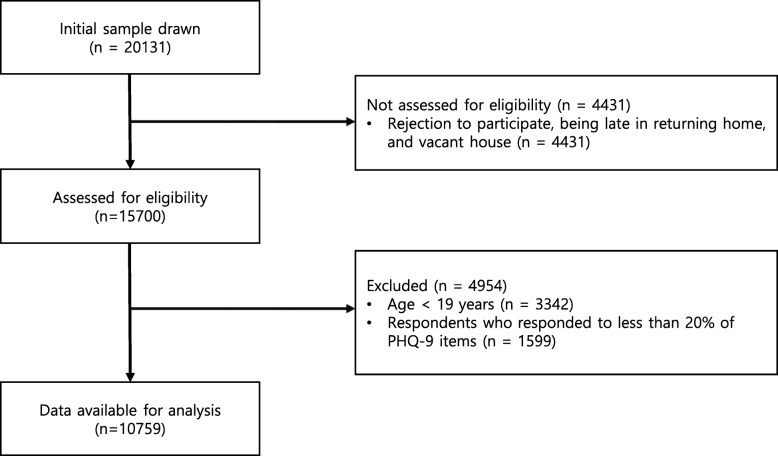
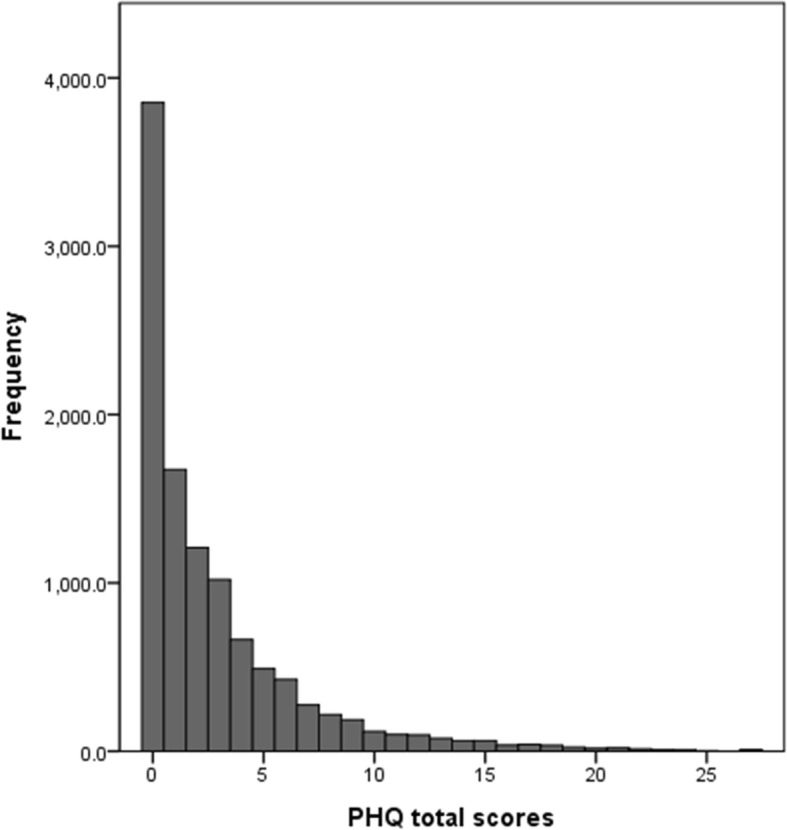
Background: The Patient Health Questionnaire-9 (PHQ-9) has been standardized in several populations and is widely used in clinical practice and health care. However, it has not been appropriately standardized in the Korean general population, and no normative data have been presented. The aim of this study was to provide the normative data and psychometric properties of the PHQ-9 in the nationally representative population of Korea. Methods: We used the nationwide cross-sectional survey data of Korea from 2014 to 2016. The data of 10,759 individuals aged over 19 years were analyzed in this study. As the distribution of the PHQ-9 scores was not normative, the percentile ranks for raw scores were provided. The survey questionnaires included the PHQ-9, The EuroQol-5 Dimension (EQ-5D), and demographic characteristics. We analyzed the construct validity and internal consistency of the PHQ-9. Results: The normative data of the PHQ-9 were generated according to the sex and different age categories. The correlation coefficient between the sum of the PHQ-9 scores and the EQ-5D index was 0.44, which was moderate. The most appropriate model was the two-factor model with five ‘affective-somatic’ labeled items and four ‘cognitive’ labeled items. Cronbach’s α for the PHQ-9 was 0.79. Conclusions: Our result supports reliability and validity with two-factor structure of PHQ-9 for measuring depression in the Korean nationally representative population. The Korean normative data on the PHQ-9 according to percentile rank can assist in interpreting and comparing scores with other populations.
Overview
The claims and statistics of this paper haven’t been checked yet.
Free: it reads the open-access text and checks the first 5 claims that cite a source we can check. Create a free account to check every claim.
Integrity signals
Registry
Cites
Statistics
Figures
Verification
Claims the paper makes
The claims and statistics of this paper haven’t been checked yet.
Free: it reads the open-access text and checks the first 5 claims that cite a source we can check. Create a free account to check every claim.
Claims other papers make about this one
Each is checked against this paper’s own text: does it say what the citing paper says it does?
The source backs part of the claim, not all of it — or backs it for a different population, condition or comparison.
In the citing paper
“mild to moderate depressive symptoms are highly prevalent and are estimated to occur in approximately 20% to 22% of the general population across Europe, Asia, and the United States [3-5].”
From Feasibility and Preliminary Efficacy of Digital Interventions for Depressive Symptoms in Working Adults: Multiarm Randomized Controlled Trial (2023) · cites this paper as [4]
Experimental — accuracy not yet measuredThe cited source says what the claim attributes to it.
In the citing paper
“We used the Korean version of the Patient Health Questionnaire-9 (PHQ-9) to determine whether participants had depressive symptoms [12].”
From Depression, anxiety, and stress in Korean general population during the COVID-19 pandemic. (2022) · cites this paper as [12]
Self-check
Percentages, sums and reported differences re-computed from the paper’s own numbers.
The self-check needs the paper’s full text.
Citations
Cites
Statistical power analysis for the behavioral sciences
(1990) · Computers, Environment and Urban Systems · doi:10.1016/0198-9715(90)90050-4 · Cited by 65,269
The PHQ-9: Validity of a brief depression severity measure
Kroenke, K., Spitzer, R. L., & Williams, J. B. W. (2001) · Journal of General Internal Medicine · doi:10.1046/j.1525-1497.2001.016009606.x · Cited by 44,910
Statistical Power Analysis for the Behavioral Sciences
Cohen, J. (2013) · doi:10.4324/9780203771587 · Cited by 25,373
(1998) · The Journal of Clinical Psychiatry · Cited by 19,139
Significance tests and goodness of fit in the analysis of covariance structures.
Bentler, P. M., & Bonett, D. G. (1980) · Psychological Bulletin · doi:10.1037//0033-2909.88.3.588 · Cited by 19,023
Bundesgesundheitsblatt - Gesundheitsforschung - Gesundheitsschutz
(2013) · Bundesgesundheitsblatt - Gesundheitsforschung - Gesundheitsschutz · doi:10.1007/103.1437-1588 · Cited by 11,796
(1998) · PubMed · Cited by 10,216
Vandenbroucke, J. P., von Elm, E., Altman, D. G., Gøtzsche, P. C., Mulrow, C. D., Pocock, S. J., Poole, C., Schlesselman, J. J., Egger, M., & Initiative, F. T. S. (2007) · PLoS Medicine · doi:10.1371/journal.pmed.0040297 · Cited by 8,613
Structural model evaluation and modification: An interval estimation approach
Steiger, J. H. (1990) · Multivariate Behavioral Research · doi:10.1207/s15327906mbr2502_4 · Cited by 7,408
A Reliability Coefficient for Maximum Likelihood Factor Analysis
Tucker, L. R., & Lewis, C. (1973) · Psychometrika · doi:10.1007/bf02291170 · Cited by 7,330
EQ-SD: a measure of health status from the EuroQol Group
Rabin, R., & Charro, F. D. (2001) · Annals of Medicine · doi:10.3109/07853890109002087 · Cited by 5,613
Vandenbroucke, J. P., Elm, E. V., Altman, D. G., Gøtzsche, P. C., Mulrow, C. D., Pocock, S. J., Poole, C., Schlesselman, J. J., Egger, M., & initiative, F. T. S. (2007) · Annals of Internal Medicine · doi:10.7326/0003-4819-147-8-200710160-00010-w1 · Cited by 3,543
Data Resource Profile: The Korea National Health and Nutrition Examination Survey (KNHANES)
Kweon, S., Kim, Y., Jang, M.-J., Kim, Y., Kim, K., Choi, S., Chun, C., Khang, Y.-H., & Oh, K. (2014) · International Journal of Epidemiology · doi:10.1093/ije/dyt228 · Cited by 2,189
Levis, B., Benedetti, A., & Thombs, B. D. (2019) · BMJ · doi:10.1136/bmj.l1476 · Cited by 1,718
FURUKAWA, T. A., KESSLER, R. C., SLADE, T., & ANDREWS, G. (2003) · Psychological Medicine · doi:10.1017/s0033291702006700 · Cited by 1,570
Wang, W., Bian, Q., Zhao, Y., Li, X., Wang, W., Du, J., Zhang, G., Zhou, Q., & Zhao, M. (2014) · General Hospital Psychiatry · doi:10.1016/j.genhosppsych.2014.05.021 · Cited by 1,480
Screening for Depression in Adults: US Preventive Services Task Force Recommendation Statement
Siu, A. L., and the US Preventive Services Task Force (USPSTF), Bibbins-Domingo, K., Grossman, D. C., Baumann, L. C., Davidson, K. W., Ebell, M., García, F. A. R., Gillman, M., Herzstein, J., et al. (2016) · JAMA · doi:10.1001/jama.2015.18392 · Cited by 1,407
Validity of the brief patient health questionnaire mood scale (PHQ-9) in the general population
Martin, A., Rief, W., Klaiberg, A., & Braehler, E. (2006) · General Hospital Psychiatry · doi:10.1016/j.genhosppsych.2005.07.003 · Cited by 1,379
The increasing burden of depression
Briley, M., & Lépine (2011) · Neuropsychiatric Disease and Treatment · doi:10.2147/ndt.s19617 · Cited by 1,211
Depression as a disease of modernity: explanations for increasing prevalence
Hidaka, B. H. (2012) · Journal of Affective Disorders · doi:10.1016/j.jad.2011.12.036 · Cited by 769
Kocalevent, R.-D., Hinz, A., & Brähler, E. (2013) · General Hospital Psychiatry · doi:10.1016/j.genhosppsych.2013.04.006 · Cited by 748
Depression, anxiety and somatization in primary care: Syndrome overlap and functional impairment
Löwe, B., Spitzer, R. L., Williams, J. B. W., Mussell, M., Schellberg, D., & Kroenke, K. (2008) · General Hospital Psychiatry · doi:10.1016/j.genhosppsych.2008.01.001 · Cited by 706
Kessler, R. C., Birnbaum, H., Bromet, E., Hwang, I., Sampson, N., & Shahly, V. (2010) · Psychological Medicine · doi:10.1017/s0033291709990213 · Cited by 542
Structured Clinical Interview for the DSM ( SCID )
First, M. B. (2015) · The Encyclopedia of Clinical Psychology · doi:10.1002/9781118625392.wbecp351 · Cited by 532 · cited 1×
“Proper diagnosis of depression should be conducted using structured diagnostic interviews, such as the Mini-International Neuropsychiatric Interview or the Structured Clinical Interview for DSM-5 [11, 12], but screening instruments are necessary considering the time and cost involved, including that in training clinic…”
MethodLee, Y.-K., Nam, H.-S., Chuang, L.-H., Kim, K.-Y., Yang, H.-K., Kwon, I.-S., Kind, P., Kweon, S.-S., & Kim, Y.-T. (2009) · Value in Health · doi:10.1111/j.1524-4733.2009.00579.x · Cited by 474
Han, C., Jo, S. A., Kwak, J.-H., Pae, C.-U., Steffens, D., Jo, I., & Park, M. H. (2008) · Comprehensive Psychiatry · doi:10.1016/j.comppsych.2007.08.006 · Cited by 465
Self-citationThe economic burden of depression and the cost-effectiveness of treatment
Wang, P. S., Simon, G., & Kessler, R. C. (2003) · International Journal of Methods in Psychiatric Research · doi:10.1002/mpr.139 · Cited by 403
Yu, X., Tam, W. W. S., Wong, P. T. K., Lam, T. H., & Stewart, S. M. (2012) · Comprehensive Psychiatry · doi:10.1016/j.comppsych.2010.11.002 · Cited by 392
Busch, M. A., Maske, U. E., Ryl, L., Schlack, R., & Hapke, U. (2013) · Bundesgesundheitsblatt - Gesundheitsforschung - Gesundheitsschutz · doi:10.1007/s00103-013-1688-3 · Cited by 322
Kim, M.-H., Cho, Y.-S., Uhm, W.-S., Kim, S., & Bae, S.-C. (2005) · Quality of Life Research · doi:10.1007/s11136-004-5681-z · Cited by 309
Depression and mortality in a longitudinal study: 1952–2011
Gilman, S. E., Sucha, E., Kingsbury, M., Horton, N. J., Murphy, J. M., & Colman, I. (2017) · Canadian Medical Association Journal · doi:10.1503/cmaj.170125 · Cited by 267
de Jonge, P., Mangano, D., & Whooley, M. A. (2007) · Psychosomatic Medicine · doi:10.1097/psy.0b013e31815743ca · Cited by 234
Rief, W., Nanke, A., Klaiberg, A., & Braehler, E. (2004) · Journal of Affective Disorders · doi:10.1016/j.jad.2003.11.006 · Cited by 169
Validation of the Patient Health Questionnaire-9 (PHQ-9) and PHQ-2 in patients with migraine
Seo, J.-G., & Park, S.-P. (2015) · The Journal of Headache and Pain · doi:10.1186/s10194-015-0552-2 · Cited by 165
Richardson, E. J., & Richards, J. S. (2008) · Rehabilitation Psychology · doi:10.1037/0090-5550.53.2.243 · Cited by 153
Shin, C., Kim, Y., Park, S., Yoon, S., Ko, Y.-H., Kim, Y.-K., Kim, S.-H., Jeon, S. W., & Han, C. (2017) · Journal of Korean Medical Science · doi:10.3346/jkms.2017.32.11.1861 · Cited by 147
Self-citationYu, N. X., Stewart, S. M., Wong, P. T. K., & Lam, T. H. (2011) · Journal of Affective Disorders · doi:10.1016/j.jad.2011.05.007 · Cited by 128
Rating depressed patients: observer- vs self-assessment
Möller, H. J. (2000) · European Psychiatry · doi:10.1016/s0924-9338(00)00229-7 · Cited by 120
Depression in primary care: part 1—screening and diagnosis
Ferenchick, E. K., Ramanuj, P., & Pincus, H. A. (2019) · BMJ · doi:10.1136/bmj.l794 · Cited by 119
The factor structure of the PHQ-9 in palliative care
Chilcot, J., Rayner, L., Lee, W. E., Price, A. C., Goodwin, L., Monroe, B., Sykes, N. P., Hansford, P., & Hotopf, M. H. (2013) · Journal of Psychosomatic Research · doi:10.1016/j.jpsychores.2012.12.012 · Cited by 116
Whisman, M. A., & Richardson, E. D. (2015) · Journal of Clinical Psychology · doi:10.1002/jclp.22188 · Cited by 108
Krause, J. S., Bombardier, C. H., & Carter, R. E. (2008) · Rehabilitation Psychology · doi:10.1037/a0013354 · Cited by 98
Kim, H. S., Shin, D. W., Lee, W. C., Kim, Y. T., & Cho, B. (2012) · Journal of Korean Medical Science · doi:10.3346/jkms.2012.27.s.s70 · Cited by 95
Normative data: their definition, interpretation, and importance for primary care physicians.
O’Connor, P. J. (1990) · PubMed · Cited by 94
Population Aging and Healthcare Expenditure in Korea
Hyun, K., Kang, S., & Lee, S. (2015) · Health Economics · doi:10.1002/hec.3209 · Cited by 94
Crawford, J. R., Garthwaite, P. H., & Slick, D. J. (2009) · The Clinical Neuropsychologist · doi:10.1080/13854040902795018 · Cited by 89 · cited 1×
“Normative data can be presented as standard scores (z or T scores); however, this may be inappropriate as psychological measures often do not have a normal distribution [20].”
BackgroundValidity and reliability of EQ-5D-3L for breast cancer patients in Korea
Kim, S., Jo, M., Lee, J.-W., Lee, H., & Kim, J. K. (2015) · Health and Quality of Life Outcomes · doi:10.1186/s12955-015-0399-x · Cited by 87
Prevalence of depressive symptoms and predictors of treatment among U.S. adults from 2005 to 2010
Wittayanukorn, S., Qian, J., & Hansen, R. A. (2014) · General Hospital Psychiatry · doi:10.1016/j.genhosppsych.2013.12.009 · Cited by 86
Prevalence of the Major Mental Disorders among the Korean Elderly
Cho, M. J., Lee, J., Kim, B., Lee, H. W., & Sohn, J. H. (2010) · Journal of Korean Medical Science · doi:10.3346/jkms.2011.26.1.1 · Cited by 61
Rancāns, E., Vrubļevska, J., Snikere, S., Koroļeva, I., & Trapencieris, M. (2013) · Journal of Affective Disorders · doi:10.1016/j.jad.2013.11.022 · Cited by 51
Kim, J.-H., Cho, M. J., Hong, J. P., Bae, J. N., Cho, S.-J., Hahm, B.-J., Lee, D.-W., Park, J.-I., Lee, J.-Y., Jeon, H. J., et al. (2015) · Journal of Korean Medical Science · doi:10.3346/jkms.2015.30.11.1659 · Cited by 51
Tomitaka, S., Kawasaki, Y., Ide, K., Akutagawa, M., Ono, Y., & Furukawa, T. A. (2018) · Frontiers in Psychiatry · doi:10.3389/fpsyt.2018.00390 · Cited by 50
Age Differences in Symptoms of Depression and Anxiety: Examining Behavioral Medicine Outpatients
Goldberg, J. H., Breckenridge, J. N., & Sheikh, J. I. (2003) · Journal of Behavioral Medicine · doi:10.1023/a:1023030605390 · Cited by 48
Screening for depression in primary care: what do we still need to know?
McAlpine, D. D., & Wilson, A. R. (2004) · Depression and Anxiety · doi:10.1002/da.20000 · Cited by 35
Yu, B., Lee, H., & Lee, K. (2011) · Saengmul jeongsin euihag/Saengmul jeongsin uihak · Cited by 26
Oyama, H., & Sakashita, T. (2014) · The Journal of Nervous and Mental Disease · doi:10.1097/nmd.0000000000000119 · Cited by 7
Cited by
Long working hours and depressive symptoms: moderation by gender, income, and job status
Choi, E.-S., Choi, K. W., Jeong, H., Lee, M., Ko, Y., Han, C., Ham, B., Chang, J., & Han, K. (2021) · Journal of Affective Disorders · doi:10.1016/j.jad.2021.03.001 · Cited by 77
Self-citationAn Analysis of Suicide Risk Factors among Farmers in the Midwestern United States
Bjornestad, A., Cuthbertson, C., & Hendricks, J. (2021) · International Journal of Environmental Research and Public Health · doi:10.3390/ijerph18073563 · Cited by 59
“The PHQ-9 [21] is a 9-item self-report measure that is widely used in health care settings to screen for depression in the general population [25,26].”
BackgroundWisting, L., Johnson, S. U., Bulik, C. M., Andreassen, O. A., Rø, Ø., & Bang, L. (2021) · BMC Psychiatry · doi:10.1186/s12888-020-03013-0 · Cited by 53
“Since the fit was mediocre, a two-factor solution proposed in the literature with cognitive and somatic symptoms was investigated [45].”
BackgroundInfluentialPsychometric evaluation and community norms of the PHQ-9, based on a representative German sample
Kliem, S., Sachser, C., Lohmann, A., Baier, D., Brähler, E., Gündel, H., & Fegert, J. M. (2024) · Frontiers in Psychiatry · doi:10.3389/fpsyt.2024.1483782 · Cited by 57
Is Dissociation a Fundamental Component of ICD-11 Complex Posttraumatic Stress Disorder?
Hyland, P., Hamer, R., Fox, R. J., Vallières, F., Karatzias, T., Shevlin, M. E., & Cloître, M. (2023) · Journal of Trauma & Dissociation · doi:10.1080/15299732.2023.2231928 · Cited by 47
“Both measures have been shown to produce reliable and valid scores in general population surveys (Hinz et al., 2017; Shin et al., 2020).”
Background
Metadata
- Authors
- Shin, C., Ko, Y.-H., An, H., Yoon, H.-K., & Han, C.
- Affiliations
- Korea University (KR)
- Corresponding author
- Han, Changsu
- Venue
- BMC Psychiatry
- Published
- 2020-04-30
- Volume
- 20
- Issue
- 1
- Pages
- 194-194
- ISSN
- 1471-244X (ISSN-L)
- PMC
- PMC7193414
- OpenAlex
- W3022128799
- Semantic Scholar
- 990aa0c95e88ce108960043d8a1c4166f13567ac
- Cited by
- 100
- References
- 57
- Citations by year
- 2026: 7 · 2025: 40 · 2024: 15 · 2023: 14 · 2022: 12 · 2021: 11 · 2020: 1
- FWCI
- 9.18
- Type
- journal article
- Language
- en
- Open access
- gold
- doi.org
- Licence
- cc-by
- creativecommons.org/licenses/by/4.0/ (tdm)
- creativecommons.org/licenses/by/4.0/ (vor)
- Locations
- BMC Psychiatry (publishedVersion, cc-by)
- PubMed Central (publishedVersion, cc-by)
- PubMed (publishedVersion)
- DOAJ (DOAJ: Directory of Open Access Journals) (submittedVersion, cc-by-sa)
- Topics
- Social Sciences › Psychology › Experimental and Cognitive Psychology › Anxiety, Depression, Psychometrics, Treatment, Cognitive Processes
- Social Sciences › Decision Sciences › Management Science and Operations Research › Psychometric Methodologies and Testing
- Social Sciences › Economics, Econometrics and Finance › Economics and Econometrics › Health Systems, Economic Evaluations, Quality of Life
- Keywords
- PHQ-9, depression screening, reference values, Korean population, psychometric properties, construct validity, internal consistency, two-factor model, cognitive symptoms, EQ-5D, depression prevalence
- MeSH terms
- Patient Health Questionnaire, Adult, Aged, Aged, 80 and over, Cross-Sectional Studies, Depression, Female, Health Surveys, Humans, Male, Middle Aged, Psychometrics, Reproducibility of Results, Young Adult, Republic of Korea
About these checks
Registry, retraction, Cites and statistics results are computed, not judged, with one exception: a printed reference that no index lists is read once by a model before it counts as a citation error. Claims are extracted by a model and kept only when their quote appears verbatim in the text; each cited source is then checked, with a model’s help, for whether it says what the claim relies on. Those verdicts can be wrong — read the claim’s quote and the cited source before relying on one.
Statistics and arithmetic are recomputed, not judged.
Confidence bands are shown only for fields calibrated on our annotated test set. None is calibrated yet, so no band is shown.
What counts as a claim ›How we measure confidence ›How we check this ›
Are you an author, or do you see a problem with this page? Request a review
Data sources
Bibliographic data: Semantic Scholar, OpenAlex, Crossref.
Contains information from the Semantic Scholar Academic Graph Datasets, made available under the ODC Attribution License (ODC-BY 1.0).
Semantic Scholar’s data is described in: Kinney, R., et al. (2023). The Semantic Scholar Open Data Platform. arXiv:2301.10140.
