

Metacognitive Training for Obsessive-Compulsive Disorder: a study protocol for a randomized controlled trial
Open accessThe DOI matches its Crossref record; 95 of the 99 references it cites were found in a registry or an index; 19 of the 89 sources its claims cite were checked for support.
Abstract
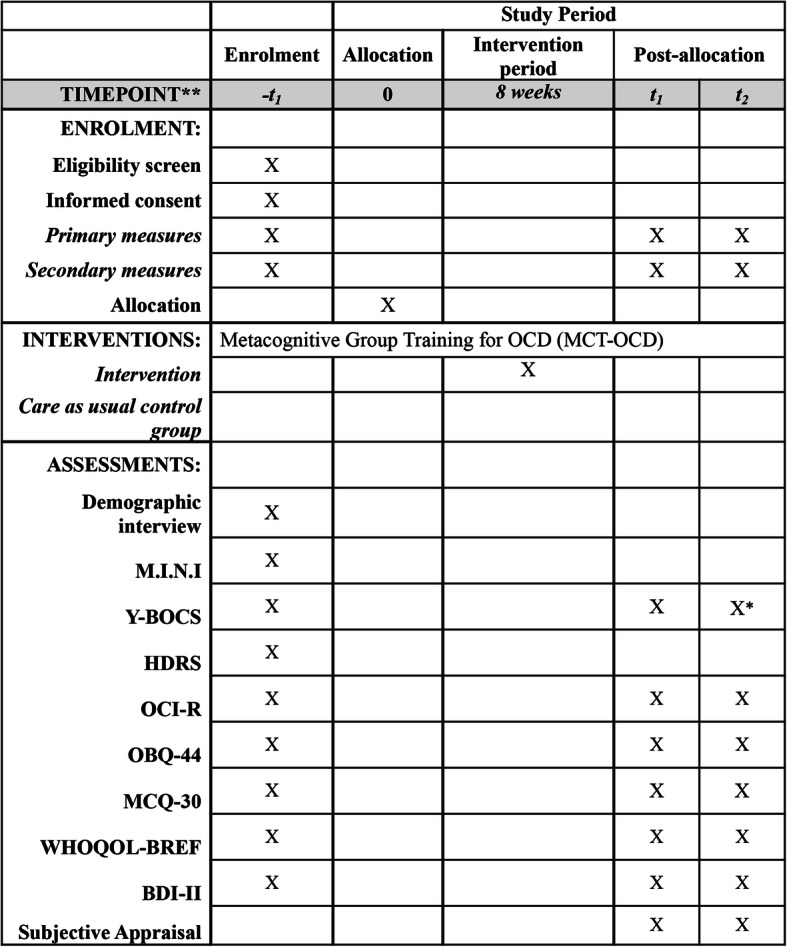
Background: A high number of patients with obsessive-compulsive disorder (OCD) do not receive cognitive-behavioral therapy with exposure and response prevention, which is the most effective treatment for OCD. Therefore, Metacognitive Training for OCD (MCT-OCD) was developed, which is a structured group therapy aiming at the modification of dysfunctional (meta-)cognitive biases, beliefs and coping styles. It can be administered by less trained personnel, thus may reach a higher number of patients. An uncontrolled pilot study (MCT-OCD pilot version) provided first evidence that the training is highly accepted by patients; OC symptoms decreased with a high effect size (η2partial = 0.50). The aim of the present study is to address the shortcomings of the pilot study (e.g., no control group) and to assess the efficacy of the revised version of the MCT-OCD in the framework of a randomized controlled trial. Methods: Eighty patients with OCD will be recruited. After a blinded assessment at baseline (-t1), patients will be randomly assigned either to the intervention group (MCT-OCD; n = 40) or to a care as usual control group (n = 40). The MCT-OCD aims to enhance patients' metacognitive competence in eight modules by addressing dysfunctional (meta-)cognitive biases and beliefs associated with OCD (e.g., intolerance of uncertainty). After 8 weeks, patients will be invited to a post assessment (t1), and then they will receive a follow-up online questionnaire 3 months following t1 (t2). The primary outcome is the Y-BOCS total score, and the secondary outcomes include the HDRS, OCI-R, OBQ-44, MCQ-30, WHOQOL-BREF, BDI-II, and subjective appraisal ratings of the MCT-OCD. We expect that OC symptoms will decrease more in the intervention group compared with the care as usual control group from-t1 to t1 and that treatment gains will be maintained until t2. Discussion: The planned study is the first to investigate the MCT-OCD, a promising new treatment, in a randomized controlled trial. The MCT-OCD may help to overcome existing treatment barriers for patients with OCD. Trial registration: German Registry for Clinical Studies (DRKS00013539), 22.02.2018. © 2020 The Author(s).
Overview
CoChat Summary
TL;DR
This paper is a study protocol for an assessor-blind randomized controlled trial testing revised Metacognitive Training for OCD (MCT-OCD) against care as usual in 80 patients with OCD. It aims to see whether the group intervention reduces Yale-Brown Obsessive Compulsive Scale (Y-BOCS) scores more than usual care over 8 weeks and whether gains persist at 3-month follow-up.
Key findings
- This is a protocol paper, so it reports no trial results yet; at submission, “no data had yet been analyzed.”
- The planned sample is 80 patients with OCD, randomized 40 to MCT-OCD and 40 to care as usual.
- The primary outcome is the Y-BOCS total score; secondary outcomes include HDRS, OCI-R, OBQ-44, MCQ-30, WHOQOL-BREF, BDI-II, and subjective appraisal ratings.
- The protocol is motivated by prior evidence from an uncontrolled pilot: acceptability was high, with 89.7% of patients saying they would recommend MCT-OCD, and OC symptoms decreased with a large effect size (η2partial = 0.50).
Methods
- Assessor-blind randomized controlled trial with two arms: MCT-OCD versus care as usual; baseline, post-treatment at 8 weeks, and follow-up at 3 months after post.
- Planned recruitment of 80 adults aged 18–70 with OCD, diagnosed by the MINI 7.0.2; participants could continue existing outpatient psychotherapy and/or pharmacological treatment.
- Main analysis plan: intention-to-treat and complete cases analyses, with ANCOVAs comparing groups and multiple imputation for missing values.
Limitations
- The paper states that the care as usual control group may not remove expectancy effects, unlike an active control.
- It also states that follow-up relies on self-rated Y-BOCS, which has disadvantages such as social desirability; this is a limitation the text explicitly acknowledges.
- Evident from the protocol design: this paper cannot report efficacy findings because it is a study protocol and, at submission, no data had yet been analyzed.
Model-written summary. Check it against the paper before relying on it.
Integrity signals
Registry
Cites
Statistics
Figures
Verification
Claims the paper makes
18 Valid · 1 Not valid · 35 Not checked · 28 Own results and interpretations
The cited sources support only part of this claim — read each source’s verdict below.
In the paper
“Moreover, the dropout rate for ERP is quite high (14.7%) [96]”
§ Metacognitive Training for Obsessive-Compulsive Disorder: a study protocol for a randomized controlled trial > Background > Psychological treatments for patients with OCD
What the sources say
- Partly supportedcites [96] Ong CW Clyde JW Bluett EJ Levin ME Twohig MP Dropout rates in exposure with response prevention for obsessive-compulsive disorder: what do the data really say? J Anxiety Disord. 2016 40 8 17 27061971 sourceExperimental — accuracy not yet measured
Section 2.2 reports a weighted mean ERP dropout rate of 14.7%. The Discussion says this was lower than earlier estimates and comparable to dropout rates for other treatments, so the characterization 'quite high' is not supported by the paper's comparisons. (LLM, conf=0.88)
plain- Asserted: passes — The authors put it forward as true.
- Checkable: passes — It can be checked against evidence.
- Load-bearing: passes — The paper’s conclusions depend on it.
- Based: passes — The paper gives a reason why it holds.
- Partly supported
Every source the paper cites for this claim was checked and supports it.
In the paper
“OCD and depression have a very high comorbidity [61].”
- Also stated in: § Discussion · plain
“OCD and depression have a high comorbidity [61]”
§ Metacognitive Training for Obsessive-Compulsive Disorder: a study protocol for a randomized controlled trial > Methods > Intervention The MCT-OCD aims to modify dysfunctional (meta-)cognitive biases, beliefs as well as dysfunctional coping strategies that contribute to the development and maintenance of OC symptoms. The number of modules has been increased from four (pilot version) to eight (revised version) and the length of the sessions extended from 60 to 90 min (over the period of 8 weeks) in order to provide more time for the presentation of the content as well as for addressing the concerns of patients. Two persons who do not have much experience in conducting group therapies and have not completed a training course (one a psychologist undergoing post-graduate training and the other an assisting intern with a bachelor’s degree) will conduct the sessions. Three to ten patients will take part in each session. As the MCT-OCD has an open group format, patients can join the group at any time. At the beginning of their first session, patients will receive a booklet that includes a summary as well as exercises for each module. Six of the eight modules deal with one dysfunctional (meta-)cognitive belief, bias or coping strategy at a time and follow the same structure: (1) an explanation of the general idea of the metacognitive training (only if new participants join the group), (2) a discussion of the exercises from the previous session, (3) an introduction of the dysfunctional (meta-)cognitive belief, bias or dysfunctional coping strategy, (4) examples and emphasis of the relevance for OCD, (5) a presentation and the practicing of techniques to overcome these (meta-)cognitive biases, beliefs or coping strategies, (6) a recap of the main content of the present module, and (7) the possibility for patients to ask questions and to say what they found most helpful. One exception is module #1 (false assumptions about OCD), which teaches patients very basic information about OCD by clarifying false assumption about the disorder. The second exception is module #8 (biased attention/biased cognitive networks), which addresses two cognitive biases (both are relatively short), but the structure is the same as in the other modules. Modules #3 and #6 include additional slides on how to deal with depression and rumination because OCD and depression have a very high comorbidity [61]. If a participant reports negative effects from the MCT-OCD, the therapist will assist the patient in finding another treatment.
What the sources say
- Supportedcites [61] Rickelt J Viechtbauer W Lieverse R Overbeek T van Balkom AJ van Oppen P The relation between depressive and obsessive-compulsive symptoms in obsessive-compulsive disorder: results from a large, naturalistic follow-up study J Affect Disord. 2016 203 241 247 27310102 source
The Introduction describes major depressive disorder as one of the most frequent comorbid diagnoses in OCD and reports current comorbidity in approximately one third of patients and lifetime comorbidity in about two thirds. The Discussion also refers to the high prevalence of current and lifetime MDD in OCD patients. (LLM, conf=0.94)
boostedstates an association- Asserted: passes — The authors put it forward as true.
- Checkable: passes — It can be checked against evidence.
- Load-bearing: passes — The paper’s conclusions depend on it.
- Based: passes — The paper gives a reason why it holds.
- Also stated in: § Discussion · plain
Every source the paper cites for this claim was checked and supports it.
In the paper
“To detect a medium to large effect size of d = 0.80, with an alpha level of α = 0.05 and a power of 0.80, G*Power [66] calculated a sample size of N = 70.”
§ Metacognitive Training for Obsessive-Compulsive Disorder: a study protocol for a randomized controlled trial > Methods > Sample size
What the sources say
- Supportedcites [66] Faul F Erdfelder E Lang A-G Buchner A G*power 3: a flexible statistical power analysis program for the social, behavioral, and biomedical sciences Behav Res Methods. 2007 39 175 191 17695343 source
The A Priori Power Analyses and Program Handling sections identify G*Power as a program that calculates sample size from effect size, significance level, and desired power. The citation identifies the software used for the citing authors’ calculation; the source paper does not itself report their N = 70 result. (LLM, conf=0.86)
plainn = 70- Asserted: passes — The authors put it forward as true.
- Checkable: passes — It can be checked against evidence.
- Load-bearing: passes — The paper’s conclusions depend on it.
- Based: passes — The paper gives a reason why it holds.
- Supported
Every source the paper cites for this claim was checked and supports it.
In the paper
“Using a non-randomized-design, Wells’ metacognitive therapy was compared to group CBT in OCD, and the metacognitive therapy showed a superior response rate (a 86.3% response rate for metacognitive therapy compared to a 64% response rate for CBT) [37].”
§ Metacognitive Training for Obsessive-Compulsive Disorder: a study protocol for a randomized controlled trial > Background > Psychological treatments for patients with OCD
What the sources say
- Supportedcites [37] Papageorgiou C Carlile K Thorgaard S Waring H Haslam J Horne L Group cognitive-behavior therapy or group metacognitive therapy for obsessive-compulsive disorder? Benchmarking and Comparative Effectiveness in a Routine Clin Serv Front Psychol 2018 9 2551 PMC6295517 30618972 source
Table 3 in the Results reports response rates of 82/95 (86.3%) for group MCT and 80/125 (64%) for group CBT; the Results also state that the difference was statistically significant. The Introduction describes the treatments as successive cohorts in a routine clinical service, consistent with a non-randomized comparison, and the Methods identify MCT as following Wells’ approach. Our copy provides no page numbers for these passages. (LLM, conf=0.94)
plainstates a cause- Asserted: passes — The authors put it forward as true.
- Checkable: passes — It can be checked against evidence.
- Load-bearing: passes — The paper’s conclusions depend on it.
- Based: passes — The paper gives a reason why it holds.
- Supported
The cited sources support only part of this claim — read each source’s verdict below.
In the paper
“because OCD and depression have a lifetime comorbidity of 56.6% [61] and share some dysfunctional beliefs and coping strategies, such as rumination [62–64].”
§ Metacognitive Training for Obsessive-Compulsive Disorder: a study protocol for a randomized controlled trial > Background > Specific contents of the MCT-OCD
What the sources say
- Not checked — no full text of the sourcecites [62] Abramowitz JS Storch EA Keeley M Cordell E Obsessive-compulsive disorder with comorbid major depression: what is the role of cognitive factors? Behav Res Ther. 2007 45 2257 2267 17521605 source
- Partly supportedcites [63] Motivala SJ Arellano M Greco RL Aitken D Hutcheson N Tadayonnejad R Relationships between obsessive-compulsive disorder, depression and functioning before and after exposure and response prevention therapy Int J Psychiatry Clin Pract. 2018 22 40 46 28691550 PMC5777899 sourceExperimental — accuracy not yet measured
The Objective section describes rumination as important in depression and associated with OCD, and explains how beliefs in OCD can trigger rumination as a way to manage distressing thoughts. It does not establish that OCD and depression share the same dysfunctional beliefs, although it supports rumination as a process relevant to both. (LLM, conf=0.83)
- Not checked — no full text of the sourcecites [64] Shaw AM Carbonella JY Arditte Hall KA Timpano KR Obsessive-compulsive and depressive symptoms: the role of depressive cognitive styles J Psychol. 2017 151 532 546 29077549 source
plainstates an association- Asserted: passes — The authors put it forward as true.
- Checkable: passes — It can be checked against evidence.
- Load-bearing: passes — The paper’s conclusions depend on it.
- Based: passes — The paper gives a reason why it holds.
29 more claims · 9 with their cited sources checked
Create a free account to see all 82 claims and every source verdict.
- It may state two separate claims as one. 26
- Probably not a substantial claim. 32
Self-check
Percentages, sums and reported differences re-computed from the paper’s own numbers.
Rated minor: it would not touch a result — a value no result rests on, a p-value that stays on the same side of the significance level, or a conflict that is clerical, resolved elsewhere in the paper, or outside its own findings.
In the paper
“The severity is rated on a scale ranging from one to five, with a maximum rating of 52.”
§ Metacognitive Training for Obsessive-Compulsive Disorder: a study protocol for a randomized controlled trial > Methods > Secondary outcome measures
Reported 52 · recomputed 85
Citations
Cites
Faul, F., Erdfelder, E., Lang, A.-G., & Buchner, A. (2007) · Behavior Research Methods · doi:10.3758/bf03193146 · Cited by 65,971 · cited 2×
“To detect a medium to large effect size of d = 0.80, with an alpha level of α = 0.05 and a power of 0.80, G*Power [66] calculated a sample size of N = 70.”
BackgroundInfluentialHamilton, M. (1960) · Journal of Neurology, Neurosurgery & Psychiatry · doi:10.1136/jnnp.23.1.56 · Cited by 32,817 · cited 8×
“Inventory-II (BDI-II) [88] and the Hamilton Depression Rating Scale (HDRS) [70], which focus on different facets of depression.”
MethodInfluentialEysenck, H. J. (1985) · Behaviour Research and Therapy · doi:10.1016/0005-7967(85)90087-7 · Cited by 31,975
“Stress: appraisal and coping,”
Folkman, S. (2013) · Encyclopedia of Behavioral Medicine · doi:10.1007/978-1-4419-1005-9_215 · Cited by 27,833
(1998) · The Journal of Clinical Psychiatry · Cited by 19,139
Metacognition and cognitive monitoring: A new area of cognitive–developmental inquiry
Flavell, J. H. (1979) · American Psychologist · doi:10.1037/0003-066x.34.10.906 · Cited by 11,282 · cited 1×
“A treatment approach that builds upon the metacognitive model [10] and focuses on dysfunctional (1)Metacognition is defined as thinking about thinking or as cognition about cognitive processes [14].”
Background(1998) · PubMed · Cited by 10,216
The Yale-Brown Obsessive Compulsive Scale: I. Development, Use, and Reliability
Goodman, W. K. (1989) · Archives of General Psychiatry · doi:10.1001/archpsyc.1989.01810110048007 · Cited by 7,712 · cited 9×
“administered in person at baseline and post assessment and assessed online at follow-up [68].”
BackgroundInfluentialBeck, A. T., Steer, R. A., & Brown, G. (2011) · PsycTESTS Dataset · doi:10.1037/t00742-000 · Cited by 7,535
Emotional processing of fear: Exposure to corrective information.
Foa, E. B., & Kozak, M. J. (1986) · Psychological Bulletin · doi:10.1037/0033-2909.99.1.20 · Cited by 5,396
Skevington, S. M., Lotfy, M., & O'Connell, K. A. (2004) · Quality of Life Research · doi:10.1023/b:qure.0000018486.91360.00 · Cited by 4,686 · cited 1×
“WHOQOL-100, is a valid and reliable instrument for assessing quality of life [87].”
The Whoqol Group (1998) · Social Science & Medicine · doi:10.1016/s0277-9536(98)00009-4 · Cited by 3,802 · cited 6×
“The World Health Organization’s WHOQOL-BREF quality of life assessment: psychometric properties and results of the international field trial.”
MethodInfluentialThe Obsessive-Compulsive Inventory: Development and validation of a short version.
Foa, E. B., Huppert, J. D., Leiberg, S., Langner, R., Kichic, R., Hajcak, G., & Salkovskis, P. M. (2002) · Psychological Assessment · doi:10.1037/1040-3590.14.4.485 · Cited by 2,959 · cited 8×
“The primary outcome is the Y-BOCS total score, and the secondary outcomes include the HDRS, OCI-R, OBQ-44, MCQ-30, WHOQOL-BREF, BDI-II, and subjective appraisal ratings of the MCT-OCD.”
BackgroundInfluentialKessler, R. C., Petukhova, M., Sampson, N. A., Zaslavsky, A. M., & Wittchen, H. (2012) · International Journal of Methods in Psychiatric Research · doi:10.1002/mpr.1359 · Cited by 2,947 · cited 1×
“prevalence of 2–3% [2] and often has a chronic course [3].”
BackgroundObsessional-compulsive problems: A cognitive-behavioural analysis
Salkovskis, P. M. (1985) · Behaviour Research and Therapy · doi:10.1016/0005-7967(85)90105-6 · Cited by 1,842
(2008) · Australian journal of advanced nursing · Cited by 1,687
A short form of the metacognitions questionnaire: properties of the MCQ-30
Wells, A., & Cartwright-Hatton, S. (2004) · Behaviour Research and Therapy · doi:10.1016/s0005-7967(03)00147-5 · Cited by 1,396 · cited 6×
“A short form of the metacognitions questionnaire: properties of the MCQ-30.”
BackgroundMethodInfluential(2002) · Journal of Psychiatric and Mental Health Nursing · doi:10.1046/m.1365-2850.2002.00006.x · Cited by 1,143
Cognitive assessment of obsessive-compulsive disorder
(1997) · Behaviour Research and Therapy · doi:10.1016/s0005-7967(97)00017-x · Cited by 963
Kühner, C., Bürger, C., Keller, F., & Hautzinger, M. (2007) · Der Nervenarzt · doi:10.1007/s00115-006-2098-7 · Cited by 935 · cited 1×
“The German version of the BDI-II shows good psychometric properties in clinical and nonclinical samples [89].”
BackgroundObsessive Compulsive Cognitions Working Group (2005) · Behaviour Research and Therapy · doi:10.1016/j.brat.2004.07.010 · Cited by 880
(1997) · Research Explorer (The University of Manchester) · Cited by 714
Öst, L.-G., Havnen, A., Hansen, B., & Kvale, G. (2015) · Clinical Psychology Review · doi:10.1016/j.cpr.2015.06.003 · Cited by 655 · cited 1×
“CBT (“either described as such or as the combination of ERP and cognitive therapy”) ([95], p.”
BackgroundKrupnick, J. L., Sotsky, S. M., Simmens, S., Moyer, J., Elkin, I., Watkins, J., & Pilkonis, P. A. (1996) · Journal of Consulting and Clinical Psychology · doi:10.1037/0022-006x.64.3.532 · Cited by 605
(2001) · Behaviour Research and Therapy · doi:10.1016/s0005-7967(00)00085-1 · Cited by 590
A simple sample size formula for analysis of covariance in randomized clinical trials
Borm, G. F., Fransen, J., & Lemmens, W. A. J. G. (2007) · Journal of Clinical Epidemiology · doi:10.1016/j.jclinepi.2007.02.006 · Cited by 575 · cited 1×
“care as usual control group), the baseline level of the respective outcome as the covariate, and the difference in the scores of the outcomes (t1 – (−t1) and t2 – (−t1), respectively) as the dependent variable will be conducted [91].”
Method(2003) · Behaviour Research and Therapy · doi:10.1016/s0005-7967(02)00099-2 · Cited by 500
Psychological treatment of obsessive–compulsive disorder: A meta-analysis
Rosa-Alcázar, A. I., Sánchez-Meca, J., Gómez-Conesa, A., & Marín-Martínez, F. (2008) · Clinical Psychology Review · doi:10.1016/j.cpr.2008.07.001 · Cited by 444 · cited 1×
“A recent study by Steketee, Siev, Yovel, Lit, and Wilhelm [32] as well as two meta-analyses showed that CT and ERP both reduced OC symptoms to a similar extent [33, 34].”
ResultAbramowitz, J. S., & Deacon, B. J. (2006) · Journal of Anxiety Disorders · doi:10.1016/j.janxdis.2006.03.001 · Cited by 432 · cited 1×
“The OCI-R contains good psychometric properties [74, 76, 77] that have been confirmed for the German version [75, 78].”
BackgroundSkapinakis, P., Caldwell, D. M., Hollingworth, W., Bryden, P., Fineberg, N. A., Salkovskis, P., Welton, N. J., Baxter, H., Kessler, D., Churchill, R., et al. (2016) · The Lancet Psychiatry · doi:10.1016/s2215-0366(16)30069-4 · Cited by 407 · cited 1×
“, selective serotonin reuptake inhibitors) are evidence-based treatments for OCD [19].”
Mataix‐Cols, D., de la Cruz, L. F., Nordsletten, A. E., Lenhard, F., Isomura, K., & Simpson, H. B. (2016) · World Psychiatry · doi:10.1002/wps.20299 · Cited by 386
The OCI-R: Validation of the subscales in a clinical sample
Huppert, J. D., Walther, M. R., Hajcak, G., Yadin, E., Foa, E. B., Simpson, H. B., & Liebowitz, M. R. (2007) · Journal of Anxiety Disorders · doi:10.1016/j.janxdis.2006.05.006 · Cited by 325 · cited 1×
“The OCI-R contains good psychometric properties [74, 76, 77] that have been confirmed for the German version [75, 78].”
BackgroundReliability of the Hamilton Rating Scale for Depression: A meta-analysis over a period of 49years
Trajković, G., Starčević, V., Latas, M., Leštarević, M., Ille, T., Bukumirić, Z., & Marinković, J. (2011) · Psychiatry Research · doi:10.1016/j.psychres.2010.12.007 · Cited by 303
Hand, I., & Büttner-Westphal, H. (2009) · Verhaltenstherapie · doi:10.1159/000257972 · Cited by 247
Metacognitive therapy for obsessive–compulsive disorder: A case series
Fisher, P. L., & Wells, A. (2008) · Journal of Behavior Therapy and Experimental Psychiatry · doi:10.1016/j.jbtep.2006.12.001 · Cited by 240 · cited 14×
“Wells A. Cognitive therapy of anxiety disorders: a practice manual and conceptual guide: Wiley; 1997.”
BackgroundInfluentialGönner, S., Leonhart, R., & Ecker, W. (2008) · Journal of Anxiety Disorders · doi:10.1016/j.janxdis.2007.07.007 · Cited by 235 · cited 2×
“The OCI-R contains good psychometric properties [74, 76, 77] that have been confirmed for the German version [75, 78].”
BackgroundObsessive-compulsive neurosis: A cognitive-behavioral formulation and approach to treatment
McFall, M. E., & Wollersheim, J. P. (1979) · Cognitive Therapy and Research · doi:10.1007/bf01184447 · Cited by 222
Eichner, C., & Berna, F. (2016) · Schizophrenia Bulletin · doi:10.1093/schbul/sbv225 · Cited by 218
Treatment Response, Symptom Remission, and Wellness in Obsessive-Compulsive Disorder
Farris, S. G., McLean, C. P., Van Meter, P. E., Simpson, H. B., & Foa, E. B. (2013) · The Journal of Clinical Psychiatry · doi:10.4088/jcp.12m07789 · Cited by 216
Ougrin, D. (2011) · BMC Psychiatry · doi:10.1186/1471-244x-11-200 · Cited by 201 · cited 1×
“A recent study by Steketee, Siev, Yovel, Lit, and Wilhelm [32] as well as two meta-analyses showed that CT and ERP both reduced OC symptoms to a similar extent [33, 34].”
ResultMoritz, S., & Lysaker, P. H. (2018) · Schizophrenia Research · doi:10.1016/j.schres.2018.06.001 · Cited by 187 · cited 5×
“specific versions have been intended as hybrids, to amalgamate a CBT and Metacognitive Training approach” ([15], p.”
BackgroundInfluentialColes, M. E., Cook, L. M., & Blake, T. R. (2007) · Behaviour Research and Therapy · doi:10.1016/j.brat.2006.12.009 · Cited by 171 · cited 1×
“Internet administration of the OCI-R produces equivalent results to paper-and-pencil administration [80].”
ResultOng, C. W., Clyde, J. W., Bluett, E. J., Levin, M. E., & Twohig, M. P. (2016) · Journal of Anxiety Disorders · doi:10.1016/j.janxdis.2016.03.006 · Cited by 160 · cited 2×
“several studies support the validity of the Y-BOCS selfrating [96] and was chosen after a cost-benefit”
BackgroundResultSolem, S., Håland, Å. T., Vogel, P. A., Hansen, B., & Wells, A. (2009) · Behaviour Research and Therapy · doi:10.1016/j.brat.2009.01.003 · Cited by 152 · cited 1×
“Another study showed that the need to control thoughts during exposure therapy predicted a subsequent improvement in OC symptoms [18].”
BackgroundQuality of life in obsessive-compulsive disorder before and after treatment
Moritz, S., Rufer, M., Fricke, S., Karow, A., Morfeld, M., Jelinek, L., & Jacobsen, D. (2005) · Comprehensive Psychiatry · doi:10.1016/j.comppsych.2005.04.002 · Cited by 150 · cited 1×
“[4, 5], even following clinically successful treatment.”
Self-citationPotentials and Limitations of Cognitive Treatments for Obsessive‐Compulsive Disorder
Abramowitz, J. S., Taylor, S., & McKay, D. (2005) · Cognitive Behaviour Therapy · doi:10.1080/16506070510041202 · Cited by 142 · cited 14×
“The authors emphasize that more research is needed in order to evaluate group therapy approaches other than CBT. CT, which in contrast to CBT focuses on the cognitive elements and does not include ERP [30], is recommended by the guidelines of the National Institute for Health and Care Excellence (NICE) [20] and is als…”
MethodInfluentialDas Zwangsinventar OCI-R - die deutsche Version des Obsessive-Compulsive Inventory-Revised
Gönner, S., Leonhart, R., & Ecker, W. (2007) · PPmP - Psychotherapie · Psychosomatik · Medizinische Psychologie · doi:10.1055/s-2007-970894 · Cited by 141
Expectancy of therapeutic gain: An empirical and conceptual critique.
Wilkins, W. (1973) · Journal of Consulting and Clinical Psychology · doi:10.1037/h0034056 · Cited by 141 · cited 1×
“Second, care as usual control groups in contrast to active control groups come with the disadvantage of not being able to eliminate expectancy-effects [93].”
BackgroundMeasuring Change in OCD: Sensitivity of the Obsessive-Compulsive Inventory-Revised
Abramowitz, J. S., Tolin, D. F., & Diefenbach, G. J. (2005) · Journal of Psychopathology and Behavioral Assessment · doi:10.1007/s10862-005-2411-y · Cited by 128
An open trial of group metacognitive therapy for obsessive-compulsive disorder
Rees, C. S., & van Koesveld, K. E. (2008) · Journal of Behavior Therapy and Experimental Psychiatry · doi:10.1016/j.jbtep.2007.11.004 · Cited by 123
A Theoretical review of cognitive biases and deficits in obsessive–compulsive disorder
Hezel, D. M., & McNally, R. J. (2016) · Biological Psychology · doi:10.1016/j.biopsycho.2015.10.012 · Cited by 118
Hansen, B., Kvale, G., Hagen, K., Havnen, A., & Öst, L.-G. (2019) · Cognitive Behaviour Therapy · doi:10.1080/16506073.2018.1478447 · Cited by 115
Philipp, R., Kriston, L., Lanio, J., Kühne, F., Härter, M., Moritz, S., & Meister, R. (2019) · Clinical Psychology & Psychotherapy · doi:10.1002/cpp.2345 · Cited by 114
Self-citationMoritz, S., Jelinek, L., Hauschildt, M., & Naber, D. (2010) · Dialogues in Clinical Neuroscience · doi:10.31887/dcns.2010.12.2/smoritz · Cited by 113 · cited 5×
“, open group concept, inclusion of “aha moments”) with the contents of a self-help manual for patients suffering from OCD called “myMCT” (for “my metacognitive training”) developed by Moritz, Jelinek, Hauschildt, and Naber [44].”
InfluentialSelf-citationKrupnick, J. L., Sotsky, S. M., Elkin, I., Simmens, S., Moyer, J., Watkins, J., & Pilkonis, P. A. (2006) · Focus · doi:10.1176/foc.4.2.269 · Cited by 111
Jónsson, H., & Hougaard, E. (2009) · Acta Psychiatrica Scandinavica · doi:10.1111/j.1600-0447.2008.01270.x · Cited by 110 · cited 1×
“Although some studies have found that individual CBT is superior to group CBT in patients with OCD [26, 27], most studies report that both are equally effective [29, 97].”
ResultLiu, Y., Tang, C., Hung, T., Tsai, P., & Lin, M. (2018) · Worldviews on Evidence-Based Nursing · doi:10.1111/wvn.12282 · Cited by 109
Obsessive-compulsive disorder with comorbid major depression: What is the role of cognitive factors?
Abramowitz, J. S., Storch, E. A., Keeley, M., & Cordell, E. (2007) · Behaviour Research and Therapy · doi:10.1016/j.brat.2007.04.003 · Cited by 107
Patient Utilization of Cognitive-Behavioral Therapy for OCD
Mancebo, M. C., Eisen, J. L., Sibrava, N. J., Dyck, I. R., & Rasmussen, S. A. (2011) · Behavior Therapy · doi:10.1016/j.beth.2010.10.002 · Cited by 107 · cited 3×
“Mancebo MC, Eisen JL, Sibrava NJ, Dyck IR, Rasmussen SA.”
BackgroundWilhelm, S., Berman, N. C., Keshaviah, A., Schwartz, R. A., & Steketee, G. (2015) · Behaviour Research and Therapy · doi:10.1016/j.brat.2014.12.006 · Cited by 102 · cited 1×
“For example, investigating mechanisms of change in a cognitive therapy (CT) for patients with OCD indicated that the amelioration of beliefs mediated treatment success [17].”
BackgroundSteketee, G., Siev, J., Yovel, I., Lit, K., & Wilhelm, S. (2019) · Behavior Therapy · doi:10.1016/j.beth.2018.04.004 · Cited by 88 · cited 3×
“Wilhelm S, Berman NC, Keshaviah A, Schwartz RA, Steketee G. Mechanisms of change in cognitive therapy for obsessive compulsive disorder: role of maladaptive beliefs and schemas.”
ResultJónsson, H., Hougaard, E., & Bennedsen, B. E. (2011) · Acta Psychiatrica Scandinavica · doi:10.1111/j.1600-0447.2010.01613.x · Cited by 80 · cited 1×
“Although some studies have found that individual CBT is superior to group CBT in patients with OCD [26, 27], most studies report that both are equally effective [29, 97].”
ResultMoritz, S., Külz, A., Voderholzer, U., Hillebrand, T., McKay, D., & Jelinek, L. (2019) · Cognitive Behaviour Therapy · doi:10.1080/16506073.2018.1494750 · Cited by 65 · cited 14×
“The authors emphasize that more research is needed in order to evaluate group therapy approaches other than CBT. CT, which in contrast to CBT focuses on the cognitive elements and does not include ERP [30], is recommended by the guidelines of the National Institute for Health and Care Excellence (NICE) [20] and is als…”
BackgroundInfluentialSelf-citationEfficacy of Metacognitive Training for Depression: A Randomized Controlled Trial
Jelinek, L., Hauschildt, M., Wittekind, C. E., Schneider, B. C., Kriston, L., & Moritz, S. (2016) · Psychotherapy and Psychosomatics · doi:10.1159/000443699 · Cited by 63 · cited 1×
“[42] and borderline personality disorder [43].”
Self-citationRickelt, J., Viechtbauer, W., Lieverse, R., Overbeek, T., van Balkom, A. J., van Oppen, P., van den Heuvel, O. A., Marcelis, M., Eikelenboom, M., Tibi, L., et al. (2016) · Journal of Affective Disorders · doi:10.1016/j.jad.2016.06.009 · Cited by 63 · cited 4×
“bidity of OCD and depression [61], as well as the revisions made to the MCT-OCD pilot version (i.”
BackgroundInfluentialMoritz, S., Jelinek, L., Klinge, R., & Naber, D. (2007) · Behavioural and Cognitive Psychotherapy · doi:10.1017/s1352465807003931 · Cited by 58
Self-citationPozza, A., & Dèttore, D. (2017) · Psychiatry Research · doi:10.1016/j.psychres.2017.09.056 · Cited by 58 · cited 1×
“Although some studies have found that individual CBT is superior to group CBT in patients with OCD [26, 27], most studies report that both are equally effective [29, 97].”
ResultNot as golden as standards should be: Interpretation of the Hamilton Rating Scale for Depression
Kriston, L., & von Wolff, A. (2011) · Journal of Affective Disorders · doi:10.1016/j.jad.2010.07.011 · Cited by 55 · cited 2×
“According to Kriston and von Wolff [72], a final rating of seven or less can be interpreted to mean the patient is not depressed.”
BackgroundJelinek, L., Moritz, S., & Hauschildt, M. (2017) · Journal of Affective Disorders · doi:10.1016/j.jad.2017.06.003 · Cited by 52 · cited 2×
“A similar questionnaire has been used for the evaluation of the D-MCT [90] and the pilot version of the MCT-OCD [48].”
MethodSelf-citationChronic obsessive–compulsive disorder: prognostic factors
van Oudheusden, L. J. B., Eikelenboom, M., van Megen, H. J. G. M., Visser, H. A. D., Schruers, K., Hendriks, G.-J., van der Wee, N., Hoogendoorn, A. W., van Oppen, P., & van Balkom, A. J. L. M. (2018) · Psychological Medicine · doi:10.1017/s0033291717003701 · Cited by 51 · cited 1×
“prevalence of 2–3% [2] and often has a chronic course [3].”
BackgroundMoritz, S., & Jelinek, L. (2011) · Depression and Anxiety · doi:10.1002/da.20843 · Cited by 42
Self-citationSchwartze, D., Barkowski, S., Burlingame, G. M., Strauss, B., & Rosendahl, J. (2016) · Journal of Obsessive-Compulsive and Related Disorders · doi:10.1016/j.jocrd.2016.05.001 · Cited by 40 · cited 3×
“Another meta-analysis [29] confirmed that group therapy is highly efficacious in reducing OC symptoms compared to wait-list control groups (g = 0.”
BackgroundResultHauschildt, M., Schröder, J., & Moritz, S. (2016) · Journal of Obsessive-Compulsive and Related Disorders · doi:10.1016/j.jocrd.2016.04.010 · Cited by 37 · cited 2×
“Despite the generally positive subjective appraisal of the myMCT, 67 to 83% of patients mentioned that instead of using myMCT as a self-help treatment, they would like to use it in face-toface psychotherapy [44, 45].”
BackgroundSelf-citationGrøtte, T., Solem, S., Myers, S. G., Hjemdal, O., Vogel, P. A., Güzey, I. C., Hansen, B., Nordahl, H. M., & Fisher, P. (2016) · Journal of Obsessive-Compulsive and Related Disorders · doi:10.1016/j.jocrd.2016.09.002 · Cited by 37 · cited 1×
“93) [84] and has been shown to have good convergent validity [85].”
BackgroundMoritz, S., & Russu, R. (2012) · Journal of Obsessive-Compulsive and Related Disorders · doi:10.1016/j.jocrd.2012.12.002 · Cited by 36
Self-citationErtle, A., Wahl, K., Bohne, A., Moritz, S., Kordon, A., & Schulte, D. (2008) · Zeitschrift für Klinische Psychologie und Psychotherapie · doi:10.1026/1616-3443.37.4.263 · Cited by 36 · cited 1×
“The OBQ-44 ([81, 82]; German version [83]) is a 44item self-report questionnaire targeting beliefs in OCD on six subscales: control of thoughts, importance of thoughts, responsibility, intolerance of uncertainty, overestimation of threat, and perfectionism.”
BackgroundSelf-citation(2017) · Oxford Medicine Online · doi:10.1093/med/9780190228163.001.0001 · Cited by 33
Moritz, S., Stepulovs, O., Schröder, J., Hottenrott, B., Meyer, B., & Hauschildt, M. (2016) · Journal of Obsessive-Compulsive and Related Disorders · doi:10.1016/j.jocrd.2016.04.001 · Cited by 32
Self-citationQuality of life and relationship satisfaction of patients with Obsessive Compulsive Disorder
Remmerswaal, K. C. P., Batelaan, N. M., Smit, J. H., van Oppen, P., & van Balkom, A. J. L. M. (2016) · Journal of Obsessive-Compulsive and Related Disorders · doi:10.1016/j.jocrd.2016.08.005 · Cited by 32 · cited 1×
“[4, 5], even following clinically successful treatment.”
Papageorgiou, C., Carlile, K., Thorgaard, S., Waring, H., Haslam, J., Horne, L., & Wells, A. (2018) · Frontiers in Psychology · doi:10.3389/fpsyg.2018.02551 · Cited by 30 · cited 1×
“3% response rate for metacognitive therapy compared to a 64% response rate for CBT) [37].”
The structure of obsessive compulsive symptoms and beliefs: A correspondence and biplot analysis
Kim, S.-K., McKay, D., Taylor, S., Tolin, D., Olatunji, B., Timpano, K., & Abramowitz, J. (2016) · Journal of Anxiety Disorders · doi:10.1016/j.janxdis.2016.01.003 · Cited by 29
Jelinek, L., Zielke, L., Hottenrott, B., Miegel, F., Cludius, B., Sure, A., & Demiralay, C. (2018) · Zeitschrift für Neuropsychologie · doi:10.1024/1016-264x/a000211 · Cited by 26 · cited 4×
“A similar questionnaire has been used for the evaluation of the D-MCT [90] and the pilot version of the MCT-OCD [48].”
BackgroundMethodInfluentialSelf-citationMotivala, S. J., Arellano, M., Greco, R. L., Aitken, D., Hutcheson, N., Tadayonnejad, R., O’Neill, J., & Feusner, J. D. (2018) · International Journal of Psychiatry in Clinical Practice · doi:10.1080/13651501.2017.1351991 · Cited by 25
Schilling, L., Moritz, S., Köther, U., & Nagel, M. (2015) · Journal of Cognitive Psychotherapy · doi:10.1891/0889-8391.29.2.153 · Cited by 24 · cited 1×
“[42] and borderline personality disorder [43].”
Self-citationVersorgung Zwangserkrankter mit kognitiver Verhaltenstherapie als Behandlungsmethode erster Wahl
Voderholzer, U., Schlegl, S., Diedrich, A., Külz, A. K., Thiel, N., Hertenstein, E., Schwartz, C., Rufer, M., Herbst, N., Nissen, C., et al. (2015) · Verhaltenstherapie · doi:10.1159/000438717 · Cited by 23 · cited 15×
“[24] suggest that the fear of being confronted with anxiety-inducing stimuli might be one of the reasons why patients do not want to undergo this treatment.”
BackgroundInfluentialSelf-citationZwänge : Diagnose, Theorien und Behandlung
Reinecker, H. S. (1991) · Cited by 23
Jelinek, L., Hauschildt, M., Hottenrott, B., Kellner, M. B., & Moritz, S. (2018) · Journal of Anxiety Disorders · doi:10.1016/j.janxdis.2018.03.012 · Cited by 19
Self-citationSession-specific effects of the Metacognitive Training for Obsessive-Compulsive Disorder (MCT-OCD)
Miegel, F., Cludius, B., Hottenrott, B., Demiralay, C., Sure, A., & Jelinek, L. (2020) · Psychotherapy Research · doi:10.1080/10503307.2019.1613582 · Cited by 19 · cited 2×
“Besides showing promising in-session as well as between-session effects, the MCT-OCD in its pilot version has also been shown to be highly accepted by patients with OCD [48], to have module-specific positive effects [50], and to result in a reduction of OC symptoms with large effect sizes [49].”
BackgroundSelf-citationThe characteristics of obsessional thinking: Difficulty demonstrating the obvious?
Tallis, F. (1995) · Clinical Psychology & Psychotherapy · doi:10.1002/cpp.5640020103 · Cited by 18
Obsessive-Compulsive and Depressive Symptoms: The Role of Depressive Cognitive Styles
Shaw, A. M., Carbonella, J. Y., Arditte Hall, K. A., & Timpano, K. R. (2017) · The Journal of Psychology · doi:10.1080/00223980.2017.1372341 · Cited by 17
Metacognitive Model and Treatment of OCD
Wells, A., Myers, S., Simons, M., & Fisher, P. (2017) · The Wiley Handbook of Obsessive Compulsive Disorders · doi:10.1002/9781118890233.ch36 · Cited by 17
The Metacognitive Training for obsessive-compulsive disorder: A pilot study
Miegel, F., Demiralay, C., Sure, A., Moritz, S., Hottenrott, B., Cludius, B., & Jelinek, L. (2022) · Current Psychology · doi:10.1007/s12144-020-01158-5 · Cited by 15
Self-citationAssociation splitting of the sexual orientation-OCD-relevant semantic network
Ching, T. H. W., & Williams, M. T. (2018) · Cognitive Behaviour Therapy · doi:10.1080/16506073.2017.1343380 · Cited by 14
Sunde, T., Walseth, L. T., Himle, J. A., Vogel, P. A., Launes, G., Haaland, V. Ø., Hoffart, A., Johnson, S. U., & Haaland, Å. T. (2017) · Journal of Obsessive-Compulsive and Related Disorders · doi:10.1016/j.jocrd.2017.06.002 · Cited by 11
Die S3-Leitlinie zur Diagnostik und Therapie der Zwangsstörungen
Kordon, A., Lotz-Rambaldi, W., Muche-Borowski, C., Zurowski, B., & Hohagen, F. (2014) · PiD - Psychotherapie im Dialog · doi:10.1055/s-0034-1376927 · Cited by 8 · cited 1×
“, patients are able to share their thoughts with others who have similar symptoms and obstacles), which has already been shown to be very helpful for patients with OCD for CBT groups [51].”
BackgroundThe field and problems of social psychology.
Krech, D., & Crutchfield, R. S. (2004) · McGraw-Hill eBooks · doi:10.1037/10024-001 · Cited by 2 · cited 1×
“A belief may be defined as “an enduring organization of perceptions and cognitions about some aspect of the individual’s world” ([13], p.”
Background(1984) · Medical Entomology and Zoology
Research works printed but not linked: 7
- Wells A. Emotional disorders and metacognition: innovative cognitive therapy: Wiley; 2000.
- National Instituate for Health and Care Excellence (NICE). Obsessive-compulsive disorder: Core interventions in the treatment of obsessive-compulsive disorder and body dysmorphic disorder: NICE clinical guideline 31: British Psychological Society; 2005. 21834191
- Bundespsychotherapeutenkammer Ein Jahr nach der Reform der Psychotherapie-Richtlinie Wartezeiten 2018 2018 40
- Schmidt K-H Metzler P Wortschatztest 1992 Weihnheim Beltz Test
- Obsessive Compulsive Cognitions Working Group Cognitive assessment of obsessive-compulsive disorder. Obsessive Compulsive Cognitions Working Group Behav Res Ther 1997 35 667 681 9193129 · DOI · Paper page
- Beck AT Steer RA Brown GK Beck depression inventory. Second Edition.Manual 1996 San Antonio The Psychological Corporation
- Moritz S Woodward TS Metacognitive training for schizofrenia pazients (MTC): a pilot study on feasibility, treatment adherence, and subjective efficacy Ger J Psychiatry. 2007 10 69 78
Cited by
Metacognitive Training for Obsessive-Compulsive Disorder: A randomized controlled trial
Miegel, F. S., Moritz, S., Hottenrott, B., Demiralay, C., & Jelinek, L. (2021) · Journal of Obsessive-Compulsive and Related Disorders · doi:10.1016/j.jocrd.2021.100647 · Cited by 33
Self-citationSyaiful, S., Huda, N., Mukminin, A., & Kamid, K. (2022) · SN Social Sciences · doi:10.1007/s43545-022-00325-8 · Cited by 47
“By developing awareness in metacognition, students are expected to be consistently used to monitor, control, and evaluate what they have done (Faivre et al. 2020; Miegel et al. 2020; Thorslund et al. 2020; Yusnaeni et al. 2020).”
BackgroundGohari, E., Moore, R. C., Depp, C. A., Ackerman, R. A., Pinkham, A. E., & Harvey, P. D. (2022) · Psychiatry Research · doi:10.1016/j.psychres.2022.114487 · Cited by 23
Self-esteem mediates the relationship between perfectionism and obsessive-compulsive symptoms
Miegel, F. S., Moritz, S., Wagener, F., Cludius, B., & Jelinek, L. (2020) · Personality and Individual Differences · doi:10.1016/j.paid.2020.110239 · Cited by 25
Self-citationMiegel, F., Cludius, B., Hottenrott, B., Demiralay, C., & Jelinek, L. (2020) · Scientific Reports · doi:10.1038/s41598-020-73122-z · Cited by 8
Self-citation
Metadata
- Authors
- Miegel, F., Demiralay, C., Moritz, S., Wirtz, J., Hottenrott, B., & Jelinek, L.
- Affiliations
- University Medical Center Hamburg-Eppendorf (DE)
- Corresponding author
- Miegel, Franziska
- Venue
- BMC Psychiatry
- Published
- 2020-07-06
- Volume
- 20
- Issue
- 1
- Pages
- 350-350
- ISSN
- 1471-244X (ISSN-L)
- PMC
- PMC7336399
- OpenAlex
- W3040129653
- Cited by
- 18
- References
- 99
- Citations by year
- 2026: 1 · 2025: 1 · 2024: 2 · 2023: 3 · 2022: 8 · 2021: 1 · 2020: 2
- FWCI
- 1.40
- Type
- journal article
- Language
- en
- Open access
- gold
- doi.org
- Licence
- cc-by
- creativecommons.org/licenses/by/4.0 (tdm)
- creativecommons.org/licenses/by/4.0 (vor)
- Locations
- BMC Psychiatry (publishedVersion, cc-by)
- PubMed Central (publishedVersion, cc-by)
- PubMed (publishedVersion)
- DOAJ (DOAJ: Directory of Open Access Journals) (submittedVersion, cc-by-sa)
- Topics
- Social Sciences › Psychology › Clinical Psychology › Obsessive-Compulsive Spectrum Disorders
- Social Sciences › Psychology › Experimental and Cognitive Psychology › Anxiety, Depression, Psychometrics, Treatment, Cognitive Processes
- Social Sciences › Psychology › Clinical Psychology › Psychoanalysis and Psychopathology Research
- Keywords
- obsessive-compulsive disorder, metacognitive training, intolerance of uncertainty, group therapy, treatment efficacy, barriers to treatment, Yale-Brown Obsessive Compulsive Scale, maintenance therapy, metacognitive skills
- MeSH terms
- Metacognition, Humans, Obsessive-Compulsive Disorder, Pilot Projects, Psychotherapy, Group, Cognitive Behavioral Therapy, Treatment Outcome
About these checks
Registry, retraction, Cites and statistics results are computed, not judged, with one exception: a printed reference that no index lists is read once by a model before it counts as a citation error. Claims are extracted by a model and kept only when their quote appears verbatim in the text; each cited source is then checked, with a model’s help, for whether it says what the claim relies on. Those verdicts can be wrong — read the claim’s quote and the cited source before relying on one.
The claim verdicts this report counts are experimental: their accuracy is not yet measured.
A language model drew the claims from the paper on 2026-10-11, under version 3 of the claim definition (model deepseek-v4.1-flash, prompt extract-v3).
A second model labelled each claim on 2026-10-11 (model jev-1.13-20260917, definition revision gold-guideline-v0.2).
Cited sources are checked with a language model’s help (gpt-6-sol).
Statistics and arithmetic are recomputed, not judged.
Confidence bands are shown only for fields calibrated on our annotated test set. None is calibrated yet, so no band is shown.
What counts as a claim ›How we measure confidence ›How we check this ›
Are you an author, or do you see a problem with this page? Request a review
Data sources
Bibliographic data: Semantic Scholar, OpenAlex, Crossref.
Contains information from the Semantic Scholar Academic Graph Datasets, made available under the ODC Attribution License (ODC-BY 1.0).
Semantic Scholar’s data is described in: Kinney, R., et al. (2023). The Semantic Scholar Open Data Platform. arXiv:2301.10140.
