

Effectiveness of arts interventions to reduce mental-health-related stigma among youth: a systematic review and meta-analysis
Open accessThe DOI matches its Crossref record; 106 of the 107 references it cites were found in a registry or an index, and 1 are not checked yet.
Abstract
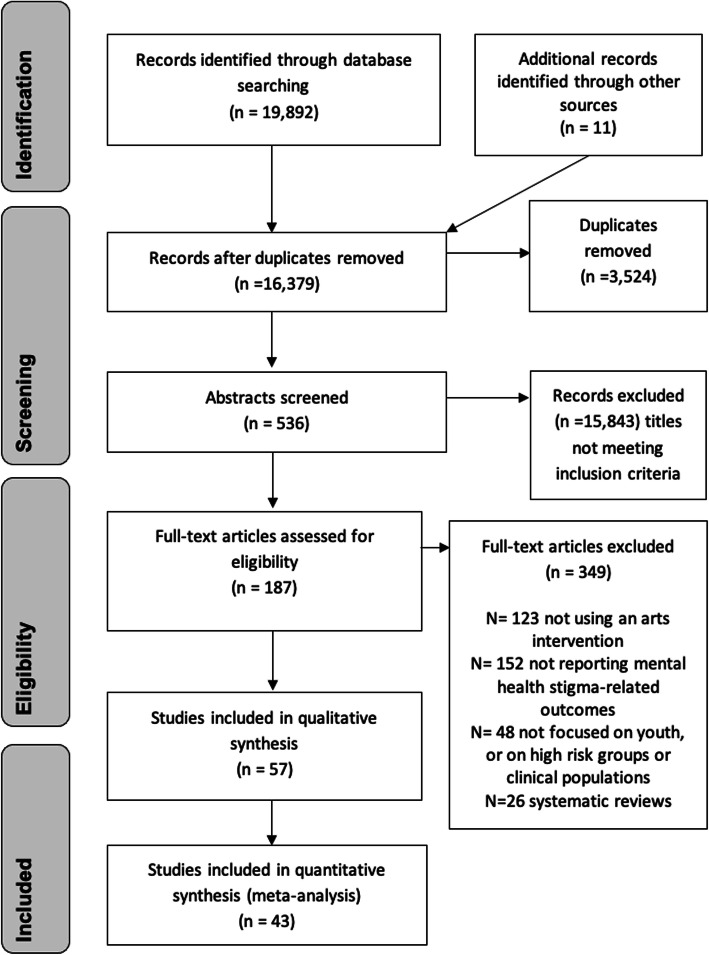
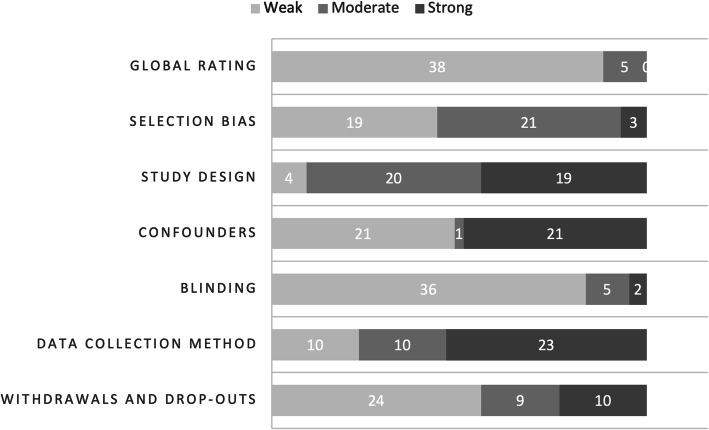
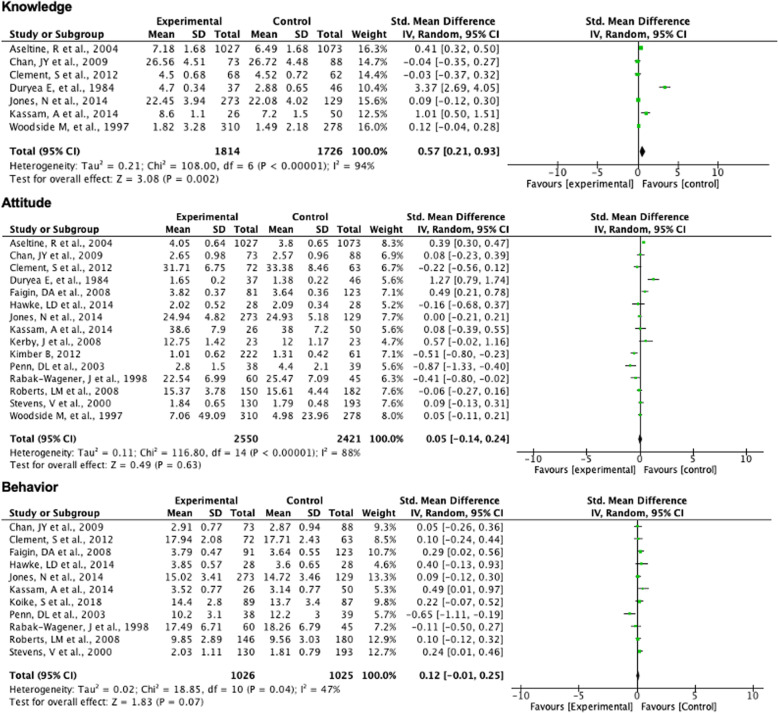
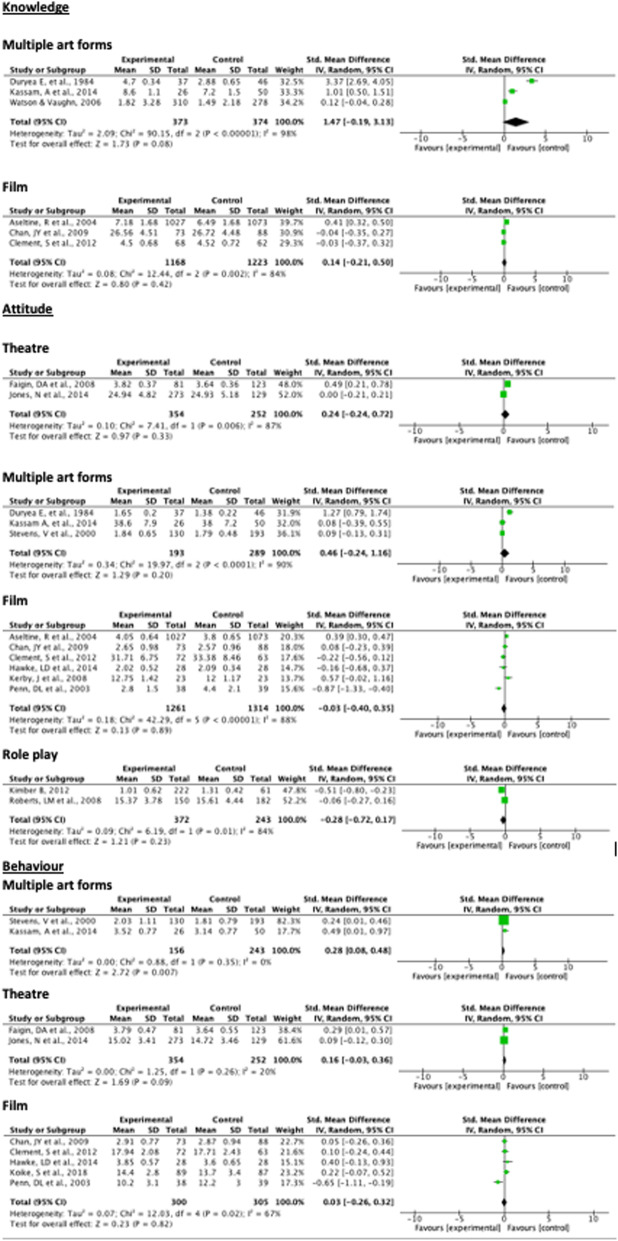
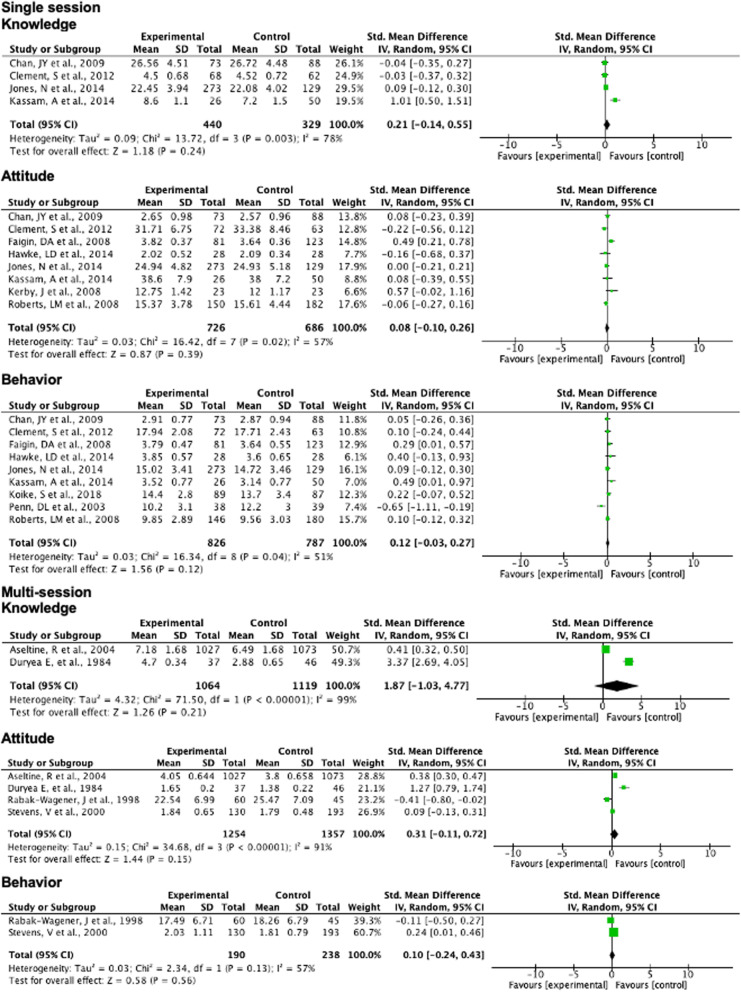
BACKGROUND: Educational interventions engage youth using visual, literary and performing arts to combat stigma associated with mental health problems. However, it remains unknown whether arts interventions are effective in reducing mental-health-related stigma among youth and if so, then which specific art forms, duration and stigma-related components in content are successful. METHODS: We searched 13 databases, including PubMed, Medline, Global Health, EMBASE, ADOLEC, Social Policy and Practice, Database of Promoting Health Effectiveness Reviews (DoPHER), Trials Register of Promoting Health Interventions (TRoPHI), EPPI-Centre database of health promotion research (Bibliomap), Web of Science, PsycINFO, Cochrane and Scopus for studies involving arts interventions aimed at reducing any or all components of mental-health-related stigma among youth (10-24-year-olds). Risk of bias was assessed using the Effective Public Health Practice Project (EPHPP) Quality Assessment Tool for Quantitative Studies. Data were extracted into tables and analysed using RevMan 5.3.5. RESULTS: Fifty-seven studies met our inclusion criteria (n = 41,621). Interventions using multiple art forms are effective in improving behaviour towards people with mental health problems to a small effect (effect size = 0.28, 95%CI 0.08-0.48; p = 0.007) No studies reported negative outcomes or unintended harms. Among studies using specific art forms, we observed high heterogeneity among intervention studies using theatre, multiple art forms, film and role play. Data in this review are inconclusive about the use of single versus multiple sessions and whether including all stigma components of knowledge, attitude and behaviour as intervention content are more effective relative to studies focused on these stigma components, individually. Common challenges faced by school-based arts interventions included lack of buy-in from school administrators and low engagement. No studies were reported from low- and middle-income countries. CONCLUSION: Arts interventions are effective in reducing mental-health-related stigma to a small effect. Interventions that employ multiple art forms together compared to studies employing film, theatre or role play are likely more effective in reducing mental-health-related stigma.
Overview
The claims and statistics of this paper haven’t been checked yet.
Free: it reads the open-access text and checks the first 5 claims that cite a source we can check. Create a free account to check every claim.
Integrity signals
Registry
Cites
Statistics
Figures
Verification
Claims the paper makes
The claims and statistics of this paper haven’t been checked yet.
Free: it reads the open-access text and checks the first 5 claims that cite a source we can check. Create a free account to check every claim.
Claims other papers make about this one
Each is checked against this paper’s own text: does it say what the citing paper says it does?
In the citing paper
“Gaiha and colleagues 117 focused on arts interventions (eg, film, theatre, and creative writing) to reduce stigma related to mental health conditions among youth (aged 10-24 years).”
From The Lancet Commission on ending stigma and discrimination in mental health (2022) · cites this paper as [117]
In the citing paper
“Overall, the results indicated positive effects and a meta-analysis showed that arts interventions are generally effective when using multiple art forms, although the effects were small.”
From The Lancet Commission on ending stigma and discrimination in mental health (2022) · cites this paper as [117]
In the citing paper
“The study quality ranged from low to moderate, with some studies reported as being methodologically strong.”
From The Lancet Commission on ending stigma and discrimination in mental health (2022) · cites this paper as [117]
In the citing paper
“57 studies were identified (quantitative and qualitative), eight of which were randomised controlled trials.”
From The Lancet Commission on ending stigma and discrimination in mental health (2022) · cites this paper as [117]
Self-check
Percentages, sums and reported differences re-computed from the paper’s own numbers.
The self-check needs the paper’s full text.
Citations
Cites
Link, B. G., & Phelan, J. C. (2001) · Annual Review of Sociology · doi:10.1146/annurev.soc.27.1.363 · Cited by 8,848
Toward a definition of mixed methods research
Johnson, R. B., Onwuegbuzie, A. J., & Turner, L. A. (2007) · Journal of Mixed Methods Research · doi:10.1177/1558689806298224 · Cited by 6,464 · cited 1×
“” [24] Studies were excluded from the review if they met one of the following criteria: – Target clinical, high-risk or at-risk populations (youth with mental disorders, including outpatients, in schools for special needs, in prisons, foster homes/ shelters and conflict zones or exposed to violence) or caregivers as t…”
BackgroundDewey, J. (2026) · Art and Its Significance · doi:10.1515/9798855805482-007 · Cited by 5,188
Gulliver, A., Griffiths, K. M., & Christensen, H. (2010) · BMC Psychiatry · doi:10.1186/1471-244x-10-113 · Cited by 3,292
Child and adolescent mental health worldwide: evidence for action
Kieling, C., Baker-Henningham, H., Belfer, M., Conti, G., Ertem, I., Omigbodun, O., Rohde, L. A., Srinath, S., Ulkuer, N., & Rahman, A. (2011) · The Lancet · doi:10.1016/s0140-6736(11)60827-1 · Cited by 2,449
Narration as a human communication paradigm: The case of public moral argument
Fisher, W. R. (1984) · Communication Monographs · doi:10.1080/03637758409390180 · Cited by 1,807 · cited 1×
“Student art projects or co-creation of art to reduce mental-health-related stigma may embody such a concept, and finds support in two theories: 1) Fisher’s communication narrative theory where art is a form of communication and storytelling and storytelling has the potential to re-shape the social world [117] and 2) G…”
BackgroundEvidence for effective interventions to reduce mental-health-related stigma and discrimination
Thornicroft, G., Mehta, N., Clement, S., Evans-Lacko, S., Doherty, M., Rose, D., Koschorke, M., Shidhaye, R., O'Reilly, C., & Henderson, C. (2016) · The Lancet · doi:10.1016/s0140-6736(15)00298-6 · Cited by 1,338
Self-citationStigma: ignorance, prejudice or discrimination?
Thornicroft, G., Rose, D., Kassam, A., & Sartorius, N. (2007) · British Journal of Psychiatry · doi:10.1192/bjp.bp.106.025791 · Cited by 826
Evans-Lacko, S., Aguilar-Gaxiola, S., Al-Hamzawi, A., Alonso, J., Benjet, C., Bruffaerts, R., Chiu, W. T., Florescu, S., de Girolamo, G., Gureje, O., et al. (2018) · Psychological Medicine · doi:10.1017/s0033291717003336 · Cited by 781 · cited 1×
“Thus, although an estimated 10–20% of youth aged 10–24 years suffer from mental health problems, [4] 63– 86% of all mental health problems that require a diagnosis generally go undetected [5].”
BackgroundPrejudice, Social Distance, and Familiarity with Mental Illness
Corrigan, P. W., Edwards, A. B., Green, A., Diwan, S. L., & Penn, D. L. (2001) · Schizophrenia Bulletin · doi:10.1093/oxfordjournals.schbul.a006868 · Cited by 690
Hanisch, S. E., Twomey, C. D., Szeto, A. C. H., Birner, U. W., Nowak, D., & Sabariego, C. (2016) · BMC Psychiatry · doi:10.1186/s12888-015-0706-4 · Cited by 564 · cited 1×
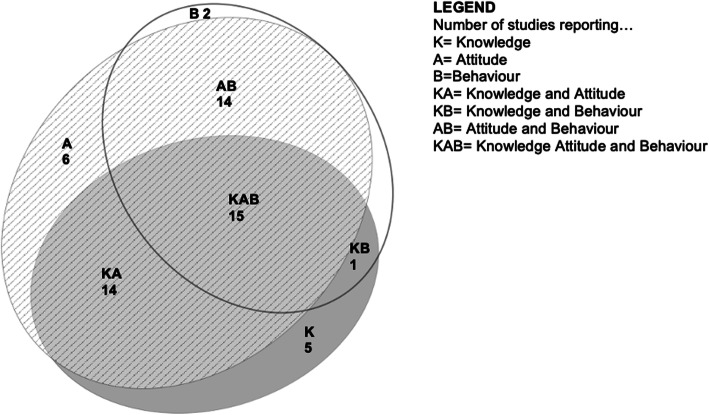
“in 2016, where they assessed and plotted successful impact on knowledge, attitude and behaviour outcomes from workplace interventions [114].”
BackgroundeulerAPE: Drawing Area-Proportional 3-Venn Diagrams Using Ellipses
Micallef, L., & Rodgers, P. (2014) · PLoS ONE · doi:10.1371/journal.pone.0101717 · Cited by 487
Griffiths, K. M., Carron-Arthur, B., Parsons, A., & Reid, R. (2014) · World Psychiatry · doi:10.1002/wps.20129 · Cited by 466
An Outcome Evaluation of the SOS Suicide Prevention Program
Aseltine, R. H., & DeMartino, R. (2004) · American Journal of Public Health · doi:10.2105/ajph.94.3.446 · Cited by 463 · cited 14×
“Other RCTs improved: attitude and behaviour using film [39]; knowledge and attitude using multiple art forms [53] and film [31]; attitude using film [43, 45]; and behavior using film [41, 52, 56].”
BackgroundMethodResultInfluentialDevelopment and psychometric properties of the Mental Health Knowledge Schedule
Evans-Lacko, S., Little, K., Meltzer, H., Rose, D., Rhydderch, D., Henderson, C., & Thornicroft, G. (2010) · The Canadian Journal of Psychiatry · doi:10.1177/070674371005500707 · Cited by 402
Universal school-based prevention programs for alcohol misuse in young people
Foxcroft, D. R., & Tsertsvadze, A. (2011) · Cochrane Database of Systematic Reviews · doi:10.1002/14651858.cd009113 · Cited by 389
Mehta, N., Clement, S., Marcus, E., Stona, A.-C., Bezborodovs, N., Evans-Lacko, S., Palacios, J., Docherty, M., Barley, E., Rose, D., et al. (2015) · British Journal of Psychiatry · doi:10.1192/bjp.bp.114.151944 · Cited by 366
Self-citationEvans-Lacko, S., Rose, D., Little, K., Flach, C., Rhydderch, D., Henderson, C., & Thornicroft, G. (2011) · Epidemiology and Psychiatric Sciences · doi:10.1017/s2045796011000308 · Cited by 363
Frey, K. S., Hirschstein, M. K., Snell, J. L., Edstrom, L. V. S., MacKenzie, E. P., & Broderick, C. J. (2005) · Developmental Psychology · doi:10.1037/0012-1649.41.3.479 · Cited by 306
Mass media interventions for reducing mental health-related stigma
Clement, S., Lassman, F., Barley, E., Evans-Lacko, S., Williams, P., Yamaguchi, S., Slade, M., Rüsch, N., & Thornicroft, G. (2013) · Cochrane Database of Systematic Reviews · doi:10.1002/14651858.cd009453.pub2 · Cited by 284
Greenberg, M. T., & Domitrovich, C. E. (2000) · Cited by 282
Prevention and early intervention to improve mental health in higher education students: A review
Reavley, N., & Jorm, A. F. (2010) · Early Intervention in Psychiatry · doi:10.1111/j.1751-7893.2010.00167.x · Cited by 273
Arts-based methods in health research: A systematic review of the literature
Fraser, K. D., & al Sayah, F. (2011) · Arts & Health · doi:10.1080/17533015.2011.561357 · Cited by 272
Yamaguchi, S., Wu, S.-I., Biswas, M., Yate, M., Aoki, Y., Barley, E. A., & Thornicroft, G. (2013) · Journal of Nervous & Mental Disease · doi:10.1097/nmd.0b013e31829480df · Cited by 220
Bungay, H., & Vella-Burrows, T. (2013) · Perspectives in Public Health · doi:10.1177/1757913912466946 · Cited by 217 · cited 1×
“Other reviews of studies among 11–18 year olds using creative activities such as music, dance, singing, drama and visual arts [22] and performing arts, [23] indicate that arts-based interventions improve knowledge, another component of mental-health-related stigma.”
BackgroundEffectiveness of anti-bullying school programs: A meta-analysis
Jiménez-Barbero, J. A., Ruiz-Hernández, J. A., Llor-Zaragoza, L., Pérez-García, M., & Llor-Esteban, B. (2016) · Children and Youth Services Review · doi:10.1016/j.childyouth.2015.12.015 · Cited by 213
Universal school-based prevention for illicit drug use
Faggiano, F., Minozzi, S., Versino, E., & Buscemi, D. (2014) · Cochrane Database of Systematic Reviews · doi:10.1002/14651858.cd003020.pub3 · Cited by 212
Filmed v. live social contact interventions to reduce stigma: randomised controlled trial
Clement, S., van Nieuwenhuizen, A., Kassam, A., Flach, C., Lazarus, A., De Castro, M., McCrone, P., Norman, I., & Thornicroft, G. (2012) · British Journal of Psychiatry · doi:10.1192/bjp.bp.111.093120 · Cited by 188
Yager, Z., & O'Dea, J. A. (2008) · Health Promotion International · doi:10.1093/heapro/dan004 · Cited by 185
Daykin, N., Orme, J., Evans, D., Salmon, D., McEachran, M., & Brain, S. (2008) · Journal of Health Psychology · doi:10.1177/1359105307086699 · Cited by 175
Chan, J. Y. N., Mak, W. W. S., & Law, L. S. C. (2009) · Social Science & Medicine · doi:10.1016/j.socscimed.2009.02.016 · Cited by 174
Interventions for preventing eating disorders in children and adolescents
Pratt, B. M., & Woolfenden, S. (2002) · Cochrane Database of Systematic Reviews · doi:10.1002/14651858.cd002891 · Cited by 171
The effects of an anti-bullying intervention programme on peers' attitudes and behaviour
Stevens, V. K., Oost, P. V., & Bourdeaudhuij, I. D. (2000) · Journal of Adolescence · doi:10.1006/jado.1999.0296 · Cited by 169
An Evaluation of a School‐Based Suicide Awareness Intervention
Kalafat, J., & Elias, M. (1994) · Suicide and Life-Threatening Behavior · doi:10.1111/j.1943-278x.1994.tb00747.x · Cited by 160 · cited 7×
“Active ingredients that facilitate successful delivery of arts-based interventions include institutional endorsement for the initiative at educational institutions [39, 75] and scheduling sessions during class times [31, 38, 41, 49].”
BackgroundInfluentialA Call to Action. A Critical Review of Mental Health Related Anti-stigma Campaigns
Walsh, D., & Foster, J. (2021) · Frontiers in Public Health · doi:10.3389/fpubh.2020.569539 · Cited by 160
Social norms information for alcohol misuse in university and college students
Foxcroft, D. R., Moreira, M. T., Almeida Santimano, N. M., & Smith, L. A. (2015) · Cochrane Database of Systematic Reviews · doi:10.1002/14651858.cd006748.pub4 · Cited by 159
Effects of school-based interventions on mental health stigmatization: a systematic review
Schachter, H. M., Girardi, A., Ly, M., Lacroix, D., Lumb, A. B., van Berkom, J., & Gill, R. (2008) · Child and Adolescent Psychiatry and Mental Health · doi:10.1186/1753-2000-2-18 · Cited by 157
Corrigan, P. W. (2011) · Psychiatric Services · doi:10.1176/ps.62.8.pss6208_0824 · Cited by 155
COMPARISON OF MEDIA-LITERACY PROGRAMS TO STRENGTHEN COLLEGE WOMEN'S RESISTANCE TO MEDIA IMAGES
Irving, L. M., & Berel, S. R. (2001) · Psychology of Women Quarterly · doi:10.1111/1471-6402.00012 · Cited by 145
Van Schoiack-Edstrom, L., Frey, K. S., & Beland, K. (2002) · School Psychology Review · doi:10.1080/02796015.2002.12086151 · Cited by 144
Evans-Lacko, S., London, J., Japhet, S., Rüsch, N., Flach, C., Corker, E., Henderson, C., & Thornicroft, G. (2012) · BMC Public Health · doi:10.1186/1471-2458-12-489 · Cited by 144
Anti-stigma training for medical students: The Education Not Discrimination project
Friedrich, B., Evans-Lacko, S., London, J., Rhydderch, D., Henderson, C., & Thornicroft, G. (2013) · British Journal of Psychiatry · doi:10.1192/bjp.bp.112.114017 · Cited by 143
The Effects of a Documentary Film About Schizophrenia on Psychiatric Stigma
Penn, D. L., Chamberlin, C., & Mueser, K. T. (2003) · Schizophrenia Bulletin · doi:10.1093/oxfordjournals.schbul.a007012 · Cited by 140
Common Elements of Adolescent Prevention Programs: Minimizing Burden While Maximizing Reach
Boustani, M. M., Frazier, S. L., Becker, K. D., Bechor, M., Dinizulu, S. M., Hedemann, E. R., Ogle, R. R., & Pasalich, D. S. (2014) · Administration and Policy in Mental Health and Mental Health Services Research · doi:10.1007/s10488-014-0541-9 · Cited by 130
Effectiveness of School-Based Drug Prevention Programs for Marijuana Use
Tobler, N. S., Lessard, T., Marshall, D., Ochshorn, P., & Roona, M. (1999) · School Psychology International · doi:10.1177/0143034399201008 · Cited by 126
Wasserman, C., Hoven, C. W., Wasserman, D., Carli, V., Sarchiapone, M., Al-Halabí, S., Apter, A., Balazs, J., Bobes, J., Cosman, D., et al. (2012) · BMC Public Health · doi:10.1186/1471-2458-12-776 · Cited by 119
Effects of an antistigma program on medical students’ attitudes towards people with schizophrenia
ALTINDAG, A., YANIK, M., UCOK, A., ALPTEKIN, K., & OZKAN, M. (2006) · Psychiatry and Clinical Neurosciences · doi:10.1111/j.1440-1819.2006.01503.x · Cited by 119
How John Dewey's Theories Underpin Art and Art Education
Goldblatt, P. (2006) · Education and Culture · doi:10.1353/eac.2006.0001 · Cited by 118
Challenging the Public Stigma of Mental Illness: A Meta-Analysis of Outcome Studies
Morris, S. B. (2012) · Psychiatric Services · doi:10.1176/appi.ps.005292011 · Cited by 117
School-Based Suicide Prevention Programs: Are They Effective?
Mazza, J. J. (1997) · School Psychology Review · doi:10.1080/02796015.1997.12085873 · Cited by 115
School‐based drama interventions in health promotion for children and adolescents: systematic review
Joronen, K., Rankin, S. H., & Åstedt‐Kurki, P. (2008) · Journal of Advanced Nursing · doi:10.1111/j.1365-2648.2008.04634.x · Cited by 112
Lemstra, M., Bennett, N., Nannapaneni, U., Neudorf, C., Warren, L., Kershaw, T., & Scott, C. (2010) · Addiction Research & Theory · doi:10.3109/16066350802673224 · Cited by 105
Arts for health: still searching for the Holy Grail
Hamilton, C., Hinks, S., & Petticrew, M. P. (2003) · Journal of Epidemiology & Community Health · doi:10.1136/jech.57.6.401 · Cited by 103
Self-citationBrief school-based interventions and behavioural outcomes for substance-using adolescents
Carney, T., Myers, B. J., Louw, J., & Okwundu, C. I. (2016) · Cochrane Database of Systematic Reviews · doi:10.1002/14651858.cd008969.pub3 · Cited by 99
Reducing Mental Health Stigma : The Relationship between Knowledge and Attitude Change
Simmons, L. K., Jones, T., & Bradley, E. (2017) · European Journal of Mental Health · doi:10.5708/ejmh.12.2017.1.2 · Cited by 95
Pitre, N., Stewart, S., Adams, S., Bedard, T., & Landry, S. (2007) · Journal of Mental Health · doi:10.1080/09638230701299160 · Cited by 92
King, K. A., Strunk, C. M., & Sorter, M. T. (2011) · Journal of School Health · doi:10.1111/j.1746-1561.2011.00630.x · Cited by 92
A controlled trial of mental illness related stigma training for medical students
Kassam, A., Glozier, N., Leese, M., Loughran, J., & Thornicroft, G. (2011) · BMC Medical Education · doi:10.1186/1472-6920-11-51 · Cited by 89
Harrod, C. S., Goss, C. W., Stallones, L., & DiGuiseppi, C. (2014) · Cochrane Database of Systematic Reviews · doi:10.1002/14651858.cd009439.pub2 · Cited by 86
Essler, V., Arthur, A., & Stickley, T. (2006) · Journal of Mental Health · doi:10.1080/09638230600608669 · Cited by 81
Reaching Out to High School Youth: The Effectiveness of a Video-Based Antistigma Program
Stuart, H. (2006) · The Canadian Journal of Psychiatry · doi:10.1177/070674370605101004 · Cited by 79
Challenging stigma around mental illness and promoting social inclusion using the performing arts
Twardzicki, M. (2008) · The Journal of the Royal Society for the Promotion of Health · doi:10.1177/1466424007087804 · Cited by 74
Woods, D. W., & Marcks, B. A. (2005) · Behavior Modification · doi:10.1177/0145445505279379 · Cited by 74
Kerby, J., Calton, T., Dimambro, B., Flood, C., & Glazebrook, C. (2008) · Psychiatric Bulletin · doi:10.1192/pb.bp.107.017152 · Cited by 73
School-based interventions targeting stigma of mental illness: systematic review
Mellor, C. (2014) · The Psychiatric Bulletin · doi:10.1192/pb.bp.112.041723 · Cited by 71 · cited 3×
“This review does not provide evidence to support conclusions from reviews by Schachter [13] and Mellor [12] on school-based interventions to reduce mental health stigma, that use of multiple art forms may coincide with multiple exposures and a more intensive engagement.”
BackgroundResultKoike, S., Yamaguchi, S., Ojio, Y., Ohta, K., Shimada, T., Watanabe, K., Thornicroft, G., & Ando, S. (2018) · Epidemiology and Psychiatric Sciences · doi:10.1017/s2045796016001050 · Cited by 71
The Effect of Media Analysis on Attitudes and Behaviors Regarding Body Image Among College Students
Rabak‐Wagener, J., Eickhoff‐Shemek, J. M., & Kelly‐Vance, L. (1998) · Journal of American College Health · doi:10.1080/07448489809595616 · Cited by 67
Watson, R., & Vaughn, L. M. (2006) · Eating Disorders · doi:10.1080/10640260600952530 · Cited by 65
Fernandez, A., Tan, K., Knaak, S. J., Chew, B., & Ghazali, S. S. (2016) · Academic Psychiatry · doi:10.1007/s40596-016-0592-1 · Cited by 64
Evaluation of a primary school drug drama project: methodological issues and key findings
Starkey, F. (2001) · Health Education Research · doi:10.1093/her/16.5.609 · Cited by 59
An Evaluation of the Drug Resistance Project: A Comparison of Film Versus Live Performance Media
Hecht, M. L., Corman, S. R., & Miller-Rassulo, M. (1993) · Health Communication · doi:10.1207/s15327027hc0502_1 · Cited by 58
On the Edge: a drama‐based mental health education programme on early psychosis for schools
Roberts, G., Somers, J., Dawe, J., Passy, R., Mays, C., Carr, G., Shiers, D., & Smith, J. (2007) · Early Intervention in Psychiatry · doi:10.1111/j.1751-7893.2007.00025.x · Cited by 48
Hawke, L. D., Michalak, E. E., Maxwell, V., & Parikh, S. V. (2014) · International Journal of Social Psychiatry · doi:10.1177/0020764013513443 · Cited by 46
Harris, P. B., & Caporella, C. A. (2019) · Dementia · doi:10.1177/1471301217752209 · Cited by 45
Faigin, D. A., & Stein, C. H. (2008) · Journal of Mental Health · doi:10.1080/09638230701505822 · Cited by 44
Mora, M., Penelo, E., Gutiérrez, T., Espinoza, P., González, M. L., & Raich, R. M. (2015) · The Scientific World Journal · doi:10.1155/2015/328753 · Cited by 43
Lima-Serrano, M., & Lima-Rodríguez, J. S. (2014) · Gaceta Sanitaria · doi:10.1016/j.gaceta.2014.05.003 · Cited by 43
Effects of exposure to mental illness in role-play on undergraduate student attitudes.
Roberts, L. M., Wiskin, C., & Roalfe, A. K. (2008) · PubMed · Cited by 41
Oduguwa, A. O., Adedokun, B., & Omigbodun, O. O. (2017) · Child and Adolescent Psychiatry and Mental Health · doi:10.1186/s13034-017-0157-4 · Cited by 40
Six-Month Follow-up Results of a Preventive Alcohol Education Intervention
Duryea, E., Mohr, P., Newman, I. M., Martin, G. L., & Egwaoje, E. (1984) · Journal of Drug Education · doi:10.2190/5wr2-wtby-c74f-lefq · Cited by 35
Kennedy, H., Marley, M., Torres, K. A., Edelblute, A., & Novins, D. K. (2018) · Arts & Health · doi:10.1080/17533015.2018.1534249 · Cited by 35
A Structural Approach to Esthetics: Toward a Definition of Art in Anthropology1
D'Azevedo, W. L. (1958) · American Anthropologist · doi:10.1525/aa.1958.60.4.02a00070 · Cited by 32
Building Beautiful Minds: Teaching Through Movies to Tackle Stigma in Psychology Students in the UAE
Petkari, E. (2017) · Academic Psychiatry · doi:10.1007/s40596-017-0723-3 · Cited by 31
Gliksman, L., Douglas, R. R., & Smythe, C. (1983) · Journal of Drug Education · doi:10.2190/k7yt-gal3-0dqj-3pbn · Cited by 30
Modifying attitudes to mental health using comedy as a delivery medium
Jones, N., Twardzicki, M., Ryan, J., Jackson, T. N., Fertout, M., Henderson, C., & Greenberg, N. L. (2014) · Social Psychiatry and Psychiatric Epidemiology · doi:10.1007/s00127-014-0868-2 · Cited by 26
Harding, C. G., Safer, L. A., Kavanagh, J., Bania, R., Carty, H., Lisnov, L., & Wysockey, K. (1996) · PubMed · Cited by 25
Park, V. T., Diwata, J. S., Win, N., Ton, V., Nam, B., Rajabally, W., & Jones, V. (2020) · International Journal of Environmental Research and Public Health · doi:10.3390/ijerph17051637 · Cited by 25
Using rap music to promote adolescent health: pilot study of VoxBox
Sofija, E., & Harris, N. (2015) · Health Promotion Journal of Australia · doi:10.1071/he14054 · Cited by 24
Salmon, D., Orme, J., Kimberlee, R. H., Jones, M., & Murphy, S. (2005) · Journal of research in nursing · doi:10.1177/174498710501000310 · Cited by 24
Safer, L. A., & Harding, C. G. (1993) · PubMed · Cited by 23
Violence prevention: Reaching adolescents with the message
Tucker, J. B., Barone, J. E., STEWART, J., HOGAN, R. J., Sarnelle, J., & Blackwood, M. M. (1999) · Pediatric Emergency Care · doi:10.1097/00006565-199912000-00019 · Cited by 23
Conrad, I., Schulze, B., Corrieri, S., Heider, D., Schomerus, G., & Riedel-Heller, S. G. (2014) · Psychiatry Research · doi:10.1016/j.psychres.2014.09.006 · Cited by 22
Hui, C. L. M., Leung, W. W. T., Wong, A. K. H., Loong, K. Y., Kok, J., Hwang, A., Lee, E. H. M., Chan, S. K. W., Chang, W. C., & Chen, E. Y. H. (2019) · Early Intervention in Psychiatry · doi:10.1111/eip.12692 · Cited by 22
Experimental Evaluation of “The Images Within”: An Alcohol Education and Prevention Program
Woodside, M., Bishop, R. M., Miller, L. T., & Swisher, J. D. (1997) · Journal of Drug Education · doi:10.2190/tbqy-93rt-0cab-8p7w · Cited by 21
Welch, T., & Welch, M. (2008) · International Journal of Mental Health Nursing · doi:10.1111/j.1447-0349.2008.00542.x · Cited by 20
Locatis, C. N., Berner, E. S., Hammack, G. G., Smith, S., Maisiak, R., & Ackerman, M. J. (2011) · BMC Medical Education · doi:10.1186/1472-6920-11-10 · Cited by 19
Transforming Undergraduate Student Perceptions of Dementia through Music and Filmmaking
Gubner, J. M., Smith, A. K., & Allison, T. A. (2020) · Journal of the American Geriatrics Society · doi:10.1111/jgs.16418 · Cited by 16
Rowe, N., Forshaw, N., & Alldred, G. (2013) · Journal of Applied Arts and Health · doi:10.1386/jaah.4.2.151_1 · Cited by 15
Bipolar disorder presenting as stalking--a case report.
Savoja, V., Sani, G., Kotzalidis, G. D., Rossi, P. D., Stefani, S., Pancheri, L., Santucci, C., Roma, P., Ferracuti, S., Simonetti, A., et al. (2011) · PubMed · Cited by 14
Reis, J., Riley, W. L., & Baer, J. S. (2000) · Journal of Educational Computing Research · doi:10.2190/775c-dgjh-cxb9-8ndx · Cited by 14
Charles, A., & Felton, A. (2019) · Child and Adolescent Mental Health · doi:10.1111/camh.12351 · Cited by 14
A review of school-based suicide prevention interventions in South Korea, 1995–2015
Kong, J. W., & Kim, J. W. (2016) · Children and Youth Services Review · doi:10.1016/j.childyouth.2016.08.007 · Cited by 12
Current issues and controversies in school and community health, sport and physical education
O’Dea, J. (2012) · Cited by 8
[The effects of preventative interventions targeting the use of stimulants].
Cuijpers, P. J. (2003) · PubMed · Cited by 4
Project Mental Health Awareness: a Multimedia, Peer-to-Peer Pilot School Curriculum
Davis-Bordovsky, K. (2020) · Contemporary School Psychology · doi:10.1007/s40688-020-00296-8 · Cited by 3
Stigma of Suicide: A Thematic Analysis of a University Participatory Public Art Project
Gerlach, J., & Greene, P. (2020) · Journal of Creativity in Mental Health · doi:10.1080/15401383.2020.1820926 · Cited by 1
Untitled work
Moher (2009) · doi:10.1371/journal.pmed1000097
Research works printed but not linked: 10
- Dewey J Art as experience 1958 New York Capricorn Books
- Effective Public Health Practice Project Quality Assessment Tool For Quantitative Studies 1998 Hamilton Effective Public Health Practice Project
- Review Manager (RevMan). Version 5.3. In: Collaboration TC, editor. Copenhagen: The Nordic Cochrane Centre; 2014.
- Chan HV Pervanas HC Evaluation of student pharmacists' participation in an interactive event to educate teens about substance abuse Pharmacotherapy 2014 34 10 e269
- Jerome LW Primary intervention for bulimia: the evaluation of a media presentation for an adolescent population. Dissertation Abstracts International B: The Sciences & Engineering 1992
- Jones S Sinha K Swinton M Millar C Rayment D Simmons M OpenMinds: creating a mental health workshop for teenagers to tackle stigma and raise awareness Psychiatr Danub 2011 23 S69 S72 21894106
- Kusel AB Primary prevention of eating disorders through media literacy training of girls. Dissertation Abstracts International B: The Sciences & Engineering 1999
- Pervanas HC Chhay S Kelleher JA Use of an interactive role-play activity to educate teens about substance abuse Annual Meeting of the American-College-of-Clinical-Pharmacy (ACCP) 2014 e212
- Marques FA de Souza Coelho CL Ávila LA Música removendo barreiras e minimizando resistências de usuários de substâncias (Music removing barriers and minimizing resistance of drug users) Rev SPAGESP. 2007 8 1 14 24
- Kennedy JK Student empowerment through on-stage theater Individ Psychol 1990 46 2 184 186
Cited by
The Lancet Commission on ending stigma and discrimination in mental health
Thornicroft, G., Sunkel, C., Alikhon Aliev, A., Baker, S., Brohan, E., el Chammay, R., Davies, K., Demissie, M., Duncan, J., Fekadu, W., et al. (2022) · The Lancet · doi:10.1016/s0140-6736(22)01470-2 · Cited by 748
Self-citationInterventions to Reduce Mental Health Stigma in Young People: A Systematic Review and Meta-Analysis
Crockett, M. A., Núñez, D., Martínez, P., Borghero, F., Campos, S., Langer, A. I., Madariaga, J. C., & Martínez, V. (2025) · JAMA Network Open · doi:10.1001/jamanetworkopen.2024.54730 · Cited by 90
McCullock, S. P., & Scrivano, R. M. (2022) · Clinical Psychology Review · doi:10.1016/j.cpr.2022.102242 · Cited by 88
Supporting youth mental health with arts-based strategies: a global perspective
Golden, T. L., Ordway, R. W., Magsamen, S. H., Mohanty, A., Chen, Y., & Ng, T. W. C. (2024) · BMC Medicine · doi:10.1186/s12916-023-03226-6 · Cited by 88
Sheikhan, N. Y., Henderson, J. L., Halsall, T., Daley, M., Brownell, S., Shah, J. L., Iyer, S. N., & Hawke, L. D. (2023) · BMC Health Services Research · doi:10.1186/s12913-023-09075-6 · Cited by 83
Metadata
- Authors
- Gaiha, S. M., Salisbury, T. T., Usmani, S., Koschorke, M., Raman, U., & Petticrew, M.
- Affiliations
- London School of Hygiene & Tropical Medicine (GB)
- King's College London (GB)
- University of Hyderabad (IN)
- Corresponding author
- Gaiha, Shivani Mathur
- Venue
- BMC Psychiatry
- Published
- 2021-07-22
- Volume
- 21
- Issue
- 1
- Pages
- 364-364
- ISSN
- 1471-244X (ISSN-L)
- PMC
- PMC8296649
- OpenAlex
- W3184317759
- Cited by
- 66
- References
- 106
- Citations by year
- 2026: 13 · 2025: 16 · 2024: 17 · 2023: 8 · 2022: 11
- FWCI
- 1.41
- Type
- journal article
- Language
- en
- Open access
- gold
- doi.org
- Licence
- cc-by
- creativecommons.org/licenses/by/4.0 (tdm)
- creativecommons.org/licenses/by/4.0 (vor)
- Locations
- BMC Psychiatry (publishedVersion, cc-by)
- PubMed Central (publishedVersion, cc-by)
- PubMed (publishedVersion)
- Research Portal (King's College London) (publishedVersion, other-oa)
- LSHTM Research Online (London School of Hygiene and Tropical Medicine) (acceptedVersion)
- DOAJ (DOAJ: Directory of Open Access Journals) (submittedVersion, cc-by-sa)
- Funders
- Wellcome Trust (084754/Z/08/Z - awarded to a consortium of universities)
- Topics
- Health Sciences › Medicine › Psychiatry and Mental health › Mental Health Treatment and Access
- Social Sciences › Psychology › Clinical Psychology › Art Therapy and Mental Health
- Social Sciences › Communication › Media Influence and Health
- Keywords
- arts-based interventions, mental health stigma, youth, stigma reduction, theatre, cinema, role play, school-based intervention, mental health education
- MeSH terms
- Adolescent, Health Promotion, Humans, Mass Media, Mental Health, Schools, Social Stigma
About these checks
Registry, retraction, Cites and statistics results are computed, not judged, with one exception: a printed reference that no index lists is read once by a model before it counts as a citation error. Claims are extracted by a model and kept only when their quote appears verbatim in the text; each cited source is then checked, with a model’s help, for whether it says what the claim relies on. Those verdicts can be wrong — read the claim’s quote and the cited source before relying on one.
Statistics and arithmetic are recomputed, not judged.
Confidence bands are shown only for fields calibrated on our annotated test set. None is calibrated yet, so no band is shown.
What counts as a claim ›How we measure confidence ›How we check this ›
Are you an author, or do you see a problem with this page? Request a review
Data sources
Bibliographic data: Semantic Scholar, OpenAlex, Crossref.
Contains information from the Semantic Scholar Academic Graph Datasets, made available under the ODC Attribution License (ODC-BY 1.0).
Semantic Scholar’s data is described in: Kinney, R., et al. (2023). The Semantic Scholar Open Data Platform. arXiv:2301.10140.
