

Depression and suicidal ideation among Chinese college students during the COVID-19 pandemic: the mediating roles of chronotype and sleep quality
Open accessThe DOI matches its Crossref record; 78 of the 78 references it cites were found in a registry or an index.
Abstract
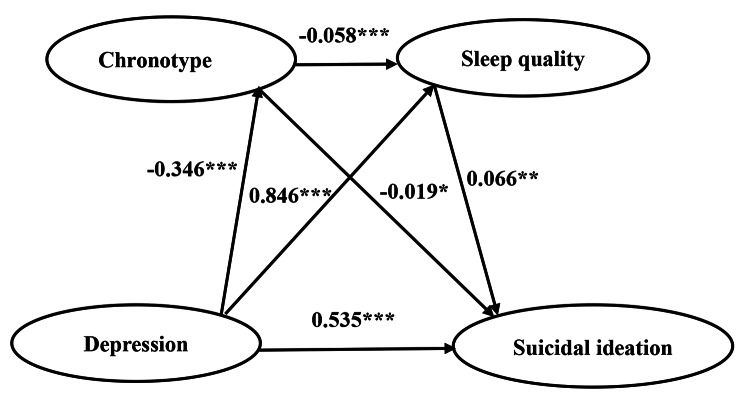
BACKGROUND: This study was intended to investigate the correlation between depression and suicidal ideation among Chinese college students during the COVID-19 pandemic and the potential mediating roles of chronotype and sleep quality in this relationship . METHODS: A sample of 4,768 college students was selected from four institutions in Anhui Province, China, and the study was conducted during the COVID-19 pandemic (November to December 2020) using a stratified, cluster, multi-stage sampling method. This study used the two-item Patient Health Questionnaire (PHQ-2) to assess depressive symptoms, the Morningness-Eveningness Questionnaire 19 (MEQ-19) to determine individual sleep chronotypes (i.e., morning or evening preference), and the Pittsburgh Sleep Quality Index (PSQI) to evaluate sleep quality. Participants were asked about suicidal ideation. MPLUS 8.3 software was used to analyze the mediating effect of chronotype and sleep quality on the relationship between depression and suicidal ideation. RESULTS: During the COVID-19 pandemic, the prevalence of suicidal ideation among Chinese college students was 5.4%. Depression was inversely correlated with chronotype (beta = - 0.346, P < 0.01) and positively correlated with sleep quality (beta = 0.846, P < 0.001), indicating that students experiencing depressive symptoms were more likely to have a later chronotype and poor sleep quality. A later chronotype (beta = - 0.019, P < 0.05) and poor sleep quality (beta = 0.066, P < 0.01) predicted suicidal ideation. Depression emerged as a direct and significant risk factor for suicidal ideation (effect value = 0.535, 95% confidence interval: 0.449 ~ 0.622). Chronotype and sleep quality were found to have potential mediating effects on the relationship between depression and suicidal ideation; however, the chain-mediating effect of chronotype and sleep quality was not statistically significant. CONCLUSIONS: Our findings suggest that during the COVID-19 pandemic, depression can precipitate suicidal ideation through its influence on sleep chronotype and quality. These compelling findings highlight the urgency of early intervention strategies intended to mitigate suicidal thoughts, particularly among students exhibiting depressive symptoms, who experience disrupted sleep patterns and poor sleep quality.
Overview
The claims and statistics of this paper haven’t been checked yet.
Free: it reads the open-access text and checks the first 5 claims that cite a source we can check. Create a free account to check every claim.
Integrity signals
Registry
Cites
Statistics
Figures
Verification
Claims the paper makes
The claims and statistics of this paper haven’t been checked yet.
Free: it reads the open-access text and checks the first 5 claims that cite a source we can check. Create a free account to check every claim.
Claims other papers make about this one
Each is checked against this paper’s own text: does it say what the citing paper says it does?
The source backs part of the claim, not all of it — or backs it for a different population, condition or comparison.
In the citing paper
“Previous studies have indicated that the development of suicidal ideation is closely associated with individuals' negative emotional experiences, anxiety levels, stress-coping capacities, and social adaptation status (Wen et al., 2024).”
From The impact mechanism of green exercise on college students' suicidal ideation: a mediation analysis based on entrance anxiety (2026) · cites this paper as Wen et al., 2024
Experimental — accuracy not yet measured
Self-check
Percentages, sums and reported differences re-computed from the paper’s own numbers.
The self-check needs the paper’s full text.
Citations
Cites
Podsakoff, P. M., MacKenzie, S. B., Lee, J.-Y., & Podsakoff, N. P. (2003) · Journal of Applied Psychology · doi:10.1037/0021-9010.88.5.879 · Cited by 82,194 · cited 1×
“[60].”
The Pittsburgh Sleep Quality Index: a new instrument for psychiatric practice and research
Buysse, D. J., Reynolds, C. F., Monk, T. H., Berman, S. R., & Kupfer, D. J. (1989) · Psychiatry Research · doi:10.1016/0165-1781(89)90047-4 · Cited by 35,234 · cited 1×
“The PSQI was used to evaluate the sleep quality of college students [54].”
MethodThe Patient Health Questionnaire-2: Validity of a Two-Item Depression Screener
Kroenke, K., Spitzer, R. L., & Williams, J. B. W. (2003) · Medical Care · doi:10.1097/01.mlr.0000093487.78664.3c · Cited by 6,359 · cited 1×
“The PHQ-2 [49] is a screening tool designed to assess symptoms of depression over the past two weeks.”
MethodCircadian typology: a comprehensive review
Adan, A., Archer, S. N., Hidalgo, M. P., Di Milia, L., Natale, V., & Randler, C. (2012) · Chronobiology International · doi:10.3109/07420528.2012.719971 · Cited by 1,384 · cited 1×
“Chronotype refers to individual preferences regarding the timing of activities and sleep patterns [21] and is an important indicator for assessing individual circadian rhythms [22].”
BackgroundKessler, R. C. (2005) · JAMA · doi:10.1001/jama.293.20.2487 · Cited by 1,073 · cited 1×
“[58, 59].”
Psychophysiological insomnia: the behavioural model and a neurocognitive perspective
PERLIS, M. L., GILES, D. E., MENDELSON, W. B., BOOTZIN, R. R., & WYATT, J. K. (1997) · Journal of Sleep Research · doi:10.1046/j.1365-2869.1997.00045.x · Cited by 795 · cited 1×
“This in turn impairs cognitive functioning, exacerbates difficulties in coping with life challenges, and potentially fosters suicidal thoughts [84–86].”
Background(2016) · PubMed · Cited by 580
Inter-individual differences in the human circadian system: A review
Kerkhof, G. A. (1985) · Biological Psychology · doi:10.1016/0301-0511(85)90019-5 · Cited by 536 · cited 1×
“Chronotype refers to individual preferences regarding the timing of activities and sleep patterns [21] and is an important indicator for assessing individual circadian rhythms [22].”
BackgroundEspie, C. A., Broomfield, N. M., MacMahon, K. M. A., Macphee, L. M., & Taylor, L. M. (2006) · Sleep Medicine Reviews · doi:10.1016/j.smrv.2006.03.002 · Cited by 532
Lopez-Duran, N. L., Kovacs, M., & George, C. J. (2009) · Psychoneuroendocrinology · doi:10.1016/j.psyneuen.2009.03.016 · Cited by 425
Sleep in university students prior to and during COVID-19 stay-at-home orders
Wright, K. P., Linton, S. K., Withrow, D., Casiraghi, L., Lanza, S. M., Iglesia, H. D. L., Vetter, C., & Depner, C. M. (2020) · Current Biology · doi:10.1016/j.cub.2020.06.022 · Cited by 293 · cited 1×
“The COVID-19 pandemic significantly disrupted college students’ sleep habits, as manifested by delayed sleep onset and offset timing, consequently promoting a shift toward eveningness (i.e., later sleep chronotype) [19, 20].”
BackgroundGeoffroy, P. A., Hoertel, N., Etain, B., Bellivier, F., Delorme, R., Limosin, F., & Peyre, H. (2018) · Journal of Affective Disorders · doi:10.1016/j.jad.2017.09.032 · Cited by 277
Quality of Sleep and Depression in College Students: A Systematic Review
Dinis, J., & Bragança, M. (2018) · Sleep Science · doi:10.5935/1984-0063.20180045 · Cited by 271 · cited 1×
“Depression is an important predictor of sleep quality [24, 35].”
BackgroundKaufman, J., Birmaher, B., Perel, J., Dahl, R. E., Moreci, P., Nelson, B., Wells, W., & Ryan, N. D. (1997) · Biological Psychiatry · doi:10.1016/s0006-3223(96)00470-2 · Cited by 263 · cited 1×
“Neurotransmitter theory proposes strong correlations among suicidal thoughts, depression, and poor sleep, all stemming from abnormalities in neurotransmitter function [8–10].”
BackgroundAntypa, N., Vogelzangs, N., Meesters, Y., Schoevers, R., & Penninx, B. W. J. H. (2016) · Depression and Anxiety · doi:10.1002/da.22422 · Cited by 252 · cited 1×
“Depression is an important predictor of circadian rhythms [23, 24] and partially mediates the relationship between psychopathy and evening chronotype preference [25].”
BackgroundPeng, P., Hao, Y., Liu, Y., Chen, S., Wang, Y., Yang, Q., Wang, X., Li, M., Wang, Y., He, L., et al. (2023) · Journal of Affective Disorders · doi:10.1016/j.jad.2022.10.040 · Cited by 239
In Search of HPA Axis Dysregulation in Child and Adolescent Depression
Guerry, J. D., & Hastings, P. D. (2011) · Clinical Child and Family Psychology Review · doi:10.1007/s10567-011-0084-5 · Cited by 195 · cited 1×
“These disturbances in sleep rhythms among individuals with depression may be closely associated with hyperactivity of the HPA axis [76–78].”
BackgroundSivertsen, B., Harvey, A. G., Lundervold, A. J., & Hysing, M. (2014) · European Child & Adolescent Psychiatry · doi:10.1007/s00787-013-0502-y · Cited by 187 · cited 1×
“Adolescents with depression encounter a range of sleep issues, including difficulties in initiating and maintaining sleep, poor sleep quality, early morning awakenings, excessive daytime sleepiness or hyper-somnia, irregular sleep–wake patterns, nightmares, and persistent sleep complaints [72–75].”
BackgroundRisk factors for suicidal ideation and suicide attempt among medical students: A meta-analysis
Seo, C., Carlo, C. D., Dong, S. X., Fournier, K., & Haykal, K.-A. (2021) · PLoS ONE · doi:10.1371/journal.pone.0261785 · Cited by 182 · cited 1×
“For example, a meta-analysis of medical students underscored the predictive power of depression for suicidal ideation, with an odds ratio of 6.87 [17].”
BackgroundInfluentialPrevalence of Suicidal Ideation in Chinese College Students: A Meta-Analysis
Li, Z.-Z., Li, Y.-M., Lei, X.-Y., Zhang, D., Liu, L., Tang, S.-Y., & Chen, L. (2014) · PLoS ONE · doi:10.1371/journal.pone.0104368 · Cited by 161 · cited 1×
“Similarly, unlike previous studies, we did not observe a statistically difference in suicidal ideation between male and female college students [68, 69].”
ResultTasnim, R., Islam, M. S., Sujan, M. S. H., Sikder, M. T., & Potenza, M. N. (2020) · Children and Youth Services Review · doi:10.1016/j.childyouth.2020.105703 · Cited by 130 · cited 2×
“Studies have unequivocally established a direct link between depression and suicidal ideation [70, 71].”
BackgroundInfluentialHaraden, D. A., Mullin, B. C., & Hankin, B. L. (2017) · Depression and Anxiety · doi:10.1002/da.22682 · Cited by 129 · cited 1×
“According to one longitudinal study, adolescents with a history of depressive symptoms or a depression diagnosis exhibited a stronger evening chronotype preference [26].”
BackgroundCasey, S. M., Varela, A., Marriott, J. P., Coleman, C. M., & Harlow, B. L. (2021) · Journal of Affective Disorders · doi:10.1016/j.jad.2021.11.006 · Cited by 129 · cited 1×
“As the most prevalent mental health disorder among college students, depression has emerged as a significant predictive risk factor for suicidal ideation both before and during the COVID-19 pandemic [11–16].”
BackgroundAssociations between chronotypes and psychological vulnerability factors of depression
Antypa, N., Verkuil, B., Molendijk, M., Schoevers, R., Penninx, B. W. J. H., & Van Der Does, W. (2017) · Chronobiology International · doi:10.1080/07420528.2017.1345932 · Cited by 121 · cited 1×
“These strategies perpetuate feelings of profound depression, which may increase suicidal thoughts [82].”
BackgroundZheng, B., Li, M., Wang, K. L., & Lv, J. (2016) · PubMed · Cited by 106
Gaş, S., Özsoy, H. E., & Aydın, K. C. (2021) · CRANIO® · doi:10.1080/08869634.2021.1883364 · Cited by 105
Prevalence of Suicide Attempts among College Students in China: A Meta-Analysis
Yang, L.-S., Zhang, Z.-H., Sun, L., Sun, Y.-H., & Ye, D.-Q. (2015) · PLOS ONE · doi:10.1371/journal.pone.0116303 · Cited by 84 · cited 1×
“Furthermore, suicide is currently the primary cause of death among those between the ages of 15 and 34 in China [3], leading to significant concerns both in schools and in society as a whole.”
BackgroundSuicidal Ideation and Attitudes Toward Suicide
Gibb, B. E., Andover, M. S., & Beach, S. R. H. (2006) · Suicide and Life-Threatening Behavior · doi:10.1521/suli.2006.36.1.12 · Cited by 81 · cited 1×
“Suicide is a major public health issue and the second leading cause of death among college students [1, 2].”
BackgroundCircadian Rhythm and Melatonin in the Treatment of Depression
Satyanarayanan, S. K., Su, H., Lin, Y., & Su, K. (2018) · Current Pharmaceutical Design · doi:10.2174/1381612824666180803112304 · Cited by 81
Self-citationChronotype: implications for sleep quality in medical students
Sun, J., Chen, M., Cai, W., Wang, Z., Wu, S., Sun, X., & Liu, H. (2019) · Chronobiology International · doi:10.1080/07420528.2019.1619181 · Cited by 78 · cited 1×
“Studies conducted on college students reinforced the connection between chronotype disruptions and suboptimal sleep quality [28, 45–48].”
BackgroundHypothalamic–pituitary–adrenal axis activity in older persons with and without a depressive disorder
Rhebergen, D., Korten, N. C. M., Penninx, B. W. J. H., Stek, M. L., van der Mast, R. C., Voshaar, R. C. O., & Comijs, H. C. (2014) · Psychoneuroendocrinology · doi:10.1016/j.psyneuen.2014.10.005 · Cited by 76 · cited 1×
“These disturbances in sleep rhythms among individuals with depression may be closely associated with hyperactivity of the HPA axis [76–78].”
BackgroundComparison of dream anxiety and subjective sleep quality between chronotypes
Selvı, Y., Aydın, A., Güleç, M., Boysan, M., Beşiroğlu, L., Özdemir, P. G., & KILIC, S. (2011) · Sleep and Biological Rhythms · doi:10.1111/j.1479-8425.2011.00511.x · Cited by 66 · cited 1×
“Disruptions in circadian rhythms can disrupt the body’s internal clock, triggering issues such as shortened sleep duration and compromised sleep quality [43, 44].”
BackgroundZeng, B., Zhao, J., Zou, L., Yang, X., Zhang, X., Wang, W., Zhao, J., & Chen, J. (2018) · Psychiatry Research · doi:10.1016/j.psychres.2018.03.022 · Cited by 65 · cited 1×
“Consequently, individuals with low ERSE may struggle to harness their emotional regulation skills to manage negative emotions, potentially resorting to avoidance, and fostering suicidal thoughts [13].”
BackgroundMedical student depression and its correlates across three international medical schools
Gold, J. A., Hu, X., Huang, G., Trockel, M., Li, W., Wu, Y., Gao, S., Liu, Z., Rohrbaugh, R. M., & Wilkins, K. M. (2019) · World Journal of Psychiatry · doi:10.5498/wjp.v9.i4.65 · Cited by 64 · cited 1×
“The PHQ-2 is widely used self-rating scale and has been reported to have good psychometric properties in Chinese populations [50].”
MethodThe effect of age and chronotype on seasonality, sleep problems, and mood
Höller, Y., Guðjónsdóttir, B. E., Valgeirsdóttir, S. K., & Heimisson, G. T. (2021) · Psychiatry Research · doi:10.1016/j.psychres.2021.113722 · Cited by 64 · cited 1×
“Disruptions in circadian rhythms can disrupt the body’s internal clock, triggering issues such as shortened sleep duration and compromised sleep quality [43, 44].”
BackgroundPersistent sleep disturbance is associated with treatment response in adolescents with depression
Manglick, M., Rajaratnam, S. M., Taffe, J., Tonge, B., & Melvin, G. (2013) · Australian & New Zealand Journal of Psychiatry · doi:10.1177/0004867413481630 · Cited by 60
Zhou, J., Hsiao, F., Shi, X., Yang, J., Huang, Y., Jiang, Y., Zhang, B., & Ma, N. (2021) · Journal of Clinical Psychology · doi:10.1002/jclp.23037 · Cited by 58
Li, H., Fu, R., Zou, Y., & Cui, Y. (2017) · Frontiers in Psychology · doi:10.3389/fpsyg.2017.01550 · Cited by 57
Self-citationLiang, S., Liu, L., Peng, X., Chen, J., Huang, A., Wang, X., Zhao, J., Fan, F., & Liu, X. (2022) · BMC Psychiatry · doi:10.1186/s12888-022-03968-2 · Cited by 57 · cited 2×
“This is lower than the rates observed in a three-wave repeated survey conducted during the out-break period, remission period, and normalized prevention and control period, which reported prevalence rates of 8.5%, 11.0%, and 12.6%, respectively [16].”
BackgroundResultInfluentialLi, Y., Zhou, Y., Ru, T., Niu, J., He, M., & Zhou, G. (2021) · Sleep Medicine · doi:10.1016/j.sleep.2021.07.008 · Cited by 56 · cited 2×
“Studies conducted on college students reinforced the connection between chronotype disruptions and suboptimal sleep quality [28, 45–48].”
BackgroundOwls and larks do not exist: COVID-19 quarantine sleep habits
Rome, O., Sinai, L., Sevitt, R., Meroody, A., Nadolne, M. J., Shilco, P., Jacobs, G. P., Shterenshis, M. V., Sosnow, A., Foonberg, M., et al. (2020) · Sleep Medicine · doi:10.1016/j.sleep.2020.09.003 · Cited by 51
Yao, Z.-Y., Wang, T., Yu, Y.-K., Li, R., Sang, X., Yi-na, F., Gong, X.-J., Sun, W., Liu, J. J. W., Wong, J. P., et al. (2023) · Journal of Affective Disorders · doi:10.1016/j.jad.2023.07.050 · Cited by 47
Ma, Z., Wang, D., Zhao, J., Zhu, Y., Zhang, Y., Chen, Z., Jiang, J., Pan, Y., Yang, Z., Zhu, Z., et al. (2022) · Journal of Affective Disorders · doi:10.1016/j.jad.2022.05.093 · Cited by 44
Pournaghash-Tehrani, S., Zamanian, H., & Amini‐Tehrani, M. (2019) · Journal of Interpersonal Violence · doi:10.1177/0886260519852160 · Cited by 43 · cited 1×
“Studies have unequivocally established a direct link between depression and suicidal ideation [70, 71].”
BackgroundSuicidality among university students in the Eastern Mediterranean region: A systematic review
Fadakar, H., Kim, J. J., Saunders, L. C., Kamel, M. M., Kianpoor, M., Moghadam, A. H., Hayati, D., Ramadhan, N. A., Maragha, T., Meyer, M., et al. (2023) · PLOS Global Public Health · doi:10.1371/journal.pgph.0002460 · Cited by 39 · cited 2×
“One plausible explanation for this association is the comorbidity of depression with other mental health issues such as anxiety, stress, panic, and pessimism, which collectively heighten the risk of suicidal thoughts [18].”
BackgroundSuicidal ideation is associated with nighttime wakefulness in a community sample
Tubbs, A. S., Fernandez, F., Perlis, M. L., Hale, L. E., Branas, C. C., Barrett, M. S., Chakravorty, S., Khader, W., & Grandner, M. A. (2020) · SLEEP · doi:10.1093/sleep/zsaa128 · Cited by 38 · cited 1×
“Specifically, nocturnal wakefulness is positively correlated with suicidal thoughts, whereas morning wakefulness is inversely related to them [33].”
BackgroundLi, T., Zhang, D., Qu, Y., Zhai, S., Xie, Y., Tao, S., Zou, L., Tao, F., & Wu, X. (2022) · Addictive Behaviors · doi:10.1016/j.addbeh.2022.107398 · Cited by 36 · cited 1×
“The MEQ-19 has been reported to have good psychometric characteristics in Chinese populations and has been extensively used in diverse populations [45, 52, 53].”
BackgroundBradford, D. R. R., Biello, S. M., & Russell, K. (2021) · Chronobiology International · doi:10.1080/07420528.2021.1931274 · Cited by 35
Yin, H., Zhang, L., Li, D., Lu, X. B., & Cheng, M. (2019) · Journal of Health Psychology · doi:10.1177/1359105319869977 · Cited by 29 · cited 1×
“Individuals with depression frequently experience poor sleep quality, a phenomenon that may be intricately linked to the volume of gray matter in the right insula [83].”
BackgroundSelf-citationMokros, Ł., Nowakowska‐Domagała, K., Koprowicz, J., Witusik, A., & Pietras, T. (2021) · Chronobiology International · doi:10.1080/07420528.2020.1865393 · Cited by 29
Wesley, K. L., Cooper, E. H., Brinton, J. T., Meier, M. R., Honaker, S. M., & Simon, S. L. (2022) · Behavioral Sleep Medicine · doi:10.1080/15402002.2022.2086871 · Cited by 28
Dong, X., Liang, G., Li, D., Liu, M.-X., Yin, Z.-J., Li, Y.-Z., Zhang, T., & Pan, C.-W. (2022) · Journal of Affective Disorders · doi:10.1016/j.jad.2022.08.091 · Cited by 28 · cited 2×
“Studies conducted on college students reinforced the connection between chronotype disruptions and suboptimal sleep quality [28, 45–48].”
BackgroundHuang, S., Wang, D., Zhao, J., Chen, H., Ma, Z., Pan, Y., Liu, X., & Fan, F. (2022) · Psychiatry Research · doi:10.1016/j.psychres.2022.114653 · Cited by 27 · cited 1×
“Furthermore, a three-wave repeated survey conducted among Chinese college students during the outbreak, remission, and prevention periods of the pandemic reported the prevalence of suicidal ideation to be 7.3%, 9.4%, and 12.6%, respectively [7].”
BackgroundInfluentialDu, W. D., Jia, Y. J., Hu, F. H., Ge, M., Cheng, Y. J., Qu, X., & Chen, H. L. (2023) · Journal of Psychiatric Research · doi:10.1016/j.jpsychires.2023.07.040 · Cited by 26
Cross-cultural adaptation and validation of the Chinese version of the Sleep Health Index
Mu, Y., Wang, Y., Yuan, J., Knutson, K. L., Zhu, D., Izci‐Balserak, B., Wu, Y., & Zhu, B. (2022) · Sleep Health · doi:10.1016/j.sleh.2022.09.005 · Cited by 25 · cited 1×
“The PSQI is widely used both in China and internationally for screening sleep disorders, and its Chinese version has been proven reliable in Chinese populations [55–57].”
MethodSuicidal Ideation and Schizophrenia: Contribution of Appraisal, Stigmatization, and Cognition
Stip, É., Caron, J., Tousignant, M., & Lecomte, Y. (2017) · The Canadian Journal of Psychiatry · doi:10.1177/0706743717715207 · Cited by 24
The stigmatization of suicide: A study of stories told by college students in China
Zou, W., Tang, L., & Bie, B. (2021) · Death Studies · doi:10.1080/07481187.2021.1958396 · Cited by 24 · cited 1×
“Additionally, factors such as the social stigmatization of suicide, interpersonal relationships, and individual feelings of shame or embarrassment may also contribute to the under-reporting of suicidal ideation [64, 65].”
BackgroundMahadi, A. R., Rafi, M. A., Shahriar, T., Seemanta, S., Rabbani, M. G., Akter, M., Majumder, M. I., & Hasan, M. T. (2022) · Frontiers in Medicine · doi:10.3389/fmed.2022.876561 · Cited by 24 · cited 1×
“Studies have documented a high prevalence of suicidal ideation among medical students [66, 67].”
BackgroundLiu, X., Yang, Y., Liu, Z., & Jia, C.-X. (2022) · Journal of Clinical Medicine · doi:10.3390/jcm11236912 · Cited by 24 · cited 1×
“Adolescents with depression encounter a range of sleep issues, including difficulties in initiating and maintaining sleep, poor sleep quality, early morning awakenings, excessive daytime sleepiness or hyper-somnia, irregular sleep–wake patterns, nightmares, and persistent sleep complaints [72–75].”
BackgroundCOVID-19 pandemic decreased sleep quality of medical students
Fernandes, A. C. A., Magalhães-Padilha, D. M., de Moura, A. C. M. A., de Aquino, C. E. F., Lima, I. B. D. A., & Mota-Rolim, S. A. (2022) · Sleep Science · doi:10.5935/1984-0063.20220075 · Cited by 22
Behavioral and psychosocial factors related to mental distress among medical students
Carlos, K. C. D. L., Ahmadi, H., Uban, K. A., & Riis, J. L. (2023) · Frontiers in Public Health · doi:10.3389/fpubh.2023.1225254 · Cited by 22
The reliability and validity of Chinese version morningness/eveningness questionnaire
张斌, 郝彦利, & 荣润国 (2006) · Zhonghua xingwei yixue yu naokexue zazhi · doi:10.3760/cma.j.issn.1005-8559.2006.09.044 · Cited by 21 · cited 1×
“The Chinese version of MEQ-19 was used to evaluate the chronotype among university students [51].”
MethodChen, Y., Zhu, L.-J., Fang, Z., Wu, N., Du, M., Jiang, M., Wang, J., Ying-shui, Y., & Zhou, C. (2021) · Frontiers in Psychiatry · doi:10.3389/fpsyt.2021.653245 · Cited by 21 · cited 2×
“Similarly, unlike previous studies, we did not observe a statistically difference in suicidal ideation between male and female college students [68, 69].”
BackgroundResultSelf-citationÜzer, A., & Gürsoy, B. K. (2022) · Chronobiology International · doi:10.1080/07420528.2022.2108438 · Cited by 19
Prevalence of and Factors Associated with Sleep-Wake Abnormalities in Patients with Cirrhosis
Kumar, M., Kainth, S., Kumar, S. A., Bhardwaj, A., KumarAggarwal, H., Maiwall, R., Jamwal, K. D., Shasthry, S. M., Jindal, A., Choudhury, A. K., et al. (2020) · Journal of Clinical and Experimental Hepatology · doi:10.1016/j.jceh.2020.10.006 · Cited by 18 · cited 1×
“For example, one study conducted among patients with cirrhosis revealed strong links between major depression and both inadequate nighttime sleep and excessive daytime drowsiness [36].”
BackgroundTubbs, A. S., Taneja, K., Ghani, S. B., Nadorff, M. R., Drapeau, C. W., Karp, J. F., Fernandez, F., Perlis, M. L., & Grandner, M. A. (2023) · Journal of American College Health · doi:10.1080/07448481.2022.2155828 · Cited by 16 · cited 1×
“Furthermore, several investigations have underscored the predictive role of sleep quality in suicidal thoughts among college students [41, 42].”
BackgroundPsychopathy and chronotype disposition: the mediating role of depression
Akram, U., Stevenson, J. C., Gardani, M., Akram, A., & Allen, S. F. (2019) · Heliyon · doi:10.1016/j.heliyon.2019.e02894 · Cited by 14 · cited 1×
“Depression is an important predictor of circadian rhythms [23, 24] and partially mediates the relationship between psychopathy and evening chronotype preference [25].”
BackgroundIncomplete off-duty work hours and sleep quality among firefighters: a cross-sectional study, Taiwan
Huang, R.-S., Chen, Y., Tsai, S.-Y., Huang, Y.-S., & Guo, Y. L. (2022) · International Archives of Occupational and Environmental Health · doi:10.1007/s00420-022-01918-9 · Cited by 13 · cited 1×
“The MEQ-19 has been reported to have good psychometric characteristics in Chinese populations and has been extensively used in diverse populations [45, 52, 53].”
BackgroundNowakowska‐Domagała, K., Podlecka, M., Sadowski, K., Pietras, T., & Mokros, Ł. (2023) · Journal of Sleep Research · doi:10.1111/jsr.13823 · Cited by 12 · cited 1×
“Furthermore, research has consistently indicated that chronotype serves as a predictor of suicidal ideation [29–32].”
BackgroundCatherman, C., Cassidy, S., Benca‐Bachman, C. E., Barber, J. M., & Palmer, R. H. C. (2021) · Journal of American College Health · doi:10.1080/07448481.2021.1891917 · Cited by 10
Bessot, N., Langeard, A., Dosseville, F. E. M., Quarck, G., & Fréret, T. (2023) · Journal of Sleep Research · doi:10.1111/jsr.13864 · Cited by 10
Aggarwal, B., Benasi, G., Makarem, N., Mayat, Z., Byun, S. S., Liao, M., & Giardina, E. V. (2023) · Sleep Health · doi:10.1016/j.sleh.2023.10.017 · Cited by 9 · cited 2×
“Depression is an important predictor of circadian rhythms [23, 24] and partially mediates the relationship between psychopathy and evening chronotype preference [25].”
BackgroundShang, H. T., Ouyang, Z., Chen, C., Duan, C. F., Bai, T., & Hou, X. H. (2022) · Journal of Digestive Diseases · doi:10.1111/1751-2980.13159 · Cited by 8
Chen, Y., Huang, H., Zhi, K., ZHANG, S., Lin, Q., Qingya, W. A. N. G., & An, W. (2020) · Advances in Psychological Science · doi:10.3724/sp.j.1042.2020.01713 · Cited by 6
Wang, S., Luo, G., Zhang, X., Jing, Y., Zaimina, Yao, C., Li, M., Chen, H., & Li, J. (2023) · European Archives of Psychiatry and Clinical Neuroscience · doi:10.1007/s00406-023-01707-6 · Cited by 6 · cited 1×
“Comparable associations have been observed among university and college students in both cross-sectional and follow-up studies [37–40].”
BackgroundŞahin, H., Çebi, K., Yıldırım, A., & Aşılar, R. H. (2023) · Journal of the American Psychiatric Nurses Association · doi:10.1177/10783903231197656 · Cited by 4 · cited 1×
“Comparable associations have been observed among university and college students in both cross-sectional and follow-up studies [37–40].”
BackgroundChoi, L. J., Shminan, A. S., Barawi, M. H., Khan, R. U., Rathakrishnan, M. A. L., & Choi, L. J. (2021) · International Journal of Academic Research in Business and Social Sciences · doi:10.6007/ijarbss/v11-i14/8572 · Cited by 1 · cited 1×
“Studies have documented a high prevalence of suicidal ideation among medical students [66, 67].”
BackgroundScale for Suicide Ideation: Psychometric properties of a self-report version
Beck, A. T., Steer, R. A., & Ranieri, W. F. (1988) · Journal of Clinical Psychology · doi:10.1002/1097-4679(198807)44:4<499::aid-jclp2270440404>3.0.co;2-6
Research works printed but not linked: 7
- Tang FQP. Social network, coping skill and suicidal ideation in college students. Chin Mental Health J. 2016;30(11):869–75.
- Xue ZX, Ren ZY, Jing L, Li H. Categorical decision tree analysis of factors influencing college students’ suicidal behavior. Psychol Dev Educ. 2024;40(3):421–30.
- Yu YK, Yao ZY, Wang T, Sang X, Kou CG, Yao B, et al. Relationship between experiential avoidance and suicidal ideation among college students. Chin Mental Health J. 2023;37(11):976–81.
- Wang X, Sun X, Zou X. Research on the pathways to cultivate and enhance the Psychological Quality of College Students under the normalization of Epidemic Prevention and Control measures. Psychol Monthly. 2020;15(20):76–7.
- Wang WX, Qian S, Zhu C, Zheng K, Hui L. Research progress on relationship between insomnia and suicide. J Clin Psychiatry. 2021;31(3):244–7.
- Jiang S, Ding JQ, Liu Y, Lu YY, Li XQ, Chen J. Early adolescent cyberbullying/Effects of bullying on sleep quality: chain mediation of social anxiety and depressed mood. Psychol Dev Educ. 2023;39(1):85–96.
- Zhao Y, Jiang MM, Wang J, Ai D, Jin YL. Effect of depression on self-harm of undergraduates: mediating effect of sleep quality and moderating effect of gender. China J Health Psychol. 2021;29(6):922–6.
Cited by
Wang, F., Zhou, Y., Hou, X., Ni, S., Xia, X., Zhang, T., Zhang, Y., Li, X., Wen, K., Wang, Y., et al. (2025) · BMC Psychiatry · doi:10.1186/s12888-025-06855-8 · Cited by 9
“Empirical evidence indicates that, compared to their peers, E-type adolescents are more likely to experience poor sleep quality, heightened sleep disturbances, and more severe depressive symptoms [30].”
Chronotype and depression: A global systematic review and meta-analysis
Dong, X., Liu, J., Wang, X., & Liang, Z. (2026) · Psychiatry Research · doi:10.1016/j.psychres.2026.116945 · Cited by 8
Wu, R., Lan, J., & Yu, W. (2026) · BMC Psychology · doi:10.1186/s40359-025-03868-6 · Cited by 5
“This pattern supports H3 and corresponds with evidence from Li. et al. [46] and Wen et al. [78].”
Liu, X., & Wang, Y. (2026) · Current Psychology · doi:10.1007/s12144-025-08999-y · Cited by 4
Mental health trajectories among Malaysian university students: A repeated cross-sectional study
Mah, P. N., Wu, S. L., Fam, J. Y., Tan, S. A., & Yap, C. C. (2026) · Psychology Health & Medicine · doi:10.1080/13548506.2026.2659692 · Cited by 2
Metadata
- Authors
- Wen, L.-Y., Zhang, L., Zhu, L.-J., Song, J.-G., Wang, A.-S., Tao, Y.-J., Li, H.-Q., Feng, Y., Jin, Y.-L., Su, H., & Chang, W.-W.
- Affiliations
- Wannan Medical College (CN)
- Anhui Medical University (CN)
- Corresponding author
- Su, Hong
- Venue
- BMC Psychiatry
- Published
- 2024-08-27
- Volume
- 24
- Issue
- 1
- Pages
- 583-583
- ISSN
- 1471-244X (ISSN-L)
- PMC
- PMC11348737
- OpenAlex
- W4401914794
- Cited by
- 13
- References
- 78
- Citations by year
- 2026: 11 · 2025: 2
- FWCI
- 6.48
- Type
- journal article
- Language
- en
- Open access
- gold
- doi.org
- Licence
- cc-by-nc-nd
- creativecommons.org/licenses/by-nc-nd/4.0 (tdm)
- creativecommons.org/licenses/by-nc-nd/4.0 (vor)
- Locations
- BMC Psychiatry (publishedVersion, cc-by-nc-nd)
- PubMed Central (publishedVersion, cc-by-nc-nd)
- PubMed (publishedVersion)
- DOAJ (DOAJ: Directory of Open Access Journals) (submittedVersion)
- Funders
- Wannan Medical College young and middle-aged humanities and social project (WKS202207)
- Scientific Research Project of Anhui Provincial Institutions of Higher Education (2022AH051208)
- National innovation and Entrepreneurship Project (202310368056, 202210368008, 202310368055)
- Anhui Province Quality Engineering (2020jyxm2086)
- Talents Program for Academic Leaders and Reserve Candidates of Wannan Medical College (No. School Administration Letter [2021] No. 46)
- Topics
- Social Sciences › Psychology › Clinical Psychology › COVID-19 and Mental Health
- Social Sciences › Psychology › Experimental and Cognitive Psychology › Sleep and related disorders
- Social Sciences › Psychology › Clinical Psychology › Suicide and Self-Harm Studies
- Keywords
- depression, suicidal ideation, chronotype, sleep quality, university students, COVID-19 pandemic, mediating effect, morningness-eveningness preference, Chinese students
- MeSH terms
- COVID-19, Sleep Quality, Chronotype, Adolescent, Adult, China, Circadian Rhythm, Depression, Female, Humans, Male, Surveys and Questionnaires, Students, Universities, Prevalence, Young Adult, Suicidal Ideation
About these checks
Registry, retraction, Cites and statistics results are computed, not judged, with one exception: a printed reference that no index lists is read once by a model before it counts as a citation error. Claims are extracted by a model and kept only when their quote appears verbatim in the text; each cited source is then checked, with a model’s help, for whether it says what the claim relies on. Those verdicts can be wrong — read the claim’s quote and the cited source before relying on one.
Statistics and arithmetic are recomputed, not judged.
Confidence bands are shown only for fields calibrated on our annotated test set. None is calibrated yet, so no band is shown.
What counts as a claim ›How we measure confidence ›How we check this ›
Are you an author, or do you see a problem with this page? Request a review
Data sources
Bibliographic data: Semantic Scholar, OpenAlex, Crossref.
Contains information from the Semantic Scholar Academic Graph Datasets, made available under the ODC Attribution License (ODC-BY 1.0).
Semantic Scholar’s data is described in: Kinney, R., et al. (2023). The Semantic Scholar Open Data Platform. arXiv:2301.10140.
