

A systematic review including meta-analysis of work environment and depressive symptoms
Open accessThe DOI matches its Crossref record; 81 of the 82 references it cites were found in a registry or an index.
Abstract
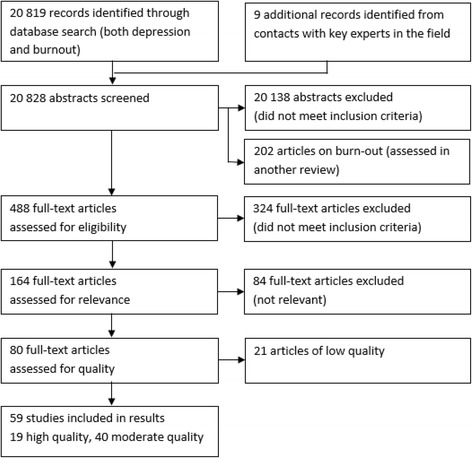
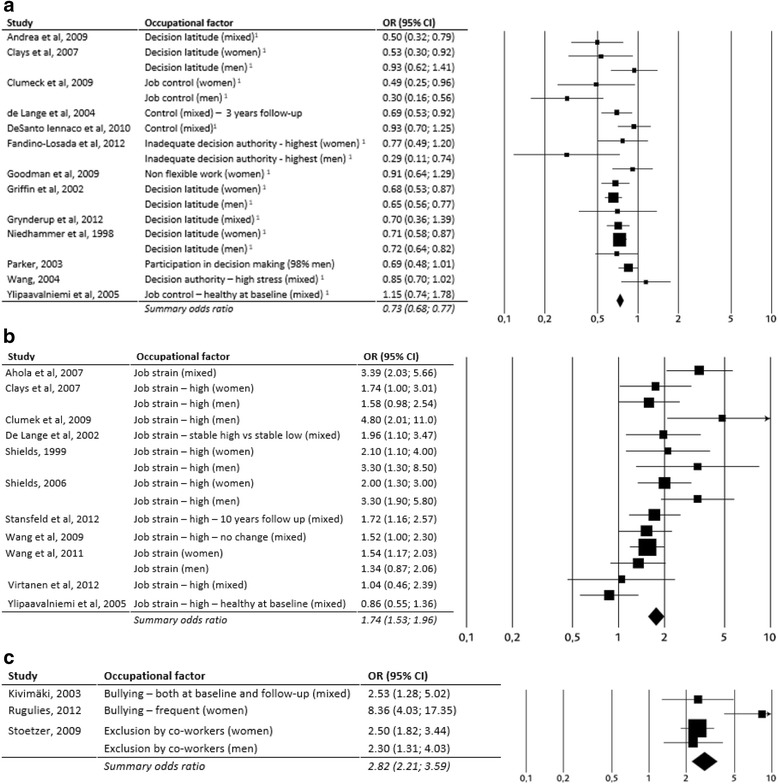
BACKGROUND: Depressive symptoms are potential outcomes of poorly functioning work environments. Such symptoms are frequent and cause considerable suffering for the employees as well as financial loss for the employers. Accordingly good prospective studies of psychosocial working conditions and depressive symptoms are valuable. Scientific reviews of such studies have pointed at methodological difficulties but still established a few job risk factors. Those reviews were published some years ago. There is need for an updated systematic review using the GRADE system. In addition, gender related questions have been insufficiently reviewed. METHOD: Inclusion criteria for the studies published 1990 to June 2013: 1. European and English speaking countries. 2. Quantified results describing the relationship between exposure (psychosocial or physical/chemical) and outcome (standardized questionnaire assessment of depressive symptoms or interview-based clinical depression). 3. Prospective or comparable case-control design with at least 100 participants. 4. Assessments of exposure (working conditions) and outcome at baseline and outcome (depressive symptoms) once again after follow-up 1-5 years later. 5. Adjustment for age and adjustment or stratification for gender. Studies filling inclusion criteria were subjected to assessment of 1.) relevance and 2.) quality using predefined criteria. Systematic review of the evidence was made using the GRADE system. When applicable, meta-analysis of the magnitude of associations was made. Consistency of findings was examined for a number of possible confounders and publication bias was discussed. RESULTS: Fifty-nine articles of high or medium high scientific quality were included. Moderately strong evidence (grade three out of four) was found for job strain (high psychological demands and low decision latitude), low decision latitude and bullying having significant impact on development of depressive symptoms. Limited evidence (grade two) was shown for psychological demands, effort reward imbalance, low support, unfavorable social climate, lack of work justice, conflicts, limited skill discretion, job insecurity and long working hours. There was no differential gender effect of adverse job conditions on depressive symptoms CONCLUSION: There is substantial empirical evidence that employees, both men and women, who report lack of decision latitude, job strain and bullying, will experience increasing depressive symptoms over time. These conditions are amenable to organizational interventions.
Overview
The claims and statistics of this paper haven’t been checked yet.
Free: it reads the open-access text and checks the first 5 claims that cite a source we can check. Create a free account to check every claim.
Integrity signals
Registry
Cites
Statistics
Figures
Verification
Claims the paper makes
The claims and statistics of this paper haven’t been checked yet.
Free: it reads the open-access text and checks the first 5 claims that cite a source we can check. Create a free account to check every claim.
Claims other papers make about this one
Each is checked against this paper’s own text: does it say what the citing paper says it does?
The source backs part of the claim, not all of it — or backs it for a different population, condition or comparison.
In the citing paper
“resulting in substantial costs not only to individual health but also to society as a whole (3, 4)”
From Reducing neuroendocrine psychosocial stress response through socio-emotional dyadic but not mindfulness online training (2024) · cites this paper as [3]
Experimental — accuracy not yet measuredThe source backs part of the claim, not all of it — or backs it for a different population, condition or comparison.
In the citing paper
“These issues have not been addressed in previous reviews on long working hours and mental health.”
From Long working hours and depressive symptoms: systematic review and meta-analysis of published studies and unpublished individual participant data (2018) · cites this paper as [5]
Experimental — accuracy not yet measuredThe cited source says what the claim attributes to it.
In the citing paper
“In prospective studies, this risk is less pronounced;33”
From Work-related psychosocial risk factors for stress-related mental disorders: an updated systematic review and meta-analysis (2020) · cites this paper as [33]
The cited source says what the claim attributes to it.
In the citing paper
“Extensive empirical evidence shows that work-related stressors contribute to the onset or deterioration of depression [19,20] and stress-related diseases [21,22].”
From Structural Dimension Exploration and Measurement Scale Development of Employee Involution in China’s Workplace Field (2022) · cites this paper as [19]
The cited source says what the claim attributes to it.
In the citing paper
“However, although several reviews of this field exist (5, 9-24), the few systematic quantifications of the evidence have been based on published cross-sectional (18, 19, 25) or published longitudinal studies ( 26).”
From Long working hours and depressive symptoms: systematic review and meta-analysis of published studies and unpublished individual participant data (2018) · cites this paper as [5]
1 more claim about this paper
Create a free account to see every claim other papers make about this one.
Self-check
Percentages, sums and reported differences re-computed from the paper’s own numbers.
The self-check needs the paper’s full text.
Citations
Cites
Dermyshi, E., Wang, Y., Yan, C., Hong, W., Qiu, G., Gong, X., & Zhang, T. (2017) · Neonatology · doi:10.1159/000454668 · Cited by 24,451
GRADE guidelines: 1. Introduction—GRADE evidence profiles and summary of findings tables
Guyatt, G., Oxman, A. D., Akl, E. A., Kunz, R., Vist, G., Brozek, J., Norris, S., Falck-Ytter, Y., Glasziou, P., & deBeer, H. (2011) · Journal of Clinical Epidemiology · doi:10.1016/j.jclinepi.2010.04.026 · Cited by 10,681
Healthy work: stress, productivity, and the reconstruction of working life
(1990) · Choice Reviews Online · doi:10.5860/choice.28-0381 · Cited by 8,220
Norderyd, O. M., Koch, G., Papias, A., Köhler, A. A., Helkimo, A. N., Brahm, C., Lindmark, U., Lindfors, N., Mattsson, A., Rolander, B., et al. (2015) · PubMed · Cited by 3,584
Bonde, J. P. E. (2008) · Occupational and Environmental Medicine · doi:10.1136/oem.2007.038430 · Cited by 919 · cited 1×
“Bonde [1] concluded that there were consistent findings that perception of adverse psy-”
BackgroundReducing work related psychological ill health and sickness absence: a systematic literature review
Michie, S., & Williams, S. (2003) · Occupational and Environmental Medicine · doi:10.1136/oem.60.1.3 · Cited by 816
Psychosocial work environment and stress-related disorders, a systematic review
Nieuwenhuijsen, K., Bruinvels, D., & Frings-Dresen, M. (2010) · Occupational Medicine · doi:10.1093/occmed/kqq081 · Cited by 696
Workplace bullying and the risk of cardiovascular disease and depression
Kivimäki, M., Virtanen, M., Vartia, M., Elovainio, M., Vahtera, J., & Keltikangas-Järvinen, L. (2003) · Occupational and Environmental Medicine · doi:10.1136/oem.60.10.779 · Cited by 593
De Lange *, A. H., Taris, T. W., Kompier, M. A. J., Houtman, I. L. D., & Bongers, P. M. (2004) · Work & Stress · doi:10.1080/02678370412331270860 · Cited by 534
The Relation between Work-related Psychosocial Factors and the Development of Depression
Netterstrom, B., Conrad, N., Bech, P., Fink, P., Olsen, O., Rugulies, R., & Stansfeld, S. (2008) · Epidemiologic Reviews · doi:10.1093/epirev/mxn004 · Cited by 467 · cited 1×
“[2] made a similar conclusion but pointed out that studies are needed that assess in more detail the duration and intensity of exposure necessary for developing depression.”
Result
Cited by
Items 201–300 of 1,000
Hinsch, D. M., Spanier, K., Radoschewski, F. M., & Bethge, M. (2019) · International Archives of Occupational and Environmental Health · doi:10.1007/s00420-018-1391-7 · Cited by 35
Woodward, A. M., Lipari, R. N., & Eaton, W. H. (2017) · Psychiatric Rehabilitation Journal · doi:10.1037/prj0000251 · Cited by 35
Too, L. S., Leach, L., & Butterworth, P. (2019) · Scandinavian Journal of Work Environment & Health · doi:10.5271/sjweh.3869 · Cited by 35
Hospital Medical and Nursing Managers’ Perspective on the Mental Stressors of Employees
Worringer, B., Genrich, M., Müller, A., Gündel, H., & Angerer, P. (2020) · International Journal of Environmental Research and Public Health · doi:10.3390/ijerph17145041 · Cited by 38
Andersen, L. L., Vinstrup, J., Thorsen, S. V., Pedersen, J., Sundstrup, E., & Rugulies, R. (2022) · Scandinavian Journal of Work Environment & Health · doi:10.5271/sjweh.4035 · Cited by 35
Åhlin, J., Westerlund, H., Griep, Y., & Hanson, L. L. M. (2017) · International Archives of Occupational and Environmental Health · doi:10.1007/s00420-017-1277-0 · Cited by 35
Porru, F., Burdorf, A., & Robroek, S. J. (2018) · European Journal of Public Health · doi:10.1093/eurpub/cky136 · Cited by 35
Giorgi, G., Pérez, J., Pignata, S., Demıral, Y., & Arcangeli, G. (2018) · BioMed Research International · doi:10.1155/2018/5130676 · Cited by 35
Karhula, K., Wöhrmann, A. M., Brauner, C., Härmä, M., Kivimäki, M., Michel, A., & Oksanen, T. (2020) · Chronobiology International · doi:10.1080/07420528.2020.1778716 · Cited by 34
Nielsen, K. M., Antino, M., Rodríguez‐Muñoz, A., & Sanz‐Vergel, A. I. (2021) · Work & Stress · doi:10.1080/02678373.2021.1889072 · Cited by 36
A fuzzy VIKOR approach for selection of ergonomic assessment method
Karuppiah, K., Bathrinath, S., & Saravanasankar, S. (2020) · Materials Today Proceedings · doi:10.1016/j.matpr.2020.02.725 · Cited by 34
Röttgen, C., Herbig, B., Weinmann, T., & Müller, A. (2024) · Frontiers in Artificial Intelligence · doi:10.3389/frai.2024.1441497 · Cited by 33
Metzler, Y. A., & Bellingrath, S. (2017) · Frontiers in Public Health · doi:10.3389/fpubh.2017.00210 · Cited by 33
Gómez, M. A. L., Sabbath, E. L., Boden, L. I., Williams, J. A. R., Hopcia, K. L., Hashimoto, D. M., & Sorensen, G. (2019) · Journal of Occupational and Environmental Medicine · doi:10.1097/jom.0000000000001736 · Cited by 33
Nordenmark, M., Almén, N., & Vinberg, S. (2020) · Societies · doi:10.3390/soc10030067 · Cited by 35
Self-Compassion and Veteran's Health: A Scoping Review
Steen, M., Lemma, L. C. G. D., Finnegan, A. P., Wepa, D., & McGhee, S. (2021) · Journal of Veterans Studies · doi:10.21061/jvs.v7i1.219 · Cited by 33
Burr, H., Lange, S., Freyer, M., Formazin, M., Rose, U., Nielsen, M. L., & Conway, P. M. (2021) · International Archives of Occupational and Environmental Health · doi:10.1007/s00420-021-01716-9 · Cited by 33
Sex and gender differences in depressive symptoms in older workers: the role of working conditions
de Breij, S., Huisman, M. A., Boot, C. R. L., & Deeg, D. J. H. (2022) · BMC Public Health · doi:10.1186/s12889-022-13416-1 · Cited by 33
Job characteristics and mental health for older workers
Carthy, V. J. C. M., Cronly, J., & Perry, I. J. (2017) · Occupational Medicine · doi:10.1093/occmed/kqx066 · Cited by 33
Meneton, P., Hoertel, N., Wiernik, E., Lemogne, C., Ribet, C., Bonenfant, S., Ménard, J., Goldberg, M., & Zins, M. (2018) · Social Science & Medicine · doi:10.1016/j.socscimed.2018.09.042 · Cited by 33
Morris, R. W., Kim, L. E., Milton, A. C., & Glozier, N. (2025) · BMC Public Health · doi:10.1186/s12889-025-22372-5 · Cited by 32
Working-time regulation, long hours working, overemployment and mental health
Otterbach, S., Charlwood, A., Fok, Y. K., & Wooden, M. (2019) · The International Journal of Human Resource Management · doi:10.1080/09585192.2019.1686649 · Cited by 33
Niedhammer, I., Bèque, M., Chastang, J., & Bertrais, S. (2020) · BMC Public Health · doi:10.1186/s12889-020-09019-3 · Cited by 32
Working Conditions and Health Among Italian Ageing Workers
d’Errico, A., Ardito, C., Leombruni, R., Ricceri, F., Costa, G., Sacerdote, C., Odone, A., the “Italian Working Group on Retirement and Health”, Amerio, A., Ardito, C., et al. (2022) · Social Indicators Research · doi:10.1007/s11205-021-02862-w · Cited by 32
Carazo, S., Pelletier, M., Talbot, D. C., Jauvin, N., Serres, G. D., & Vézina, M. (2022) · Journal of Occupational and Environmental Medicine · doi:10.1097/jom.0000000000002487 · Cited by 35
Pedersen, L. M., Jakobsen, A. L., Buttenschøn, H. N., & Haagerup, A. (2022) · International Journal of Nursing Studies · doi:10.1016/j.ijnurstu.2022.104380 · Cited by 34
Job demands, control and social support as predictors of trajectories of depressive symptoms
Åhlin, J., Rajaleid, K., Jansson‐Fröjmark, M., Westerlund, H., & Hanson, L. L. M. (2018) · Journal of Affective Disorders · doi:10.1016/j.jad.2018.04.067 · Cited by 33
Svane-Petersen, A. C., Holm, A., Burr, H., Framke, E., Melchior, M., Rod, N. H., Sivertsen, B., Stansfeld, S. A., Sørensen, J. K., Virtanen, M., et al. (2019) · Social Psychiatry and Psychiatric Epidemiology · doi:10.1007/s00127-019-01769-9 · Cited by 32
Holmgren, K. E., Hensing, G. K. E., Bültmann, U., Hadžibajramović, E., & Larsson, M. E. H. (2019) · BMC Public Health · doi:10.1186/s12889-019-7452-3 · Cited by 32
Effects of vigor at work and weekly physical activity on job stress and mental health
Cortés-Denia, D., Isoard‐Gautheur, S., López‐Zafra, E., & Pulido‐Martos, M. (2022) · Scientific Reports · doi:10.1038/s41598-022-19966-z · Cited by 31
Benavides, F. G., Utzet, M., Serra, C., Delano, P., García-Gómez, M., Ayala, A., Delclós, J., Ronda, E., López, V. G., & García, A. M. (2024) · Gaceta Sanitaria · doi:10.1016/j.gaceta.2024.102378 · Cited by 32
Fujishiro, K., Hajat, A., Landsbergis, P. A., Meyer, J. D., Schreiner, P. J., & Kaufman, J. D. (2017) · SSM - Population Health · doi:10.1016/j.ssmph.2017.05.010 · Cited by 31
Leineweber, C., Falkenberg, H., & Albrecht, S. (2018) · Frontiers in Psychology · doi:10.3389/fpsyg.2018.00640 · Cited by 32
Workplace Bullying and Mental Health
Conway, P. M., Høgh, A., Balducci, C., & Ebbesen, D. K. (2018) · Springer eBooks · doi:10.1007/978-981-10-6173-8_5-1 · Cited by 34
Letellier, M.-C., Duchaine, C., Aubé, K., Talbot, D. C., Mantha-Bélisle, M.-M., Sultan‐Taïeb, H., St‐Hilaire, F., Biron, C., Vézina, M., & Brisson, C. (2018) · International Journal of Environmental Research and Public Health · doi:10.3390/ijerph15030426 · Cited by 30
Too, L. S., Leach, L., & Butterworth, P. (2020) · Occupational and Environmental Medicine · doi:10.1136/oemed-2020-106840 · Cited by 30
Madsen, I. E. H., Svane-Petersen, A. C., Holm, A., Burr, H., Framke, E., Melchior, M., Rod, N. H., Sivertsen, B., Stansfeld, S. A., Sørensen, J. K., et al. (2021) · Journal of Affective Disorders · doi:10.1016/j.jad.2021.03.065 · Cited by 30
Arvidsson, I., Leo, U., Oudin, A., Nilsson, K., Håkansson, C., Österberg, K., & Persson, R. (2021) · International Journal of Environmental Research and Public Health · doi:10.3390/ijerph18105376 · Cited by 31
Lamovšek, A., Černe, M., Radević, I., & Božič, K. (2022) · Applied Research in Quality of Life · doi:10.1007/s11482-022-10100-9 · Cited by 34
Rico, M. S., Plessz, M., Airagnes, G., Ribet, C., Hoertel, N., Goldberg, M., Zins, M., & Meneton, P. (2023) · PLoS ONE · doi:10.1371/journal.pone.0288747 · Cited by 30
Castro-Bedriñana, J. I., Chirinos-Peinado, D. M., Ríos-Ríos, E., Castro-Chirinos, G., Rodríguez, P. C., & Cruz-Calderón, G. D. L. (2023) · Toxics · doi:10.3390/toxics11100809 · Cited by 30
Heimgartner, N., Meier, S., Grolimund, S., Ponti, S., Arpagaus, S., Kappeler, F., & Gaab, J. (2021) · PLoS ONE · doi:10.1371/journal.pone.0252568 · Cited by 30
Habtu, Y., Kumie, A., Selamu, M., Harada, H., & Girma, E. (2024) · Scientific Reports · doi:10.1038/s41598-024-72930-x · Cited by 29
Effort-Reward Imbalance Is Associated With Alcohol-Related Problems. WIRUS-Screening Study
Skogen, J. C., Thørrisen, M. M., Bonsaksen, T., Vahtera, J., Sivertsen, B., & Aas, R. W. (2019) · Frontiers in Psychology · doi:10.3389/fpsyg.2019.02079 · Cited by 29
Kwak, L., Lornudd, C., Björklund, C., Bergström, G., Nybergh, L., Elinder, L. S., Stigmar, K., Wåhlin, C., & Jensen, I. B. (2019) · BMC Public Health · doi:10.1186/s12889-019-7976-6 · Cited by 30
Zaghini, F., Vellone, E., Maurici, M., Sestili, C., Mannocci, A., Ercoli, E., Magnavita, N., Torre, G. L., Alvaro, R., & Sili, A. (2020) · La Medicina del Lavoro · doi:10.23749/mdl.v111i4.9075 · Cited by 29
Jiang, Y., Wu, C., Hu, T., Chen, M., Liu, W., Zhou, Y., Chen, Z., & Xu, X. (2020) · BMJ Open · doi:10.1136/bmjopen-2020-037544 · Cited by 30
Stengård, J., Mellner, C., Toivanen, S., & Nyberg, A. (2021) · Sex Roles · doi:10.1007/s11199-021-01261-2 · Cited by 29
Machine learning models for predicting depression in Korean young employees
Kim, S., Gil, M., & Min, E. J. (2023) · Frontiers in Public Health · doi:10.3389/fpubh.2023.1201054 · Cited by 29
Serrano‐Alarcón, M., Ardito, C., Leombruni, R., Kentikelenis, A., d’Errico, A., Odone, A., Costa, G., Stückler, D., & IWGRH (2022) · Health Economics · doi:10.1002/hec.4749 · Cited by 29
Lee, B.-J., Lamichhane, D. K., Jung, D.-Y., Moon, S.-H., Kim, S., & Kim, H. (2015) · Industrial Health · doi:10.2486/indhealth.2015-0191 · Cited by 29
Naturally! Examining Nature’s Role in Workplace Strain Reduction
Thompson, A. H., & Bruk‐Lee, V. (2019) · Occupational Health Science · doi:10.1007/s41542-019-00033-5 · Cited by 30
Work and mental health: what do we know and how can we intervene?
Rugulies, R., & Aust, B. (2019) · Scandinavian Journal of Work Environment & Health · doi:10.5271/sjweh.3856 · Cited by 29
Dou, G., Li, G., Yuan, Y., Liu, B., & Yang, L. (2022) · International Journal of Environmental Research and Public Health · doi:10.3390/ijerph192114454 · Cited by 28
“Extensive empirical evidence shows that work-related stressors contribute to the onset or deterioration of depression [19,20] and stress-related diseases [21,22].”
BackgroundKrizni management v digitalni dobi: primer geografskih informacijskih sistemov
Urh, M., & Jereb, E. (2022) · doi:10.18690/um.fov.1.2022.6 · Cited by 28
Arensman, E., Leduc, M., O’Brien, C., Corcoran, P. E., Griffin, E., Leduc, C., Coppens, E., Tsantila, F., Ross, V. L., Abdulla, K., et al. (2023) · Trials · doi:10.1186/s13063-023-07537-0 · Cited by 28
Relationship between menstruation status and work conditions in Japan
Nishikitani, M., Nakao, M., Tsurugano, S., Inoure, M., & Yano, E. (2017) · BioPsychoSocial Medicine · doi:10.1186/s13030-017-0112-x · Cited by 28
Current perspectives on sex differences in tension-type headache
Fuensalida‐Novo, S., Jiménez‐Antona, C., Benito-González, E., Cigarán‐Méndez, M., Parás‐Bravo, P., & Fernández‐de‐las‐Peñas, C. (2020) · Expert Review of Neurotherapeutics · doi:10.1080/14737175.2020.1780121 · Cited by 28
Sjöberg, O. (2021) · Scandinavian Journal of Public Health · doi:10.1177/14034948211042130 · Cited by 28
Stengård, J., Leineweber, C., Virtanen, M., Westerlund, H., & Wang, H. (2021) · European Journal of Ageing · doi:10.1007/s10433-021-00672-0 · Cited by 28
Engels, M., Boß, L., Engels, J., Kuhlmann, R., Kuske, J., Lepper, S., Lesener, L., Pavlista, V., Diebig, M., Lunau, T., et al. (2022) · BMC Public Health · doi:10.1186/s12889-022-12921-7 · Cited by 28
Stengård, J., Peristera, P., Johansson, G., & Nyberg, A. (2021) · BMC Public Health · doi:10.1186/s12889-021-12236-z · Cited by 28
Barcons, C., García, B., Sarri, C., Rodríguez, E., Cunillera, O., Parellada, N., Fernandez, B., Alvarado, C. E., Barrio, C., Fleta, J. C., et al. (2019) · BMC Family Practice · doi:10.1186/s12875-019-1036-2 · Cited by 28
Clausen, T., Conway, P. M., Burr, H., Kristensen, T. S., Hansen, Å. M., Garde, A. H., & Høgh, A. (2019) · International Archives of Occupational and Environmental Health · doi:10.1007/s00420-019-01428-1 · Cited by 28
van de Voort, I., de Rijk, A. E., Hensing, G. K. E., & Bertilsson, M. (2019) · Journal of Occupational and Environmental Medicine · doi:10.1097/jom.0000000000001629 · Cited by 27
Haben digitale Technologien bei der Arbeit Einfluss auf die psychische Gesundheit?
Dragano, N., Riedel-Heller, S. G., & Lunau, T. (2021) · Der Nervenarzt · doi:10.1007/s00115-021-01192-z · Cited by 27
The Demand Control Support Work Stress Model
Theorell, T. (2020) · Handbook series in occupational health sciences · doi:10.1007/978-3-030-31438-5_13 · Cited by 27
Self-citationMurtaza, G., Roques, O., Talpur, Q., Khan, R., & Haq, I. U. (2022) · Personnel Review · doi:10.1108/pr-09-2020-0706 · Cited by 28
Effort-Reward Imbalance and Affective Disorders
Rugulies, R., Aust, B., & Madsen, I. E. H. (2016) · Aligning perspectives on health, safety and well-being · doi:10.1007/978-3-319-32937-6_6 · Cited by 28
Humanitarian aid workers’ mental health and duty of care
Jachens, L. (2019) · Europe’s Journal of Psychology · doi:10.5964/ejop.v15i4.2221 · Cited by 27
Teachers’ workload, turnover intentions, and mental health: perspectives of Australian teachers
Granziera, H., Collie, R. J., Roberts, A., Corkish, B., Tickell, A. M., Deady, M., O’Dea, B., Tye, M., & Werner‐Seidler, A. (2025) · Social Psychology of Education · doi:10.1007/s11218-025-10113-w · Cited by 26
Does Depression Mediate the Effect of Work Organization Conditions on Job Performance?
Parent‐Lamarche, A., Marchand, A., & Saade, S. (2020) · Journal of Occupational and Environmental Medicine · doi:10.1097/jom.0000000000001822 · Cited by 26
Musculoskeletal pain as a predictor for depression in the general working population of Denmark
Hannerz, H., Holtermann, A., & Madsen, I. E. H. (2020) · Scandinavian Journal of Public Health · doi:10.1177/1403494819875337 · Cited by 26
Migliore, M.-C., Ricceri, F., Lazzarato, F., & d’Errico, A. (2021) · International Archives of Occupational and Environmental Health · doi:10.1007/s00420-021-01720-z · Cited by 26
Inoue, A., Kawakami, N., Eguchi, H., & Tsutsumi, A. (2016) · Journal of Occupational Health · doi:10.1539/joh.16-0129-oa · Cited by 26
Mutambudzi, M. S., Theorell, T., & Li, J. (2018) · Journal of Occupational and Environmental Medicine · doi:10.1097/jom.0000000000001525 · Cited by 26
Self-citationThe scale of Work-Related Affective Feelings (WORAF)
Jaworek, M., Marek, T., & Karwowski, W. (2019) · Applied Ergonomics · doi:10.1016/j.apergo.2019.102945 · Cited by 26
Physician Mental Workload Scale in China: Development and Psychometric Evaluation
Lu, C., Hu, Y., Fu, Q. J., Governor, S., Wang, L., Li, C., Deng, L., & Xie, J. (2019) · BMJ Open · doi:10.1136/bmjopen-2019-030137 · Cited by 26
Gonçalves, J. S., & Sato, T. D. O. (2020) · BMC Public Health · doi:10.1186/s12889-020-08928-7 · Cited by 26
Sterud, T., & Hanvold, T. N. (2020) · International Archives of Occupational and Environmental Health · doi:10.1007/s00420-020-01581-y · Cited by 26
New Insight into HIV-Related Psychological Distress: A Concept Analysis
Ma, H., Bu, M., Zhai, H., Li, B. J., & Xiong, L. (2022) · Clinical Nursing Research · doi:10.1177/10547738221081002 · Cited by 25
Psychosocial work environment as a dynamic network: a multi-wave cohort study
Elovainio, M. J., Hakulinen, C. A., Komulainen, K., Kivimäki, M., Virtanen, M., Ervasti, J. M., & Oksanen, T. (2022) · Scientific Reports · doi:10.1038/s41598-022-17283-z · Cited by 26
Chacón, A., Navarro, M. L. A., Pérez-Chacón, M., & Mas, M. D. L. M. B. (2023) · Behavioral Sciences · doi:10.3390/bs13060496 · Cited by 25
Framke, E., Sørensen, O. H., Pedersen, J., & Rugulies, R. (2016) · Scandinavian Journal of Work Environment & Health · doi:10.5271/sjweh.3559 · Cited by 25
Niedhammer, I., Lesuffleur, T., Coutrot, T., & Chastang, J. (2016) · International Archives of Occupational and Environmental Health · doi:10.1007/s00420-016-1142-6 · Cited by 25
Cho, S., Kim, H., Lee, J., Lim, S., & Jeong, W. C. (2019) · Medicine · doi:10.1097/md.0000000000014894 · Cited by 25
Lange, S., Burr, H., Rose, U., & Conway, P. M. (2019) · International Archives of Occupational and Environmental Health · doi:10.1007/s00420-019-01492-7 · Cited by 25
Ghezzi, V., Probst, T. M., Петитта, Л., Ciampa, V., Ronchetti, M., Tecco, C. D., Iavicoli, S., & Barbaranelli, C. (2020) · International Journal of Environmental Research and Public Health · doi:10.3390/ijerph17103611 · Cited by 25
Conway, P. M., Burr, H., Rose, U., Clausen, T., & Balducci, C. (2021) · International Journal of Environmental Research and Public Health · doi:10.3390/ijerph182010805 · Cited by 25
Soziale Stressoren und stressbedingte Erkrankungen
Siegrist, J. (2017) · Springer eBooks · doi:10.1007/978-3-662-49322-9_4 · Cited by 26
Jung, J., Jeong, I., Lee, K. J., Won, G., & Park, J. B. (2018) · Annals of Occupational and Environmental Medicine · doi:10.1186/s40557-018-0249-5 · Cited by 24
Pohrt, A., Fodor, D. P., Burr, H., & Kendel, F. (2021) · International Archives of Occupational and Environmental Health · doi:10.1007/s00420-021-01735-6 · Cited by 25
Need for Recovery as an Early Sign of Depression Risk in a Working Population
Nieuwenhuijsen, K., Sluiter, J. K., & Dewa, C. S. (2016) · Journal of Occupational and Environmental Medicine · doi:10.1097/jom.0000000000000866 · Cited by 24
Psychosocial work characteristics, recovery, and health-related outcomes in teaching
Gluschkoff, K. (2017) · Helda - University of Helsinki Institutional Repository · Cited by 24
Xu, N., Chen, P., Lang, R., Kong, L., & Qu, H. (2021) · International Journal of Disability Development and Education · doi:10.1080/1034912x.2021.1975263 · Cited by 23
Genrich, M., Angerer, P., Worringer, B., Gündel, H., Kröner, F., & Müller, A. (2022) · International Journal of Environmental Research and Public Health · doi:10.3390/ijerph191912610 · Cited by 23
On the asymmetry of losses and gains: Implications of changing work conditions for well-being.
Meier, L. L., Keller, A. C., Reis, D., & Nohe, C. (2023) · Journal of Applied Psychology · doi:10.1037/apl0001080 · Cited by 25
Yoon, J., & Ahn, Y. (2015) · Journal of Affective Disorders · doi:10.1016/j.jad.2015.09.030 · Cited by 23
A Social Inequalities Perspective on Effort-Reward Imbalance at Work
Dragano, N., & Wahrendorf, M. (2016) · Aligning perspectives on health, safety and well-being · doi:10.1007/978-3-319-32937-6_4 · Cited by 23
Norberg, J., Alexanderson, K. A. E., Framke, E., Rugulies, R., & Farrants, K. (2019) · Scandinavian Journal of Public Health · doi:10.1177/1403494819846367 · Cited by 23
Metadata
- Authors
- Theorell, T., Hammarström, A., Aronsson, G., Träskman Bendz, L., Grape, T., Hogstedt, C., Marteinsdottir, I., Skoog, I., & Hall, C.
- Affiliations
- Stockholm University (SE)
- University Hospital of Umeå (SE)
- Karolinska Institutet (SE)
- University of Gothenburg (SE)
- SBU - Swedish Agency for Health Technology Assessment and Assessment of Social Services (SE)
- Corresponding author
- Theorell, Töres
- Venue
- BMC Public Health
- Published
- 2015-08-01
- Volume
- 15
- Issue
- 1
- Pages
- 738-738
- ISSN
- 1471-2458 (ISSN-L)
- PMC
- PMC4522058
- OpenAlex
- W2118480036
- Cited by
- 982
- References
- 82
- Citations by year
- 2026: 54 · 2025: 74 · 2024: 93 · 2023: 96 · 2022: 120 · 2021: 120 · 2020: 115 · 2019: 115 · 2018: 90 · 2017: 70 · 2016: 31 · 2015: 2
- FWCI
- 11.55
- Type
- journal article
- Language
- en
- Open access
- gold
- doi.org
- Locations
- BMC Public Health (publishedVersion, cc-by)
- Europe PMC (PubMed Central) (publishedVersion, other-oa)
- PubMed Central (publishedVersion, cc-by)
- PubMed (publishedVersion)
- DiVA (Linkoping University) (submittedVersion, other-oa)
- DiVA at Umeå University (Umeå University) (submittedVersion, other-oa)
- Lund University Publications (Lund University) (submittedVersion, other-oa)
- Funders
- World Health Organization
- Topics
- Health Sciences › Medicine › Public Health, Environmental and Occupational Health › Workplace Health and Well-being
- Health Sciences › Medicine › Public Health, Environmental and Occupational Health › Occupational Health and Burnout
- Health Sciences › Medicine › Public Health, Environmental and Occupational Health › Employment and Welfare Studies
- Keywords
- depressive symptoms, work environment, psychosocial work environment, job strain, job control, bullying, effort-reward imbalance, social support, job insecurity, long working hours, gender differences, workplace mental health, job demands
- MeSH terms
- Adult, Depression, Female, Health Status, Humans, Job Satisfaction, Male, Middle Aged, Occupational Diseases, Prospective Studies, Sweden, Comorbidity, Workload, Workplace, Risk Assessment
About these checks
Registry, retraction, Cites and statistics results are computed, not judged, with one exception: a printed reference that no index lists is read once by a model before it counts as a citation error. Claims are extracted by a model and kept only when their quote appears verbatim in the text; each cited source is then checked, with a model’s help, for whether it says what the claim relies on. Those verdicts can be wrong — read the claim’s quote and the cited source before relying on one.
Statistics and arithmetic are recomputed, not judged.
Confidence bands are shown only for fields calibrated on our annotated test set. None is calibrated yet, so no band is shown.
What counts as a claim ›How we measure confidence ›How we check this ›
Are you an author, or do you see a problem with this page? Request a review
Data sources
Bibliographic data: Semantic Scholar, OpenAlex, Crossref.
Contains information from the Semantic Scholar Academic Graph Datasets, made available under the ODC Attribution License (ODC-BY 1.0).
Semantic Scholar’s data is described in: Kinney, R., et al. (2023). The Semantic Scholar Open Data Platform. arXiv:2301.10140.
