

A systematic review including meta-analysis of work environment and depressive symptoms
Open accessThe DOI matches its Crossref record; 81 of the 82 references it cites were found in a registry or an index.
Abstract
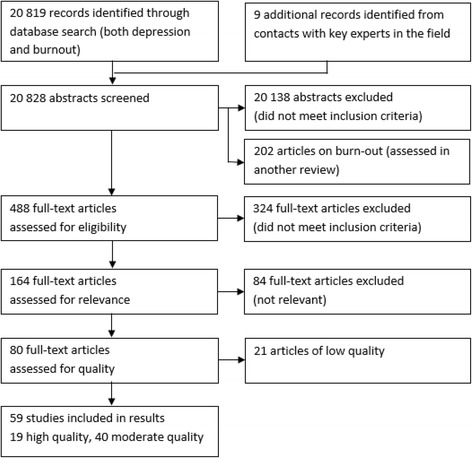
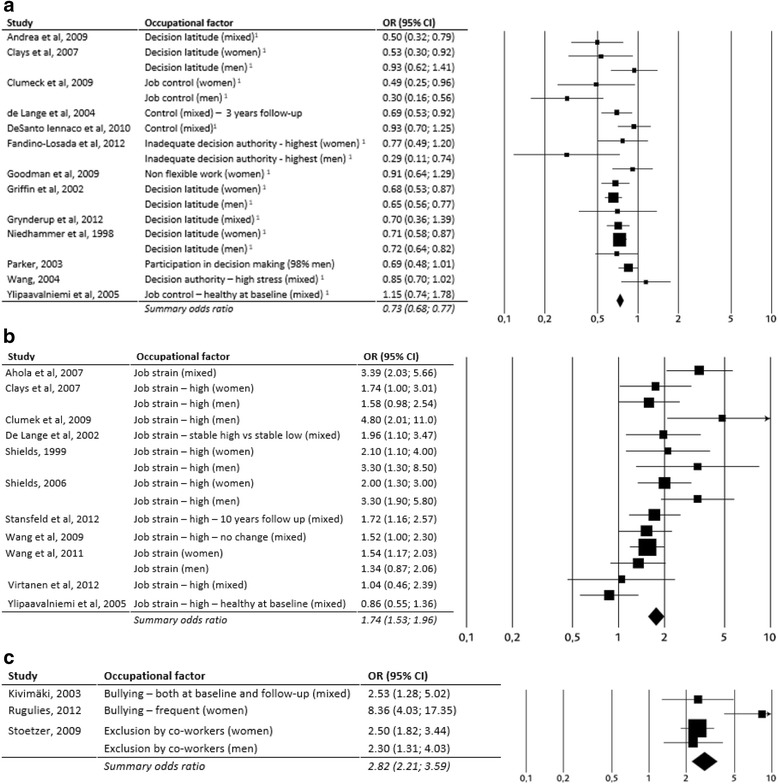
BACKGROUND: Depressive symptoms are potential outcomes of poorly functioning work environments. Such symptoms are frequent and cause considerable suffering for the employees as well as financial loss for the employers. Accordingly good prospective studies of psychosocial working conditions and depressive symptoms are valuable. Scientific reviews of such studies have pointed at methodological difficulties but still established a few job risk factors. Those reviews were published some years ago. There is need for an updated systematic review using the GRADE system. In addition, gender related questions have been insufficiently reviewed. METHOD: Inclusion criteria for the studies published 1990 to June 2013: 1. European and English speaking countries. 2. Quantified results describing the relationship between exposure (psychosocial or physical/chemical) and outcome (standardized questionnaire assessment of depressive symptoms or interview-based clinical depression). 3. Prospective or comparable case-control design with at least 100 participants. 4. Assessments of exposure (working conditions) and outcome at baseline and outcome (depressive symptoms) once again after follow-up 1-5 years later. 5. Adjustment for age and adjustment or stratification for gender. Studies filling inclusion criteria were subjected to assessment of 1.) relevance and 2.) quality using predefined criteria. Systematic review of the evidence was made using the GRADE system. When applicable, meta-analysis of the magnitude of associations was made. Consistency of findings was examined for a number of possible confounders and publication bias was discussed. RESULTS: Fifty-nine articles of high or medium high scientific quality were included. Moderately strong evidence (grade three out of four) was found for job strain (high psychological demands and low decision latitude), low decision latitude and bullying having significant impact on development of depressive symptoms. Limited evidence (grade two) was shown for psychological demands, effort reward imbalance, low support, unfavorable social climate, lack of work justice, conflicts, limited skill discretion, job insecurity and long working hours. There was no differential gender effect of adverse job conditions on depressive symptoms CONCLUSION: There is substantial empirical evidence that employees, both men and women, who report lack of decision latitude, job strain and bullying, will experience increasing depressive symptoms over time. These conditions are amenable to organizational interventions.
Overview
The claims and statistics of this paper haven’t been checked yet.
Free: it reads the open-access text and checks the first 5 claims that cite a source we can check. Create a free account to check every claim.
Integrity signals
Registry
Cites
Statistics
Figures
Verification
Claims the paper makes
The claims and statistics of this paper haven’t been checked yet.
Free: it reads the open-access text and checks the first 5 claims that cite a source we can check. Create a free account to check every claim.
Claims other papers make about this one
Each is checked against this paper’s own text: does it say what the citing paper says it does?
The source backs part of the claim, not all of it — or backs it for a different population, condition or comparison.
In the citing paper
“resulting in substantial costs not only to individual health but also to society as a whole (3, 4)”
From Reducing neuroendocrine psychosocial stress response through socio-emotional dyadic but not mindfulness online training (2024) · cites this paper as [3]
Experimental — accuracy not yet measuredThe source backs part of the claim, not all of it — or backs it for a different population, condition or comparison.
In the citing paper
“These issues have not been addressed in previous reviews on long working hours and mental health.”
From Long working hours and depressive symptoms: systematic review and meta-analysis of published studies and unpublished individual participant data (2018) · cites this paper as [5]
Experimental — accuracy not yet measuredThe cited source says what the claim attributes to it.
In the citing paper
“In prospective studies, this risk is less pronounced;33”
From Work-related psychosocial risk factors for stress-related mental disorders: an updated systematic review and meta-analysis (2020) · cites this paper as [33]
The cited source says what the claim attributes to it.
In the citing paper
“Extensive empirical evidence shows that work-related stressors contribute to the onset or deterioration of depression [19,20] and stress-related diseases [21,22].”
From Structural Dimension Exploration and Measurement Scale Development of Employee Involution in China’s Workplace Field (2022) · cites this paper as [19]
The cited source says what the claim attributes to it.
In the citing paper
“However, although several reviews of this field exist (5, 9-24), the few systematic quantifications of the evidence have been based on published cross-sectional (18, 19, 25) or published longitudinal studies ( 26).”
From Long working hours and depressive symptoms: systematic review and meta-analysis of published studies and unpublished individual participant data (2018) · cites this paper as [5]
1 more claim about this paper
Create a free account to see every claim other papers make about this one.
Self-check
Percentages, sums and reported differences re-computed from the paper’s own numbers.
The self-check needs the paper’s full text.
Citations
Cites
Dermyshi, E., Wang, Y., Yan, C., Hong, W., Qiu, G., Gong, X., & Zhang, T. (2017) · Neonatology · doi:10.1159/000454668 · Cited by 24,451
GRADE guidelines: 1. Introduction—GRADE evidence profiles and summary of findings tables
Guyatt, G., Oxman, A. D., Akl, E. A., Kunz, R., Vist, G., Brozek, J., Norris, S., Falck-Ytter, Y., Glasziou, P., & deBeer, H. (2011) · Journal of Clinical Epidemiology · doi:10.1016/j.jclinepi.2010.04.026 · Cited by 10,681
Healthy work: stress, productivity, and the reconstruction of working life
(1990) · Choice Reviews Online · doi:10.5860/choice.28-0381 · Cited by 8,220
Norderyd, O. M., Koch, G., Papias, A., Köhler, A. A., Helkimo, A. N., Brahm, C., Lindmark, U., Lindfors, N., Mattsson, A., Rolander, B., et al. (2015) · PubMed · Cited by 3,584
Bonde, J. P. E. (2008) · Occupational and Environmental Medicine · doi:10.1136/oem.2007.038430 · Cited by 919 · cited 1×
“Bonde [1] concluded that there were consistent findings that perception of adverse psy-”
BackgroundReducing work related psychological ill health and sickness absence: a systematic literature review
Michie, S., & Williams, S. (2003) · Occupational and Environmental Medicine · doi:10.1136/oem.60.1.3 · Cited by 816
Psychosocial work environment and stress-related disorders, a systematic review
Nieuwenhuijsen, K., Bruinvels, D., & Frings-Dresen, M. (2010) · Occupational Medicine · doi:10.1093/occmed/kqq081 · Cited by 696
Workplace bullying and the risk of cardiovascular disease and depression
Kivimäki, M., Virtanen, M., Vartia, M., Elovainio, M., Vahtera, J., & Keltikangas-Järvinen, L. (2003) · Occupational and Environmental Medicine · doi:10.1136/oem.60.10.779 · Cited by 593
De Lange *, A. H., Taris, T. W., Kompier, M. A. J., Houtman, I. L. D., & Bongers, P. M. (2004) · Work & Stress · doi:10.1080/02678370412331270860 · Cited by 534
The Relation between Work-related Psychosocial Factors and the Development of Depression
Netterstrom, B., Conrad, N., Bech, P., Fink, P., Olsen, O., Rugulies, R., & Stansfeld, S. (2008) · Epidemiologic Reviews · doi:10.1093/epirev/mxn004 · Cited by 467 · cited 1×
“[2] made a similar conclusion but pointed out that studies are needed that assess in more detail the duration and intensity of exposure necessary for developing depression.”
Result
Cited by
Items 801–900 of 1,000
Sumartini, E., & Ernyasih, E. (2025) · Antigen Jurnal Kesehatan Masyarakat dan Ilmu Gizi · doi:10.57213/antigen.v3i3.777 · Cited by 2
Knutsen, R. H., Nielsen, M. B., Fostervold, K. I., & Johannessen, H. A. (2025) · International Archives of Occupational and Environmental Health · doi:10.1007/s00420-025-02183-2 · Cited by 2
Zábrodská, K., Kveton, P., Jelínek, M., Mudrák, J., Dragomirecká, E., Zernerova, L., Šípová, I., & Máčel, M. (2026) · BMC Psychology · doi:10.1186/s40359-026-03961-4 · Cited by 2
Bacci, G., Converso, D., Guidetti, G., Sottimano, I., & Viotti, S. (2026) · Safety · doi:10.3390/safety12010021 · Cited by 2
Occupational and Psychosocial Risk Factors for Depression Among Truck Drivers: A Systematic Review
Cong, W., Ye, A., Zheng, M., Weng, S., Chen, X., Zhou, Z., & Tan, Y. (2026) · Issues in Mental Health Nursing · doi:10.1080/01612840.2026.2612955 · Cited by 2
Ceilings: Gender Inequality in Hours, Earnings and Health
Strazdins, L. M., Doan, T. T., Leach, L., Li, J., Pollmann‐Schult, M., & Kaiser, T. (2026) · Social Indicators Research · doi:10.1007/s11205-026-03820-0 · Cited by 2
Habtu, Y., Kumie, A., Selamu, M., Hasen, H., Kusheta, S., Demelash, R., & Girma, E. (2026) · Discover Mental Health · doi:10.1007/s44192-026-00416-5 · Cited by 2
Workplace bullying research at a crossroads: a five-decade bibliometric analysis and future pathways
Budhiraja, M., & Dhall, R. (2026) · Personnel Review · doi:10.1108/pr-08-2025-0860 · Cited by 2
Validation of the Russian version of the Copenhagen Psychosocial Questionnaire
Novikova, A. V., Shirokov, V. A., Kuzmin, S. V., Novikov, A. A., & Perevezentseva, A. S. (2026) · Journal of Occupational and Environmental Hygiene · doi:10.1080/15459624.2026.2649753 · Cited by 2
Bahgat, M. M., El-Helw, N. R., Abdel-Hamid, A. M., Fata, M., Ashour, M. S., & Atteya, A. M. A. (2026) · BMC Oral Health · doi:10.1186/s12903-026-09266-7 · Cited by 2
Validation of the Questionnaire on Psychosocial Risks, Well-Being, and Health at Work (QRBEST)
Gilbert‐Ouimet, M., Truchon, M., Aubé, K., Hervieux, V., Biron, C., Langlois, L., Pelletier, M., & Lerouge, L. (2026) · Scandinavian Journal of Work and Organizational Psychology · doi:10.16993/sjwop.451 · Cited by 2
Gacau, K. K., Kombe, Y., Ngayo, M. O., & Mwaniki, P. (2016) · Journal of Health, Medicine and Nursing · Cited by 2
Hayashi, T., Odagiri, Y., Takamiya, T., Kikuchi, H., Fukushima, N., & Inoue, S. (2019) · BMJ Open · doi:10.1136/bmjopen-2019-029556 · Cited by 2
Choi, B., & Seo, Y. (2023) · Annals of Occupational and Environmental Medicine · doi:10.35371/aoem.2023.35.e7 · Cited by 2
Experiences of rehabilitation coordination among people on sick leave with mental health problems
Lork, K., Danielsson, L., Larsson, M. E. H., & Holmgren, K. E. (2024) · Scandinavian Journal of Primary Health Care · doi:10.1080/02813432.2024.2361242 · Cited by 2
MENTES EM RISCO: EPIDEMIOLOGIA DOS TRANSTORNOS MENTAIS OCUPACIONAIS EM HOMENS NO BRASIL (2010-2022)
Neto, J. M. D. S., da Silva, G. G. V., Silva, J. O., do Prado, I. L., de Bessa, N. B., Soares, G. A. F. D. S., Cardoso, M. C. D. O., Santos, O. A. X., & Fraga, G. G. (2024) · Revista Ibero-Americana de Humanidades, Ciências e Educação · doi:10.51891/rease.v10i6.14709 · Cited by 2
Informell omsorg, arbetsrelaterad stress och psykisk ohälsa hos förvärvsarbetare
Czajkowski, L., Nilsen, C., Shaw, B. A., Leineweber, C., & Sacco, L. (2025) · Arbetsmarknad & Arbetsliv · doi:10.58236/aa.25305 · Cited by 2
The impact of work pressure on health: The compensatory effect of social capital on women
Zhang, M., & Zhang, J. (2024) · Modern Science · doi:10.3724/j.issn.1671-4342.20240034 · Cited by 2
Rokach, A., & Patel, K. (2021) · Elsevier eBooks · doi:10.1016/b978-0-12-819174-3.00011-5 · Cited by 2
Buxton, A. E., Remmers, C., Köhling, J., & Michalak, J. (2021) · Verhaltenstherapie · doi:10.1159/000518693 · Cited by 2
Parent‐Lamarche, A., Marchand, A., & Saade, S. (2021) · International Archives of Occupational and Environmental Health · doi:10.1007/s00420-021-01792-x · Cited by 2
Kretzler, B., König, H., & Hajek, A. (2021) · International Journal of Environmental Research and Public Health · doi:10.3390/ijerph182312688 · Cited by 2
Moulin, S. (2022) · Canadian Journal of Career Development · doi:10.53379/cjcd.2022.327 · Cited by 2
Management v krizah: Izbrana poglavja
Šprajc, P. (2022) · doi:10.18690/um.fov.1.2022 · Cited by 3
Yip, Y. T., Teoh, A. N., & Low, P. K. (2023) · Journal of Concurrent Disorders · doi:10.54127/hbsf9201 · Cited by 2
Working Careers with Common Mental Disorders
Hensing, G. K. E. (2023) · Handbook series in occupational health sciences · doi:10.1007/978-3-030-94023-2_23-1 · Cited by 2
The Unseen Crisis: Embryologist Burnout and its Impact on IVF Success Rates
Başar, M. (2023) · American Journal of Biomedical Science & Research · doi:10.34297/ajbsr.2023.18.002514 · Cited by 2
Exploring Perceived Workplace Psychosocial Factors and Its Relation on Mental Health Among Baristas
Abidin, N. H. N. Z., Ramli, N. F. N., Abidin, N. Z. Z., Ilias, K., Buhari, S. S., & Amin, N. A. (2023) · Malaysian Journal of Medicine and Health Sciences · doi:10.47836/mjmhs.19.s9.27 · Cited by 2
A narrative review on psychosocial factors associated with suicide amongst youth
Shophi, T. (2024) · EUREKA Social and Humanities · doi:10.21303/2504-5571.2024.003352 · Cited by 2
Credible Sadness, Coercive Sadness: Depression as a Functional Response to Adversity and Strife
Hagen, E. H., & Syme, K. (2024) · Oxford University Press eBooks · doi:10.1093/oxfordhb/9780197544754.013.58 · Cited by 2
Roystonn, K., Koh, Y. S., Shafie, S., Sambasivam, R., Vaingankar, J. A., Chong, S. A., & Subramaniam, M. (2024) · Journal of Affective Disorders · doi:10.1016/j.jad.2024.08.046 · Cited by 2
Hartvigsson, T., Sandman, L., Bergström, G., & Brämberg, E. B. (2024) · Health Care Analysis · doi:10.1007/s10728-024-00491-1 · Cited by 2
Matsumura, Y., Yamamoto, R., Shinzawa, M., Nakamura, Y., Li, Q., Mizui, M., Matsui, I., Sakaguchi, Y., Shinomiya, H., Ishibashi, C., et al. (2024) · Journal of Occupational and Environmental Medicine · doi:10.1097/jom.0000000000003238 · Cited by 2
Abusive Supervision as Predictor of Perceived Stress and Cyberloafing at Work
Duran, B., & Metin-Orta, I. (2024) · İş ve İnsan Dergisi · doi:10.18394/iid.1395152 · Cited by 2
Bergdolt, J., Hubert, S., Schreiter, J., Jenderny, S., Beblo, T., Drießen, M., Steinhart, I., & Dehn, L. B. (2025) · BMC Psychiatry · doi:10.1186/s12888-025-06826-z · Cited by 2
Chong, J. P. (2018) · Elsevier eBooks · doi:10.1016/b978-0-323-58182-0.00005-5 · Cited by 2
Hirokawa, K., Ohira, T., Kajiura, M., Imano, H., Kitamura, A., Kiyama, M., Okada, T., & Iso, H. (2020) · Brain and Behavior · doi:10.1002/brb3.1541 · Cited by 2
Mobbing and Dark Triad Personality Traits
Okumuşoğlu, S. (2021) · The Journal of Turk-Islam World Social Studies · doi:10.29228/tidsad.54694 · Cited by 2
Izobraževanje v času pandemije COVID-19
Jereb, E., & Urh, M. (2022) · doi:10.18690/um.fov.1.2022.2 · Cited by 2
The Quality of Life and the Bio-Molecular Profile in Working Environment: A Systematic Review
Ghelli, F., Malandrone, F., Bellisario, V., Squillacioti, G., Panizzolo, M., Colombi, N., Ostacoli, L., & Bono, R. (2022) · Sustainability · doi:10.3390/su14138100 · Cited by 2
Chronischer beruflicher Stress: Behandlungsansätze mit Psychotherapie
Koch, S., Lehr, D., & Hillert, A. (2022) · PPmP - Psychotherapie · Psychosomatik · Medizinische Psychologie · doi:10.1055/a-1841-3145 · Cited by 2
Sola, H. D., Salazar, A., Palomo‐Osuna, J., Dueñas, M., Failde, I., & Moral-Muñoz, J. A. (2022) · Heliyon · doi:10.1016/j.heliyon.2022.e12483 · Cited by 2
Communication in Tourism: Tour(ist) guides, Storytelling and the DRAMMA model
Jasna, J., Webb, J., Petek, V., & Gliha, M. K. (2024) · doi:10.18690/um.ft.1.2024.6 · Cited by 2
Effektivität der Funktionellen Entspannung zur Stressprävention
Gebhardt, M. (2016) · mediaTUM (Technical University of Munich) · Cited by 2
The Lived Experience of Work Stress and Coping in Eldercare Hospice Nurses
Abraham, Y. (2020) · ScholarWorks (Walden University) · Cited by 2
Lippel, K., Nakache, D., & Cedillo, L. (2020) · SSRN Electronic Journal · doi:10.2139/ssrn.3585384 · Cited by 2
Ферландер, С., Stickley, A., Анатольевна, К. О., Jukkala, T., Carlson, P., & Mäkinen, I. H. (2017) · BMC Psychology · doi:10.1186/s40359-017-0190-3 · Cited by 2
Employment and Health Mapping Report: Evidence and Gap Map of Systematic Reviews
Campbell, F., Llewellyn, J., Chambers, D., Wong, R., & Meier, P. S. (2022) · doi:10.36399/gla.pubs.311523 · Cited by 2
Gender Differences in Depression Symptom Severity: An AI-expedited Meta-analysisPreprint
Scherbakov, D., Heider, P. M., Obeid, J. S., Alekseyenko, A. V., & Lenert, L. A. (2025) · Research Square · doi:10.21203/rs.3.rs-6578485/v1 · Cited by 2
Las variables moduladoras del acoso psicológico en el trabajo: un enfoque victimológico y forense
López, V. D. (2021) · Docta Complutense (Universidad Complutense de Madrid) · Cited by 2
Nordic journal of working life studies
(n.d.) · RWTH Publications (RWTH Aachen) · Cited by 2
Nikunlaakso, R. (2024) · UEF eRepo (University of Eastern Finland) · Cited by 2
Interactions of Work and Health: An Economic Perspective
Barnay, T. (2020) · Springer eBooks · doi:10.1007/978-3-030-05031-3_30-1 · Cited by 1
The Stress Profile: The Influence of Personal Characteristics on Response to Occupational Trauma
Jerabek, I., & Muoio, D. (2019) · IGI Global eBooks · doi:10.4018/978-1-7998-0954-8.ch013 · Cited by 1
Baog, I. W., Radin, M. L., Cagape, W. E., Clerigo, K. O., & Magayo, J. C. (2022) · International Journal of Research Publications · doi:10.47119/ijrp100961320222922 · Cited by 1
Heber, E., Lehr, D., Ebert, D. D., Fraunhofer, L., & Großmann, I. (2023) · Springer eBooks · doi:10.1007/978-3-662-65816-1_13 · Cited by 1
Lohnen sich Maßnahmen gegen Arbeitsstress?
Angerer, P., & Gündel, H. (2023) · Organisationsberatung Supervision Coaching · doi:10.1007/s11613-023-00825-3 · Cited by 1
Izawa, S., Yamada, K. C., Nakamura‐Taira, N., Kameyama, R., & Tanoue, A. (2023) · Current Psychology · doi:10.1007/s12144-023-05364-9 · Cited by 1
Examining parental stress and its link to hair cortisol and DHEA levels in kindergartners
Rapp, L., & Pollatos, O. (2024) · Psychology and Health · doi:10.1080/08870446.2024.2347659 · Cited by 1
Hospitality Employees’ Mental Health Issues: A Review
Ghazali, H. B., Mohamad, S. F., Othman, M. A. R., & Ishak, M. (2024) · International Journal of Academic Research in Business and Social Sciences · doi:10.6007/ijarbss/v14-i7/21850 · Cited by 1
Matsuura, A., Sasahara, S., Doki, S., Hori, D., Ikeda, Y., Kanai, N., Migaki, W., Tsukada, H., & Takao, S. (2025) · Cureus · doi:10.7759/cureus.85945 · Cited by 1
Inadera, H., Matsumura, K., Kasamatsu, H., Sakai, J., Tsuchida, A., & the Japan Environment and Children’s Study (JECS) Group (2025) · PLoS ONE · doi:10.1371/journal.pone.0326864 · Cited by 1
Testing the feasibility of 30 min of daily outdoor office work for stress management: A pilot study
Andreasson, P., Toivanen, S., Abraham, F. J., & Bälter, K. A. (2025) · Work · doi:10.1177/10519815251356168 · Cited by 1
Ogata, A., & Ide-Okochi, A. (2025) · International Journal of Nursing Sciences · doi:10.1016/j.ijnss.2025.08.006 · Cited by 1
Desquitado, M. (2025) · NURSE EDUCATORS AND PRACTITIONERS JOURNAL · doi:10.64397/nepj.v01i01.2025.a01 · Cited by 1
The paradox of care: Navigating emotional demands in Faroese nursing practice
Skaale, S. O., Djurhuus, E., & Davidsen, A. H. (2025) · Acta Psychologica · doi:10.1016/j.actpsy.2025.105586 · Cited by 1
Decent work in the United States: A public health perspective
Pratap, P., Sokas, R. K., Oladosu, M., Neimark, R., & Landsbergis, P. A. (2025) · Work · doi:10.1177/10519815251394860 · Cited by 1
Registered Nurses’ Work Environment Associated with Auto-Anamnesis, Auto-Triage, and Online Chat
Stadin, M. R., & Cajander, Å. (2025) · Nordic Journal of Working Life Studies · doi:10.18291/njwls.161779 · Cited by 1
Sedentary Lifestyle - A Multidisciplinary Perspective
Branquinho, L., Valente, N., Forte, P. M., Teixeira, J. E., & Ferraz, R. M. P. (2025) · IntechOpen eBooks · doi:10.5772/intechopen.1008077 · Cited by 1
Nazha, H. M., Alomari, M., & Darwich, M. A. (2026) · International Journal of Environmental Research and Public Health · doi:10.3390/ijerph23010096 · Cited by 1
Niedhammer, I., Quatrevaux, M., & Bertrais, S. (2026) · European Journal of Public Health · doi:10.1093/eurpub/ckag012 · Cited by 1
Takahashi, R., Yabe, H., Ishikawa, H., Hibino, T., TAKIGIKU, Y., Moriyama, Y., Kono, K., & YAMADA, T. (2026) · Journal of UOEH · doi:10.7888/juoeh.48.35 · Cited by 1
Salonen, L., Falkstedt, D., Pan, K., Albin, M. C., Mehlum, I. S., Undem, K., Leinonen, T., & Solovieva, S. (2026) · Scandinavian Journal of Work Environment & Health · doi:10.5271/sjweh.4279 · Cited by 1
Threat Detected: Hypergaze and the Evolutionary Roots of Burnout on Video Calls
Garcia, H. A., Reiss, J. J., & Garza, R. (2026) · Evolutionary Psychological Science · doi:10.1007/s40806-026-00470-w · Cited by 1
Kim, S.-H., & Song, H. (2026) · Safety and Health at Work · doi:10.1016/j.shaw.2026.03.008 · Cited by 1
Unveiling emotional strain: The interplay of loneliness, stress, and depression among school leaders
Özyıldırım, G., & Gläser‐Zikuda, M. (2026) · Educational Management Administration & Leadership · doi:10.1177/17411432261438258 · Cited by 1
Maeda, Y., Matsunaga, M., Hosaka, Y., Ishikawa, K., & Ota, A. (2026) · Journal of Occupational Health · doi:10.1093/joccuh/uiag017 · Cited by 1
Barbosa, F. C., Fracassi, B., Tadine, R. M., Rezende, J. D. P., da Silva, E. J., & Ferreira, D. L. D. S. (2026) · Derecho y cambio social. · doi:10.54899/dcs.v23i89.5247 · Cited by 3
Taibi, Y., Müller, A., Bellingrath, S., Neuhaus, C. A., & Metzler, Y. A. (2026) · Frontiers in Psychology · doi:10.3389/fpsyg.2026.1753317 · Cited by 1
Depresión en trabajadores de una empresa privada: prevalencia y consideraciones para la salud mental
Sozoranga, J. S. B., Fonseca, C. F. M., Zavala-Jara, S. N., & Villavicencio-Quevedo, P. J. (2026) · Revista Científica Ciencia y Método · doi:10.55813/gaea/rcym/v4/n2/195 · Cited by 1
Marić, A. M., Palameta, M., Mabić, M., Zalihić, A., Obrdalj, E. Č., Pupić, A., Berberović, M., & Kostić, S. (2026) · Croatian Medical Journal · doi:10.3325/cmj.2026.67.85 · Cited by 1
Naipaul, T., Naipaul, J., Persaud, R., Gangai, K. N., Naipaul, R., & Bacchus, S. (2026) · Culture & Psychology · doi:10.1177/1354067x261459962 · Cited by 1
Hanson, L. L. M., Madsen, I. E. H., Blomqvist, S., Holmgren, R., Sørensen, K., & Rugulies, R. (2026) · Scandinavian Journal of Work Environment & Health · doi:10.5271/sjweh.4308 · Cited by 1
Kleine, J., Kohnen, D., Campione, A., & Busse, R. (2026) · BMC Nursing · doi:10.1186/s12912-026-04953-w · Cited by 1
van de Ven, S. R. B., Gevonden, M. J., Huizinga, N. A., Keur‐Huizinga, L., van der Mee, D. J., Noordzij, M. L., & de Geus, E. J. C. (2026) · Biological Psychology · doi:10.1016/j.biopsycho.2026.109369 · Cited by 1
Workplace management of musculoskeletal and mental health risks: translating evidence into practice
Macdonald, W., McCredie, K. B., & Oakman, J. (2026) · Applied Ergonomics · doi:10.1016/j.apergo.2026.104895 · Cited by 1
Selbst-Etikett Burnout? – Das diagnostische Spektrum dahinter
Rothermund, E., von Wietersheim, J., & Balint, E. M. (2018) · PiD - Psychotherapie im Dialog · doi:10.1055/a-0556-2431 · Cited by 1
Measuring the quality of the working environment: The job characteristics approach
OECD (2017) · OECD eBooks · doi:10.1787/9789264278240-7-en · Cited by 1
Daniels, K., Glover, J. L., Nayani, R., Mellor, N. J., & Munir, F. (2017) · Policy and Practice in Health and Safety · doi:10.1080/14773996.2017.1376833 · Cited by 1
Erwerbsverlauf und Gesundheit älterer weiblicher Beschäftigter
Tophoven, S. (2018) · doi:10.3278/300988w · Cited by 1
Concepts and Social Variations of Disability in Working-Age Populations
Siegrist, J., & Li, J. (2020) · Springer eBooks · doi:10.1007/978-3-030-24334-0_36 · Cited by 1
The Associationalist Demand–Control (ADC) Theory: Toward a Sustainable Psychosocial Work Environment
Karasek, R. A. (2020) · Springer eBooks · doi:10.1007/978-3-030-05031-3_25-1 · Cited by 1
Conway, P. M., Erlangsen, A., Grynderup, M. B., Clausen, T., Bjørner, J. B., Burr, H., Francioli, L., Garde, A. H., Hansen, Å. M., Hanson, L. L. M., et al. (2020) · Figshare · doi:10.6084/m9.figshare.13072199 · Cited by 1
A conversation on health research collaborations and career with Dr. Gordon Guyatt: A commentary
Johansson, I., Naji, L., Rodrigues, M., Akula, K. K., Hu, Z. J., Kay, J., Thabane, L., & Guyatt, G. H. (2021) · Journal of Clinical Epidemiology · doi:10.1016/j.jclinepi.2021.01.019 · Cited by 1
Herring, M. G., Martin, L., & Kristman, V. L. (2021) · Frontiers in Psychiatry · doi:10.3389/fpsyt.2021.673123 · Cited by 1
Influence at Work tied to Materiality in Danish Care Work
Svendsen, P. A., Abildgaard, J. S., Tanggaard, L., Madsen, I. E. H., & Andersen, M. F. (2021) · Nordic Journal of Working Life Studies · doi:10.18291/njwls.129222 · Cited by 1
Arafat, Y., Darmawati, T., & Mukminin, H. (2021) · JPPI (Jurnal Penelitian Pendidikan Indonesia) · doi:10.29210/020211143 · Cited by 1
Chin, S. T. S., Khan, A., & Anwar, M. (2021) · Gomal University Journal of Research · doi:10.51380/gujr-37-04-01 · Cited by 1
OECD (2017) · OECD eBooks · doi:10.1787/9789264278240-2-en · Cited by 1
Metadata
- Authors
- Theorell, T., Hammarström, A., Aronsson, G., Träskman Bendz, L., Grape, T., Hogstedt, C., Marteinsdottir, I., Skoog, I., & Hall, C.
- Affiliations
- Stockholm University (SE)
- University Hospital of Umeå (SE)
- Karolinska Institutet (SE)
- University of Gothenburg (SE)
- SBU - Swedish Agency for Health Technology Assessment and Assessment of Social Services (SE)
- Corresponding author
- Theorell, Töres
- Venue
- BMC Public Health
- Published
- 2015-08-01
- Volume
- 15
- Issue
- 1
- Pages
- 738-738
- ISSN
- 1471-2458 (ISSN-L)
- PMC
- PMC4522058
- OpenAlex
- W2118480036
- Cited by
- 982
- References
- 82
- Citations by year
- 2026: 54 · 2025: 74 · 2024: 93 · 2023: 96 · 2022: 120 · 2021: 120 · 2020: 115 · 2019: 115 · 2018: 90 · 2017: 70 · 2016: 31 · 2015: 2
- FWCI
- 11.55
- Type
- journal article
- Language
- en
- Open access
- gold
- doi.org
- Locations
- BMC Public Health (publishedVersion, cc-by)
- Europe PMC (PubMed Central) (publishedVersion, other-oa)
- PubMed Central (publishedVersion, cc-by)
- PubMed (publishedVersion)
- DiVA (Linkoping University) (submittedVersion, other-oa)
- DiVA at Umeå University (Umeå University) (submittedVersion, other-oa)
- Lund University Publications (Lund University) (submittedVersion, other-oa)
- Funders
- World Health Organization
- Topics
- Health Sciences › Medicine › Public Health, Environmental and Occupational Health › Workplace Health and Well-being
- Health Sciences › Medicine › Public Health, Environmental and Occupational Health › Occupational Health and Burnout
- Health Sciences › Medicine › Public Health, Environmental and Occupational Health › Employment and Welfare Studies
- Keywords
- depressive symptoms, work environment, psychosocial work environment, job strain, job control, bullying, effort-reward imbalance, social support, job insecurity, long working hours, gender differences, workplace mental health, job demands
- MeSH terms
- Adult, Depression, Female, Health Status, Humans, Job Satisfaction, Male, Middle Aged, Occupational Diseases, Prospective Studies, Sweden, Comorbidity, Workload, Workplace, Risk Assessment
About these checks
Registry, retraction, Cites and statistics results are computed, not judged, with one exception: a printed reference that no index lists is read once by a model before it counts as a citation error. Claims are extracted by a model and kept only when their quote appears verbatim in the text; each cited source is then checked, with a model’s help, for whether it says what the claim relies on. Those verdicts can be wrong — read the claim’s quote and the cited source before relying on one.
Statistics and arithmetic are recomputed, not judged.
Confidence bands are shown only for fields calibrated on our annotated test set. None is calibrated yet, so no band is shown.
What counts as a claim ›How we measure confidence ›How we check this ›
Are you an author, or do you see a problem with this page? Request a review
Data sources
Bibliographic data: Semantic Scholar, OpenAlex, Crossref.
Contains information from the Semantic Scholar Academic Graph Datasets, made available under the ODC Attribution License (ODC-BY 1.0).
Semantic Scholar’s data is described in: Kinney, R., et al. (2023). The Semantic Scholar Open Data Platform. arXiv:2301.10140.
