

A systematic review including meta-analysis of work environment and depressive symptoms
Open accessThe DOI matches its Crossref record; 81 of the 82 references it cites were found in a registry or an index.
Abstract
BACKGROUND: Depressive symptoms are potential outcomes of poorly functioning work environments. Such symptoms are frequent and cause considerable suffering for the employees as well as financial loss for the employers. Accordingly good prospective studies of psychosocial working conditions and depressive symptoms are valuable. Scientific reviews of such studies have pointed at methodological difficulties but still established a few job risk factors. Those reviews were published some years ago. There is need for an updated systematic review using the GRADE system. In addition, gender related questions have been insufficiently reviewed. METHOD: Inclusion criteria for the studies published 1990 to June 2013: 1. European and English speaking countries. 2. Quantified results describing the relationship between exposure (psychosocial or physical/chemical) and outcome (standardized questionnaire assessment of depressive symptoms or interview-based clinical depression). 3. Prospective or comparable case-control design with at least 100 participants. 4. Assessments of exposure (working conditions) and outcome at baseline and outcome (depressive symptoms) once again after follow-up 1-5 years later. 5. Adjustment for age and adjustment or stratification for gender. Studies filling inclusion criteria were subjected to assessment of 1.) relevance and 2.) quality using predefined criteria. Systematic review of the evidence was made using the GRADE system. When applicable, meta-analysis of the magnitude of associations was made. Consistency of findings was examined for a number of possible confounders and publication bias was discussed. RESULTS: Fifty-nine articles of high or medium high scientific quality were included. Moderately strong evidence (grade three out of four) was found for job strain (high psychological demands and low decision latitude), low decision latitude and bullying having significant impact on development of depressive symptoms. Limited evidence (grade two) was shown for psychological demands, effort reward imbalance, low support, unfavorable social climate, lack of work justice, conflicts, limited skill discretion, job insecurity and long working hours. There was no differential gender effect of adverse job conditions on depressive symptoms CONCLUSION: There is substantial empirical evidence that employees, both men and women, who report lack of decision latitude, job strain and bullying, will experience increasing depressive symptoms over time. These conditions are amenable to organizational interventions.
Overview
The claims and statistics of this paper haven’t been checked yet.
Free: it reads the open-access text and checks the first 5 claims that cite a source we can check. Create a free account to check every claim.
Integrity signals
Registry
Cites
Statistics
Figures
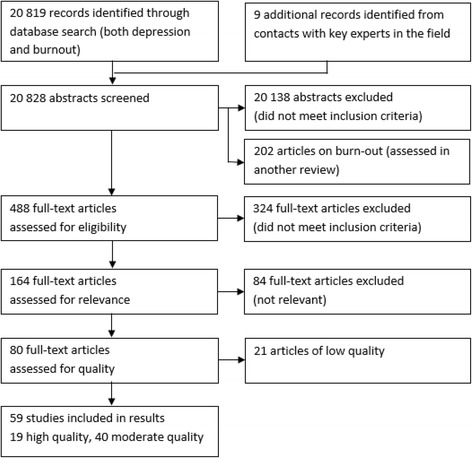
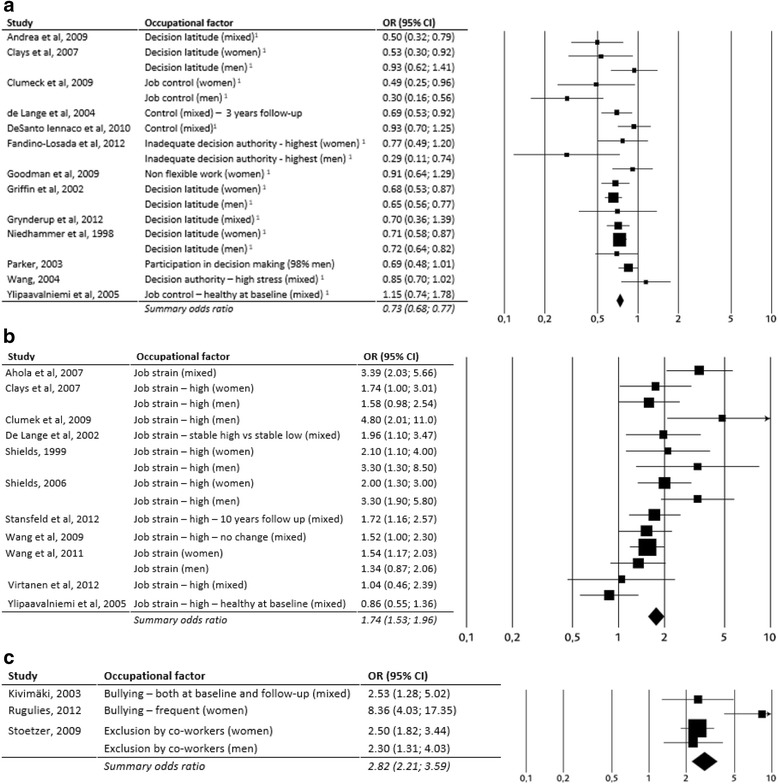
Verification
Claims the paper makes
The claims and statistics of this paper haven’t been checked yet.
Free: it reads the open-access text and checks the first 5 claims that cite a source we can check. Create a free account to check every claim.
Claims other papers make about this one
Each is checked against this paper’s own text: does it say what the citing paper says it does?
The source backs part of the claim, not all of it — or backs it for a different population, condition or comparison.
In the citing paper
“resulting in substantial costs not only to individual health but also to society as a whole (3, 4)”
From Reducing neuroendocrine psychosocial stress response through socio-emotional dyadic but not mindfulness online training (2024) · cites this paper as [3]
Experimental — accuracy not yet measuredThe source backs part of the claim, not all of it — or backs it for a different population, condition or comparison.
In the citing paper
“These issues have not been addressed in previous reviews on long working hours and mental health.”
From Long working hours and depressive symptoms: systematic review and meta-analysis of published studies and unpublished individual participant data (2018) · cites this paper as [5]
Experimental — accuracy not yet measuredThe cited source says what the claim attributes to it.
In the citing paper
“In prospective studies, this risk is less pronounced;33”
From Work-related psychosocial risk factors for stress-related mental disorders: an updated systematic review and meta-analysis (2020) · cites this paper as [33]
The cited source says what the claim attributes to it.
In the citing paper
“Extensive empirical evidence shows that work-related stressors contribute to the onset or deterioration of depression [19,20] and stress-related diseases [21,22].”
From Structural Dimension Exploration and Measurement Scale Development of Employee Involution in China’s Workplace Field (2022) · cites this paper as [19]
The cited source says what the claim attributes to it.
In the citing paper
“However, although several reviews of this field exist (5, 9-24), the few systematic quantifications of the evidence have been based on published cross-sectional (18, 19, 25) or published longitudinal studies ( 26).”
From Long working hours and depressive symptoms: systematic review and meta-analysis of published studies and unpublished individual participant data (2018) · cites this paper as [5]
1 more claim about this paper
Create a free account to see every claim other papers make about this one.
Self-check
Percentages, sums and reported differences re-computed from the paper’s own numbers.
The self-check needs the paper’s full text.
Citations
Cites
Dermyshi, E., Wang, Y., Yan, C., Hong, W., Qiu, G., Gong, X., & Zhang, T. (2017) · Neonatology · doi:10.1159/000454668 · Cited by 24,451
GRADE guidelines: 1. Introduction—GRADE evidence profiles and summary of findings tables
Guyatt, G., Oxman, A. D., Akl, E. A., Kunz, R., Vist, G., Brozek, J., Norris, S., Falck-Ytter, Y., Glasziou, P., & deBeer, H. (2011) · Journal of Clinical Epidemiology · doi:10.1016/j.jclinepi.2010.04.026 · Cited by 10,681
Healthy work: stress, productivity, and the reconstruction of working life
(1990) · Choice Reviews Online · doi:10.5860/choice.28-0381 · Cited by 8,220
Norderyd, O. M., Koch, G., Papias, A., Köhler, A. A., Helkimo, A. N., Brahm, C., Lindmark, U., Lindfors, N., Mattsson, A., Rolander, B., et al. (2015) · PubMed · Cited by 3,584
Bonde, J. P. E. (2008) · Occupational and Environmental Medicine · doi:10.1136/oem.2007.038430 · Cited by 919 · cited 1×
“Bonde [1] concluded that there were consistent findings that perception of adverse psy-”
BackgroundReducing work related psychological ill health and sickness absence: a systematic literature review
Michie, S., & Williams, S. (2003) · Occupational and Environmental Medicine · doi:10.1136/oem.60.1.3 · Cited by 816
Psychosocial work environment and stress-related disorders, a systematic review
Nieuwenhuijsen, K., Bruinvels, D., & Frings-Dresen, M. (2010) · Occupational Medicine · doi:10.1093/occmed/kqq081 · Cited by 696
Workplace bullying and the risk of cardiovascular disease and depression
Kivimäki, M., Virtanen, M., Vartia, M., Elovainio, M., Vahtera, J., & Keltikangas-Järvinen, L. (2003) · Occupational and Environmental Medicine · doi:10.1136/oem.60.10.779 · Cited by 593
De Lange *, A. H., Taris, T. W., Kompier, M. A. J., Houtman, I. L. D., & Bongers, P. M. (2004) · Work & Stress · doi:10.1080/02678370412331270860 · Cited by 534
The Relation between Work-related Psychosocial Factors and the Development of Depression
Netterstrom, B., Conrad, N., Bech, P., Fink, P., Olsen, O., Rugulies, R., & Stansfeld, S. (2008) · Epidemiologic Reviews · doi:10.1093/epirev/mxn004 · Cited by 467 · cited 1×
“[2] made a similar conclusion but pointed out that studies are needed that assess in more detail the duration and intensity of exposure necessary for developing depression.”
Result
Cited by
Items 301–400 of 1,000
Psychological Distress Reported by Primary Care Physicians in China During the COVID-19 Pandemic
Zeng, X., Peng, T., Hao, X., Zou, C., Lin, K., Liao, X., Chen, S., & Hayhoe, B. W. J. (2021) · Psychosomatic Medicine · doi:10.1097/psy.0000000000000939 · Cited by 23
Lyubykh, Z., Turner, N., Weinhardt, J. M., Davis, J. S., & Dumaisnil, A. (2025) · Human Resource Management · doi:10.1002/hrm.22310 · Cited by 23
Digital Technologies As a Factor of Techno-Stress: Problems and Possibilities for Their Solution
Konovalova, V. (2022) · Management of the personnel and intellectual resources in Russia · doi:10.12737/2305-7807-2022-11-3-17-21 · Cited by 23
Selinheimo, S., Gluschkoff, K., Kausto, J., Turunen, J., Koskinen, A., & Väänänen, A. (2023) · Social Psychiatry and Psychiatric Epidemiology · doi:10.1007/s00127-023-02523-y · Cited by 22
Expressive writing as a practice against work stress: A literature review
Lukenda, K., Sülzenbrück, S., & Sutter, C. (2023) · Journal of Workplace Behavioral Health · doi:10.1080/15555240.2023.2240512 · Cited by 22
Nakamura‐Taira, N., Izawa, S., & Yamada, K. C. (2018) · Psychiatry Research · doi:10.1016/j.psychres.2017.12.090 · Cited by 22
The long‐term effects of psychological demands on chronic fatigue
LeGal, P., Rhéaume, A., & Mullen, J. E. (2019) · Journal of Nursing Management · doi:10.1111/jonm.12857 · Cited by 22
Lutz, R., Jungbäck, N., Wischlitzki, E., & Drexler, H. (2023) · BMC Public Health · doi:10.1186/s12889-023-15014-1 · Cited by 22
Exploring Factors Impacting on Psychological Well-Being of Health Care Workers
Johari, F. S., & Omar, R. (2019) · International Journal of Academic Research in Business and Social Sciences · doi:10.6007/ijarbss/v9-i2/5711 · Cited by 22
Meschede, M., Roick, C., Ehresmann, C., Badura, B., Meyer, M., Ducki, A., & Schröder, H. (2020) · Springer eBooks · doi:10.1007/978-3-662-61524-9_22 · Cited by 22
Stevens, M., Barker, M. E., Dennison, E. M., Harris, E. C., Linaker, C., Weller, S., & Walker-Bone, K. E. (2022) · BMC Public Health · doi:10.1186/s12889-022-12541-1 · Cited by 21
Clausen, T., Rugulies, R., & Li, J. (2022) · Journal of Affective Disorders · doi:10.1016/j.jad.2022.09.036 · Cited by 21
Bouillon‐Minois, J., Trousselard, M., Mulliez, A., Adeyemi, O. J., Schmidt, J., Thivel, D., Ugbolue, U. C., Borel, M., Moustafa, F., Vallet, G. T., et al. (2023) · Frontiers in Psychiatry · doi:10.3389/fpsyt.2022.1043110 · Cited by 21
Baka, Ł., Prusik, M., & Jasielska, D. (2023) · Frontiers in Psychiatry · doi:10.3389/fpsyt.2022.1037053 · Cited by 21
Frazier, C. G. (2023) · Society and Mental Health · doi:10.1177/21568693231156452 · Cited by 21
Hartmann, B., Leucht, V., & Loerbroks, A. (2016) · Journal of Asthma · doi:10.1080/02770903.2016.1201836 · Cited by 21
Herr, R. M., Li, J., Loerbroks, A., Angerer, P., Siegrist, J., & Fischer, J. E. (2017) · Journal of Psychosomatic Research · doi:10.1016/j.jpsychores.2017.05.003 · Cited by 21
Tatsuse, T., Sekine, M., & Yamada, M. (2018) · Journal of Occupational and Environmental Medicine · doi:10.1097/jom.0000000000001491 · Cited by 21
Hoven, H., Siegrist, J., Goldberg, M., Ribet, C., Zins, M., & Wahrendorf, M. (2019) · SSM - Population Health · doi:10.1016/j.ssmph.2019.100351 · Cited by 21
For better or for worse? Psychosocial work environment and direct participation practices
Llorens, C., Navarro, A., Salas‐Nicás, S., Utzet, M., & Moncada, S. (2019) · Safety Science · doi:10.1016/j.ssci.2019.02.028 · Cited by 21
Won, G., Park, J. B., Lee, K. J., Ha, R., Lee, S., & Jeong, I. (2019) · Annals of Occupational and Environmental Medicine · doi:10.35371/aoem.2019.31.e13 · Cited by 21
Internet use, employment performance and the health of Chinese residents
Yang, K. (2021) · International Health · doi:10.1093/inthealth/ihab034 · Cited by 21
Chung, Y.-J., Jung, W.-C., Kim, H., & Cho, S. (2017) · International Journal of Environmental Research and Public Health · doi:10.3390/ijerph14121440 · Cited by 21
Rivière, M., Leroyer, A., Carreira, L. F., Blanchon, T., Plancke, L., Melchior, M., & Younès, N. (2018) · BMJ Open · doi:10.1136/bmjopen-2017-020770 · Cited by 21
Dworsky, M. S., & Broten, N. (2018) · RAND Corporation eBooks · doi:10.7249/rr2566 · Cited by 21
Kählke, F., Buntrock, C., Smit, F., Berking, M., Lehr, D., Heber, E., Funk, B., Riper, H. M., & Ebert, D. D. (2018) · JMIR Mental Health · doi:10.2196/10866 · Cited by 21
Examining Effort–Reward Imbalance and Depressive Symptoms Among Turkish University Workers
Keser, A., Li, J., & Siegrist, J. (2018) · Workplace Health & Safety · doi:10.1177/2165079918807227 · Cited by 21
Jahrami, H., Faris, M. E., Ghazzawi, H., Saif, Z., Habib, L., Shivappa, N., & Hébert, J. R. (2019) · Nutrients · doi:10.3390/nu11081867 · Cited by 21
Does hotel employees’ mental health matter? Assessment of its antecedents and coping behavior
Wong, A. K. F., Kim, S., & Xu, Y. (2025) · International Journal of Hospitality Management · doi:10.1016/j.ijhm.2025.104084 · Cited by 20
Working Time Characteristics and Mental Health among Corrections and Transportation Workers
Cavallari, J. M., Garza, J. L. B., Ferguson, J. M., Laguerre, R. A., Decker, R. E., Suleiman, A. O., & Dugan, A. G. (2021) · Annals of Work Exposures and Health · doi:10.1093/annweh/wxaa131 · Cited by 20
Household Income and Psychological Distress: Exploring Women’s Paid and Unpaid Work as Mediators
Janzen, B. L., & Hellsten, L.-A. M. (2021) · International Journal of Environmental Research and Public Health · doi:10.3390/ijerph18126402 · Cited by 20
Understanding How Workplace Dynamics Affect the Psychological Well-Being of University Teachers
Michulek, J., Gajanová, Ľ., Šujanská, L., & Tesárová, E. N. (2024) · Administrative Sciences · doi:10.3390/admsci14120336 · Cited by 20
Lunau, T., Dragano, N., Siegrist, J., & Wahrendorf, M. (2017) · International Archives of Occupational and Environmental Health · doi:10.1007/s00420-017-1225-z · Cited by 20
Kobayashi, Y., Watanabe, K., Otsuka, Y., Eguchi, H., Kawakami, N., Imamura, K., & van Dierendonck, D. (2020) · Frontiers in Psychology · doi:10.3389/fpsyg.2020.01711 · Cited by 20
Ebbevi, D., Schwarz, U. V. T., Hasson, H., Sundberg, C. J., & Frykman, M. (2020) · International Journal of Workplace Health Management · doi:10.1108/ijwhm-10-2019-0126 · Cited by 20
Bertrais, S., Mauroux, A., Chastang, J., & Niedhammer, I. (2020) · Depression and Anxiety · doi:10.1002/da.23111 · Cited by 21
Concurrent and lagged effects of psychosocial job stressors on symptoms of burnout
Hadžibajramović, E., Ahlborg, G., & Grimby‐Ekman, A. (2019) · International Archives of Occupational and Environmental Health · doi:10.1007/s00420-019-01437-0 · Cited by 21
Wallensten, J., Mobarrez, F., Åsberg, M., Borg, K., Beser, A., Wilczek, A., & Nager, A. (2021) · Scientific Reports · doi:10.1038/s41598-021-96313-8 · Cited by 19
Schoolteachers with voice handicap are twice as likely to report depressive symptoms
Gonzáléz, A. D., Lopes, A. C. B. D. A., de Andrade, S. M., Gabani, F. L., Santos, M. C. D. S., Rodrigues, R., & Mesas, A. E. (2022) · European Archives of Oto-Rhino-Laryngology · doi:10.1007/s00405-022-07376-w · Cited by 19
Factors affecting depression among married adults: a gender-based household cross-sectional study
Wadood, A., Karim, M. R., Alim, S. M. A. H. M., Rana, M. M., & Hossain, M. G. (2023) · BMC Public Health · doi:10.1186/s12889-023-16979-9 · Cited by 20
Hammarström, A., Westerlund, H., Janlert, U., Virtanen, P., Ziaei, S., & Östergren, P. (2024) · BMC Public Health · doi:10.1186/s12889-024-18461-6 · Cited by 19
Self-citationGrimmond, T., King, T. L., LaMontagne, A. D., Oostermeijer, S., Harrap, B., Newberry‐Dupé, J., & Reavley, N. J. (2024) · American Journal of Industrial Medicine · doi:10.1002/ajim.23620 · Cited by 19
Braun, J. W., Darius, S., & Böckelmann, I. (2024) · Healthcare · doi:10.3390/healthcare12222249 · Cited by 19
Miyake, Y., Tanaka, K., & Arakawa, M. (2020) · Psychiatry Research · doi:10.1016/j.psychres.2020.113224 · Cited by 19
How Do Hospital Medical and Nursing Managers Perceive Work-Related Strain on Their Employees?
Worringer, B., Genrich, M., Müller, A., Junne, F., & Angerer, P. (2020) · International Journal of Environmental Research and Public Health · doi:10.3390/ijerph17134660 · Cited by 19
Niedhammer, I., Milner, A. J., Coutrot, T., Geoffroy-Perez, B., LaMontagne, A. D., & Chastang, J. (2020) · Psychosomatic Medicine · doi:10.1097/psy.0000000000000878 · Cited by 23
Bergman, L. E., Bernhard‐Oettel, C., Bujacz, A., Leineweber, C., & Toivanen, S. (2021) · Frontiers in Psychology · doi:10.3389/fpsyg.2020.598303 · Cited by 19
Mental Health Outcomes Among Civil Servants Aiding in Coronavirus Disease 2019 Control
Hu, Q., Hu, X., Zheng, B., & Li, L. (2021) · Frontiers in Public Health · doi:10.3389/fpubh.2021.601791 · Cited by 19
Lützerath, J., Bleier, H., & Schaller, A. (2022) · Healthcare · doi:10.3390/healthcare10020375 · Cited by 19
Daryanto, B., Putri, F. R., Kurniawan, J., Ilmawan, M., & Fajar, J. K. (2022) · Frontiers in Public Health · doi:10.3389/fpubh.2022.894946 · Cited by 19
Barrech, A., Riedel, N., Li, J., Herr, R. M., Mörtl, K., Angerer, P., & Gündel, H. (2017) · European Journal of Public Health · doi:10.1093/eurpub/ckx068 · Cited by 19
Work and depression: The moderating role of personality traits
Parent‐Lamarche, A., & Marchand, A. (2019) · Journal of Workplace Behavioral Health · doi:10.1080/15555240.2019.1614455 · Cited by 20
Kim, D. J. (2018) · Scandinavian Journal of Work Environment & Health · doi:10.5271/sjweh.3751 · Cited by 19
Sconfienza, C., Lindfors, P., Lantz, A., & Sverke, M. (2019) · Journal of Occupational Health · doi:10.1002/1348-9585.12020 · Cited by 19
Nilsen, C., Andel, R., Darin‐Mattsson, A., & Kåreholt, I. (2019) · BMC Public Health · doi:10.1186/s12889-019-7473-y · Cited by 19
Macedo, M. J. D. A., de Freitas, C. P. P., Bermúdez, M. B., Vazquez, A. C. S., Salum, G. A., & Dreher, C. B. (2023) · Journal of Psychiatric Research · doi:10.1016/j.jpsychires.2023.09.005 · Cited by 18
Kristman, V. L., Lowey, J., Fraser, L., Armstrong, S. J., & Sawula, S. (2019) · BMC Public Health · doi:10.1186/s12889-019-6976-x · Cited by 19
Multicohort study of change in job strain, poor mental health and incident cardiometabolic disease
Hanson, L. L. M., Rod, N. H., Vahtera, J., Peristera, P., Pentti, J., Rugulies, R., Madsen, I. E. H., LaMontagne, A. D., Milner, A. J., Lange, T., et al. (2019) · Occupational and Environmental Medicine · doi:10.1136/oemed-2018-105595 · Cited by 18
Dobson, M., Schnall, P. L., Rosskam, E., & Landsbergis, P. A. (2020) · Springer eBooks · doi:10.1007/978-3-030-24334-0_13 · Cited by 18
Longitudinal associations between occupational stress and depressive symptoms
Kim, H. D., Park, S., Won, Y., Ju, H., Jang, S. W., Choi, G., Jang, H.-S., Kim, H., & Leem, J. (2020) · Annals of Occupational and Environmental Medicine · doi:10.35371/aoem.2020.32.e13 · Cited by 18
Storeng, S. H., Sund, E. R., & Krokstad, S. (2020) · BMC Public Health · doi:10.1186/s12889-020-08993-y · Cited by 19
Mátó, V., Tarkó, K., Lippai, L. L., Nagymajtényi, L., & Paulik, E. (2020) · Slovenian Journal of Public Health · doi:10.2478/sjph-2021-0003 · Cited by 18
Longitudinal Reciprocal Relationships Between the Psychosocial Work Environment and Burnout
Shahidi, F. V., Smith, P. M., Oudyk, J., & Gignac, M. A. M. (2021) · Journal of Occupational and Environmental Medicine · doi:10.1097/jom.0000000000002396 · Cited by 18
Suto, M., Balogun, O. O., Dhungel, B., Kato, T., & Takehara, K. (2022) · International Journal of Environmental Research and Public Health · doi:10.3390/ijerph19084779 · Cited by 18
Clausen, T., Christensen, K. B., Sørensen, J. K., Bjørner, J. B., Madsen, I. E. H., Borg, V., & Rugulies, R. (2022) · Annals of Work Exposures and Health · doi:10.1093/annweh/wxac069 · Cited by 18
Björkenstam, E., Helgesson, M., Gustafsson, K., Virtanen, M., Hanson, L. L. M., & Mittendorfer‐Rutz, E. (2021) · European Journal of Public Health · doi:10.1093/eurpub/ckab091 · Cited by 17
Autonomy in the context of cognitive demands—is the resource becoming a stressor?
Zolg, S., & Herbig, B. (2023) · International Archives of Occupational and Environmental Health · doi:10.1007/s00420-023-01966-9 · Cited by 17
Alaie, I., Svedberg, P., Ropponen, A., & Narusyte, J. (2023) · JAMA Network Open · doi:10.1001/jamanetworkopen.2023.17905 · Cited by 17
Cao, Z., Min, J., Xiang, Y., Wang, X., & Xu, C. (2024) · BMJ Mental Health · doi:10.1136/bmjment-2023-300915 · Cited by 17
Duchaine, C. S., Aubé, K., Gilbert‐Ouimet, M., Pena-Gralle, A. P. B., Vézina, M., Ndjaboué, R., Massamba, V. K., Trudel, X., LESAGE, A. D., Moore, L., et al. (2019) · BMJ Open · doi:10.1136/bmjopen-2019-033093 · Cited by 18
Hoffmann, J., Kersting, C., & Weltermann, B. (2020) · PLoS ONE · doi:10.1371/journal.pone.0240052 · Cited by 17
Work-Related Traumatic Stress Response in Nurses Employed in COVID-19 Settings
Karanikola, M. N. K., Mpouzika, M. D. A., Papathanassoglou, E. D. E., Kaikoushi, K., Hatzioannou, A., Leontiou, I., Livadiotis, C., Christophorou, N., & Chatzittofis, A. (2022) · International Journal of Environmental Research and Public Health · doi:10.3390/ijerph191711049 · Cited by 17
Oakman, J., Lambert, K. A., Weale, V. P., Stuckey, R., & Graham, M. (2023) · International Journal of Environmental Research and Public Health · doi:10.3390/ijerph20043046 · Cited by 17
On effort–reward imbalance and depression
Theorell, T. (2017) · Scandinavian Journal of Work Environment & Health · doi:10.5271/sjweh.3642 · Cited by 17
Self-citationWeber, J., Heming, M., Apolinário-Hagen, J., Liszio, S., & Angerer, P. (2024) · Biological Psychology · doi:10.1016/j.biopsycho.2024.108762 · Cited by 16
“Growing scientific evidence indicates that psychosocial stress increases the risk for the development of several chronic diseases and acute cardiovascular events (Niedhammer et al., 2021; Sara et al., 2018; Seidler et al., 2022; Theorell et al., 2015).”
BackgroundAlqahtani, B., Alruqi, W. M., Bhandari, S., Abudayyeh, O. Y., & Liu, H. (2022) · CivilEng · doi:10.2139/ssrn.4032293 · Cited by 16
Hazzard, V. M., Mason, T. B., Smith, K. E., Schaefer, L. M., Anderson, L. M., Dodd, D. R., Crosby, R. D., & Wonderlich, S. A. (2022) · Journal of Psychiatric Research · doi:10.1016/j.jpsychires.2022.12.025 · Cited by 17
Practical pathway for the management of depression in the workplace: a Canadian perspective
Chokka, P. R., Bender, A., Brennan, S., Ahmed, G., Corbière, M., Dozois, D. J. A., Habert, J., Harrison, J., Katzman, M. A., McIntyre, R. S., et al. (2023) · Frontiers in Psychiatry · doi:10.3389/fpsyt.2023.1207653 · Cited by 16
Chirinos-Peinado, D. M., Castro-Bedriñana, J. I., Barnes, E. P. G., Ríos-Ríos, E., García–Olarte, E., & Castro-Chirinos, G. (2024) · Toxics · doi:10.3390/toxics12050308 · Cited by 16
Conway, P. M., Erlangsen, A., Grynderup, M. B., Clausen, T., Bjørner, J. B., Burr, H., Francioli, L., Garde, A. H., Hansen, Å. M., Hanson, L. L. M., et al. (2024) · Journal of Affective Disorders · doi:10.1016/j.jad.2024.09.134 · Cited by 16
Ståhl, C., Lundqvist, D., & Reineholm, C. (2025) · Safety Science · doi:10.1016/j.ssci.2025.106917 · Cited by 16
Disabling working environments and mental health: A commentary
Milner, A. J., Shields, M., King, T. L., Aitken, Z., LaMontagne, A. D., & Kavanagh, A. M. (2019) · Disability and health journal · doi:10.1016/j.dhjo.2019.06.002 · Cited by 16
Smyth, A., de Bloom, J., Syrek, C. J., Domin, M., Janneck, M., Reins, J. A., & Lehr, D. (2020) · BMC Public Health · doi:10.1186/s12889-020-09354-5 · Cited by 16
Åhlin, J., Halonen, J. I., Madsen, I. E. H., Rugulies, R., Sørensen, J. K., & Hanson, L. L. M. (2021) · Journal of Affective Disorders · doi:10.1016/j.jad.2020.12.061 · Cited by 16
Prevalence of depression disorder in industrial workers: a meta-analysis
Amiri, S. (2021) · International Journal of Occupational Safety and Ergonomics · doi:10.1080/10803548.2021.1912448 · Cited by 16
The Associations Between Job Strain, Workplace PERMA Profiler, and Work Engagement
Yang, C., Watanabe, K., & Kawakami, N. (2021) · Journal of Occupational and Environmental Medicine · doi:10.1097/jom.0000000000002455 · Cited by 16
Sato, T. D. O., de Faria, B. S. F., Albuquerque, B. B., da Silva, F. L., Rohwedder, L. S., de Azevedo, R. T., Gonçalves, J. S., Vieira, L. M. S. M. D. A., Triches, M. I., de Sousa, R. A., et al. (2022) · Healthcare · doi:10.3390/healthcare10102096 · Cited by 16
Watanabe, K., & Tsutsumi, A. (2022) · JMIR Formative Research · doi:10.2196/40339 · Cited by 16
The Psychosocial Model of Absenteeism: Transition from 4.0 to 5.0
Sitarević, A., Nešić, A., Sofić, A., Banjac, N., & Novaković, N. (2023) · Behavioral Sciences · doi:10.3390/bs13040332 · Cited by 17
Chirinos-Peinado, D. M., Castro-Bedriñana, J. I., Ríos-Ríos, E., Castro-Chirinos, G., & Quispe-Poma, Y. (2023) · Biological Trace Element Research · doi:10.1007/s12011-023-03838-2 · Cited by 16
Wrede, S. J. S., Esch, T., & Michaelsen, M. M. (2025) · BMC Digital Health · doi:10.1186/s44247-025-00186-0 · Cited by 16
Effect of Changing Work Stressors and Coping Resources on Psychological Distress
Lian, Y., Gu, Y., Han, R., Jiang, Y., Guan, S., Xiao, J., & Liu, J. (2016) · Journal of Occupational and Environmental Medicine · doi:10.1097/jom.0000000000000777 · Cited by 16
Barrech, A., Seubert, C., Glaser, J., & Gündel, H. (2018) · International Archives of Occupational and Environmental Health · doi:10.1007/s00420-018-1302-y · Cited by 16
Barrech, A., Baumert, J. J., Gündel, H., & Ladwig, K. (2018) · BMC Public Health · doi:10.1186/s12889-018-5621-4 · Cited by 16
Kollberg, K. S., Wiley, J. F., Ross, K. M., Jorge-Miller, A., Hammen, C. L., Weihs, K. L., & Stanton, A. L. (2018) · Annals of Behavioral Medicine · doi:10.1093/abm/kay045 · Cited by 16
Heinrichs, K., Angerer, P., Li, J., Loerbroks, A., Weigl, M., & Müller, A. (2019) · Work & Stress · doi:10.1080/02678373.2019.1577310 · Cited by 16
Gilbert‐Ouimet, M., Trudel, X., Aubé, K., Ndjaboué, R., Duchaine, C. S., Blanchette, C., Mâsse, B. R., Vézina, M., Milot, A., & Brisson, C. (2020) · Occupational and Environmental Medicine · doi:10.1136/oemed-2019-106242 · Cited by 16
Nazif‐Muñoz, J. I., Laurent, J. G. C., Browning, M. H. E. M., Spengler, J. D., & Alvarez, H. A. O. (2020) · International Journal of Environmental Research and Public Health · doi:10.3390/ijerph17218146 · Cited by 16
Malinauskiene, V. A., Малинаускас, Р. К., & Malinauskas, M. (2018) · Women & Health · doi:10.1080/03630242.2017.1421288 · Cited by 16
Yamauchi, T., Sasaki, T., Yoshikawa, T., Matsumoto, S., Takahashi, M., Suka, M., & Yanagisawa, H. (2018) · Journal of Occupational and Environmental Medicine · doi:10.1097/jom.0000000000001283 · Cited by 16
Metadata
- Authors
- Theorell, T., Hammarström, A., Aronsson, G., Träskman Bendz, L., Grape, T., Hogstedt, C., Marteinsdottir, I., Skoog, I., & Hall, C.
- Affiliations
- Stockholm University (SE)
- University Hospital of Umeå (SE)
- Karolinska Institutet (SE)
- University of Gothenburg (SE)
- SBU - Swedish Agency for Health Technology Assessment and Assessment of Social Services (SE)
- Corresponding author
- Theorell, Töres
- Venue
- BMC Public Health
- Published
- 2015-08-01
- Volume
- 15
- Issue
- 1
- Pages
- 738-738
- ISSN
- 1471-2458 (ISSN-L)
- PMC
- PMC4522058
- OpenAlex
- W2118480036
- Cited by
- 982
- References
- 82
- Citations by year
- 2026: 54 · 2025: 74 · 2024: 93 · 2023: 96 · 2022: 120 · 2021: 120 · 2020: 115 · 2019: 115 · 2018: 90 · 2017: 70 · 2016: 31 · 2015: 2
- FWCI
- 11.55
- Type
- journal article
- Language
- en
- Open access
- gold
- doi.org
- Locations
- BMC Public Health (publishedVersion, cc-by)
- Europe PMC (PubMed Central) (publishedVersion, other-oa)
- PubMed Central (publishedVersion, cc-by)
- PubMed (publishedVersion)
- DiVA (Linkoping University) (submittedVersion, other-oa)
- DiVA at Umeå University (Umeå University) (submittedVersion, other-oa)
- Lund University Publications (Lund University) (submittedVersion, other-oa)
- Funders
- World Health Organization
- Topics
- Health Sciences › Medicine › Public Health, Environmental and Occupational Health › Workplace Health and Well-being
- Health Sciences › Medicine › Public Health, Environmental and Occupational Health › Occupational Health and Burnout
- Health Sciences › Medicine › Public Health, Environmental and Occupational Health › Employment and Welfare Studies
- Keywords
- depressive symptoms, work environment, psychosocial work environment, job strain, job control, bullying, effort-reward imbalance, social support, job insecurity, long working hours, gender differences, workplace mental health, job demands
- MeSH terms
- Adult, Depression, Female, Health Status, Humans, Job Satisfaction, Male, Middle Aged, Occupational Diseases, Prospective Studies, Sweden, Comorbidity, Workload, Workplace, Risk Assessment
About these checks
Registry, retraction, Cites and statistics results are computed, not judged, with one exception: a printed reference that no index lists is read once by a model before it counts as a citation error. Claims are extracted by a model and kept only when their quote appears verbatim in the text; each cited source is then checked, with a model’s help, for whether it says what the claim relies on. Those verdicts can be wrong — read the claim’s quote and the cited source before relying on one.
Statistics and arithmetic are recomputed, not judged.
Confidence bands are shown only for fields calibrated on our annotated test set. None is calibrated yet, so no band is shown.
What counts as a claim ›How we measure confidence ›How we check this ›
Are you an author, or do you see a problem with this page? Request a review
Data sources
Bibliographic data: Semantic Scholar, OpenAlex, Crossref.
Contains information from the Semantic Scholar Academic Graph Datasets, made available under the ODC Attribution License (ODC-BY 1.0).
Semantic Scholar’s data is described in: Kinney, R., et al. (2023). The Semantic Scholar Open Data Platform. arXiv:2301.10140.
